
Chapter 3 Creative Thinking Learning Objectives 1 2
Chapter 3 Creative Thinking
Learning Objectives 1 2 Describe the elements of Creative Thinking Identify various characteristics of effective Brainstorming
“Creativity”: “ The ability to develop new, useful, and unexpected alternatives to solve problems or take advantage of opportunities”
Times to Cultivate Creative Thinking 1. While Showering 2. While Commuting 3. While using the bathroom 4. When falling asleep 5. During a Boring Meeting
Times to Cultivate Creative Thinking (Cont’d) 6. During Leisure Reading 7. While Exercising 8. Middle of the night 9. Listening to a Sermon 10. Performing Manual Labor
Four (4) Phases of the Creativity Process: 1. Preparation 2. Incubation 3. Illumination 4. Verification
Brainstorming: “ Is a group creativity technique designed to generate a large number of ideas to solve a problem”
Osborn’s Four Rules of Brainstorming: 1. Go for Quality Ideas 2. Withhold Judgment 3. Build on the Ideas of Others 4. Seek Wild Ideas!
Ladder of Abstraction: 1. Ask “why” 2. Ask “How” 3. Give Specific Ideas!
Theory of Inventive Problem Solving (TRIZ): 1. A methodology, a set of tools, and a knowledge base for generating innovative ideas and solutions for problem solving.
Theory of Inventive Problem Solving (TRIZ) (Cont’d) 2. Based on theory that there are universal principals that form the basis for creative innovations (www. aitriz. org)
Chapter 4 The Process of Innovative Problem Solving
Learning Objectives 1 2 Distinguish the key components for a creating Problem Solving team Recognize the key phases in implementing brainstorming ideas
Criteria for Running a Problem Solving Workshop: 1. The problem must be important 2. There must be no easy OR obvious solution 3. Participants must be committed to solving the problem and the leader must support the process 4. The problem should be auditable
There Roles in an Innovative Problem Solving Workshop 1. Client 2. Participants 3. Facilitator
The “True Client”: Is the single individual who has the authority and the will to use it to assign people and resources to implement the initiatives identified by a problem solving workshop.
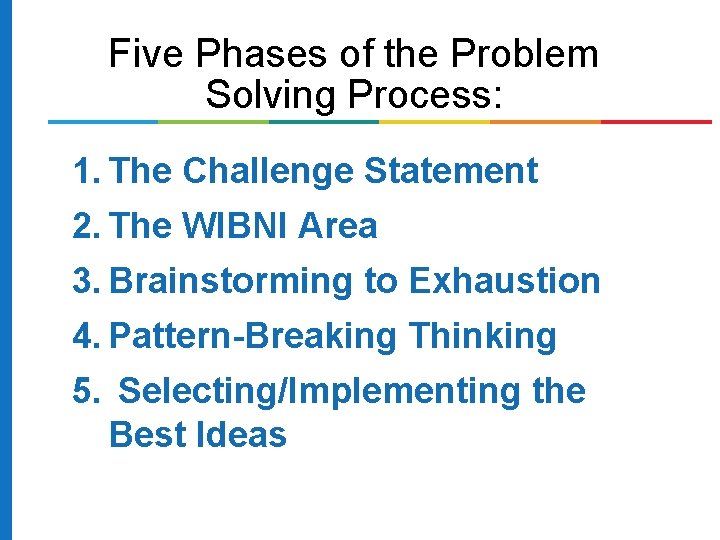
Five Phases of the Problem Solving Process: 1. The Challenge Statement 2. The WIBNI Area 3. Brainstorming to Exhaustion 4. Pattern-Breaking Thinking 5. Selecting/Implementing the Best Ideas

The End
- Slides: 18