
Chapter 3 Convolution Representation CT UnitImpulse Response Consider
- Slides: 20
Chapter 3 Convolution Representation
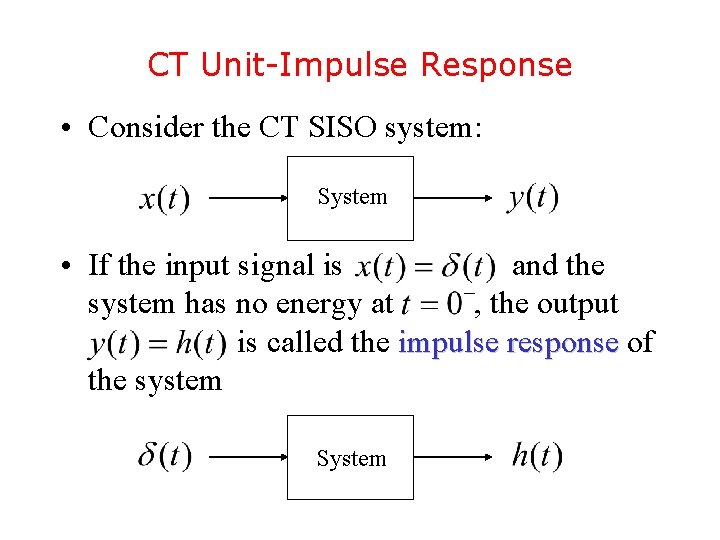
CT Unit-Impulse Response • Consider the CT SISO system: System • If the input signal is and the system has no energy at , the output is called the impulse response of the system System
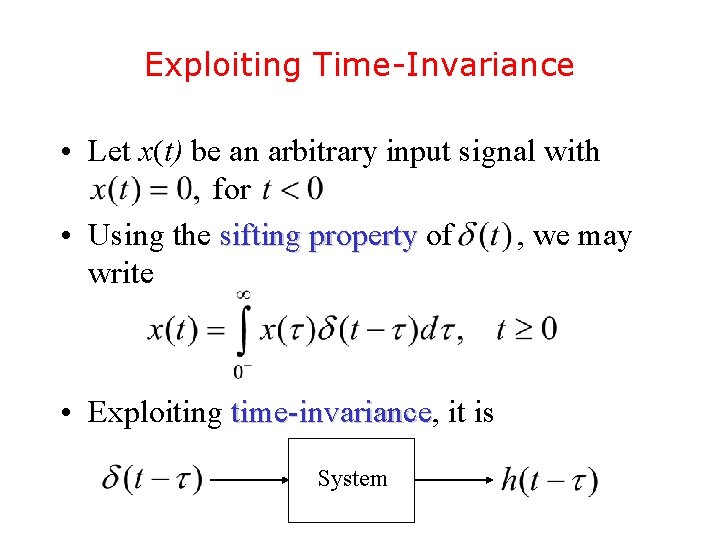
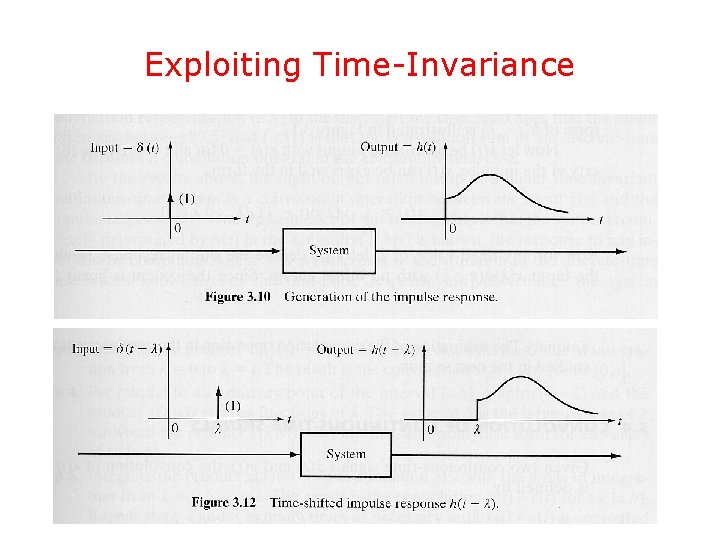
Exploiting Time-Invariance • Let x(t) be an arbitrary input signal with for • Using the sifting property of , we may write • Exploiting time-invariance, time-invariance it is System
Exploiting Time-Invariance
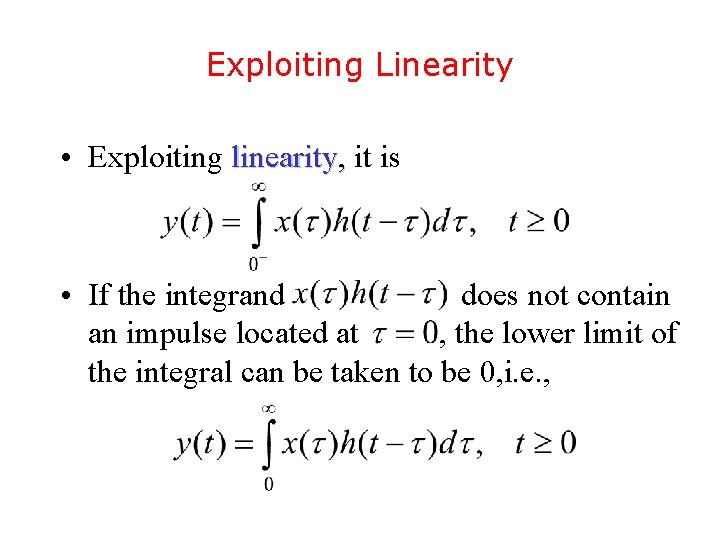
Exploiting Linearity • Exploiting linearity, it is • If the integrand does not contain an impulse located at , the lower limit of the integral can be taken to be 0, i. e. ,
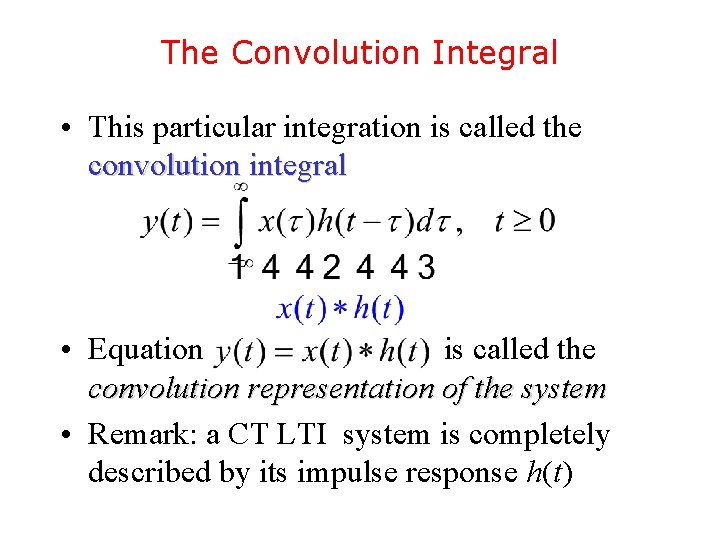
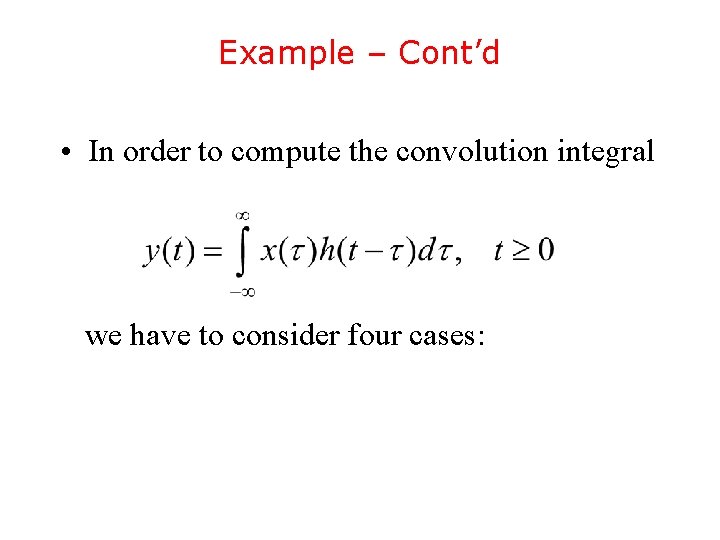
The Convolution Integral • This particular integration is called the convolution integral • Equation is called the convolution representation of the system • Remark: a CT LTI system is completely described by its impulse response h(t)
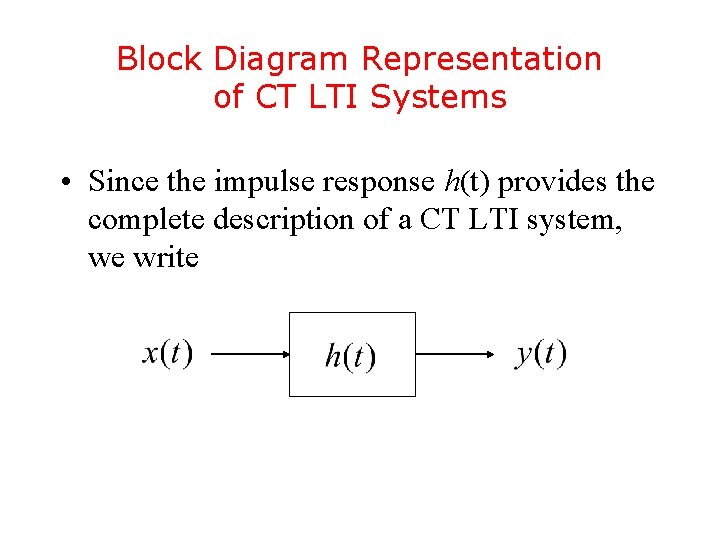
Block Diagram Representation of CT LTI Systems • Since the impulse response h(t) provides the complete description of a CT LTI system, we write
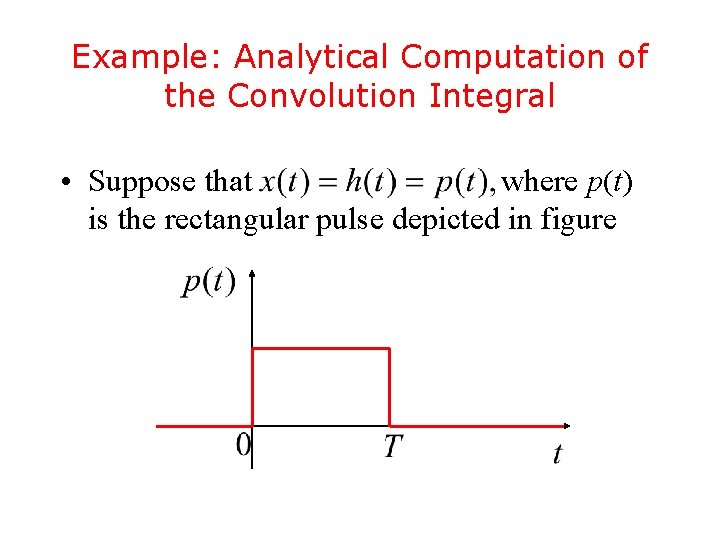
Example: Analytical Computation of the Convolution Integral • Suppose that where p(t) is the rectangular pulse depicted in figure
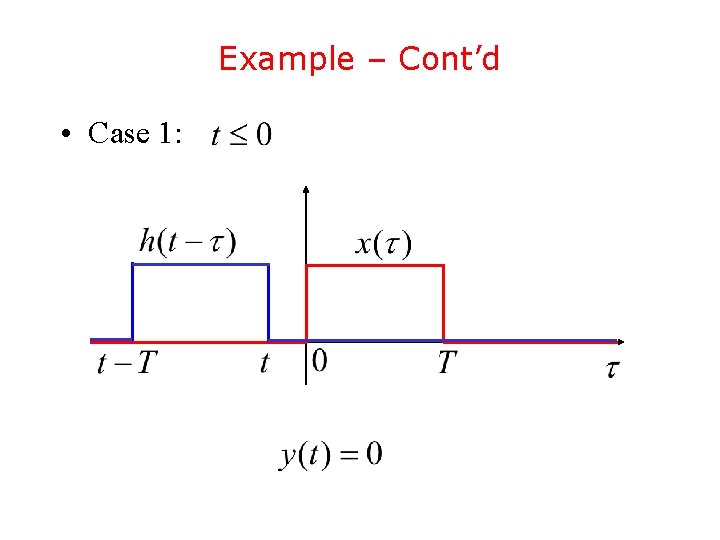
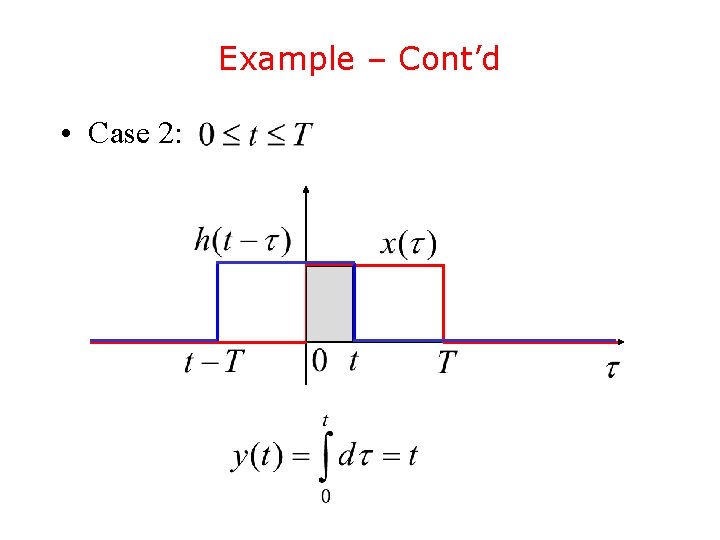
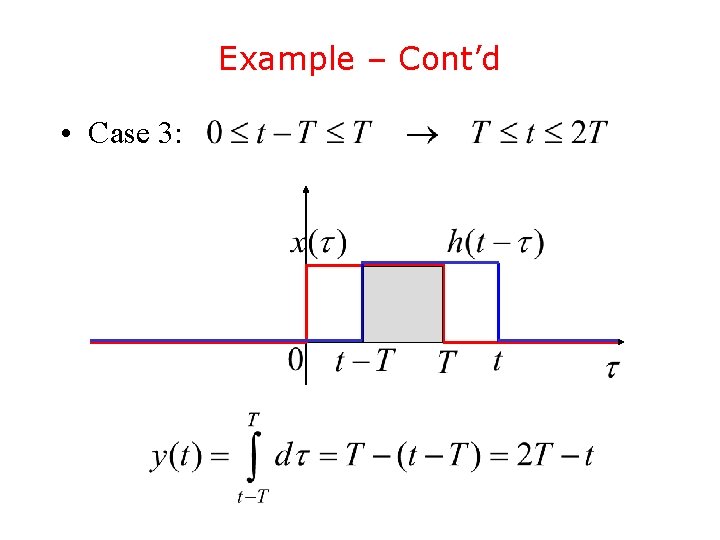
Example – Cont’d • In order to compute the convolution integral we have to consider four cases:
Example – Cont’d • Case 1:
Example – Cont’d • Case 2:
Example – Cont’d • Case 3:
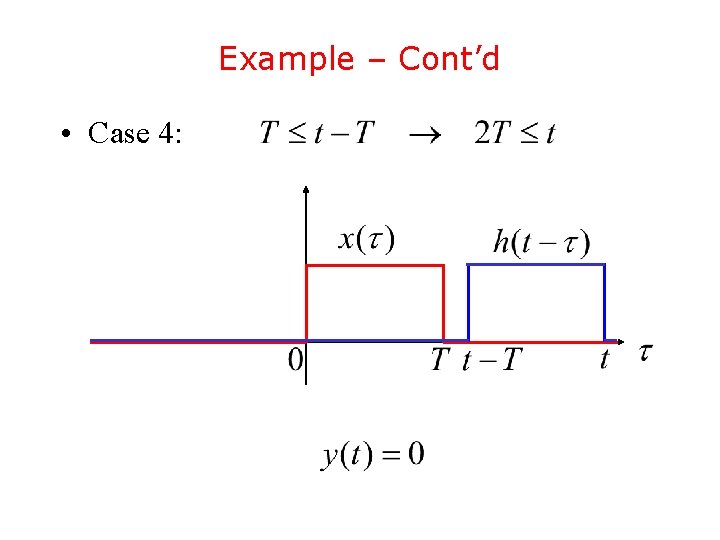
Example – Cont’d • Case 4:
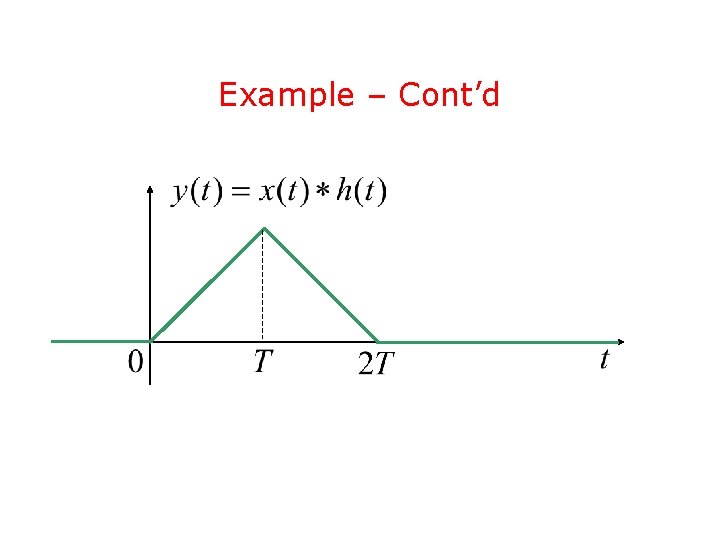
Example – Cont’d
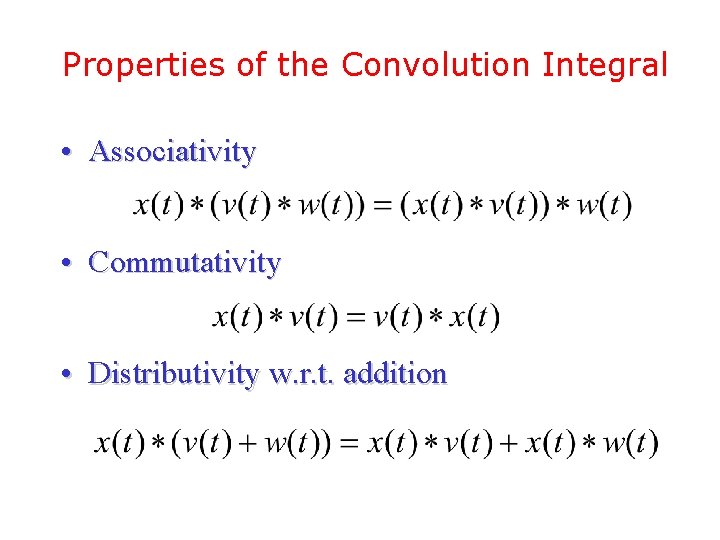
Properties of the Convolution Integral • Associativity • Commutativity • Distributivity w. r. t. addition
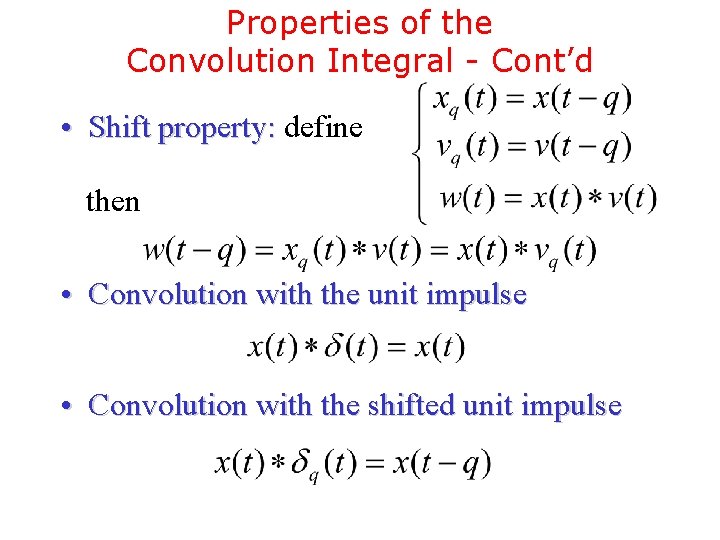
Properties of the Convolution Integral - Cont’d • Shift property: define then • Convolution with the unit impulse • Convolution with the shifted unit impulse
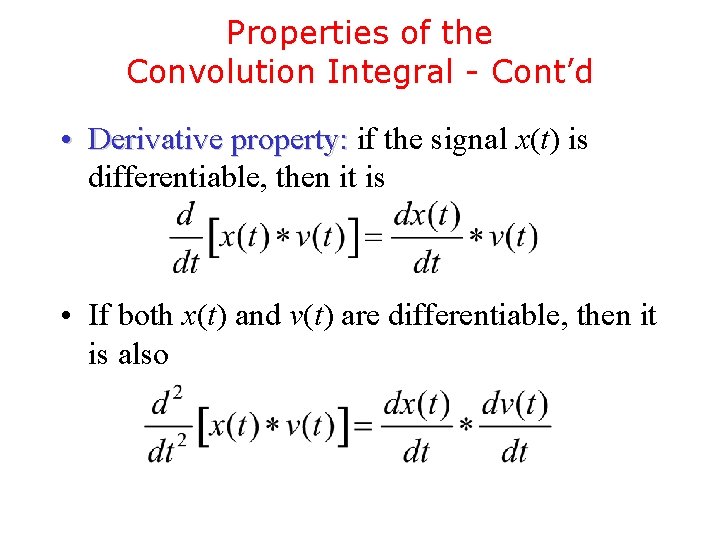
Properties of the Convolution Integral - Cont’d • Derivative property: if the signal x(t) is differentiable, then it is • If both x(t) and v(t) are differentiable, then it is also
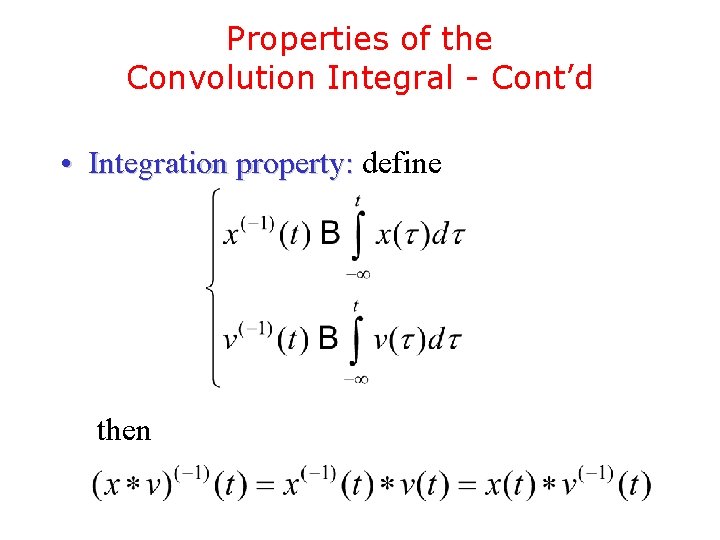
Properties of the Convolution Integral - Cont’d • Integration property: define then
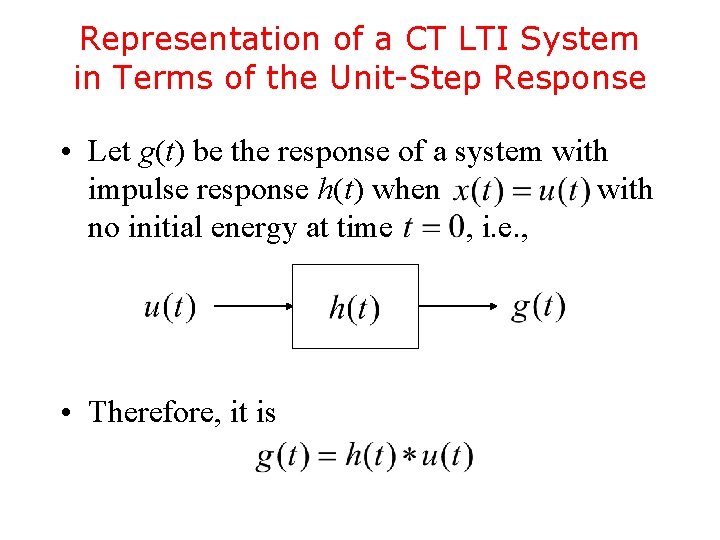
Representation of a CT LTI System in Terms of the Unit-Step Response • Let g(t) be the response of a system with impulse response h(t) when with no initial energy at time , i. e. , • Therefore, it is
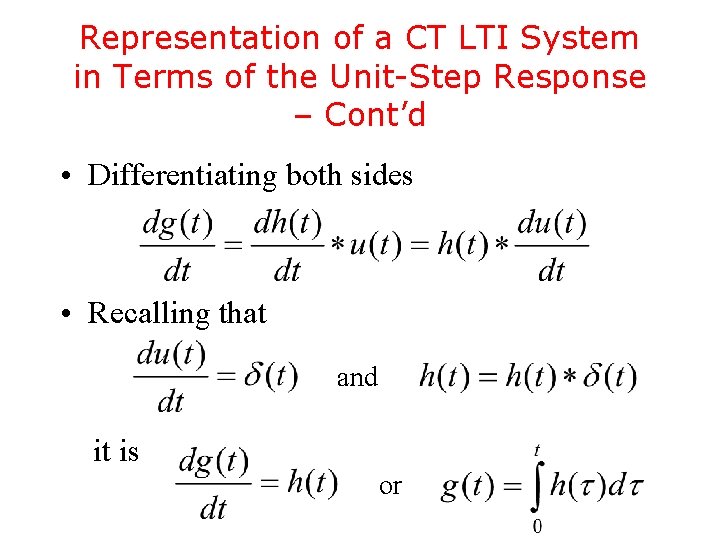
Representation of a CT LTI System in Terms of the Unit-Step Response – Cont’d • Differentiating both sides • Recalling that and it is or