
Chapter 3 Contrasting Cultural Values Topics Semantic Differences
- Slides: 30
Chapter 3 Contrasting Cultural Values
Topics • • Semantic Differences Attribution and Perception Attitudes Toward Women Work Attitudes Toward Ethics Religious Influences Individualism and Collectivism © 2011 Pearson Education, Inc. publishing as Prentice Hall 2
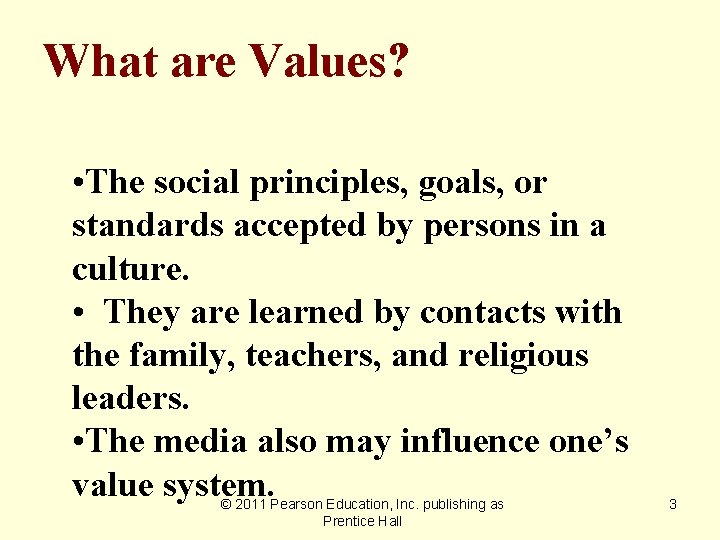
What are Values? • The social principles, goals, or standards accepted by persons in a culture. • They are learned by contacts with the family, teachers, and religious leaders. • The media also may influence one’s value system. © 2011 Pearson Education, Inc. publishing as Prentice Hall 3
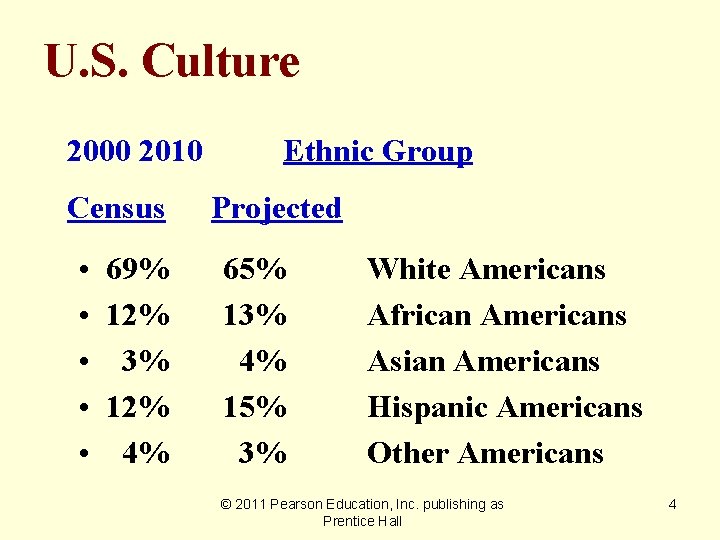
U. S. Culture 2000 2010 Census • • • 69% 12% 3% 12% 4% Ethnic Group Projected 65% 13% 4% 15% 3% White Americans African Americans Asian Americans Hispanic Americans Other Americans © 2011 Pearson Education, Inc. publishing as Prentice Hall 4
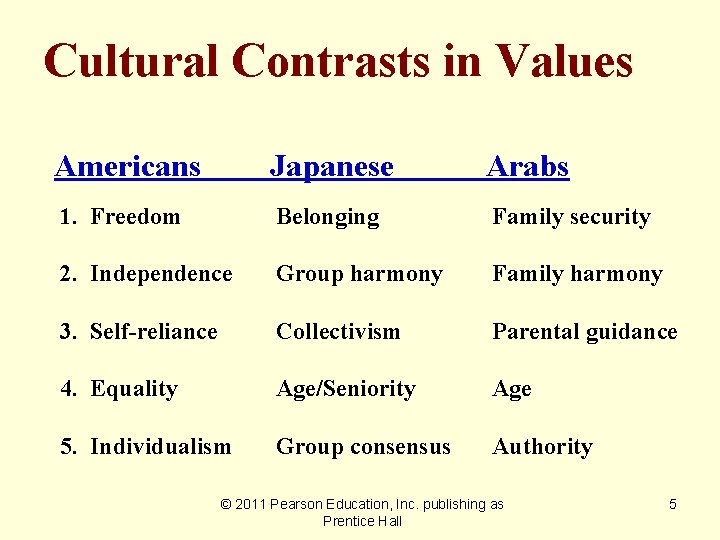
Cultural Contrasts in Values Americans Japanese Arabs 1. Freedom Belonging Family security 2. Independence Group harmony Family harmony 3. Self-reliance Collectivism Parental guidance 4. Equality Age/Seniority Age 5. Individualism Group consensus Authority © 2011 Pearson Education, Inc. publishing as Prentice Hall 5
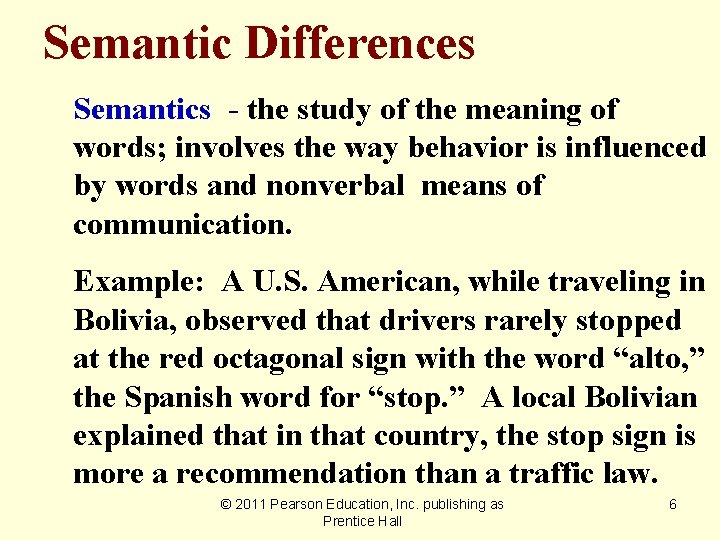
Semantic Differences Semantics - the study of the meaning of words; involves the way behavior is influenced by words and nonverbal means of communication. Example: A U. S. American, while traveling in Bolivia, observed that drivers rarely stopped at the red octagonal sign with the word “alto, ” the Spanish word for “stop. ” A local Bolivian explained that in that country, the stop sign is more a recommendation than a traffic law. © 2011 Pearson Education, Inc. publishing as Prentice Hall 6
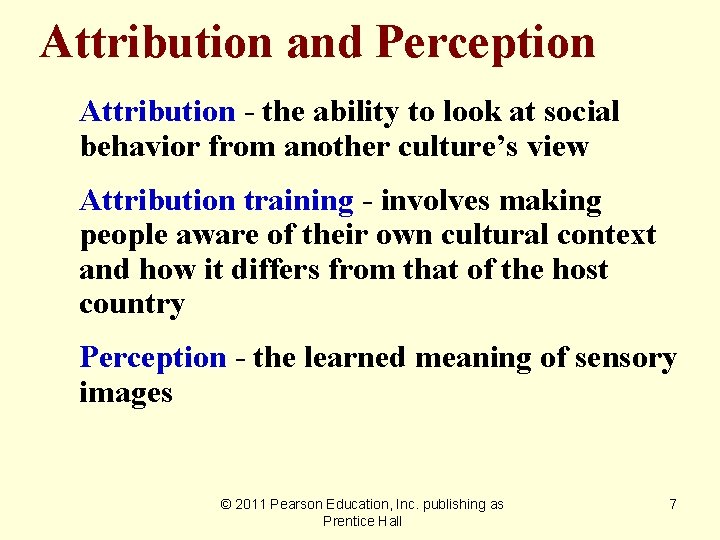
Attribution and Perception Attribution - the ability to look at social behavior from another culture’s view Attribution training - involves making people aware of their own cultural context and how it differs from that of the host country Perception - the learned meaning of sensory images © 2011 Pearson Education, Inc. publishing as Prentice Hall 7
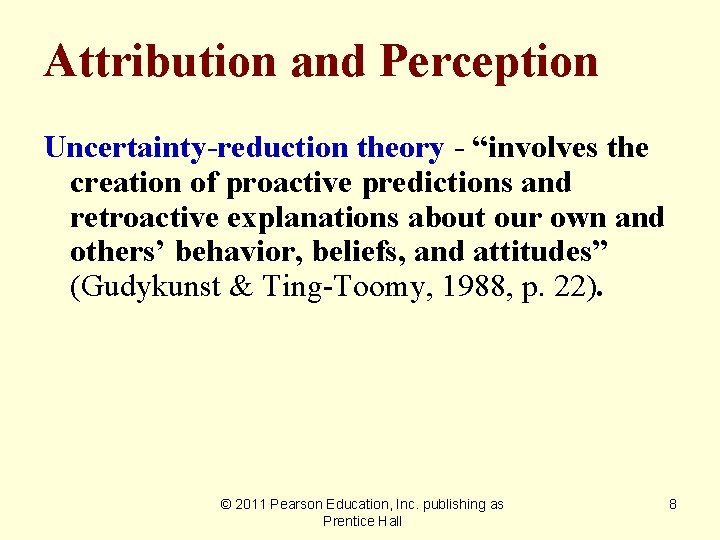
Attribution and Perception Uncertainty-reduction theory - “involves the creation of proactive predictions and retroactive explanations about our own and others’ behavior, beliefs, and attitudes” (Gudykunst & Ting-Toomy, 1988, p. 22). © 2011 Pearson Education, Inc. publishing as Prentice Hall 8
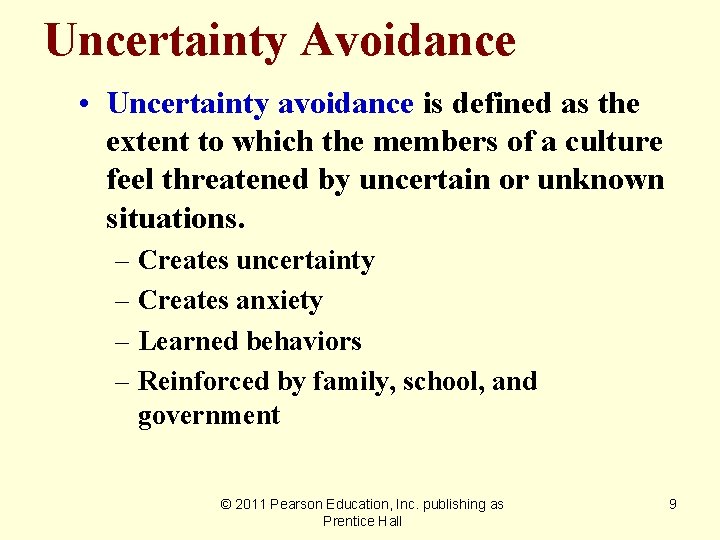
Uncertainty Avoidance • Uncertainty avoidance is defined as the extent to which the members of a culture feel threatened by uncertain or unknown situations. – Creates uncertainty – Creates anxiety – Learned behaviors – Reinforced by family, school, and government © 2011 Pearson Education, Inc. publishing as Prentice Hall 9
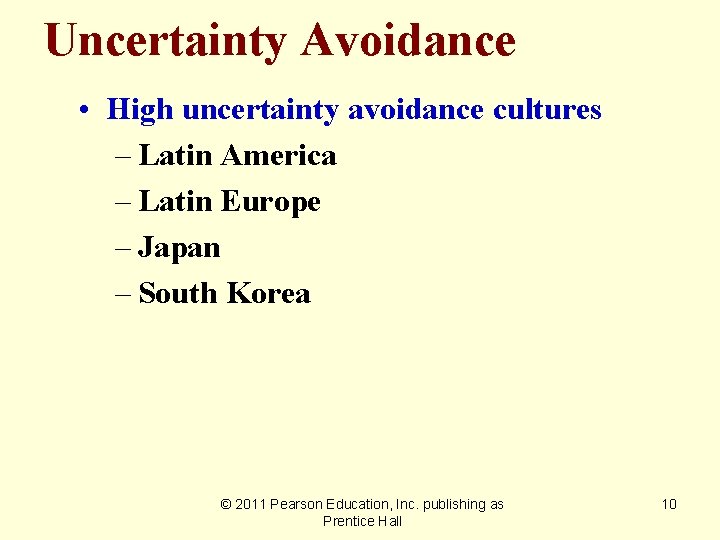
Uncertainty Avoidance • High uncertainty avoidance cultures – Latin America – Latin Europe – Japan – South Korea © 2011 Pearson Education, Inc. publishing as Prentice Hall 10
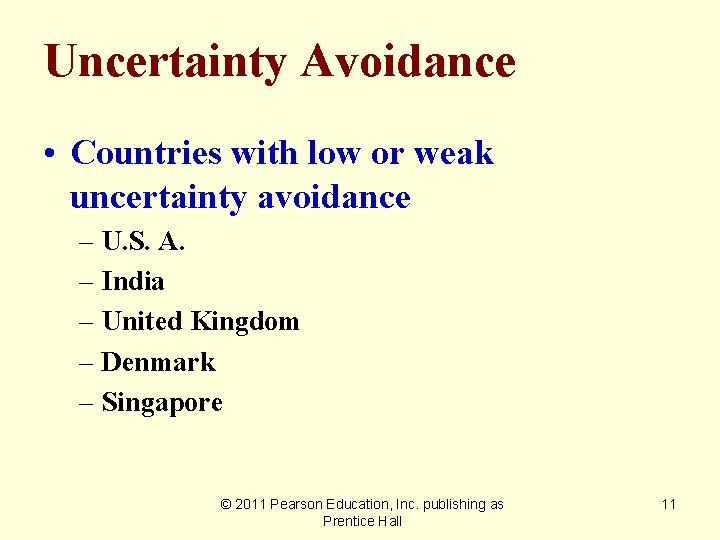
Uncertainty Avoidance • Countries with low or weak uncertainty avoidance – U. S. A. – India – United Kingdom – Denmark – Singapore © 2011 Pearson Education, Inc. publishing as Prentice Hall 11
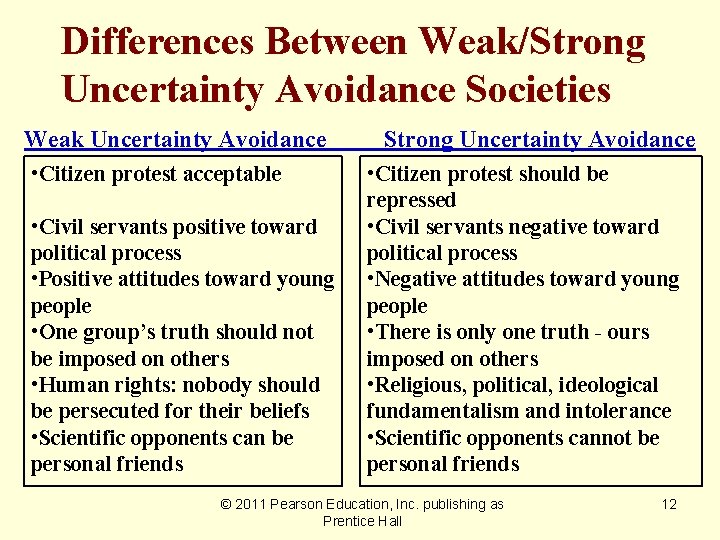
Differences Between Weak/Strong Uncertainty Avoidance Societies Weak Uncertainty Avoidance • Citizen protest acceptable • Civil servants positive toward political process • Positive attitudes toward young people • One group’s truth should not be imposed on others • Human rights: nobody should be persecuted for their beliefs • Scientific opponents can be personal friends Strong Uncertainty Avoidance • Citizen protest should be repressed • Civil servants negative toward political process • Negative attitudes toward young people • There is only one truth - ours imposed on others • Religious, political, ideological fundamentalism and intolerance • Scientific opponents cannot be personal friends © 2011 Pearson Education, Inc. publishing as Prentice Hall 12
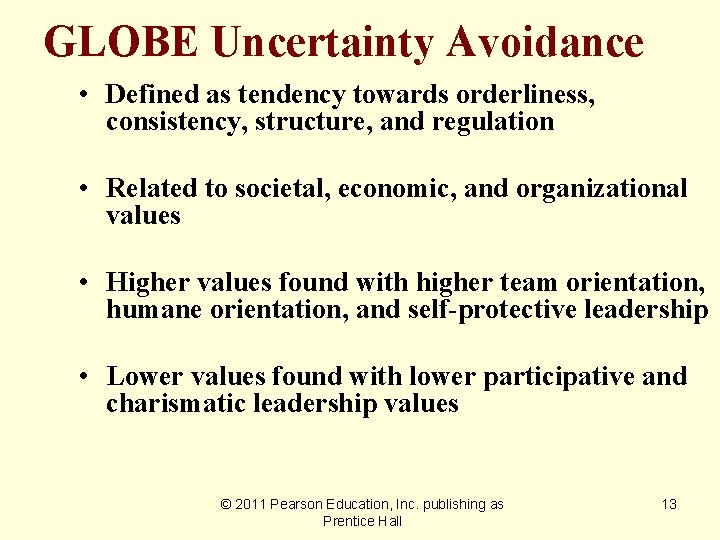
GLOBE Uncertainty Avoidance • Defined as tendency towards orderliness, consistency, structure, and regulation • Related to societal, economic, and organizational values • Higher values found with higher team orientation, humane orientation, and self-protective leadership • Lower values found with lower participative and charismatic leadership values © 2011 Pearson Education, Inc. publishing as Prentice Hall 13
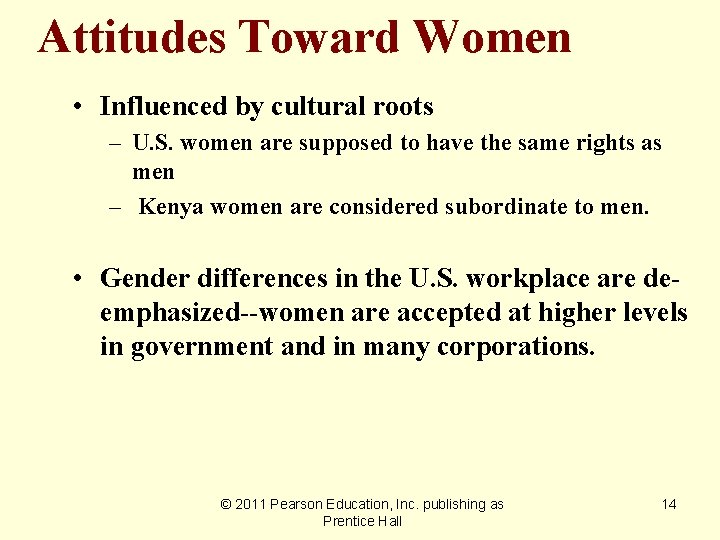
Attitudes Toward Women • Influenced by cultural roots – U. S. women are supposed to have the same rights as men – Kenya women are considered subordinate to men. • Gender differences in the U. S. workplace are deemphasized--women are accepted at higher levels in government and in many corporations. © 2011 Pearson Education, Inc. publishing as Prentice Hall 14
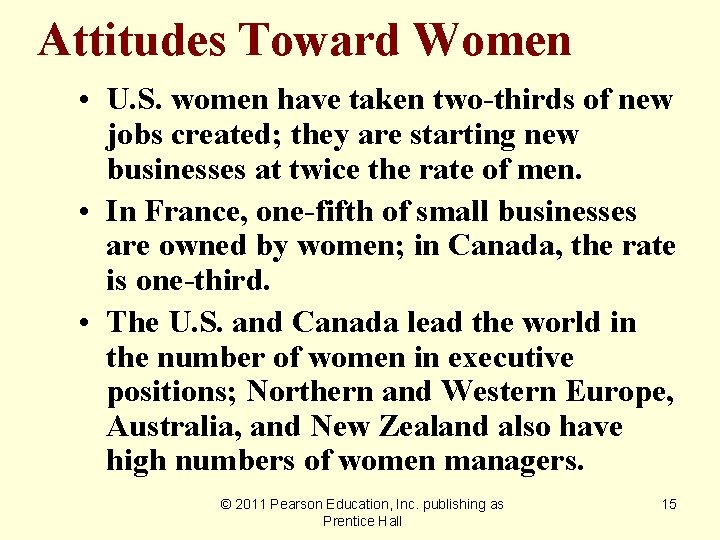
Attitudes Toward Women • U. S. women have taken two-thirds of new jobs created; they are starting new businesses at twice the rate of men. • In France, one-fifth of small businesses are owned by women; in Canada, the rate is one-third. • The U. S. and Canada lead the world in the number of women in executive positions; Northern and Western Europe, Australia, and New Zealand also have high numbers of women managers. © 2011 Pearson Education, Inc. publishing as Prentice Hall 15
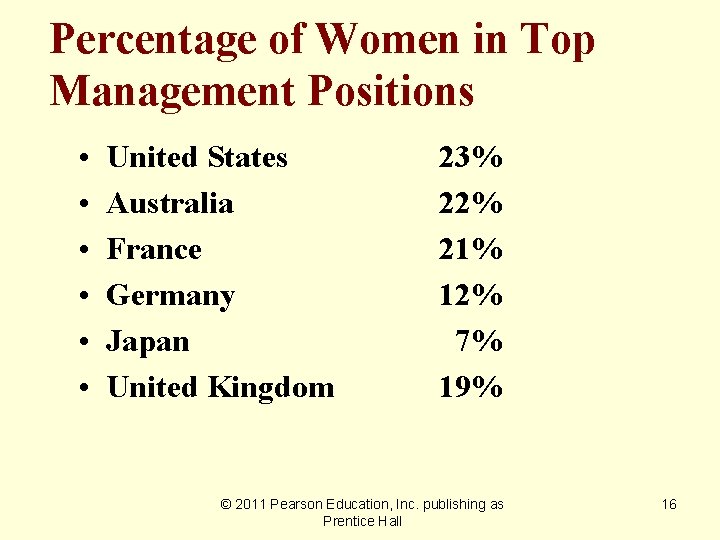
Percentage of Women in Top Management Positions • • • United States Australia France Germany Japan United Kingdom 23% 22% 21% 12% 7% 19% © 2011 Pearson Education, Inc. publishing as Prentice Hall 16
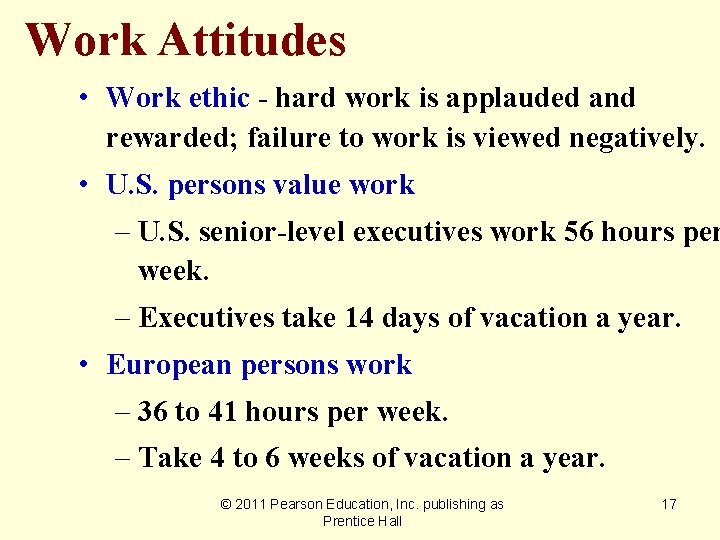
Work Attitudes • Work ethic - hard work is applauded and rewarded; failure to work is viewed negatively. • U. S. persons value work – U. S. senior-level executives work 56 hours per week. – Executives take 14 days of vacation a year. • European persons work – 36 to 41 hours per week. – Take 4 to 6 weeks of vacation a year. © 2011 Pearson Education, Inc. publishing as Prentice Hall 17
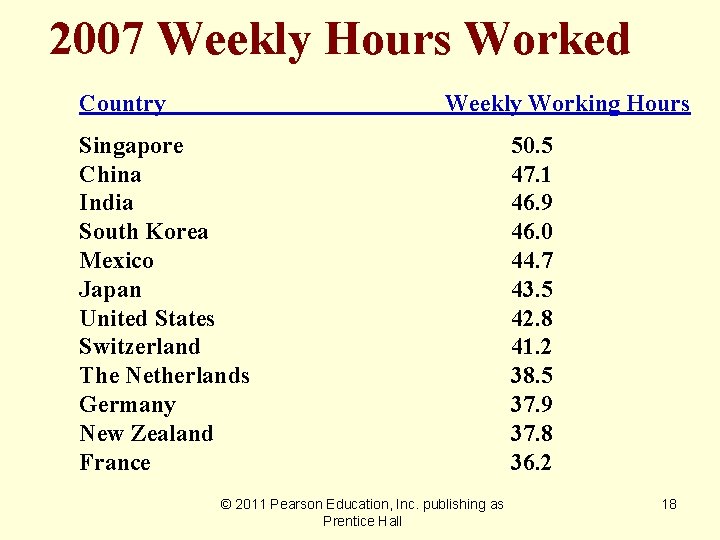
2007 Weekly Hours Worked Country Weekly Working Hours Singapore China India South Korea Mexico Japan United States Switzerland The Netherlands Germany New Zealand France © 2011 Pearson Education, Inc. publishing as Prentice Hall 50. 5 47. 1 46. 9 46. 0 44. 7 43. 5 42. 8 41. 2 38. 5 37. 9 37. 8 36. 2 18
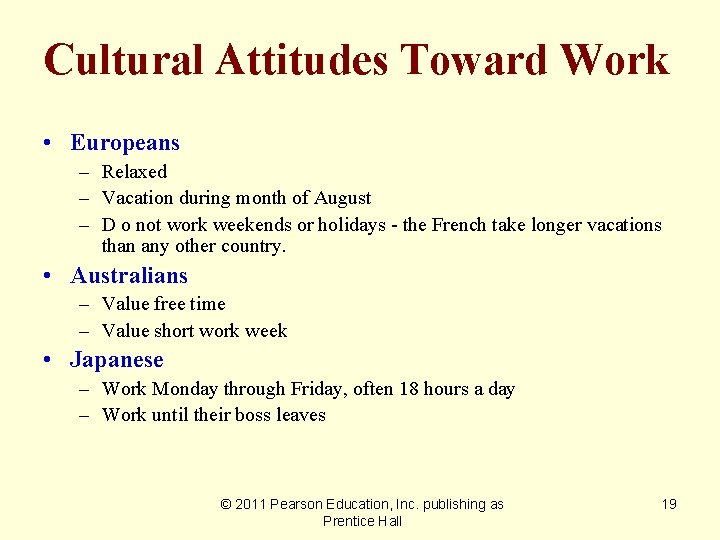
Cultural Attitudes Toward Work • Europeans – Relaxed – Vacation during month of August – D o not work weekends or holidays - the French take longer vacations than any other country. • Australians – Value free time – Value short work week • Japanese – Work Monday through Friday, often 18 hours a day – Work until their boss leaves © 2011 Pearson Education, Inc. publishing as Prentice Hall 19
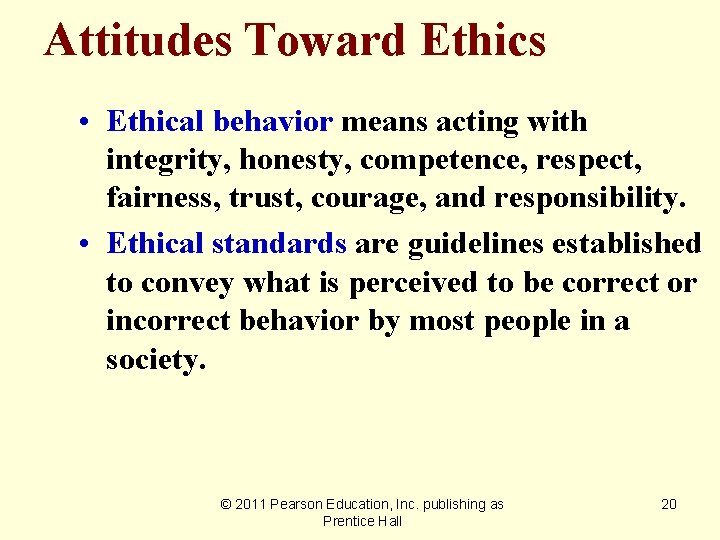
Attitudes Toward Ethics • Ethical behavior means acting with integrity, honesty, competence, respect, fairness, trust, courage, and responsibility. • Ethical standards are guidelines established to convey what is perceived to be correct or incorrect behavior by most people in a society. © 2011 Pearson Education, Inc. publishing as Prentice Hall 20
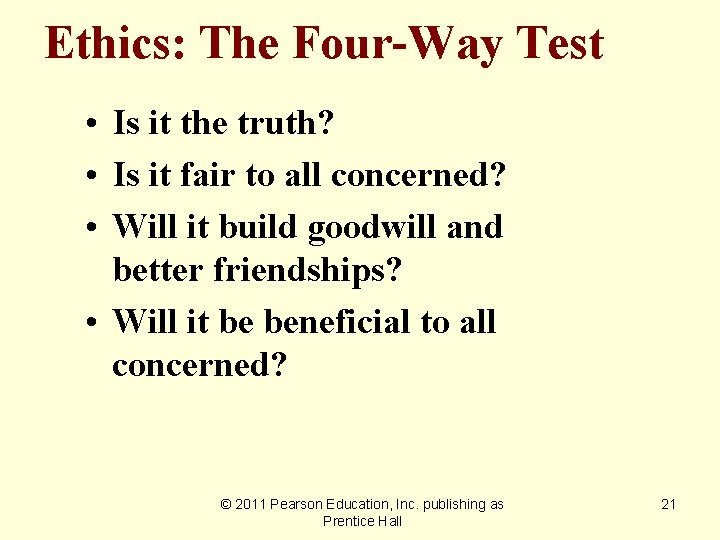
Ethics: The Four-Way Test • Is it the truth? • Is it fair to all concerned? • Will it build goodwill and better friendships? • Will it be beneficial to all concerned? © 2011 Pearson Education, Inc. publishing as Prentice Hall 21
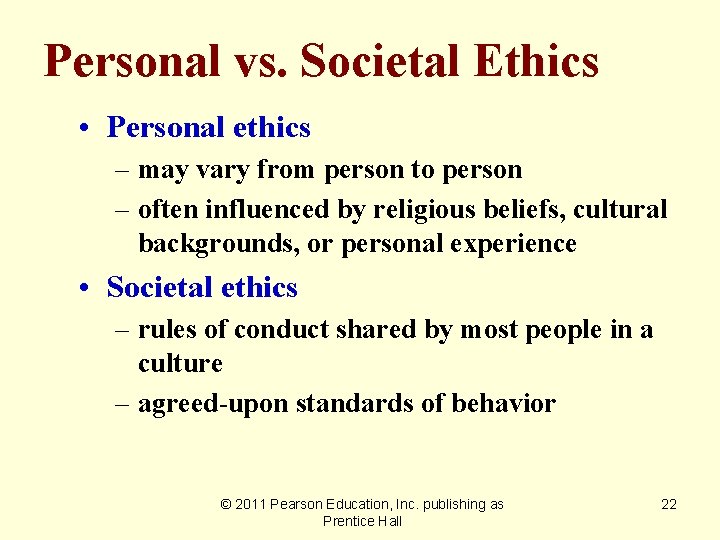
Personal vs. Societal Ethics • Personal ethics – may vary from person to person – often influenced by religious beliefs, cultural backgrounds, or personal experience • Societal ethics – rules of conduct shared by most people in a culture – agreed-upon standards of behavior © 2011 Pearson Education, Inc. publishing as Prentice Hall 22
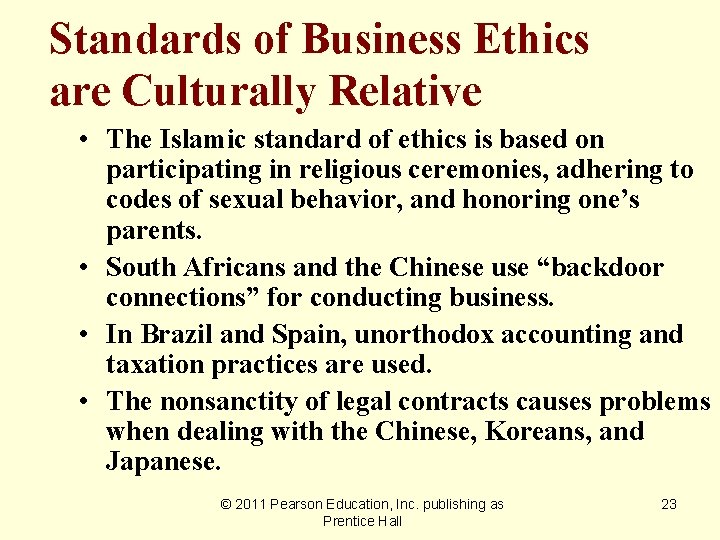
Standards of Business Ethics are Culturally Relative • The Islamic standard of ethics is based on participating in religious ceremonies, adhering to codes of sexual behavior, and honoring one’s parents. • South Africans and the Chinese use “backdoor connections” for conducting business. • In Brazil and Spain, unorthodox accounting and taxation practices are used. • The nonsanctity of legal contracts causes problems when dealing with the Chinese, Koreans, and Japanese. © 2011 Pearson Education, Inc. publishing as Prentice Hall 23
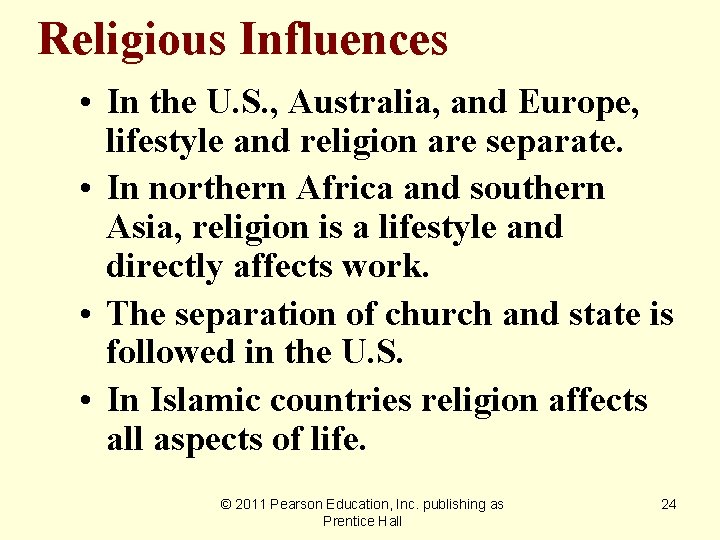
Religious Influences • In the U. S. , Australia, and Europe, lifestyle and religion are separate. • In northern Africa and southern Asia, religion is a lifestyle and directly affects work. • The separation of church and state is followed in the U. S. • In Islamic countries religion affects all aspects of life. © 2011 Pearson Education, Inc. publishing as Prentice Hall 24
Religious Influences • Muslims stop work five times a day to pray. • Religion is not a significant part of life in China; the ideology of communism endorses atheism. • Non-literate religions are practiced by Native Hawaiians and by people of Zaire. • Religion affects what people eat in some countries: – beef is not eaten by Hindus – pork is eaten by neither Muslims nor Orthodox Jews © 2011 Pearson Education, Inc. publishing as Prentice Hall 25
Individualism and Collectivism • Individualism - attitude of valuing ourselves as separate individuals with responsibility for our own destinies and actions. • Collectivism - emphasizes common interests, conformity, cooperation, and interdependence. • The Hofstede and GLOBE studies – Hofstede uses a linear scale – GLOBE has multiple levels • In-group collectivism • Institutional collectivism © 2011 Pearson Education, Inc. publishing as Prentice Hall 26
Power Distance • Inequality within society – Power, wealth, status, and social position – Physical – Intellectual • Index measures the degree of acceptance of unequal distribution of power • Both Hofstede and GLOBE agree on this construct © 2011 Pearson Education, Inc. publishing as Prentice Hall 27
Gender Indices • Hofstede’s Masculinity and Femininity Index measures assertiveness versus modesty • GLOBE study gender egalitarianism measures roles men and women are suited for – Denmark and New Zealand most gender egalitarian; Eastern Europe and Nordic Europe – Iran and Qatar are the least gender egalitarian; Middle East, Confucian Asia, Germanic Europe © 2011 Pearson Education, Inc. publishing as Prentice Hall 28
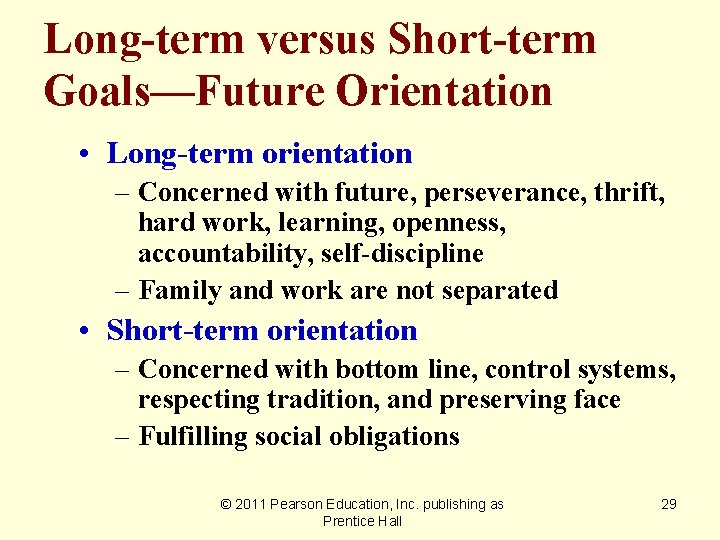
Long-term versus Short-term Goals—Future Orientation • Long-term orientation – Concerned with future, perseverance, thrift, hard work, learning, openness, accountability, self-discipline – Family and work are not separated • Short-term orientation – Concerned with bottom line, control systems, respecting tradition, and preserving face – Fulfilling social obligations © 2011 Pearson Education, Inc. publishing as Prentice Hall 29
© 2011 Pearson Education, Inc. publishing as Prentice Hall 30