
Chapter 3 Contending Perspectives How to Think about
Chapter 3 Contending Perspectives: How to Think about International Relations Theoretically
Theory: Making Sense of International Relations • What is theory? Ø A set of propositions and concepts that explains phenomena by specifying relationships among the concepts • What does theory do? Ø Generates hypotheses, which are specific statements positing a relationship among variables
Theory: Making Sense of International Relations • What does theory tells us? Ø Testing hypotheses generated by theory can explain why things happen and suggest best courses of action in international relations
Levels of Analysis • Why use levels of analysis? Ø Help orient questions Ø Suggest appropriate type of evidence to explore • Three levels: Ø Individual Ø State Ø International system


The Individual Level of Analysis • Focus on decision makers and participants in decision making, particularly: Ø Personality Ø Perceptions Ø Choices Ø Activities
The State Level of Analysis • Explanations derived from domestic factors, such as: Ø Characteristics of the state (including geography, natural resources, demographics, history) Ø Type of government Ø Type of economic system Ø Interest groups
The International Level of Analysis • Explanations stem from: Ø Anarchic characteristics of the system Ø General characteristics of the interactions among states, regional organizations, and international organizations Ø May also include the roles of multinational corporations and nongovernmental organizations Ø Includes the distribution of power among these actors
Realism: Core Assumptions • Starts with Thucydides’ History of the Peloponnesian War: Ø State is principal actor in international relations Ø State is a unitary actor: acts with one voice Ø Decision makers are rational actors Ø Primacy of security: states must first protect themselves from foreign and domestic enemies
Evolution of Realism • St. Augustine Ø Humans are flawed, egoistic, and selfish Ø Humans are thus power seeking and self-absorbed
Evolution of Realism • Machiavelli Ø Leaders need to focus on maintaining the security and stability of the state Ø Promoted use of alliances; offensive and defensive strategies to protect the state • Hobbes: states exist in an anarchic international system in which the threat of war is perpetual
Contemporary Realism • Morgenthau: Politics among Nations (the realist Bible) • International politics is a struggle for power Ø Flawed individual struggles for self-preservation in state of nature; forms state Ø State seeks national interest through balance of power
Contemporary Realism • International politics is a struggle for power Ø Because the international system is anarchic, struggle for power is continuous Ø Leaders driven by a different morality: preserving the state and pursuing its interests Ø States are effectively unitary, rational actors driven by concerns of relative capabilities because of need for security
An Ideal Realist Policy? • Offensive realists: Ø Cannot be certain of another’s intentions Ø Always improve own relative power position Ø Conquest pays: expansionist policy builds relative power position and intimidates rivals into cooperation or eliminates them
An Ideal Realist Policy? • Defensive realists: Ø Defensive postures (military, diplomatic, economic) do not directly threaten other states Ø Conquest does not pay: states tend to balance each other against aggressors; few wars benefit those that start them
Neorealism • Waltz, Theory of International Politics Ø Structure of the international system determines state behavior Ø System lacks an overarching authority Ø Importance of distribution of capabilities of states, which defines their place in the system Ø International cooperation is unlikely because of insecurity over relative gains and possibility of cheating
Liberalism: Core Assumptions • Roots in thought of the ancient Greeks: Ø Individuals are rational, able to understand basic laws of nature and human society Ø Thus, people have the capacity to improve their condition by creating a just society Ø If a just society is not created, fault lies with inadequate institutions and/or corrupt environment
Evolution of Liberalism • Montesquieu Ø Human nature not necessarily defective, but problems arise when people enter society and form separate nations Ø War is product of society, not inherent to humans Ø Education overcomes defects in society; prepares individual for civic life
Evolution of Liberalism • Kant Ø International anarchy can be overcome through federation of sovereign states Ø Democracy best protects human rights and freedom and preserves peace through a check on leaders
Contemporary Liberalism • Nineteenth century: free trade promotes interdependence between states and prevents war • Twentieth century: Wilson Ø War is preventable through collective security Ø International institutions as problem-solvers and war preventers: League of Nations
Contemporary Liberalism • Others: disarmament, international law and courts; other international institutions to foster best human characteristics
Neoliberal Institutionalism • Axelrod, Keohane, and Nye: Why do states choose to cooperate most of the time, even under anarchy? Ø Prisoner’s dilemma—cooperation is in self-interest, given possibility of reciprocity Ø Thus, cooperation can be learned
Neoliberal Institutionalism • Axelrod, Keohane, and Nye: Why do states choose to cooperate most of the time, even under anarchy? Ø Institutions can enable cooperation by preventing cheating; reducing transaction costs; building common interests, thus shaping state preferences Ø Institutions can bring mutual gains
Post–Cold War Developments in Liberalism • Democratic Peace Ø Democracies do not fight each other; might be that shared democratic norms and culture inhibit aggression Ø Multitude of voices restrains leaders Ø Membership in common international institutions binds democracies
Constructivism • State behavior shaped by elite beliefs, identities, social norms • Individuals forge, shape, and change culture through ideas and practices • Interests at all levels socially constructed via constant interaction
Constructivism • National interests are ever-changing and the result of social identities of state actors • People bring meaning to material structures • International organizations can socialize states and individuals to norms
Constructivism: Power and Change • Power exists in every exchange, and ideas and identity are its source • Wendt: “anarchy is what states make of it” • Sovereignty as a contested concept; states lack exclusive control, while sovereignty is continuously challenged by new institutions and new needs
Constructivism: Power and Change • Change occurs through diffusion of ideas, socialization, or internationalization of norms • Identities change as a result of cooperative behavior and learning
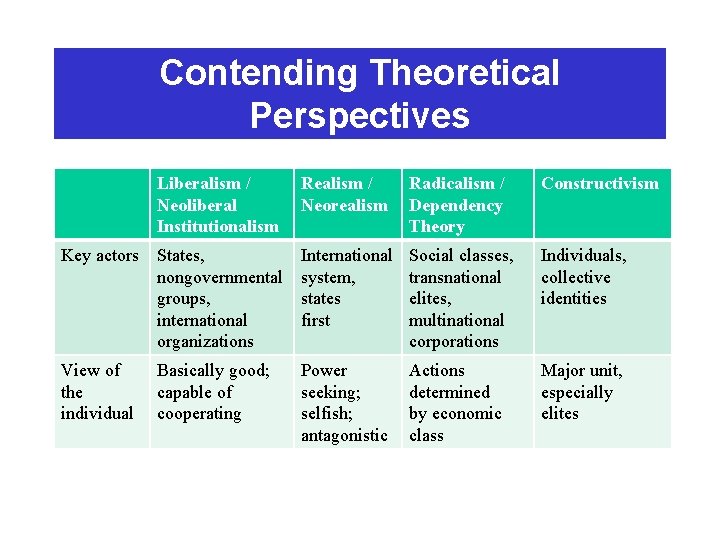
Contending Theoretical Perspectives Liberalism / Neoliberal Institutionalism Realism / Neorealism Radicalism / Dependency Theory Constructivism Key actors States, nongovernmental groups, international organizations International system, states first Social classes, transnational elites, multinational corporations Individuals, collective identities View of the individual Basically good; capable of cooperating Power seeking; selfish; antagonistic Actions determined by economic class Major unit, especially elites
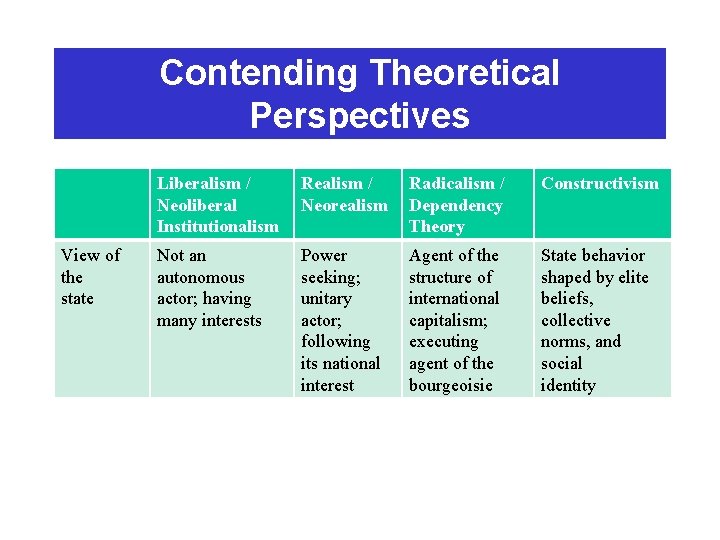
Contending Theoretical Perspectives View of the state Liberalism / Neoliberal Institutionalism Realism / Neorealism Radicalism / Dependency Theory Constructivism Not an autonomous actor; having many interests Power seeking; unitary actor; following its national interest Agent of the structure of international capitalism; executing agent of the bourgeoisie State behavior shaped by elite beliefs, collective norms, and social identity
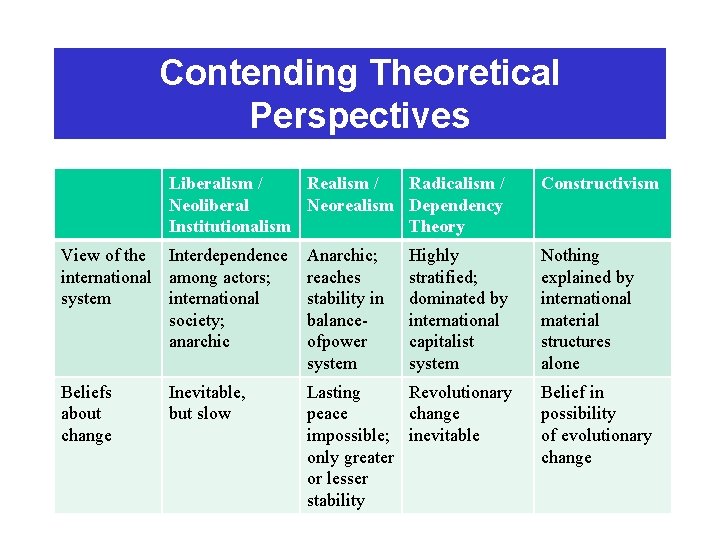
Contending Theoretical Perspectives Liberalism / Realism / Radicalism / Neoliberal Neorealism Dependency Institutionalism Theory View of the Interdependence international among actors; system international society; anarchic Anarchic; reaches stability in balanceofpower system Beliefs about change Lasting Revolutionary peace change impossible; inevitable only greater or lesser stability Inevitable, but slow Highly stratified; dominated by international capitalist system Constructivism Nothing explained by international material structures alone Belief in possibility of evolutionary change
Radical Perspective • Marx: economic determinism Ø In capitalism, private interests control labor and market exchanges, which creates also controls the on working classes (proletariat) Ø Clashes inevitable as proletariat seeks freedom from controlling, capitalist bourgeois, and new order emerges
Radical Perspective • Marx: economic determinism Ø Seeks to explain relationship between means of production, social relations, and power Ø Core beliefs in historical evolution from feudalism to capitalism, which brought bourgeois class to power, and primacy of economics for explaining phenomena
Radicalism and International Relations • Global system is hierarchical by-product of imperialism —seeks system change • Hobson: Ø Imperialism caused by overproduction of goods and services in developed world, underconsumption of these by underpaid lower classes in developed world, and oversavings by upper classes
Radicalism and International Relations • Hobson: Ø Developed states expand to find new markets, which keeps wages low due to foreign competition, and savings are invested into new markets rather than improving workers’ conditions
Developed versus Less Developed • Developed countries can expand sell surplus goods in less developed states, undermining locals and creating unequal trade terms • Wealthy developed countries can constrain less developed states and make them dependent; domination and suppression arise from uneven development
Developed versus Less Developed • Dependency theory: multinational corporations (MNCs) and international banks establish, maintain, and exploit dependent relationships • Less dependent have few options, as internal structures (ex. : land ownership) are also class based
- Slides: 37