
CHAPTER 3 Consumer Behaviour Concepts and Target Marketing
CHAPTER 3 Consumer Behaviour Concepts and Target Marketing 3 -1 Copyright © 2009 Pearson Education Canada
Learning Objectives § Explain how consumer behaviour concepts influence the development of marketing communications strategies § Assess the information needed to identify and select target markets § Distinguish between demographic, psychographic, geographic, and behaviourresponse segmentation variables Continued… 3 -2 Copyright © 2009 Pearson Education Canada
Learning Objectives (cont. ) § Explain the influence of relationship marketing concepts on marketing communications strategies § Explain the concept of positioning and its role in developing marketing communications strategies. 3 -3 Copyright © 2009 Pearson Education Canada

Consumer Behaviour Marketers must have access to data concerning consumers; buying habits and which kinds of media they favour, in order to develop convincing communications programs. §Who makes the buying decision? §Who influences the buying decision? §What motivates the buyers and people of influence to take action? 3 -4 Copyright © 2009 Pearson Education Canada
Needs and Motives Need: § Absence of something useful Motive: § Condition prompting action to satisfy a need Communicating benefits and presenting the right image prompts the action to purchase. 3 -5 Copyright © 2009 Pearson Education Canada
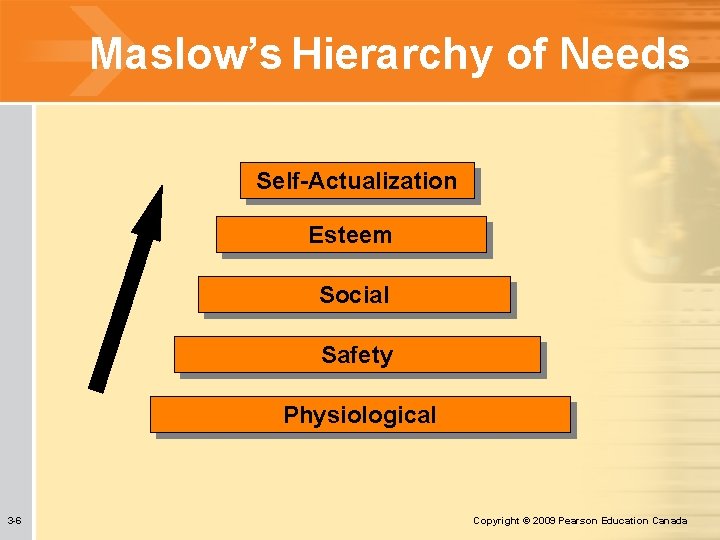
Maslow’s Hierarchy of Needs Self-Actualization Esteem Social Safety Physiological 3 -6 Copyright © 2009 Pearson Education Canada
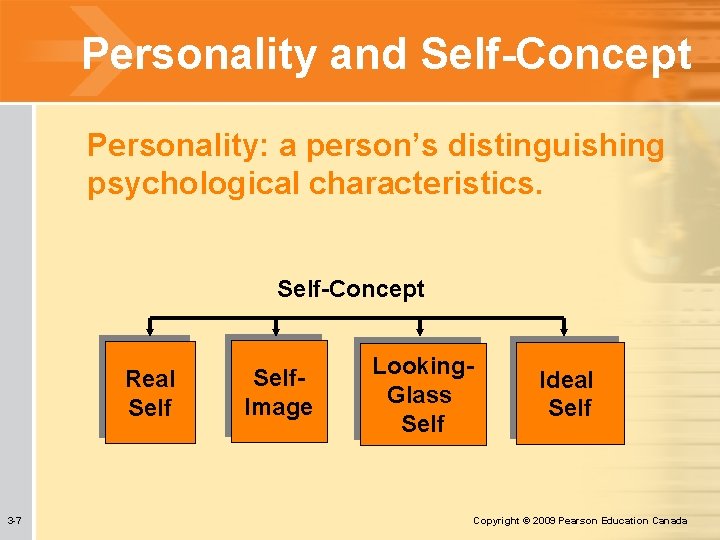
Personality and Self-Concept Personality: a person’s distinguishing psychological characteristics. Self-Concept Real Self 3 -7 Self. Image Looking. Glass Self Ideal Self Copyright © 2009 Pearson Education Canada

Perceptions People receive and interpret messages differently. Selective Exposure Selective Perception Selective Retention 3 -8 Copyright © 2009 Pearson Education Canada
Attitudes Favourable or unfavourable feelings about an idea or object. §Advertising messages should coincide with the prevailing attitudes held by the target market. Trying to alter an attitude is expensive and risky. 3 -9 Copyright © 2009 Pearson Education Canada
Reference Groups A group, class, or category of people to which individuals believe they belong, whether or not they actually do. § A member of a group experiences considerable pressure to “fit in”. § Co-workers § Sports teams § Hobby clubs § Fraternal organizations § Schoolmates 3 -10 Copyright © 2009 Pearson Education Canada
Family members influence buying decisions. §The changing roles of family members have blurred the lines of responsibility between men and women. §New responsibilities and shared decisionmaking has led to double targeting. 3 -11 Copyright © 2009 Pearson Education Canada
Identifying and Selecting Target Markets The ability of a company to target specific customers is based on the concept of market segmentation. §Market Segmentation - dividing a large market into smaller homogeneous markets based on common needs or similar lifestyles. 3 -12 Copyright © 2009 Pearson Education Canada
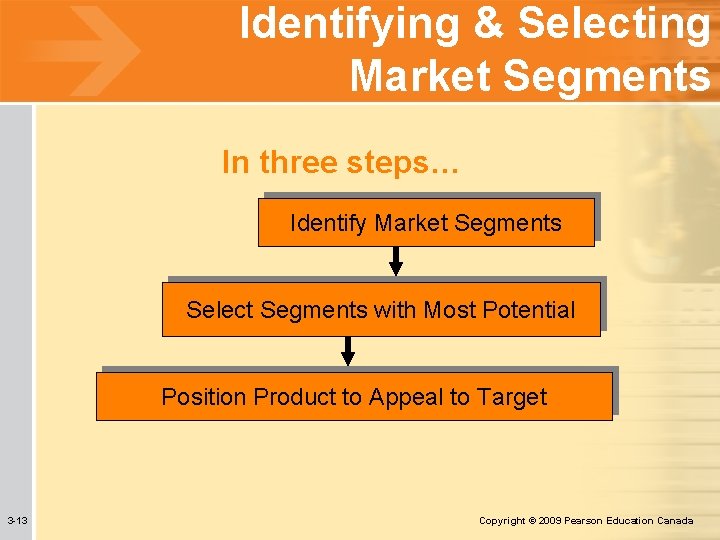
Identifying & Selecting Market Segments In three steps… Identify Market Segments Select Segments with Most Potential Position Product to Appeal to Target 3 -13 Copyright © 2009 Pearson Education Canada
Demographic Segmentation Target market are pursued on the basis of: § § § 3 -14 Age Gender Income, Occupation, Education, Marital Status & Household Formation Cultural Mix Copyright © 2009 Pearson Education Canada
Key Demographic Trends §Population is Getting Older §Economic Power of Women §The Formation of Households is Changing §Ethnic Diversity Continues What are some impacts of these trends? 3 -15 Copyright © 2009 Pearson Education Canada
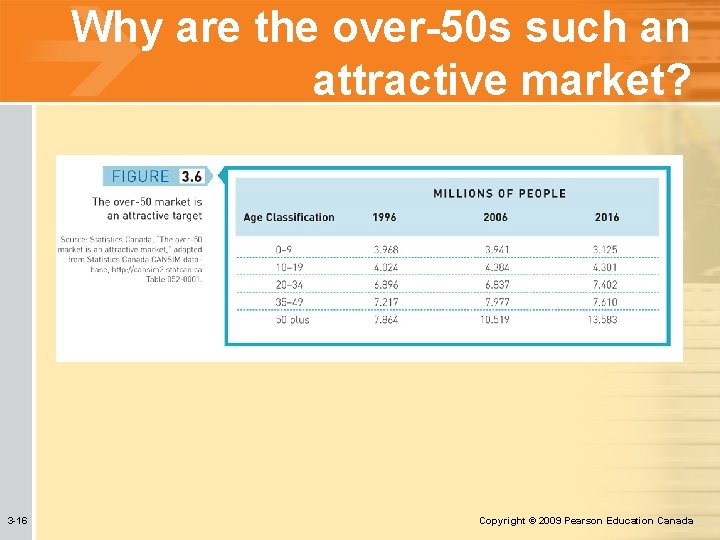
Why are the over-50 s such an attractive market? 3 -16 Copyright © 2009 Pearson Education Canada
Psychographic Segmentation Examines individuals by lifestyles. § Activities § Interests § Opinions §Its consideration shows how individuals who look similar demographically, behave differently when other factors are known. Marketers position brands according to certain lifestyles. 3 -17 Copyright © 2009 Pearson Education Canada
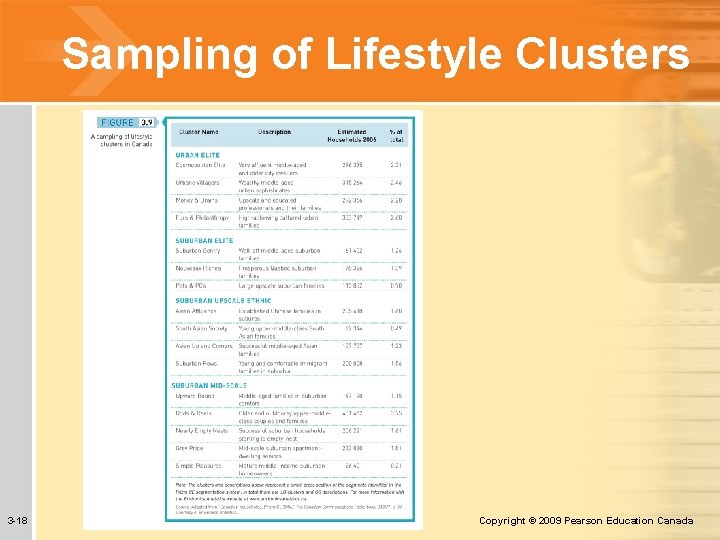
Sampling of Lifestyle Clusters 3 -18 Copyright © 2009 Pearson Education Canada
Geographic Segmentation The division of geographically expansive market (Canada) into smaller geographical units (e. g. , BC) § Regional language and culture § Urban / Suburban vs Rural § Four broad urban regions §Ontario’s Golden Horseshoe §Lower Mainland of BC and southern Vancouver Island 3 -19 §Montreal and region §Calgary-Edmonton corridor Copyright © 2009 Pearson Education Canada
Direct Segmentation Companies target customers individually. §It is now possible to design unique products and communications strategies for current and prospective customers. §Customer relationship management (CRM) §Database management systems 3 -20 Copyright © 2009 Pearson Education Canada
Behaviour – Response Segmentation Dividing buyers into groups according to: §Occasion-for-use §Benefits-sought §Frequency of use §Loyalty-response 3 -21 Copyright © 2009 Pearson Education Canada
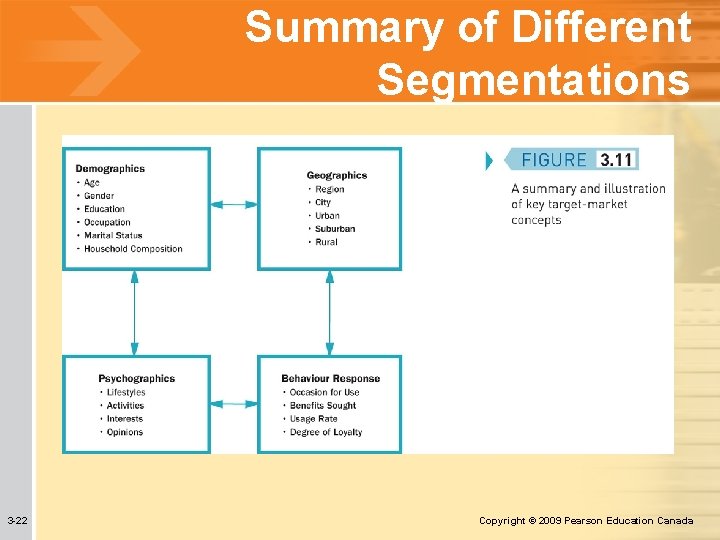
Summary of Different Segmentations 3 -22 Copyright © 2009 Pearson Education Canada
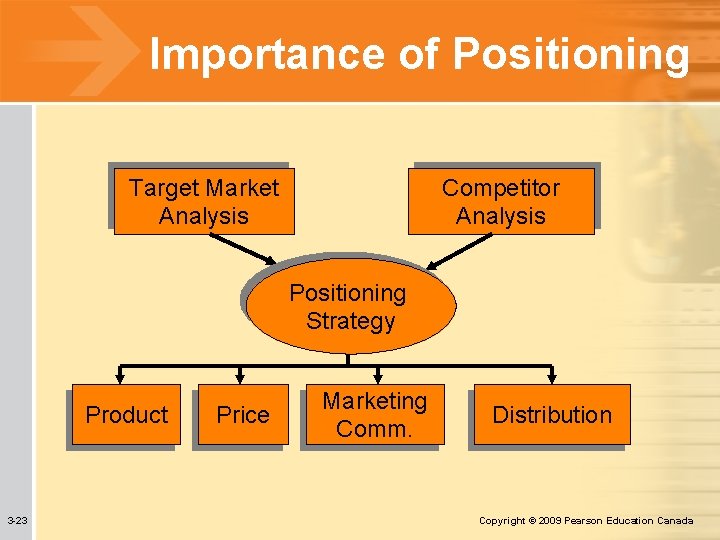
Importance of Positioning Target Market Analysis Competitor Analysis Positioning Strategy Product 3 -23 Price Marketing Comm. Distribution Copyright © 2009 Pearson Education Canada
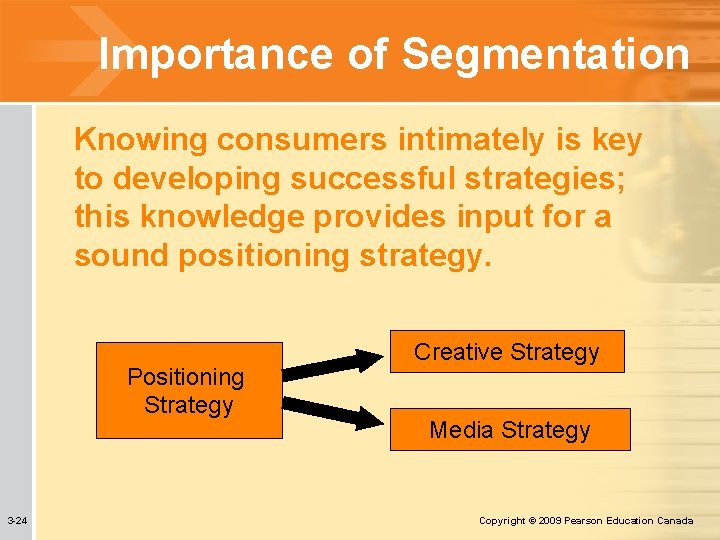
Importance of Segmentation Knowing consumers intimately is key to developing successful strategies; this knowledge provides input for a sound positioning strategy. Positioning Strategy 3 -24 Creative Strategy Media Strategy Copyright © 2009 Pearson Education Canada
Market Positioning Concepts Positioning is the selling concept that motivates purchase §it can be a tangible benefit or an image that a company wants to instill in the minds of customers. §It is very important that the positioning statement aptly describe a primary benefit and an image that is important to the target market. 3 -25 Copyright © 2009 Pearson Education Canada
Positioning and Marketing Communications Advertising can communicate the positioning strategy many different ways. § Head-On § Brand-Leadership § Product-Differentiation § Innovation § Lifestyle 3 -26 Copyright © 2009 Pearson Education Canada
Repositioning Changing the place a brand occupies in the customer’s mind in relation to competitive products. §Repositioning is considered if consumer attitudes change or if the marketing activity of a direct competitor changes. 3 -27 Copyright © 2009 Pearson Education Canada
- Slides: 27