
CHAPTER 3 Consumer Behavior CHAPTER OUTLINE 3 1
CHAPTER 3 Consumer Behavior CHAPTER OUTLINE 3. 1 Consumer Preferences 3. 2 Budget Constraints 3. 3 Consumer Choice 3. 5 Marginal Utility and Consumer Choice Prepared by: Fernando Quijano, Illustrator Copyright © 2013 Pearson Education, Inc. • Microeconomics • Pindyck/Rubinfeld, 8 e. 1 of 40
Consumer Behavior ● theory of consumer behavior Description of how consumers allocate incomes among different goods and services to maximize their wellbeing. Consumer behavior is best understood in three distinct steps: 1. Consumer Preferences 2. Budget Constraints 3. Consumer Choices WHAT DO CONSUMERS DO? Recent models of consumer behavior incorporate more realistic assumptions about rationality and decision making. A basic “workhorse” of economics, our model makes simplifying assumptions to explain much of what we actually observe regarding consumer choice and the characteristics of consumer demand. Copyright © 2013 Pearson Education, Inc. • Microeconomics • Pindyck/Rubinfeld, 8 e. 2 of 40
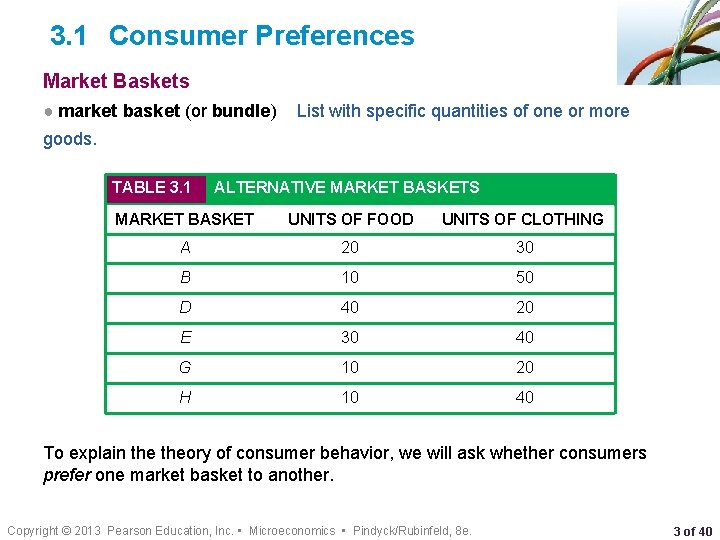
3. 1 Consumer Preferences Market Baskets ● market basket (or bundle) List with specific quantities of one or more goods. TABLE 3. 1 ALTERNATIVE MARKET BASKETS MARKET BASKET UNITS OF FOOD UNITS OF CLOTHING A 20 30 B 10 50 D 40 20 E 30 40 G 10 20 H 10 40 To explain theory of consumer behavior, we will ask whether consumers prefer one market basket to another. Copyright © 2013 Pearson Education, Inc. • Microeconomics • Pindyck/Rubinfeld, 8 e. 3 of 40
Some Basic Assumptions about Preferences 1. Completeness: Preferences are assumed to be complete. In other words, consumers can compare and rank all possible baskets. Thus, for any two market baskets A and B, a consumer will prefer A to B, will prefer B to A, or will be indifferent between the two. By indifferent we mean that a person will be equally satisfied with either basket. Note that these preferences ignore costs. A consumer might prefer steak to hamburger but buy hamburger because it is cheaper. Copyright © 2013 Pearson Education, Inc. • Microeconomics • Pindyck/Rubinfeld, 8 e. 4 of 40
2. Transitivity: Preferences are transitive. Transitivity means that if a consumer prefers basket A to basket B and basket B to basket C, then the consumer also prefers A to C. Transitivity is normally regarded as necessary for consumer consistency. 3. More is better than less: Goods are assumed to be desirable—i. e. , to be good. Consequently, consumers always prefer more of any good to less. In addition, consumers are never satisfied or satiated; more is always better, even if just a little better. Copyright © 2013 Pearson Education, Inc. • Microeconomics • Pindyck/Rubinfeld, 8 e. 5 of 40
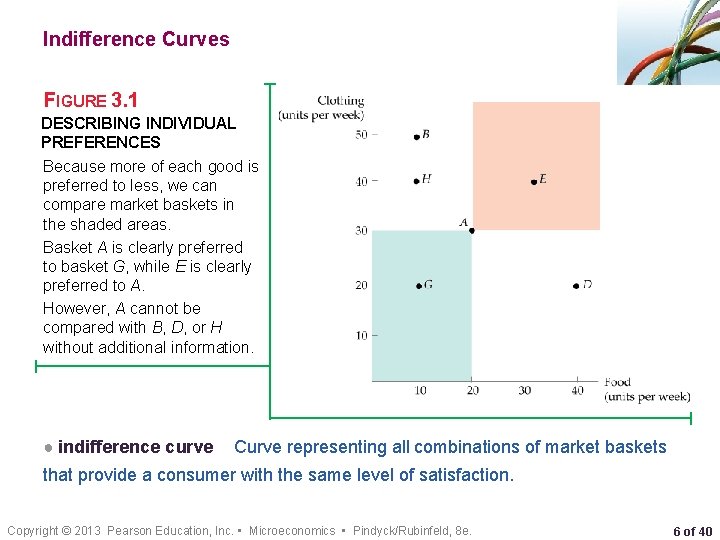
Indifference Curves FIGURE 3. 1 DESCRIBING INDIVIDUAL PREFERENCES Because more of each good is preferred to less, we can compare market baskets in the shaded areas. Basket A is clearly preferred to basket G, while E is clearly preferred to A. However, A cannot be compared with B, D, or H without additional information. ● indifference curve Curve representing all combinations of market baskets that provide a consumer with the same level of satisfaction. Copyright © 2013 Pearson Education, Inc. • Microeconomics • Pindyck/Rubinfeld, 8 e. 6 of 40
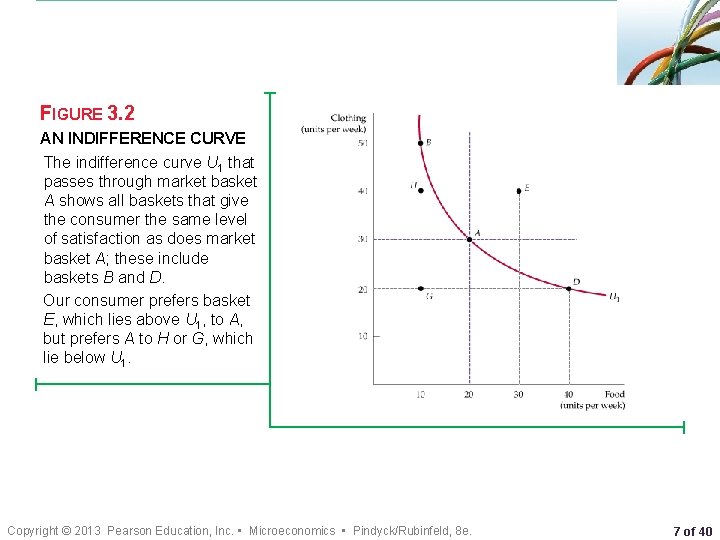
FIGURE 3. 2 AN INDIFFERENCE CURVE The indifference curve U 1 that passes through market basket A shows all baskets that give the consumer the same level of satisfaction as does market basket A; these include baskets B and D. Our consumer prefers basket E, which lies above U 1, to A, but prefers A to H or G, which lie below U 1. Copyright © 2013 Pearson Education, Inc. • Microeconomics • Pindyck/Rubinfeld, 8 e. 7 of 40
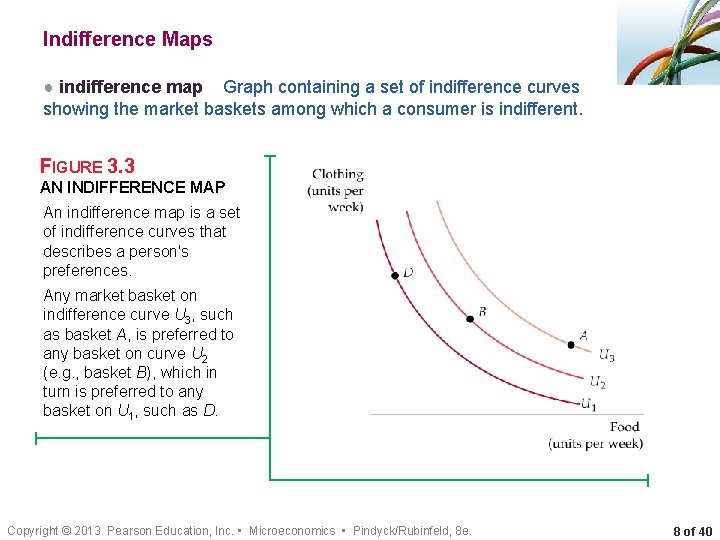
Indifference Maps ● indifference map Graph containing a set of indifference curves showing the market baskets among which a consumer is indifferent. FIGURE 3. 3 AN INDIFFERENCE MAP An indifference map is a set of indifference curves that describes a person's preferences. Any market basket on indifference curve U 3, such as basket A, is preferred to any basket on curve U 2 (e. g. , basket B), which in turn is preferred to any basket on U 1, such as D. Copyright © 2013 Pearson Education, Inc. • Microeconomics • Pindyck/Rubinfeld, 8 e. 8 of 40
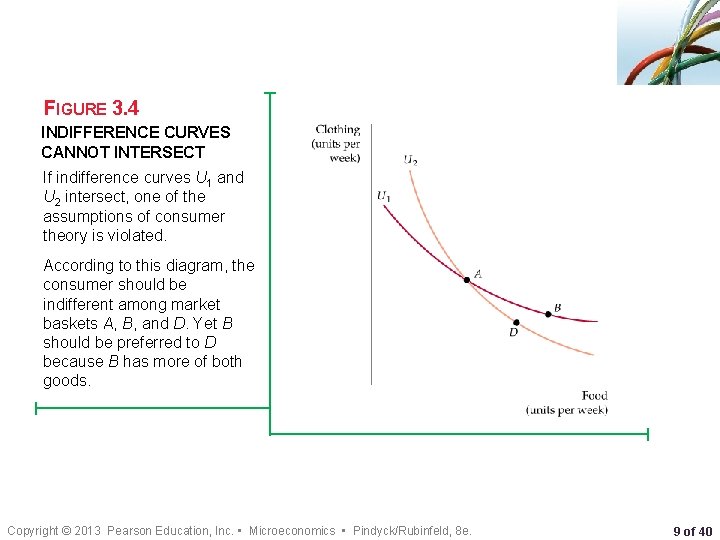
FIGURE 3. 4 INDIFFERENCE CURVES CANNOT INTERSECT If indifference curves U 1 and U 2 intersect, one of the assumptions of consumer theory is violated. According to this diagram, the consumer should be indifferent among market baskets A, B, and D. Yet B should be preferred to D because B has more of both goods. Copyright © 2013 Pearson Education, Inc. • Microeconomics • Pindyck/Rubinfeld, 8 e. 9 of 40
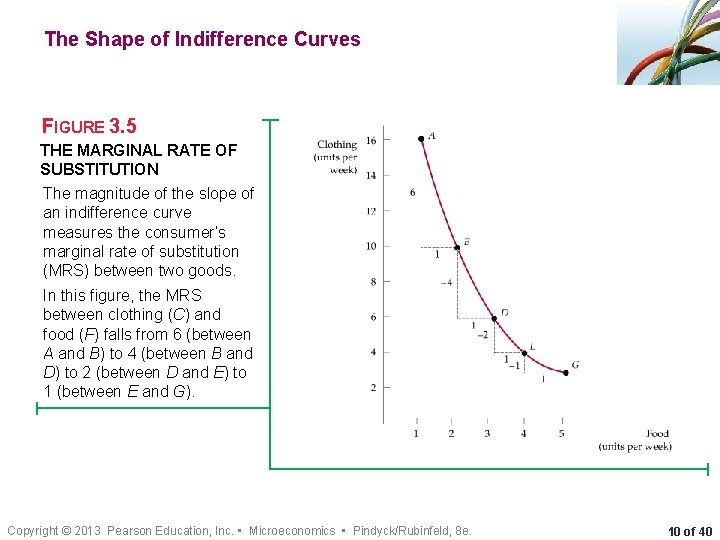
The Shape of Indifference Curves FIGURE 3. 5 THE MARGINAL RATE OF SUBSTITUTION The magnitude of the slope of an indifference curve measures the consumer’s marginal rate of substitution (MRS) between two goods. In this figure, the MRS between clothing (C) and food (F) falls from 6 (between A and B) to 4 (between B and D) to 2 (between D and E) to 1 (between E and G). Copyright © 2013 Pearson Education, Inc. • Microeconomics • Pindyck/Rubinfeld, 8 e. 10 of 40
The Marginal Rate of Substitution ● marginal rate of substitution (MRS) Maximum amount of a good that a consumer is willing to give up in order to obtain one additional unit of another good. CONVEXITY Observe that the MRS falls as we move down the indifference curve. The decline in the MRS reflects our fourth assumption regarding consumer preferences: a diminishing marginal rate of substitution. When the MRS diminishes along an indifference curve, the curve is convex. Copyright © 2013 Pearson Education, Inc. • Microeconomics • Pindyck/Rubinfeld, 8 e. 11 of 40
Perfect Substitutes and Perfect Complements ● perfect substitutes Two goods for which the marginal rate of substitution of one for the other is a constant. ● perfect complements Two goods for which the MRS is zero or infinite; the indifference curves are shaped as right angles. BADS ● bad Good for which less is preferred rather than more. Copyright © 2013 Pearson Education, Inc. • Microeconomics • Pindyck/Rubinfeld, 8 e. 12 of 40
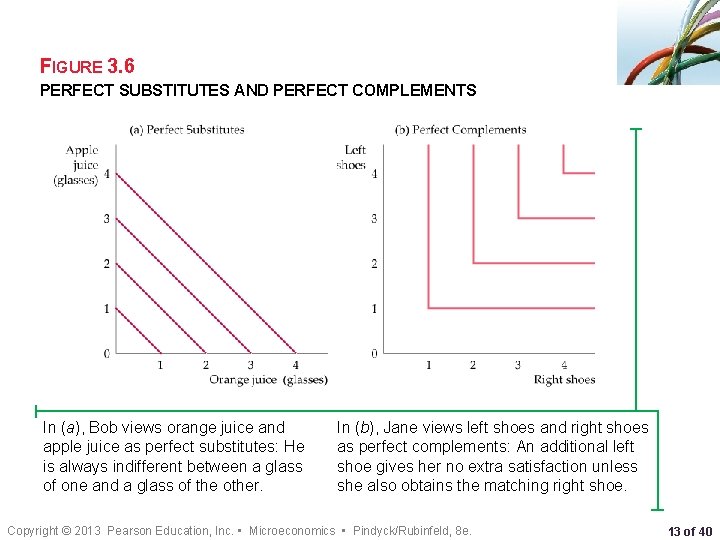
FIGURE 3. 6 PERFECT SUBSTITUTES AND PERFECT COMPLEMENTS In (a), Bob views orange juice and apple juice as perfect substitutes: He is always indifferent between a glass of one and a glass of the other. In (b), Jane views left shoes and right shoes as perfect complements: An additional left shoe gives her no extra satisfaction unless she also obtains the matching right shoe. Copyright © 2013 Pearson Education, Inc. • Microeconomics • Pindyck/Rubinfeld, 8 e. 13 of 40
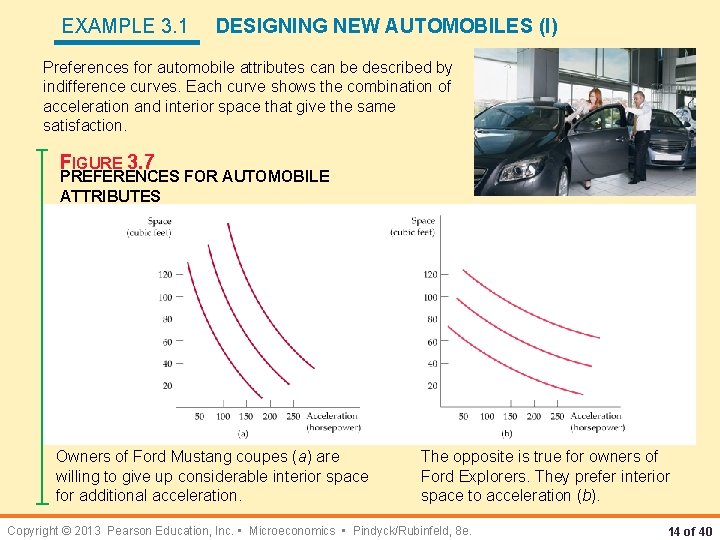
EXAMPLE 3. 1 DESIGNING NEW AUTOMOBILES (I) Preferences for automobile attributes can be described by indifference curves. Each curve shows the combination of acceleration and interior space that give the same satisfaction. FIGURE 3. 7 PREFERENCES FOR AUTOMOBILE ATTRIBUTES Owners of Ford Mustang coupes (a) are willing to give up considerable interior space for additional acceleration. The opposite is true for owners of Ford Explorers. They prefer interior space to acceleration (b). Copyright © 2013 Pearson Education, Inc. • Microeconomics • Pindyck/Rubinfeld, 8 e. 14 of 40
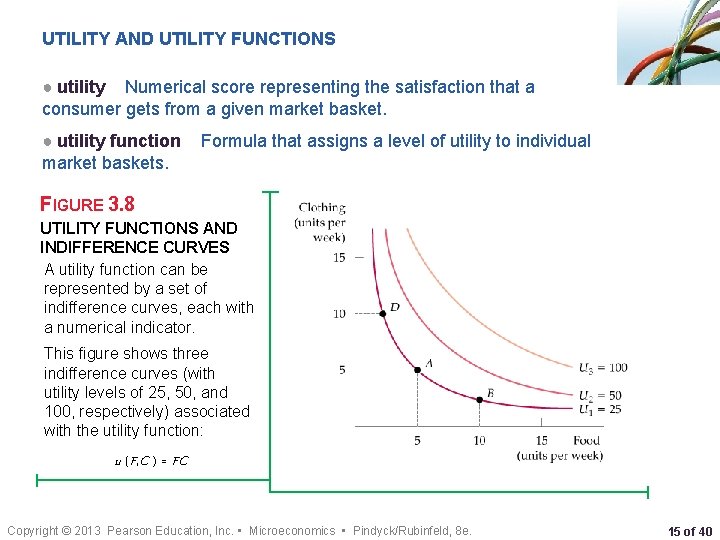
UTILITY AND UTILITY FUNCTIONS ● utility Numerical score representing the satisfaction that a consumer gets from a given market basket. ● utility function market baskets. Formula that assigns a level of utility to individual FIGURE 3. 8 UTILITY FUNCTIONS AND INDIFFERENCE CURVES A utility function can be represented by a set of indifference curves, each with a numerical indicator. This figure shows three indifference curves (with utility levels of 25, 50, and 100, respectively) associated with the utility function: u (F, C ) = FC Copyright © 2013 Pearson Education, Inc. • Microeconomics • Pindyck/Rubinfeld, 8 e. 15 of 40
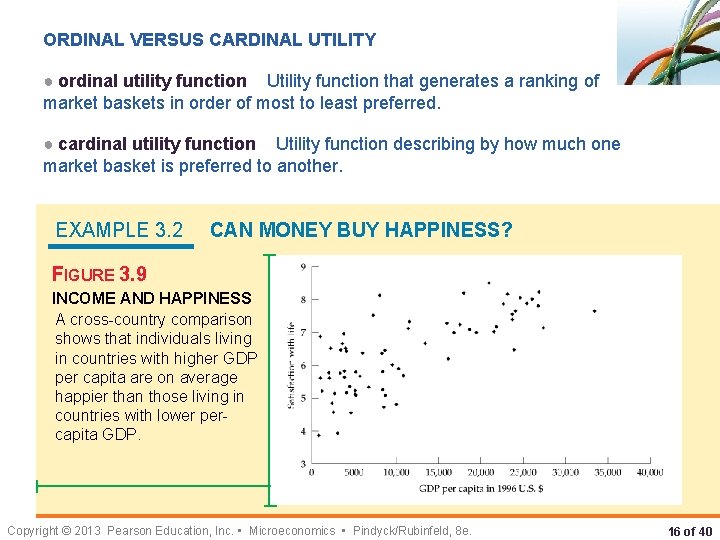
ORDINAL VERSUS CARDINAL UTILITY ● ordinal utility function Utility function that generates a ranking of market baskets in order of most to least preferred. ● cardinal utility function Utility function describing by how much one market basket is preferred to another. EXAMPLE 3. 2 CAN MONEY BUY HAPPINESS? FIGURE 3. 9 INCOME AND HAPPINESS A cross-country comparison shows that individuals living in countries with higher GDP per capita are on average happier than those living in countries with lower percapita GDP. Copyright © 2013 Pearson Education, Inc. • Microeconomics • Pindyck/Rubinfeld, 8 e. 16 of 40
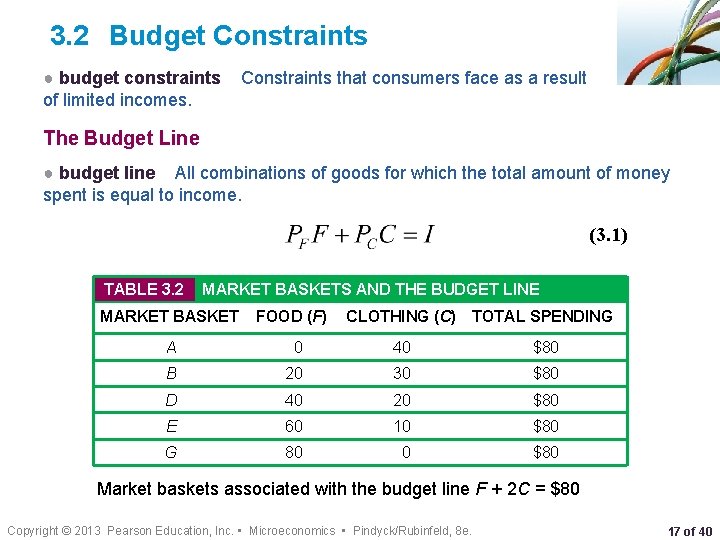
3. 2 Budget Constraints ● budget constraints of limited incomes. Constraints that consumers face as a result The Budget Line ● budget line All combinations of goods for which the total amount of money spent is equal to income. (3. 1) TABLE 3. 2 MARKET BASKETS AND THE BUDGET LINE MARKET BASKET FOOD (F) CLOTHING (C) TOTAL SPENDING A 0 40 $80 B 20 30 $80 D 40 20 $80 E 60 10 $80 G 80 0 $80 Market baskets associated with the budget line F + 2 C = $80 Copyright © 2013 Pearson Education, Inc. • Microeconomics • Pindyck/Rubinfeld, 8 e. 17 of 40
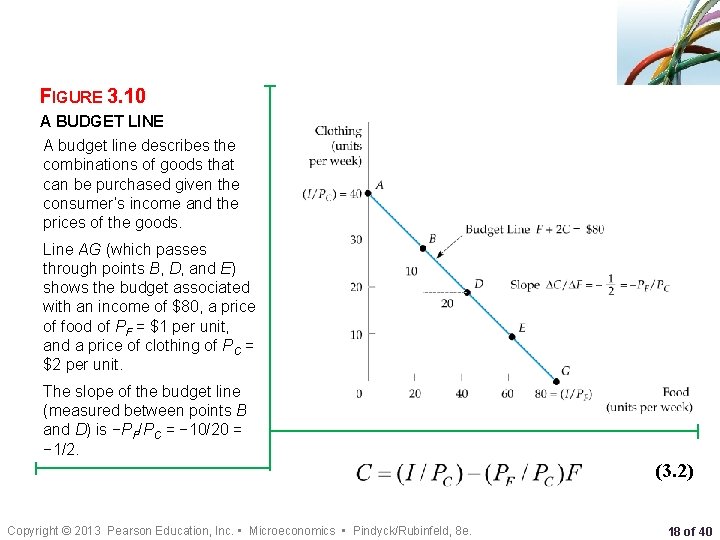
FIGURE 3. 10 A BUDGET LINE A budget line describes the combinations of goods that can be purchased given the consumer’s income and the prices of the goods. Line AG (which passes through points B, D, and E) shows the budget associated with an income of $80, a price of food of PF = $1 per unit, and a price of clothing of PC = $2 per unit. The slope of the budget line (measured between points B and D) is −PF/PC = − 10/20 = − 1/2. (3. 2) Copyright © 2013 Pearson Education, Inc. • Microeconomics • Pindyck/Rubinfeld, 8 e. 18 of 40
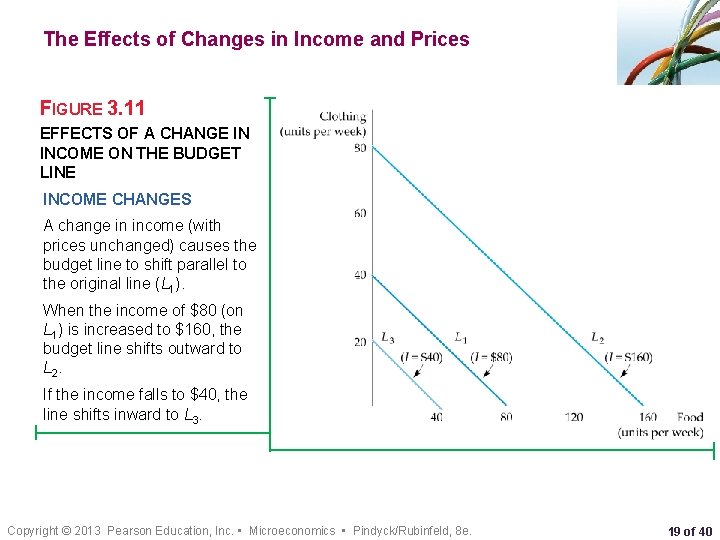
The Effects of Changes in Income and Prices FIGURE 3. 11 EFFECTS OF A CHANGE IN INCOME ON THE BUDGET LINE INCOME CHANGES A change in income (with prices unchanged) causes the budget line to shift parallel to the original line (L 1). When the income of $80 (on L 1) is increased to $160, the budget line shifts outward to L 2. If the income falls to $40, the line shifts inward to L 3. Copyright © 2013 Pearson Education, Inc. • Microeconomics • Pindyck/Rubinfeld, 8 e. 19 of 40
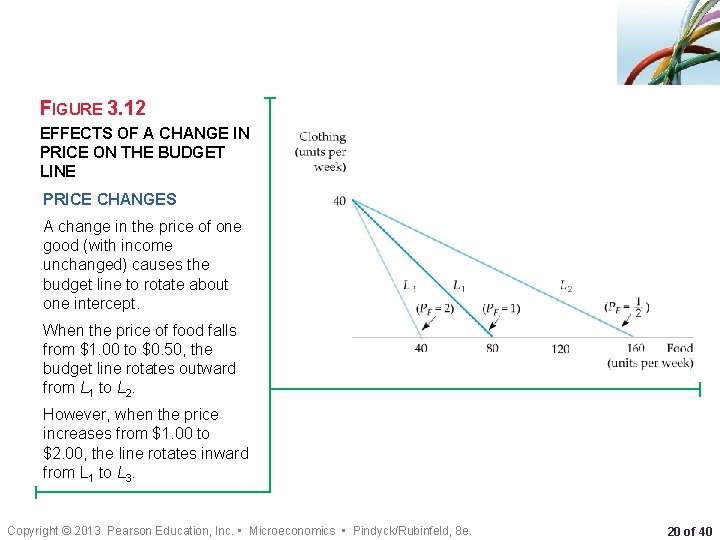
FIGURE 3. 12 EFFECTS OF A CHANGE IN PRICE ON THE BUDGET LINE PRICE CHANGES A change in the price of one good (with income unchanged) causes the budget line to rotate about one intercept. When the price of food falls from $1. 00 to $0. 50, the budget line rotates outward from L 1 to L 2. However, when the price increases from $1. 00 to $2. 00, the line rotates inward from L 1 to L 3. Copyright © 2013 Pearson Education, Inc. • Microeconomics • Pindyck/Rubinfeld, 8 e. 20 of 40
3. 3 Consumer Choice The maximizing market basket must satisfy two conditions: 1. It must be located on the budget line. 2. It must give the consumer the most preferred combination of goods and services. Copyright © 2013 Pearson Education, Inc. • Microeconomics • Pindyck/Rubinfeld, 8 e. 21 of 40
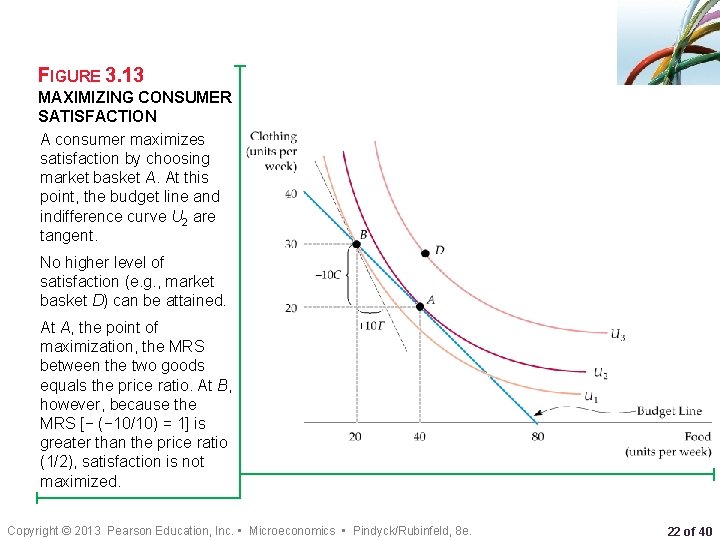
FIGURE 3. 13 MAXIMIZING CONSUMER SATISFACTION A consumer maximizes satisfaction by choosing market basket A. At this point, the budget line and indifference curve U 2 are tangent. No higher level of satisfaction (e. g. , market basket D) can be attained. At A, the point of maximization, the MRS between the two goods equals the price ratio. At B, however, because the MRS [− (− 10/10) = 1] is greater than the price ratio (1/2), satisfaction is not maximized. Copyright © 2013 Pearson Education, Inc. • Microeconomics • Pindyck/Rubinfeld, 8 e. 22 of 40
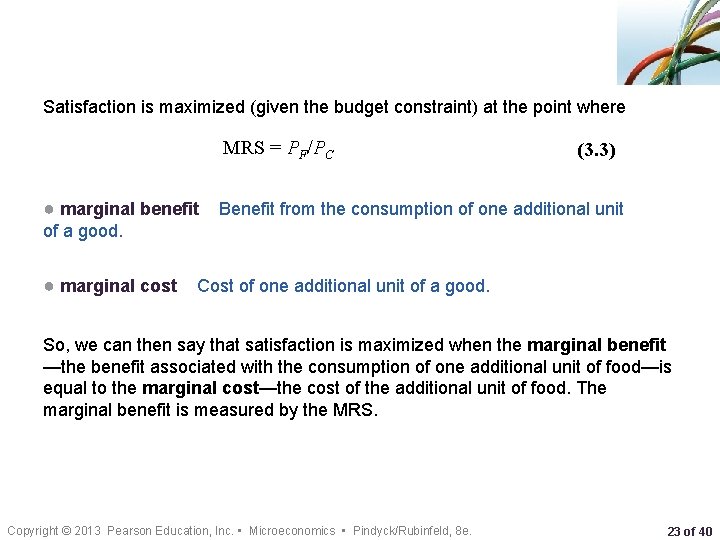
Satisfaction is maximized (given the budget constraint) at the point where MRS = PF/PC ● marginal benefit (3. 3) Benefit from the consumption of one additional unit of a good. ● marginal cost Cost of one additional unit of a good. So, we can then say that satisfaction is maximized when the marginal benefit —the benefit associated with the consumption of one additional unit of food—is equal to the marginal cost—the cost of the additional unit of food. The marginal benefit is measured by the MRS. Copyright © 2013 Pearson Education, Inc. • Microeconomics • Pindyck/Rubinfeld, 8 e. 23 of 40
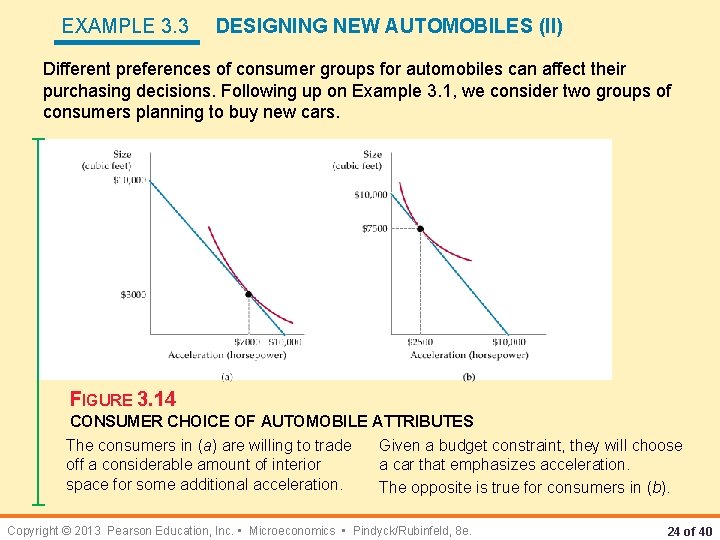
EXAMPLE 3. 3 DESIGNING NEW AUTOMOBILES (II) Different preferences of consumer groups for automobiles can affect their purchasing decisions. Following up on Example 3. 1, we consider two groups of consumers planning to buy new cars. FIGURE 3. 14 CONSUMER CHOICE OF AUTOMOBILE ATTRIBUTES The consumers in (a) are willing to trade Given a budget constraint, they will choose off a considerable amount of interior a car that emphasizes acceleration. space for some additional acceleration. The opposite is true for consumers in (b). Copyright © 2013 Pearson Education, Inc. • Microeconomics • Pindyck/Rubinfeld, 8 e. 24 of 40
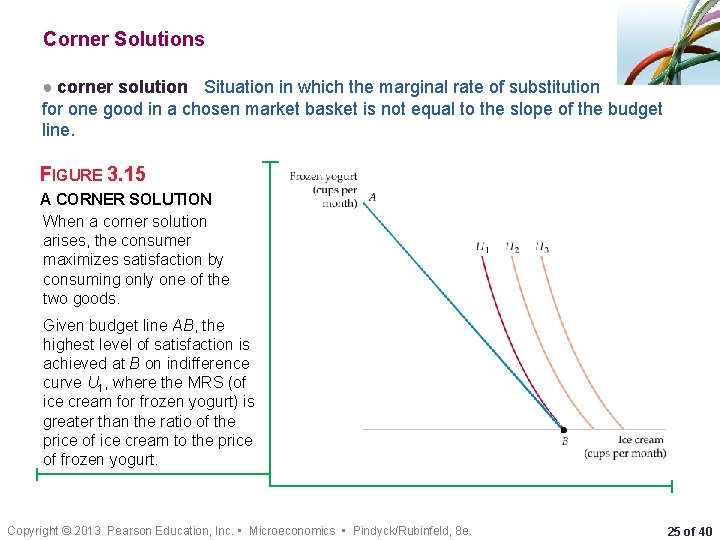
Corner Solutions ● corner solution Situation in which the marginal rate of substitution for one good in a chosen market basket is not equal to the slope of the budget line. FIGURE 3. 15 A CORNER SOLUTION When a corner solution arises, the consumer maximizes satisfaction by consuming only one of the two goods. Given budget line AB, the highest level of satisfaction is achieved at B on indifference curve U 1, where the MRS (of ice cream for frozen yogurt) is greater than the ratio of the price of ice cream to the price of frozen yogurt. Copyright © 2013 Pearson Education, Inc. • Microeconomics • Pindyck/Rubinfeld, 8 e. 25 of 40
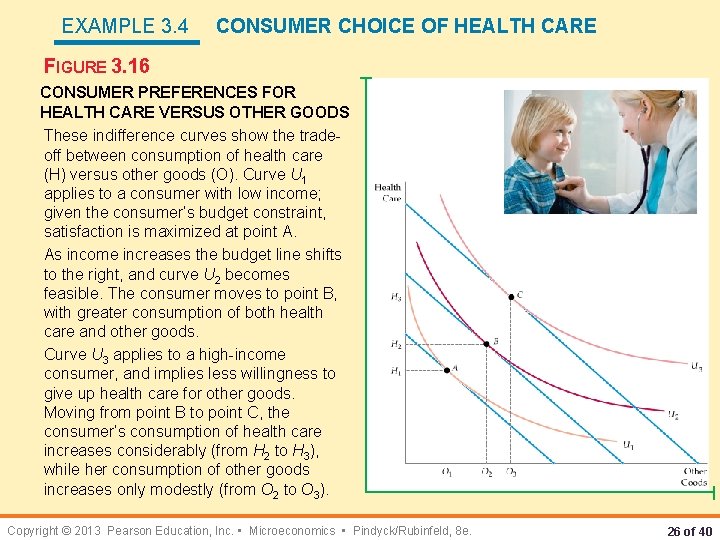
EXAMPLE 3. 4 CONSUMER CHOICE OF HEALTH CARE FIGURE 3. 16 CONSUMER PREFERENCES FOR HEALTH CARE VERSUS OTHER GOODS These indifference curves show the tradeoff between consumption of health care (H) versus other goods (O). Curve U 1 applies to a consumer with low income; given the consumer’s budget constraint, satisfaction is maximized at point A. As income increases the budget line shifts to the right, and curve U 2 becomes feasible. The consumer moves to point B, with greater consumption of both health care and other goods. Curve U 3 applies to a high-income consumer, and implies less willingness to give up health care for other goods. Moving from point B to point C, the consumer’s consumption of health care increases considerably (from H 2 to H 3), while her consumption of other goods increases only modestly (from O 2 to O 3). Copyright © 2013 Pearson Education, Inc. • Microeconomics • Pindyck/Rubinfeld, 8 e. 26 of 40
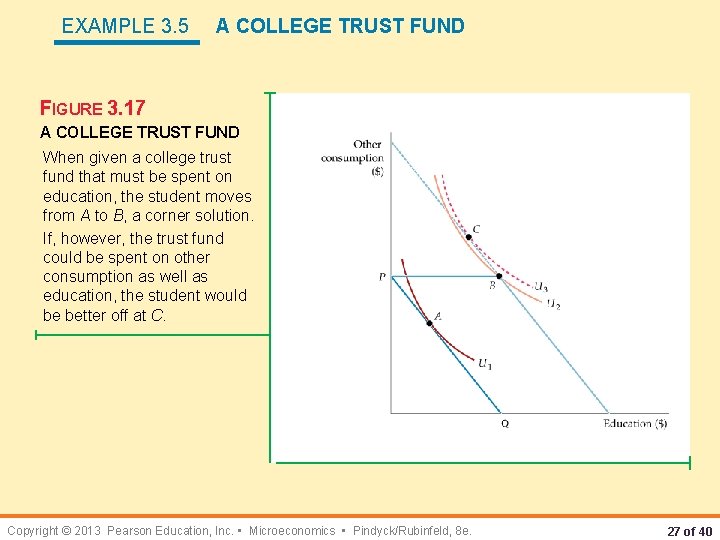
EXAMPLE 3. 5 A COLLEGE TRUST FUND FIGURE 3. 17 A COLLEGE TRUST FUND When given a college trust fund that must be spent on education, the student moves from A to B, a corner solution. If, however, the trust fund could be spent on other consumption as well as education, the student would be better off at C. Copyright © 2013 Pearson Education, Inc. • Microeconomics • Pindyck/Rubinfeld, 8 e. 27 of 40
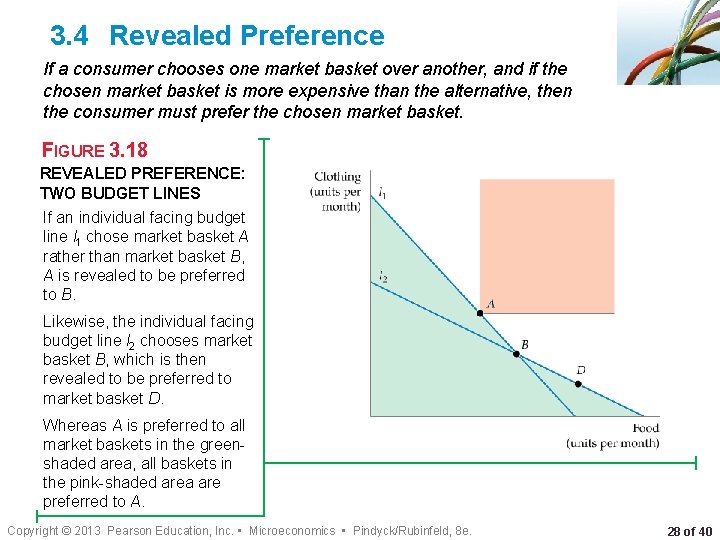
3. 4 Revealed Preference If a consumer chooses one market basket over another, and if the chosen market basket is more expensive than the alternative, then the consumer must prefer the chosen market basket. FIGURE 3. 18 REVEALED PREFERENCE: TWO BUDGET LINES If an individual facing budget line l 1 chose market basket A rather than market basket B, A is revealed to be preferred to B. Likewise, the individual facing budget line l 2 chooses market basket B, which is then revealed to be preferred to market basket D. Whereas A is preferred to all market baskets in the greenshaded area, all baskets in the pink-shaded area are preferred to A. Copyright © 2013 Pearson Education, Inc. • Microeconomics • Pindyck/Rubinfeld, 8 e. 28 of 40
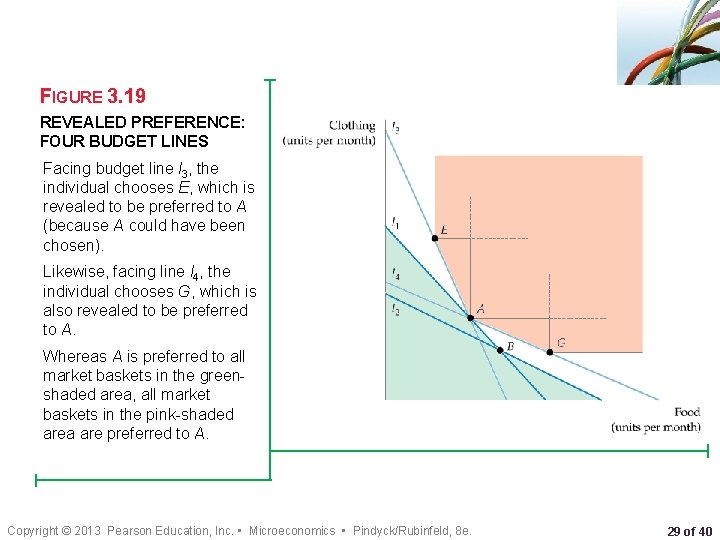
FIGURE 3. 19 REVEALED PREFERENCE: FOUR BUDGET LINES Facing budget line l 3, the individual chooses E, which is revealed to be preferred to A (because A could have been chosen). Likewise, facing line l 4, the individual chooses G, which is also revealed to be preferred to A. Whereas A is preferred to all market baskets in the greenshaded area, all market baskets in the pink-shaded area are preferred to A. Copyright © 2013 Pearson Education, Inc. • Microeconomics • Pindyck/Rubinfeld, 8 e. 29 of 40
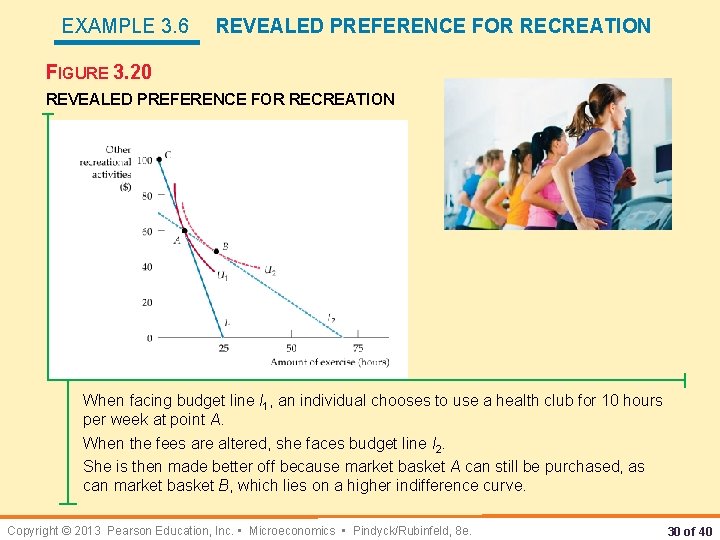
EXAMPLE 3. 6 REVEALED PREFERENCE FOR RECREATION FIGURE 3. 20 REVEALED PREFERENCE FOR RECREATION When facing budget line l 1, an individual chooses to use a health club for 10 hours per week at point A. When the fees are altered, she faces budget line l 2. She is then made better off because market basket A can still be purchased, as can market basket B, which lies on a higher indifference curve. Copyright © 2013 Pearson Education, Inc. • Microeconomics • Pindyck/Rubinfeld, 8 e. 30 of 40
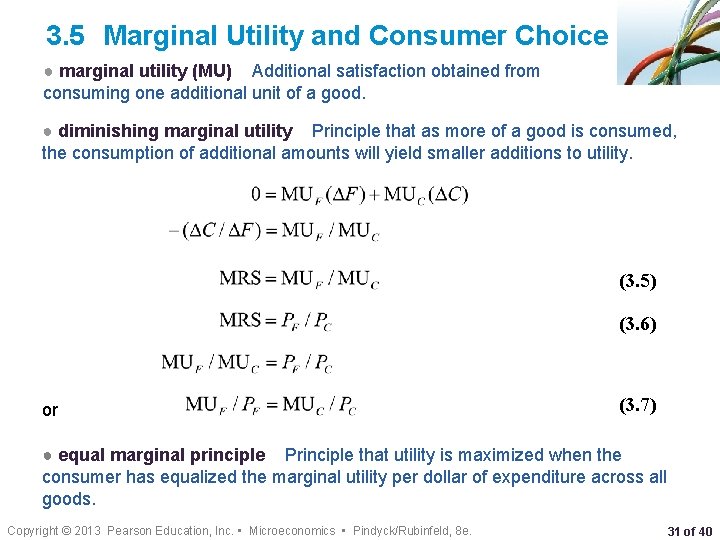
3. 5 Marginal Utility and Consumer Choice ● marginal utility (MU) Additional satisfaction obtained from consuming one additional unit of a good. ● diminishing marginal utility Principle that as more of a good is consumed, the consumption of additional amounts will yield smaller additions to utility. (3. 5) (3. 6) or (3. 7) ● equal marginal principle Principle that utility is maximized when the consumer has equalized the marginal utility per dollar of expenditure across all goods. Copyright © 2013 Pearson Education, Inc. • Microeconomics • Pindyck/Rubinfeld, 8 e. 31 of 40
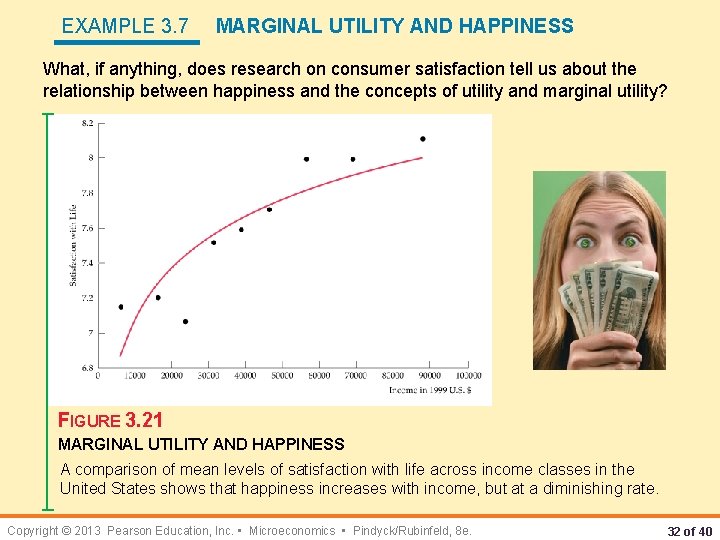
EXAMPLE 3. 7 MARGINAL UTILITY AND HAPPINESS What, if anything, does research on consumer satisfaction tell us about the relationship between happiness and the concepts of utility and marginal utility? FIGURE 3. 21 MARGINAL UTILITY AND HAPPINESS A comparison of mean levels of satisfaction with life across income classes in the United States shows that happiness increases with income, but at a diminishing rate. Copyright © 2013 Pearson Education, Inc. • Microeconomics • Pindyck/Rubinfeld, 8 e. 32 of 40
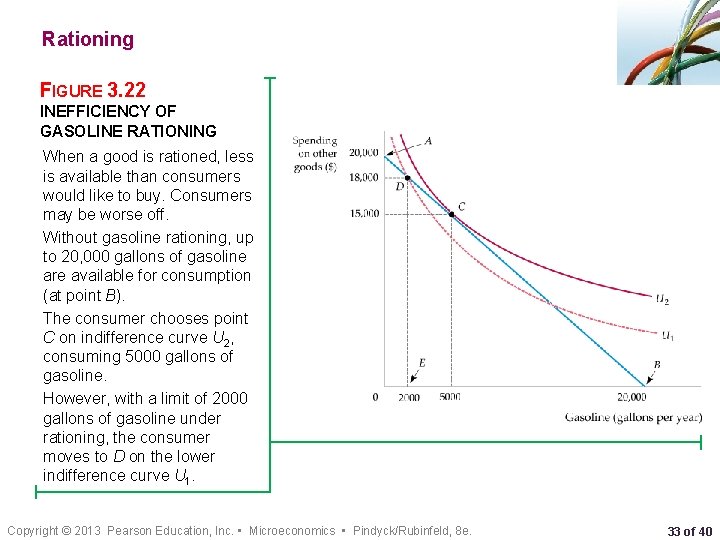
Rationing FIGURE 3. 22 INEFFICIENCY OF GASOLINE RATIONING When a good is rationed, less is available than consumers would like to buy. Consumers may be worse off. Without gasoline rationing, up to 20, 000 gallons of gasoline are available for consumption (at point B). The consumer chooses point C on indifference curve U 2, consuming 5000 gallons of gasoline. However, with a limit of 2000 gallons of gasoline under rationing, the consumer moves to D on the lower indifference curve U 1. Copyright © 2013 Pearson Education, Inc. • Microeconomics • Pindyck/Rubinfeld, 8 e. 33 of 40
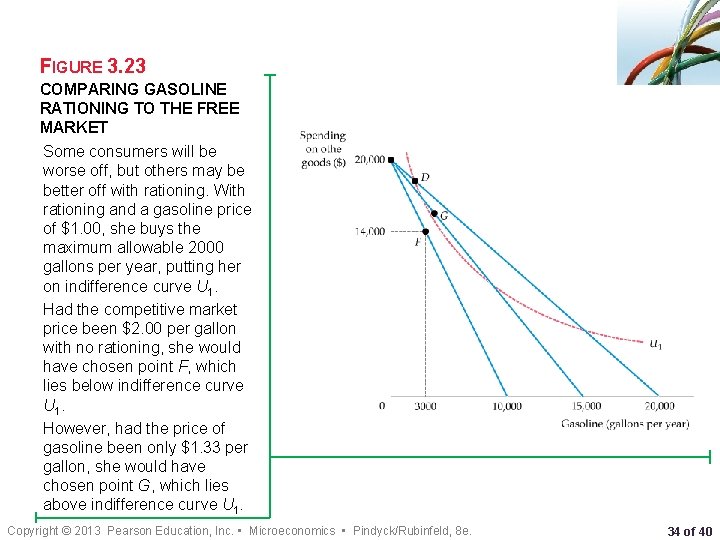
FIGURE 3. 23 COMPARING GASOLINE RATIONING TO THE FREE MARKET Some consumers will be worse off, but others may be better off with rationing. With rationing and a gasoline price of $1. 00, she buys the maximum allowable 2000 gallons per year, putting her on indifference curve U 1. Had the competitive market price been $2. 00 per gallon with no rationing, she would have chosen point F, which lies below indifference curve U 1. However, had the price of gasoline been only $1. 33 per gallon, she would have chosen point G, which lies above indifference curve U 1. Copyright © 2013 Pearson Education, Inc. • Microeconomics • Pindyck/Rubinfeld, 8 e. 34 of 40
- Slides: 34