
Chapter 3 Consciousness and the TwoTrack Mind PSYCHOLOGY
- Slides: 61
Chapter 3 Consciousness and the Two-Track Mind PSYCHOLOGY David G. Myers C. Nathan De. Wall Twelfth Edition
Chapter Overview § Basic Consciousness Concepts § Sleep and Dreams § Drugs and Consciousness
The Place of Consciousness in Psychology’s History § 1880 s: Psychology defined as description and explanation of states of consciousness § First half of 20 th century: Direct observation of behavior § 1960 s: Consciousness nearly lost; science of behavior § After 1960 s: Study of consciousness altered by hypnosis, drugs, and meditation; importance of cognition § Today: Under the influence of cognitive psychology, neuroscience, and cognitive neuroscience, consciousness reclaims its place as an important area of research
Brain States and Consciousness § Awareness of self and environment § Cognitive neuroscience § Interdisciplinary study of the brain activity linked with cognition (including perception, thinking, memory, and language)
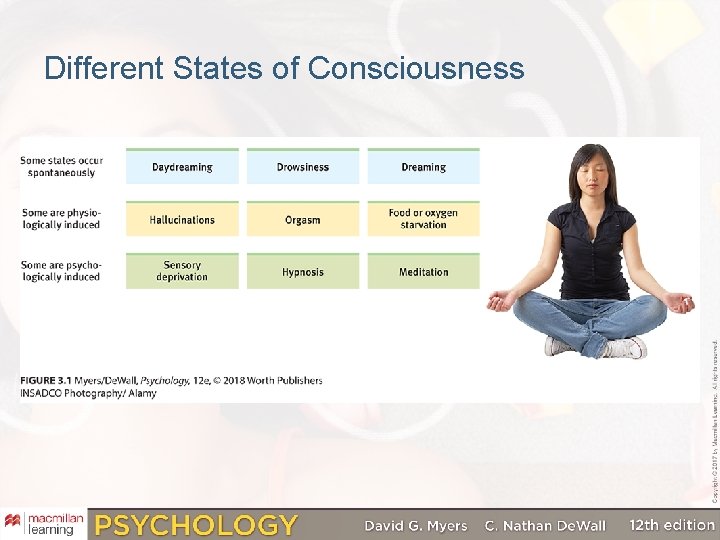
Different States of Consciousness
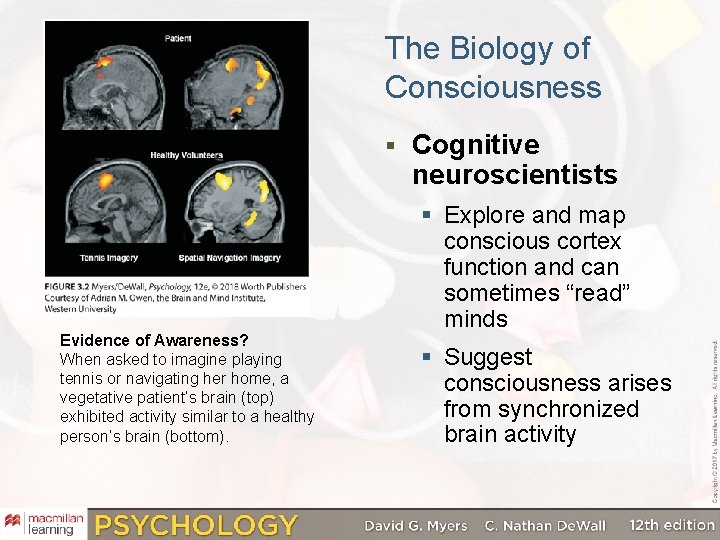
The Biology of Consciousness § Cognitive neuroscientists Evidence of Awareness? When asked to imagine playing tennis or navigating her home, a vegetative patient’s brain (top) exhibited activity similar to a healthy person’s brain (bottom). § Explore and map conscious cortex function and can sometimes “read” minds § Suggest consciousness arises from synchronized brain activity
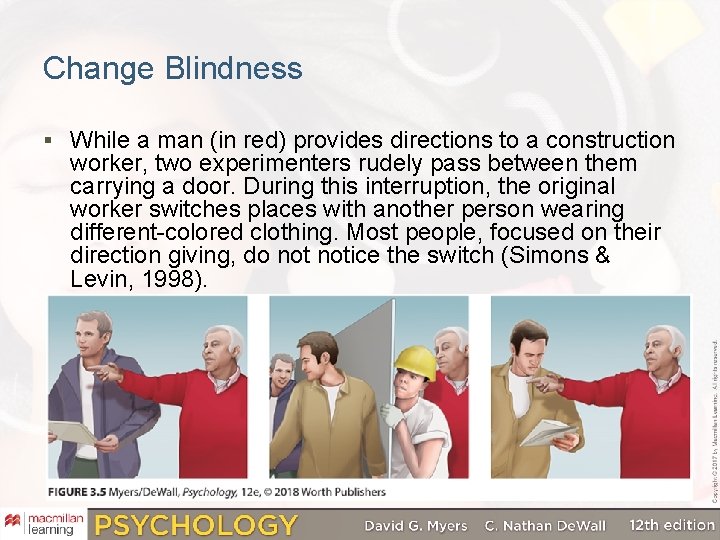
Consciousness and Selective Attention § Selective attention • Focusing conscious awareness on a particular stimulus § Inattentional blindness § Failure to see visible objects when attention is directed elsewhere § Change blindness § Failure to notice changes in the environment, a form of inattentional blindness
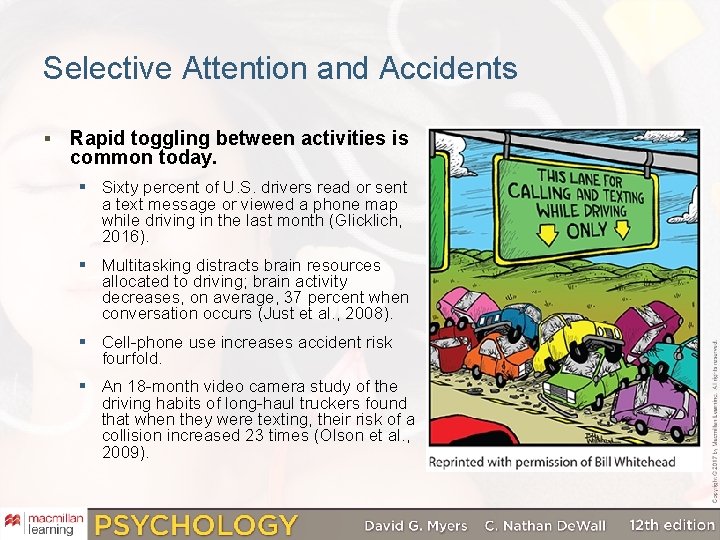
Selective Attention and Accidents § Rapid toggling between activities is common today. § Sixty percent of U. S. drivers read or sent a text message or viewed a phone map while driving in the last month (Glicklich, 2016). § Multitasking distracts brain resources allocated to driving; brain activity decreases, on average, 37 percent when conversation occurs (Just et al. , 2008). § Cell-phone use increases accident risk fourfold. § An 18 -month video camera study of the driving habits of long-haul truckers found that when they were texting, their risk of a collision increased 23 times (Olson et al. , 2009).
Change Blindness § While a man (in red) provides directions to a construction worker, two experimenters rudely pass between them carrying a door. During this interruption, the original worker switches places with another person wearing different-colored clothing. Most people, focused on their direction giving, do notice the switch (Simons & Levin, 1998).
Dual Processing: The Two-Track Mind (part 1) § Dual processing § Information is often simultaneously processed on separate conscious (explicit) and unconscious (implicit) tracks. § Perceptions, memory, attitudes, and other cognitions are affected. § Blindsight awareness § A person can respond to a visual stimulus without consciously experiencing it.
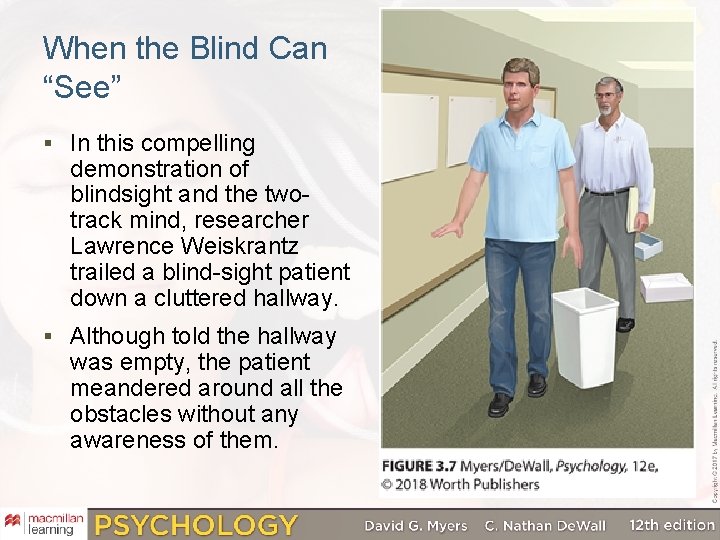
When the Blind Can “See” § In this compelling demonstration of blindsight and the twotrack mind, researcher Lawrence Weiskrantz trailed a blind-sight patient down a cluttered hallway. § Although told the hallway was empty, the patient meandered around all the obstacles without any awareness of them.
Dual Processing: The Two-Track Mind (part 2) § Parallel processing § Processing many aspects of a problem simultaneously; the brain’s natural mode of information processing for many functions § Sequential processing § Focusing conscious awareness on a particular stimulus
What Is Sleep? § Sleep § Periodic, natural loss of consciousness—as distinct from unconsciousness resulting from a coma, general anesthesia, or hibernation (adapted from Dement, 1999)
True or False? § When people dream of performing some activity, their limbs often move in concert with the dream. § Older adults sleep more than young adults. § Sleepwalkers are acting out their dreams. § Sleep experts recommend treating insomnia with an occasional sleeping pill. § Some people dream every night; others seldom dream.
False! § When people dream of performing some activity, their limbs often move in concert with the dream. § Older adults sleep more than young adults. § Sleepwalkers are acting out their dreams. § Sleep experts recommend treating insomnia with an occasional sleeping pill. § Some people dream every night; others seldom dream.
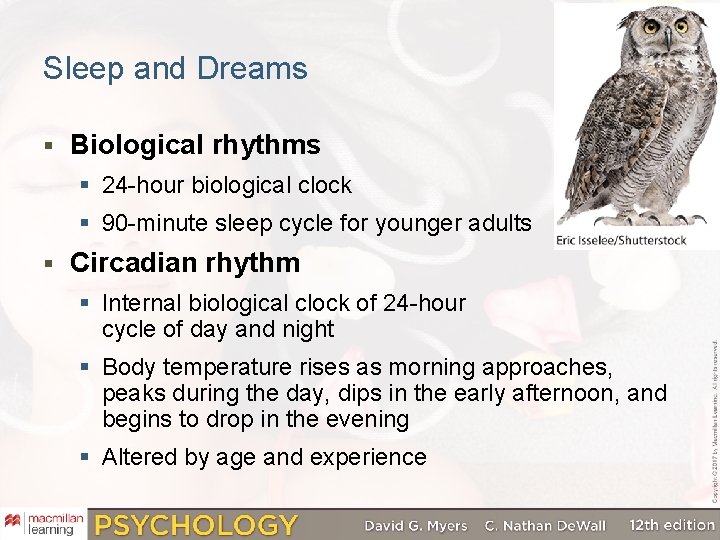
Sleep and Dreams § Biological rhythms § 24 -hour biological clock § 90 -minute sleep cycle for younger adults § Circadian rhythm § Internal biological clock of 24 -hour cycle of day and night § Body temperature rises as morning approaches, peaks during the day, dips in the early afternoon, and begins to drop in the evening § Altered by age and experience
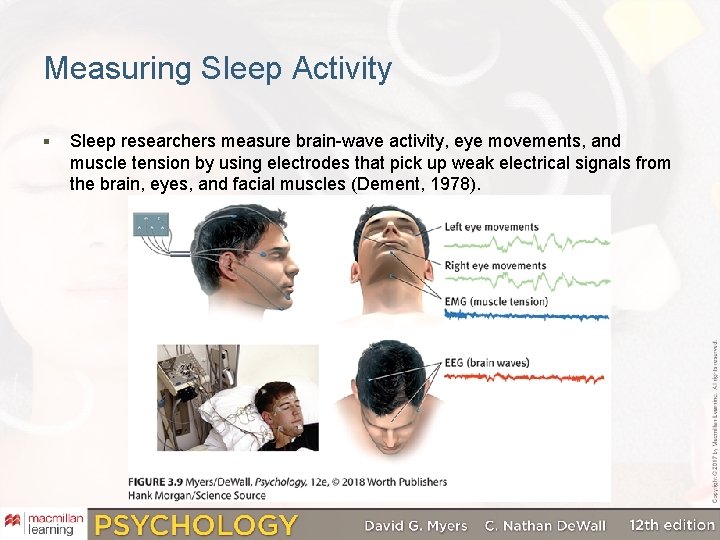
Measuring Sleep Activity § Sleep researchers measure brain-wave activity, eye movements, and muscle tension by using electrodes that pick up weak electrical signals from the brain, eyes, and facial muscles (Dement, 1978).
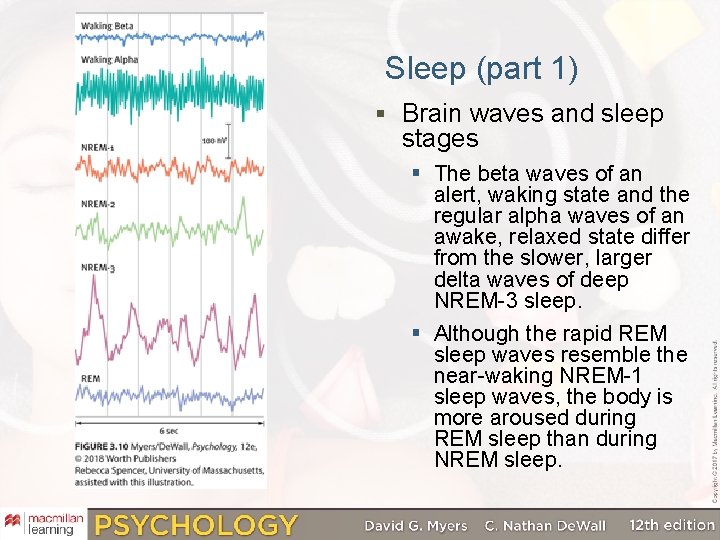
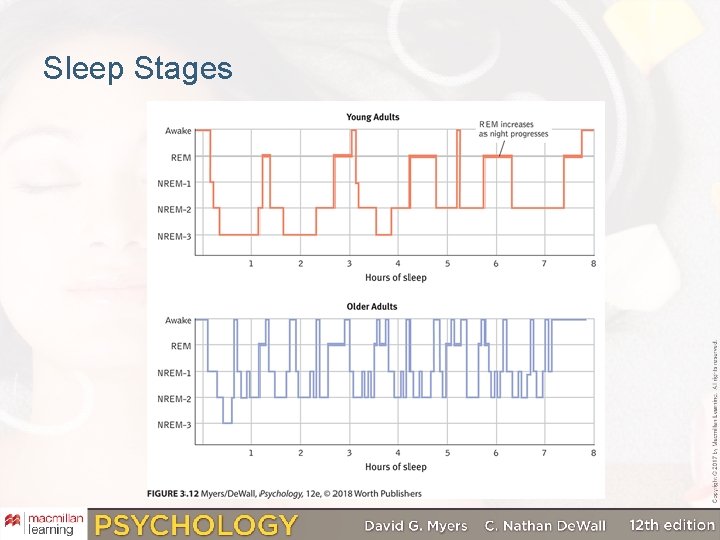
Sleep (part 1) § Brain waves and sleep stages § The beta waves of an alert, waking state and the regular alpha waves of an awake, relaxed state differ from the slower, larger delta waves of deep NREM-3 sleep. § Although the rapid REM sleep waves resemble the near-waking NREM-1 sleep waves, the body is more aroused during REM sleep than during NREM sleep.
Sleep (part 2) § Alpha waves § Relatively slow brain waves of a relaxed, awake state § Hallucinations § False sensory experiences, such as seeing something in the absence of an external visual stimulus § Delta waves § Large, slow brain waves associated with deep sleep
REM Sleep § REM (rapid eye movement) § Sleep stage during which vivid dreams commonly occur § REM rebound § Tendency for REM sleep to increase following REM sleep deprivation
Sleep Stages
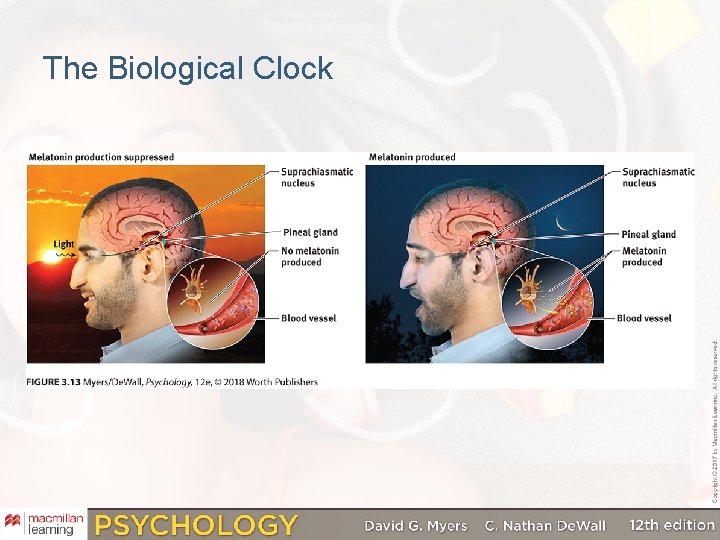
What Affects Our Sleep Patterns? § Sleep patterns are genetically and culturally influenced. § Bright morning light activates light-sensitive proteins that trigger the suprachiasmatic nucleus (SCN) to cause decreased production of melatonin in the morning and increased production in the evening. § Social jet lag may occur when sleep routines are disrupted during weekends.
Why Do We Sleep? § Sleep may have played a protective role in human § § evolution by keeping people safe during potentially dangerous periods. Sleep helps restore and repair damaged neurons. REM and NREM-2 sleep help strengthen neural connections that build enduring memories. Sleep promotes creative problem solving the next day. During deep sleep, the pituitary gland secretes a growth hormone necessary for muscle development.
The Biological Clock
Sleep Loss § After a succession of 5 -hour nights, we accumulate a sleep debt that cannot be satisfied by one long sleep. § In a 2013 Gallup poll, 40 percent of Americans reported getting 6 hours or less sleep per night (Jones, 2013).
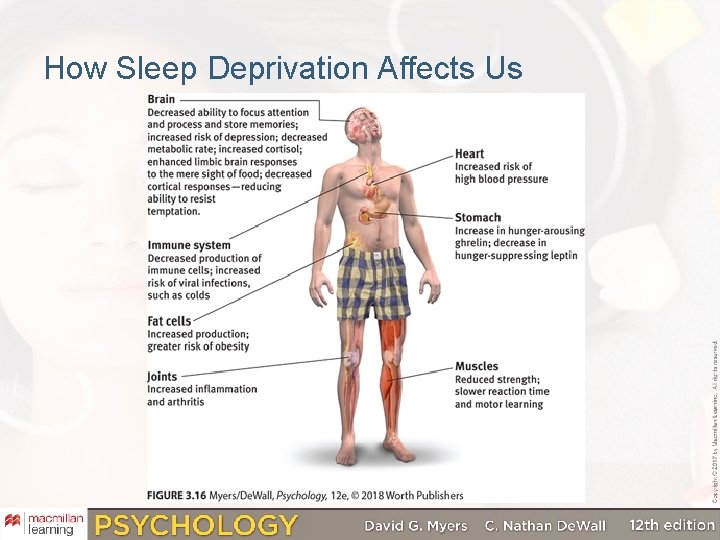
Effects of Sleep Loss § Sleep deprivation § Causes fatigue and irritability § Impairs concentration, productivity, and memory consolidation § Can lead to depression, obesity, joint pain, a suppressed immune system, and slowed performance with a greater vulnerability to accidents
How Sleep Deprivation Affects Us
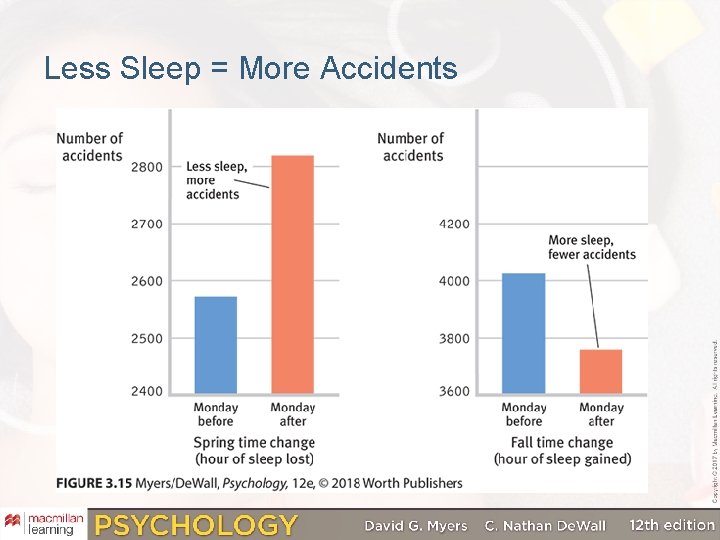
Less Sleep = More Accidents
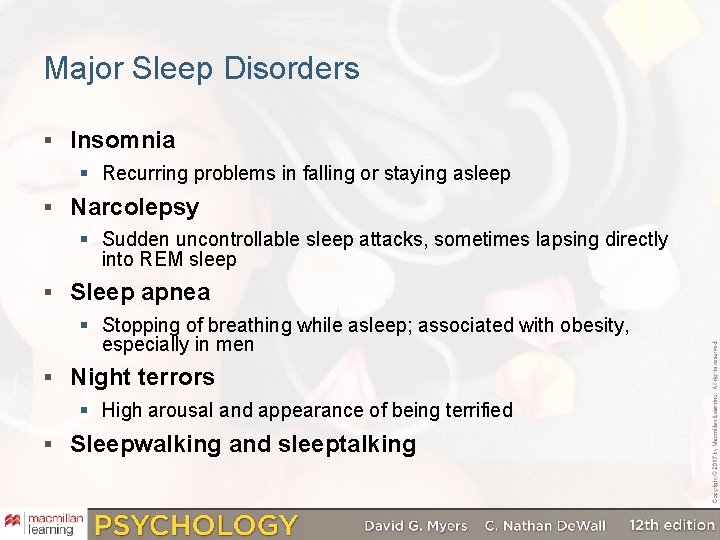
Major Sleep Disorders § Insomnia § Recurring problems in falling or staying asleep § Narcolepsy § Sudden uncontrollable sleep attacks, sometimes lapsing directly into REM sleep § Sleep apnea § Stopping of breathing while asleep; associated with obesity, especially in men § Night terrors § High arousal and appearance of being terrified § Sleepwalking and sleeptalking
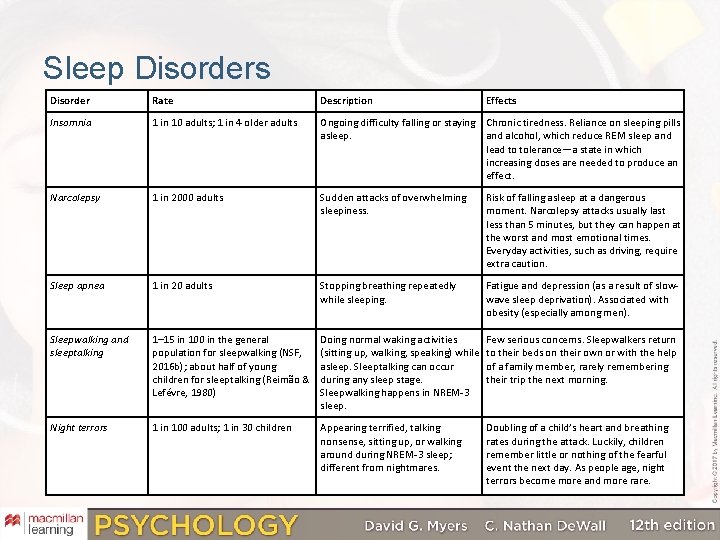
Sleep Disorders Disorder Rate Description Effects Insomnia 1 in 10 adults; 1 in 4 older adults Ongoing difficulty falling or staying Chronic tiredness. Reliance on sleeping pills asleep. and alcohol, which reduce REM sleep and lead to tolerance—a state in which increasing doses are needed to produce an effect. Narcolepsy 1 in 2000 adults Sudden attacks of overwhelming sleepiness. Risk of falling asleep at a dangerous moment. Narcolepsy attacks usually last less than 5 minutes, but they can happen at the worst and most emotional times. Everyday activities, such as driving, require extra caution. Sleep apnea 1 in 20 adults Stopping breathing repeatedly while sleeping. Fatigue and depression (as a result of slowwave sleep deprivation). Associated with obesity (especially among men). Sleepwalking and sleeptalking 1– 15 in 100 in the general population for sleepwalking (NSF, 2016 b); about half of young children for sleeptalking (Reimão & Lefévre, 1980) Doing normal waking activities (sitting up, walking, speaking) while asleep. Sleeptalking can occur during any sleep stage. Sleepwalking happens in NREM-3 sleep. Few serious concerns. Sleepwalkers return to their beds on their own or with the help of a family member, rarely remembering their trip the next morning. Night terrors 1 in 100 adults; 1 in 30 children Appearing terrified, talking nonsense, sitting up, or walking around during NREM-3 sleep; different from nightmares. Doubling of a child’s heart and breathing rates during the attack. Luckily, children remember little or nothing of the fearful event the next day. As people age, night terrors become more and more rare.
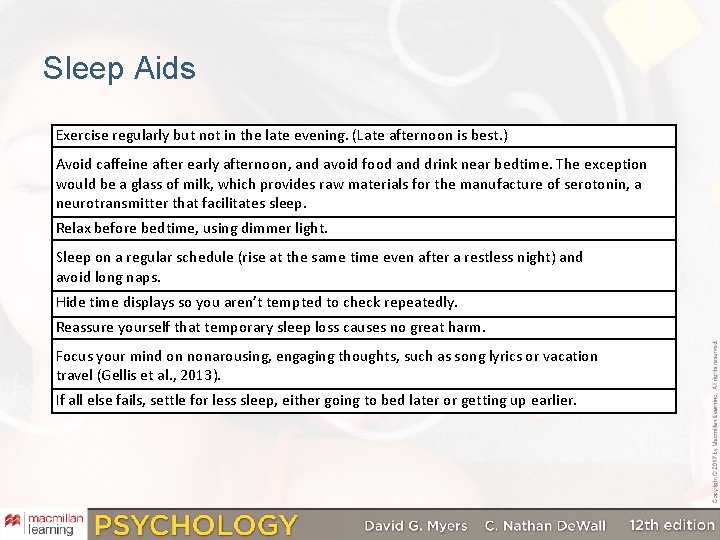
Sleep Aids Exercise regularly but not in the late evening. (Late afternoon is best. ) Avoid caffeine after early afternoon, and avoid food and drink near bedtime. The exception would be a glass of milk, which provides raw materials for the manufacture of serotonin, a neurotransmitter that facilitates sleep. Relax before bedtime, using dimmer light. Sleep on a regular schedule (rise at the same time even after a restless night) and avoid long naps. Hide time displays so you aren’t tempted to check repeatedly. Reassure yourself that temporary sleep loss causes no great harm. Focus your mind on nonarousing, engaging thoughts, such as song lyrics or vacation travel (Gellis et al. , 2013). If all else fails, settle for less sleep, either going to bed later or getting up earlier.
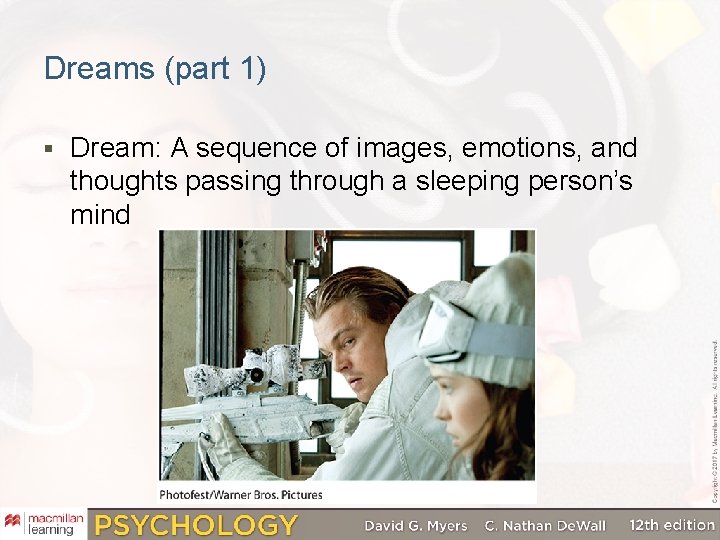
Dreams (part 1) § Dream: A sequence of images, emotions, and thoughts passing through a sleeping person’s mind
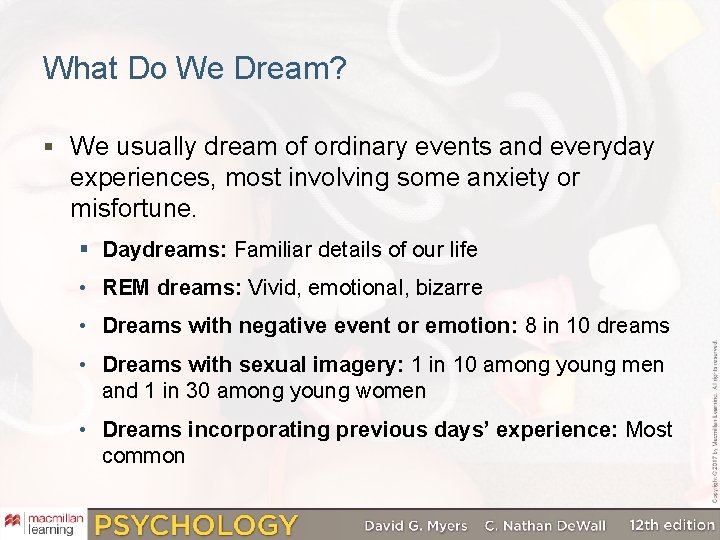
What Do We Dream? § We usually dream of ordinary events and everyday experiences, most involving some anxiety or misfortune. § Daydreams: Familiar details of our life • REM dreams: Vivid, emotional, bizarre • Dreams with negative event or emotion: 8 in 10 dreams • Dreams with sexual imagery: 1 in 10 among young men and 1 in 30 among young women • Dreams incorporating previous days’ experience: Most common
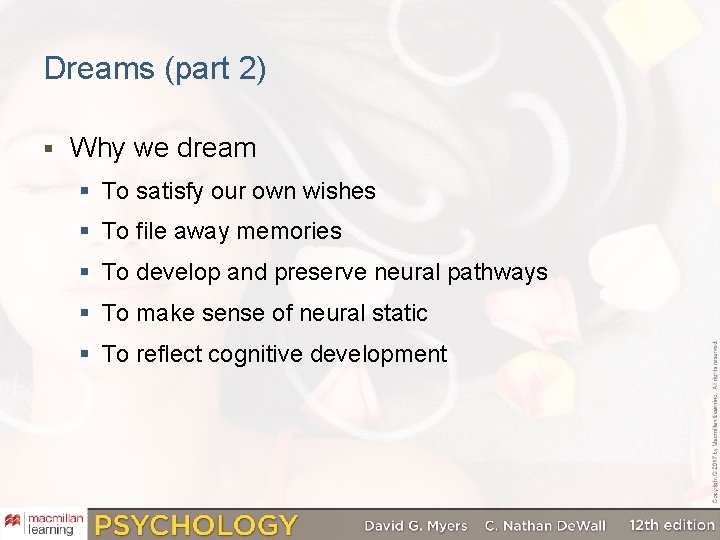
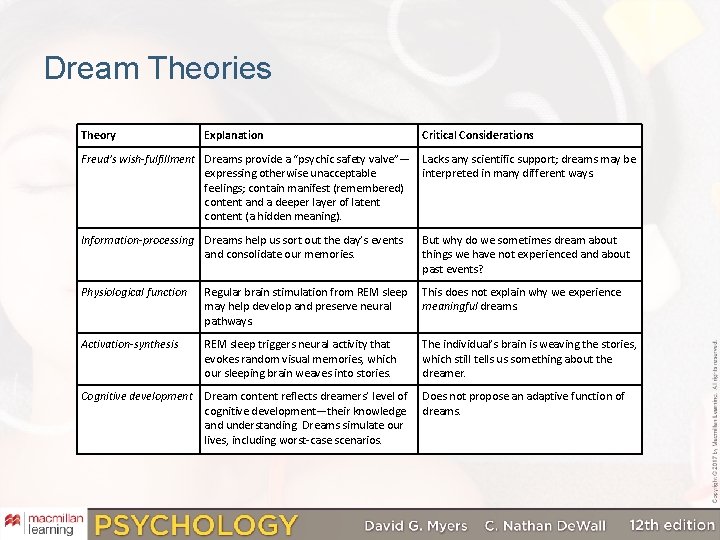
Dreams (part 2) § Why we dream § To satisfy our own wishes § To file away memories § To develop and preserve neural pathways § To make sense of neural static § To reflect cognitive development
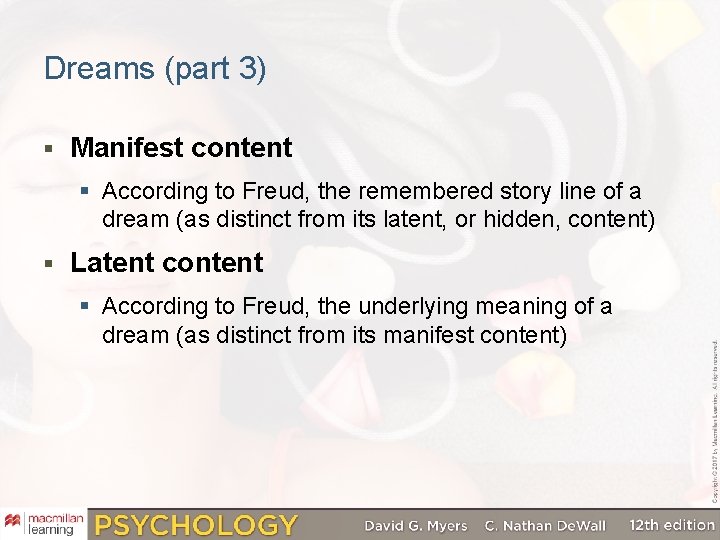
Dreams (part 3) § Manifest content § According to Freud, the remembered story line of a dream (as distinct from its latent, or hidden, content) § Latent content § According to Freud, the underlying meaning of a dream (as distinct from its manifest content)
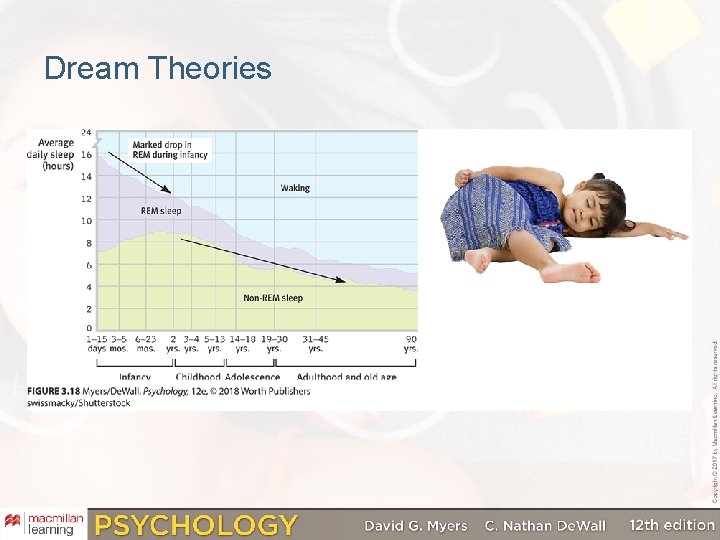
Dream Theories
Dream Theories Theory Explanation Critical Considerations Freud’s wish-fulfillment Dreams provide a “psychic safety valve”— expressing otherwise unacceptable feelings; contain manifest (remembered) content and a deeper layer of latent content (a hidden meaning). Lacks any scientific support; dreams may be interpreted in many different ways. Information-processing Dreams help us sort out the day’s events and consolidate our memories. But why do we sometimes dream about things we have not experienced and about past events? Physiological function Regular brain stimulation from REM sleep may help develop and preserve neural pathways. This does not explain why we experience meaningful dreams. Activation-synthesis REM sleep triggers neural activity that evokes random visual memories, which our sleeping brain weaves into stories. The individual’s brain is weaving the stories, which still tells us something about the dreamer. Cognitive development Dream content reflects dreamers’ level of cognitive development—their knowledge and understanding. Dreams simulate our lives, including worst-case scenarios. Does not propose an adaptive function of dreams.
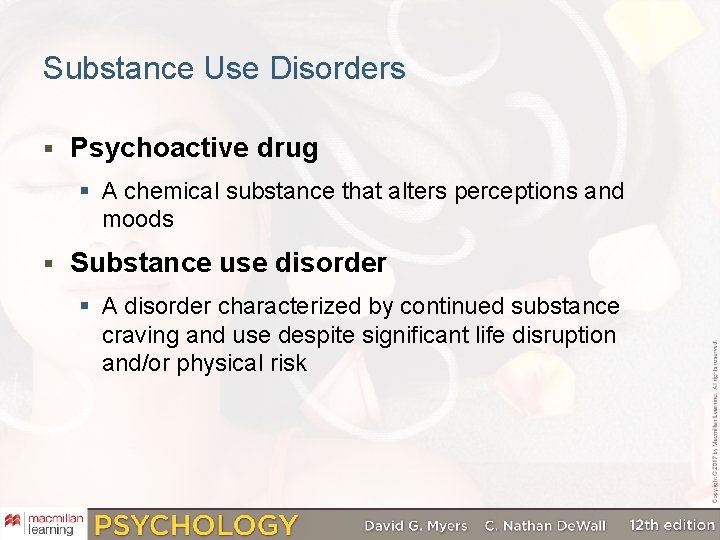
Substance Use Disorders § Psychoactive drug § A chemical substance that alters perceptions and moods § Substance use disorder § A disorder characterized by continued substance craving and use despite significant life disruption and/or physical risk
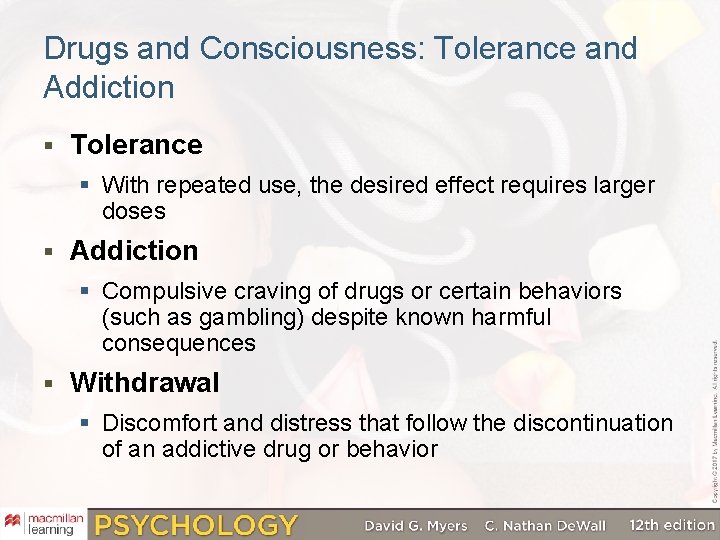
Drugs and Consciousness: Tolerance and Addiction § Tolerance § With repeated use, the desired effect requires larger doses § Addiction § Compulsive craving of drugs or certain behaviors (such as gambling) despite known harmful consequences § Withdrawal § Discomfort and distress that follow the discontinuation of an addictive drug or behavior
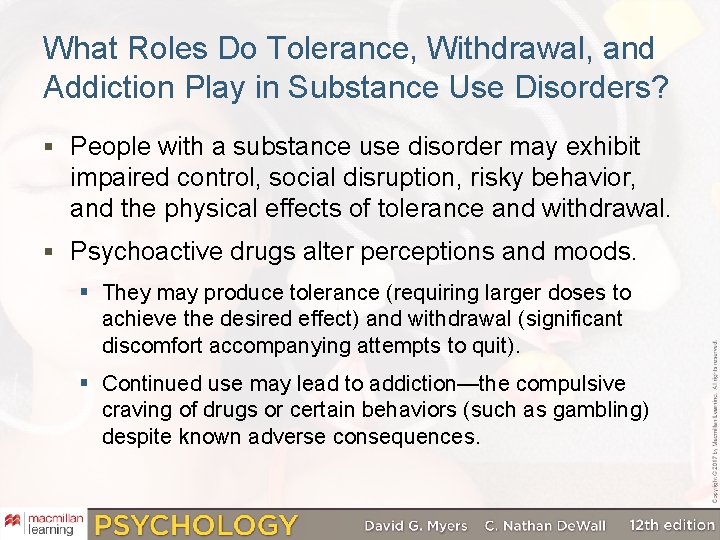
What Roles Do Tolerance, Withdrawal, and Addiction Play in Substance Use Disorders? § People with a substance use disorder may exhibit impaired control, social disruption, risky behavior, and the physical effects of tolerance and withdrawal. § Psychoactive drugs alter perceptions and moods. § They may produce tolerance (requiring larger doses to achieve the desired effect) and withdrawal (significant discomfort accompanying attempts to quit). § Continued use may lead to addiction—the compulsive craving of drugs or certain behaviors (such as gambling) despite known adverse consequences.
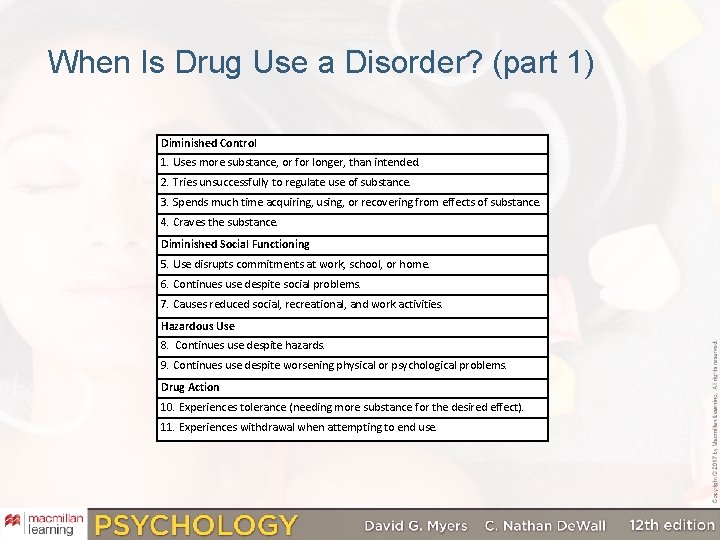
When Is Drug Use a Disorder? (part 1) Diminished Control 1. Uses more substance, or for longer, than intended. 2. Tries unsuccessfully to regulate use of substance. 3. Spends much time acquiring, using, or recovering from effects of substance. 4. Craves the substance. Diminished Social Functioning 5. Use disrupts commitments at work, school, or home. 6. Continues use despite social problems. 7. Causes reduced social, recreational, and work activities. Hazardous Use 8. Continues use despite hazards. 9. Continues use despite worsening physical or psychological problems. Drug Action 10. Experiences tolerance (needing more substance for the desired effect). 11. Experiences withdrawal when attempting to end use.
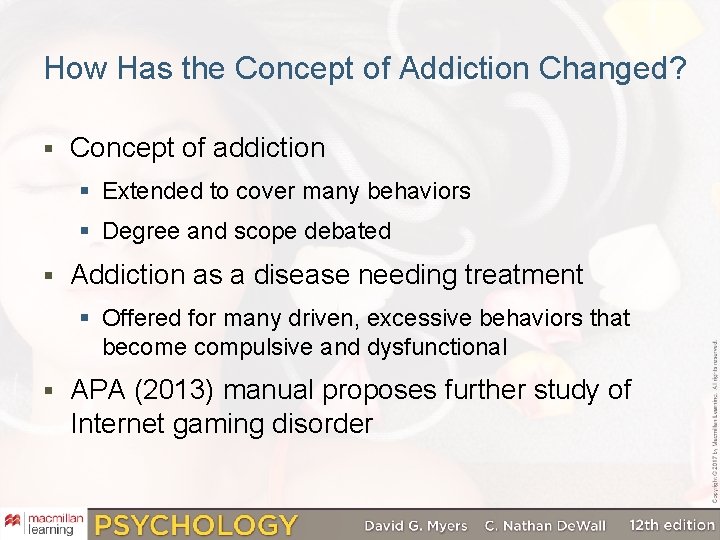
How Has the Concept of Addiction Changed? § Concept of addiction § Extended to cover many behaviors § Degree and scope debated § Addiction as a disease needing treatment § Offered for many driven, excessive behaviors that become compulsive and dysfunctional § APA (2013) manual proposes further study of Internet gaming disorder
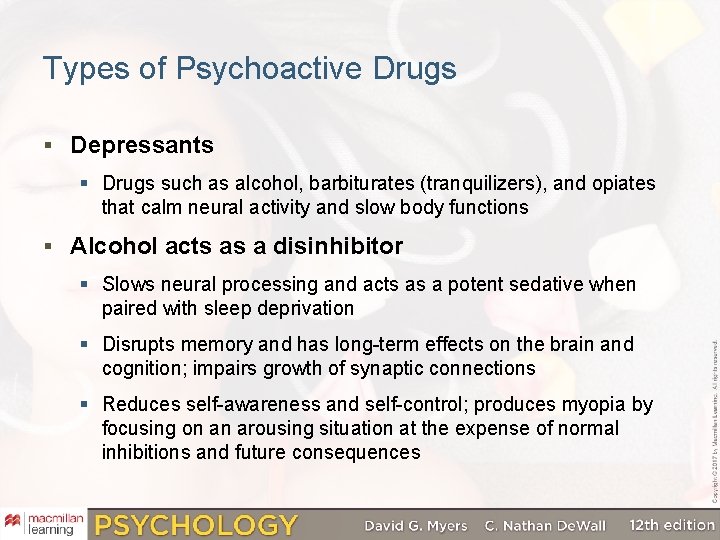
Types of Psychoactive Drugs § Depressants § Drugs such as alcohol, barbiturates (tranquilizers), and opiates that calm neural activity and slow body functions § Alcohol acts as a disinhibitor § Slows neural processing and acts as a potent sedative when paired with sleep deprivation § Disrupts memory and has long-term effects on the brain and cognition; impairs growth of synaptic connections § Reduces self-awareness and self-control; produces myopia by focusing on an arousing situation at the expense of normal inhibitions and future consequences
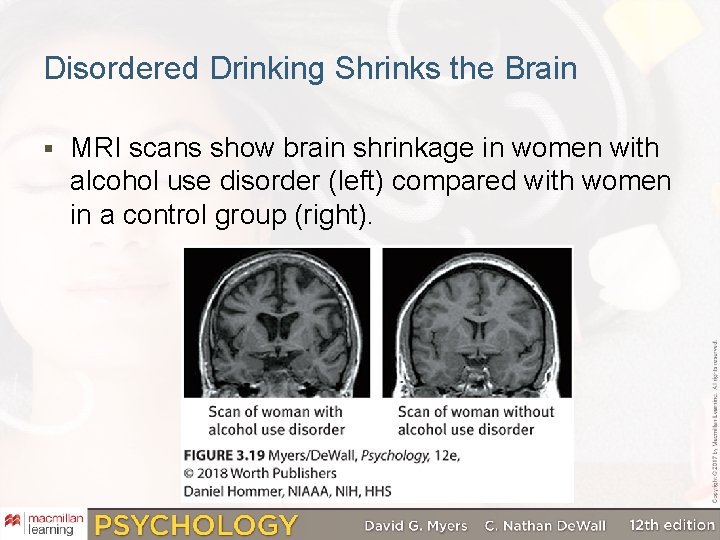
Disordered Drinking Shrinks the Brain § MRI scans show brain shrinkage in women with alcohol use disorder (left) compared with women in a control group (right).
Alcohol Expectancy Effects § Expectations influence behavior § Attribution of social behaviors or sexual responses to alcohol releases inhibitions. § Fourteen intervention studies with college students lowered the participants’ positive expectations of alcohol and reduced drinking in the ensuing month. § Alcohol use disorder § Alcohol use marked by tolerance, withdrawal, and a drive to continue problematic use
Depressants (part 1) § Barbiturates § Depress the activity of the central nervous system, reducing anxiety but impairing memory and judgment § Can impair memory and judgment; potentially lethal when combined with alcohol § Nembutal, Seconal, and Amytal
Depressants (part 2) § Opiates § Include opium and its derivatives, such as codeine, morphine and heroin; addictive § Constrict the pupils, slow breathing, and cause lethargy § Depress neural activity, temporarily lessening pain and anxiety § Cause withdrawal when ingestion is stopped
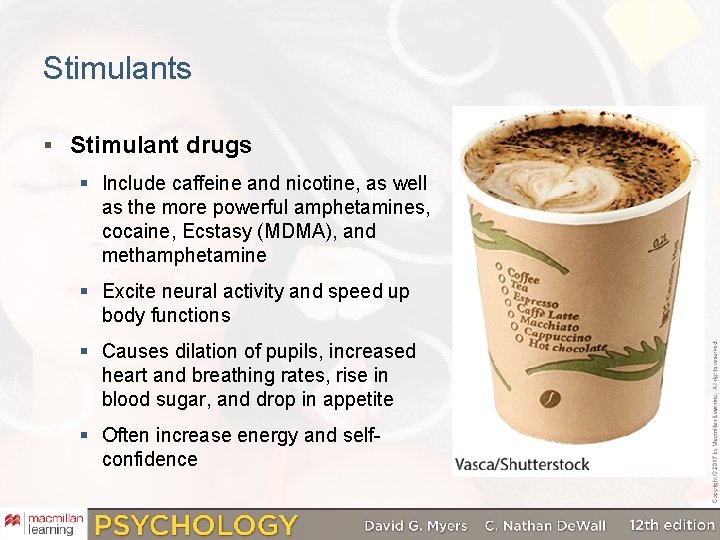
Stimulants § Stimulant drugs § Include caffeine and nicotine, as well as the more powerful amphetamines, cocaine, Ecstasy (MDMA), and methamphetamine § Excite neural activity and speed up body functions § Causes dilation of pupils, increased heart and breathing rates, rise in blood sugar, and drop in appetite § Often increase energy and selfconfidence
Nicotine § The stimulating and highly addictive psychoactive drug in tobacco § Signals the central nervous system to release a flood of neurotransmitters § Diminishes appetite, boosts alertness and mental efficiency, calms anxiety, and reduces sensitivity to pain § Produces challenging acute craving and withdrawal symptoms that contribute to relapse after attempts to quit use
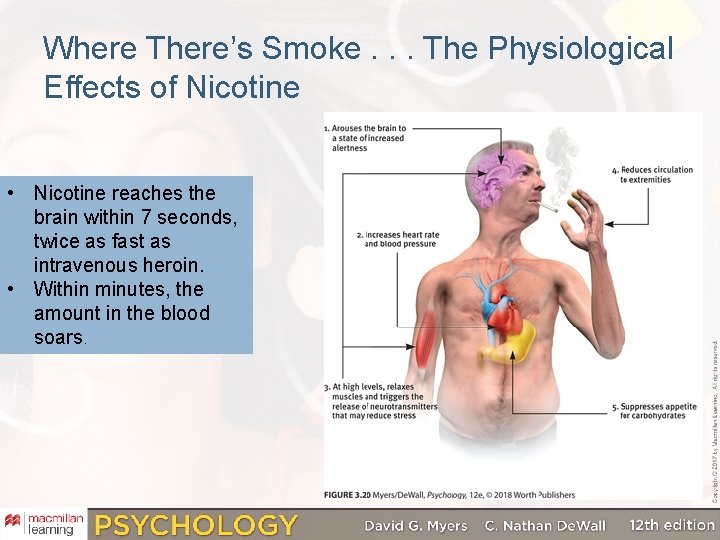
Where There’s Smoke. . . The Physiological Effects of Nicotine • Nicotine reaches the brain within 7 seconds, twice as fast as intravenous heroin. • Within minutes, the amount in the blood soars.
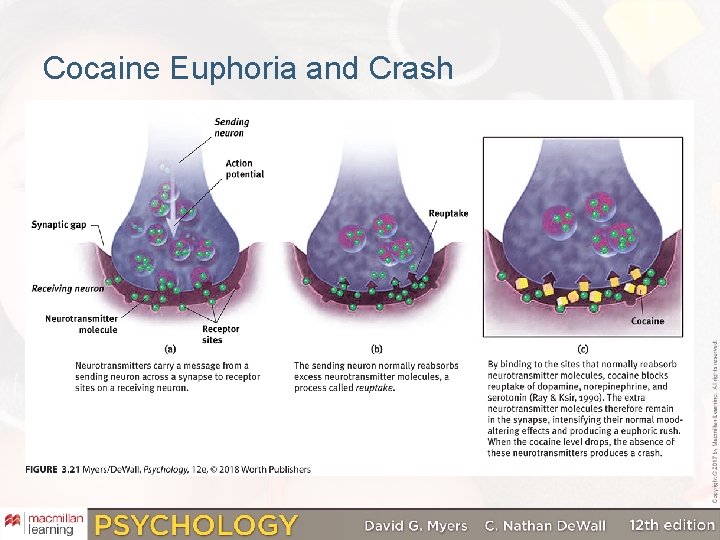
Cocaine § Produces a quick rush of euphoria § A crash of agitated depression occurs within 15 to 30 minutes after neurotransmitter levels drop. § Psychological effects depend on dosage and form consumed and the user’s expectations and personality.
Cocaine Euphoria and Crash
Other Stimulants § Methamphetamine § Psychological effects depend on the dosage and form consumed and the user’s expectations and personality § Powerfully addictive § Ecstasy (MDMA) § Synthetic stimulant and mild hallucinogen § Produces euphoria, but with short-term health risks and longer-term harm to mood and cognition
Hallucinogens § Distort perceptions § Call up sensory images without any input from the senses § Marijuana § Leaves contain THC (delta-9 -tetrahydrocannabinol) § When smoked or eaten, produce increased sensitivity to colors, sounds, tastes, and smells § Lingers in the body § Can relax, disinhibit, impair motor and perceptual skills, and diminish reaction time
Marijuana § According to the U. S. National Academies of Sciences, Engineering, and Medicine (2017), marijuana use: § Alleviates chronic pain and chemotherapy-related nausea § Is not associated with tobacco-related cancers, such as lung cancer § Is predictive of increased risk of traffic accidents, chronic bronchitis, psychosis, social anxiety disorder, and suicidal thoughts § Likely contributes to impaired attention, learning, and memory, and possibly to academic underachievement
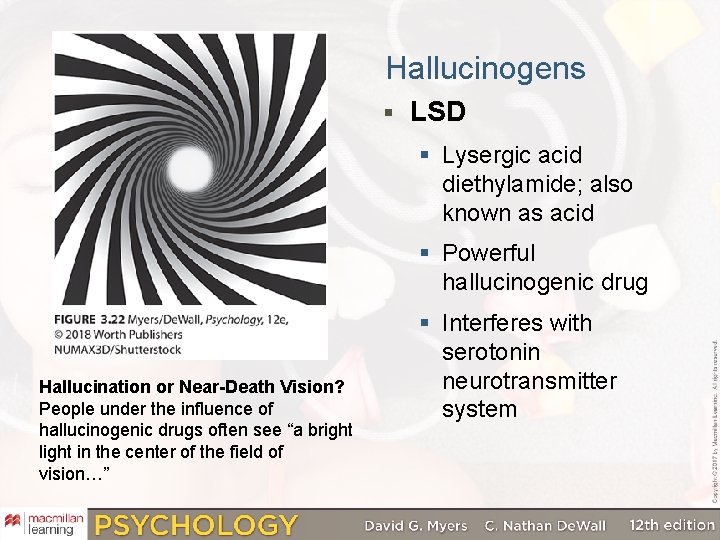
Hallucinogens § LSD § Lysergic acid diethylamide; also known as acid § Powerful hallucinogenic drug Hallucination or Near-Death Vision? People under the influence of hallucinogenic drugs often see “a bright light in the center of the field of vision…” § Interferes with serotonin neurotransmitter system
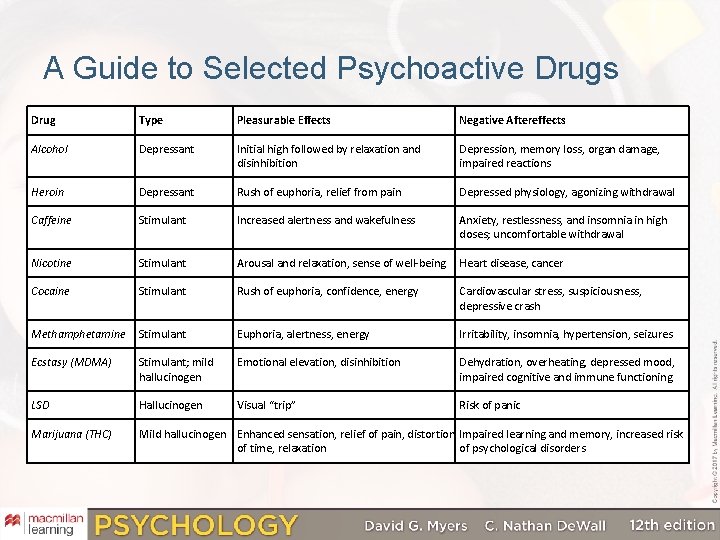
A Guide to Selected Psychoactive Drugs Drug Type Pleasurable Effects Negative Aftereffects Alcohol Depressant Initial high followed by relaxation and disinhibition Depression, memory loss, organ damage, impaired reactions Heroin Depressant Rush of euphoria, relief from pain Depressed physiology, agonizing withdrawal Caffeine Stimulant Increased alertness and wakefulness Anxiety, restlessness, and insomnia in high doses; uncomfortable withdrawal Nicotine Stimulant Arousal and relaxation, sense of well-being Heart disease, cancer Cocaine Stimulant Rush of euphoria, confidence, energy Cardiovascular stress, suspiciousness, depressive crash Methamphetamine Stimulant Euphoria, alertness, energy Irritability, insomnia, hypertension, seizures Ecstasy (MDMA) Stimulant; mild hallucinogen Emotional elevation, disinhibition Dehydration, overheating, depressed mood, impaired cognitive and immune functioning LSD Hallucinogen Visual “trip” Risk of panic Marijuana (THC) Mild hallucinogen Enhanced sensation, relief of pain, distortion Impaired learning and memory, increased risk of time, relaxation of psychological disorders
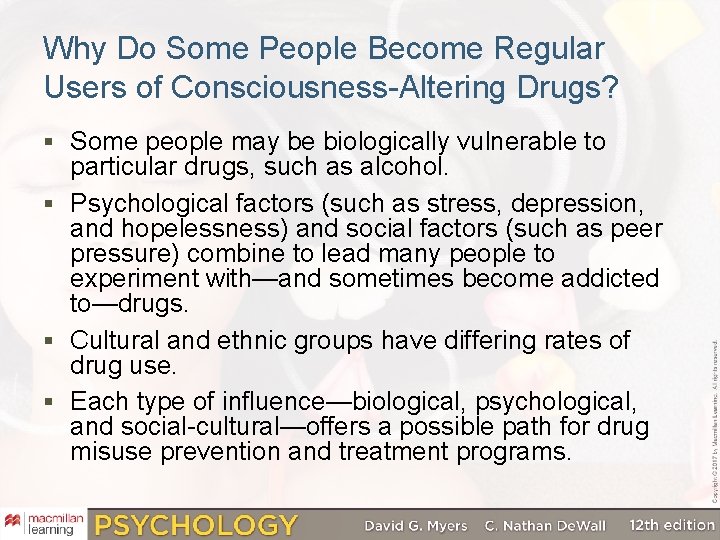
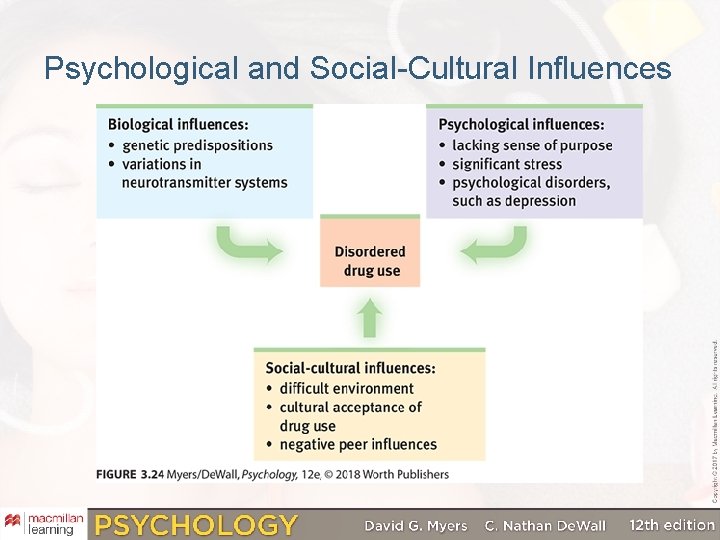
Why Do Some People Become Regular Users of Consciousness-Altering Drugs? § Some people may be biologically vulnerable to particular drugs, such as alcohol. § Psychological factors (such as stress, depression, and hopelessness) and social factors (such as peer pressure) combine to lead many people to experiment with—and sometimes become addicted to—drugs. § Cultural and ethnic groups have differing rates of drug use. § Each type of influence—biological, psychological, and social-cultural—offers a possible path for drug misuse prevention and treatment programs.
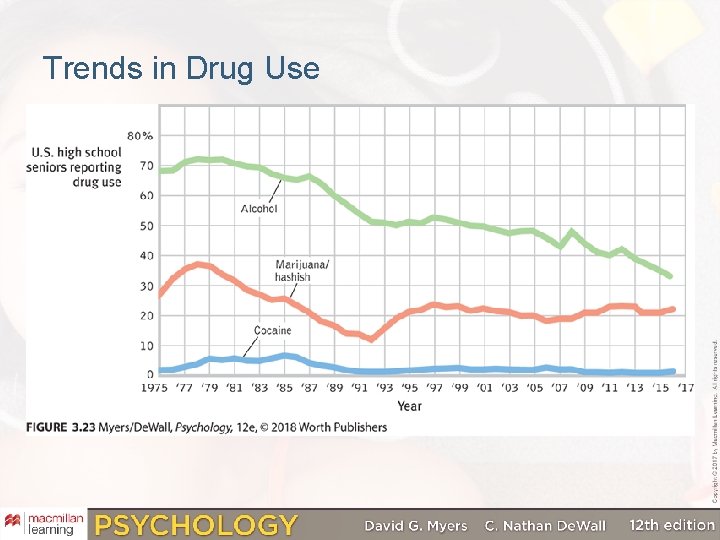
Trends in Drug Use
Psychological and Social-Cultural Influences
Drug Prevention and Treatment Programs § Educate young people about the long-term costs of a drug’s temporary pleasures § Help young people find other ways to boost their self-esteem and purpose in life § Attempt to modify peer associations or to “inoculate” youths against peer pressures by training them in refusal skills