
CHAPTER 3 Complement Acknowledgements n Addis Ababa University
CHAPTER 3 Complement
Acknowledgements n Addis Ababa University n Jimma University n Hawassa University n Haramaya University n University of Gondor n American Society for clinical Pathology n Center for Disease Control and Prevention Ethiopia
Learning objectives Upon completion of this lesson the student will be able to: q Understand different pathways of complement activation q Discuss the biologic properties of C activation products q Describe the significance of Complement system in host resistance, inflammation and damage to cells q Discuss the mechanism of regulating complement activation and its products
Outline 3. 1. Introduction to Complement 3. 2. Complement Activation 3. 2. 1. Classical Pathway of Complement Activation 3. 2. 2. Alternate Pathway of Complement Activation 3. 2. 3. The Lectin Pathway of Complement Activation 3. 3. The Functions of Complement 3. 4. Regulation of the Complement System 3. 5. Laboratory Issues in Complement 3. 6. Complement Disorder
3. 1. Introduction to Complement n Complement component are proteins and glycoproteins, about 5% of serum proteins ¨ Synthesized mainly by liver hepatocytes, blood monocytes, tissue macrophages, plus epithelial cells of the gastrointestinal and genitourinary tracts. n Complement components are designated by ¨ Numerals (C 1–C 9), ¨ Letter symbols (e. g. , factor D), or ¨ Trivial names (e. g. , homologous restriction factor).
Cont… n Peptide fragments formed by activation of a component are denoted by small letters. n These are proteins important in inflammation n Are normally present in the circulation in an inactive state – once activated show enzymatic action on subsequent components and finally target antigen
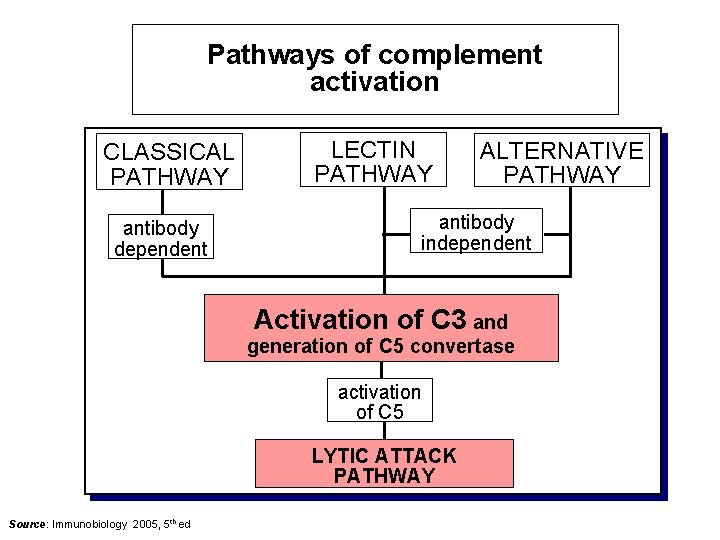
3. 2. Complement Activation n The two major pathways of complement activation are ¨ The classical pathway which is activated by certain isotypes of Abs bound to Ags and ¨ The alternative pathway which is activated on microbial cell surfaces in the absence of antibody. n At least 30 are activated in the classical pathway by antibody

3. 2. 1. Classical Pathway of Complement Activation n n Is initiated by binding complement protein C 1 to antibody (Ig. G or Ig. M) molecules that have attached to foreign antigens. C 1 is composed of 3 parts: C 1 q which binds antibody while C 1 r and C 1 s are proteases. Source: Kuby immunology 2007, 5 th ed
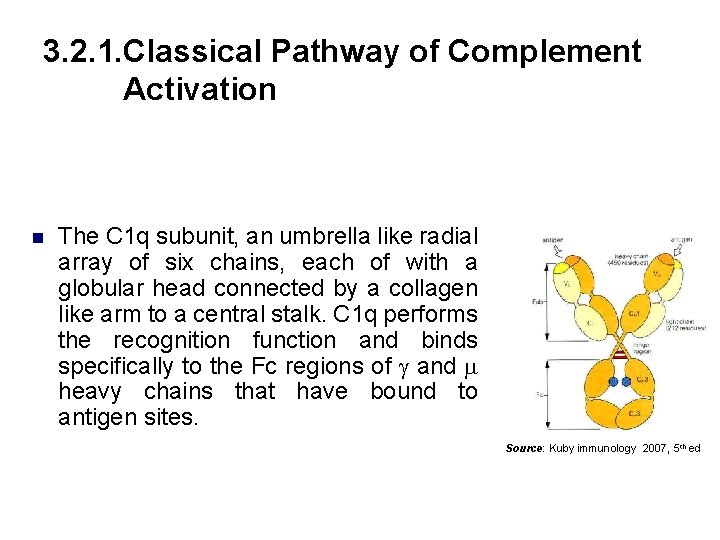
3. 2. 1. Classical Pathway of Complement Activation n The C 1 q subunit, an umbrella like radial array of six chains, each of with a globular head connected by a collagen like arm to a central stalk. C 1 q performs the recognition function and binds specifically to the Fc regions of and heavy chains that have bound to antigen sites. Source: Kuby immunology 2007, 5 th ed
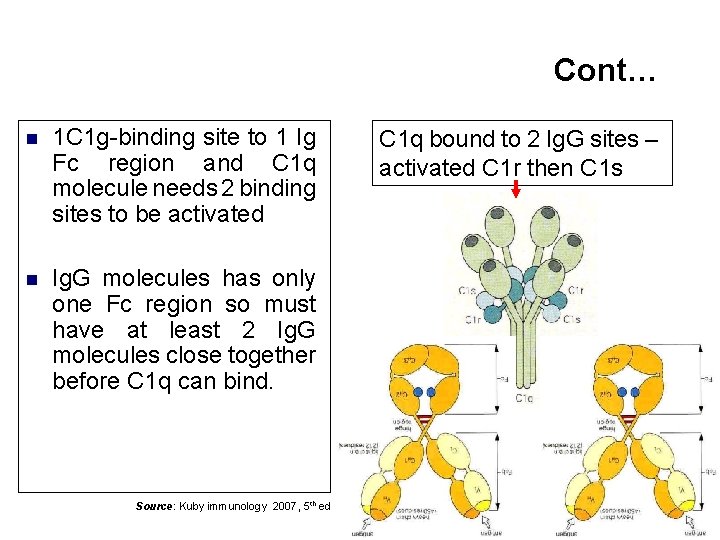
Cont… n 1 C 1 g-binding site to 1 Ig Fc region and C 1 q molecule needs 2 binding sites to be activated n Ig. G molecules has only one Fc region so must have at least 2 Ig. G molecules close together before C 1 q can bind. Source: Kuby immunology 2007, 5 th ed C 1 q bound to 2 Ig. G sites – activated C 1 r then C 1 s
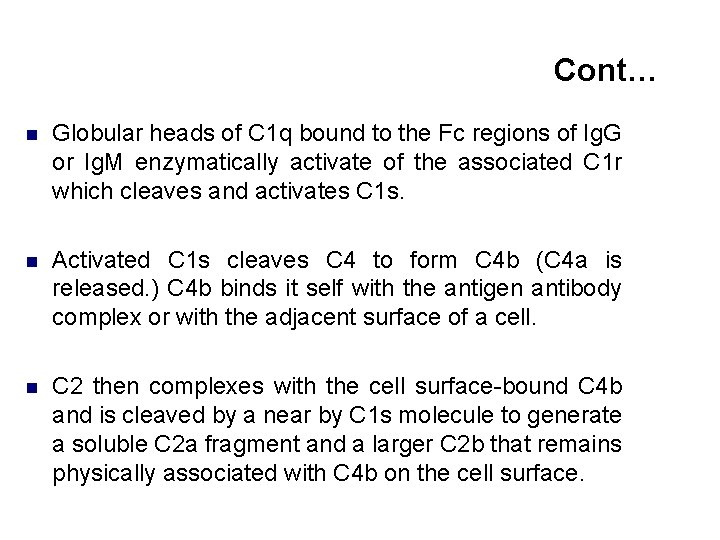
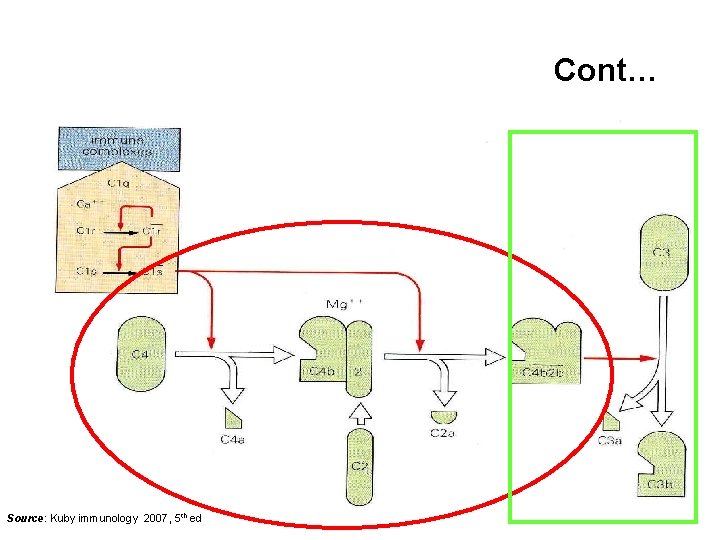
Cont… n Globular heads of C 1 q bound to the Fc regions of Ig. G or Ig. M enzymatically activate of the associated C 1 r which cleaves and activates C 1 s. n Activated C 1 s cleaves C 4 to form C 4 b (C 4 a is released. ) C 4 b binds it self with the antigen antibody complex or with the adjacent surface of a cell. n C 2 then complexes with the cell surface-bound C 4 b and is cleaved by a near by C 1 s molecule to generate a soluble C 2 a fragment and a larger C 2 b that remains physically associated with C 4 b on the cell surface.
Cont… Source: Kuby immunology 2007, 5 th ed
Cont… n n n In the green box on the previous slide, C 4 b 2 b complex, C 3 convertase, is binding to and proteolytically cleaving C 3 ¨ The C 4 b actively binds the C 3 and C 2 b catalyzes proteolysis of the C 3 making it active for the next step. Activation of C 3 b is an critical point of expanding the complement activation Proteolysis of C 3 cleaves ¨ A small C 3 a fragment, ¨ Leaving C 3 b’s that may remain bound with the C 4 b 2 b on the antibody or form covalent bonds with the cells surface near the antigen/antibody complex.
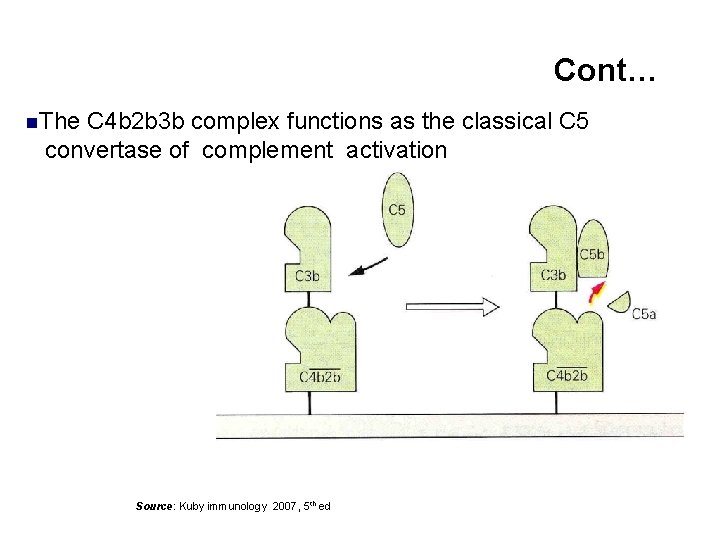
Cont… n. The C 4 b 2 b 3 b complex functions as the classical C 5 convertase of complement activation Source: Kuby immunology 2007, 5 th ed
3. 2. 2. Alternate Pathway of Complement Activation n The alternative pathway activation results in proteolysis of C 3 and stable attachment of its breakdown product C 3 b to microbial surfaces without a role for antibody. ¨ Microbial surfaces (viral, parasite and fungal surface antigens) and lipopolysaccharides can accomplish this. ¨ Normally small amounts of C 3 b are activated in the absence of antigen/antibody reactions or by the alternate pathway.
Cont… n The surface bound C 3 b binds Factor B, a plasma protein n Bound Factor B is cleaved by Factor D, a plasma serine protease to generate a fragment called Bb that remains attached to C 3 b forming C 3 b. Bb (and Ba is released ). ¨ C 3 b. Bb has a short active life (5 min. ) unless stabilized by Properidin, a serum component, – this extends the active life up to 30 minutes. n The C 3 b. Bb complex is the alternative pathway’s C 3 convertase, and it functions to cleave more C 3 molecules amplifying the reaction.
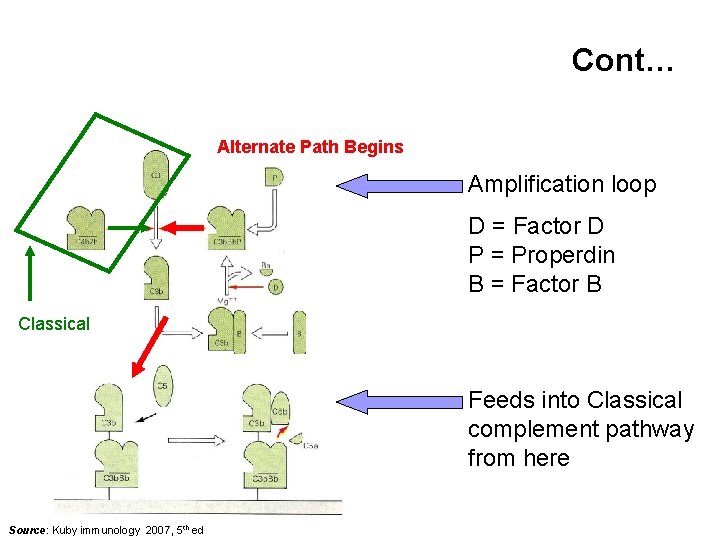
Cont… Alternate Path Begins Amplification loop D = Factor D P = Properdin B = Factor B Classical Feeds into Classical complement pathway from here Source: Kuby immunology 2007, 5 th ed
Cont… n The C 3 convertase activity of C 3 b. Bb generates the C 3 b. Bb 3 b complex, which exhibits C 5 convertase activity, analogous to the C 4 b 2 a 3 b complex in the classical pathway. n The nonenzymatic C 3 b component binds C 5, and the Bb component subsequently hydrolyzes the bound C 5 to generate C 5 a and C 5 b.
3. 2. 3. The Lectin Pathway of Complement Activation n Lectins are proteins that recognize and bind to specific carbohydrate targets. (Because the lectin that activates complement binds to mannose residues, some authors designate this the MBLectin pathway or mannan-binding lectin pathway. ) n The lectin pathway, like the alternative pathway, does not depend on antibody for its activation. n However, the mechanism is more like that of the classical pathway, because after initiation, it proceeds, through the action of C 4 and C 2, to produce a C 5 convertase
Cont… n The lectin pathway is activated by bound mannose-binding lectin (MBL) to mannose residues found on microorganisms including certain Salmonella, Listeria, and Neisseria strains, as well as Cryptococcus neoformans and Candida albicans. n MBL, an acute phase protein, functions in the complement pathway similarly to C 1 q, which it resembles in structure. n After MBL binds to the surface of a cell or pathogen, MBLassociated serine proteases, MASP-1 and MASP-2, bind to MBL.
Cont… n The active MBL/MASP-1/MASP-2 complex cleaves and activates C 4 and C 2. The MASP-1 and -2 proteins, structurally similar to C 1 r and C 1 s, mimic their activities. n This means of activating the C 2–C 4 components to form a C 5 convertase without need for specific antibody binding represents an important innate defense mechanism comparable to the alternative pathway, but utilizing the elements of the classical pathway except for the C 1 proteins.
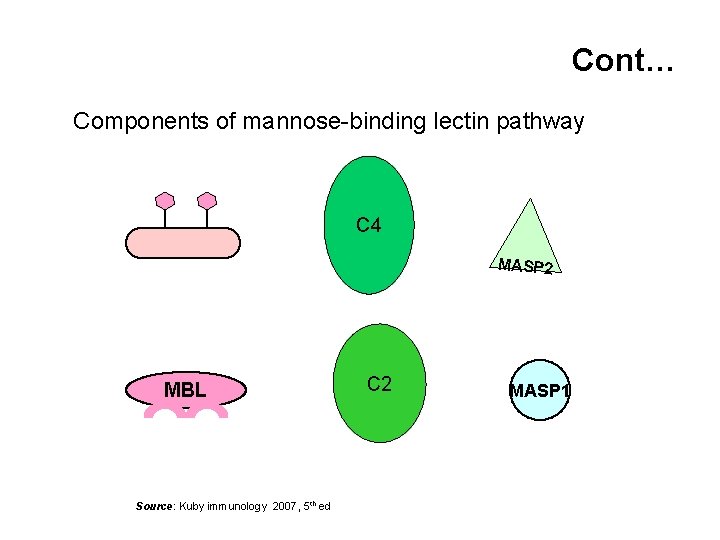
Cont… Components of mannose-binding lectin pathway C 4 MASP 2 MBL Source: Kuby immunology 2007, 5 th ed C 2 MASP 1
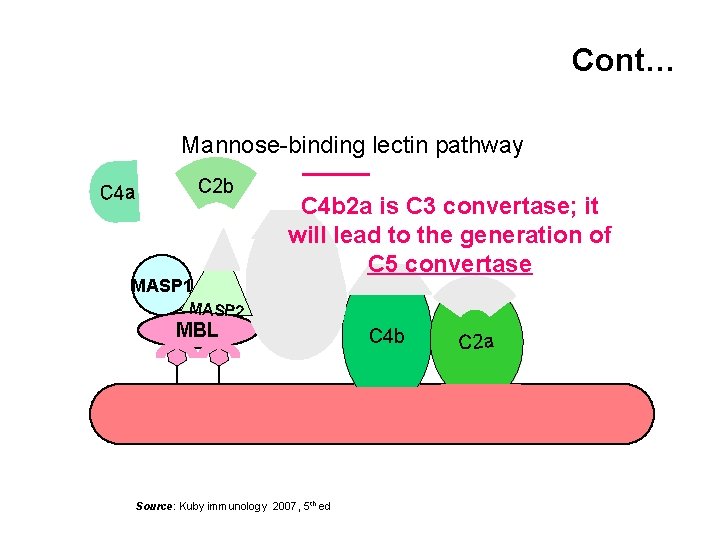
Cont… Mannose-binding lectin pathway _____ C 2 b C 4 a MASP 1 MASP 2 C 4 b 2 a is C 3 convertase; it will lead to the generation of C 5 convertase C 4 b C 4 a 2 CC 2 MBL Source: Kuby immunology 2007, 5 th ed C 4 b C 2 a
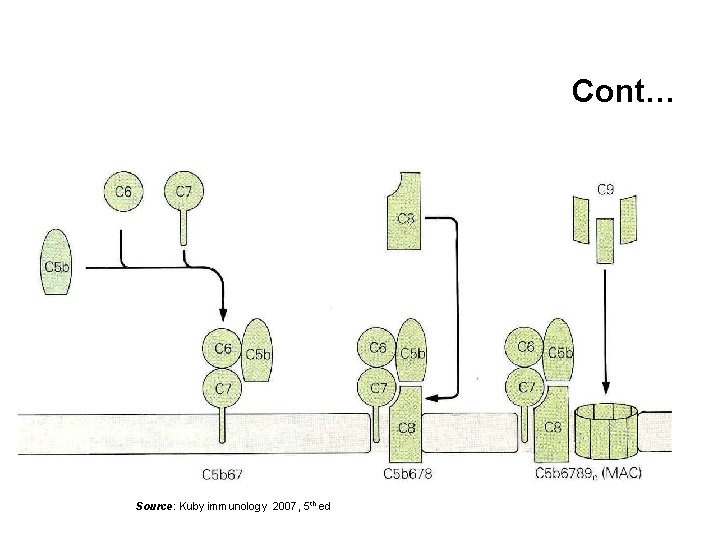
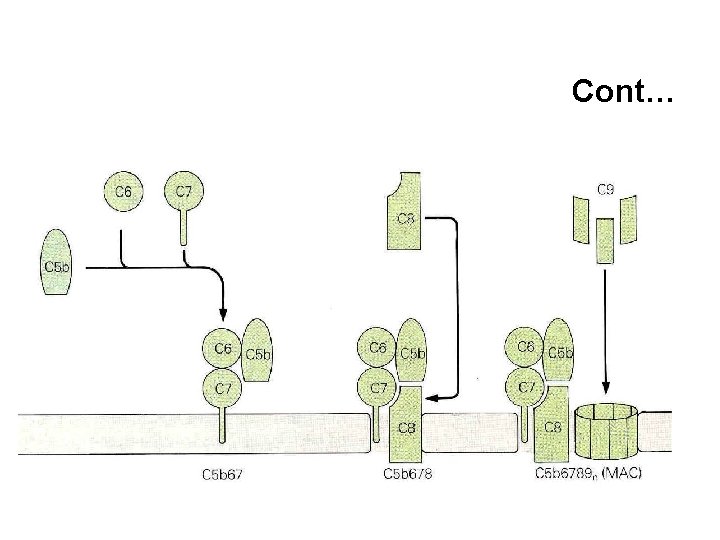
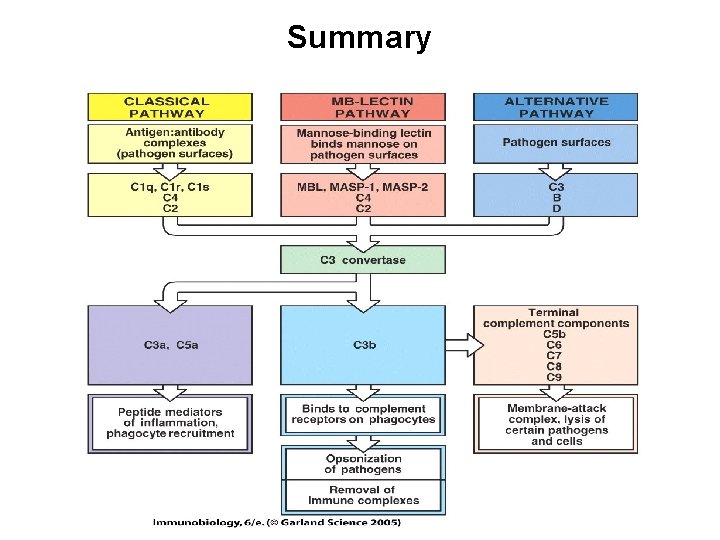
Terminal Sequence Shared by ALL Pathways n The terminal sequence of complement activation involves C 5 b, C 6, C 7, C 8, and C 9, which interact sequentially to form a macromolecular structure called the membrane-attack complex (MAC). n This complex forms a large channel through the membrane of the target cell, enabling ions and small molecules to diffuse freely across the membrane. n The end result of activating the classical, alternative, or lectin pathway
n C 5 convertase cleave C 5 into a small C 5 a fragment that is released and the large C 5 b fragment, which binds to the surface of the target cell and provides a binding site for the subsequent components of the membrane-attack complex n The C 5 b component is extremely labile and becomes inactive within 2 minutes unless C 6 binds to it and stabilizes its activity. n C 6, C 7, C 8, and C 9, are structurally related proteins with out enzymatic activity. n As C 5 b 6 binds to C 7, the resulting complex undergoes a hydrophilic-amphiphilic structural transition that exposes hydrophobic regions, which serve as binding sites for membrane phospholipids.
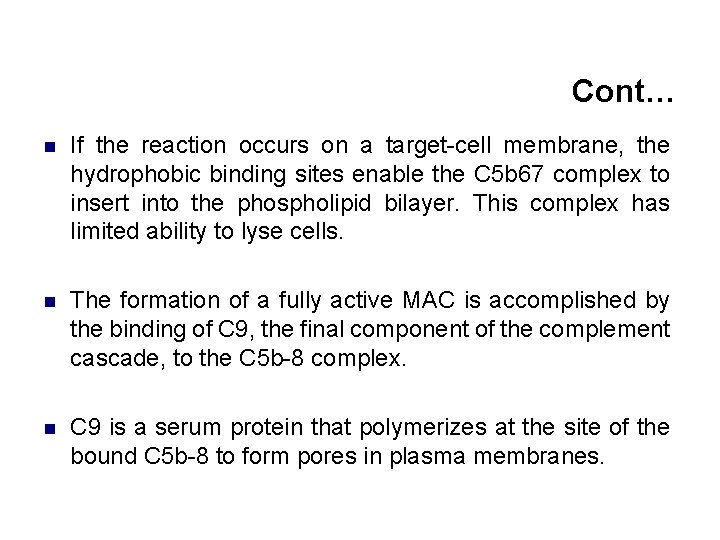
Cont… n If the reaction occurs on a target-cell membrane, the hydrophobic binding sites enable the C 5 b 67 complex to insert into the phospholipid bilayer. This complex has limited ability to lyse cells. n The formation of a fully active MAC is accomplished by the binding of C 9, the final component of the complement cascade, to the C 5 b-8 complex. n C 9 is a serum protein that polymerizes at the site of the bound C 5 b-8 to form pores in plasma membranes.
Cont… Source: Kuby immunology 2007, 5 th ed
Cont…
Pathways of complement activation CLASSICAL PATHWAY antibody dependent LECTIN PATHWAY ALTERNATIVE PATHWAY antibody independent Activation of C 3 and generation of C 5 convertase activation of C 5 LYTIC ATTACK PATHWAY Source: Immunobiology 2005, 5 th ed

Overview of Complement cascade
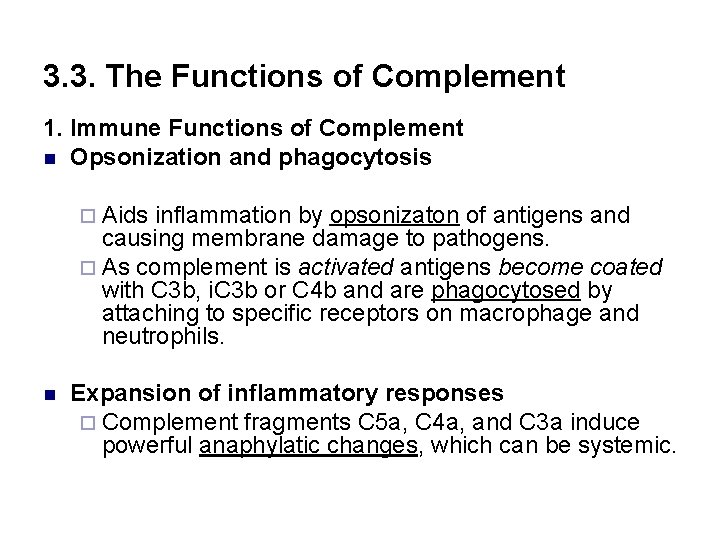
3. 3. The Functions of Complement 1. Immune Functions of Complement n Opsonization and phagocytosis ¨ Aids inflammation by opsonizaton of antigens and causing membrane damage to pathogens. ¨ As complement is activated antigens become coated with C 3 b, i. C 3 b or C 4 b and are phagocytosed by attaching to specific receptors on macrophage and neutrophils. n Expansion of inflammatory responses ¨ Complement fragments C 5 a, C 4 a, and C 3 a induce powerful anaphylatic changes, which can be systemic.

Cont… n Complement- mediated cytolysis ¨ Membrane Attack Complex (MAC) permits complement-mediated lysis of foreign organism. This appears to be a important defense against only a few types of microbes such as Nisseria because genetic defects in MAC components do not reduce desruction of other pathogens
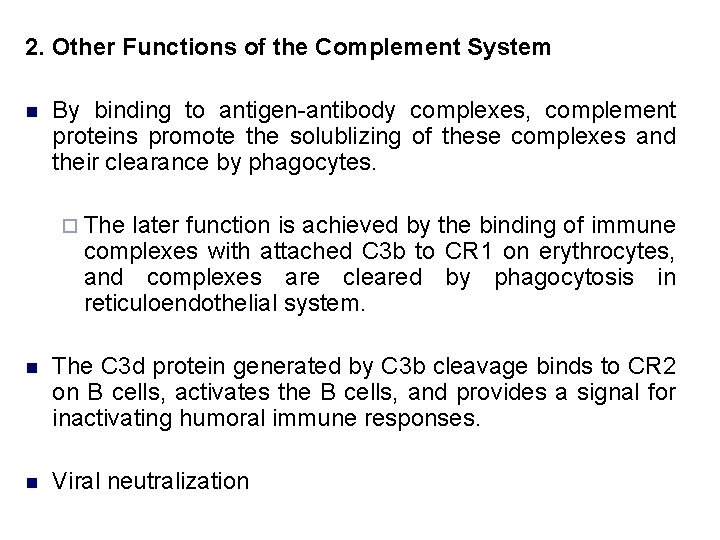
2. Other Functions of the Complement System n By binding to antigen-antibody complexes, complement proteins promote the solublizing of these complexes and their clearance by phagocytes. ¨ The later function is achieved by the binding of immune complexes with attached C 3 b to CR 1 on erythrocytes, and complexes are cleared by phagocytosis in reticuloendothelial system. n The C 3 d protein generated by C 3 b cleavage binds to CR 2 on B cells, activates the B cells, and provides a signal for inactivating humoral immune responses. n Viral neutralization
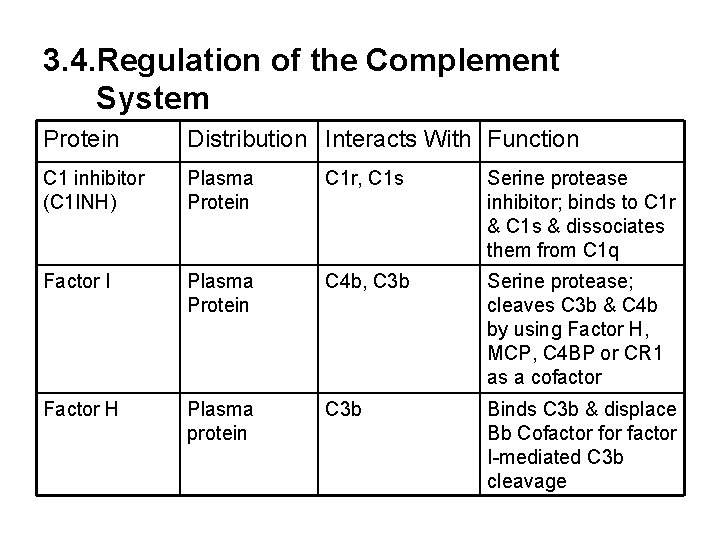
3. 4. Regulation of the Complement System Protein Distribution Interacts With Function C 1 inhibitor (C 1 INH) Plasma Protein C 1 r, C 1 s Serine protease inhibitor; binds to C 1 r & C 1 s & dissociates them from C 1 q Factor I Plasma Protein C 4 b, C 3 b Serine protease; cleaves C 3 b & C 4 b by using Factor H, MCP, C 4 BP or CR 1 as a cofactor Factor H Plasma protein C 3 b Binds C 3 b & displace Bb Cofactor I-mediated C 3 b cleavage
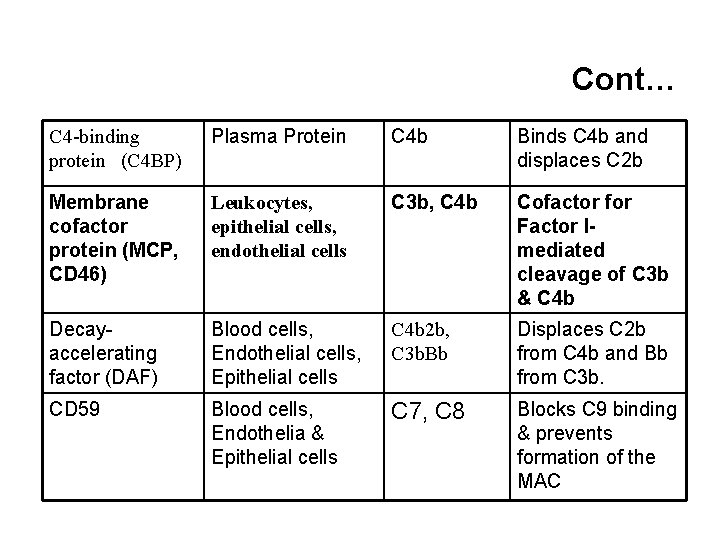
Cont… C 4 -binding protein (C 4 BP) Plasma Protein C 4 b Binds C 4 b and displaces C 2 b Membrane cofactor protein (MCP, CD 46) Leukocytes, epithelial cells, endothelial cells C 3 b, C 4 b Cofactor for Factor Imediated cleavage of C 3 b & C 4 b Decayaccelerating factor (DAF) Blood cells, Endothelial cells, Epithelial cells C 4 b 2 b, C 3 b. Bb Displaces C 2 b from C 4 b and Bb from C 3 b. CD 59 Blood cells, Endothelia & Epithelial cells C 7, C 8 Blocks C 9 binding & prevents formation of the MAC
3. 5. Laboratory Issues in Complement n Why measure? ¨ Complement over utilization (decreases) n Infection (bacterial, etc) n Autoimmune (indication of flare or active disease) n Long list ¨ Complement increases n Acute phase proteins n Any disease associated with increase in acute phase proteins (ie. Rheumatoid Arthritis, Diabetes, ulcerative colitis)
cont… n n Complement deficiencies (rare) What to measure? ¨ CH 50 (Hemolytic complement Assay) n Good screen for clinically relevant levels ¨ Decreased levels/Function ¨ All parameters taken into account n Assay description - cautions (labile protein)
cont… ¨ C 3, C 4 Quantitative Measurements n Classical vs Alternative pathway indication ¨ C 3 common to both, C 4 only Classical n Highest serum conc. - easy to measure n Follow disease course - sensitive ¨ Other components n Rarely C 2, C 1 q inh quantitative & functional n C 5 -9 Extremely rare
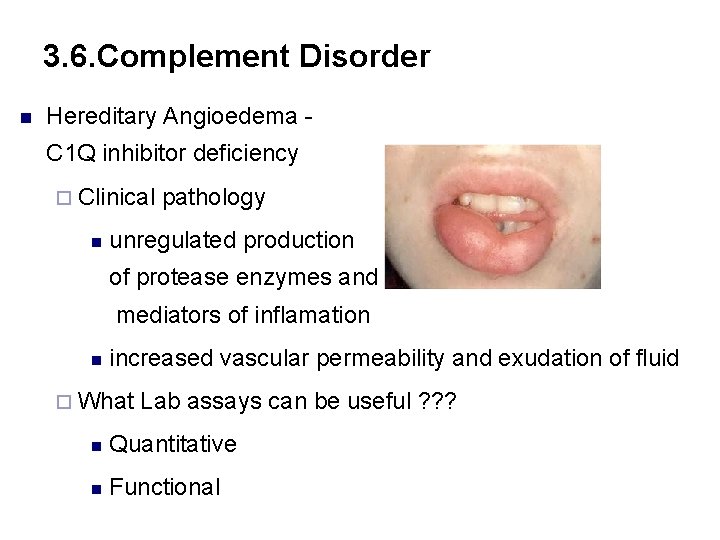
3. 6. Complement Disorder n Hereditary Angioedema C 1 Q inhibitor deficiency ¨ Clinical n pathology unregulated production of protease enzymes and mediators of inflamation n increased vascular permeability and exudation of fluid ¨ What Lab assays can be useful ? ? ? n Quantitative n Functional
Summary
Cont… n The complement system comprises a group of serum proteins, many of which exist in inactive forms. n key role complement in cell lysis, the complement system mediates opsonization of bacteria, activation of inflammation, and clearance of immune complexes n Clinical consequences of inherited complement deficiencies range from increases in susceptibility to infection to tissue damage caused by immune complexes.
Review Questions 1. Explain different pathways of complement activation 2. Discuss the functions of complement 3. Discuss the mechanism of regulating complement activation 4. What is the disorders caused due to deficiency of complement
Reference 1. Kuby; Goldsby et. al. Immunology. 2007 (5 th ed) 2. Tizard. Immunology an introduction, 4 th edition , Saunders publishing, 1994 3. Naville J. Bryant Laboratory Immunology and Serology 3 rd edition. Serological services Ltd. Toronto, Ontario, Canada, 1992 4. Abul K. Abbas and Andrew H. Lichtman. Cellular And Molecular Immunology 2008, 5 th edition 5. Mary T. Keogan, Eleanor M. Wallace and Paula O’Leary Concise clinical immunology for health professionals , 2006 6. Ivan M. Roitt and Peter J. Delves Essential immunology 2001, 3 rd ed 7. Reginald Gorczynski and Jacqueline Stanley, Clinical immunology 1990.
- Slides: 43