
Chapter 3 Classic Theories of Economic Growth and

- Slides: 30
Chapter 3 Classic Theories of Economic Growth and Development Copyright © 2009 Pearson Addison-Wesley. All rights reserved.
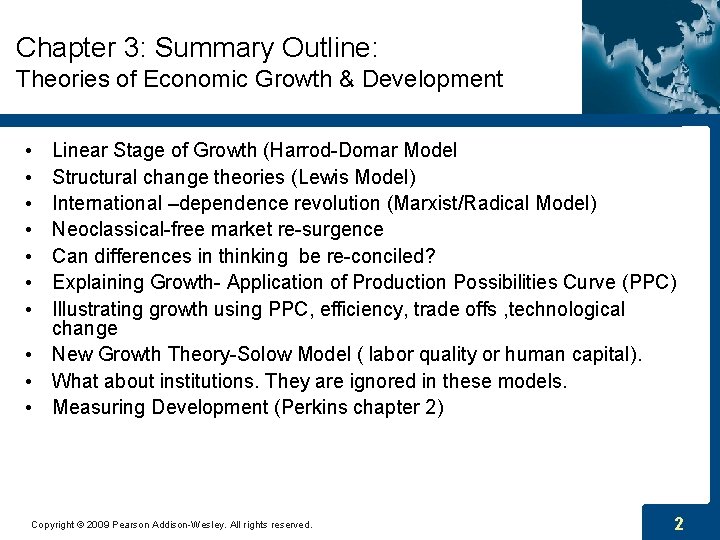
Chapter 3: Summary Outline: Theories of Economic Growth & Development • • Linear Stage of Growth (Harrod-Domar Model Structural change theories (Lewis Model) International –dependence revolution (Marxist/Radical Model) Neoclassical-free market re-surgence Can differences in thinking be re-conciled? Explaining Growth- Application of Production Possibilities Curve (PPC) Illustrating growth using PPC, efficiency, trade offs , technological change • New Growth Theory-Solow Model ( labor quality or human capital). • What about institutions. They are ignored in these models. • Measuring Development (Perkins chapter 2) Copyright © 2009 Pearson Addison-Wesley. All rights reserved. 2
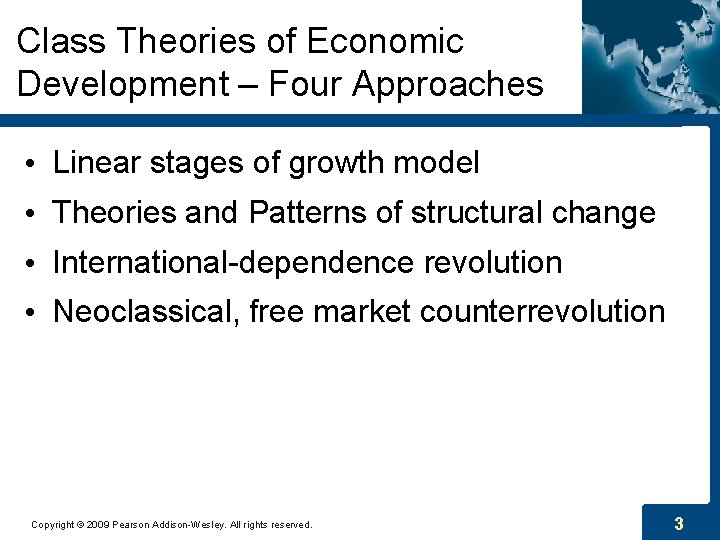
Class Theories of Economic Development – Four Approaches • Linear stages of growth model • Theories and Patterns of structural change • International-dependence revolution • Neoclassical, free market counterrevolution Copyright © 2009 Pearson Addison-Wesley. All rights reserved. 3
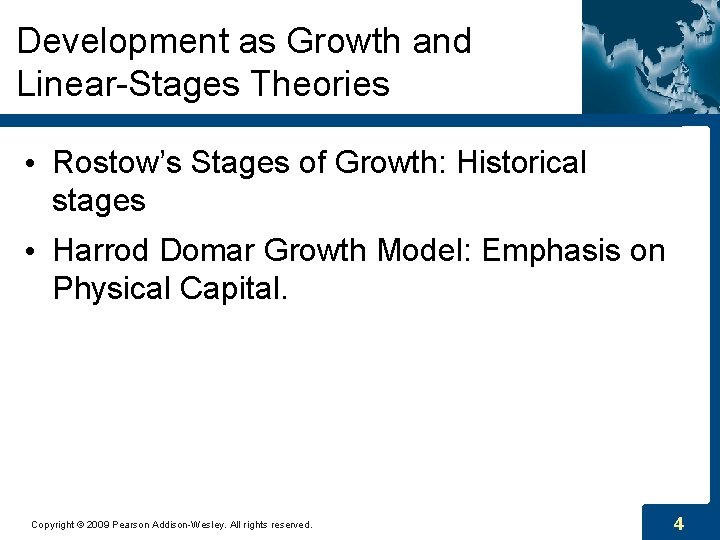
Development as Growth and Linear-Stages Theories • Rostow’s Stages of Growth: Historical stages • Harrod Domar Growth Model: Emphasis on Physical Capital. Copyright © 2009 Pearson Addison-Wesley. All rights reserved. 4
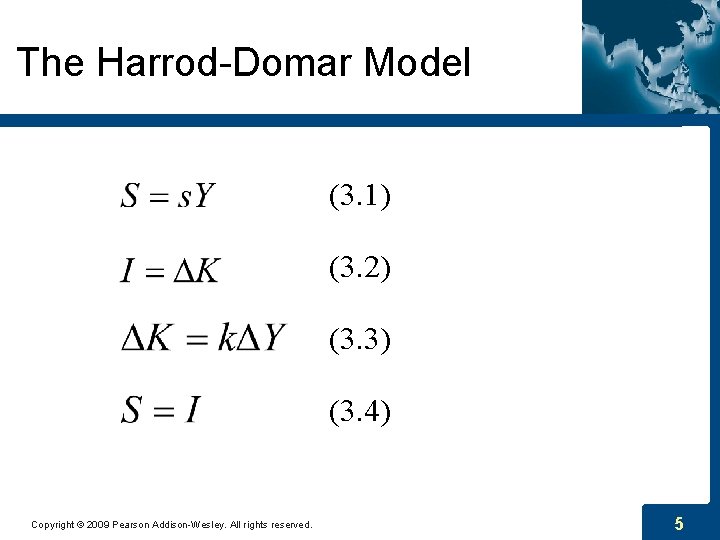
The Harrod-Domar Model (3. 1) (3. 2) (3. 3) (3. 4) Copyright © 2009 Pearson Addison-Wesley. All rights reserved. 5
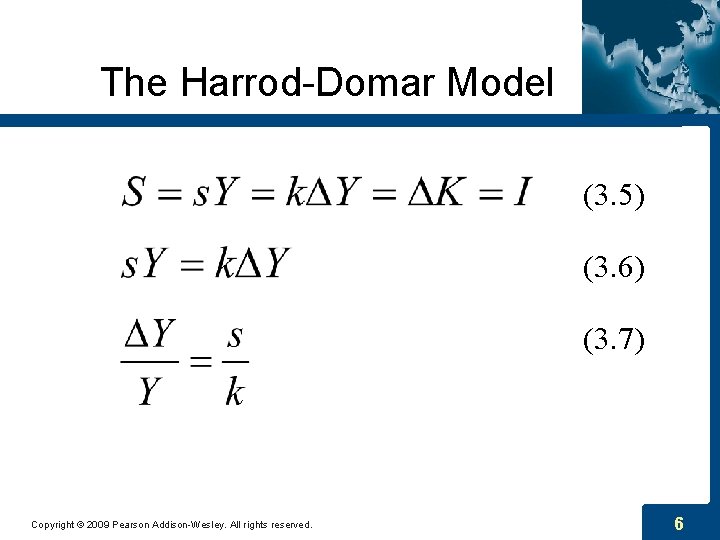
The Harrod-Domar Model (3. 5) (3. 6) (3. 7) Copyright © 2009 Pearson Addison-Wesley. All rights reserved. 6
Criticisms of the Stages Model • Necessary versus sufficient conditions Copyright © 2009 Pearson Addison-Wesley. All rights reserved. 7
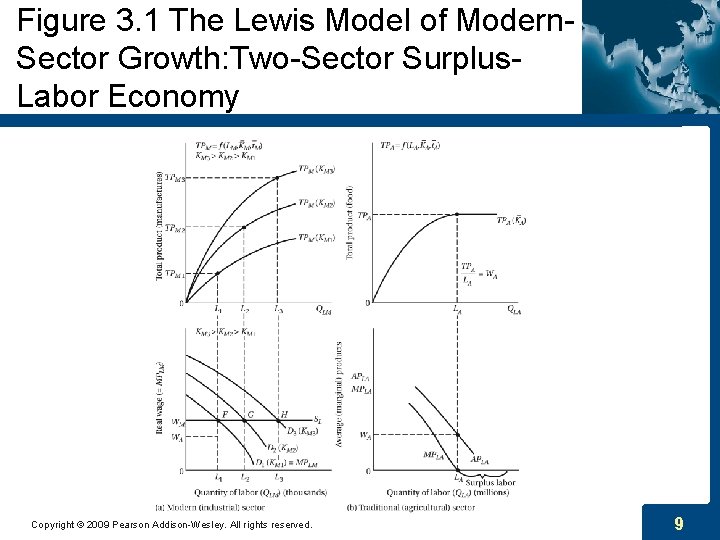
Structural-Change Models • The Lewis two-sector model • Modern and traditional sector Copyright © 2009 Pearson Addison-Wesley. All rights reserved. 8
Figure 3. 1 The Lewis Model of Modern. Sector Growth: Two-Sector Surplus. Labor Economy Copyright © 2009 Pearson Addison-Wesley. All rights reserved. 9
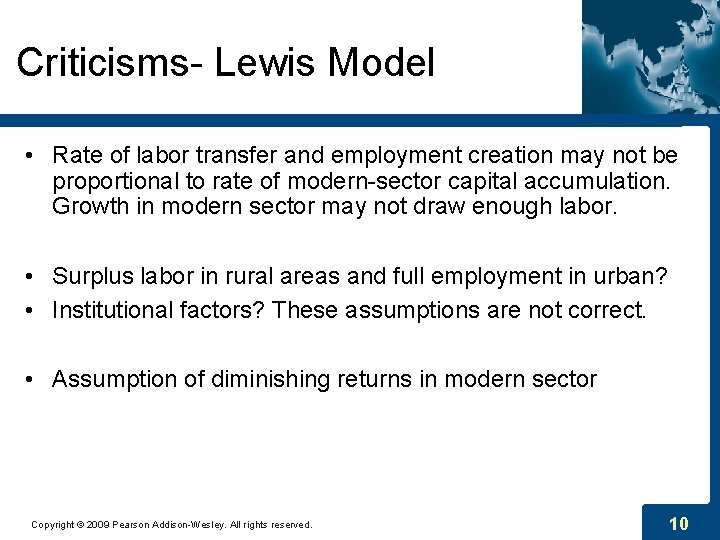
Criticisms- Lewis Model • Rate of labor transfer and employment creation may not be proportional to rate of modern-sector capital accumulation. Growth in modern sector may not draw enough labor. • Surplus labor in rural areas and full employment in urban? • Institutional factors? These assumptions are not correct. • Assumption of diminishing returns in modern sector Copyright © 2009 Pearson Addison-Wesley. All rights reserved. 10
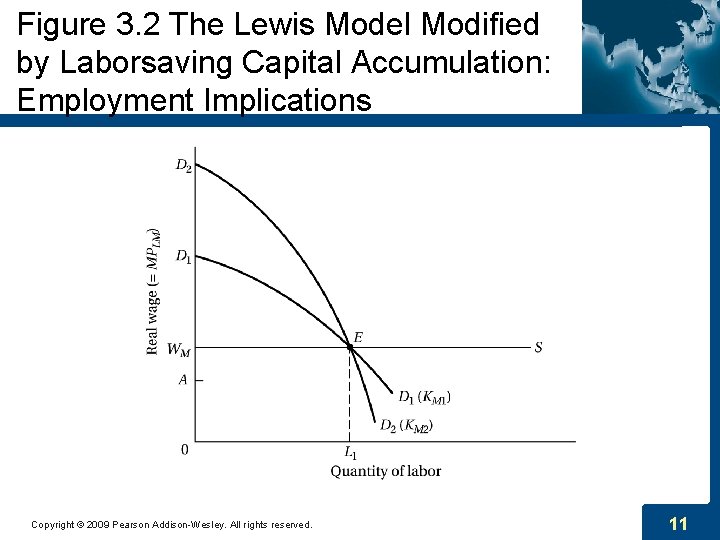
Figure 3. 2 The Lewis Model Modified by Laborsaving Capital Accumulation: Employment Implications Copyright © 2009 Pearson Addison-Wesley. All rights reserved. 11
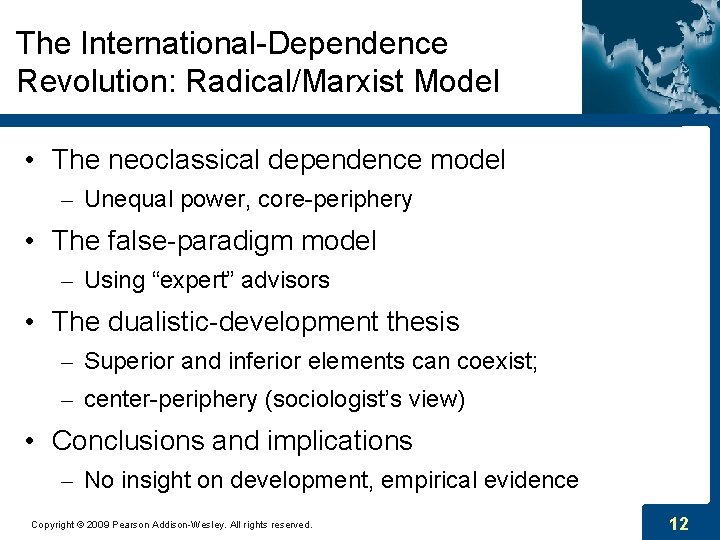
The International-Dependence Revolution: Radical/Marxist Model • The neoclassical dependence model – Unequal power, core-periphery • The false-paradigm model – Using “expert” advisors • The dualistic-development thesis – Superior and inferior elements can coexist; – center-periphery (sociologist’s view) • Conclusions and implications – No insight on development, empirical evidence Copyright © 2009 Pearson Addison-Wesley. All rights reserved. 12
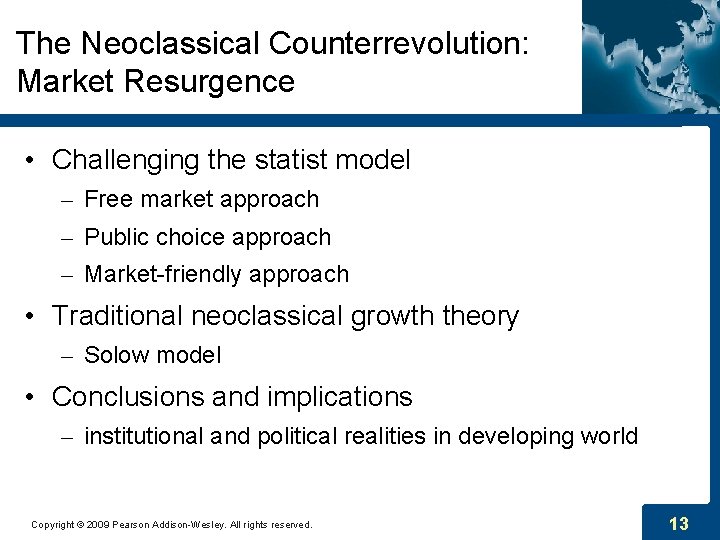
The Neoclassical Counterrevolution: Market Resurgence • Challenging the statist model – Free market approach – Public choice approach – Market-friendly approach • Traditional neoclassical growth theory – Solow model • Conclusions and implications – institutional and political realities in developing world Copyright © 2009 Pearson Addison-Wesley. All rights reserved. 13
Theories of Development: Reconciling the Differences • Development economics has no universally accepted paradigm? But everything does not go? • Insights and understandings are continually evolving: Lessons from experience & history • Each theory has some strengths and some weaknesses: • But there are better theories tested with reality of evidence and experience Copyright © 2009 Pearson Addison-Wesley. All rights reserved. 14
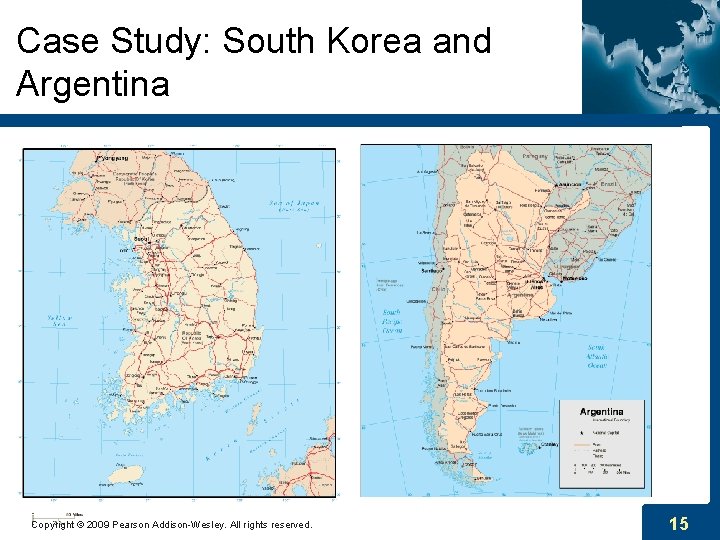
Case Study: South Korea and Argentina Copyright © 2009 Pearson Addison-Wesley. All rights reserved. 15
Concepts for Review • Autarky • Dominance • Average product • Dualism • Capital-labor ratio • Capital-output ratio • Center • False-paradigm model • Free market • Closed economy • Free-market analysis • Comprador groups • Harrod-Domar growth • Dependence model Copyright © 2009 Pearson Addison-Wesley. All rights reserved. 16
Concepts for Review (cont’d) • Lewis two-sector model • Neocolonial dependence model • Marginal product • New institutionalism • Market-friendly approach • New political economy approach • Necessary condition • Open economy • Neoclassical counterrevolution • Patterns-of Development analysis Copyright © 2009 Pearson Addison-Wesley. All rights reserved. 17
Concepts for Review (cont’d) • Periphery • Production function • Public choice theory • Savings ratio • Self-sustaining growth • Solow neoclassical growth model Copyright © 2009 Pearson Addison-Wesley. All rights reserved. • Stages-of-growth model of development • Structural-change theory • Structural transformation • Sufficient condition • Surplus labor 18
Concepts for Review (cont’d) • Traditional neoclassical growth theory • Underdevelopment Copyright © 2009 Pearson Addison-Wesley. All rights reserved. 19
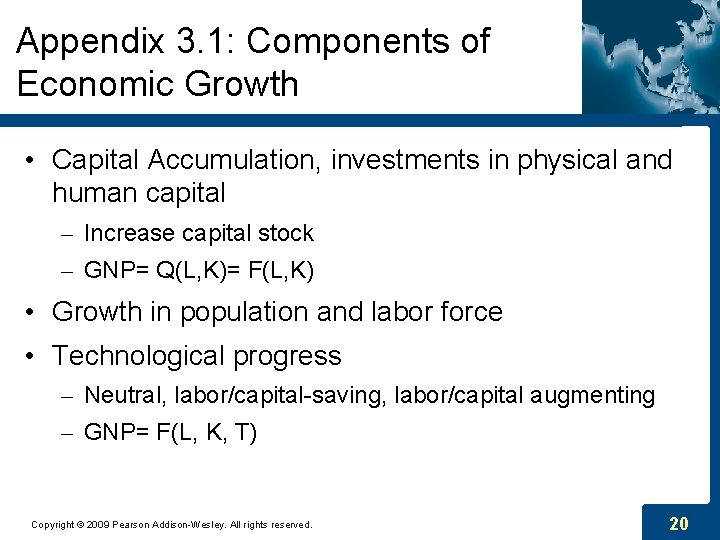
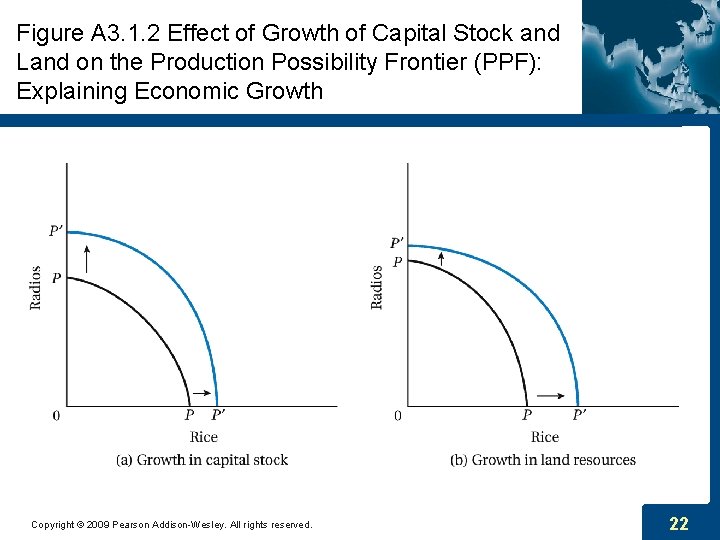
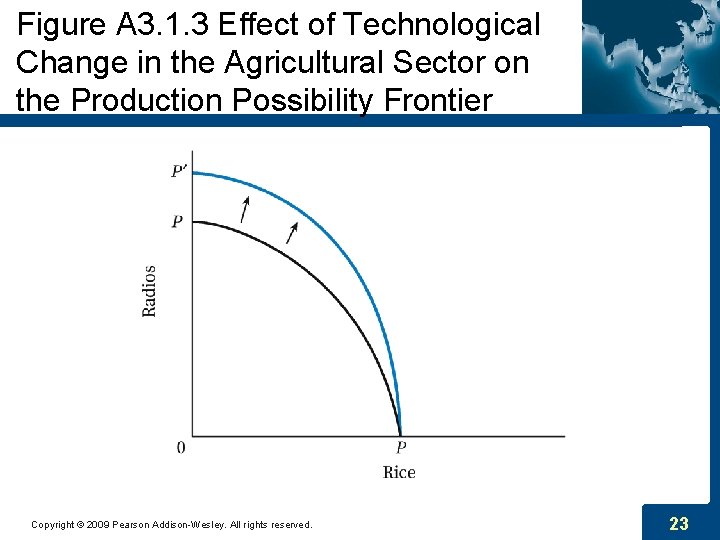
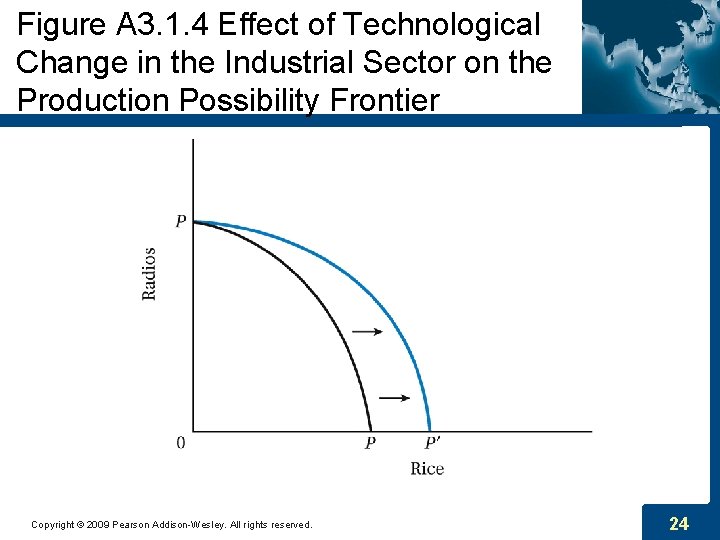
Appendix 3. 1: Components of Economic Growth • Capital Accumulation, investments in physical and human capital – Increase capital stock – GNP= Q(L, K)= F(L, K) • Growth in population and labor force • Technological progress – Neutral, labor/capital-saving, labor/capital augmenting – GNP= F(L, K, T) Copyright © 2009 Pearson Addison-Wesley. All rights reserved. 20
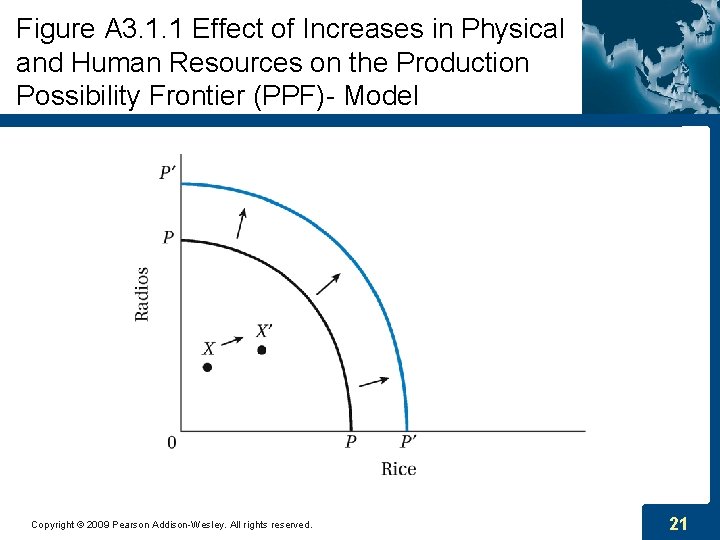
Figure A 3. 1. 1 Effect of Increases in Physical and Human Resources on the Production Possibility Frontier (PPF)- Model Copyright © 2009 Pearson Addison-Wesley. All rights reserved. 21
Figure A 3. 1. 2 Effect of Growth of Capital Stock and Land on the Production Possibility Frontier (PPF): Explaining Economic Growth Copyright © 2009 Pearson Addison-Wesley. All rights reserved. 22
Figure A 3. 1. 3 Effect of Technological Change in the Agricultural Sector on the Production Possibility Frontier Copyright © 2009 Pearson Addison-Wesley. All rights reserved. 23
Figure A 3. 1. 4 Effect of Technological Change in the Industrial Sector on the Production Possibility Frontier Copyright © 2009 Pearson Addison-Wesley. All rights reserved. 24
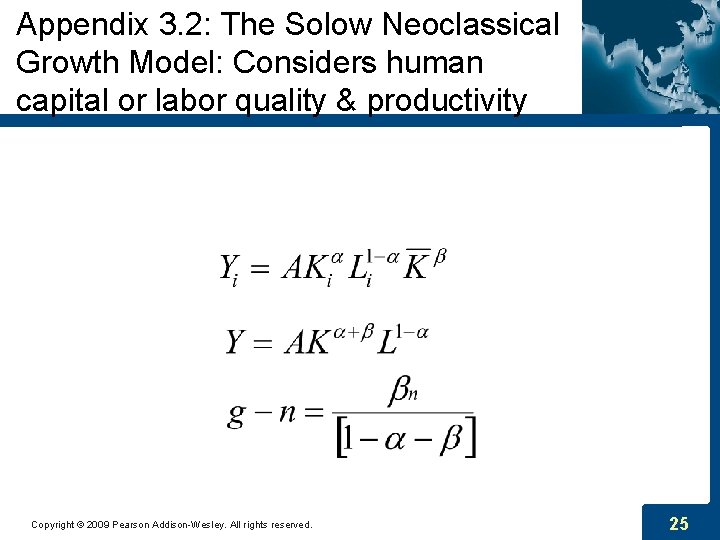
Appendix 3. 2: The Solow Neoclassical Growth Model: Considers human capital or labor quality & productivity Copyright © 2009 Pearson Addison-Wesley. All rights reserved. 25
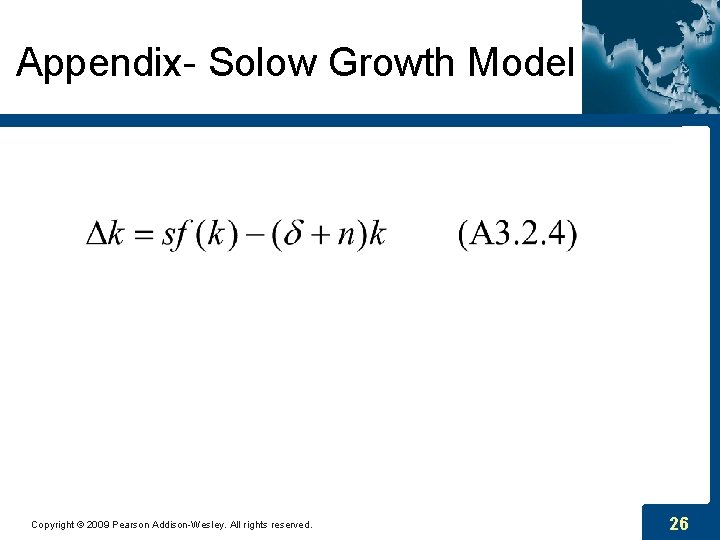
Appendix- Solow Growth Model Copyright © 2009 Pearson Addison-Wesley. All rights reserved. 26
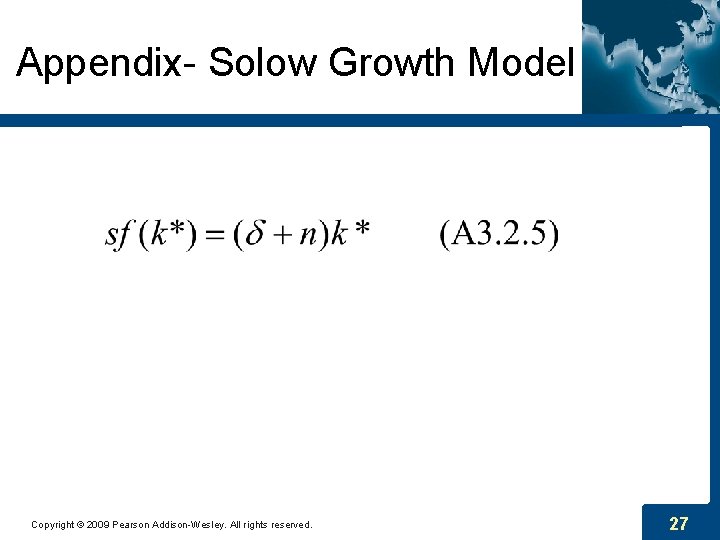
Appendix- Solow Growth Model Copyright © 2009 Pearson Addison-Wesley. All rights reserved. 27
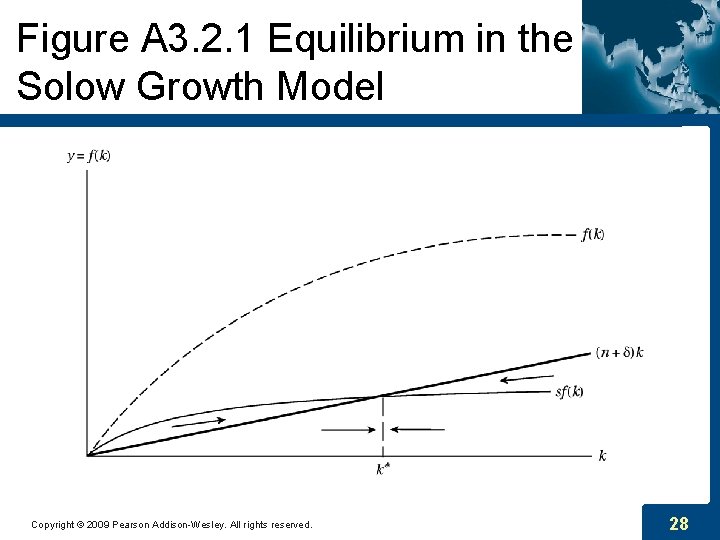
Figure A 3. 2. 1 Equilibrium in the Solow Growth Model Copyright © 2009 Pearson Addison-Wesley. All rights reserved. 28
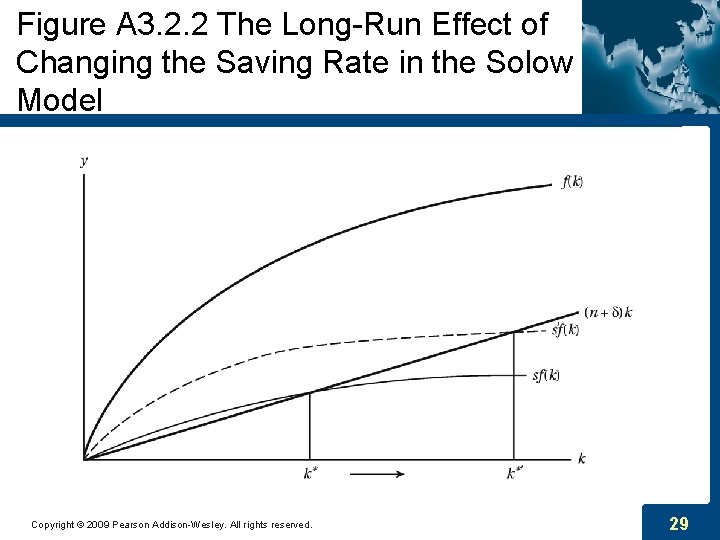
Figure A 3. 2. 2 The Long-Run Effect of Changing the Saving Rate in the Solow Model Copyright © 2009 Pearson Addison-Wesley. All rights reserved. 29
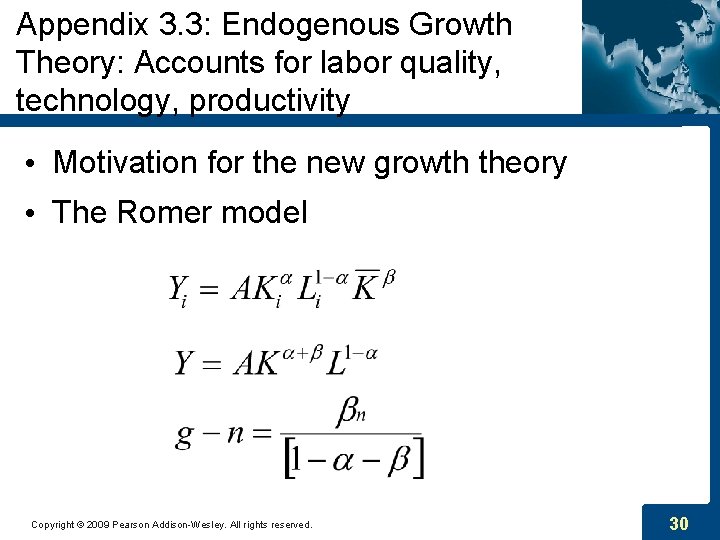
Appendix 3. 3: Endogenous Growth Theory: Accounts for labor quality, technology, productivity • Motivation for the new growth theory • The Romer model Copyright © 2009 Pearson Addison-Wesley. All rights reserved. 30