
Chapter 3 CIRCUIT ANALYSIS I Principles of Electric
- Slides: 32
Chapter 3 CIRCUIT ANALYSIS I Principles of Electric Circuits - Floyd © Copyright 2006 Prentice-Hall
Chapter 3 TOPIC 1. Ohm’s Law 2. Power 3. Energy Principles of Electric Circuits - Floyd © Copyright 2006 Prentice-Hall
Chapter 3 Review of V, I, and R Voltage is the amount of energy per charge available to move electrons from one point to another in a circuit. Current is the rate of charge flow and is measured in amperes. Resistance is the opposition to current and is measured in ohms. Principles of Electric Circuits - Floyd © Copyright 2006 Prentice-Hall
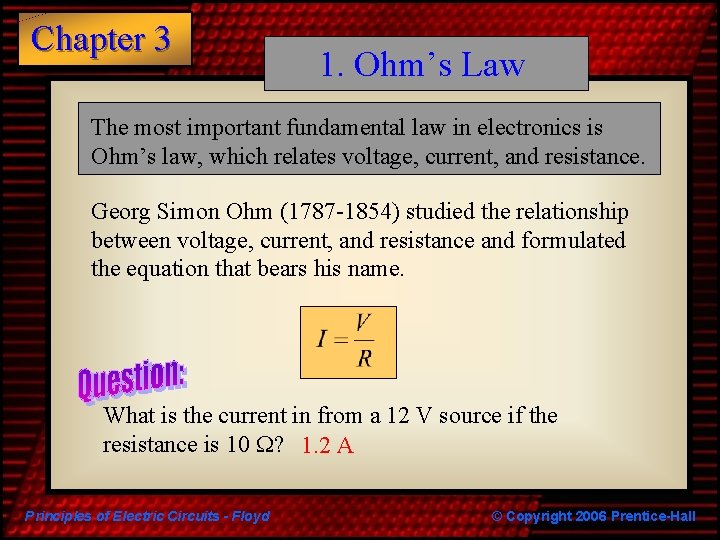
Chapter 3 1. Ohm’s Law The most important fundamental law in electronics is Ohm’s law, which relates voltage, current, and resistance. Georg Simon Ohm (1787 -1854) studied the relationship between voltage, current, and resistance and formulated the equation that bears his name. What is the current in from a 12 V source if the resistance is 10 W? 1. 2 A Principles of Electric Circuits - Floyd © Copyright 2006 Prentice-Hall
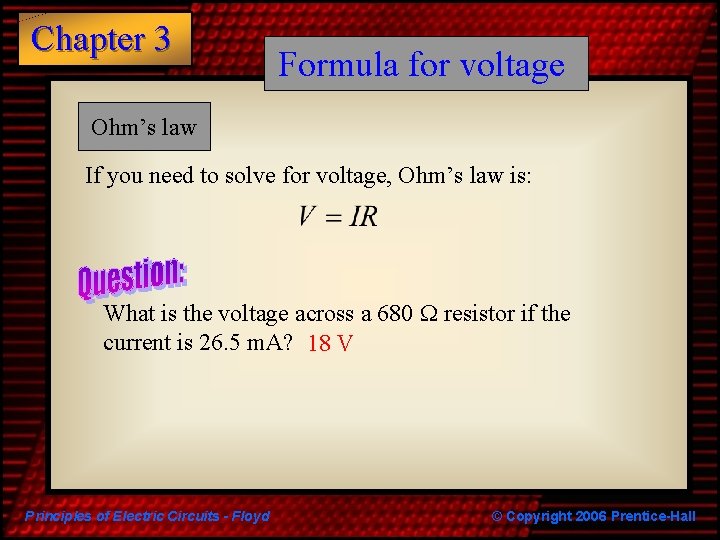
Chapter 3 Formula for voltage Ohm’s law If you need to solve for voltage, Ohm’s law is: What is the voltage across a 680 W resistor if the current is 26. 5 m. A? 18 V Principles of Electric Circuits - Floyd © Copyright 2006 Prentice-Hall
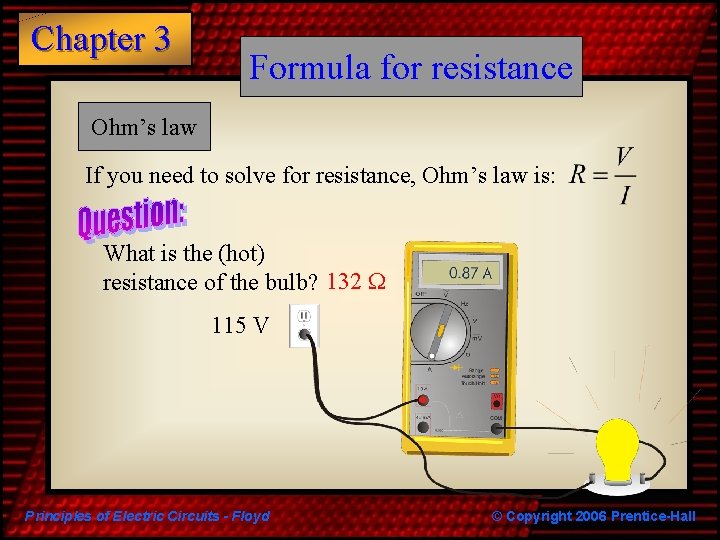
Chapter 3 Formula for resistance Ohm’s law If you need to solve for resistance, Ohm’s law is: What is the (hot) resistance of the bulb? 132 W 115 V Principles of Electric Circuits - Floyd © Copyright 2006 Prentice-Hall
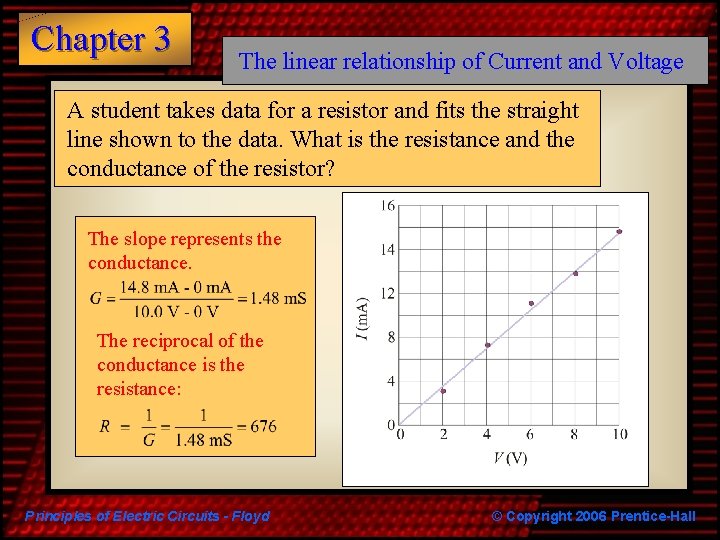
Chapter 3 The linear relationship of Current and Voltage A student takes data for a resistor and fits the straight ofthe Current versus Voltage line. Graph shown to data. What is the resistance and the conductance of the resistor? The slope represents the conductance. The reciprocal of the conductance is the resistance: Principles of Electric Circuits - Floyd © Copyright 2006 Prentice-Hall
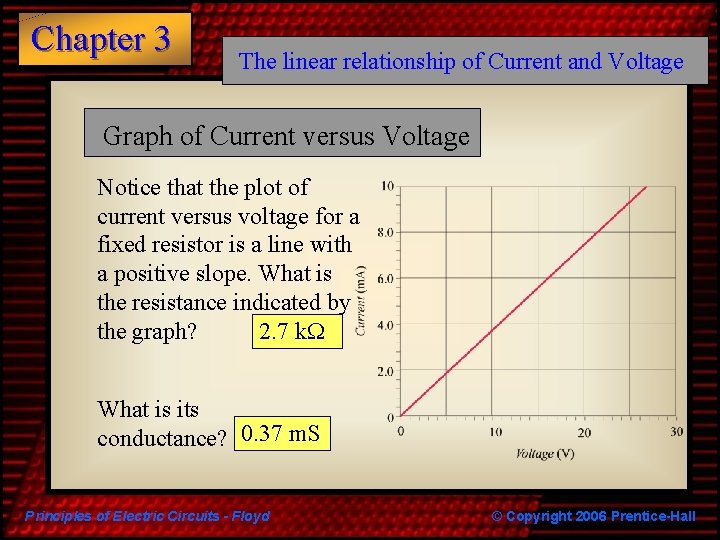
Chapter 3 The linear relationship of Current and Voltage Graph of Current versus Voltage Notice that the plot of current versus voltage for a fixed resistor is a line with a positive slope. What is the resistance indicated by 2. 7 k. W the graph? What is its conductance? 0. 37 m. S Principles of Electric Circuits - Floyd © Copyright 2006 Prentice-Hall
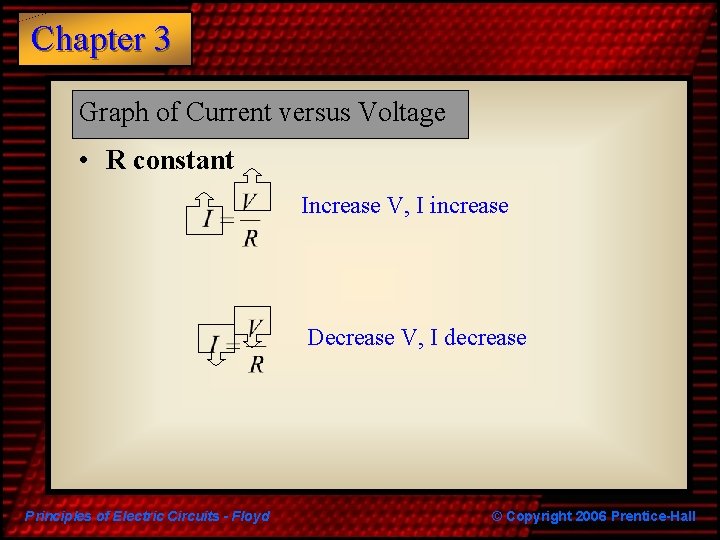
Chapter 3 Graph of Current versus Voltage • R constant Increase V, I increase Decrease V, I decrease Principles of Electric Circuits - Floyd © Copyright 2006 Prentice-Hall
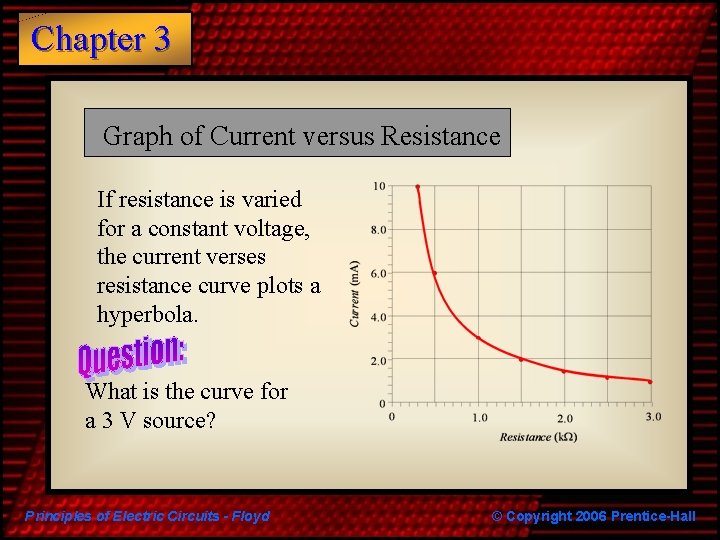
Chapter 3 Graph of Current versus Resistance If resistance is varied for a constant voltage, the current verses resistance curve plots a hyperbola. What is the curve for a 3 V source? Principles of Electric Circuits - Floyd © Copyright 2006 Prentice-Hall
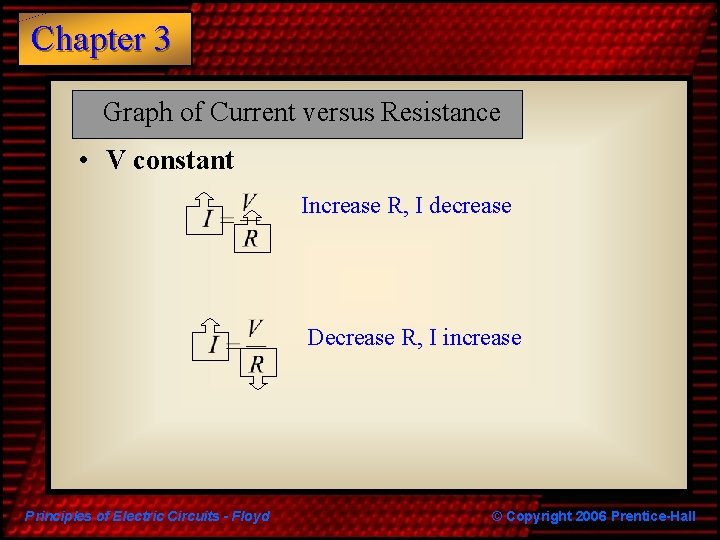
Chapter 3 Graph of Current versus Resistance • V constant Increase R, I decrease Decrease R, I increase Principles of Electric Circuits - Floyd © Copyright 2006 Prentice-Hall
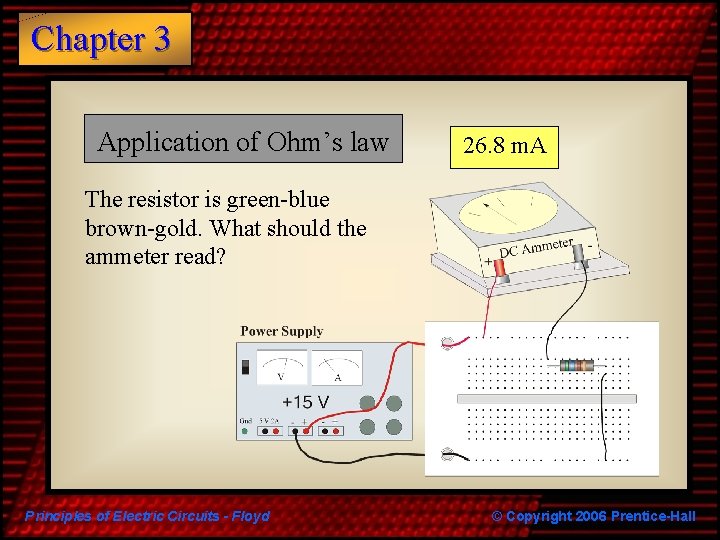
Chapter 3 Application of Ohm’s law 26. 8 m. A The resistor is green-blue brown-gold. What should the ammeter read? Principles of Electric Circuits - Floyd © Copyright 2006 Prentice-Hall
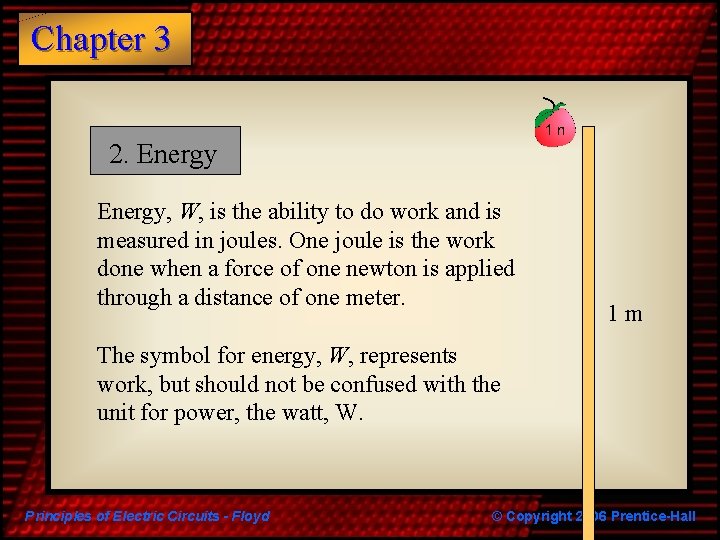
Chapter 3 2. Energy, W, is the ability to do work and is measured in joules. One joule is the work done when a force of one newton is applied through a distance of one meter. 1 m The symbol for energy, W, represents work, but should not be confused with the unit for power, the watt, W. Principles of Electric Circuits - Floyd © Copyright 2006 Prentice-Hall
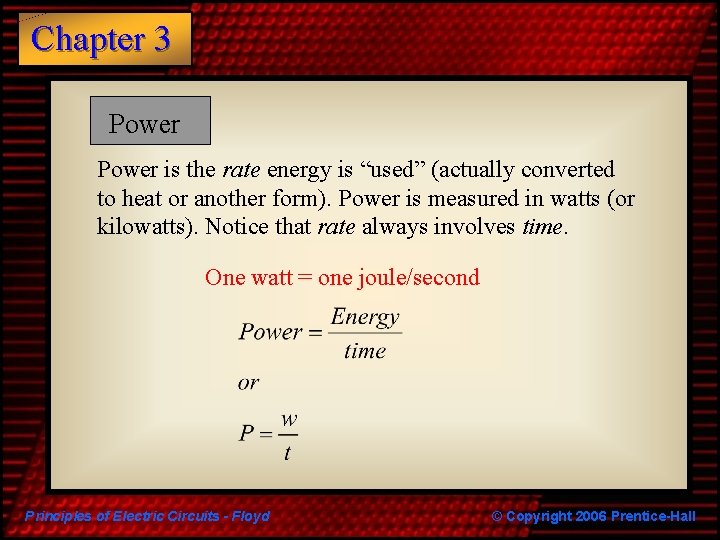
Chapter 3 Power is the rate energy is “used” (actually converted to heat or another form). Power is measured in watts (or kilowatts). Notice that rate always involves time. One watt = one joule/second Principles of Electric Circuits - Floyd © Copyright 2006 Prentice-Hall
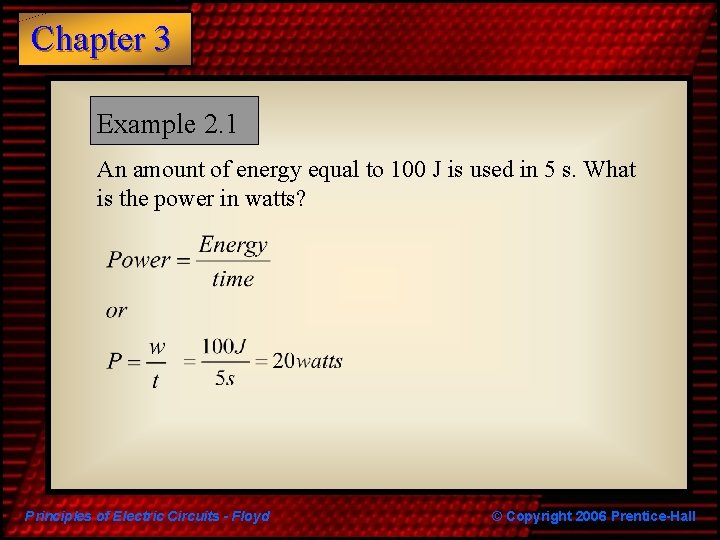
Chapter 3 Example 2. 1 An amount of energy equal to 100 J is used in 5 s. What is the power in watts? Principles of Electric Circuits - Floyd © Copyright 2006 Prentice-Hall
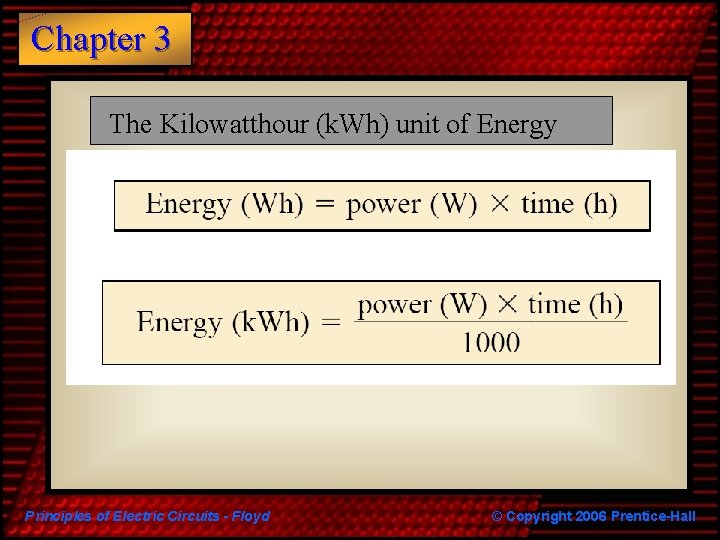
Chapter 3 The Kilowatthour (k. Wh) unit of Energy Principles of Electric Circuits - Floyd © Copyright 2006 Prentice-Hall
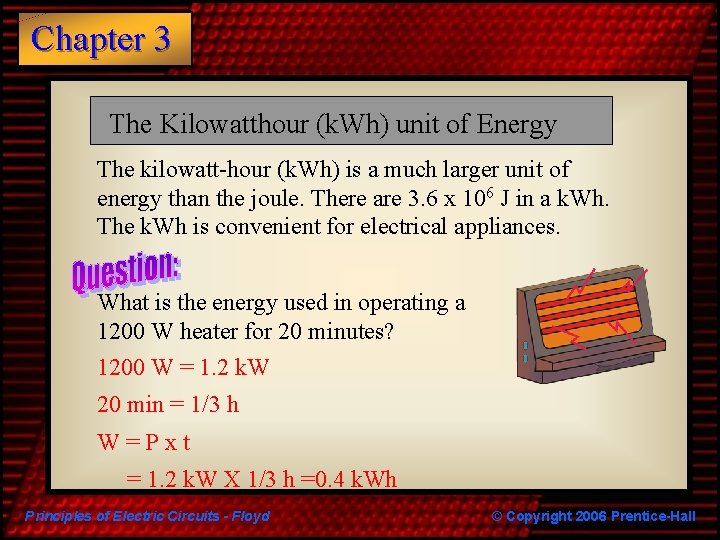
Chapter 3 The Kilowatthour (k. Wh) unit of Energy The kilowatt-hour (k. Wh) is a much larger unit of energy than the joule. There are 3. 6 x 10⁶ J in a k. Wh. The k. Wh is convenient for electrical appliances. What is the energy used in operating a 1200 W heater for 20 minutes? 1200 W = 1. 2 k. W 20 min = 1/3 h W=Pxt = 1. 2 k. W X 1/3 h =0. 4 k. Wh Principles of Electric Circuits - Floyd © Copyright 2006 Prentice-Hall
Chapter 3 Example 2. 2 Determine the number of kilowatthours for each of the following energy consumptions: (a) 1400 W for 1 hour (b) 2500 W for 2 hours (c) 100, 000 W for 5 hours Principles of Electric Circuits - Floyd © Copyright 2006 Prentice-Hall
Chapter 3 Example 2. 3 If a power company charges RM 0. 10 for each k. Wh of energy delivered to a customer, find the total cost of operating a 500 W television set for 2 hour, six 75 W light bulbs for 4 hour, a 1500 W clothes drier for 30 min and 2 k. W electric heater for 45 minutes. Principles of Electric Circuits - Floyd © Copyright 2006 Prentice-Hall
Chapter 3 Example 2. 4 If electrical energy costs RM 0. 12/k. Wh, for how long could a 900 W oven be operated without costing more than 36 cents. Principles of Electric Circuits - Floyd © Copyright 2006 Prentice-Hall
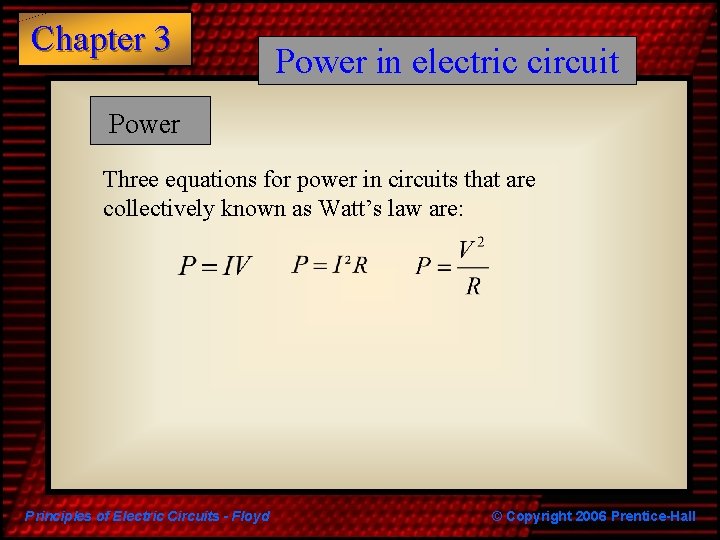
Chapter 3 Power in electric circuit Power Three equations for power in circuits that are collectively known as Watt’s law are: Principles of Electric Circuits - Floyd © Copyright 2006 Prentice-Hall
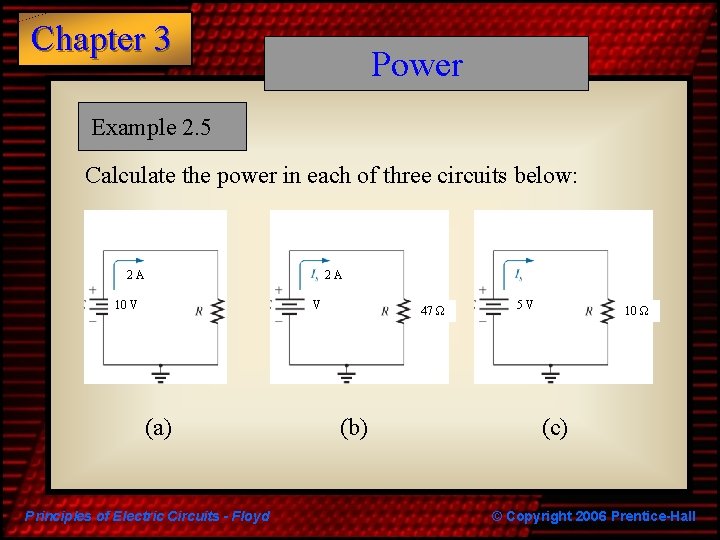
Chapter 3 Power Example 2. 5 Calculate the power in each of three circuits below: 2 A 2 A 10 V V (a) Principles of Electric Circuits - Floyd 47 Ω (b) 5 V 10 Ω (c) © Copyright 2006 Prentice-Hall
Chapter 3 Power Example 2. 6 A 100 W light bulb operates on 120 V. How much current does it require? Principles of Electric Circuits - Floyd © Copyright 2006 Prentice-Hall
Chapter 3 Power Resistor Power Rating • A resistor gives off heat when there is current through it. • There is a limit to the amount of the heat that a resistor can give off, which is specified by its power rating. • The power rating is the maximum amount of power that a resistor can dissipate without being damaged by excessive heat buildup. • The power rating is not related to ohmic value (resistance) but rather determined by the physical size and shape of the resistor. • The larger the surface area of resistor, the more power it can dissipate Principles of Electric Circuits - Floyd © Copyright 2006 Prentice-Hall
Chapter 3 Power How to select the proper power rating for an application • When a resistor is used in circuit, its power rating must be greater than the maximum that it will have to handle. • For example, if a carbon-composition resistor is to be dissipate 0. 75 W in a circuit application, its rating should be at least next higher standard value which is 1 W. Principles of Electric Circuits - Floyd © Copyright 2006 Prentice-Hall
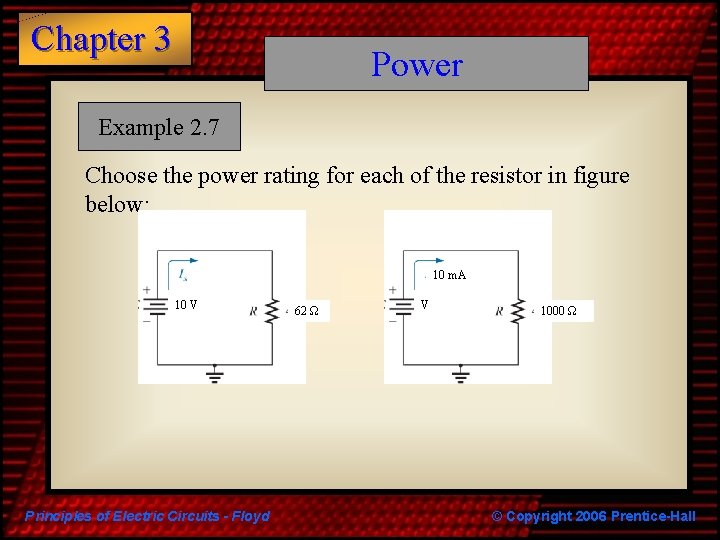
Chapter 3 Power Example 2. 7 Choose the power rating for each of the resistor in figure below: 10 m. A 10 V Principles of Electric Circuits - Floyd 62 Ω V 1000 Ω © Copyright 2006 Prentice-Hall
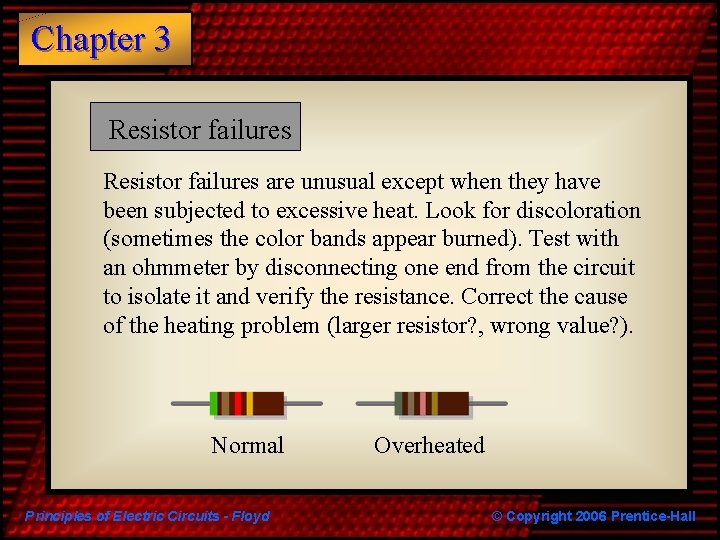
Chapter 3 Resistor failures are unusual except when they have been subjected to excessive heat. Look for discoloration (sometimes the color bands appear burned). Test with an ohmmeter by disconnecting one end from the circuit to isolate it and verify the resistance. Correct the cause of the heating problem (larger resistor? , wrong value? ). Normal Principles of Electric Circuits - Floyd Overheated © Copyright 2006 Prentice-Hall
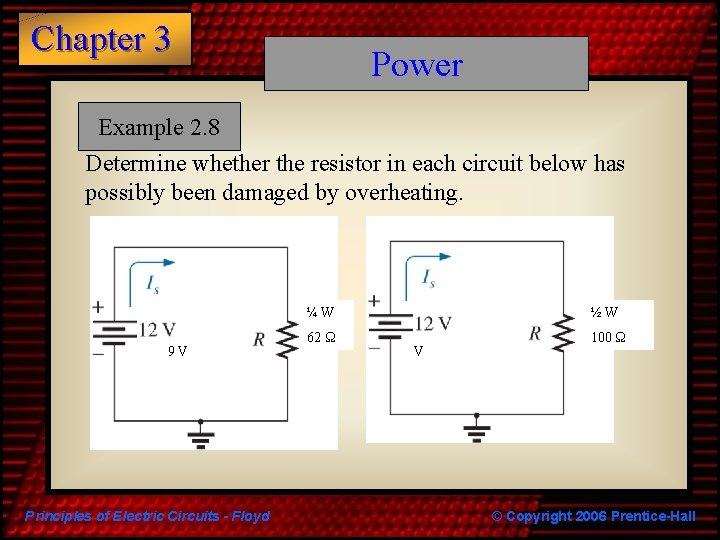
Chapter 3 Power Example 2. 8 Determine whether the resistor in each circuit below has possibly been damaged by overheating. ¼W 9 V Principles of Electric Circuits - Floyd 62 Ω ½W V 100 Ω © Copyright 2006 Prentice-Hall
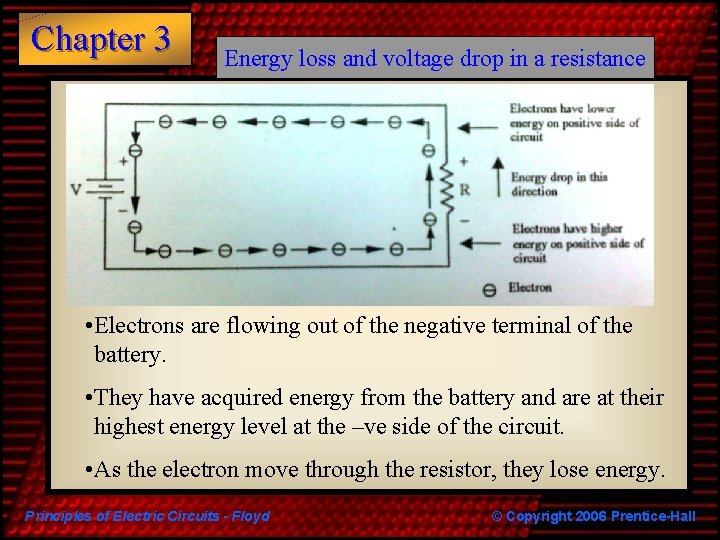
Chapter 3 Energy loss and voltage drop in a resistance • Electrons are flowing out of the negative terminal of the battery. • They have acquired energy from the battery and are at their highest energy level at the –ve side of the circuit. • As the electron move through the resistor, they lose energy. Principles of Electric Circuits - Floyd © Copyright 2006 Prentice-Hall
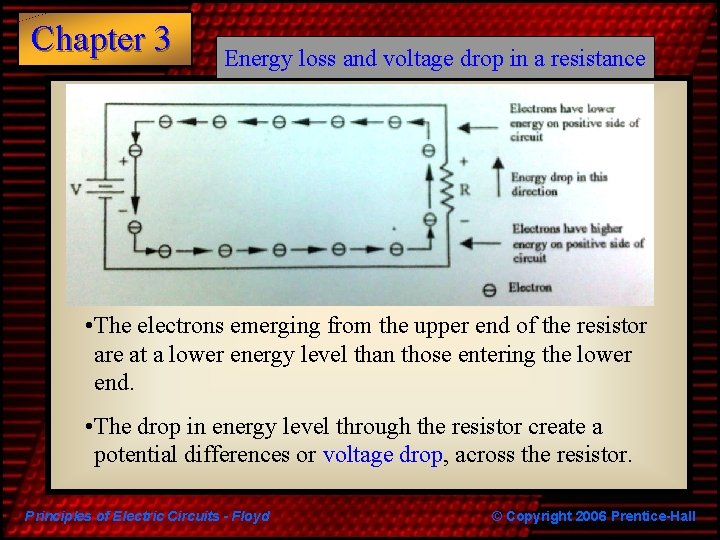
Chapter 3 Energy loss and voltage drop in a resistance • The electrons emerging from the upper end of the resistor are at a lower energy level than those entering the lower end. • The drop in energy level through the resistor create a potential differences or voltage drop, across the resistor. Principles of Electric Circuits - Floyd © Copyright 2006 Prentice-Hall
Chapter 3 Selected Key Terms Linear Characterized by a straight-line relationship. Ohm’s law A law stating that current is directly proportional to voltage and inversely proportional to current. Troubleshooting A systematic process of isolating, identifying, and correcting a fault in a circuit or system. Principles of Electric Circuits - Floyd © Copyright 2006 Prentice-Hall
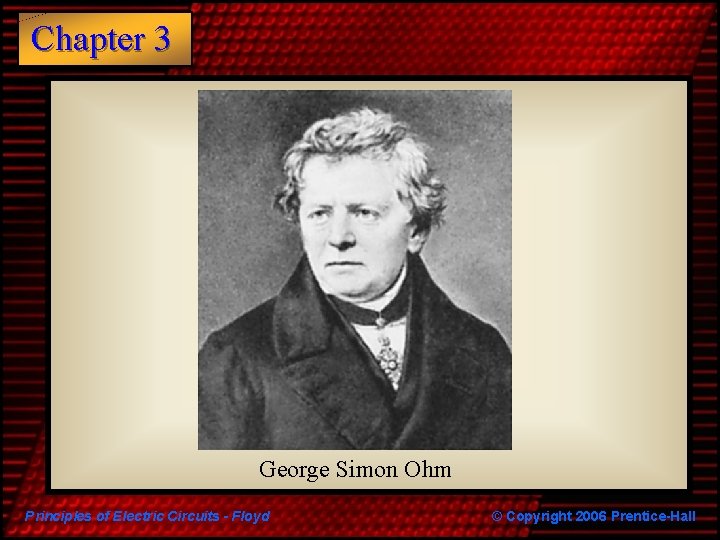
Chapter 3 George Simon Ohm Principles of Electric Circuits - Floyd © Copyright 2006 Prentice-Hall