
Chapter 3 Cells 1 3 1 Introduction Cell
- Slides: 29
Chapter 3: Cells 1
3. 1: Introduction Cell: basic organizational structure of the human body • 50 -100 trillion cells in the human body. Differentiation: cell specialization Result: cells vary in size and shape and function. 2
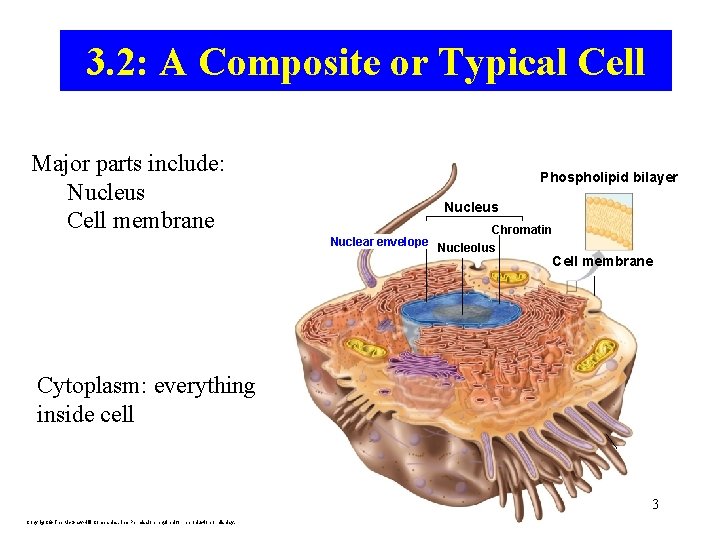
3. 2: A Composite or Typical Cell Major parts include: Nucleus Cell membrane Phospholipid bilayer Nucleus Chromatin Nuclear envelope Nucleolus Cell membrane Cytoplasm: everything inside cell 3 Copyright © The Mc. Graw-Hill Companies, Inc. Permission required for reproduction or display.
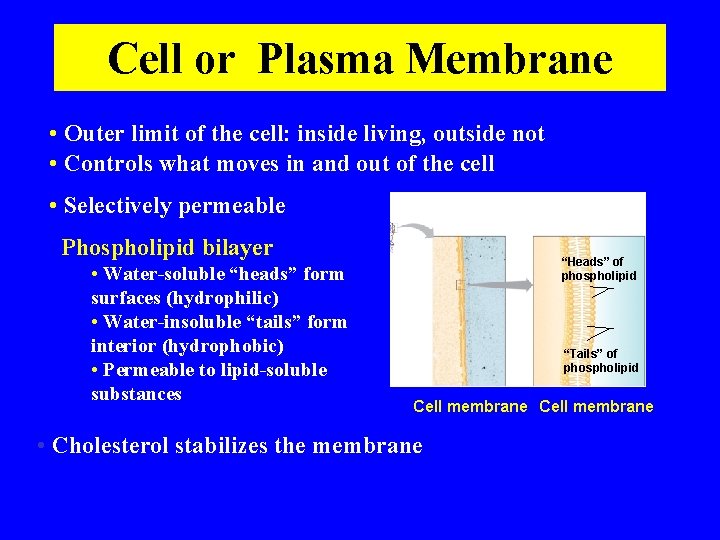
Cell or Plasma Membrane • Outer limit of the cell: inside living, outside not • Controls what moves in and out of the cell • Selectively permeable Phospholipid bilayer • Water-soluble “heads” form surfaces (hydrophilic) • Water-insoluble “tails” form interior (hydrophobic) • Permeable to lipid-soluble substances “Heads” of phospholipid “Tails” of phospholipid Cell membrane • Cholesterol stabilizes the membrane
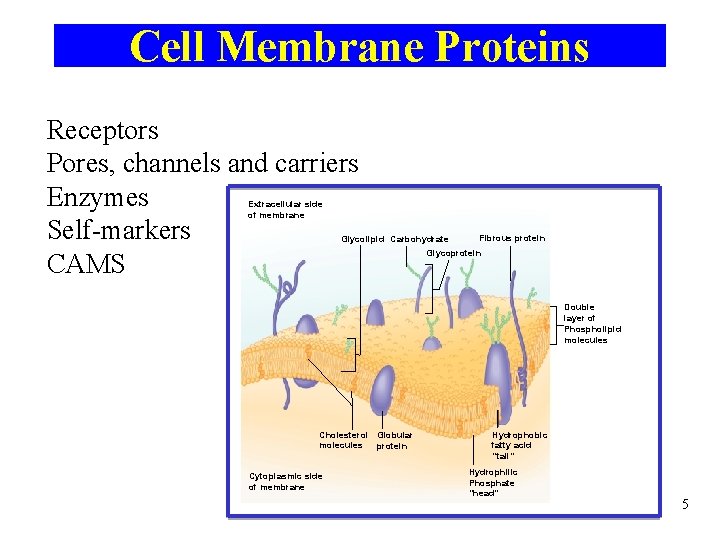
Cell Membrane Proteins Receptors Pores, channels and carriers Enzymes Self-markers CAMS Extracellular side of membrane Glycolipid Carbohydrate Fibrous protein Glycoprotein Double layer of Phospholipid molecules Cholesterol Globular molecules protein Cytoplasmic side of membrane Hydrophobic fatty acid “tail” Hydrophilic Phosphate “head” 5
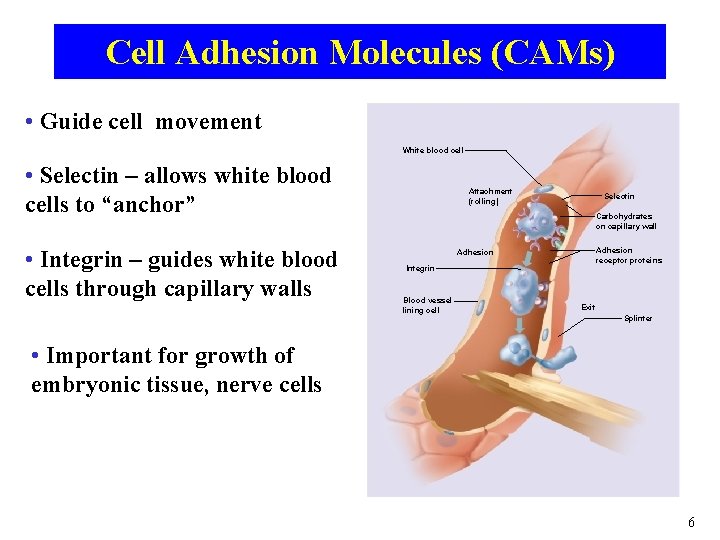
Cell Adhesion Molecules (CAMs) • Guide cell movement White blood cell • Selectin – allows white blood cells to “anchor” • Integrin – guides white blood cells through capillary walls Attachment (rolling) Selectin Carbohydrates on capillary wall Adhesion receptor proteins Adhesion Integrin Blood vessel lining cell Exit Splinter • Important for growth of embryonic tissue, nerve cells 6
Cytoplasm Two major components Cytosol = watery substance, gel-like in aperence, matrix that makes up body of cell Organelles = solid structures that carry out main functions of cell 7
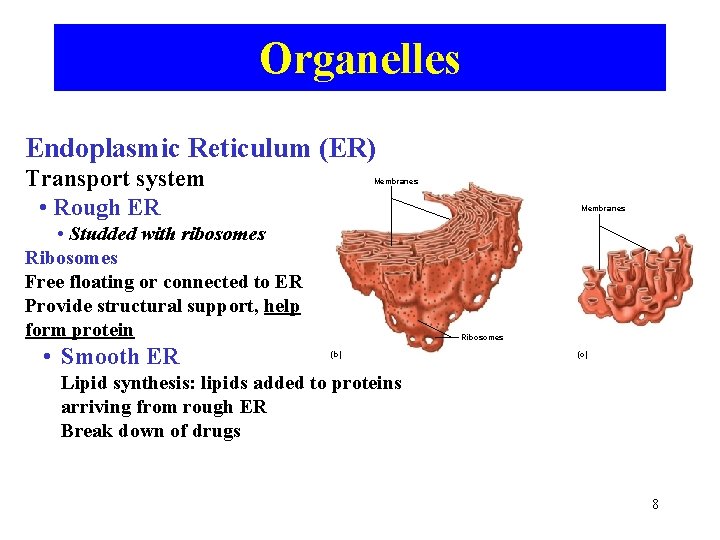
Organelles Endoplasmic Reticulum (ER) Transport system • Rough ER Membranes • Studded with ribosomes Ribosomes Free floating or connected to ER Provide structural support, help form protein • Smooth ER Ribosomes (b) (c) Lipid synthesis: lipids added to proteins arriving from rough ER Break down of drugs 8
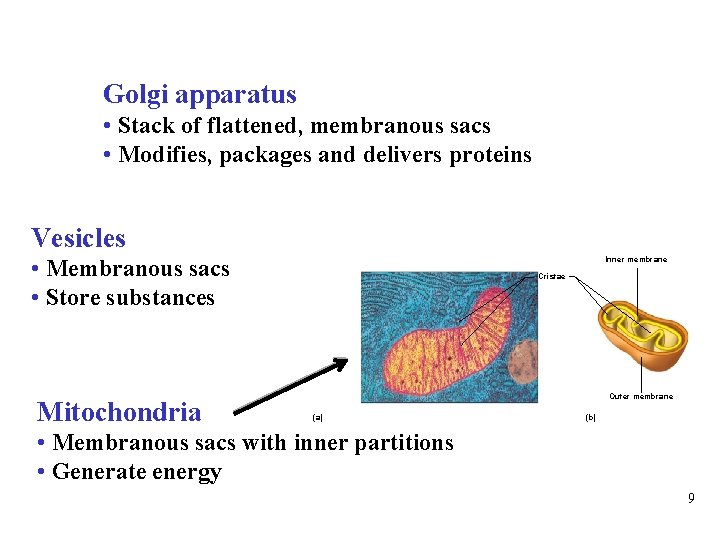
Golgi apparatus • Stack of flattened, membranous sacs • Modifies, packages and delivers proteins Vesicles • Membranous sacs • Store substances Mitochondria Inner membrane Cristae Outer membrane (a) (b) • Membranous sacs with inner partitions • Generate energy 9
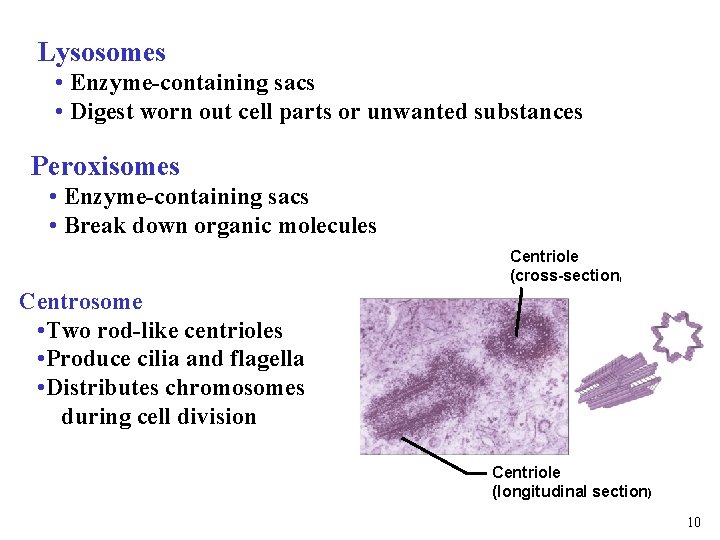
Lysosomes • Enzyme-containing sacs • Digest worn out cell parts or unwanted substances Peroxisomes • Enzyme-containing sacs • Break down organic molecules Centriole (cross-section ) Centrosome • Two rod-like centrioles • Produce cilia and flagella • Distributes chromosomes during cell division Centriole (longitudinal section) 10
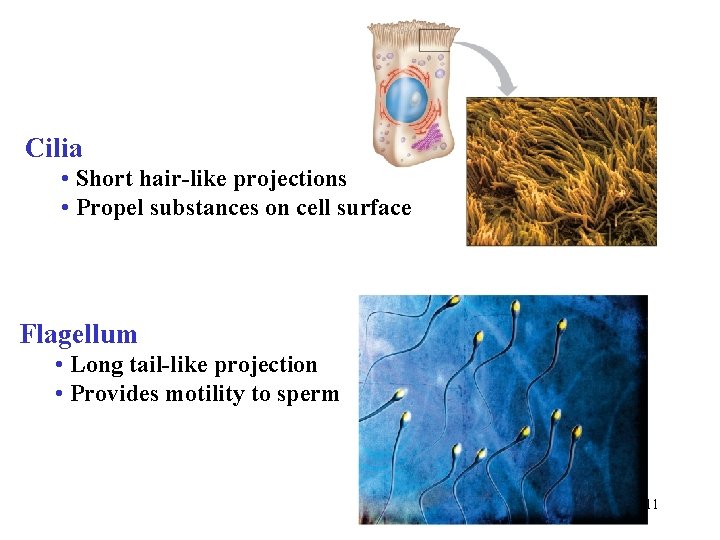
Cilia • Short hair-like projections • Propel substances on cell surface Flagellum • Long tail-like projection • Provides motility to sperm 11
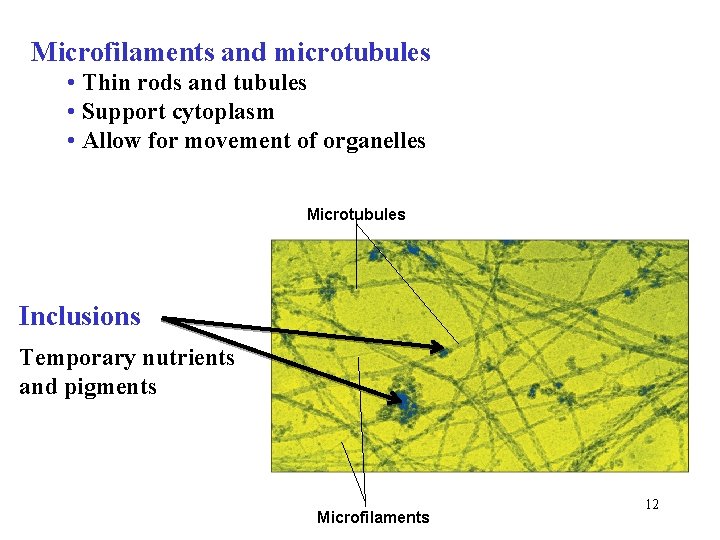
Microfilaments and microtubules • Thin rods and tubules • Support cytoplasm • Allow for movement of organelles Microtubules Inclusions Temporary nutrients and pigments Microfilaments 12
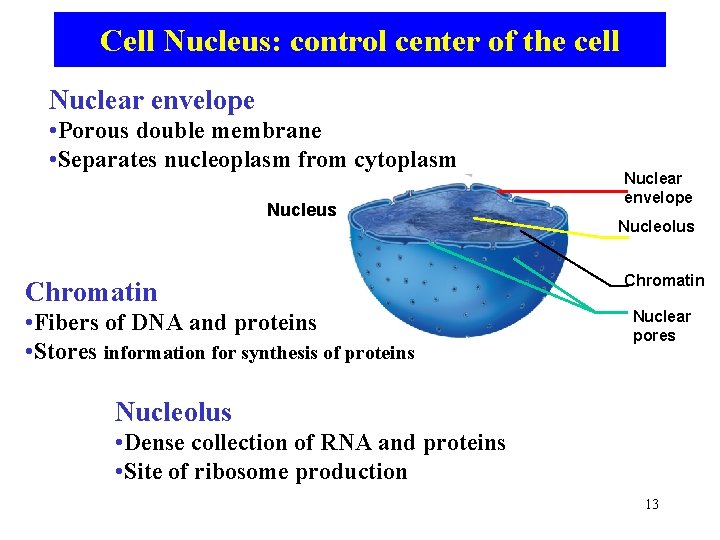
Cell Nucleus: control center of the cell Nuclear envelope • Porous double membrane • Separates nucleoplasm from cytoplasm Nucleus Chromatin • Fibers of DNA and proteins • Stores information for synthesis of proteins Nuclear envelope Nucleolus Chromatin Nuclear pores Nucleolus • Dense collection of RNA and proteins • Site of ribosome production 13
3. 3: Movements Into & Out of the Cell Passive Processes: (Physical) Require no cellular energy Active Processes: (Physiological/biochemical) Require cellular energy 14
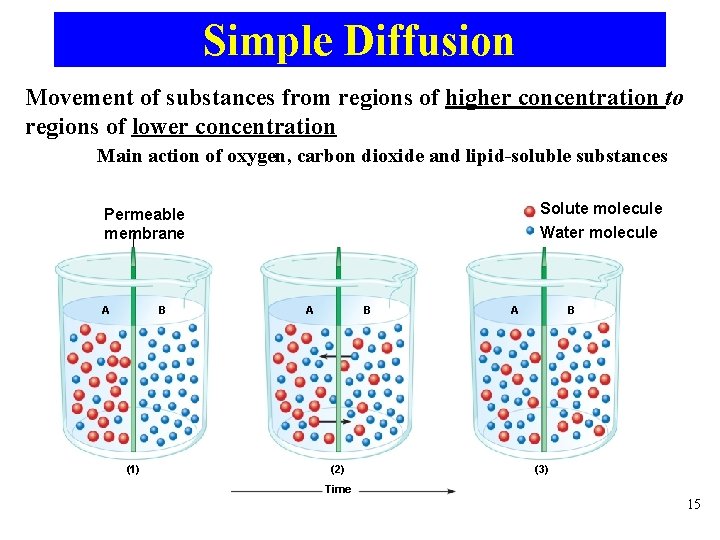
Simple Diffusion Movement of substances from regions of higher concentration to regions of lower concentration Main action of oxygen, carbon dioxide and lipid-soluble substances Solute molecule Water molecule Permeable membrane A B (1) A B (2) A B (3) Time 15
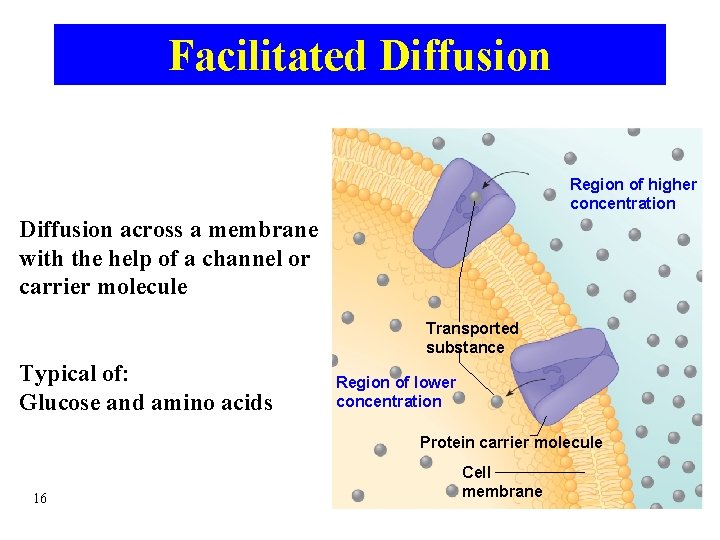
Facilitated Diffusion Region of higher concentration Diffusion across a membrane with the help of a channel or carrier molecule Transported substance Typical of: Glucose and amino acids Region of lower concentration Protein carrier molecule 16 Cell membrane
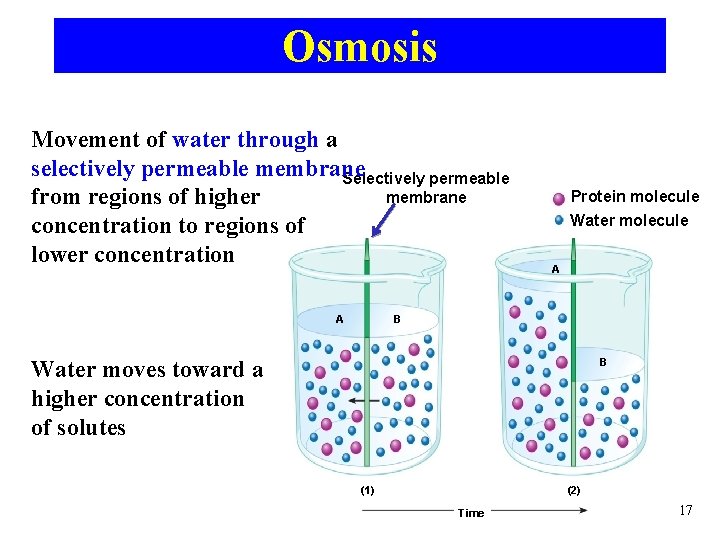
Osmosis Movement of water through a selectively permeable membrane Selectively permeable membrane from regions of higher concentration to regions of lower concentration A Protein molecule Water molecule A B B Water moves toward a higher concentration of solutes (1) (2) Time 17
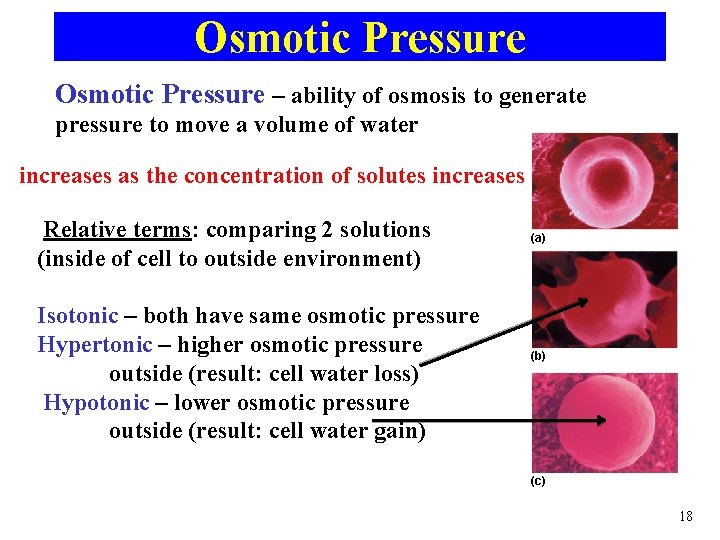
Osmotic Pressure – ability of osmosis to generate pressure to move a volume of water increases as the concentration of solutes increases Relative terms: comparing 2 solutions (inside of cell to outside environment) Isotonic – both have same osmotic pressure Hypertonic – higher osmotic pressure outside (result: cell water loss) Hypotonic – lower osmotic pressure outside (result: cell water gain) (a) (b) (c) 18
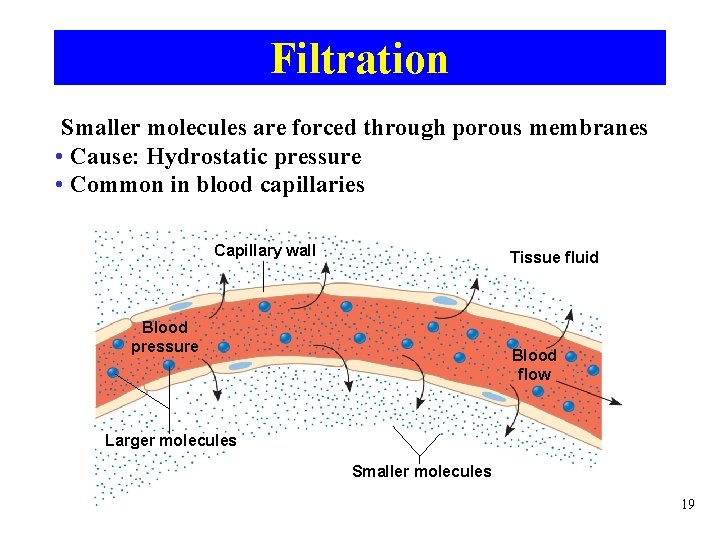
Filtration Smaller molecules are forced through porous membranes • Cause: Hydrostatic pressure • Common in blood capillaries Capillary wall Tissue fluid Blood pressure Blood flow Larger molecules Smaller molecules 19
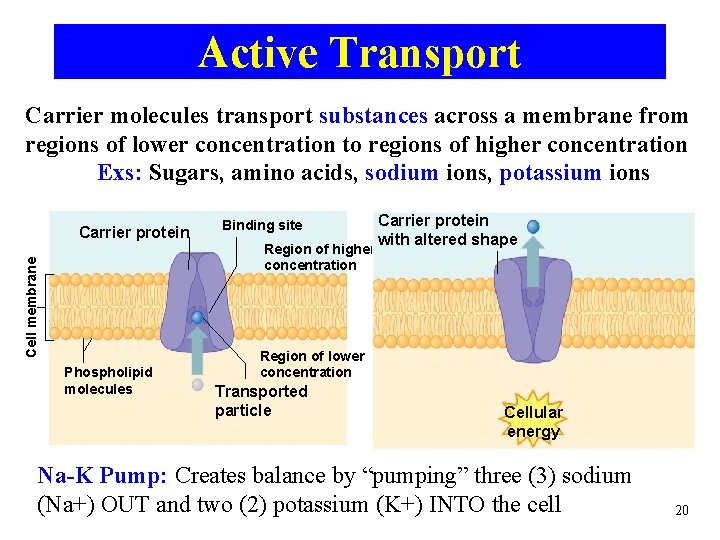
Active Transport Carrier molecules transport substances across a membrane from regions of lower concentration to regions of higher concentration Exs: Sugars, amino acids, sodium ions, potassium ions Carrier protein Binding site Cell membrane Region of higher concentration Phospholipid molecules Carrier protein with altered shape Region of lower concentration Transported particle Cellular energy Na-K Pump: Creates balance by “pumping” three (3) sodium (Na+) OUT and two (2) potassium (K+) INTO the cell 20
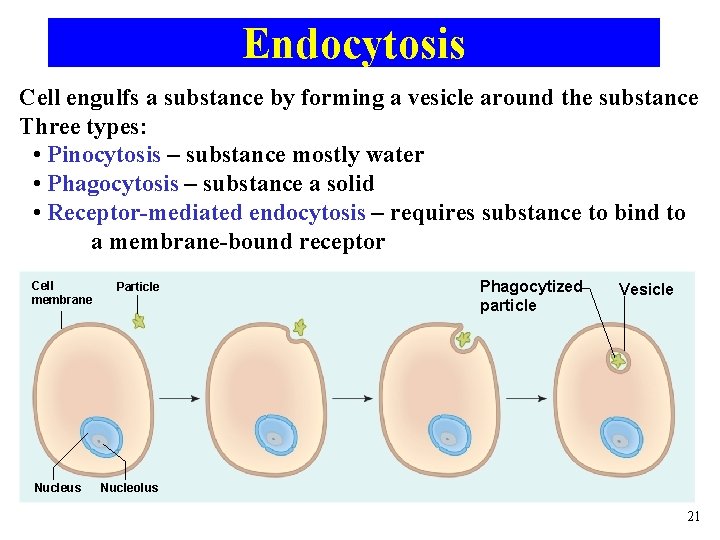
Endocytosis Cell engulfs a substance by forming a vesicle around the substance Three types: • Pinocytosis – substance mostly water • Phagocytosis – substance a solid • Receptor-mediated endocytosis – requires substance to bind to a membrane-bound receptor Cell membrane Nucleus Particle Phagocytized particle Vesicle Nucleolus 21
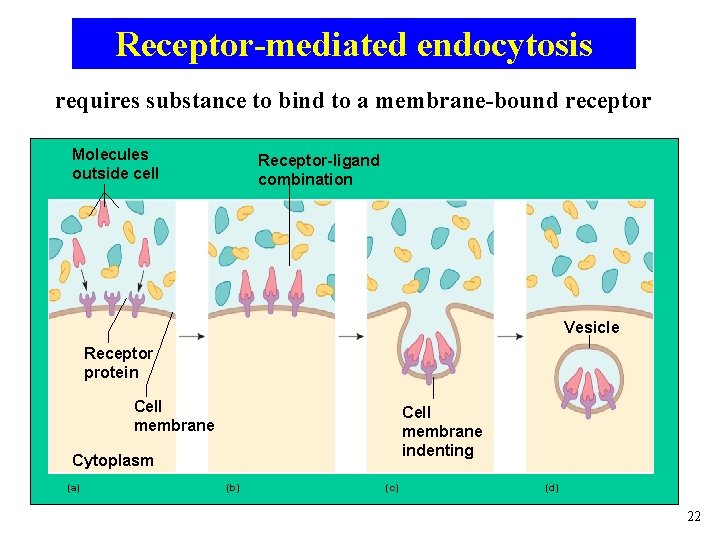
Receptor-mediated endocytosis requires substance to bind to a membrane-bound receptor Molecules outside cell Receptor-ligand combination Vesicle Receptor protein Cell membrane indenting Cytoplasm (a) (b) (c) (d) 22
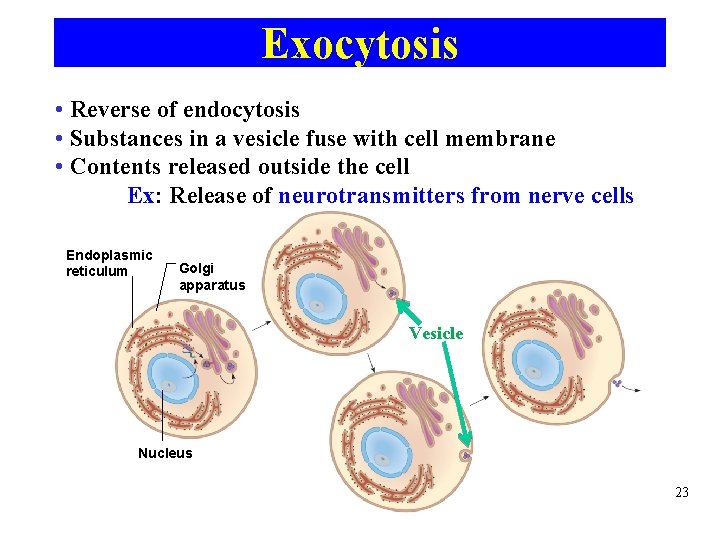
Exocytosis • Reverse of endocytosis • Substances in a vesicle fuse with cell membrane • Contents released outside the cell Ex: Release of neurotransmitters from nerve cells Endoplasmic reticulum Golgi apparatus Vesicle Nucleus 23
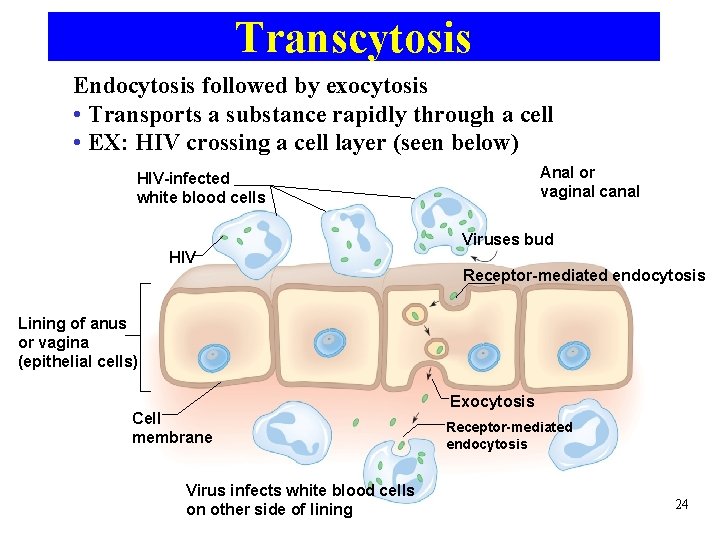
Transcytosis Endocytosis followed by exocytosis • Transports a substance rapidly through a cell • EX: HIV crossing a cell layer (seen below) Anal or vaginal canal HIV-infected white blood cells Viruses bud HIV Receptor-mediated endocytosis Lining of anus or vagina (epithelial cells) Cell membrane Virus infects white blood cells on other side of lining Exocytosis Receptor-mediated endocytosis 24
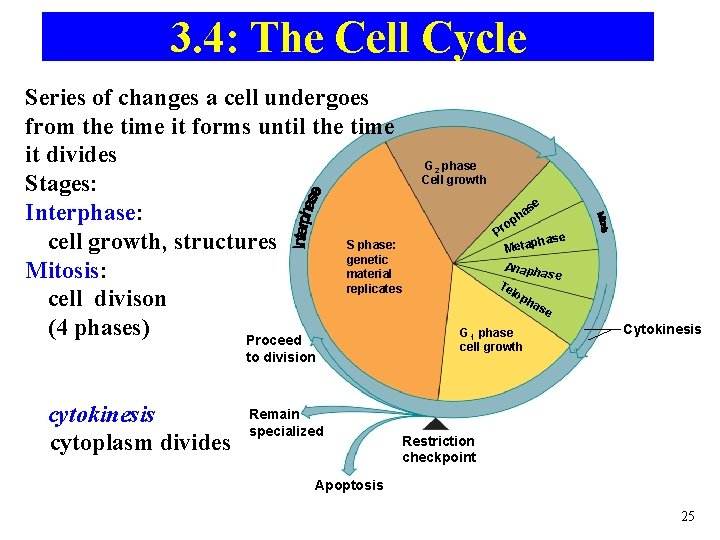
3. 4: The Cell Cycle Series of changes a cell undergoes from the time it forms until the time it divides Stages: Interphase: cell growth, structures S phase: genetic Mitosis: material replicates cell divison (4 phases) Proceed to division cytokinesis cytoplasm divides Remain specialized G 2 phase Cell growth e s ha op Pr hase Metap Anapha se Te lop ha se G 1 phase cell growth Cytokinesis Restriction checkpoint Apoptosis 25
3. 5: Control of Cell Division Cell division capacities vary greatly among cell types • Skin and blood cells divide often and continually • Neuron cells divide a specific number of times then cease Chromosome tips (telomeres) that shorten with each mitosis provide a mitotic clock Growth factors and hormones stimulate cell division Contact (density dependent) inhibition: presence of a certain amount of cells stops division Tumors: consequence of loss of cell cycle control 26
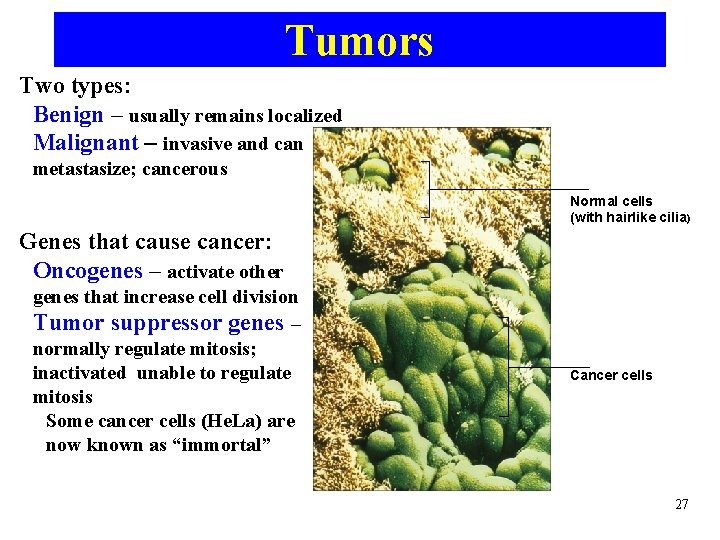
Tumors Two types: Benign – usually remains localized Malignant – invasive and can metastasize; cancerous Normal cells (with hairlike cilia) Genes that cause cancer: Oncogenes – activate other genes that increase cell division Tumor suppressor genes – normally regulate mitosis; inactivated unable to regulate mitosis Some cancer cells (He. La) are now known as “immortal” Cancer cells 27
3. 6: Stem and Progenitor Cells Stem cell: Can divide to form two new stem cells or a stem cell and a progenitor cell Types Totipotent – can give rise to every cell type Pluripotent – can give rise to a restricted number of cell types Progenitor cell: Committed to be a specific cell type (pluripotent) 28
3. 7: Cell Death Apoptosis: • Programmed cell death • Acts as a protective mechanism • Is a continuous process 29