
Chapter 3 Cell Structure Looking at Cells l

- Slides: 43
Chapter 3 Cell Structure
Looking at Cells l The invention of microscopes allowed scientists to view cells for the first time l Scientists use the metric system to measure the size of cells
l Metric Units vary on scales of 10
Metric Units l Length-Meter l Mass-Gram l Temperature-Celsius l Time-Seconds l Volume-Liter
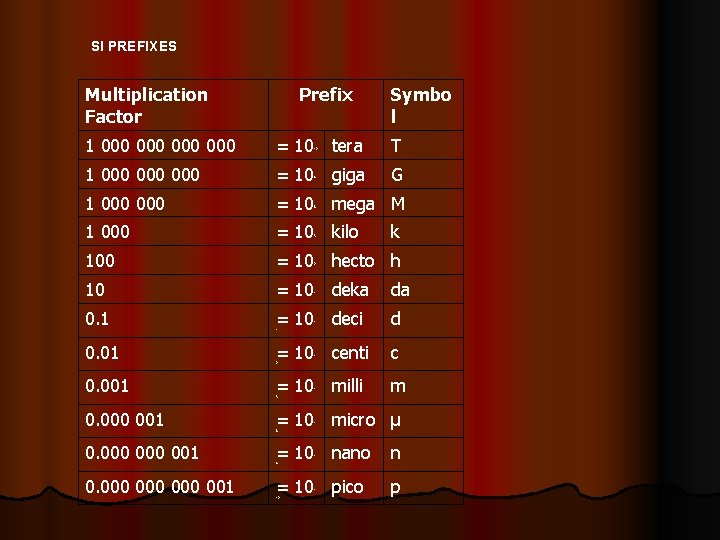
SI PREFIXES Multiplication Factor Prefix Symbo l 1 000 000 = 10 tera T 1 000 000 = 10 giga G 1 000 = 10 mega M 1 000 = 10 kilo 100 = 10 hecto h 10 = 10 deka da 0. 1 = 10 deci d 0. 01 = 10 centi c 0. 001 = 10 milli m 0. 000 001 = 10 micro µ 0. 000 001 = 10 nano n 0. 000 000 001 = 10 pico p 12 9 6 3 k 2 1 - 2 - 3 - 6 - 9 - 12
Characteristics of Microscopes l Robert Hooke in 1665 used a microscope to view cork cells l Two common types of microscopes: Light and Electron
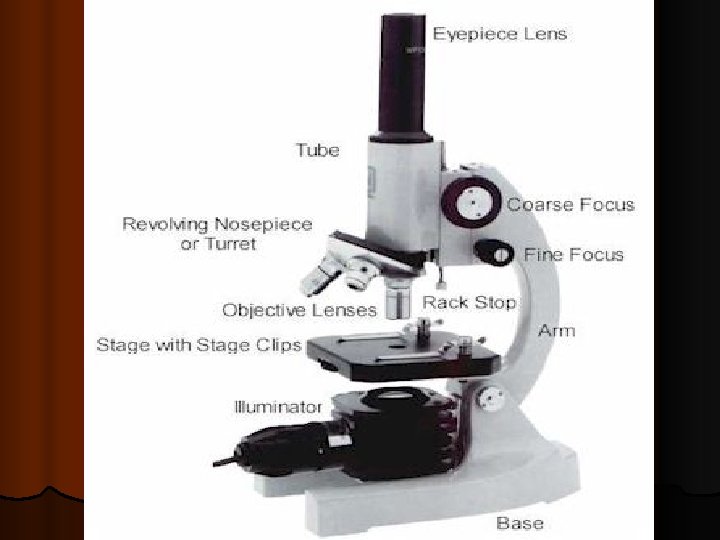
Light Microscope l Light passes through one or more lenses l Compound Light Microscopes use two lenses
Electron Microscope l Uses a beam of electrons instead of light to create an image l Transmission Electron Microscopes shoots a beam of electrons l Scanning Tunneling Microscope measures the difference in voltage caused by electrons that leak from the object
l Magnification-the ability to make an image larger l Resolution-the measure of clarity of an image
http: //science. nhmccd. edu/biolab/microscope. htm
3 -2 Cell Features
The Cell Theory l Schleiden concluded that cells make up every part of a plant in 1838 l Schwann concluded that cells make up every part of animals in 1834 l Virchow determined that cells can only come from other cells in 1858
l 1. All living things are made of one or more cells l 2. Cells are the basic unit of structure and function in organisms l 3. All cells arise from existing cells
Why must cells be small? l If surface to volume ratio is to low, substances cannot move through the cell quickly enough l Small cells are stronger than larger ones (water balloon)
Common Features to Cells l Cell Membrane-outer boundary, semipermeable l Cytoplasm-cell interior made of water and other molecules needed for cellular functions l Cytoskeleton-microscopic fibers used for cellular structure l Ribosomes-site of protein production
Prokaryotes l Single celled organisms (Bacteria) l Lack a nucleus and membrane bound organelles l Very small l Evolved at least 3. 5 billion years ago
Characteristics of Bacteria l Exist in a wide range of environments l Can live without oxygen and make their own food l DNA is circular in shape l Have a cell wall surrounding the membrane
l Some have a capsule around the cell wall used for clinging to objects l Some use a flagella (whip-like tail) for locomotion
Eukaryotes l Contain a nucleus and membrane bound organelles (structure that carries out specific function inside the cell) l Evolved at least 1. 5 billion years ago
l http: //programs. northlandcollege. edu/biol ogy/Biology 1111/animations/flagellum. htm l
Cell Membrane l Selectively Permeable (like a bouncer) l Made of phospholipids (lipid made of a phosphate group and two fatty acids) l Have a polar head and two nonpolar tails
l Head portion is water loving (hydrophilic) and tails are water fearing (hydrophobic) l Arrange in a lipid bilayer l Ions and most polar molecules are repelled by the nonpolar interior
l http: //www. stolaf. edu/people/giannini/flas hanimat/lipids/membrane%20 fluidity. swf
l Proteins are located in the membrane l Marker, Receptor, Transport, and Enzyme Proteins l Membrane is fluid!!!!!!!
3 -3 Cell Organelles l Nucleus-control cellular functions in eukaryotes l Surrounded by nuclear membrane or envelope (pores)
l Substances like ribosomal proteins and RNA made in nucleus pass through pores l DNA stored in nucleus (wound with proteins)
l Ribosomes-make proteins l Located free floating in the cytoplasm or attached to endoplasmic reticulum (ER)
l Endoplasmic Reticulum (ER)system of internal membranes that move proteins and other substances through the cell l Rough ER-embedded with ribosomes
l When a protein is made, it passes into the ER by way of a vesicle (membrane bound sac used for transporting substances) l Smooth ER-lacks ribosomes, used for making lipids and breaking down toxins
l Golgi Apparatus-flattened, membrane-bound sacs that package and distribute things in the cell
5 Step Process to Packaging and Distribution of Proteins l Ribosomes make proteins on RER. Then packaged into vesicles.
l Vesicles transport the new proteins from RER to golgi apparatus
l In the golgi apparatus, proteins are processed and then packaged into new vesicles
l Many of the vesicles move to the membrane and release contents outside the cell
l Other vesicles like lysosomes remain inside cell
l Lysosome-small spherical organelles that contain digestive enzymes used for breaking down proteins, carbs, and nucleic acids
ATP Production l Mitochondria-rod shaped organelles used for making ATP, combine oxygen with food molecules l Have their own distinct DNA, transferred from the mother
Plant Cells l Cell Wall-nonliving barrier outside the cell membrane l Supports and protects the cell l Made of cellulose (polysaccharide)
l Chloroplasts-use light energy to make carbohydrates for the plant
l Central Vacuole-large storage vacuole for holding stores of water and other substances l When full, push against the cell wall l When shrunken, release pressure against the cell wall (plant wilts)
l http: //www. tvdsb. on. ca/westmin/science/ sbi 3 a 1/Cells/cells. htm
l http: //www. mhhe. com/biosci/esp/2001_g bio/default. htm#ok l http: //www. johnkyrk. com/