
Chapter 3 Cell Structure and Function Plasma Membrane
Chapter 3 Cell Structure and Function Plasma Membrane and Methods of Transport
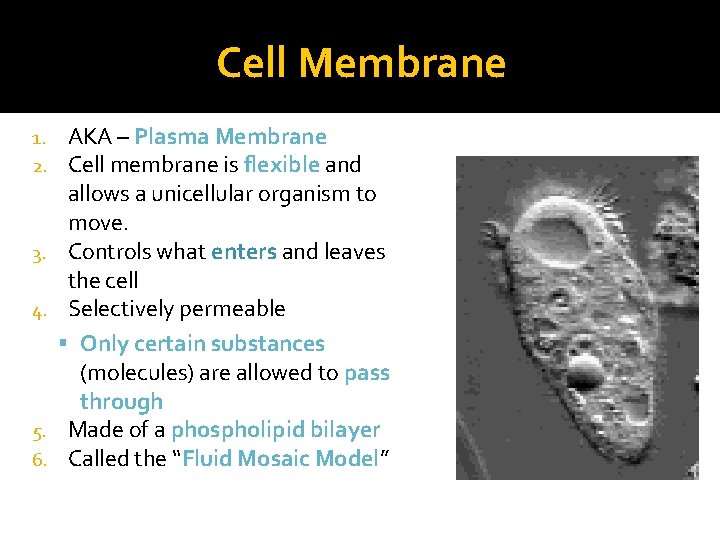
Cell Membrane 1. 2. 3. 4. 5. 6. AKA – Plasma Membrane Cell membrane is flexible and allows a unicellular organism to move. Controls what enters and leaves the cell Selectively permeable Only certain substances (molecules) are allowed to pass through Made of a phospholipid bilayer Called the “Fluid Mosaic Model”
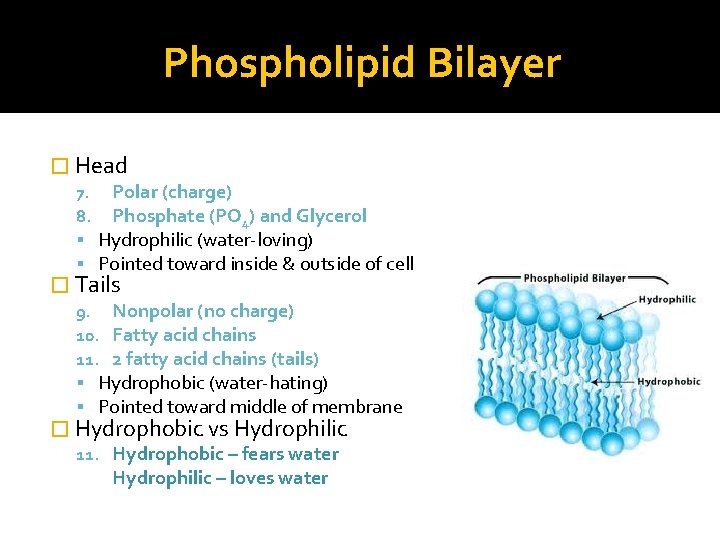
Phospholipid Bilayer � Head 7. Polar (charge) 8. Phosphate (PO 4) and Glycerol Hydrophilic (water-loving) Pointed toward inside & outside of cell � Tails 9. Nonpolar (no charge) 10. Fatty acid chains 11. 2 fatty acid chains (tails) Hydrophobic (water-hating) Pointed toward middle of membrane � Hydrophobic vs Hydrophilic 11. Hydrophobic – fears water Hydrophilic – loves water
Homeostasis 13. Balanced internal condition of cells 14. Also called equilibrium 15. Maintained by plasma membrane controlling what enters and leaves the cell
Functions of Plasma Membrane 16. 7 Functions of plasma membrane a. Protective barrier b. Regulates transport in and out of the cell c. d. e. f. g. (selectively permeable) Allows cell recognition Provides anchoring sites for filaments of cytoskeleton Provides a binding site for enzymes Interlocking surfaces bind cells together (junctions) Contains the cytoplasm (fluid in cell)
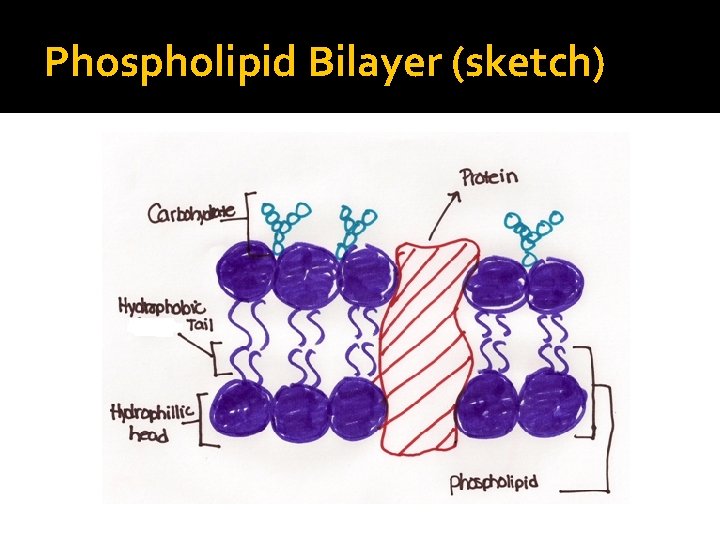
Phospholipid Bilayer (sketch)
What else is in the phospholipid bilayer? 18. Cholesterol and proteins – other 2 components of bilayer �Cholesterol/carbohydrates 19. Provides support and flexibility 20. Proteins Functions a. Regulates which particles can pass across membranes b. Act as enzymes in chemical reactions c. Act as markers (nametags) for cell recognition and fighting off disease
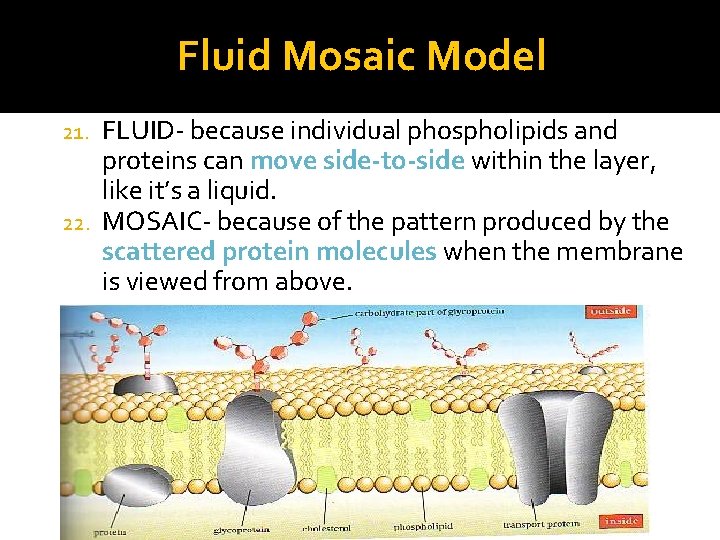
Fluid Mosaic Model FLUID- because individual phospholipids and proteins can move side-to-side within the layer, like it’s a liquid. 22. MOSAIC- because of the pattern produced by the scattered protein molecules when the membrane is viewed from above. 21.
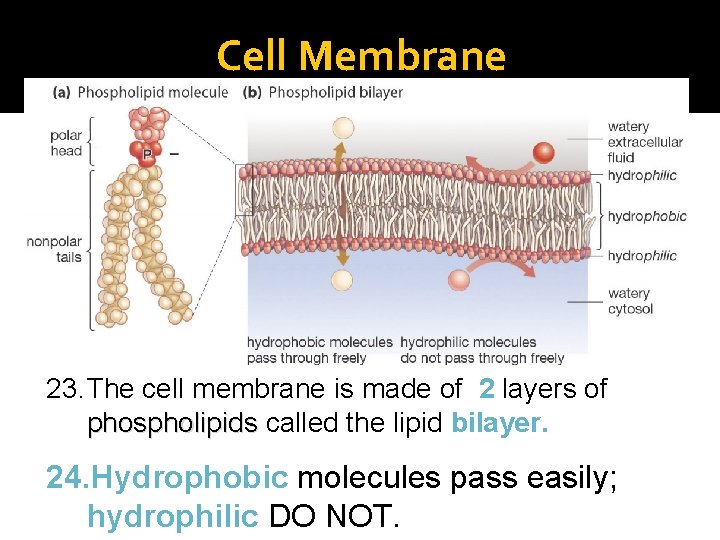
Cell Membrane 23. The cell membrane is made of 2 layers of phospholipids called the lipid bilayer. 24. Hydrophobic molecules pass easily; hydrophilic DO NOT.
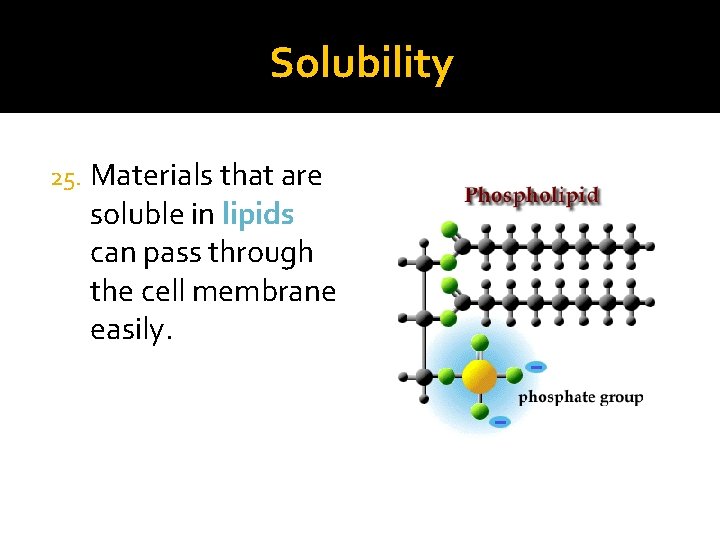
Solubility 25. Materials that are soluble in lipids can pass through the cell membrane easily.
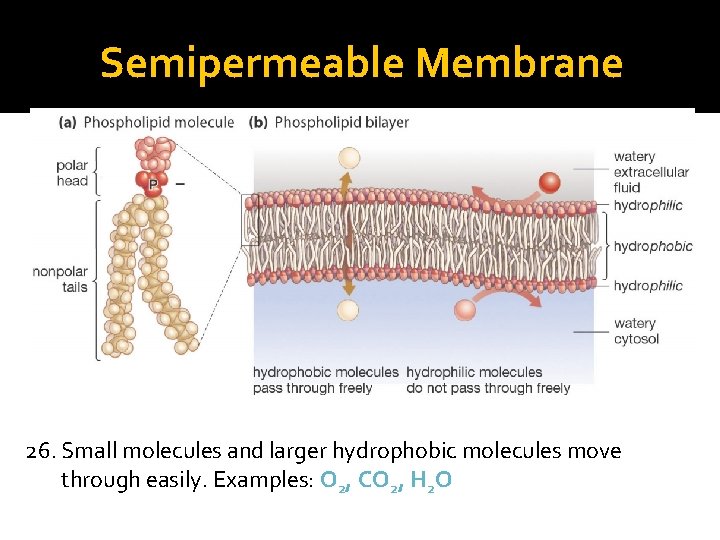
Semipermeable Membrane 26. Small molecules and larger hydrophobic molecules move through easily. Examples: O 2, CO 2, H 2 O
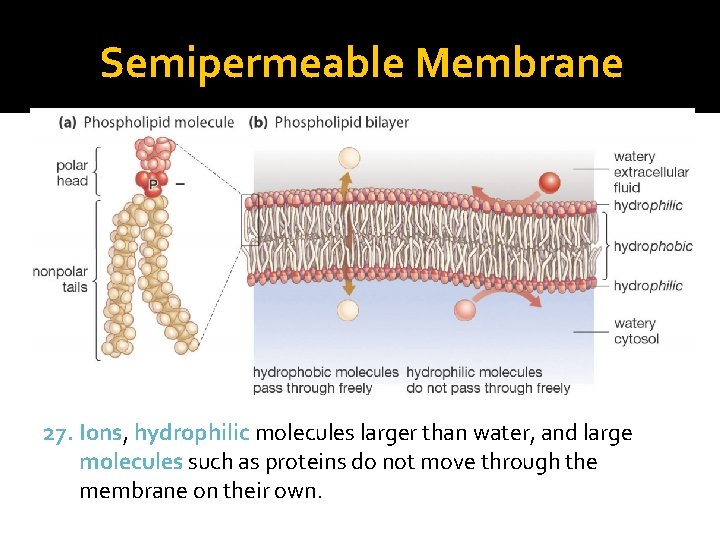
Semipermeable Membrane 27. Ions, hydrophilic molecules larger than water, and large molecules such as proteins do not move through the membrane on their own.
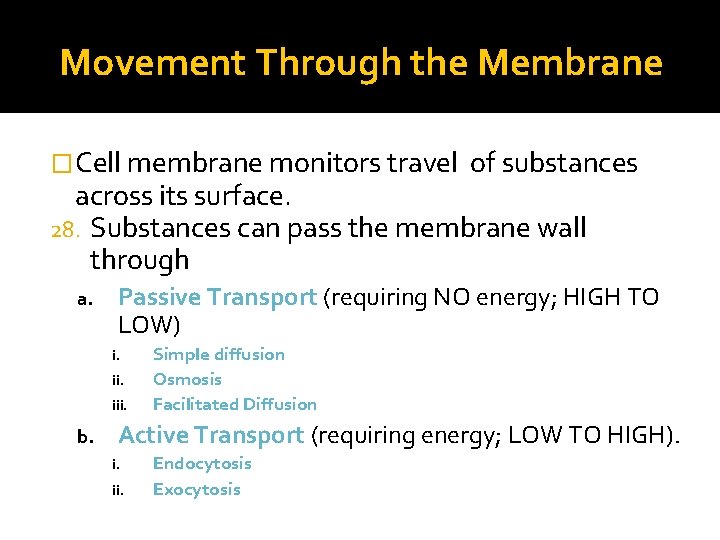
Movement Through the Membrane �Cell membrane monitors travel of substances across its surface. 28. Substances can pass the membrane wall through a. Passive Transport (requiring NO energy; HIGH TO LOW) i. iii. b. Simple diffusion Osmosis Facilitated Diffusion Active Transport (requiring energy; LOW TO HIGH). i. ii. Endocytosis Exocytosis

Passive Transport 29. 30. When molecules/ particles pass through a cell membrane WITHOUT energy; high to low concentration 3 Types: a. Diffusion—movement of O 2, CO 2, alcohol b. Osmosis—movement of H 2 O only c. Facilitated Diffusion—movement of larger particles (glucose); need a facilitator protein
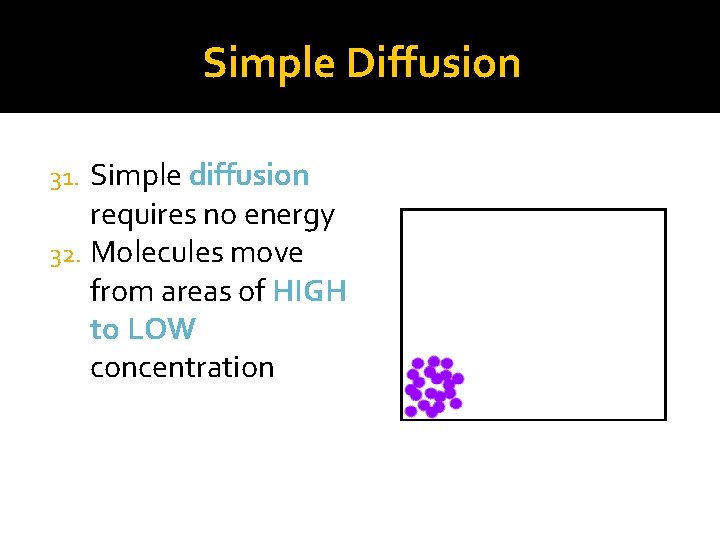
Simple Diffusion Simple diffusion requires no energy 32. Molecules move from areas of HIGH to LOW concentration 31.
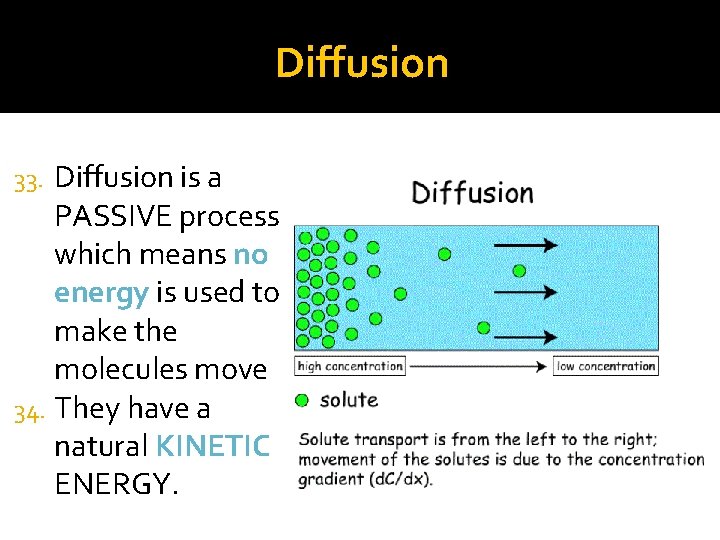
Diffusion is a PASSIVE process which means no energy is used to make the molecules move 34. They have a natural KINETIC ENERGY. 33.
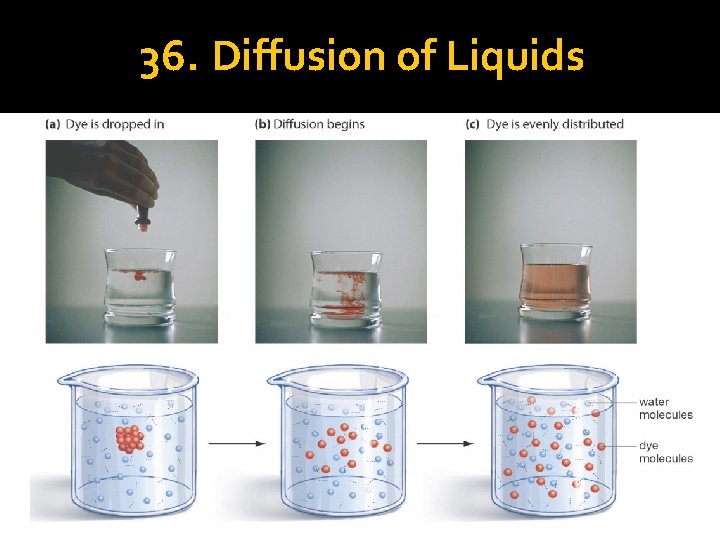
36. Diffusion of Liquids
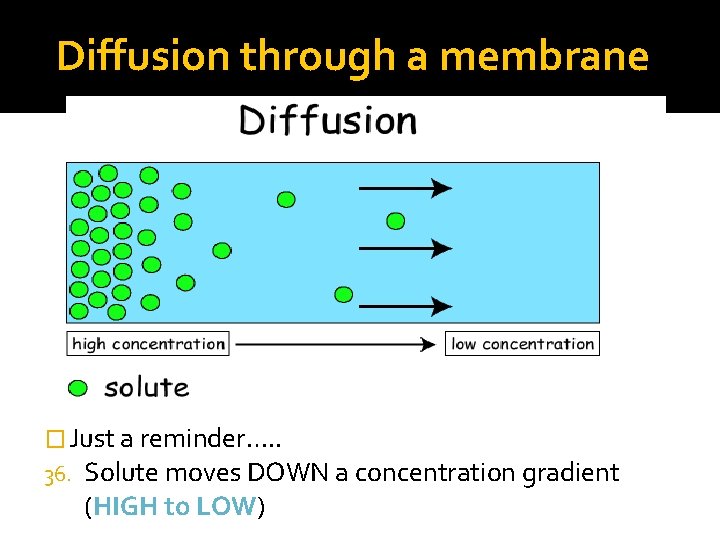
Diffusion through a membrane � Just a reminder…. . 36. Solute moves DOWN a concentration gradient (HIGH to LOW)
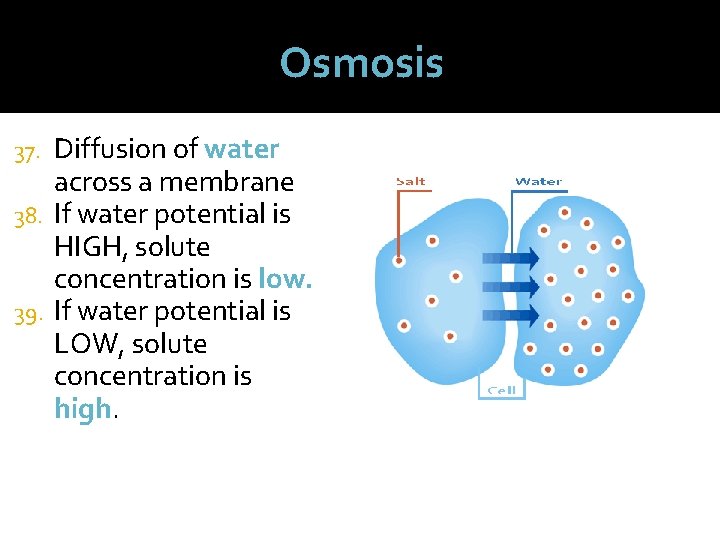
Osmosis Diffusion of water across a membrane 38. If water potential is HIGH, solute concentration is low. 39. If water potential is LOW, solute concentration is high. 37.
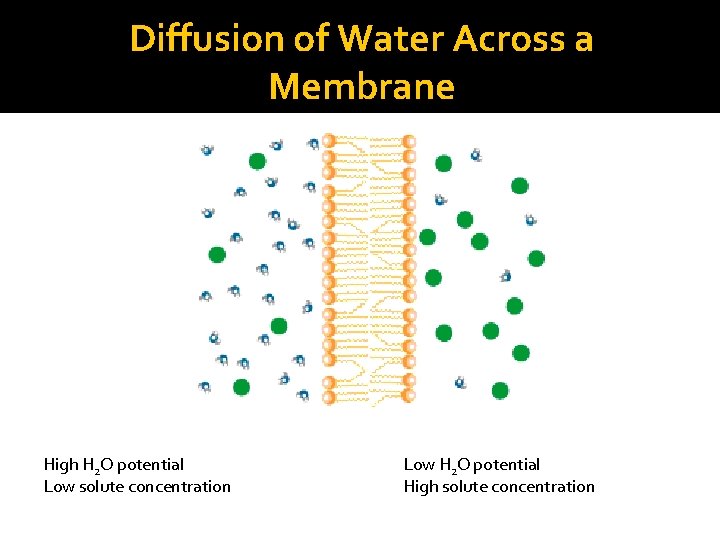
Diffusion of Water Across a Membrane High H 2 O potential Low solute concentration Low H 2 O potential High solute concentration
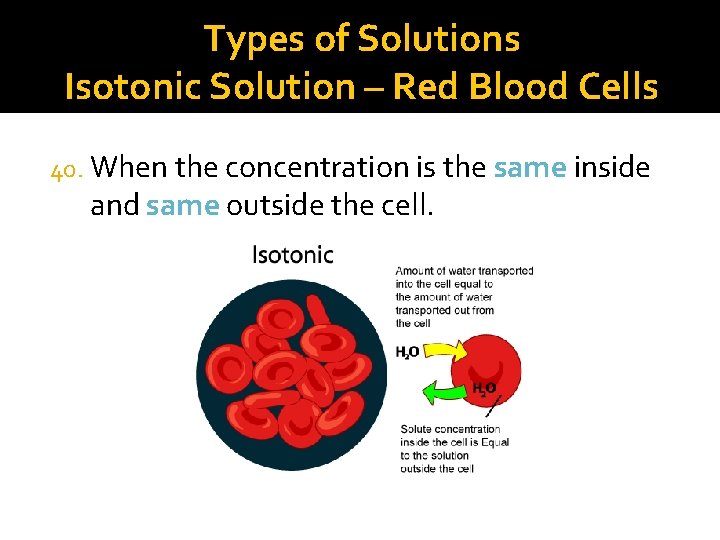
Types of Solutions Isotonic Solution – Red Blood Cells 40. When the concentration is the same inside and same outside the cell.
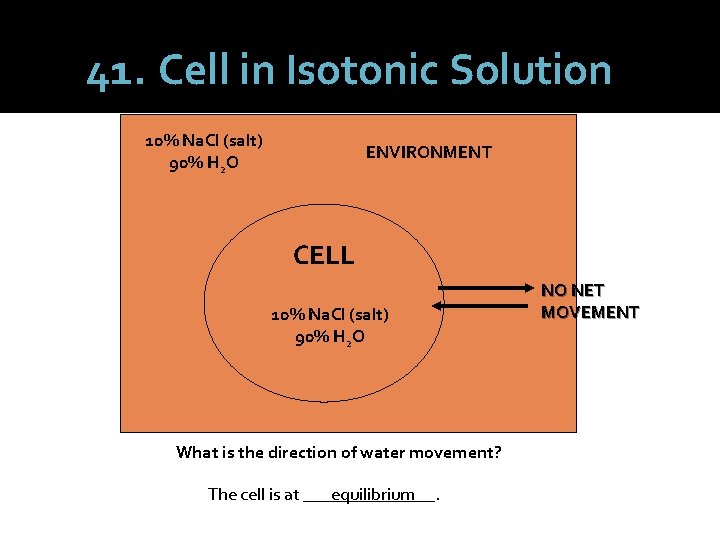
41. Cell in Isotonic Solution 10% Na. Cl (salt) 90% H 2 O ENVIRONMENT CELL 10% Na. Cl (salt) 90% H 2 O What is the direction of water movement? The cell is at ________. equilibrium NO NET MOVEMENT
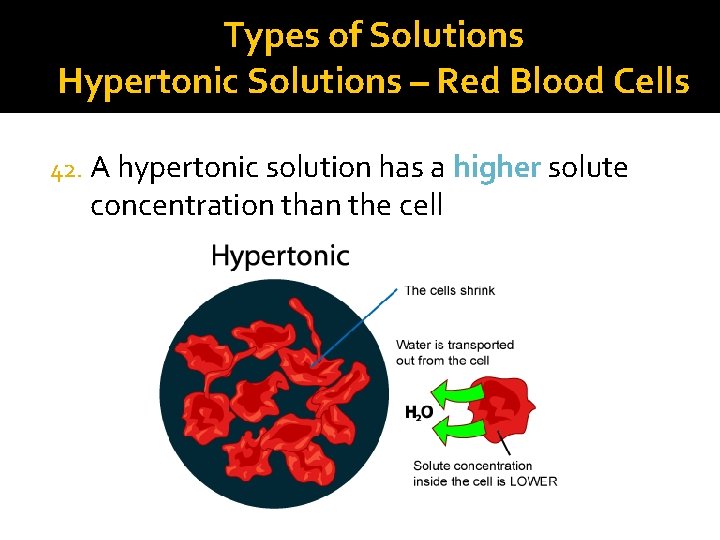
Types of Solutions Hypertonic Solutions – Red Blood Cells 42. A hypertonic solution has a higher solute concentration than the cell
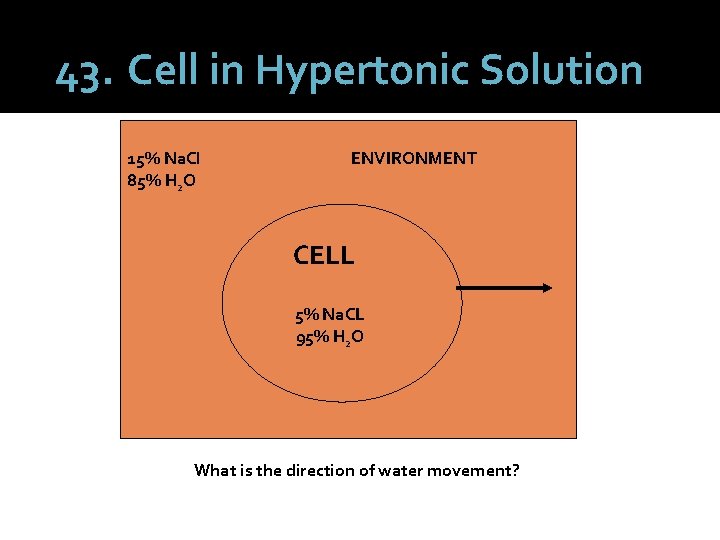
43. Cell in Hypertonic Solution 15% Na. Cl 85% H 2 O ENVIRONMENT CELL 5% Na. CL 95% H 2 O What is the direction of water movement?
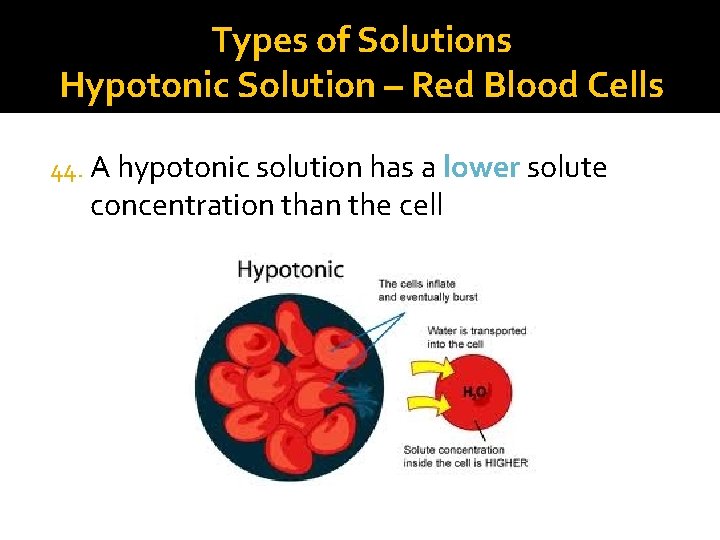
Types of Solutions Hypotonic Solution – Red Blood Cells 44. A hypotonic solution has a lower solute concentration than the cell
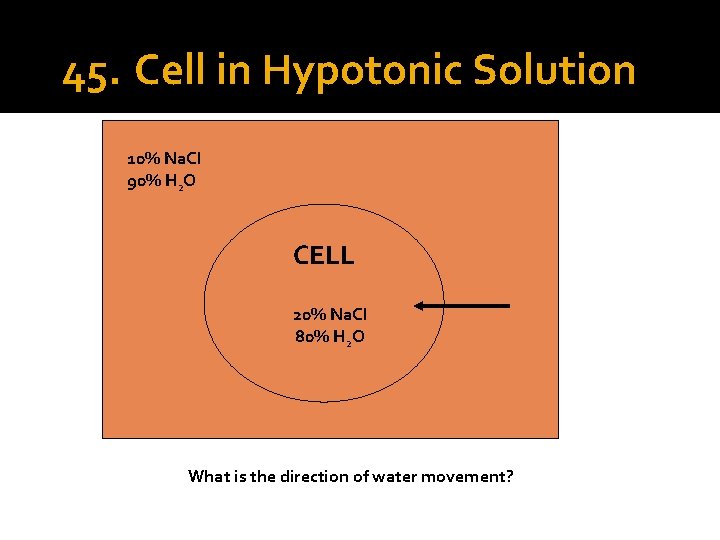
45. Cell in Hypotonic Solution 10% Na. Cl 90% H 2 O CELL 20% Na. Cl 80% H 2 O What is the direction of water movement?
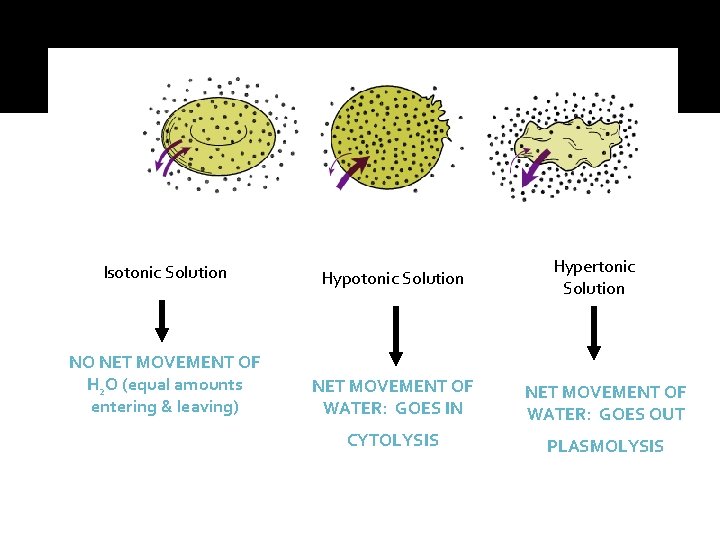
Hypertonic Solution Isotonic Solution Hypotonic Solution NO NET MOVEMENT OF H 2 O (equal amounts entering & leaving) NET MOVEMENT OF WATER: GOES IN NET MOVEMENT OF WATER: GOES OUT CYTOLYSIS PLASMOLYSIS
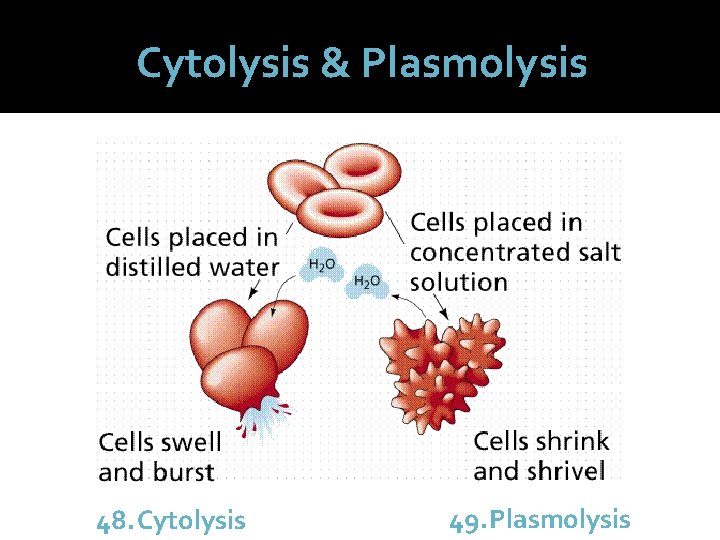
Cytolysis & Plasmolysis 48. Cytolysis 49. Plasmolysis
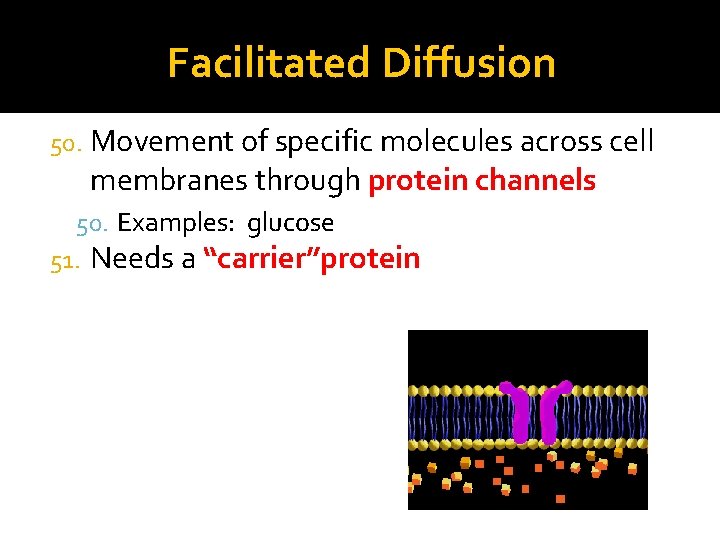
Facilitated Diffusion 50. Movement of specific molecules across cell membranes through protein channels 50. Examples: glucose 51. Needs a “carrier”protein
Active Transport 52. Active Transport - when particles (solutes) pass through a cell membrane WITH energy, but go from low to high concentration 53. This requires energy in the form of ATP a. Requires a transport protein or “pump” b. Usually found in the cell membrane 54. Moves AGAINST the concentration gradient
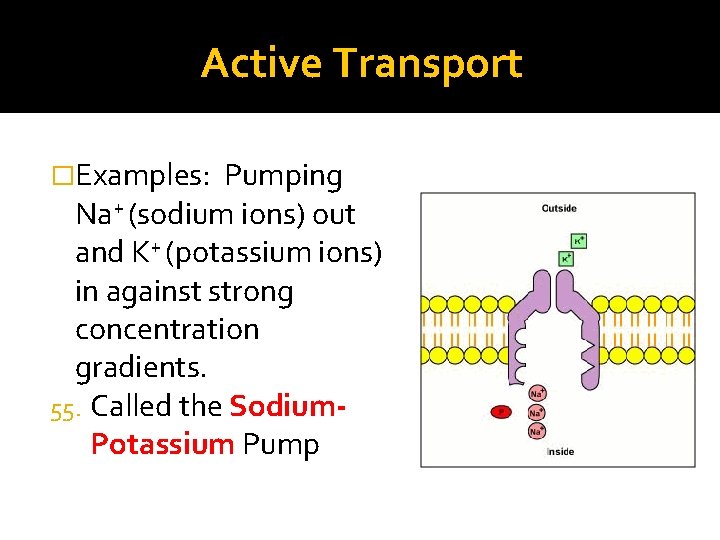
Active Transport �Examples: Pumping Na+ (sodium ions) out and K+ (potassium ions) in against strong concentration gradients. 55. Called the Sodium. Potassium Pump
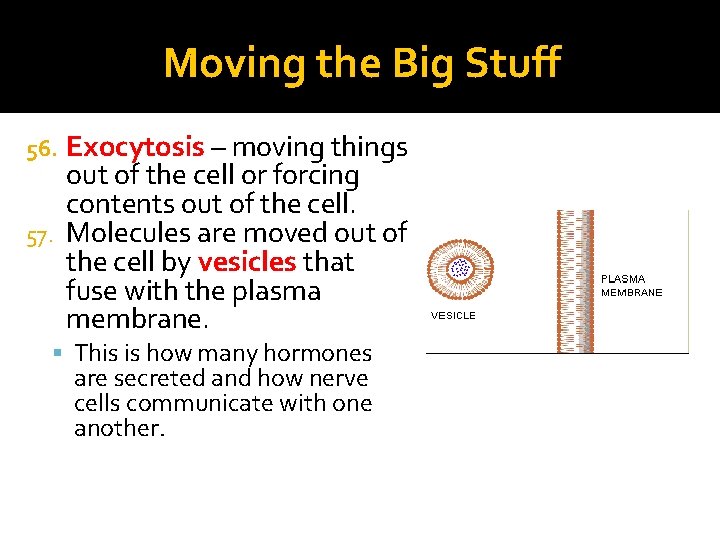
Moving the Big Stuff Exocytosis – moving things out of the cell or forcing contents out of the cell. 57. Molecules are moved out of the cell by vesicles that fuse with the plasma membrane. 56. This is how many hormones are secreted and how nerve cells communicate with one another.
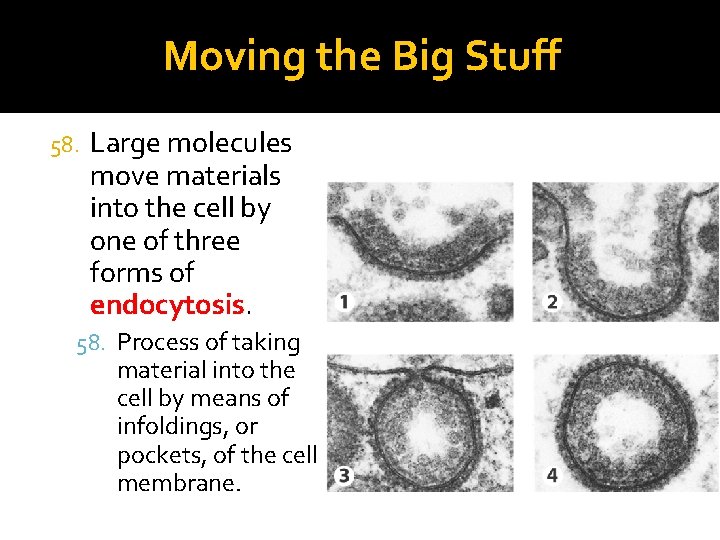
Moving the Big Stuff 58. Large molecules move materials into the cell by one of three forms of endocytosis. 58. Process of taking material into the cell by means of infoldings, or pockets, of the cell membrane.
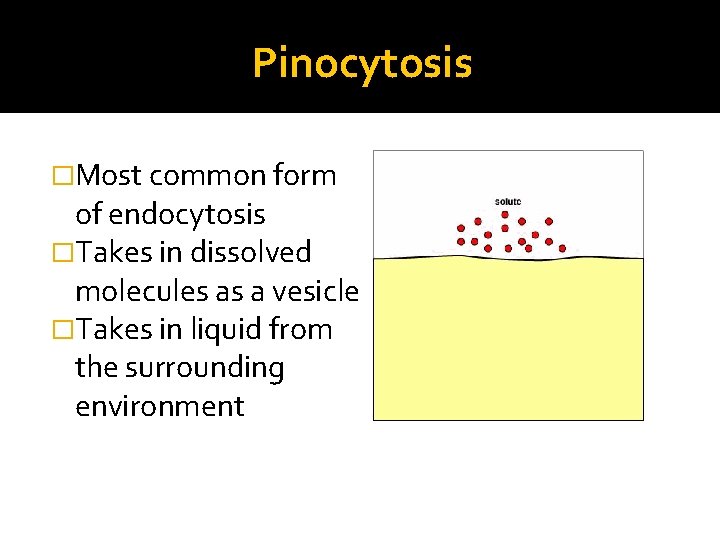
Pinocytosis �Most common form of endocytosis �Takes in dissolved molecules as a vesicle �Takes in liquid from the surrounding environment
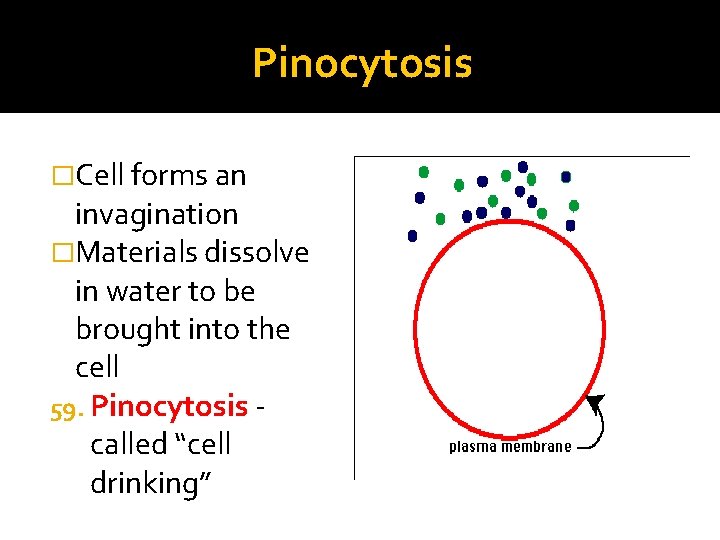
Pinocytosis �Cell forms an invagination �Materials dissolve in water to be brought into the cell 59. Pinocytosis called “cell drinking”
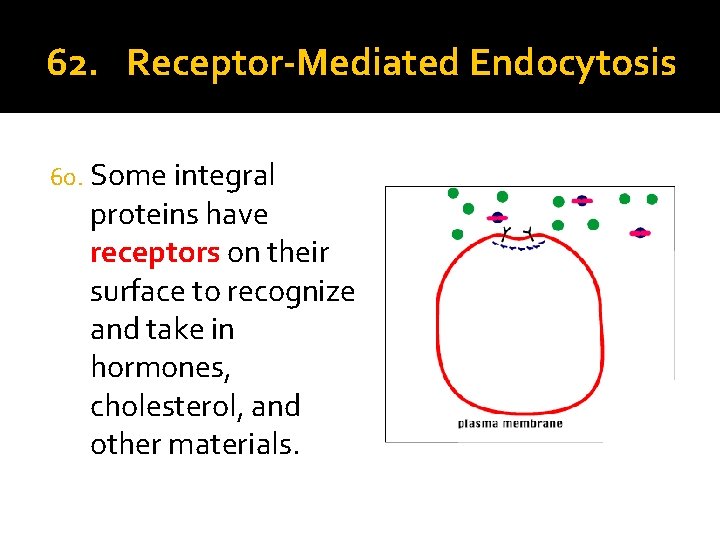
62. Receptor-Mediated Endocytosis 60. Some integral proteins have receptors on their surface to recognize and take in hormones, cholesterol, and other materials.
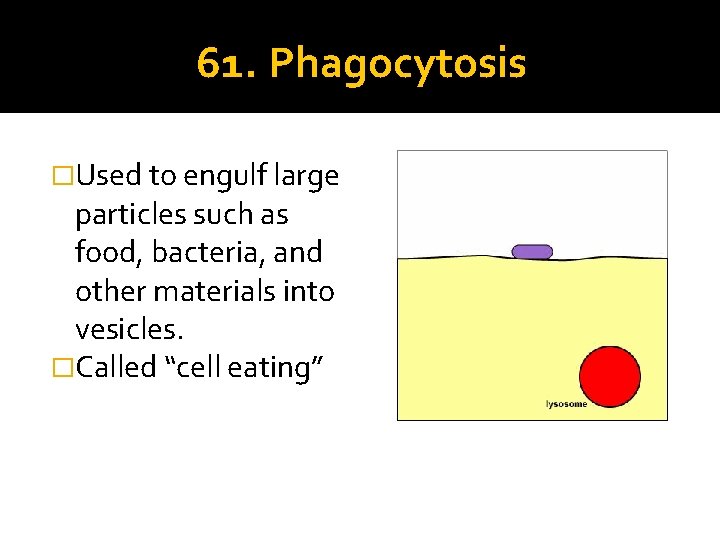
61. Phagocytosis �Used to engulf large particles such as food, bacteria, and other materials into vesicles. �Called “cell eating”
- Slides: 38