
Chapter 3 Cell Diversity Learning Objectives n n

Chapter 3 Cell Diversity
Learning Objectives n n Cell Diversity Cell Physiology
Cell Diversity: Connective n Fibroblasts: Elongated cell that secretes cable-like protein fibers. n n Large rough ER and Golgi apparatus Erythrocyte (RBC): carries O 2 throughout the body. n No organelles, lots of hemogolbin
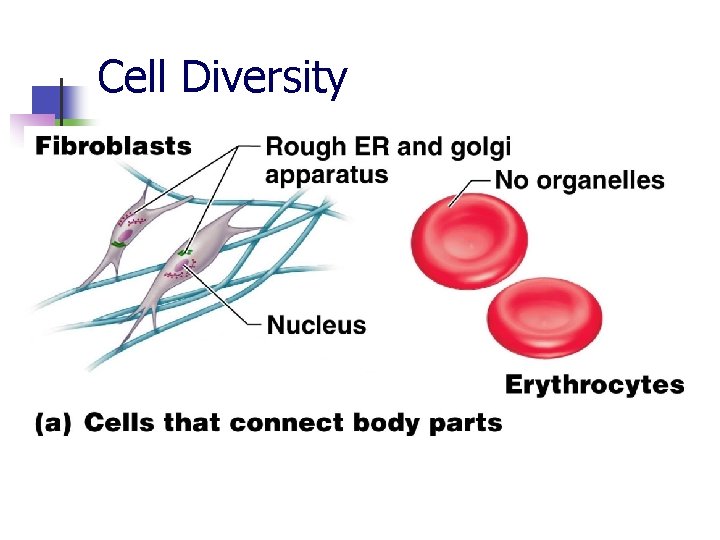
Cell Diversity
Cell Diversity: Covers and Lines n Epithelial Cell: intermediate filaments resist tearing n Hexagonal shape, pack together in sheets
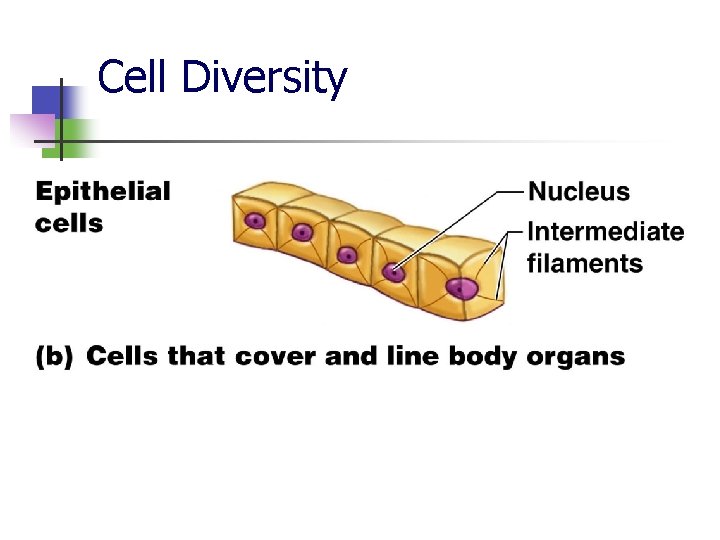
Cell Diversity
Cell Diversity: Movement n Skeletal and Smooth Muscle cells n n Elongated Lots of contractile filaments
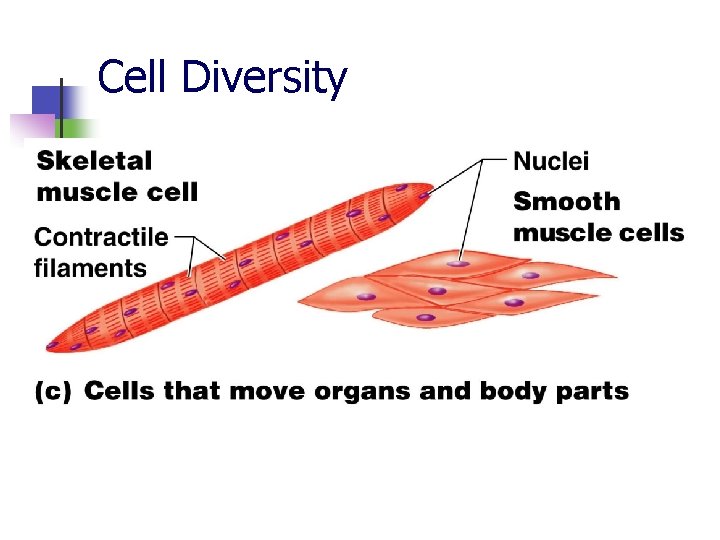
Cell Diversity
Cell Diversity: Store nutrients n Fat cells (adipose): n Spherical shape holds large lipid droplet
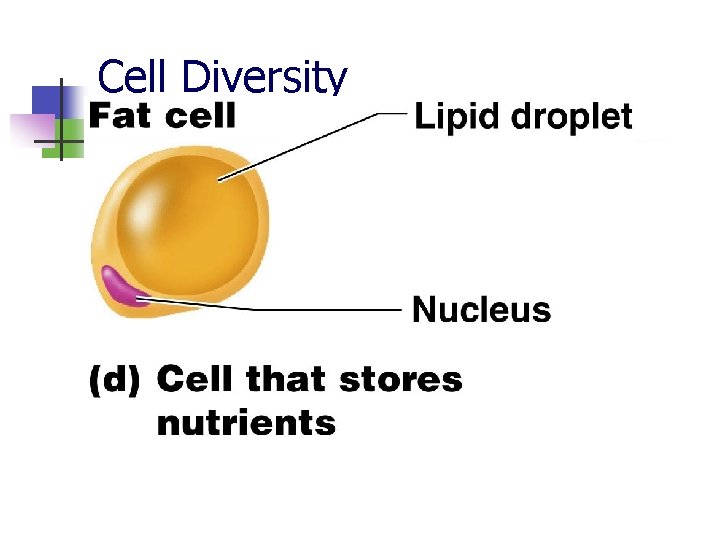
Cell Diversity
Cell Diversity: Fights disease n Macrophages, T-cells, B-cells (WBC’s): n n Some have pseudopods (fake feet) Lots of lysosomes
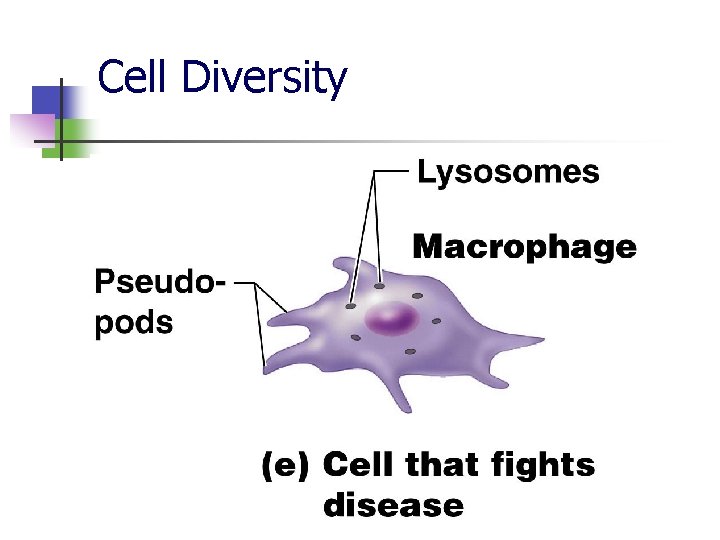
Cell Diversity
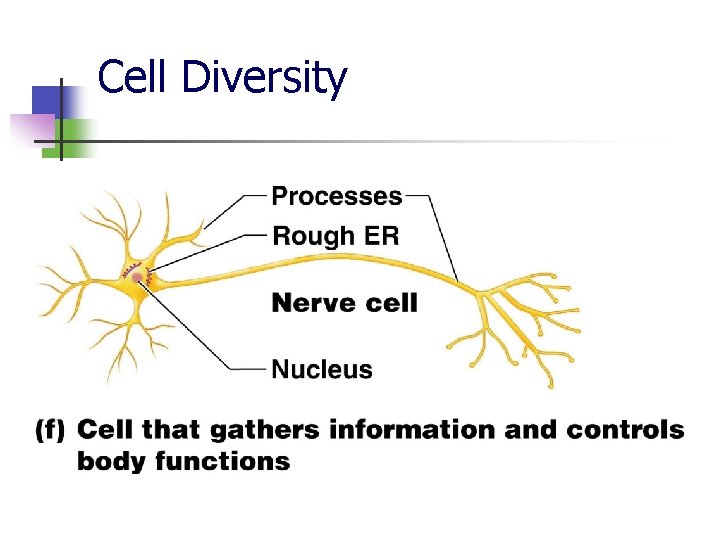
Cell Diversity: Gathers information and controls body functions n Nerve cell (neuron): n n n Axon: sends info Dendrites: receives info Lots of ER to synthesize membrane components.
Cell Diversity
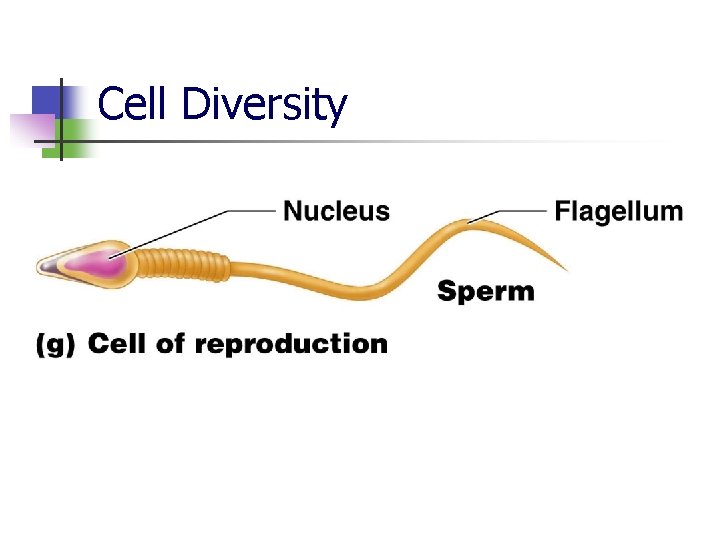
Cell Diversity: Reproduction n Oocyte: n n Female Largest cell in the body Lots of organelles Sperm: n n n Male Long and streamline flagellum
Cell Diversity
Cell Physiology: Membrane Transport n n Membrane transport—movement of substances into and out of the cell Two basic methods of transport n Passive transport n No energy is required n Active transport n Cell must provide metabolic energy (ATP)
Solutions and Transport n n n Solution—homogeneous mixture of two or more components n Solvent—dissolving medium; typically water in the body n Solutes—components in smaller quantities within a solution Intracellular fluid—nucleoplasm and cytosol Interstitial fluid—fluid on the exterior of the cell
Selective Permeability n n The plasma membrane allows some materials to pass while excluding others This permeability influences movement both into and out of the cell
Passive Transport Processes n n Diffusion: Movement of a substance from a high concentration to a low concentration n Usually lipid-soluble or small enough to pass through membrane pores n Osmosis n Water diffusion n Assisted by aquaporins Facilitated diffusion: substances require a protein carrier n Usually lipid insoluble or large
Active Transport Processes n ATP is used for transport because the substance may n n n be too big Not able to pass the lipid interior of the membrane Have to move against a concentration gradient
Active Transport Processes n Two common forms of active transport n Active transport (solute pumping) n Vesicular transport n Exocytosis – substances leave the cell through a vesicle n Endocytosis – substances enter the cell through a vesicle n Phagocytosis – “Cell eating” n Pinocytosis – “cell drinking”
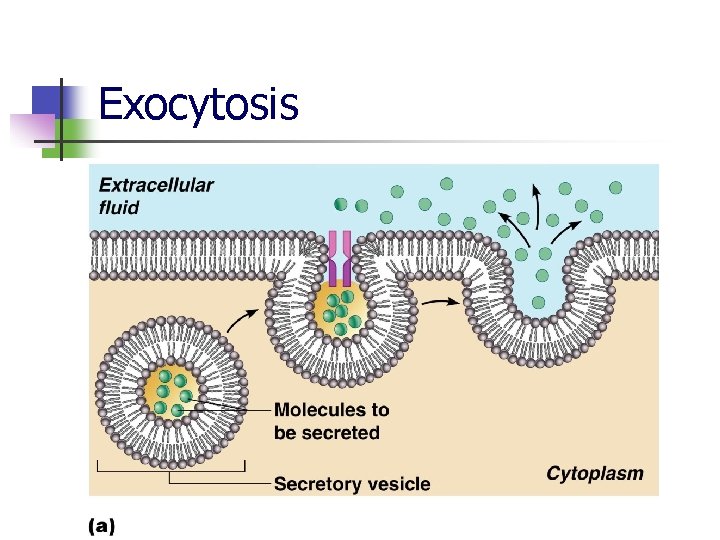
Exocytosis
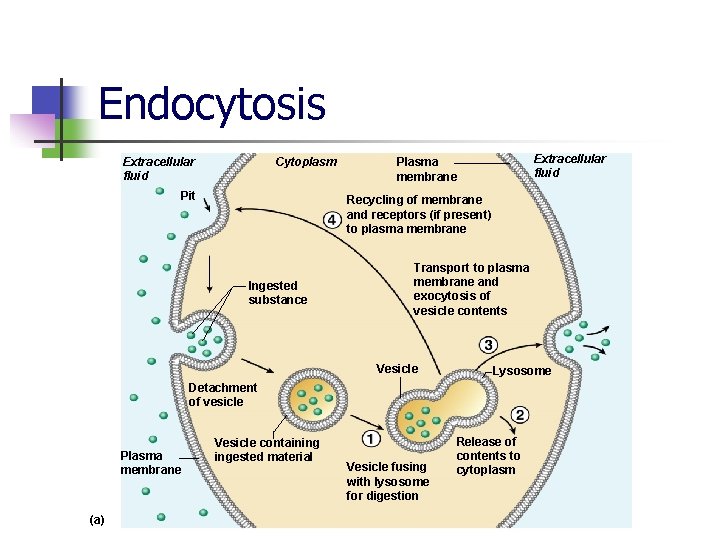
Endocytosis Extracellular fluid Cytoplasm Pit Extracellular fluid Plasma membrane Recycling of membrane and receptors (if present) to plasma membrane Ingested substance Transport to plasma membrane and exocytosis of vesicle contents Vesicle Lysosome Detachment of vesicle Plasma membrane (a) Vesicle containing ingested material Vesicle fusing with lysosome for digestion Release of contents to cytoplasm
- Slides: 24