
CHAPTER 3 Business Income Expenses Part I Income
CHAPTER 3 Business Income & Expenses: Part I Income Tax Fundamentals 2013 Student Slides Gerald E. Whittenburg Martha Altus-Buller Steven Gill 2013 Cengage Learning
Defining Trade or Business & Tests for Deductibility Ø A trade or business is not specifically defined in the Internal Revenue Code, but is generally an activity conducted for a profit Ø For a deduction to generally be considered deductible for a trade/business, it must: o o o Be ordinary and necessary Have a legitimate business purpose Be reasonable in light of the fees that are generated as a result of the expense 2013 Cengage Learning
Self-Employment Tax ØTaxpayers with net earnings of $400 or more required to pay self-employment tax ◦ File Schedule SE with Form 1040 ØTax equals ◦ Social security tax (10. 4% on the first $110, 100) plus ◦ Medicare tax (2. 9% of all net earnings) ØTaxpayer gets a deduction for AGI equal to half of the self-employment tax 2013 Cengage Learning
Transportation Ø Cost of plane, rail, bus and auto (actual or standard) potentially deductible Ø May choose standard mileage deduction ◦ $. 555 per mile ◦ Plus business portion of • Parking, tolls and personal property taxes and • Auto loan interest (if self-employed) ◦ To use standard mileage deduction, taxpayer must �Own or lease car �Not rent out �Not own fleet using 5 or more autos simultaneously �Not have taken depreciation other than straight-line �Not have taken Section 179 depreciation on auto 2013 Cengage Learning
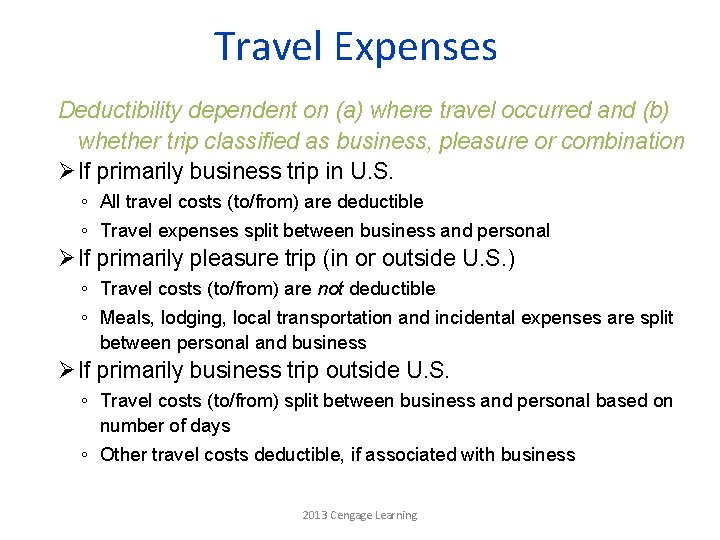
Travel Expenses Deductibility dependent on (a) where travel occurred and (b) whether trip classified as business, pleasure or combination Ø If primarily business trip in U. S. ◦ All travel costs (to/from) are deductible ◦ Travel expenses split between business and personal Ø If primarily pleasure trip (in or outside U. S. ) ◦ Travel costs (to/from) are not deductible ◦ Meals, lodging, local transportation and incidental expenses are split between personal and business Ø If primarily business trip outside U. S. ◦ Travel costs (to/from) split between business and personal based on number of days ◦ Other travel costs deductible, if associated with business 2013 Cengage Learning
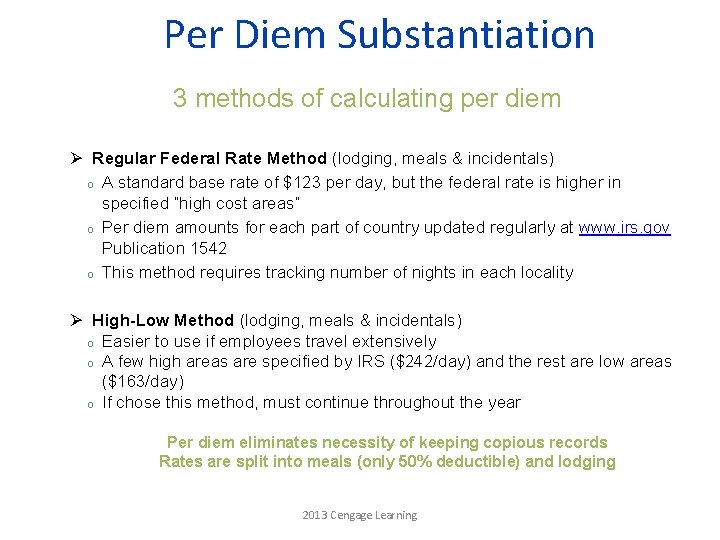
Per Diem Substantiation 3 methods of calculating per diem Ø Regular Federal Rate Method (lodging, meals & incidentals) o A standard base rate of $123 per day, but the federal rate is higher in specified “high cost areas” o Per diem amounts for each part of country updated regularly at www. irs. gov Publication 1542 o This method requires tracking number of nights in each locality Ø High-Low Method (lodging, meals & incidentals) o Easier to use if employees travel extensively o A few high areas are specified by IRS ($242/day) and the rest are low areas ($163/day) o If chose this method, must continue throughout the year Per diem eliminates necessity of keeping copious records Rates are split into meals (only 50% deductible) and lodging 2013 Cengage Learning
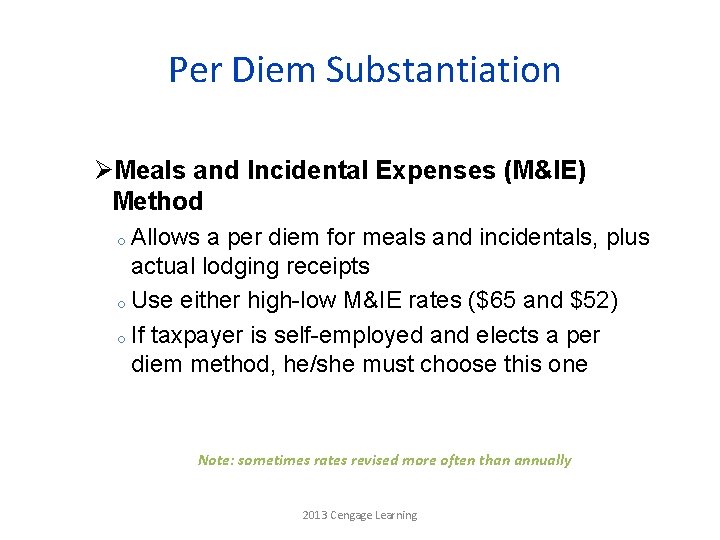
Per Diem Substantiation ØMeals and Incidental Expenses (M&IE) Method o Allows a per diem for meals and incidentals, plus actual lodging receipts o Use either high-low M&IE rates ($65 and $52) o If taxpayer is self-employed and elects a per diem method, he/she must choose this one Note: sometimes rates revised more often than annually 2013 Cengage Learning
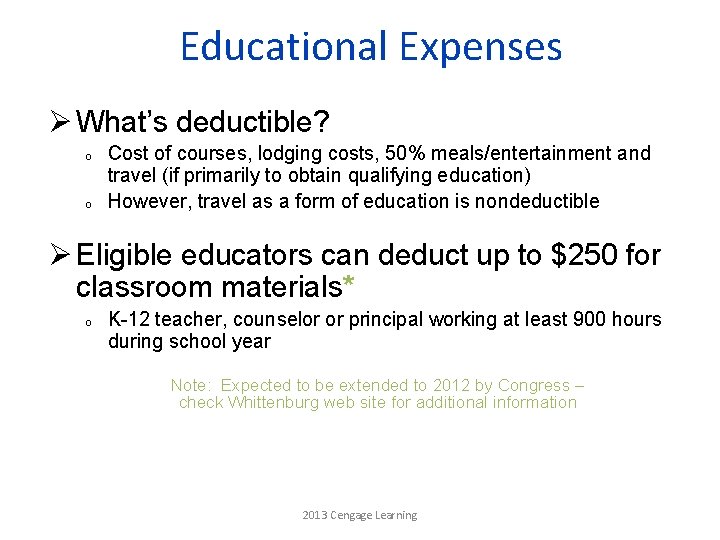
Educational Expenses Ø What’s deductible? o o Cost of courses, lodging costs, 50% meals/entertainment and travel (if primarily to obtain qualifying education) However, travel as a form of education is nondeductible Ø Eligible educators can deduct up to $250 for classroom materials* o K-12 teacher, counselor or principal working at least 900 hours during school year Note: Expected to be extended to 2012 by Congress – check Whittenburg web site for additional information 2013 Cengage Learning
Bad Debts Two categories of bad debts ØBusiness bad debts are ordinary deductions ◦ Those that arise from trade/business ◦ These are deductible ØNon-business bad debts are short-term capital losses, which are netted against other capital gains and losses ◦ Report on Schedule D ◦ Subject to $3, 000/year loss limitation (discussed in Chapter 8 in more detail) 2013 Cengage Learning
Office in Home (OIH) Ø Deduction for business use of a home is allowed only by exception, including o Home used regularly and exclusively as principal place of business or required for the “convenience of employer” when regular office not provided or o The regular place to manage business or meet with clients/patients or o Office is separate structure and used exclusively for business or o Dwelling unit is used for inventory storage and home is taxpayer’s sole place of business 2013 Cengage Learning
OIH – Form 8829 Ø Complete Form 8829 – “Expenses for Business Use of Your Home” o o If taxpayer is self-employed Allowable deduction carries from 8829 to bottom of Schedule C If taken as an employee business expense Allowable deduction carries to Schedule A • But can only take if necessary for employer convenience and • Employer does not provide a regular office 2013 Cengage Learning
- Slides: 11