
Chapter 3 Biopsychology The Nervous System Neurons Neurotransmitters
Chapter 3 Biopsychology
The Nervous System Neurons & Neurotransmitters • • • Function of Neurons How neurons communicate Action Potentials Function of Neurotransmitters SSRI’s
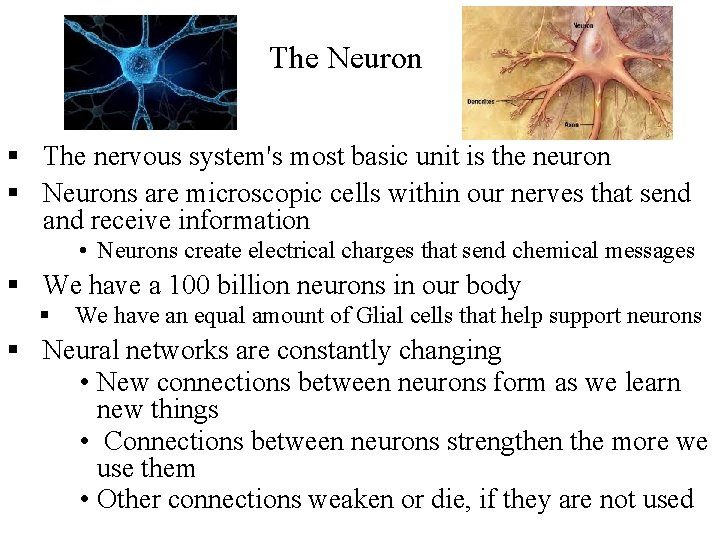
Neurons The Neuron § The nervous system's most basic unit is the neuron § Neurons are microscopic cells within our nerves that send and receive information • Neurons create electrical charges that send chemical messages § We have a 100 billion neurons in our body § We have an equal amount of Glial cells that help support neurons § Neural networks are constantly changing • New connections between neurons form as we learn new things • Connections between neurons strengthen the more we use them • Other connections weaken or die, if they are not used
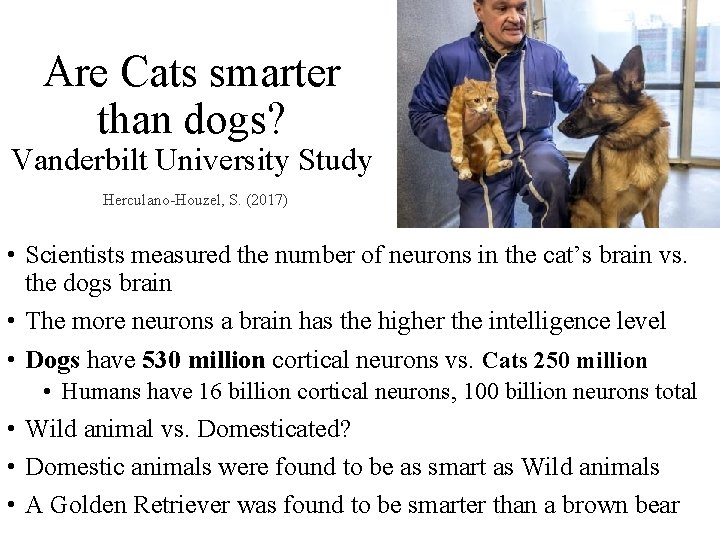
Are Cats smarter than dogs? Vanderbilt University Study Herculano-Houzel, S. (2017) • Scientists measured the number of neurons in the cat’s brain vs. the dogs brain • The more neurons a brain has the higher the intelligence level • Dogs have 530 million cortical neurons vs. Cats 250 million • Humans have 16 billion cortical neurons, 100 billion neurons total • Wild animal vs. Domesticated? • Domestic animals were found to be as smart as Wild animals • A Golden Retriever was found to be smarter than a brown bear
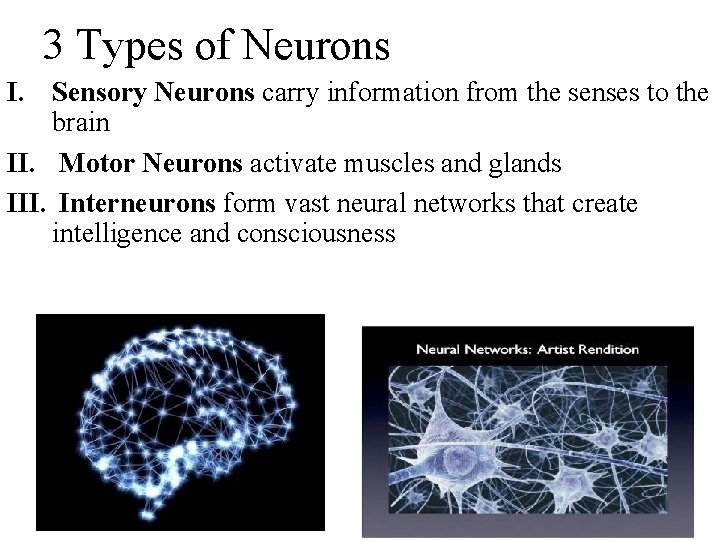
3 Types of Neurons I. Sensory Neurons carry information from the senses to the brain II. Motor Neurons activate muscles and glands III. Interneurons form vast neural networks that create intelligence and consciousness
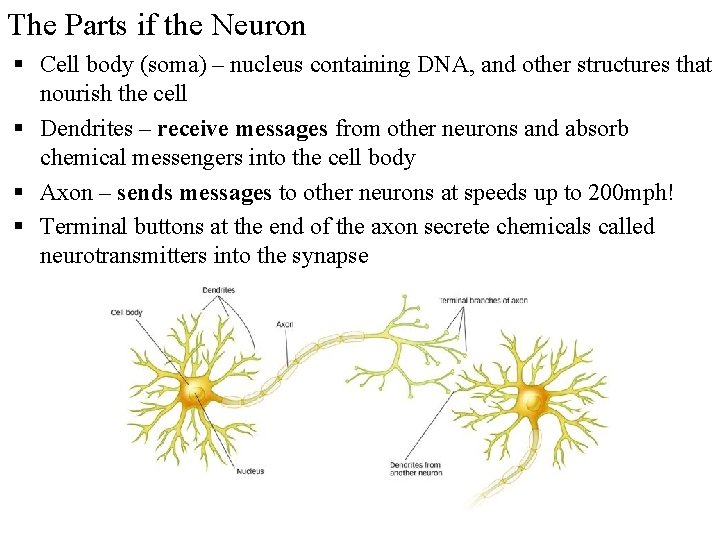
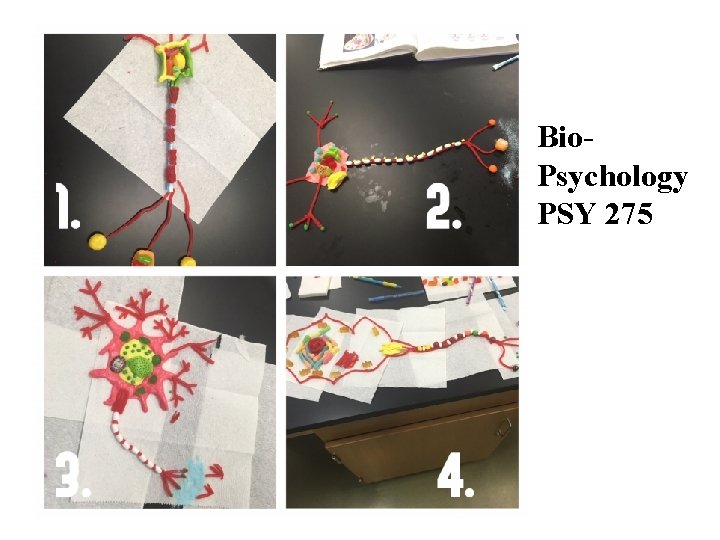
The Parts if the Neuron § Cell body (soma) – nucleus containing DNA, and other structures that nourish the cell § Dendrites – receive messages from other neurons and absorb chemical messengers into the cell body § Axon – sends messages to other neurons at speeds up to 200 mph! § Terminal buttons at the end of the axon secrete chemicals called neurotransmitters into the synapse
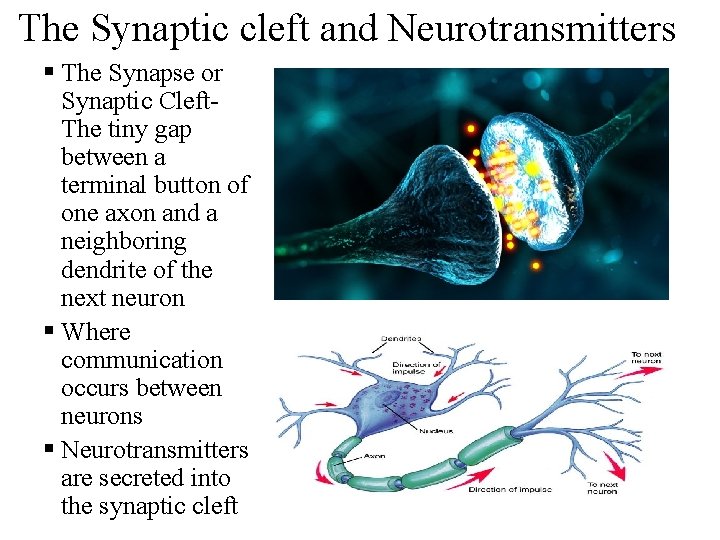
The Synaptic cleft and Neurotransmitters § The Synapse or Synaptic Cleft. The tiny gap between a terminal button of one axon and a neighboring dendrite of the next neuron § Where communication occurs between neurons § Neurotransmitters are secreted into the synaptic cleft
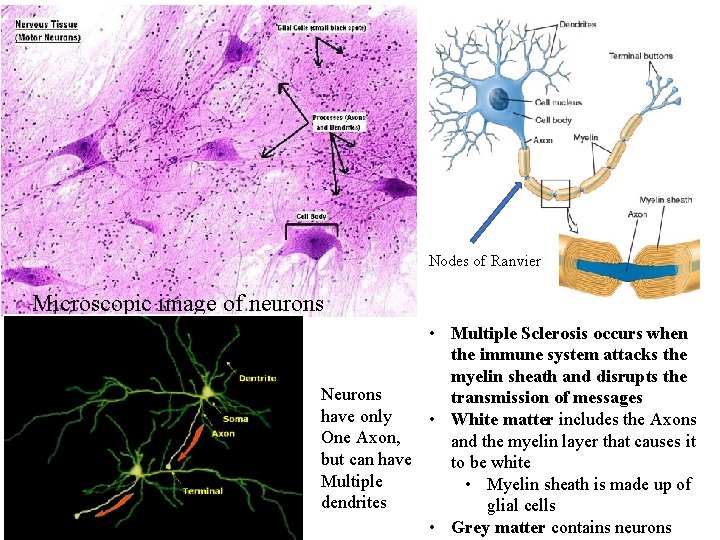
Nodes of Ranvier Microscopic image of neurons • Multiple Sclerosis occurs when the immune system attacks the myelin sheath and disrupts the Neurons transmission of messages have only • White matter includes the Axons One Axon, and the myelin layer that causes it but can have to be white Multiple • Myelin sheath is made up of dendrites glial cells • Grey matter contains neurons
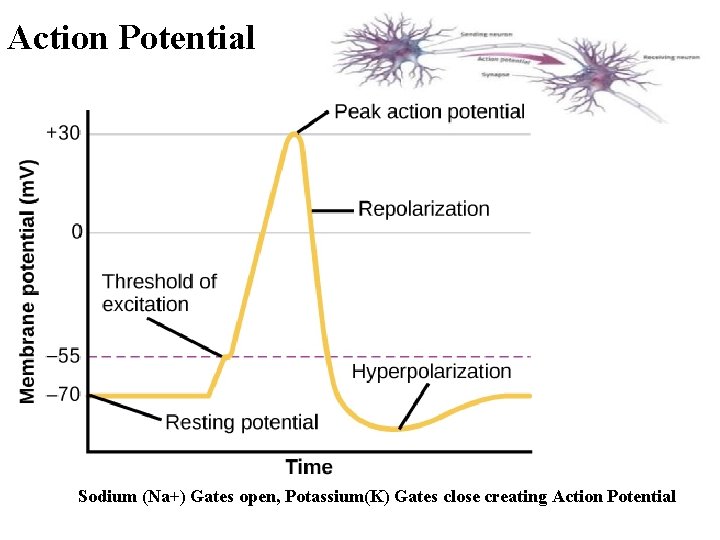
Action Potential • Resting potential § A resting neuron has a neutral electrical charge waiting to be activated § Sodium Na+ is more concentrated outside the cell and Potassium K is higher inside the cell • Threshold § The neuron receives a chemical signal from an adjacent neuron causing gates to open and allow Na+ molecules to rush in creating an electrical charge. When the charge reaches it’s threshold the neuron fires it’s action potential • Action Potential § The nerve impulse when the neuron fires and sends the message down the axon § All or nothing Sodium (Na+) Gatesevent open, Potassium(K) Gates close creating Action Potential
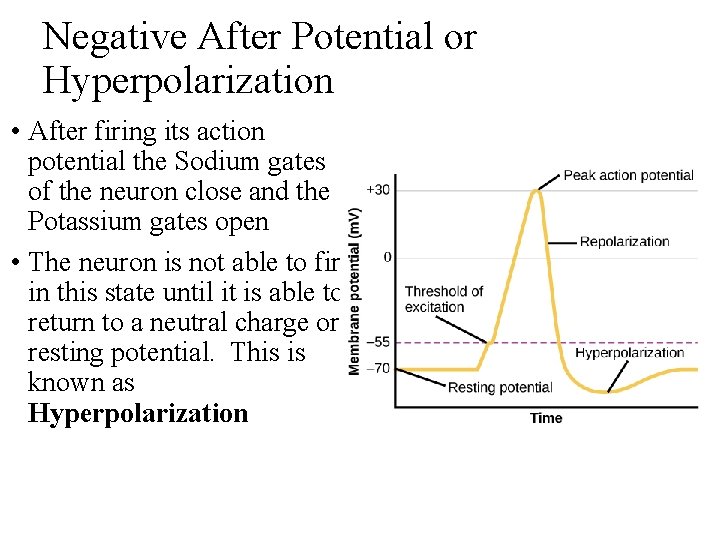
Negative After Potential or Hyperpolarization • After firing its action potential the Sodium gates of the neuron close and the Potassium gates open • The neuron is not able to fire in this state until it is able to return to a neutral charge or resting potential. This is known as Hyperpolarization
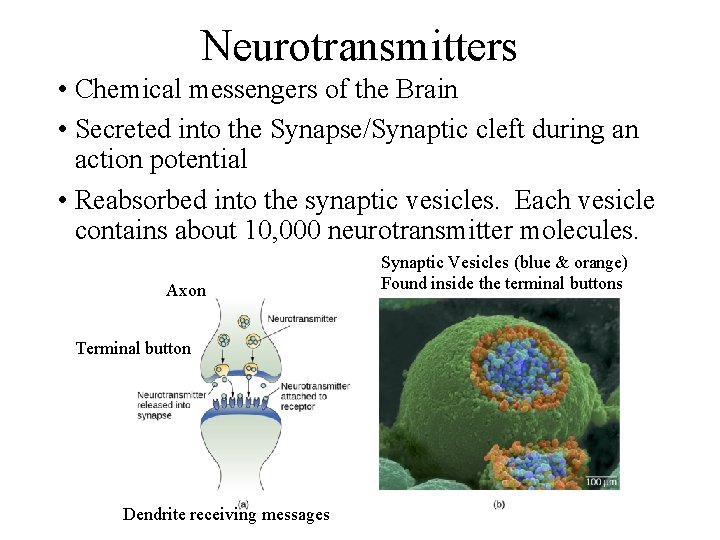
Neurotransmitters • Chemical messengers of the Brain • Secreted into the Synapse/Synaptic cleft during an action potential • Reabsorbed into the synaptic vesicles. Each vesicle contains about 10, 000 neurotransmitter molecules. Axon Terminal button Dendrite receiving messages Synaptic Vesicles (blue & orange) Found inside the terminal buttons
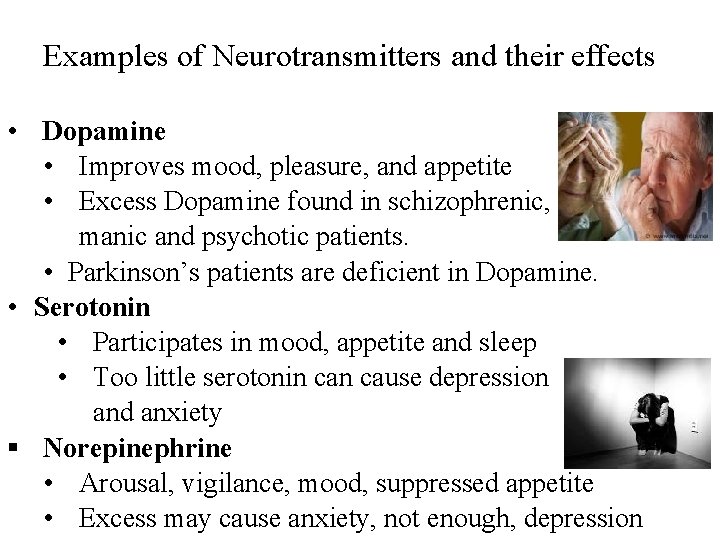
Examples of Neurotransmitters and their effects • Dopamine • Improves mood, pleasure, and appetite • Excess Dopamine found in schizophrenic, manic and psychotic patients. • Parkinson’s patients are deficient in Dopamine. • Serotonin • Participates in mood, appetite and sleep • Too little serotonin cause depression and anxiety § Norepinephrine • Arousal, vigilance, mood, suppressed appetite • Excess may cause anxiety, not enough, depression
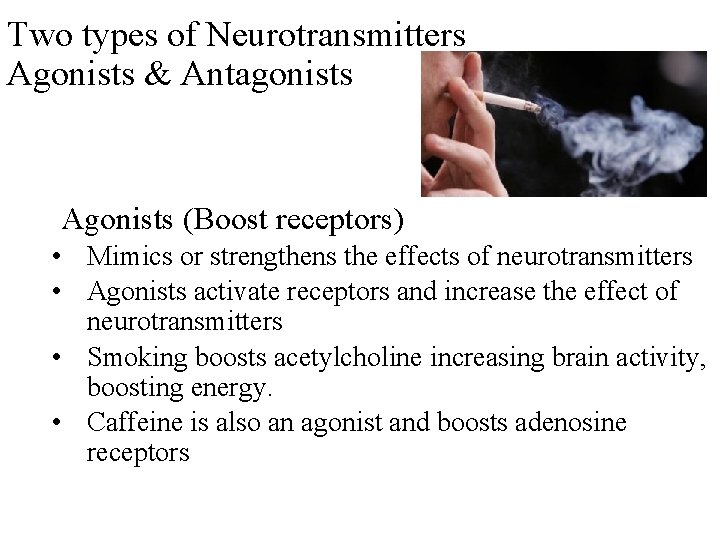
Two types of Neurotransmitters Agonists & Antagonists Agonists (Boost receptors) • Mimics or strengthens the effects of neurotransmitters • Agonists activate receptors and increase the effect of neurotransmitters • Smoking boosts acetylcholine increasing brain activity, boosting energy. • Caffeine is also an agonist and boosts adenosine receptors
Antagonists (Block receptors) • Block neurotransmitter receptors so fewer messages are sent. • Slows transmission of messages. • Anti-psychotics are antagonists for dopamine, blocking Dopamine's effects. • Both Antagonists and Agonists bind to receptor sites, but Antagonists slow messages and Agonists increase activity and activate receptors.
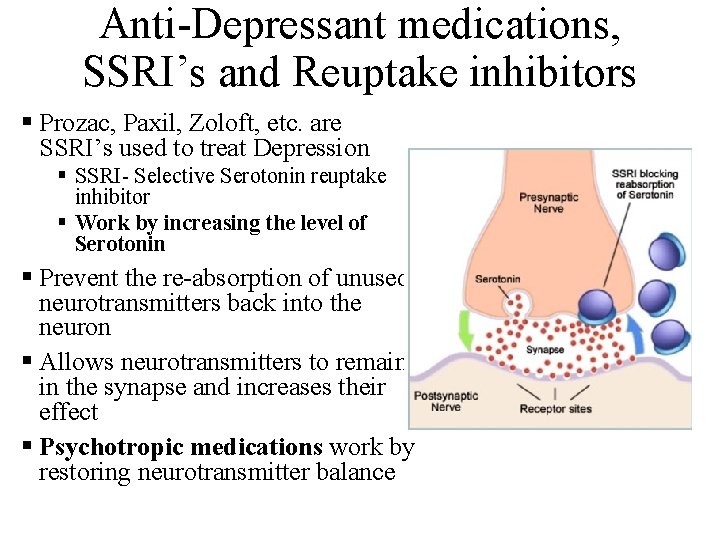
Anti-Depressant medications, SSRI’s and Reuptake inhibitors § Prozac, Paxil, Zoloft, etc. are SSRI’s used to treat Depression § SSRI- Selective Serotonin reuptake inhibitor § Work by increasing the level of Serotonin § Prevent the re-absorption of unused neurotransmitters back into the neuron § Allows neurotransmitters to remain in the synapse and increases their effect § Psychotropic medications work by restoring neurotransmitter balance
Bio. Psychology PSY 275
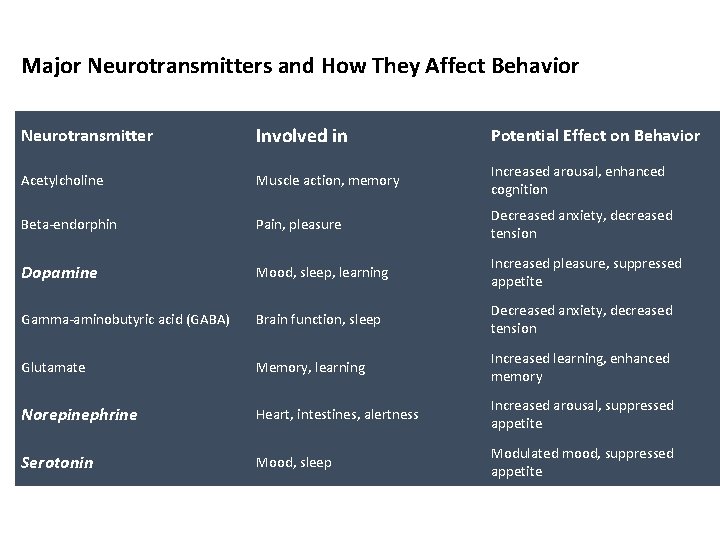
Major Neurotransmitters and How They Affect Behavior Neurotransmitter Involved in Potential Effect on Behavior Acetylcholine Muscle action, memory Increased arousal, enhanced cognition Beta-endorphin Pain, pleasure Decreased anxiety, decreased tension Dopamine Mood, sleep, learning Increased pleasure, suppressed appetite Gamma-aminobutyric acid (GABA) Brain function, sleep Decreased anxiety, decreased tension Glutamate Memory, learning Increased learning, enhanced memory Norepinephrine Heart, intestines, alertness Increased arousal, suppressed appetite Serotonin Mood, sleep Modulated mood, suppressed appetite
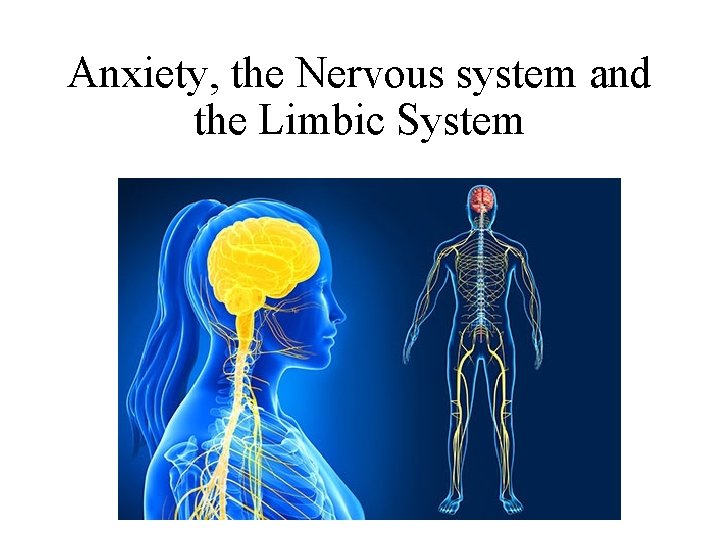
Anxiety, the Nervous system and the Limbic System
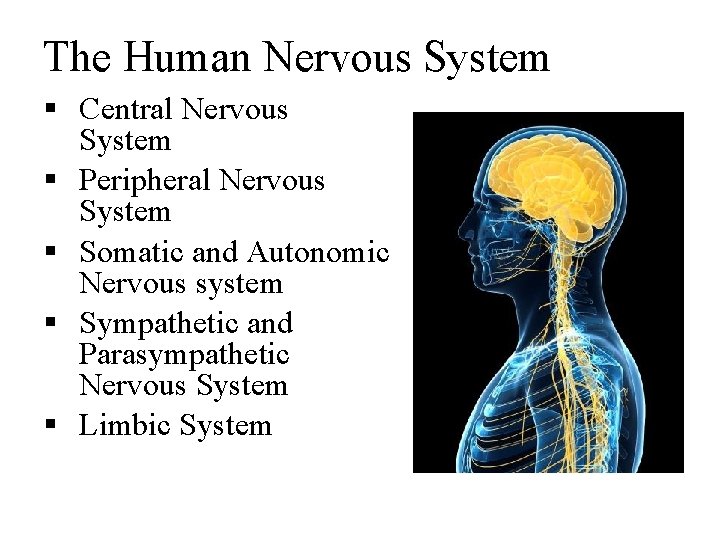
The Human Nervous System § Central Nervous System § Peripheral Nervous System § Somatic and Autonomic Nervous system § Sympathetic and Parasympathetic Nervous System § Limbic System § techniques
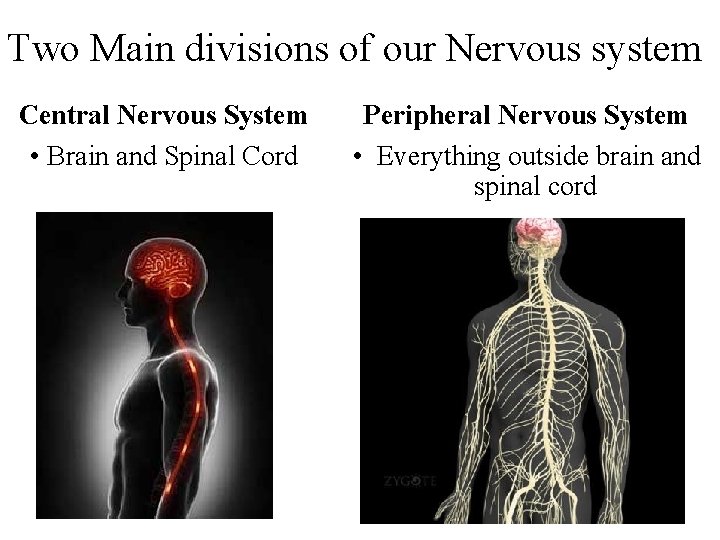
Two Main divisions of our Nervous system Central Nervous System • Brain and Spinal Cord Peripheral Nervous System • Everything outside brain and spinal cord
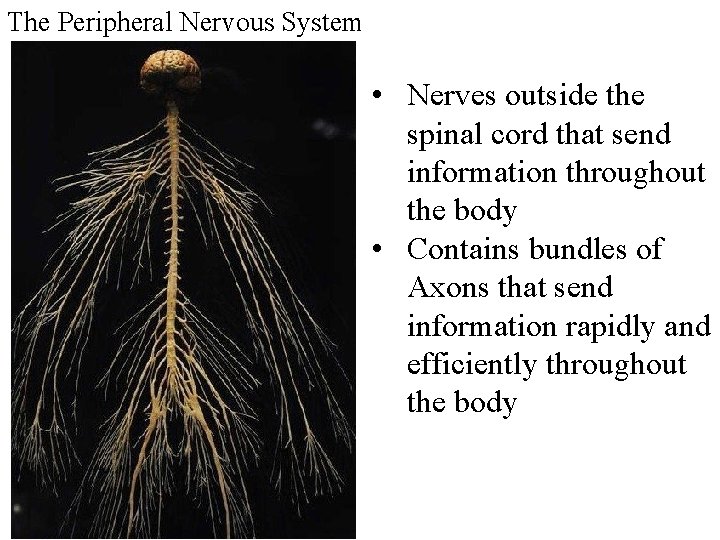
The Peripheral Nervous System • Nerves outside the spinal cord that send information throughout the body • Contains bundles of Axons that send information rapidly and efficiently throughout the body
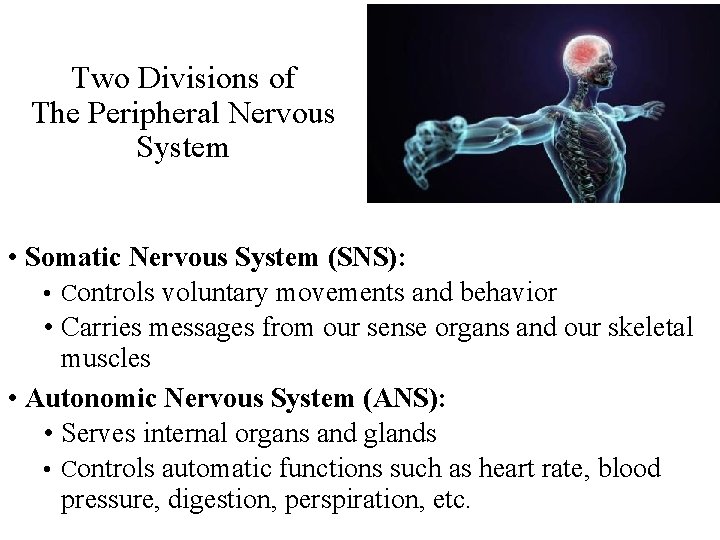
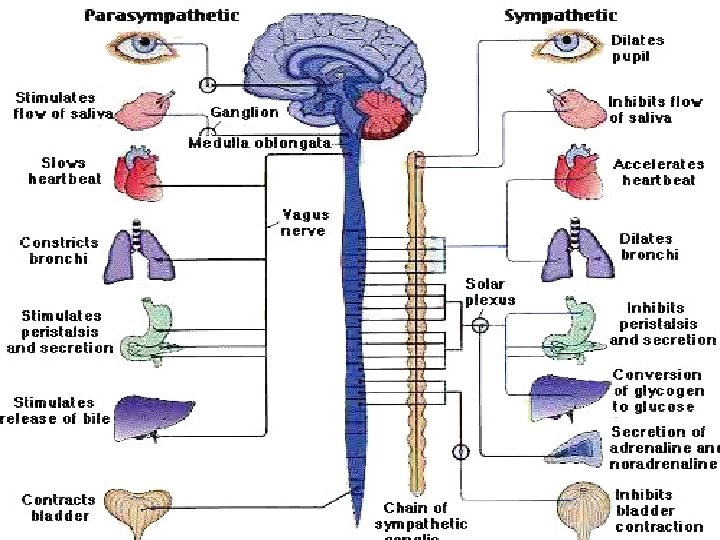
Two Divisions of The Peripheral Nervous System • Somatic Nervous System (SNS): • Controls voluntary movements and behavior • Carries messages from our sense organs and our skeletal muscles • Autonomic Nervous System (ANS): • Serves internal organs and glands • Controls automatic functions such as heart rate, blood pressure, digestion, perspiration, etc.
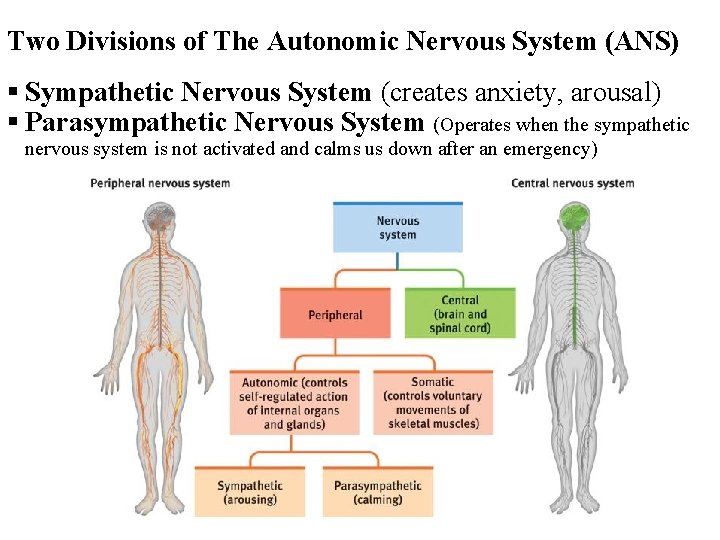
Two Divisions of The Autonomic Nervous System (ANS) § Sympathetic Nervous System (creates anxiety, arousal) § Parasympathetic Nervous System (Operates when the sympathetic nervous system is not activated and calms us down after an emergency)
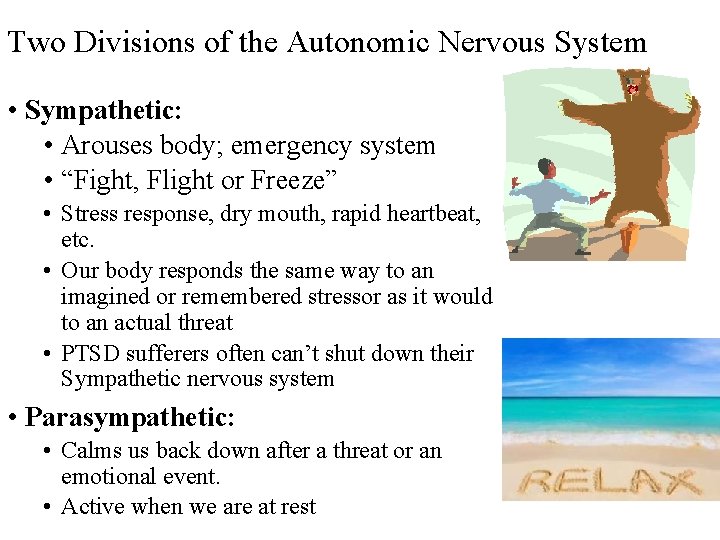
Two Divisions of the Autonomic Nervous System • Sympathetic: • Arouses body; emergency system • “Fight, Flight or Freeze” • Stress response, dry mouth, rapid heartbeat, etc. • Our body responds the same way to an imagined or remembered stressor as it would to an actual threat • PTSD sufferers often can’t shut down their Sympathetic nervous system • Parasympathetic: • Calms us back down after a threat or an emotional event. • Active when we are at rest
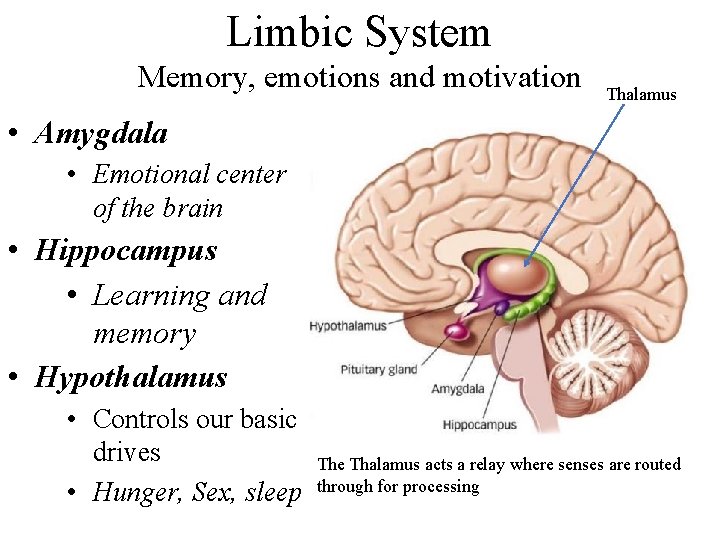
Limbic System Memory, emotions and motivation Thalamus • Amygdala • Emotional center of the brain • Hippocampus • Learning and memory • Hypothalamus • Controls our basic drives • Hunger, Sex, sleep The Thalamus acts a relay where senses are routed through for processing
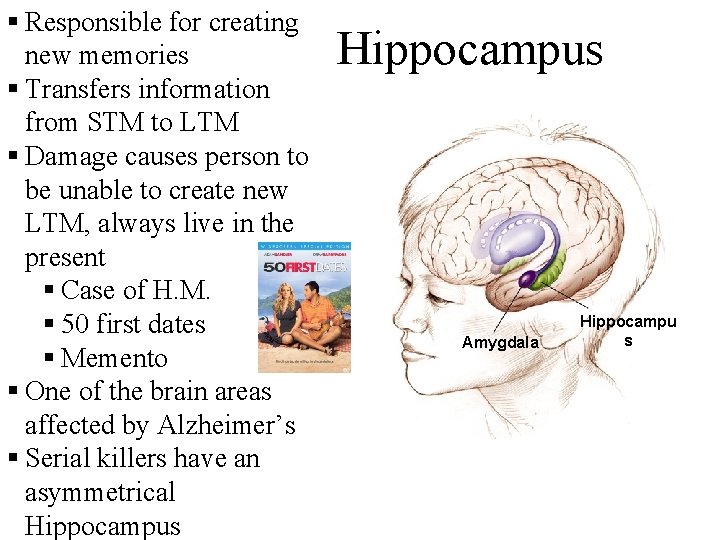
§ Responsible for creating new memories § Transfers information from STM to LTM § Damage causes person to be unable to create new LTM, always live in the present § Case of H. M. § 50 first dates § Memento § One of the brain areas affected by Alzheimer’s § Serial killers have an asymmetrical Hippocampus Amygdala Hippocampu s
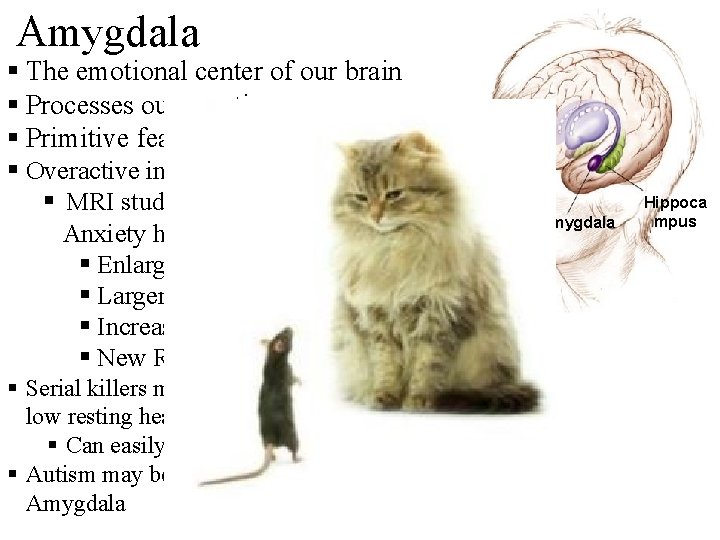
Amygdala § The emotional center of our brain § Processes our emotions § Primitive fear response, activates/SNS § Overactive in anxiety sufferers § MRI studies of people with severe Anxiety have shown: § Enlarged amygdala § Larger fear centers § Increased neural connections § New Research in reversing enlargement § Serial killers may have amygdala abnormalities, low resting heart rate, low emotional response § Can easily pass a polygraph § Autism may be caused by faulty connections in the Amygdala Hippoca mpus
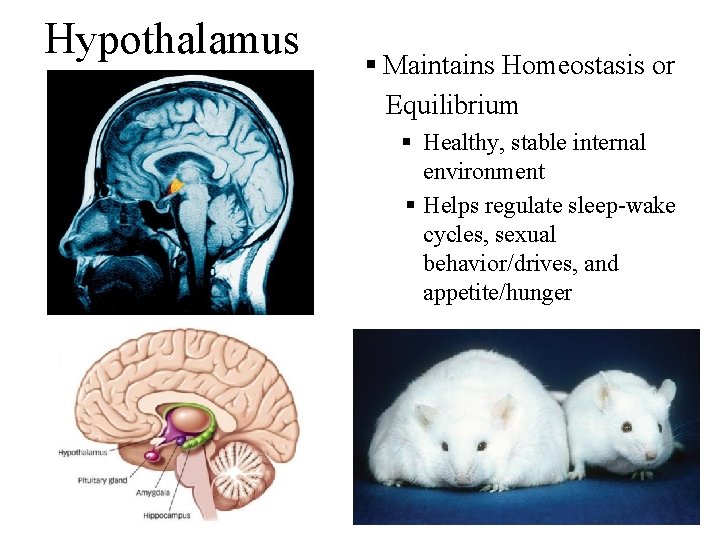
Hypothalamus § Maintains Homeostasis or Equilibrium § Healthy, stable internal environment § Helps regulate sleep-wake cycles, sexual behavior/drives, and appetite/hunger
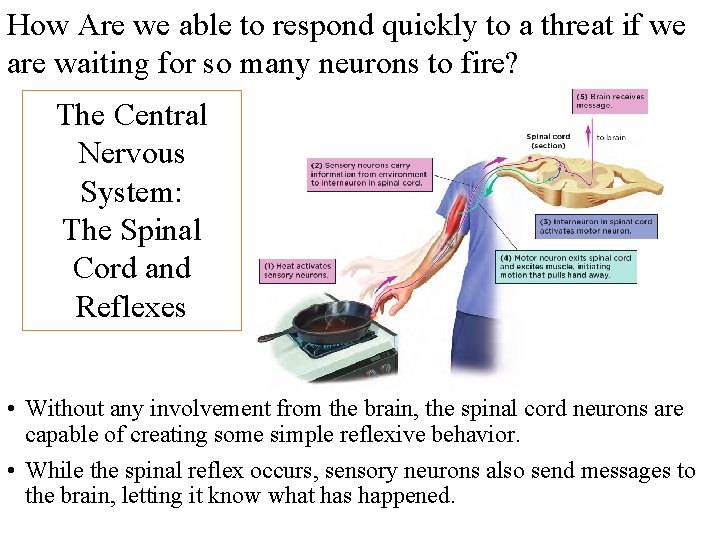
How Are we able to respond quickly to a threat if we are waiting for so many neurons to fire? The Central Nervous System: The Spinal Cord and Reflexes • Without any involvement from the brain, the spinal cord neurons are capable of creating some simple reflexive behavior. • While the spinal reflex occurs, sensory neurons also send messages to the brain, letting it know what has happened.
The Brain
The Brain § § § Cerebral Cortex Right and Left Hemispheres of the Brain Language and the Brain Lobes of the Brain and their functions Midbrain and Hindbrain Structures Brain imaging techniques
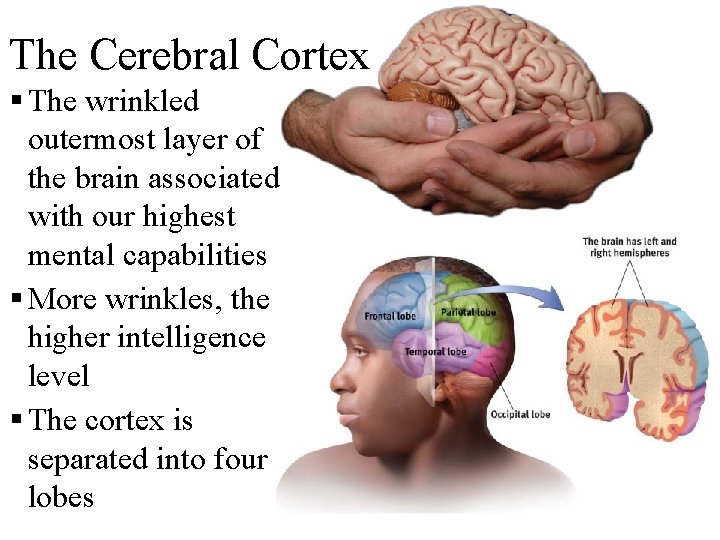
The Cerebral Cortex § The wrinkled outermost layer of the brain associated with our highest mental capabilities § More wrinkles, the higher intelligence level § The cortex is separated into four lobes
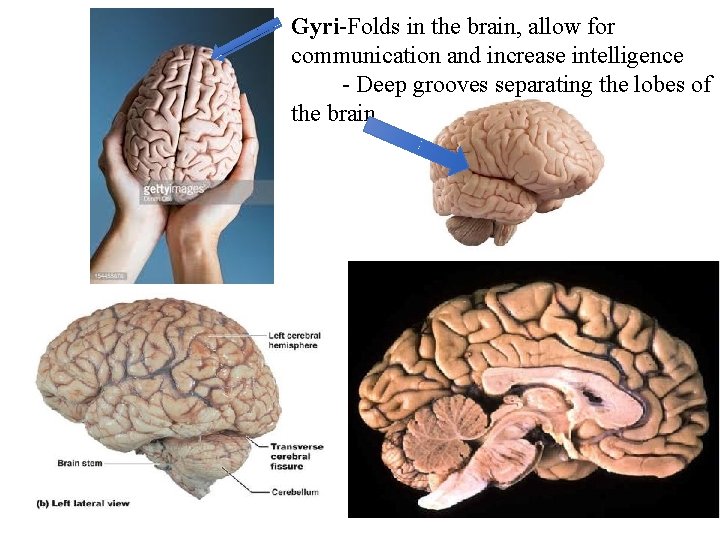
Gyri-Folds in the brain, allow for communication and increase intelligence Sulci- Deep grooves separating the lobes of the brain
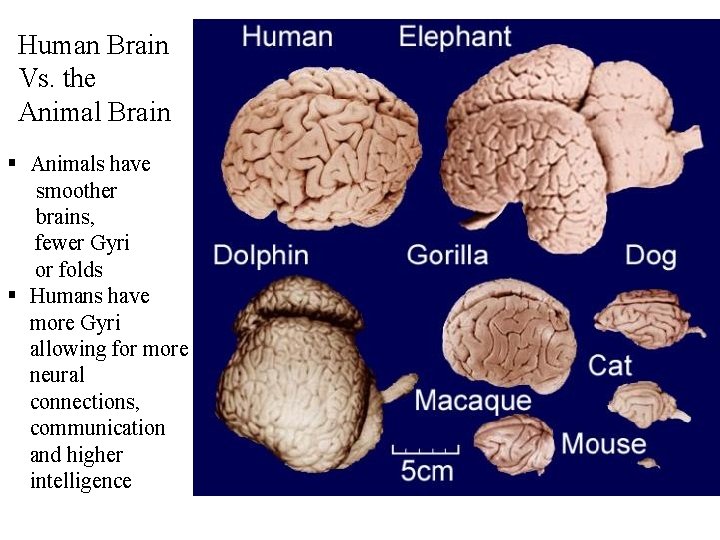
Human Brain Vs. the Animal Brain § Animals have smoother brains, fewer Gyri or folds § Humans have more Gyri allowing for more neural connections, communication and higher intelligence
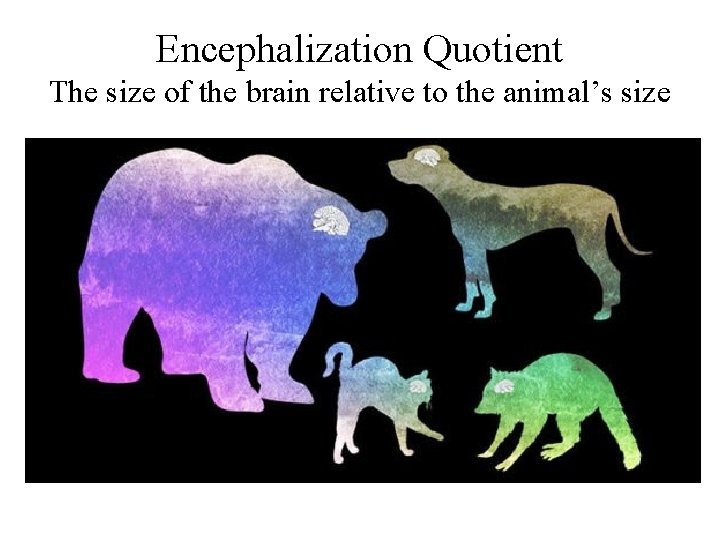
Encephalization Quotient The size of the brain relative to the animal’s size
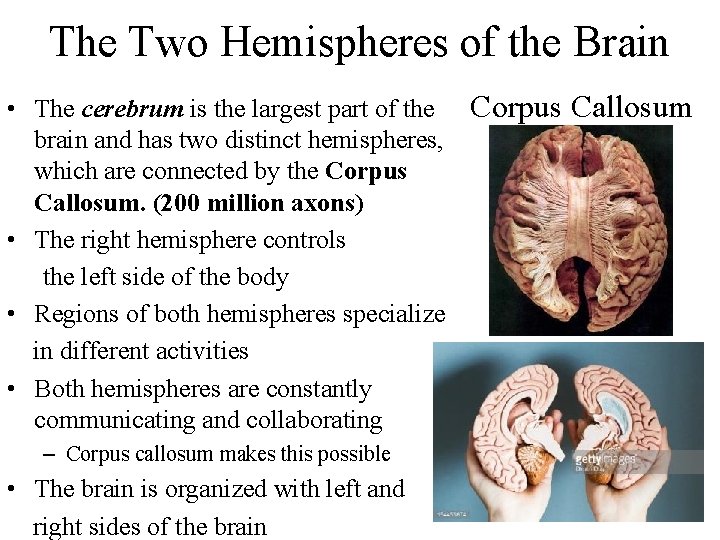
The Two Hemispheres of the Brain • The cerebrum is the largest part of the brain and has two distinct hemispheres, which are connected by the Corpus Callosum. (200 million axons) • The right hemisphere controls the left side of the body • Regions of both hemispheres specialize in different activities • Both hemispheres are constantly communicating and collaborating – Corpus callosum makes this possible • The brain is organized with left and right sides of the brain Corpus Callosum

Brain Hemisphere Specialization • The left hemisphere is generally the language center of the brain • Lateralization is the tendency to use specific parts of the brain for specific tasks • Both sides of the brain are capable of right and left brain activities • Studies of split brain patients show a remarkable ability for the brain to adapt called Neuroplasticity • Accidental brain injuries and surgical removal of parts of the brain give us information about the functions of different parts of the brain.

Split Brain surgeries § Corpus Callosum is cut to stop severe seizures § The person now has two brains. The left and right hemisphere no longer communicate with each other. § Creates only subtle deficits. § If a person is presented with an apple in the left hemisphere, they cannot say what it is. The language center is in the left, but the image of the apple is processed in the right hemisphere
Severed Corpus Callosum Patient (5: 46) https: //www. youtube. com/watch? v=zx 53 Zj 7 EKQE
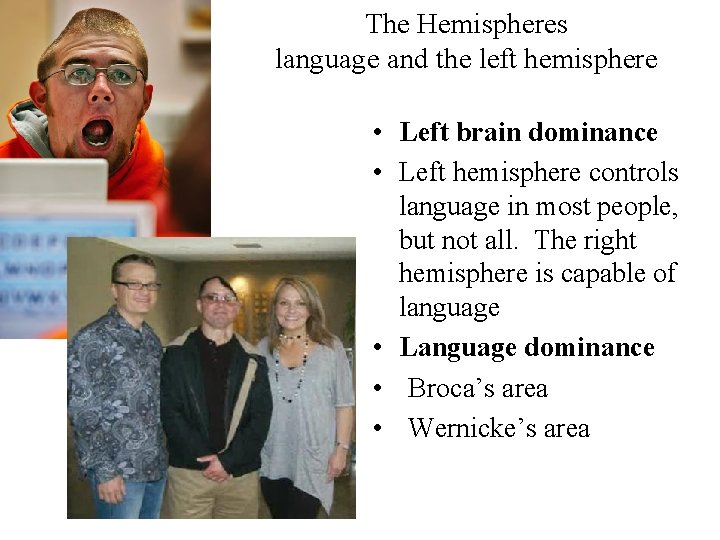
The Hemispheres language and the left hemisphere • Left brain dominance • Left hemisphere controls language in most people, but not all. The right hemisphere is capable of language • Language dominance • Broca’s area • Wernicke’s area
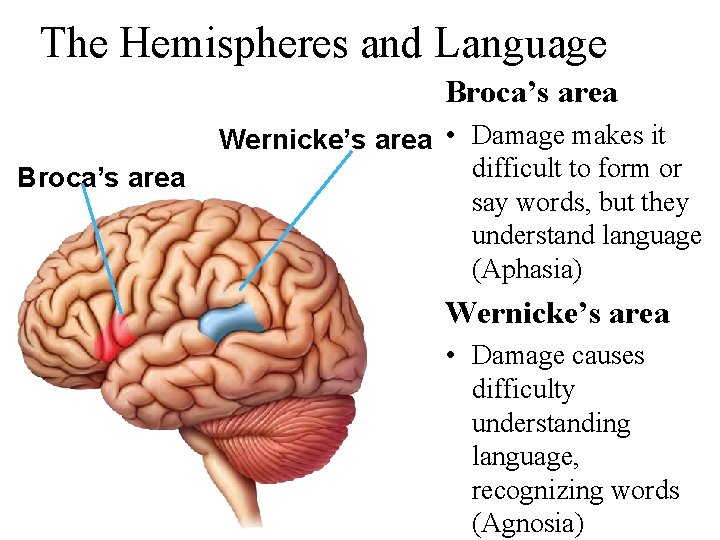
The Hemispheres and Language Broca’s area Wernicke’s area • Damage makes it difficult to form or say words, but they understand language (Aphasia) Wernicke’s area • Damage causes difficulty understanding language, recognizing words (Agnosia)
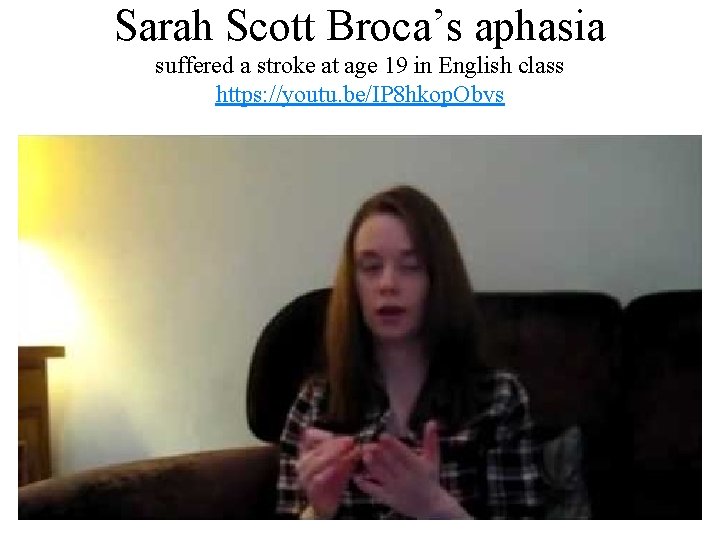
Sarah Scott Broca’s aphasia suffered a stroke at age 19 in English class https: //youtu. be/IP 8 hkop. Obvs
Sarah Scott Broca’s Aphasia Video (7: 18) https: //www. youtube. com/watch? v=1 apl. Tv. EQ 6 ew
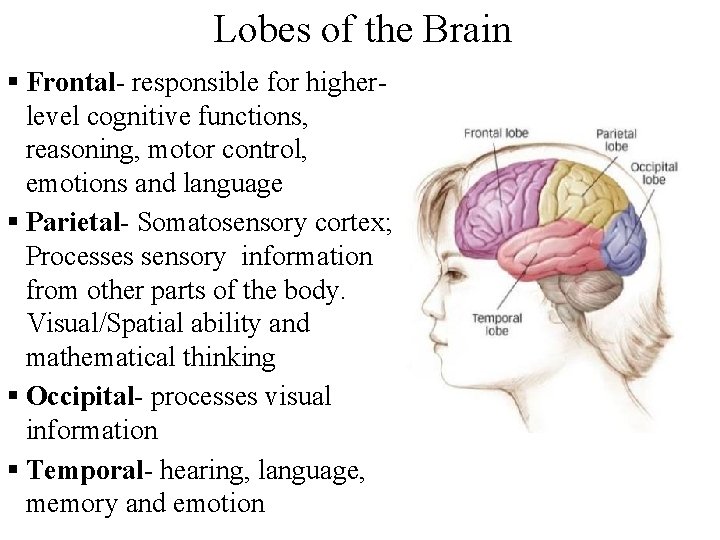
Lobes of the Brain § Frontal- responsible for higherlevel cognitive functions, reasoning, motor control, emotions and language § Parietal- Somatosensory cortex; Processes sensory information from other parts of the body. Visual/Spatial ability and mathematical thinking § Occipital- processes visual information § Temporal- hearing, language, memory and emotion
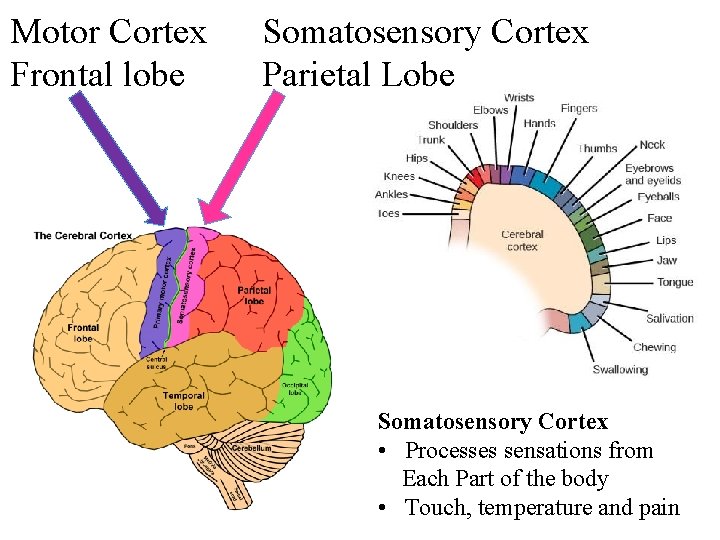
Motor Cortex Frontal lobe Somatosensory Cortex Parietal Lobe Somatosensory Cortex • Processes sensations from Each Part of the body • Touch, temperature and pain
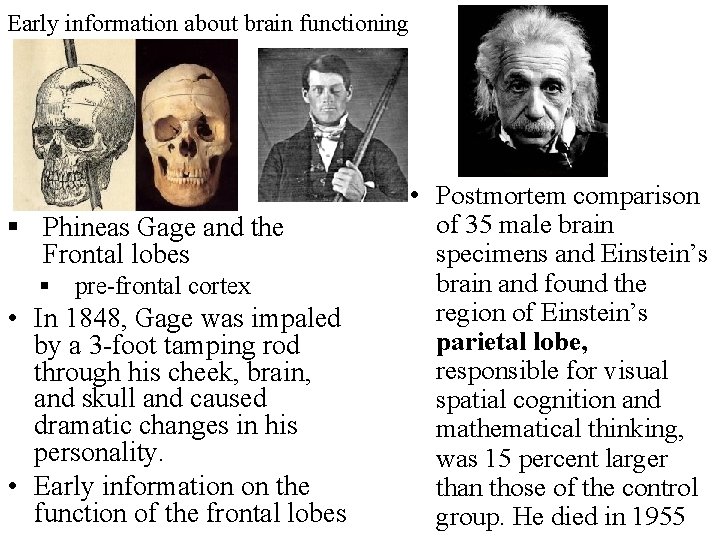
Early information about brain functioning § Phineas Gage and the Frontal lobes § pre-frontal cortex • In 1848, Gage was impaled by a 3 -foot tamping rod through his cheek, brain, and skull and caused dramatic changes in his personality. • Early information on the function of the frontal lobes • Postmortem comparison of 35 male brain specimens and Einstein’s brain and found the region of Einstein’s parietal lobe, responsible for visual spatial cognition and mathematical thinking, was 15 percent larger than those of the control group. He died in 1955

Pictures of Albert Einstein’s Brain released 2013 (2: 34) https: //www. youtube. com/watch? v=La. Fv. Ap. Jwl. R 4

Video (3: 00)? ? ? How Einstein’s brain is different than yours https: //www. youtube. com/watch? v=rnl. E 9 q 5 IEu. I
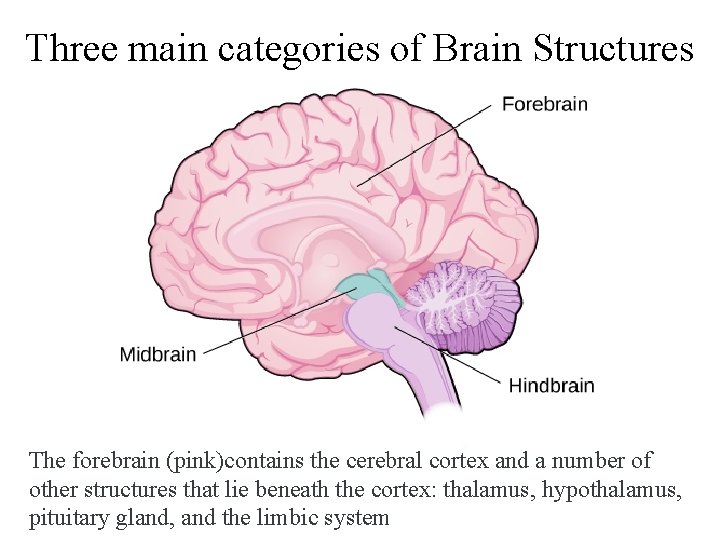
Three main categories of Brain Structures The forebrain (pink)contains the cerebral cortex and a number of other structures that lie beneath the cortex: thalamus, hypothalamus, pituitary gland, and the limbic system
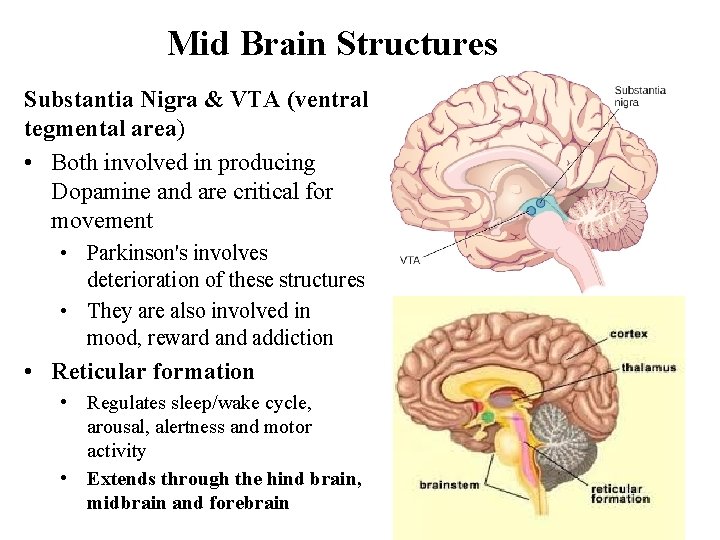
Mid Brain Structures Substantia Nigra & VTA (ventral tegmental area) • Both involved in producing Dopamine and are critical for movement • Parkinson's involves deterioration of these structures • They are also involved in mood, reward and addiction • Reticular formation • Regulates sleep/wake cycle, arousal, alertness and motor activity • Extends through the hind brain, midbrain and forebrain
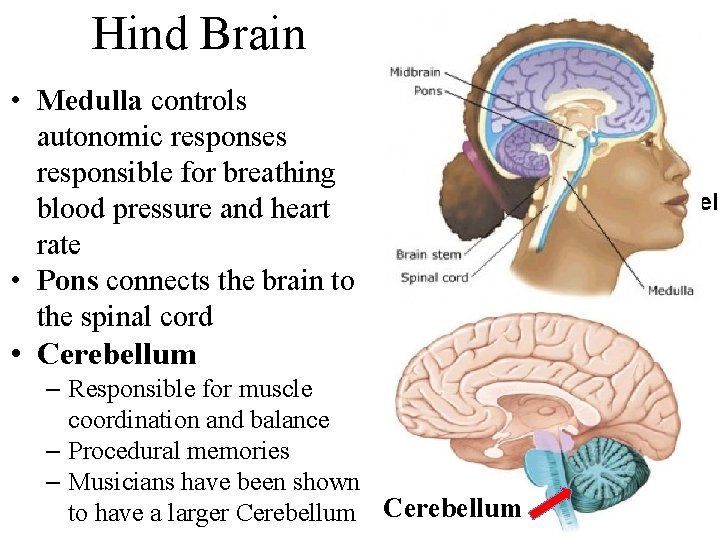
Hind Brain • Medulla controls autonomic responses responsible for breathing blood pressure and heart rate • Pons connects the brain to the spinal cord • Cerebellum – Responsible for muscle coordination and balance – Procedural memories – Musicians have been shown to have a larger Cerebellum Cerebell
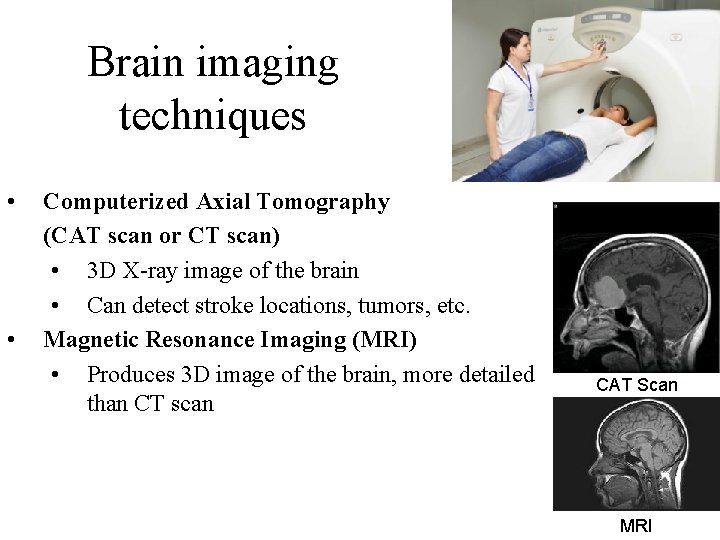
Brain imaging techniques • • Computerized Axial Tomography (CAT scan or CT scan) • 3 D X-ray image of the brain • Can detect stroke locations, tumors, etc. Magnetic Resonance Imaging (MRI) • Produces 3 D image of the brain, more detailed than CT scan CAT Scan MRI
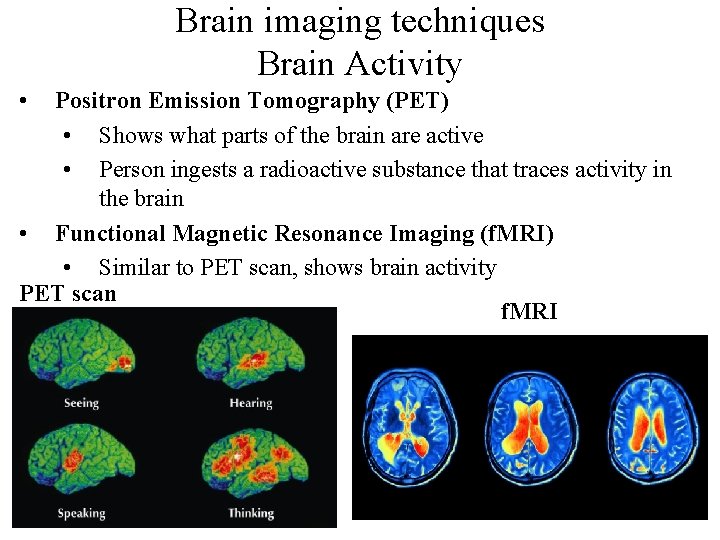
Brain imaging techniques Brain Activity • Positron Emission Tomography (PET) • Shows what parts of the brain are active • Person ingests a radioactive substance that traces activity in the brain • Functional Magnetic Resonance Imaging (f. MRI) • Similar to PET scan, shows brain activity PET scan f. MRI
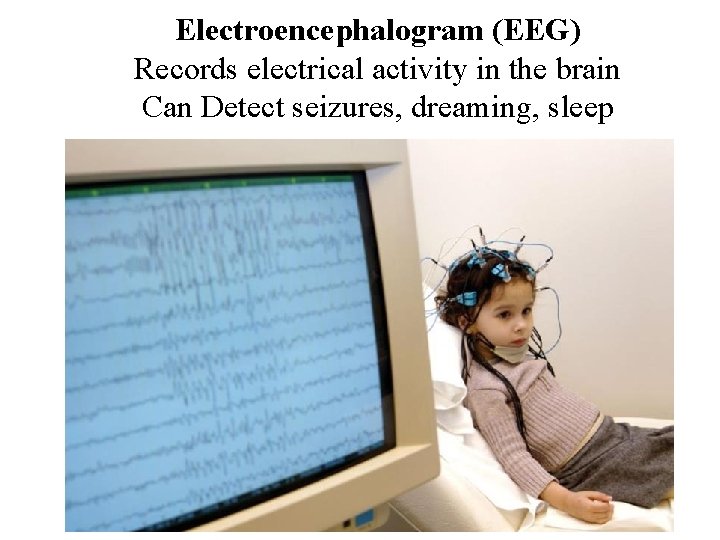
Electroencephalogram (EEG) Records electrical activity in the brain Can Detect seizures, dreaming, sleep
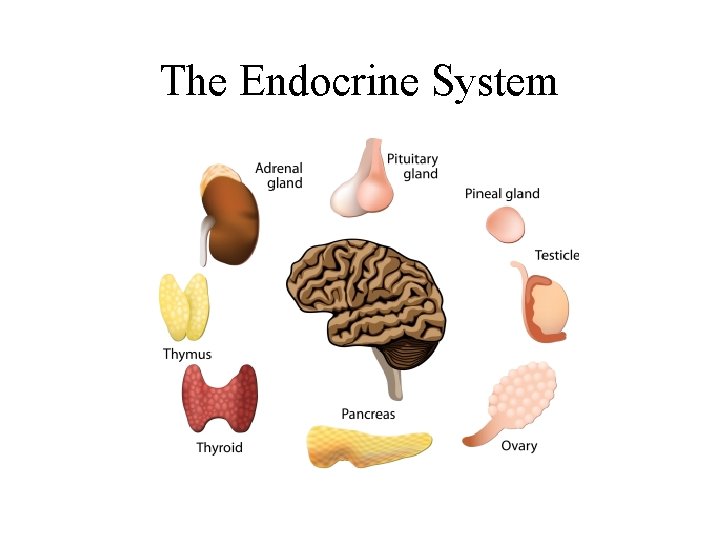
The Endocrine System
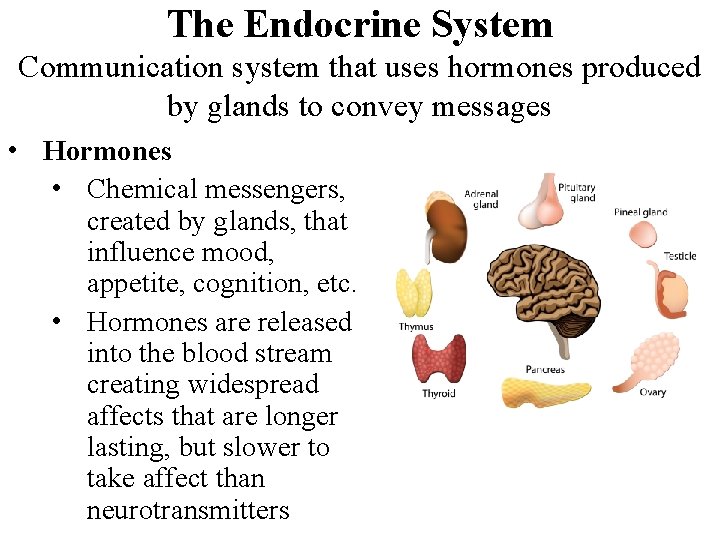
The Endocrine System Communication system that uses hormones produced by glands to convey messages • Hormones • Chemical messengers, created by glands, that influence mood, appetite, cognition, etc. • Hormones are released into the blood stream creating widespread affects that are longer lasting, but slower to take affect than neurotransmitters
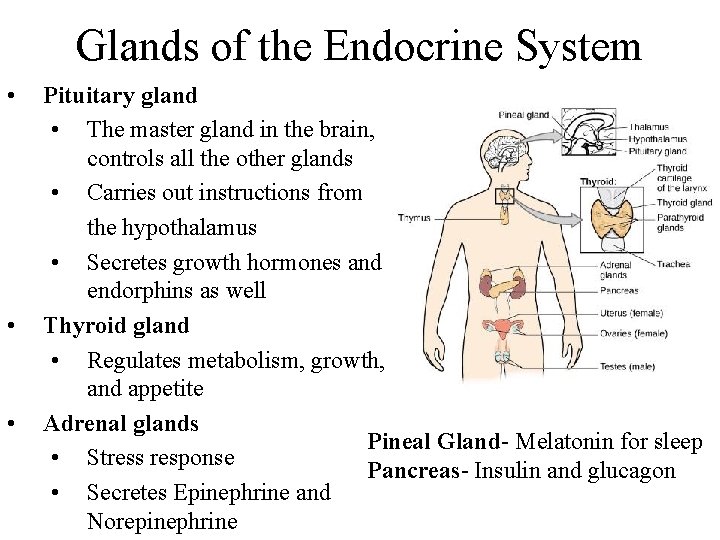
Glands of the Endocrine System • • • Pituitary gland • The master gland in the brain, controls all the other glands • Carries out instructions from the hypothalamus • Secretes growth hormones and endorphins as well Thyroid gland • Regulates metabolism, growth, and appetite Adrenal glands Pineal Gland- Melatonin for sleep • Stress response Pancreas- Insulin and glucagon • Secretes Epinephrine and Norepinephrine
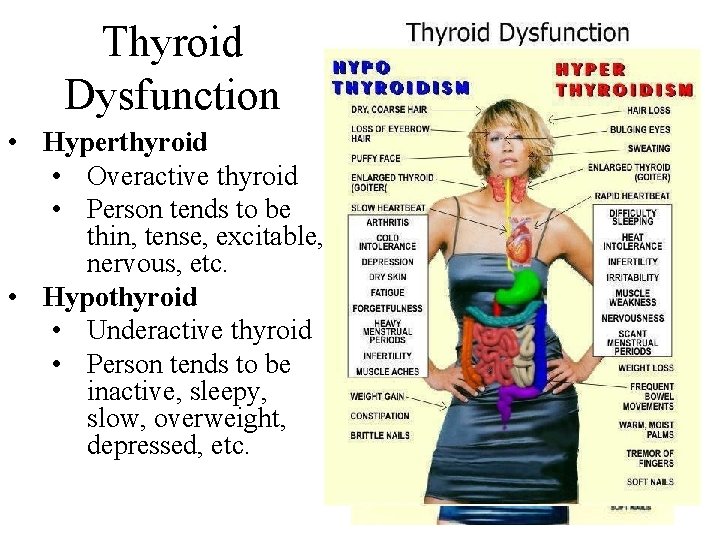
Thyroid Dysfunction • Hyperthyroid • Overactive thyroid • Person tends to be thin, tense, excitable, nervous, etc. • Hypothyroid • Underactive thyroid • Person tends to be inactive, sleepy, slow, overweight, depressed, etc. •
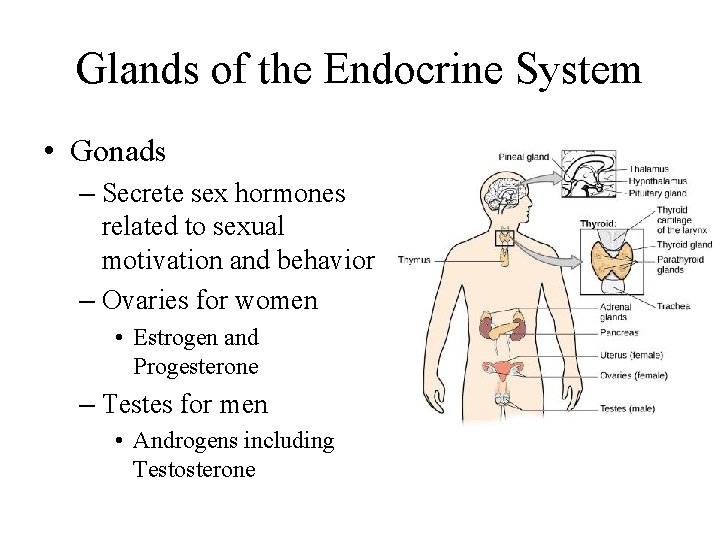
Glands of the Endocrine System • Gonads – Secrete sex hormones related to sexual motivation and behavior – Ovaries for women • Estrogen and Progesterone – Testes for men • Androgens including Testosterone
- Slides: 60