
Chapter 3 Behavioral Economics Thinking Processes Decision Making
Chapter 3: Behavioral Economics, Thinking Processes, Decision Making, and Investment Behavior
Topic Covered • • Behavioral Economics, Heuristics, and Decision Making. Investment Heuristics and Investing in Financial Assets. The Trust Heuristic and Decision Making. Other Critic al Decision‐Making Heuristics. – – – Knightian Uncertainty versus Risk Animal Spirits. Beauty Contest. Herding. Loss Aversion. Disposition Effect. Illusion of Control. Overconfidence. Overoptimism. Lack of Bayesian Updating. Ambiguity Aversion. Winner’s Curse. • Rational Investor Decision Making in a World of Complex Information
Behavioral Economic s, Heuristics, and Decision Making • From the perspective of behavioral economics, both the limited and unique processing capacity of the human brain and the decision‐making environment influence decision makers. People adopt ways to decide and choose that differ from how they would behave under the behavioral and institutional assumptions of traditional economics. • Simon (1978, 1987) developed the concepts of bounded rationality and satisficing to encapsulate smart decision‐making processes that smart human decision makers develop, adapt, and adopt. Simon (1987, p. 267) defines bounded rationality as “rational choice that takes into account the cognitive limitations of the decision‐maker— limitations of both knowledge and computational capacity. Bounded rationality. . . is deeply concerned with the ways in which the actual decision‐making process influences the decisions that are reached. ”
Cont. • Todd and Gigerenzer (2003) and Gigerenzer (2007) refer to decision‐making shortcuts that are satisficing by nature as fast and frugal heuristics. Such heuristics might be largely intuitive or more deliberative in nature. Kahneman (2011) calls the former fast thinking and the latter slow thinking. • In this the individuals learn through education and experience as well as from others and develop methods of arriving at decisions that are best practice. • Fast and frugal heuristics are similar to the affect heuristic. It represents a decision‐making shortcut that is quick and relatively easy and is typically predicated on intuition and influenced by emotional considerations.
Investment Heuristic s and Investing in Financial Assets
The Trust Heuristic and Decision Making • The trust heuristic is a nonconventional tool used by decision makers who might engage in irrational or error prone and biased behavior. • Like many such heuristics, emotional and intuitive variables affect the trust heuristic. Trust has been part the human decision‐ making toolbox for a millennium. In the absence of legal guarantees for enforcing contracts, the trust heuristic becomes a substitute for such legal guarantees. It also lowers the transaction costs of engaging in contractual arrangements and buying goods and services, even when legal guarantees and redress are in place
Cont. • Trust is the high probability expectation that the other party to a transaction will deliver on promises made. The reputation of the other party often serves as the basis for trust. Trust‐based transactions are often enforced through the negative reputational effect when reneging on a transaction or a relationship and the positive effect when holding true to a contract or a relationship. • Individuals will invest with family, friends, and members of their community or religious group because they believe that these individuals can be trusted. This type of trust can be enforced if one believes that if the bonds of trust are broken the party in question will suffer reputational and/or economic costs. Moreover, individuals often follow the leaders whom they trust and engage in herding behavior when they are unsure about what product or financial asset to buy or sell.

Other Critical Decision‐Making Heuristics Knightian Uncertainty versus Risk : • Behavioral economics views uncertainty where outcomes can be projected based on assigned probabilities (expected values) and also when uncertainty is such that expected outcomes cannot easily be predicted. • Knightian uncertainty is uncertainty that cannot be measured with any precision. Risk can be measured in terms of probabilistic outcomes, based on past parameters and outcomes.
Cont. Animal Spirits • Animal spirits, also called irrational exuberance, is an important driver of investment behavior. In traditional economic modeling, animal spirits do not affect investor behavior. But animal spirits are certainly a fast and frugal heuristic that characterizes much investor decision making. In contemporary behavioral economics, animal spirits are often a source of error and bias in decision making, which can result in manias, panics, and eventually crashes in asset markets, with large repercussions for the rest of the economy. • Keynes (1936) refers to animal spirits as behavior that is motivated by emotive factors, as opposed to calculating or hard‐core economic rationality demanded by traditional economics.
Cont. • Although animal spirits are not calculating behavior, they are based on a sense of what one expects to occur in the near future and a heuristic based on one’s expectations in a world of uncertainty. Animal spirits are informed by the information that an individual has at hand by the behavior of others whom one believes or trusts have a better understanding of market movements and outcomes than oneself. Beauty Contest • In economics, a beauty contest refers to rational individuals estimating what future prices (the beauty) might be by anticipating what other people believe future prices (the most beautiful) will be, as opposed to what the fundamental value (true beauty) of the assets actually is. Such beliefs, if actualized, help determine the direction and movements in future prices (i. e. , investor sentiment and momentum).
Cont. Herding • Herding occurs when decision makers follow the leader in terms, for example, of investment decisions. • Herding occurs in the face of bounded rationality and Knightian uncertainty. It occurs when investors are unsure how asset prices will move and trust in the wisdom of the crowds or the leader of the crowd
Cont. Loss Aversion • According to Kahneman and Tversky (1979), individuals have a strong aversion to losses (loss aversion) when holding risk parameters constant. • people weigh losses about twice as much as gains, so that $100 gained does not neutralize $100 lost, which would be the case based on conventional wisdom.
Cont. Disposition Effect • The disposition effect results in individuals selling stocks too quickly that have appreciated in price, but holding on to stocks that have depreciated in price for too long. • This is consistent with acknowledging gains but not losses. In this case individuals will sell high too quickly to avoid possible losses (i. e. , a decline in the value of a stock)
Cont. Illusion of Control • An illusion of control occurs when decision makers believe they have some control over outcomes although they do not. • These decision makers then proceed to design and adopt strategies that they believe will affect outcomes but which are determined either randomly or are outside of their control
Cont. Overconfidence • Unlike the illusion of control, overconfidence pertains to scenarios in which decision makers can actually affect outcome. • Overconfident individuals are those who subjectively believe that they can affect outcomes to a greater extent than they actually can. When this occurs they will invest in projects or overinvest because of overconfidence • bias. • Kahneman (2011) maintains that an important factor responsible for overconfidence is the illusion of validity. He contends that individuals tend to construct consistent narratives that confirm their prior beliefs.
Cont. Overoptimism • Overoptimism occurs when an individual believes that he or she is less at risk or more likely to achieve a certain rate of return or outcome than is objectively true. • An overly optimistic investor believes that he or she is less likely to fail or is more likely to succeed than another individual, even if no clear and unequivocal objective basis exists for this belief.
Cont. Ambiguity Aversion • Ambiguity aversion occurs when an individual avoids prospects where the outcome is ambiguous (i. e. , less information and certainty about ambiguous outcomes exist) and favors more certain outcomes. • This is the case even if the expected value of the ambiguous prospect is greater than the present value of the more certain prospect.
Cont. Winner’s Curse • Some evidence indicates that in auctions and initial stock offerings, investors pay more than the intrinsic value of these options (Thaler 1988; Kagel and Levin 2002). • The winner is cursed by winning a prospect that either generates financial losses or generates gains that are less than expected. • The winner is cursed by overvaluing the intrinsic value of the prospect for which they bid.
Rational Investor Decision Making in a World of Complex Information • The errors and biases approach to investor behavior focuses on systematic errors and biases in decision making. • In contrast, the bounded rationality approach pays at least as much attention to the decision‐making environment, which is assumed to have a critically important effect on decision making. • This decision‐making environment, which was also a by‐product of financial market deregulation, reduced the cost to rational individuals and large financial corporations of knowingly engaging in very high‐risk behavior • Individuals were protected from downside risks while benefiting from the success of risky bets.
Cont. • This created a classic moral hazard environment that eventually resulted in catastrophic damage to financial markets and to the real economy because markets never internalized the negative externalities • Apart from incentives, the state of information is important to the decision‐making environment. Misleading information and information that is difficult to understand or locate can contribute to errors in decision making.
Cont.
Cont.
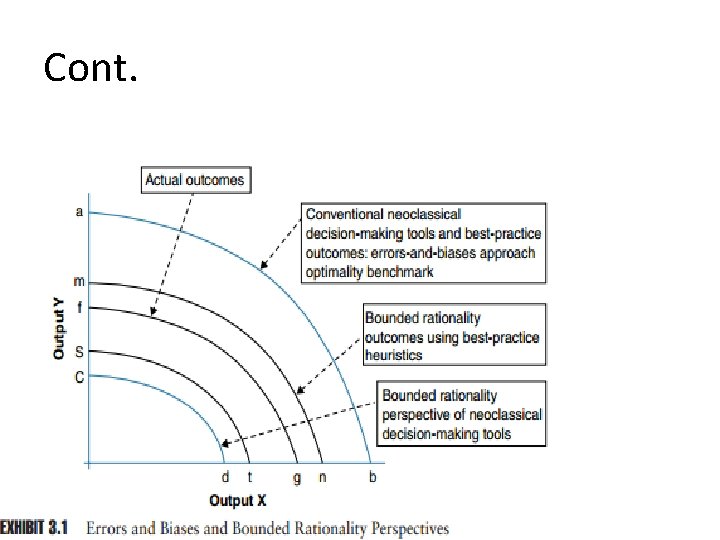
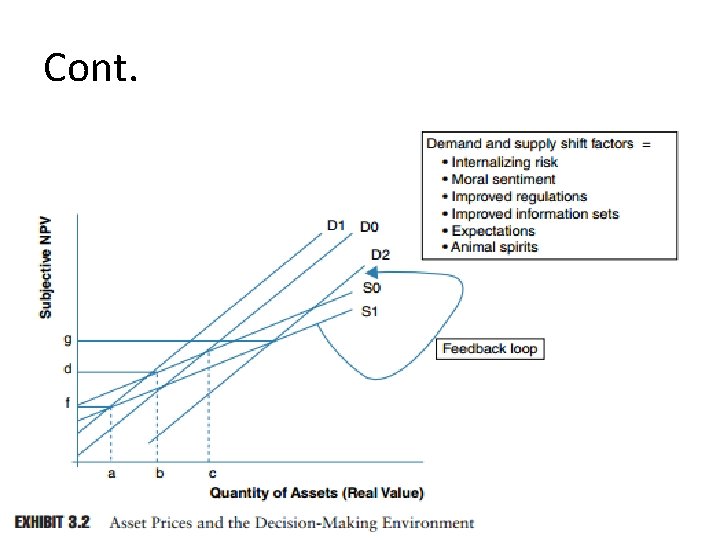
Cont. • Exhibits 3. 1 and 3. 2 illustrate some of these arguments. Exhibit 3. 1 highlights some main distinctions between the different approaches to behavioral and traditional economics regarding decision making. • Exhibit 3. 2 maps out demand supply functions for financial or housing assets as these relate to asset prices.
- Slides: 23