
Chapter 3 Basic Toxicology Oil and Gas Technology
Chapter 3 Basic Toxicology Oil and Gas Technology 1
Toxicity is the ability of a substance to cause damage to living tissue, impairment of the central nervous system, severe illness, or in extreme cases, death when ingested, inhaled, or absorbed through the skin. The administration of a particular dosage of a chemical, and the subsequent response by experimental animals, can help predict that chemical's toxic effect on humans. The dose-response behavior is represented by a dose-response curve, which demonstrates that not all individuals will respond to a particular dose of a chemical in the same manner. Oil and Gas Technology 2
Toxicity (cont. ) The toxicity of a substance is the potential of that substance to cause harm. The degree of harm is dependent on a number of factors. These are: · · · toxicity: how much of the substance is required to cause harm, route of exposure: how the substance enters your body, dose: how much enters your body, duration: the length of time you are exposed, reaction and interaction: other substances you are exposed to sensitivity: how your body reacts to the substance compared to others. Oil and Gas Technology 3
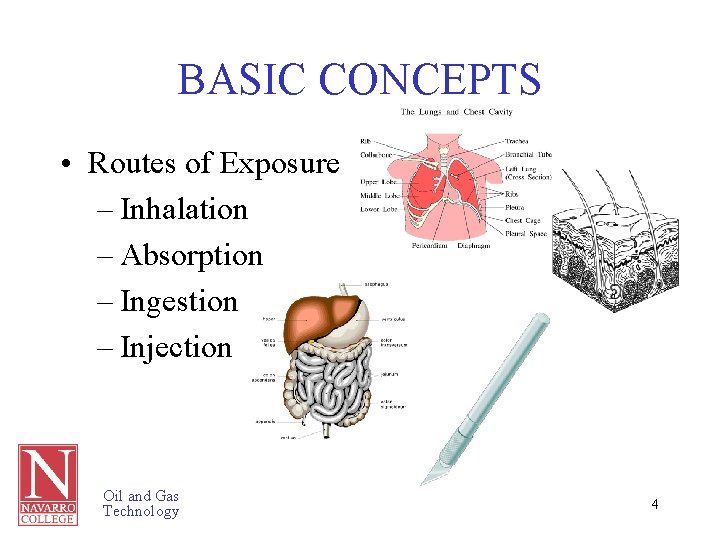
BASIC CONCEPTS • Routes of Exposure – Inhalation – Absorption – Ingestion – Injection Oil and Gas Technology 4
Inhalation • Gases, vapors, and/or particulates • Either exhaled or deposited • If deposited then damage can occur – direct contact with lung tissue – diffusion into blood supply • Most common source of problems Oil and Gas Technology 5
Absorption • Absorption through the skin • Effects from innocuous (i. e. redness) to more severe effects (destruction of skin tissue) • Can also diffuse into the blood stream • Eyes can be particularly sensitive Oil and Gas Technology 6

Ingestion • Ingestion is a less likely route and often less harmful • Soluble or corrosive chemicals can cause problems • Good hygiene practices prevent most occurrences Oil and Gas Technology 7
Injection • Entrance through skin penetration • Direct contact with circulatory system • Take care or avoid sharp objects such as corroded drums/cans Oil and Gas Technology 8
• ALL Chemicals can be TOXIC • Quantity or DOSE of a chemical needed to cause specific effect varies considerably • The dose, chemical and physical properties, and the physiology of the exposed subject determine the degree of toxicity • The point on the curve where 50% of the test animals have died as a result of a particular chemical dosage is referred to as the Lethal Dose 50, or LD 50. Oil and Gas Technology 9
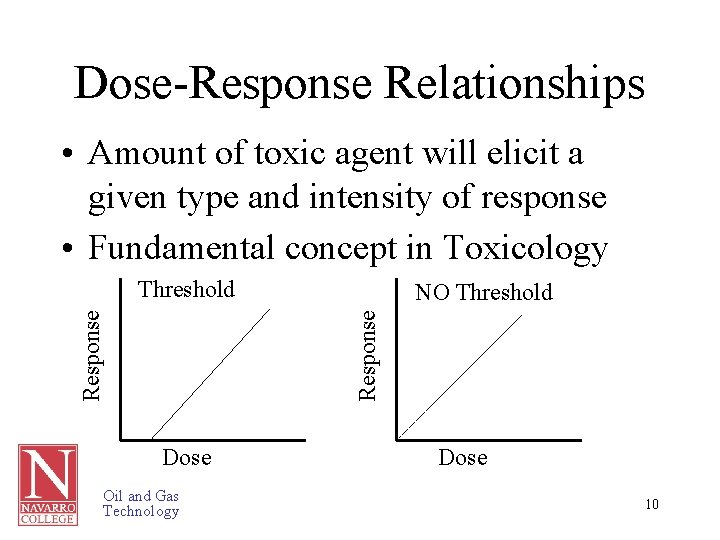
Dose-Response Relationships • Amount of toxic agent will elicit a given type and intensity of response • Fundamental concept in Toxicology NO Threshold Response Threshold Dose Oil and Gas Technology Dose 10

Factors Influencing Toxicity • • • Duration and frequency of exposure Route of entry Allergy Interspecies and interspecies variations Age Gender Oil and Gas Technology 11
Factors Influencing Toxicity (Cont. ) • • Genetics Physical state Nutrition Dose and concentration Oil and Gas Technology 12
Toxic Hazards • Exposure does NOT always result in DEATH • Various types of effects – Systemic Poisons – Asphyxiants – Irritants – Allergic Reactions Oil and Gas Technology 13
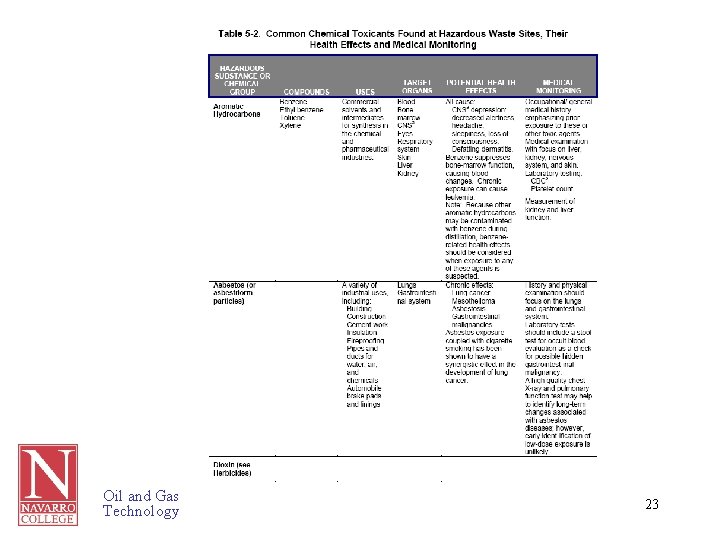
Toxic Hazards (cont. ) LOCAL EFFECTS When a toxic substance causes damage at the point where it first contacts the body. The most common points at which substances first contact the body are the skin, eyes, nose, throat and lungs. SYSTEMIC EFFECTS Toxic substances can also enter the body and travel in the bloodstream to internal organs. The internal organs most commonly affected are the liver, kidneys, heart, nervous system (including the brain) and reproductive system Oil and Gas Technology 14
Asphyxiants • Agents that deprive the tissues of oxygen – Some such as Carbon Monoxide prevent oxygen in blood from moving into tissues – Others such as hydrogen cyanide prevent normal oxygen transfer either from the blood to the tissues or within the cell itself Oil and Gas Technology 15
Irritants • Materials that cause inflammation of membranes – Can affect the eyes, skin, respiratory tract, or gastrointestinal tract – Irritant must come in direct contact with the tissue to cause an inflammation reaction Oil and Gas Technology 16
Allergic Reactions • Frequent exposure to chemicals can cause the body to respond with an allergic reaction – Can manifest itself in one or more symptoms – Body becomes sensitized to that chemical Oil and Gas Technology 17
Permissible Exposure Limits (PELs) There are three types of OSHA PELs: · · · The 8 -Hour Time Weighted Average (TWA) is the average employee exposure over an 8 -hour period. The measured level may sometimes go above the TWA value, as long as the 8 -hour average stays below. The Ceiling Limit is the maximum allowable level. It must never be exceeded, even for an instant. The Excursion Limit is a value that can be exceeded only for a specified short period of time (between 5 -15 minutes), which is called the Excursion Duration. Oil and Gas Technology 18
Exposure Monitoring When toxic chemicals are present, your exposure can be estimated by measuring the concentration of a given chemical in the air and the duration of exposure. This environmental monitoring is usually done by industrial hygienists, using various types of instruments. The air is collected from your breathing zone (the air around your nose and mouth) The exposure levels calculated from this monitoring can then be compared to the PEL for that chemical Oil and Gas Technology 19
Practical Clues to Exposure • • • Odor - Don't depend on odor to warn you. Some very hazardous chemicals have no odor (carbon monoxide), Others produce olfactory fatigue (hydrogen sulfide) Taste Particles in Nose or Mucous Settled Dust or Mist Immediate Symptoms - If you experience symptoms known to be caused (MSDS) by a chemical during or shortly after its use, you may have been overexposed. Symptoms might include tears in your eyes; a burning sensation of skin, nose, or throat; a cough; dizziness or a headache Oil and Gas Technology 20
Reducing Exposure • • Knowledge Engineering Controls Personal Protective Equipment Checklist for researching toxic substances used on the job Oil and Gas Technology 21
Checklist · · · · · What is the substance? What's in it? How toxic is it? Are health effects acute, chronic, or both? Is there evidence based on research with animals or humans that the substance is a carcinogen? A mutagen? A teratogen or reproductive toxin? How does this substance enter the body (routes of entry): inhalation, skin absorption, ingestion? What is the legal exposure limit (PEL) or recommended TLV? To how much of the substance are you being exposed? What is the concentration of the substance in the workplace air? How long are you exposed? Are you exposed to other chemicals at the same time? Can they have a combined (additive or synergistic) effect? Do you have any medical conditions or take any drugs that might interact with chemicals? What controls are recommended to prevent overexposure? Is any type of medical testing recommended? Oil and Gas Technology 22
Oil and Gas Technology 23
- Slides: 23