
Chapter 3 Basic Hand Tools Objectives After studying
Chapter 3 Basic Hand Tools
Objectives After studying this chapter, you will be able to: • Identify common automotive hand tools. • List safety rules for hand tools. • Select the right tool for a given job. • Maintain and store tools properly. • Use hand tools safely. • Explain why insulated tools must be used when servicing electric drive trains. • Correctly answer ASE certification test questions referring to hand tools. © Goodheart-Willcox Co. , Inc. Permission granted to reproduce for educational use only.
Tool Rules • • Purchase quality tools Keep tools organized Keep tools clean Use right tool for job © Goodheart-Willcox Co. , Inc. Permission granted to reproduce for educational use only.
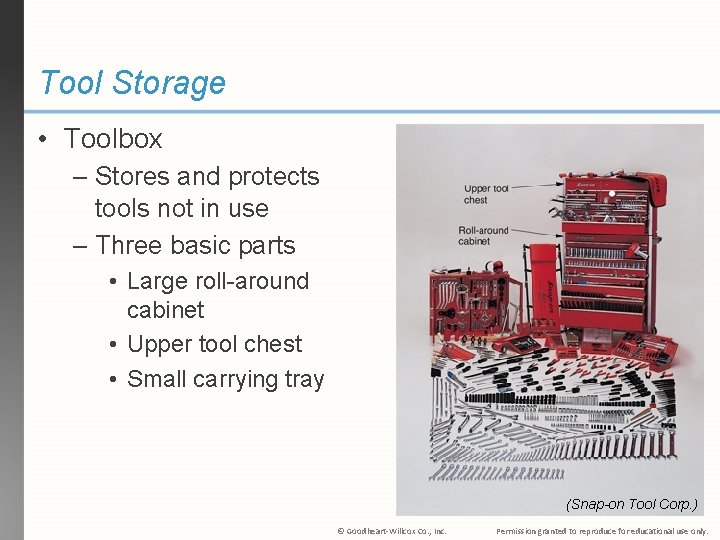
Tool Storage • Toolbox – Stores and protects tools not in use – Three basic parts • Large roll-around cabinet • Upper tool chest • Small carrying tray (Snap-on Tool Corp. ) © Goodheart-Willcox Co. , Inc. Permission granted to reproduce for educational use only.
Toolbox Organization • Keep related tools in same drawer • Do not keep small delicate tools with large heavy ones • Tool holders – Help organize small tools – Provide portability © Goodheart-Willcox Co. , Inc. Permission granted to reproduce for educational use only.
Wrenches • Used to install and remove nuts and bolts • Wrench size – Measured across wrench jaws • Stamped on side of wrench – Conventional (inches) – Metric (millimeter) © Goodheart-Willcox Co. , Inc. Permission granted to reproduce for educational use only.
Wrench Safety Rules • • Always select correct size Never hammer on wrench When possible, pull don’t push Never use steel bar or pipe to increase leverage © Goodheart-Willcox Co. , Inc. Permission granted to reproduce for educational use only.
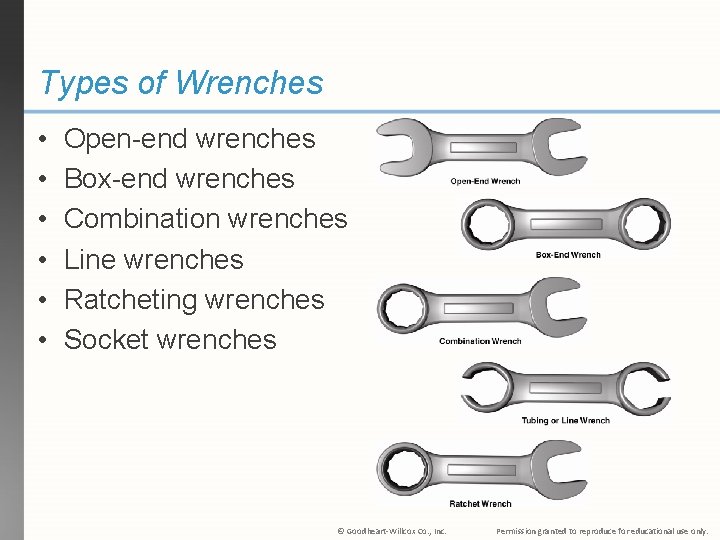
Types of Wrenches • • • Open-end wrenches Box-end wrenches Combination wrenches Line wrenches Ratcheting wrenches Socket wrenches © Goodheart-Willcox Co. , Inc. Permission granted to reproduce for educational use only.
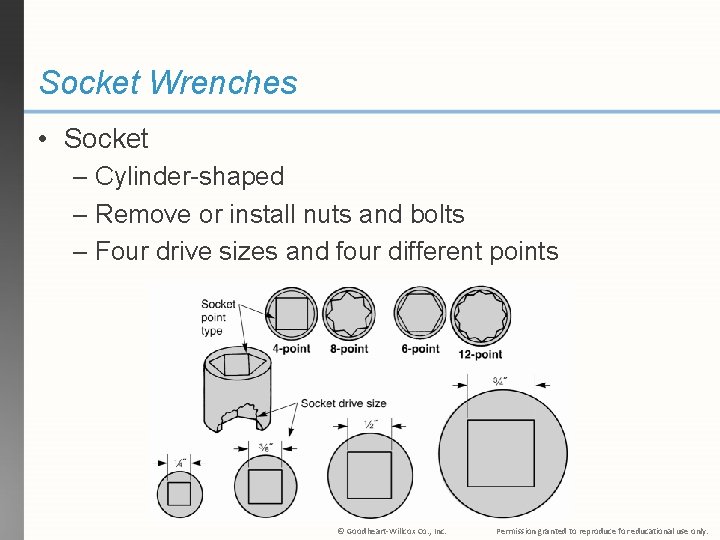
Socket Wrenches • Socket – Cylinder-shaped – Remove or install nuts and bolts – Four drive sizes and four different points © Goodheart-Willcox Co. , Inc. Permission granted to reproduce for educational use only.
Socket Wrenches (Cont. ) • Socket handles – Fit into square opening in top of socket • Extensions – Used between socket and its handle • Universal joint – Swivel that lets socket wrench reach around obstructions © Goodheart-Willcox Co. , Inc. Permission granted to reproduce for educational use only.
Other Wrench Types • Adjustable wrench or crescent wrench – Has jaws that adjust to different head sizes • Pipe wrench – Used to grasp cylindrical objects • Allen wrench – Hexagonal (six-sided) shaft-type wrench • Used for set screws on pulleys, gears, and knobs © Goodheart-Willcox Co. , Inc. Permission granted to reproduce for educational use only.
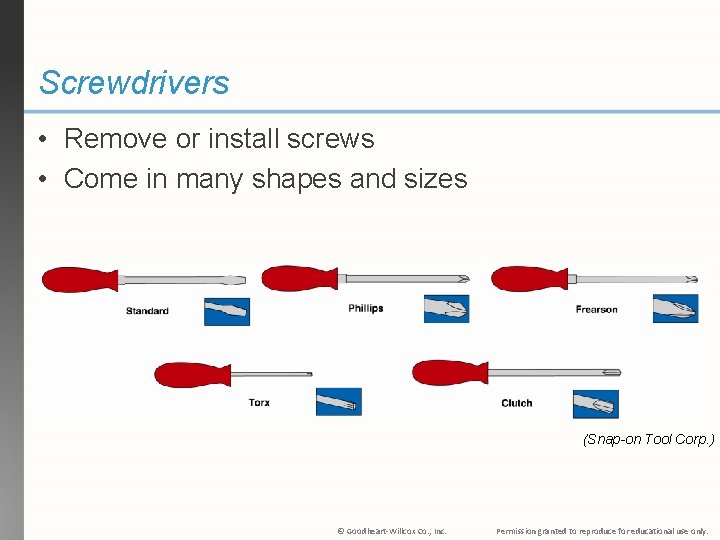
Screwdrivers • Remove or install screws • Come in many shapes and sizes (Snap-on Tool Corp. ) © Goodheart-Willcox Co. , Inc. Permission granted to reproduce for educational use only.
Screwdrivers (Cont. ) • Offset and stubby screwdrivers – Use in tight places • Starting screwdrivers – Hold screw until started • Scratch awl – Has sharp pointed tip • Impact driver – Used to loosen extremely tight screws © Goodheart-Willcox Co. , Inc. Permission granted to reproduce for educational use only.
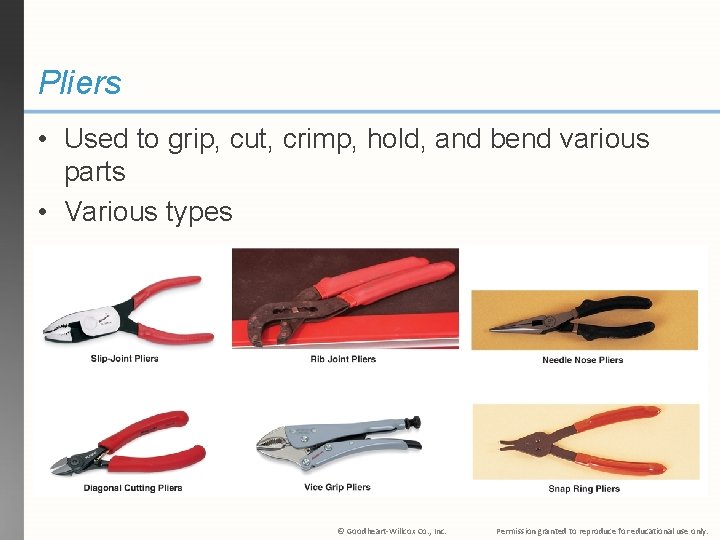
Pliers • Used to grip, cut, crimp, hold, and bend various parts • Various types © Goodheart-Willcox Co. , Inc. Permission granted to reproduce for educational use only.
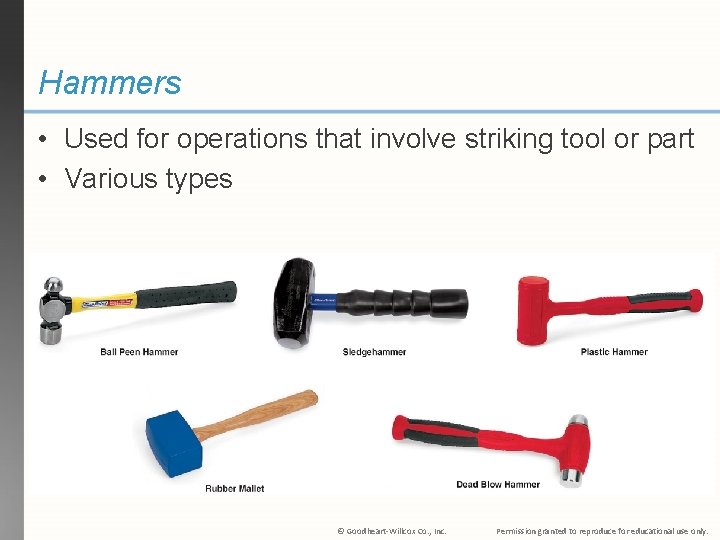
Hammers • Used for operations that involve striking tool or part • Various types © Goodheart-Willcox Co. , Inc. Permission granted to reproduce for educational use only.
Hammer Safety Rules • Select right size hammer • Always check hammer head is tight on handle • Use brass, plastic, or dead blow hammer on parts that may be damaged using steel hammer • Grasp hammer near end of handle and strike squarely © Goodheart-Willcox Co. , Inc. Permission granted to reproduce for educational use only.
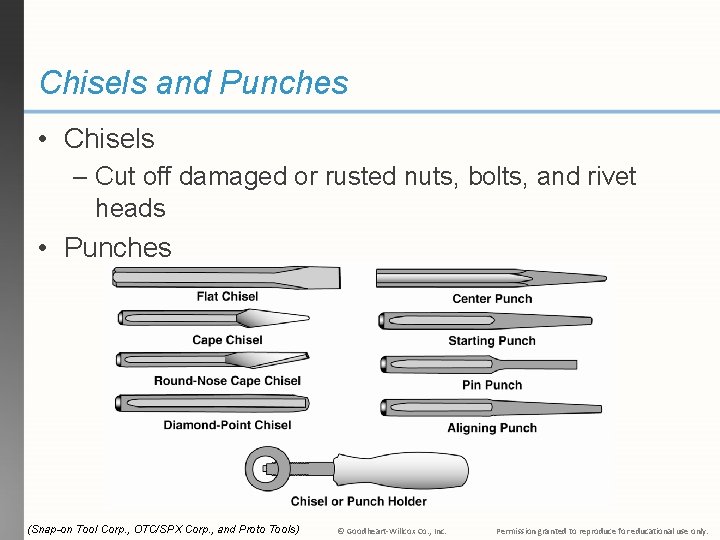
Chisels and Punches • Chisels – Cut off damaged or rusted nuts, bolts, and rivet heads • Punches (Snap-on Tool Corp. , OTC/SPX Corp. , and Proto Tools) © Goodheart-Willcox Co. , Inc. Permission granted to reproduce for educational use only.
Punch Types • Center punch – Used to mark parts for reassembly or start hole before drilling • Starting punch or drift punch – Used to drive pins, shafts, and metal rods partway out of hole • Pin punch – Used after starting punch to push shaft or rod • Aligning punch – Used for lining up parts during assembly © Goodheart-Willcox Co. , Inc. Permission granted to reproduce for educational use only.
Chisel and Punch Safety Rules • Use largest punch or chisel that will work • Keep both ends of punch or chisel properly ground and shaped • Grind off and chamfer mushroomed tool • Grind slowly to avoid overheating • Wear eye protection © Goodheart-Willcox Co. , Inc. Permission granted to reproduce for educational use only.
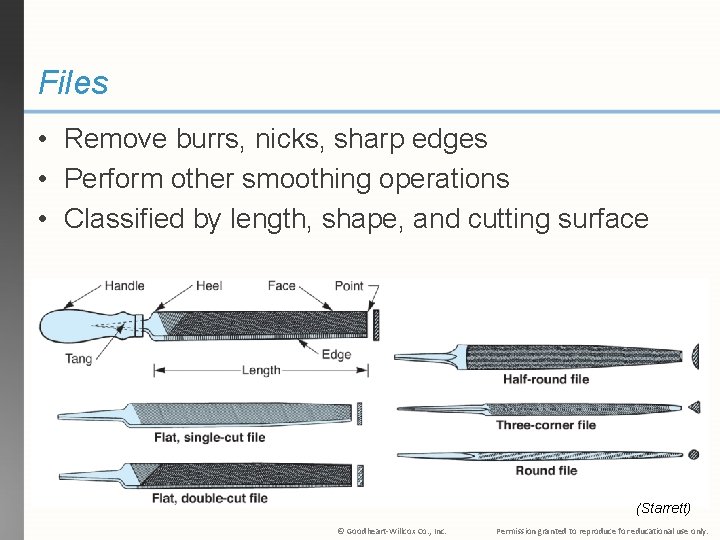
Files • Remove burrs, nicks, sharp edges • Perform other smoothing operations • Classified by length, shape, and cutting surface (Starrett) © Goodheart-Willcox Co. , Inc. Permission granted to reproduce for educational use only.
File Safety Rules • • • Never use file without handle securely attached Apply pressure only on forward stroke Place one hand on handle and other on file tip Do not file too rapidly Clean clogged file with file card or wire brush Never hammer or pry with file © Goodheart-Willcox Co. , Inc. Permission granted to reproduce for educational use only.
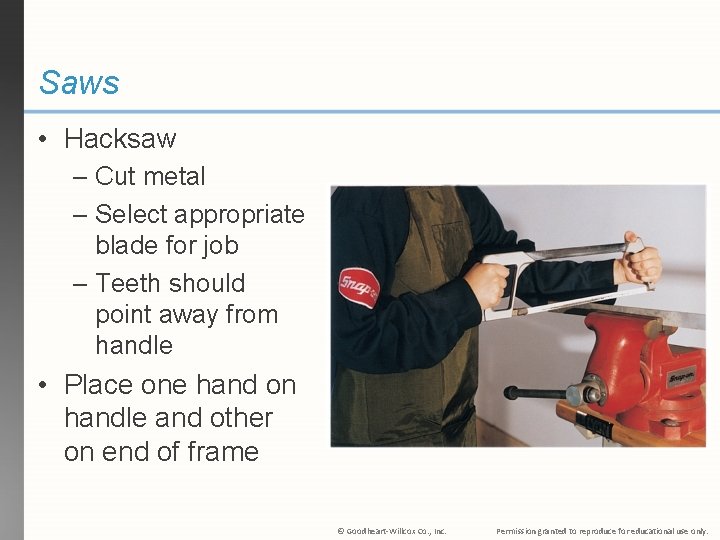
Saws • Hacksaw – Cut metal – Select appropriate blade for job – Teeth should point away from handle • Place one hand on handle and other on end of frame © Goodheart-Willcox Co. , Inc. Permission granted to reproduce for educational use only.
Holding Tools • Vice – Holds parts during cutting, drilling, hammering, and pressing operations • Vice caps or wood blocks – Prevent damage to delicate parts in vice • C-clamp (portable) – Holds parts to work surface during drilling, filing, cutting, or welding operations © Goodheart-Willcox Co. , Inc. Permission granted to reproduce for educational use only.
Vice Safety Rules • • • Never hammer on vice handle Keep moving parts clean and oiled Wear safety glasses Be careful not to damage parts in jaws Use vice caps © Goodheart-Willcox Co. , Inc. Permission granted to reproduce for educational use only.
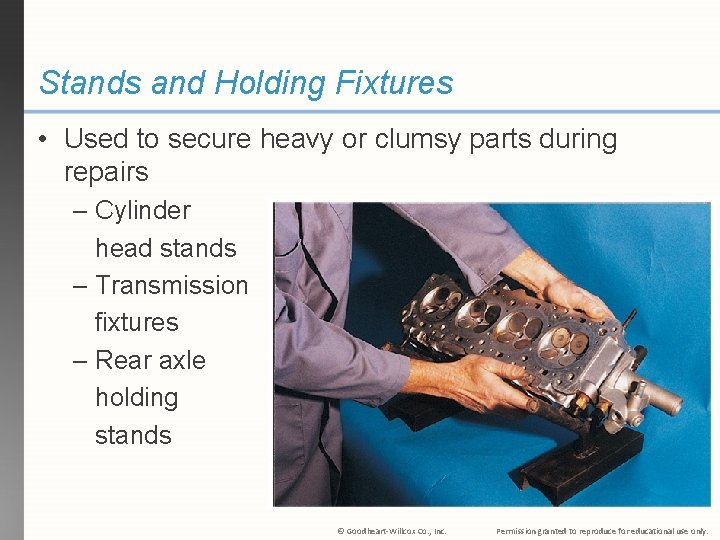
Stands and Holding Fixtures • Used to secure heavy or clumsy parts during repairs – Cylinder head stands – Transmission fixtures – Rear axle holding stands © Goodheart-Willcox Co. , Inc. Permission granted to reproduce for educational use only.
Cleaning Tools • Remove carbon, rust, dirt, grease, old gaskets, and dried oil from parts – Scrapers • Remove grease, gaskets, sludge, dried oil, and carbon from flat surfaces • Wear gloves and watch hands – Brushes • Remove light rust, paint, and dirt from irregularly shaped parts © Goodheart-Willcox Co. , Inc. Permission granted to reproduce for educational use only.
Probe and Pickup Tools • Used when dropped nuts, bolts, or small parts cannot be reached by hand – Magnetic pickup tool – Finger pickup tool – Mirror probe © Goodheart-Willcox Co. , Inc. Permission granted to reproduce for educational use only.
Cutting Tools • Used to open part boxes • Cut off insulation • Various cutting and scraping tasks © Goodheart-Willcox Co. , Inc. Permission granted to reproduce for educational use only.
Pry Bars • Strong steel bars • Used for assembly, disassembly, and adjustment operations – Aligning heavy parts • Use caution while prying © Goodheart-Willcox Co. , Inc. Permission granted to reproduce for educational use only.
Insulated Tools • Insulate user from electric shock and electrocution – Frequently used for hybrid electric drive train service • Only use tools rated for 1000 V • Available in sets for hybrid vehicle service © Goodheart-Willcox Co. , Inc. Permission granted to reproduce for educational use only.
Insulated Tools (Cont. ) • • • Insulated wrenches Electrician’s pliers High-voltage pliers Plastic pliers Graphite and HV screwdrivers © Goodheart-Willcox Co. , Inc. Permission granted to reproduce for educational use only.
- Slides: 32