
Chapter 3 Basic Foundations Standards Models and Language
Chapter 3 Basic Foundations: Standards, Models, and Language Chapter 3 Week 2 Basic Foundations: Standards, Models, and Language

Student Manual Chapter 3: Subramanian; Gonsalves & Rani (2010) Sections • Chapter Overview Basic Foundations: Standards, Models, and Language 95 • 3. 1 Network Management Standards 96 • 3. 5 Communication Model 107 • Chapter Summary 125 Part II SNMP and Network Management 93 3 Basic Foundations: Standards, Models, and Language 95 3. 1 Network Management Standards 96 3. 2 Network Management Models 99 3. 3 Organization Model 100 3. 4 Information Model 102 3. 4. 1 Management Information Tree 104 3. 4. 2 Managed Object Perspective 105 3. 5 Communication Model 107 3. 6 Abstract Syntax Notation One: ASN. 1 109 3. 6. 1 Terminology, Symbols, and Conventions 109 3. 6. 2 Objects and Data Types 114 3. 6. 3 Object Name 119 3. 6. 4 An Example of Use of. ASN. 1 from ISO 8824 119 3. 7 Encoding Structure 120 3. 8 Macros 123 3. 9 Functional Model 124 Summary 125

Objectives • Standards, Models, and Language needed for network management • Network Models • OSI • Internet • TMN • IEEE 802 • Web-based • Management communication protocols v SNMP • CMIP • XML • CORBA • ASN. 1 language • Syntax • Macro • Basic encoding rule • Management application functions

overview In Part I we had an overview of networking and management of network and systems. We learned about network technology and components that need to be managed. There are several management standards and models inexistence for managing networks, systems, and services. We can understand appreciate them better by first looking at the commonality among them, and then the differences that distinguish them. These goals form the objectives of this chapter. We will consider the foundations that are needed to build various network management models and protocols. We will survey the network management standards and present the general architecture of the network management models in Section 3. 1. The International Standards Organization (ISO) has defined a generalized model that addresses all aspects of network management. We will cover the three models of the architecture in Sections 3. 3 through 3. 5, which deal with organization, information, and communication. Then we will learn the basics of the formal language, ASN. l, and the data structure that is used for management systems to store management information and communicate with each other in Sections 3. 6 through 3. 8. All the above three models are designed for management applications to manage networks, systems, and services. The fourth model, functional model, addresses these in Section 3. 9. The applications fall into the categories of fault, configuration, performance, security, and accounting. In a global perspective, three areas of network need managing. They are network, systems, and services; inter-layer protocols; and intra-layer protocols. In this book our focus will be on network and system management aspects. We define network management as management of the network comprising nodes and links, and system management as managing system resources, such as central processor usage, disk usage, and application processes. Service management deals with services provided by organizations to customers. Service management is an extension of network and systems. The two leading models of network management are the Internet model and the Open System Interconnection (OSI) model. The Internet model is the most widely used for network management. It is a simple scalar model and hence easy to implement. The OSI model, which is object oriented, is more complex and harder to implement. However, with the matured state of object-oriented technology and the convergence of data and telecommunications technologies, object-oriented implementation of network management has come into vogue. We will address this in Chapter 16. A higher-level management network called the Telecommunications Management Network (TMN) is also based on the OSI model. It addresses all levels of management including service and business aspects. We will study TMN in Chapter 10. In this book we will be concerned primarily with the study of Internet-based SNMP model. The OSI model is discussed in Appendix A.

Chapter 3 Basic Foundations: Standards, Models, and Language Introduction • Standards organizations • Protocol standards of transport layers • Protocol standards of management (application) layer • Management Models • Language

Table 3. 1 Network Management Standards Standard OSI/CMIP SNMP/Internet TMN IEEE Web-based Management Salient Points 1. International standard (ISO/OSI) 2. Management of data communications network - LAN and WAN 3. Deals with all 7 layers 4. Most complete 5. Object oriented 6. Well structured and layered 7. Consumes large resource in implementation 1. Industry standard (IETF) 2. Originally intended for management of Internet components, currently adopted for WAN and telecommunication systems 3. Easy to implement 4. Most widely implemented 1. 2. 3. 4. 5. International standard (ITU-T) Management of telecommunications network Based on OSI network management framework Addresses both network and administrative aspects of management e. TOM industry standard for business processes for implementing TMN using NGOSS framework 1. 2. 3. 4. IEEE standards adopted internationally Addresses LAN and MAN management Adopts OSI standards significantly Deals with first two layers of OSI RM 1. Web-Based Enterprise Management (WBEM) 2. Java Management Extension (JMX) 3. XML-Based Network Management 4. CORBA-based Network Management

3. 1 NETWORK MANAGEMENT STANDARDS There are several network management standards that are in use today. Table 3. 1 lists four standards, along with a fifth class based on emerging technologies, and their salient points. The four are the OSI model, the Internet model, TMN, and IEEE LAN/MAN. Open System Interconnection (OSI) management standard, is the standard adopted by the International Standards Organization (ISO). The OSI management protocol standard is Common Management Information Protocol (CMIP). The OSI management protocol has built-in services, Common Management Information Service (CMIS), which specify the basic services needed to perform the various functions. It is the most comprehensive set of specifications and addresses all seven layers. OSI specifications are structured and deal with all seven layers of the OSI Reference Model. The specifications are object oriented and hence managed objects are based on object classes and inheritance rules. Besides specifying the management protocols, CMIP/CMIS also address network management applications. Some of the major drawbacks of the OSI management standard were that it was complex and that the CMIP stack was large. Although these are no longer impediments to the implementation of the CMIP/CMIS network management, SNMP is the protocol that is extensively deployed. In contrast to the CMIP protocol, the Simple Network Management Protocol (SNMP) presented in Table 3. 1 is truly simple as its name indicates. It started as an industry standard and has since become very much like standard specifications of a standards organization. The Internet Engineering Task Force (IETF) is responsible for all Internet specifications including network management. The managed objects are defined as scalar objects in SNMP. It was primarily intended to manage Internet components, but is now used to manage WAN and telecommunications systems. It is easy to implement and is the most widely implemented network management system today. We will discuss SNMP management in more detail in this book.

3. 1 NETWORK MANAGEMENT STANDARDS (cont. ) The third category in Table 3. 1, TMN, is designed to manage the telecommunications network and is oriented toward the needs of telecommunications service providers. TMN is ITU-T (International Telecommunications Union — Telecommunications) standard and is based on OSI CMIP/CMIS specifications. TMN extends the concept of management beyond managing networks and network components. Its specifications address service and business considerations (M 3000). Chapter 10 is devoted to the discussion of TMN. Enhanced Telecommunications Operations Map (e. TOM) is a guidebook for business processes in the telecommunications industry. It is an extension of TMN. It is being developed by Tele Management Forum (TM Forum) as component of NGOSS (New Generation OSS). The main difference between the TMN and e. TOM approaches is that the TMN has been developed starting from networks and network equipment (bottom up), while e. TOM is a top-down approach. The e. TOM framework has been incorporated within the TMN framework as a set of standards (M. 3050. x). The IEEE standards for Local Area Network (LAN) and Metropolitan Area Network (MAN) specifications shown in Table 3. 1 are only concerned with OSI layers 1 (physical) and 2 (data link). Those specifications are structured similar to OSI specifications. Both OSI/CMIP and Internet/SNMP protocols use IEEE standards for the lower layers. • The IEEE 802. x series of specifications define the standards for the various physical media and data link protocols. • IEEE 802. 1 specifications present overview, architecture, and management. • The IEEE 802. 2 standard specifies the Logical Link Control (LLC) layer. As we saw in Chapter 1 (Figure 1. 14), the LLC layer provides transparency of the various physical media and protocols to the network layer. • The others in series are for specific media and protocols. For example, 802. 3 specifications are for Ethernet LANs.

3. 1 NETWORK MANAGEMENT STANDARDS (cont. ) The last category in Table 3. 1 addresses several emerging management technologies. One of them is based on using Web technology, Web server for the management system and Web browsers for network management stations. In Web-based management, the organization model uses Web server-Web browser architecture. Much of the object-oriented technology, such as hypermedia server, CORBA-oriented transportation, and client-server push-technology influence the Web-based management. The Web-Based Enterprise Management (WBEM) standard is developed by the Desktop Management Task Force (DMTF). It is based on the Common Information Model (CIM) data model transported using CIM Operations over HTTP. The Java Management Extension [JMX] is an open Java technology for management. It defines management architecture, application programming interfaces (APIs), and management services under a single umbrella specification. It was developed under Sun Microsystems's JMAPI (Java Management API) initiative. XML is a meta-markup language standardized by the Worldwide Web Consortium (W 3 C) for document exchange in the Web. XML-based network management is based on a network management method, which defines management information by XML and the exchange of data for management in the form of an XML document, and it uses an XML document-processing standard method for processing data. Common Object Request Broker Architecture (CORBA)-based Network Management is an object-oriented client-server model that uses CORBA. The objects are defined using Interface Description Language (IDL) and uses a distributed managed objects architecture. With the Web-based management system, not only can object-oriented technology be implemented but also the dedicated workstation constraint is removed by the use of a Web browser. However, which objectoriented technology should an IT manager choose? There is no clear-cut answer to this question, and different vendors have implemented NMSs using different technologies for different applications.

3. 2 NETWORK MANAGEMENT MODELS The OSI network model is an ISO standard and is most complete of all the models. It is structured and it addresses all aspects of management. Figure 3. 1 shows an OSI network management architectural model that comprises four models. They are the organization model, the information model, the communication model, and the functional model. Although, the above classification is based on the OSI architectural model, and only parts of it are applicable to other models, it helps us understand the holistic picture of different aspects of network management. 1. The organization model describes the components of a network management system, their functions, and their infrastructure. It defines the terms object, agent, and manager. 2. The information model deals with the structure and the organization of management information. ISO 10165 specifies the Structure of Management information (SMI) and the information database, management information base (MIB). SMI describes how the management information is structured and MIB deals with the relationship and storage of management information. 3. The communication model. There are three components to this — management application processes that function in the application layer, layer management between layers, and layer operation. 4. The functional model is deals with the user-oriented requirements of network management. As mentioned in Chapter 1, there are five functional application areas defined in OSI, namely configuration, fault, performance, security, and accounting. These are defined as system management functions in OSI.
3. 2 NETWORK MANAGEMENT MODELS it lends itself to addressing service and business management that are more than just networking. The second standard listed in Table 3. 1 is SNMP/Internet standard. IETF does not define architecture for the SNMP management model explicitly. However, it does exist implicitly. The organization, information, and communication models are similar to OSI models. The SNMP network management model dresses the functional model in terms of operations, administration, and security. SNMP-based management is widely used for campus-wide networks, although enterprise-wide networks are also managed by using distributed configurations of SNMP-based network management systems (NMSs). SNMP-based management systems, tools, and applications are addressed in Chapter 9. The third standard listed in Table 3. 1 is the TMN, which is based on the OSI model. Thus, the four models apply to TMN. The focus of the TMN standard is towards managing telecommunications networks. As mentioned earlier, it extends the application functions of OSI further into business and service considerations. Operations systems support service and business management. The fourth standard in Table 3. 1 is the IEEE Standard on management and is dedicated to the management of layers 1 and 2 of the OSI Reference Model. It is applicable to LAN and MAN. LAN refers to local area network and MAN (Metropolitan Area Network) refers to metropolitan (intra-city) network. It also addresses standards on broadband network management, which is of great relevance to the current technology. Broadband management is covered in Part IV. Since it deals only with physical and data link layers, it is primarily concerned with the communication model. In Web-based and object-oriented management, the organization model uses Web server-Web browser architecture. Much of the object-oriented technology, such as hypermedia server, CORBA-oriented transportation, and client-server push-technology are influencing Web-based management. Applications developed under Web-based management could still fall under the OSI functional model. We will now look at each of the models.

3. 3 ORGANIZATION MODEL CH-03 The organization model describes the components of network management and their relationships. Figure 3. 2 shows a representation of a two-tier model. Network objects consist of network elements such as hosts, hubs, bridges, routers, etc. They can be classified into managed and unmanaged objects or elements. The managed elements have a management process running in them called an agent. The unmanaged elements do not have a management process running in them. For example, one can buy a managed or unmanaged hub. Obviously the managed hub has management capability built into it and hence is more expensive than the unmanaged hub, which does not have an agent running in it. The manager communicates with the agent in the managed element. The manager manages the managed element. As shown in Figure 3. 2, there is a database in the manager, but not in the agent. The manager queries and receives management data from the agent, processes them, and stores them in its database. The agent can also send a minimal set of alarm information to the manager unsolicited. Figure 3. 3 presents a three-tier configuration. The intermediate layer acts as both agent and manager. As manager, it collects data from the network elements, processes them, and stores the results in its database. As agent, it transmits information to the top-level manager. For example, an intermediate system is used for making statistical measurements on a network and passes the information as needed to the top-level manager.

CH-03 3. 3 ORGANIZATION MODEL The organization model describes the components of network management and their relationships Network objects consist of network elements such as hosts, hubs, bridges, routers, etc. They can be classified into managed and unmanaged objects or elements. The managed elements have a management process running in them called an agent. The unmanaged elements do not have a management process running in them. A two-tier model. The manager manages the managed element. There is a database in the manager, but not in the agent. The manager queries and receives management data from the agent, processes them, and stores them in its database. The agent can also send a minimal set of alarm information to the manager unsolicited. Figure 3. 3 presents a three-tier configuration. The intermediate layer acts as both agent and manager. As manager, it collects data from the network elements, processes them, and stores the results in its database. As agent, it transmits information to the top-level manager. Network domains can be managed locally; and a global view of the networks can be monitored by a manager of managers (Mo. M), as shown in Figure 3. 4. Mo. M manages the entire network. Network management systems can also be configured on a peer-to-peer relationship.
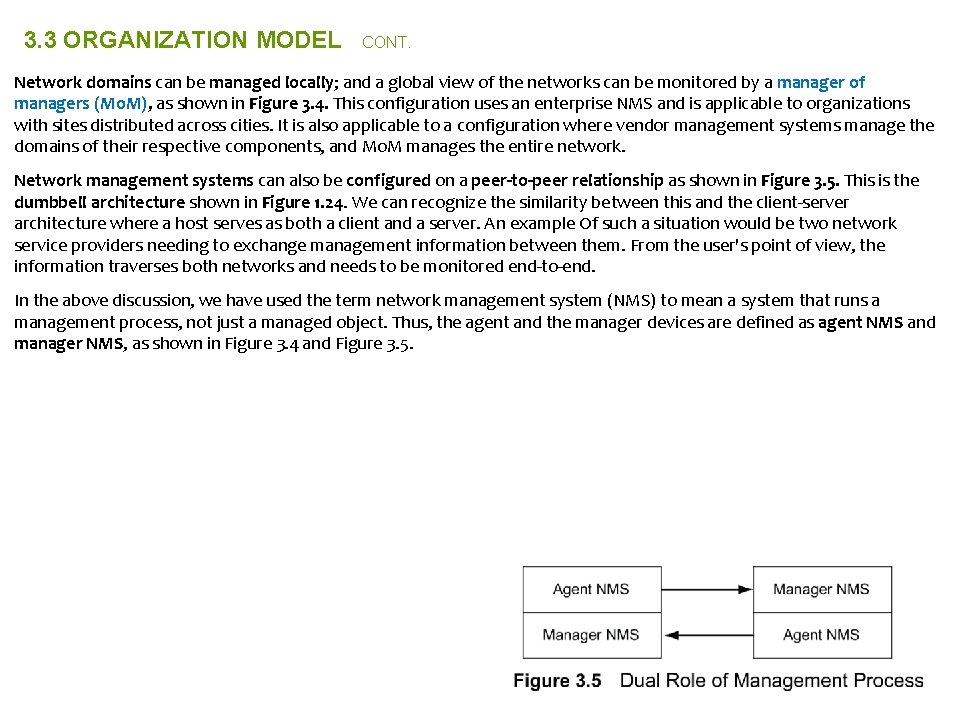
3. 3 ORGANIZATION MODEL CONT. Network domains can be managed locally; and a global view of the networks can be monitored by a manager of managers (Mo. M), as shown in Figure 3. 4. This configuration uses an enterprise NMS and is applicable to organizations with sites distributed across cities. It is also applicable to a configuration where vendor management systems manage the domains of their respective components, and Mo. M manages the entire network. Network management systems can also be configured on a peer-to-peer relationship as shown in Figure 3. 5. This is the dumbbell architecture shown in Figure 1. 24. We can recognize the similarity between this and the client-server architecture where a host serves as both a client and a server. An example Of such a situation would be two network service providers needing to exchange management information between them. From the user's point of view, the information traverses both networks and needs to be monitored end-to-end. In the above discussion, we have used the term network management system (NMS) to mean a system that runs a management process, not just a managed object. Thus, the agent and the manager devices are defined as agent NMS and manager NMS, as shown in Figure 3. 4 and Figure 3. 5.
3. 5 COMMUNICATION MODEL We have discussed in the previous section how information content is defined (SMI) and stored (MIB). We will now address the model associated with how the information is exchanged between systems? Management data are communicated between agent and manager processes, as well as between manager processes. Three aspects need to be addressed in the communication of information between two entities: transport medium of message exchange (transport protocol), message format of communication (application protocol), and the actual message (commands and responses). Let us illustrate this by an example of Azita buying a car from an automobile salesperson, Roberto.
3. 5 COMMUNICATION MODEL (cont. ) Figure 3. 11 presents the communication model. The applications in the manager module initiate requests to the agent in the Internet model. It is part of the operations in the OSI model. The agent executes the request on the network element; i. e. , managed object, and returns responses to the manager. The traps/notifications are the unsolicited messages, such as alarms, generated by the agent. Figure 3. 12 presents the communication protocol used to transfer information between managed object and managing processes, as well as between management processes. The OSI model uses CMIP along with CMIS. The Internet uses SNMP for communication. The services are part of operations using requests, responses, and alarm notifications. OSI uses both connection-oriented and connectionless protocols for transportation. For example, the TCP 4 transport layer protocol riding on top of the x. 25 protocol could be used for connection-oriented transporting and application messages. TP 4 over Connectionless Network Protocol is used for connectionless transportation. The Internet uses connectionless UDP/IP protocol for transporting messages. CMIP and SNMP specify the management communication protocols for OS 1 and Internet management. CMIP is addressed in Appendix A. SNMP is extensively covered throughout the book. The application processes invoke the management communication layer protocols. OST deals with messages in the specification of managed objects. Managed objects and their attributes could be manipulated by operations. Basic application service modules are defined by CMIS. In the Internet, operations are executed by SNMP messages.
Summary The foundations of standards, models, and language needed to delve into the study of network management have been addressed in this chapter. These are the four network management models OSI, Internet, Telecommunications Network Management, and IEEE 802 — and a fifth emerging one using Web technology. The OSI management model categorizes the four functions of network management into four models. They are configuration, information, communication, and application functions. The organization model describes the management process in the network element, called the agent process, and the management process in the manager. We presented the two-tier and three-tier architectural models and the relationship between them. The information model addresses the SMI that enables processes running in different components in the network to exchange management data. We defined the management object for both OSI and Internet/SNMP management models. The two primary communications protocols are CMIP in OSI and SNMP in the Internet. We discussed the syntactical format, Abstract Syntax Notation One, and how it is applied to defining managed objects. We presented the terminology, symbols, and conventions used in ASN. 1, and then defined the various categories and structure of data types. We defined the managed objects in OSI and SNMP/lnternet management models in adequate detail so that we should be prepared to study SNMP management in the next two chapters. We briefly covered how ASN. 1 is applied to specifying the management information tree and MIB by giving some specific examples. The text-oriented ASN. 1 specifications need to be encoded for transmission of data between systems. We defined the extension to ASN. 1 in defining an ASN. 1 macro and presented an example from the SNMP management model used to create a new object. The application functions are subdivided into five categories of management: configuration, fault, performance, security, and accounting. We have addressed each function briefly in this chapter.
Test Bank 6. Which of the following is not associated with a Network Management Standard? a) TMN b) IEEE c) ODI/CMIP d) SNMP/Internet e) ACM 7. Which of the following is not a Network management Model? a) Logical model b) Organization model c) Information model d) Functional model e) Communication model 8. Select the incorrect statement from the following: a) Network Management functional models include configuration and fault management b) Network Management functional models include performance management and security management c) OSI network Management functional models include accounting applications d) SLA management is one of the OSI functional models e) OSI functional models address user application
Assignment 1 Q 2 Explain the difference between the database of an NMS and MIB. How do you implement each in a Network Management System? A database of an NMS is a physical database containing the network objects and values. It is implemented using any proprietary database software. MIB is a virtual database that is used by network management and agent applications to exchange information about the network objects. It has a hierarchical structure and the schema of the MIB is compiled into the management and agent management software.
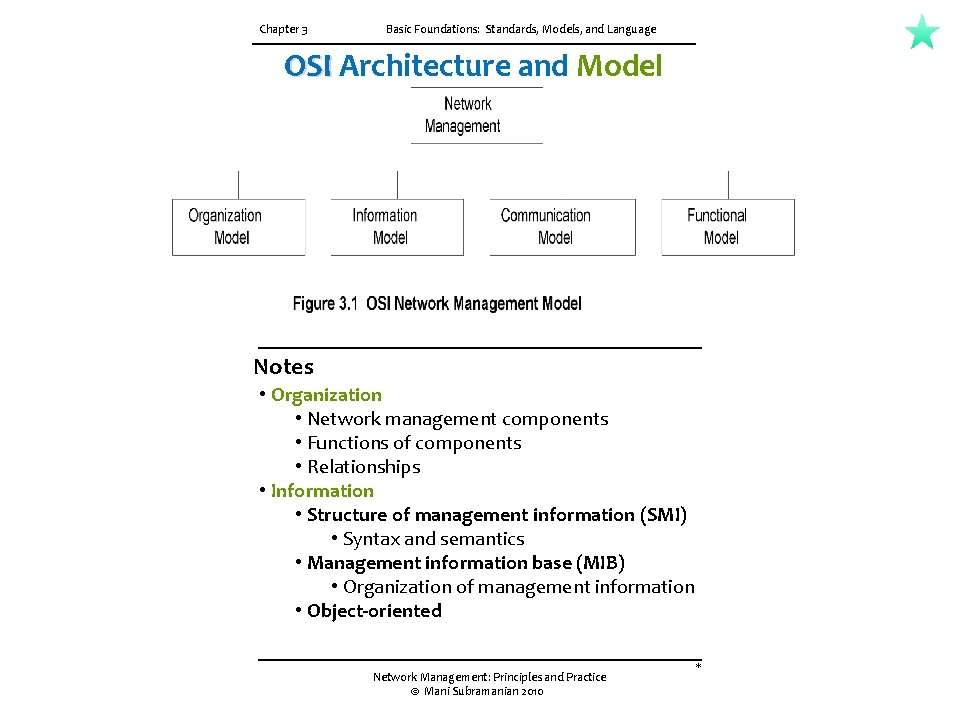
Chapter 3 Basic Foundations: Standards, Models, and Language OSI Architecture and Model Notes • Organization • Network management components • Functions of components • Relationships • Information • Structure of management information (SMI) • Syntax and semantics • Management information base (MIB) • Organization of management information • Object-oriented Network Management: Principles and Practice © Mani Subramanian 2010 *

Chapter 3 Basic Foundations: Standards, Models, and Language OSI Architecture and Model (cont. ) Notes • Communication • Transfer syntax with bidirectional messages • Transfer structure (PDU) • Functions • Application functions • Configure components • Monitor components • Measure performance • Secure information • Usage accounting Network Management: Principles and Practice © Mani Subramanian 2010 *
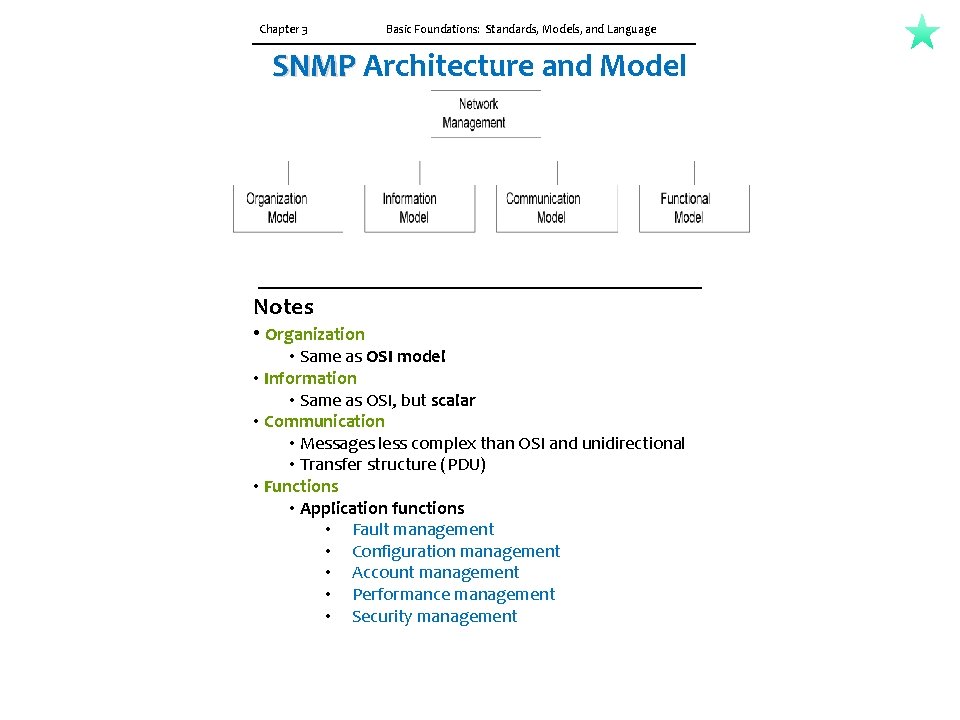
Chapter 3 Basic Foundations: Standards, Models, and Language SNMP Architecture and Model Notes • Organization • Same as OSI model • Information • Same as OSI, but scalar • Communication • Messages less complex than OSI and unidirectional • Transfer structure (PDU) • Functions • Application functions • Fault management • Configuration management • Account management • Performance management • Security management
Chapter 3 Basic Foundations: Standards, Models, and Language TMN Architecture • Addresses management of telecommunication networks • Based on OSI model • Superstructure on OSI network • Addresses network, service, and business management Notes Network Management: Principles and Practice © Mani Subramanian 2010 *
Chapter 3 Basic Foundations: Standards, Models, and Language Organizational Model • Manager • Sends requests to agents • Monitors alarms • Houses applications • Provides user interface • Agent • Gathers information from objects • Configures parameters of objects • Responds to managers’ requests • Generates alarms and sends them to managers • Managed object • Network element that is managed • Houses management agent • All objects are not managed / manageable Network Management: Principles and Practice © Mani Subramanian 2010 *
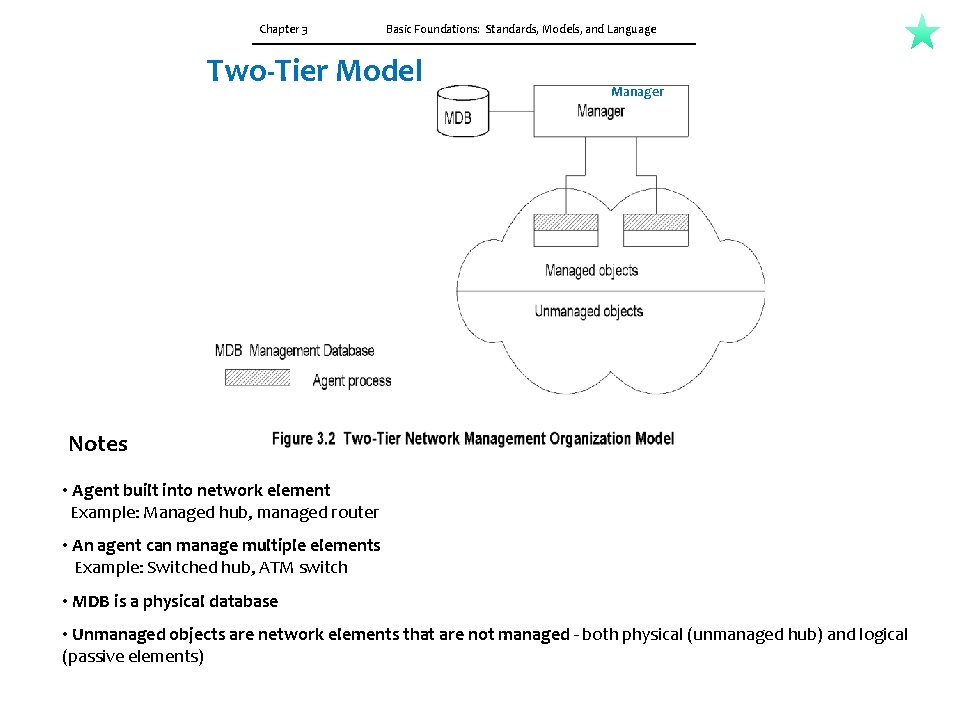
Chapter 3 Basic Foundations: Standards, Models, and Language Two-Tier Model Manager Notes • Agent built into network element Example: Managed hub, managed router • An agent can manage multiple elements Example: Switched hub, ATM switch • MDB is a physical database • Unmanaged objects are network elements that are not managed - both physical (unmanaged hub) and logical (passive elements)
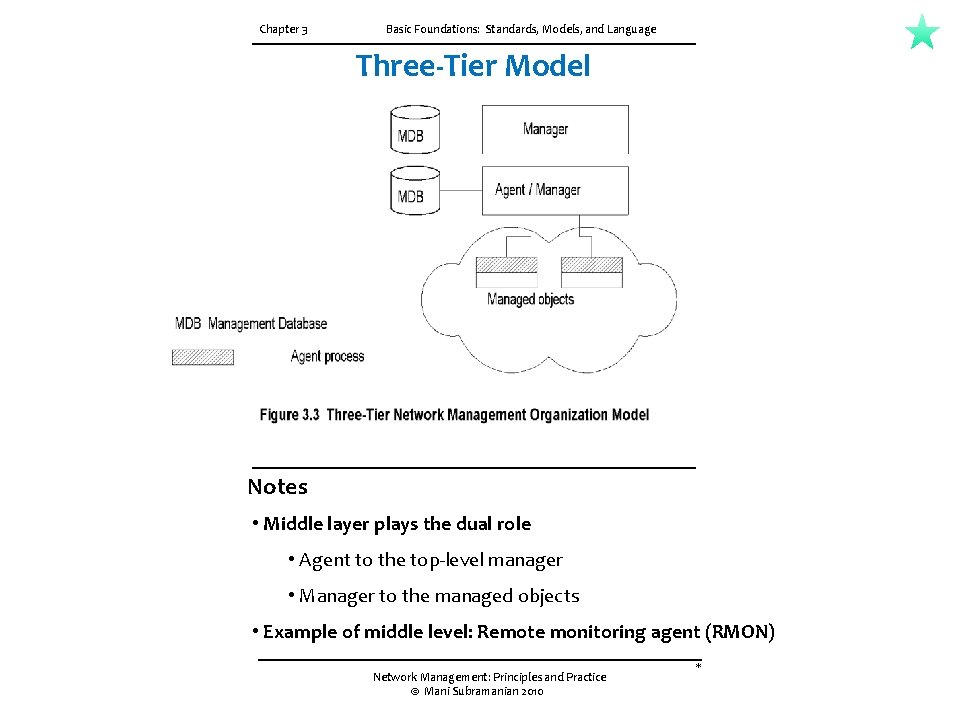
Chapter 3 Basic Foundations: Standards, Models, and Language Three-Tier Model Notes • Middle layer plays the dual role • Agent to the top-level manager • Manager to the managed objects • Example of middle level: Remote monitoring agent (RMON) Network Management: Principles and Practice © Mani Subramanian 2010 *
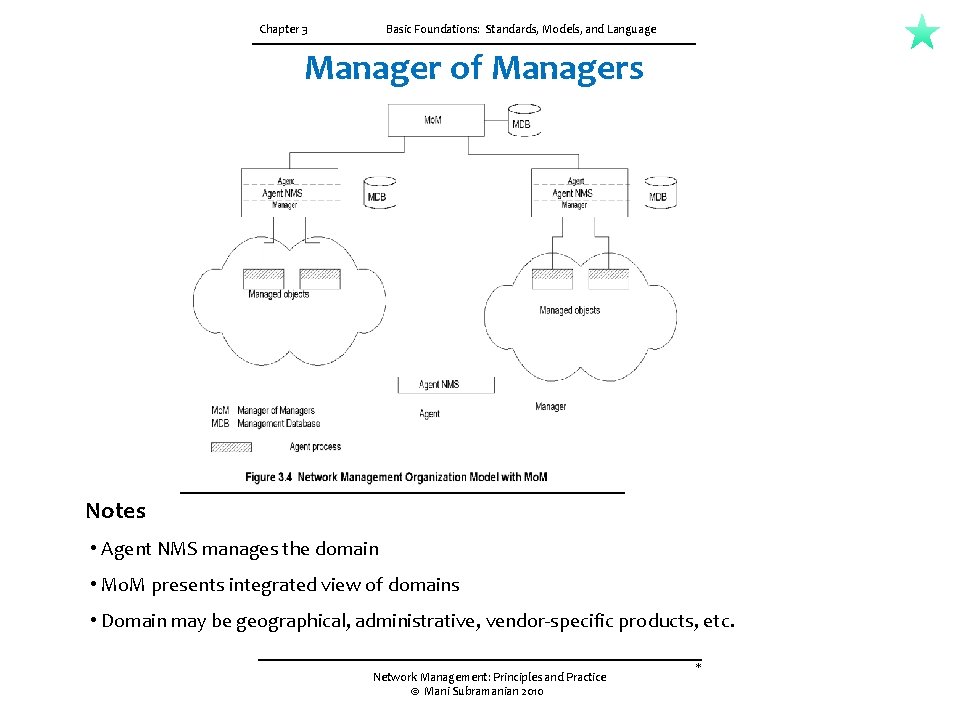
Chapter 3 Basic Foundations: Standards, Models, and Language Manager of Managers Notes • Agent NMS manages the domain • Mo. M presents integrated view of domains • Domain may be geographical, administrative, vendor-specific products, etc. Network Management: Principles and Practice © Mani Subramanian 2010 *
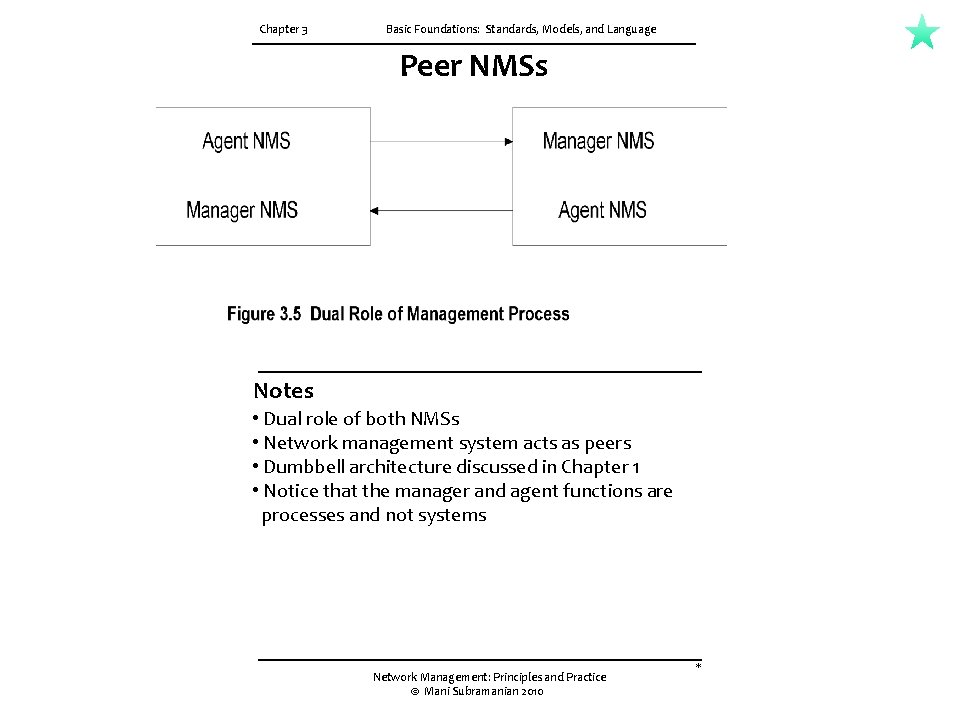
Chapter 3 Basic Foundations: Standards, Models, and Language Peer NMSs Notes • Dual role of both NMSs • Network management system acts as peers • Dumbbell architecture discussed in Chapter 1 • Notice that the manager and agent functions are processes and not systems Network Management: Principles and Practice © Mani Subramanian 2010 *
Chapter 3 Basic Foundations: Standards, Models, and Language Information Model: Analogy • Figure in a book uniquely identified by • ISBN, Chapter, and Figure number in that hierarchical order • ID: {ISBN, chapter, figure} • The three elements above define the syntax • Semantics is the meaning of the three entities according to Webster’s dictionary • The information comprises syntax and semantics about an object An information model is concerned with the structure and storage of information on network components is passed between the agent and management processes. The information model specifies the information base to describe managed objects and the relationship between managed objects. The structure defining the syntax and semantics of management information is specified by Structure of Management Information (SMI). The information base is called the Management Information Base (MIB). The MIB is used by both agent and management processes to store and exchange management information. The MIB associated with an agent is called an agent MIB and the MIB associated with a manager is designated as the manager MIB. The manager MIB consists of information on all the network components that it manages; whereas the MIB associated with an agent process needs to know only its local information, its MIB view. For example, a county may have many libraries. Each library has an index of all the books in that location — its MIB view. However, the central index at the county's main library, which manages all other libraries, has the index of all books in all the county's libraries —global manager MIB view.
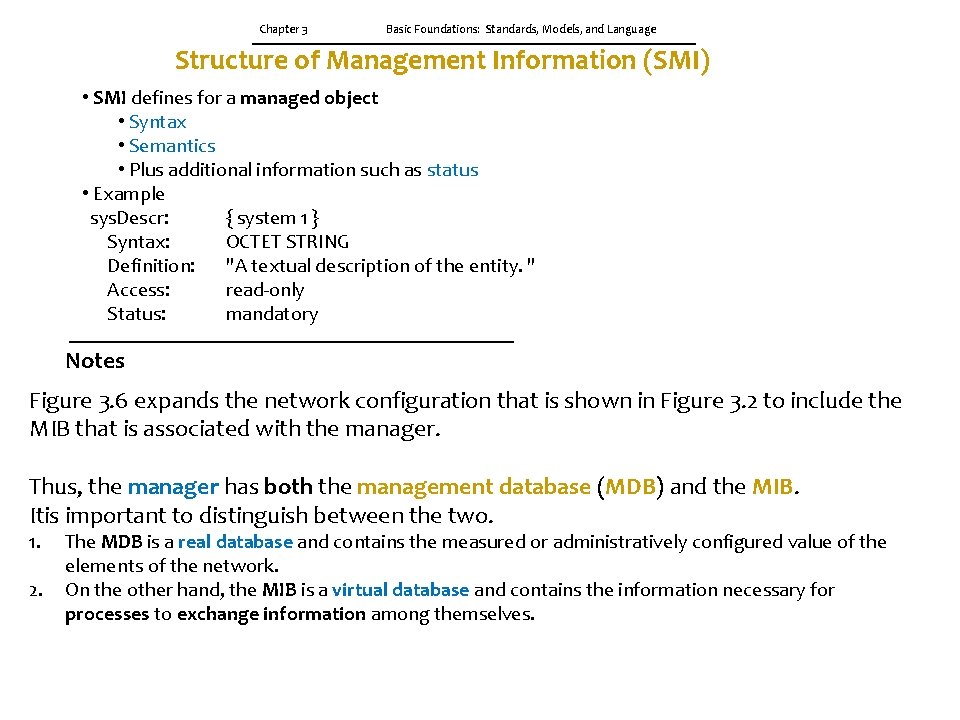
Chapter 3 Basic Foundations: Standards, Models, and Language Structure of Management Information (SMI) • SMI defines for a managed object • Syntax • Semantics • Plus additional information such as status • Example sys. Descr: { system 1 } Syntax: OCTET STRING Definition: "A textual description of the entity. " Access: read-only Status: mandatory Notes Figure 3. 6 expands the network configuration that is shown in Figure 3. 2 to include the MIB that is associated with the manager. Thus, the manager has both the management database (MDB) and the MIB. Itis important to distinguish between the two. 1. 2. The MDB is a real database and contains the measured or administratively configured value of the elements of the network. On the other hand, the MIB is a virtual database and contains the information necessary for processes to exchange information among themselves.
Chapter 3 Basic Foundations: Standards, Models, and Language Management Information Base (MIB) • Information base contains information about objects • Organized by grouping of related objects • Defines relationship between objects • It is NOT a physical database. It is a virtual database that is compiled into management module Notes Network Management: Principles and Practice © Mani Subramanian 2010 *
Chapter 3 Basic Foundations: Standards, Models, and Language Information Base View: An Analogy • Fulton County library system has many branches • Each branch has a set of books • The books in each branch is a different set • The information base of the county has the view (catalog) of all books • The information base of each branch has the catalog of books that belong to that branch. That is, each branch has its view (catalog) of the information base • Let us apply this to MIB view Notes Network Management: Principles and Practice © Mani Subramanian 2010 *
Chapter 3 Basic Foundations: Standards, Models, and Language MIB View and Access of an Object • A managed object has many attributes - its information base • There are several operations that can be performed on the objects • A user (manager) can view and perform only certain operations on the object by invoking the management agent • The view of the object attributes that the agent perceives is the MIB view • The operation that a user can perform is the MIB access Notes Network Management: Principles and Practice © Mani Subramanian 2010 *
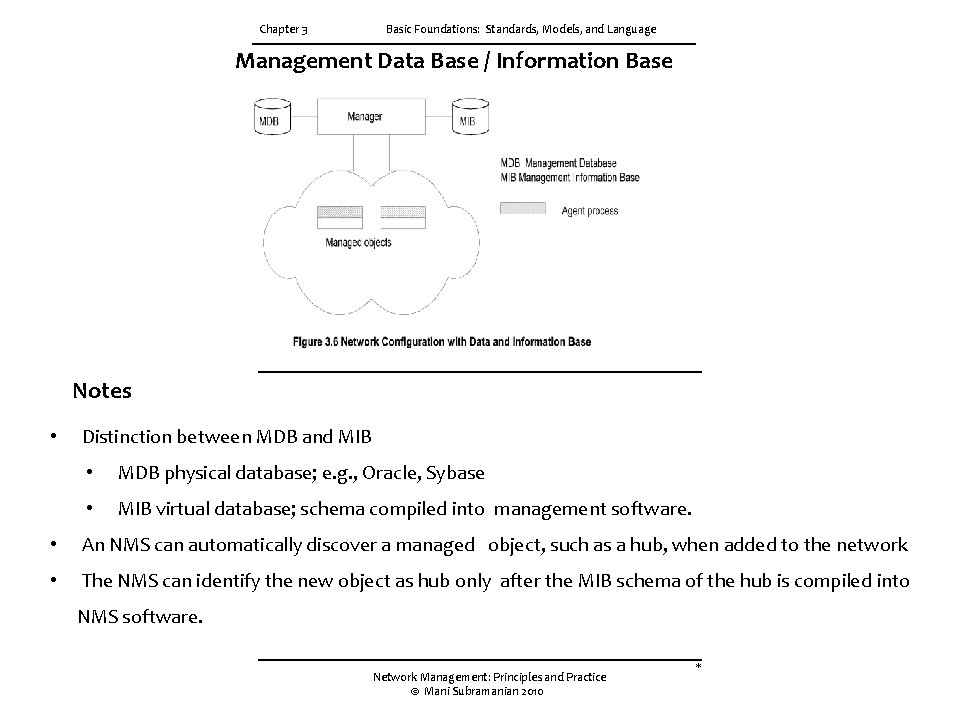
Chapter 3 Basic Foundations: Standards, Models, and Language Management Data Base / Information Base Notes • Distinction between MDB and MIB • MDB physical database; e. g. , Oracle, Sybase • MIB virtual database; schema compiled into management software. • An NMS can automatically discover a managed object, such as a hub, when added to the network • The NMS can identify the new object as hub only after the MIB schema of the hub is compiled into NMS software. Network Management: Principles and Practice © Mani Subramanian 2010 *
Chapter 3 Basic Foundations: Standards, Models, and Language Managed Object • Managed objects can be • Network elements (hardware, system) • Hubs, bridges, routers, transmission facilities • Software (non-physical) • Programs, algorithms • Administrative information • Contact person, name of group of objects (IP group) Notes Network Management: Principles and Practice © Mani Subramanian 2010 *
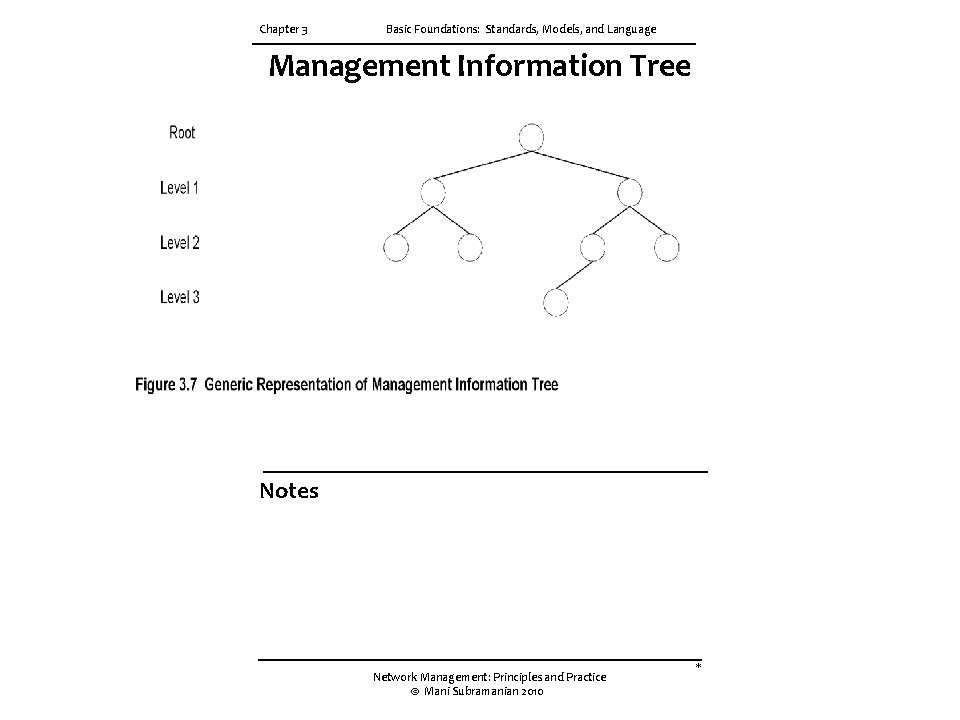
Chapter 3 Basic Foundations: Standards, Models, and Language Management Information Tree Notes Network Management: Principles and Practice © Mani Subramanian 2010 *
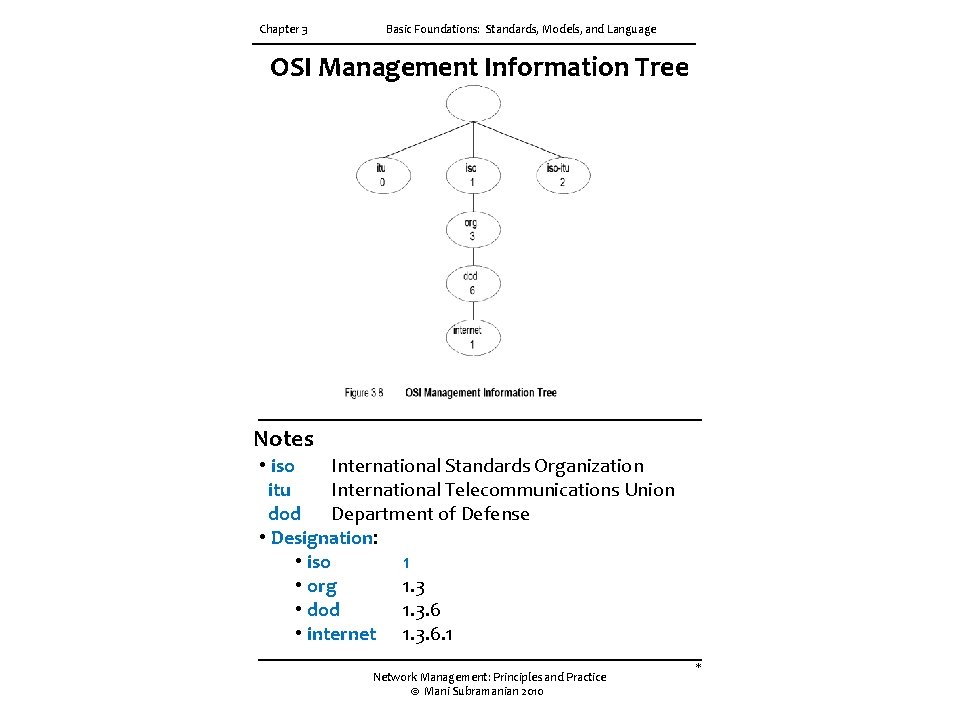
Chapter 3 Basic Foundations: Standards, Models, and Language OSI Management Information Tree Notes • iso International Standards Organization itu International Telecommunications Union dod Department of Defense • Designation: • iso 1 • org 1. 3 • dod 1. 3. 6 • internet 1. 3. 6. 1 Network Management: Principles and Practice © Mani Subramanian 2010 *
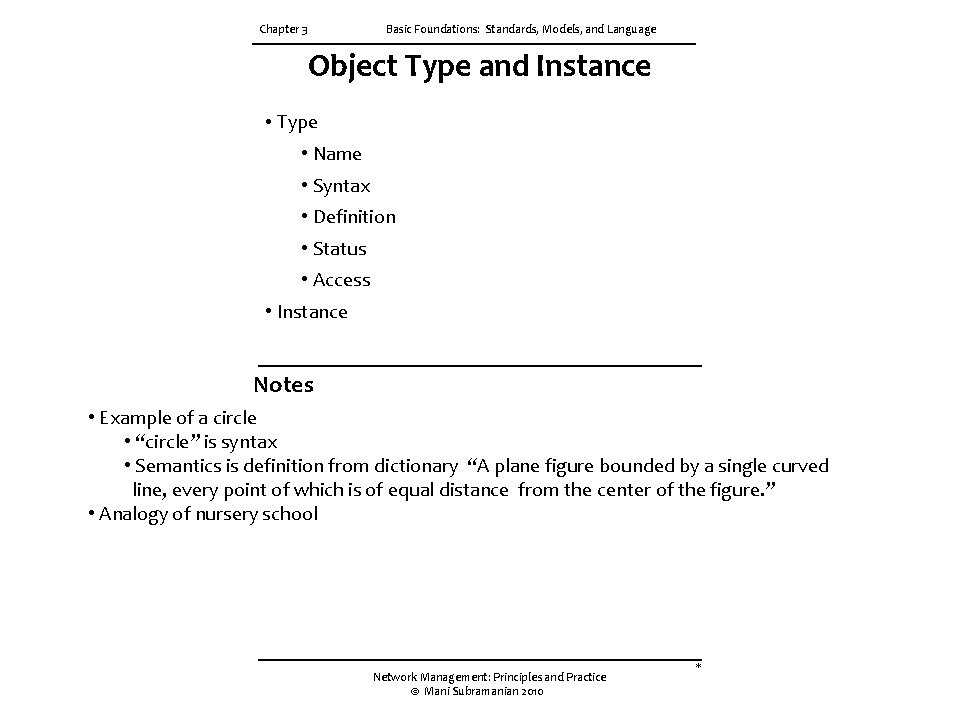
Chapter 3 Basic Foundations: Standards, Models, and Language Object Type and Instance • Type • Name • Syntax • Definition • Status • Access • Instance Notes • Example of a circle • “circle” is syntax • Semantics is definition from dictionary “A plane figure bounded by a single curved line, every point of which is of equal distance from the center of the figure. ” • Analogy of nursery school Network Management: Principles and Practice © Mani Subramanian 2010 *
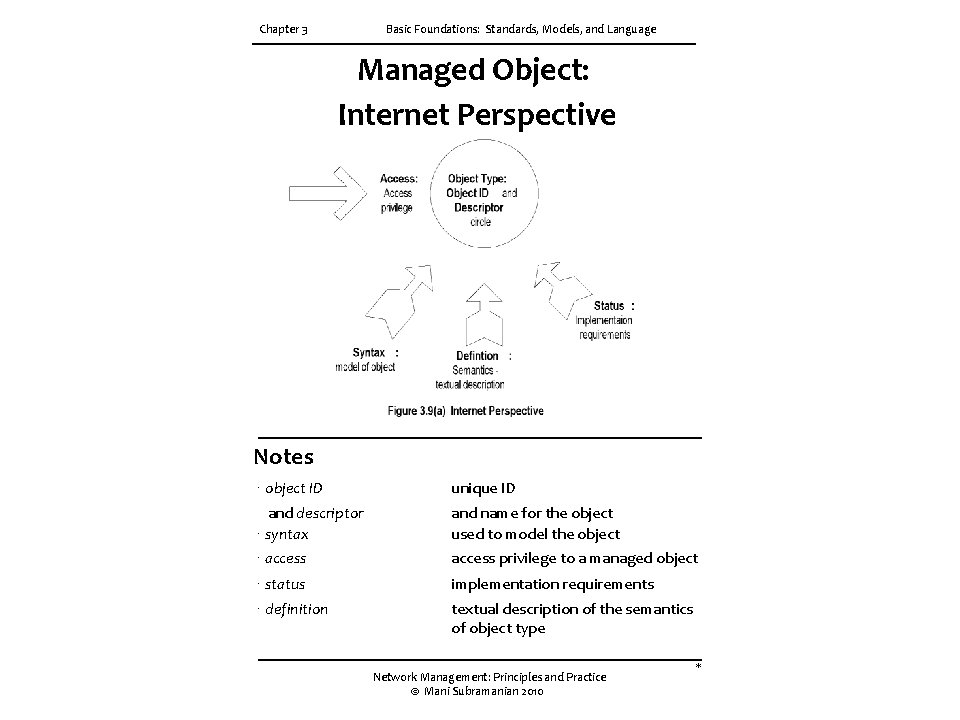
Chapter 3 Basic Foundations: Standards, Models, and Language Managed Object: Internet Perspective Notes ∙ object ID unique ID and descriptor ∙ syntax and name for the object used to model the object ∙ access privilege to a managed object ∙ status implementation requirements ∙ definition textual description of the semantics of object type Network Management: Principles and Practice © Mani Subramanian 2010 *
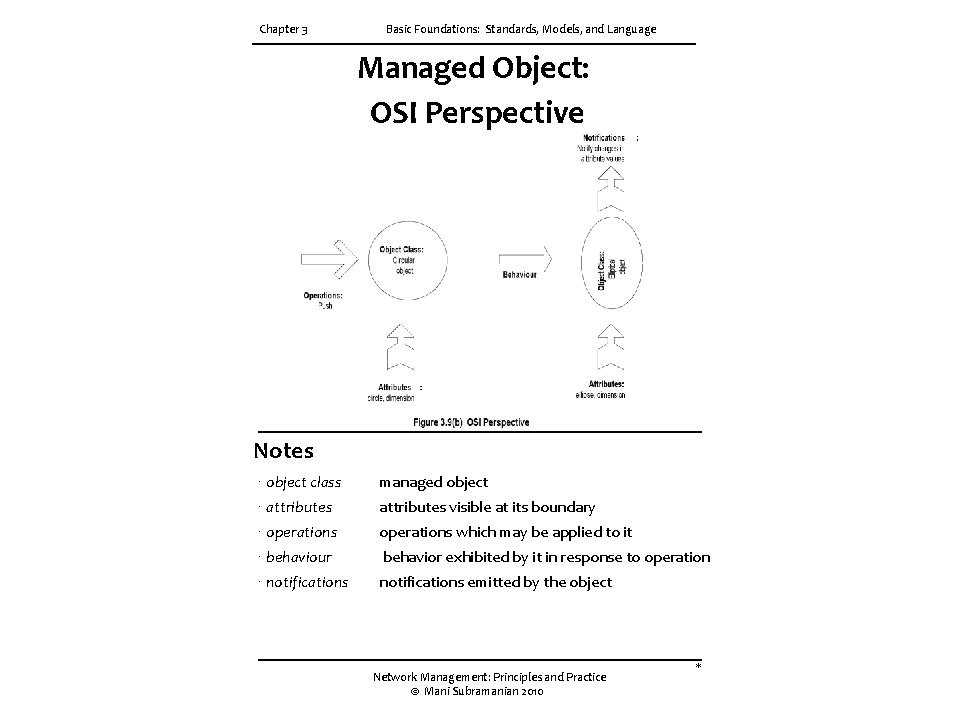
Chapter 3 Basic Foundations: Standards, Models, and Language Managed Object: OSI Perspective Notes ∙ object class managed object ∙ attributes visible at its boundary ∙ operations which may be applied to it ∙ behaviour behavior exhibited by it in response to operation ∙ notifications emitted by the object Network Management: Principles and Practice © Mani Subramanian 2010 *
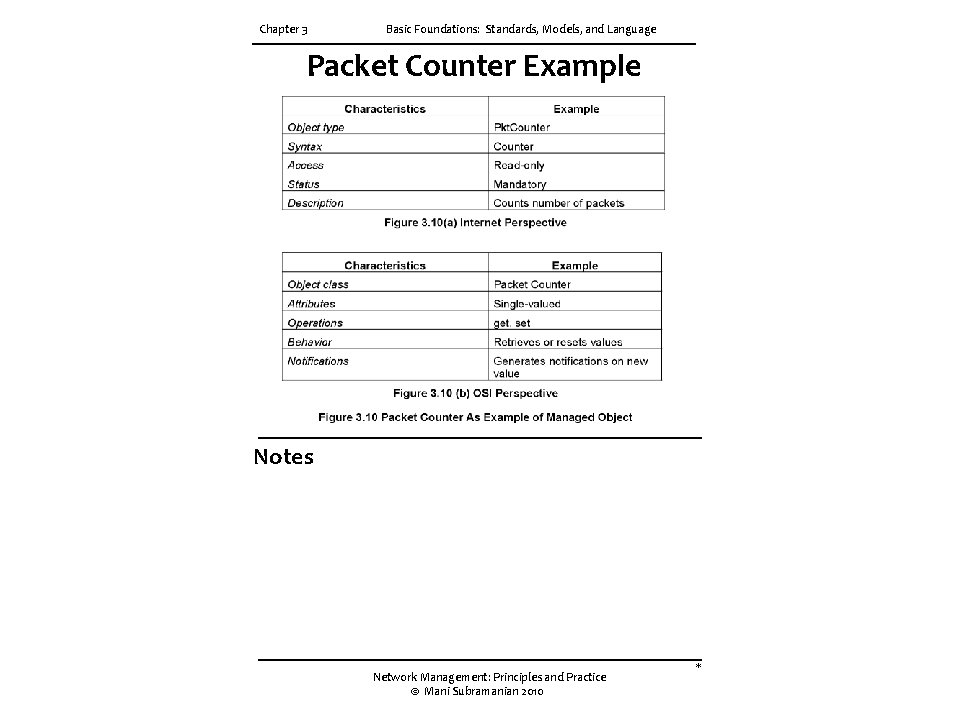
Chapter 3 Basic Foundations: Standards, Models, and Language Packet Counter Example Notes Network Management: Principles and Practice © Mani Subramanian 2010 *
Chapter 3 Basic Foundations: Standards, Models, and Language Internet vs. OSI Managed Object • Scalar object in Internet vs. Object-oriented approach in OSI • OSI characteristics of operations, behavior, and notification are part of communication model in Internet: get/set and response/alarm • Internet syntax is absorbed as part of OSI attributes • Internet access is part of OSI security model • Internet status is part of OSI conformance application • OSI permits creation and deletion of objects; Internet does not: Enhancement in SNMPv 2 Notes Network Management: Principles and Practice © Mani Subramanian 2010 *
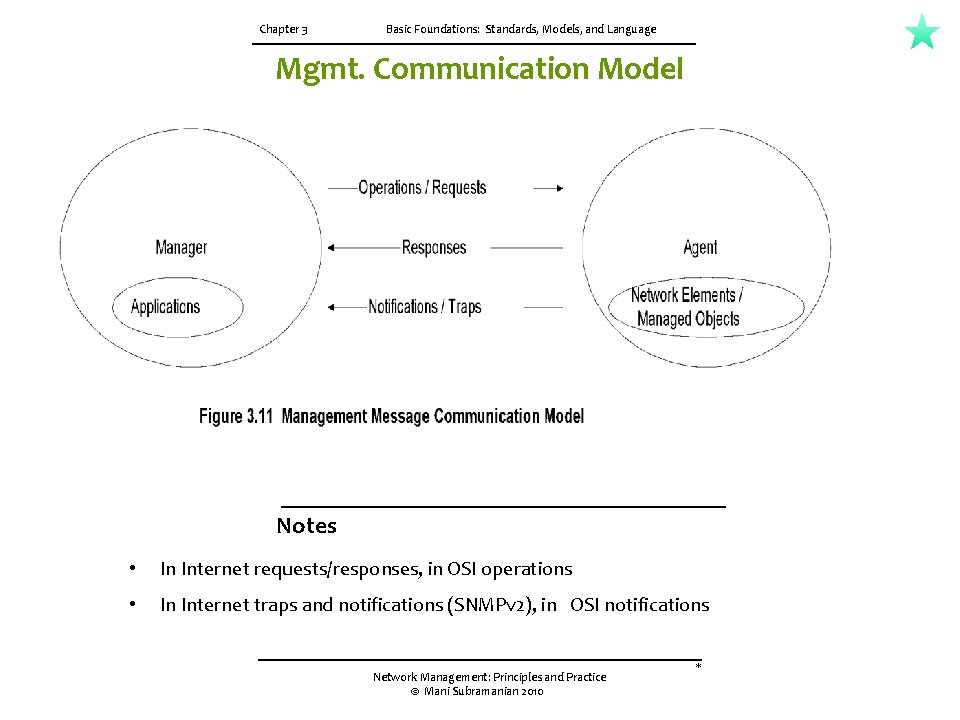
Chapter 3 Basic Foundations: Standards, Models, and Language Mgmt. Communication Model Notes • In Internet requests/responses, in OSI operations • In Internet traps and notifications (SNMPv 2), in OSI notifications Network Management: Principles and Practice © Mani Subramanian 2010 *
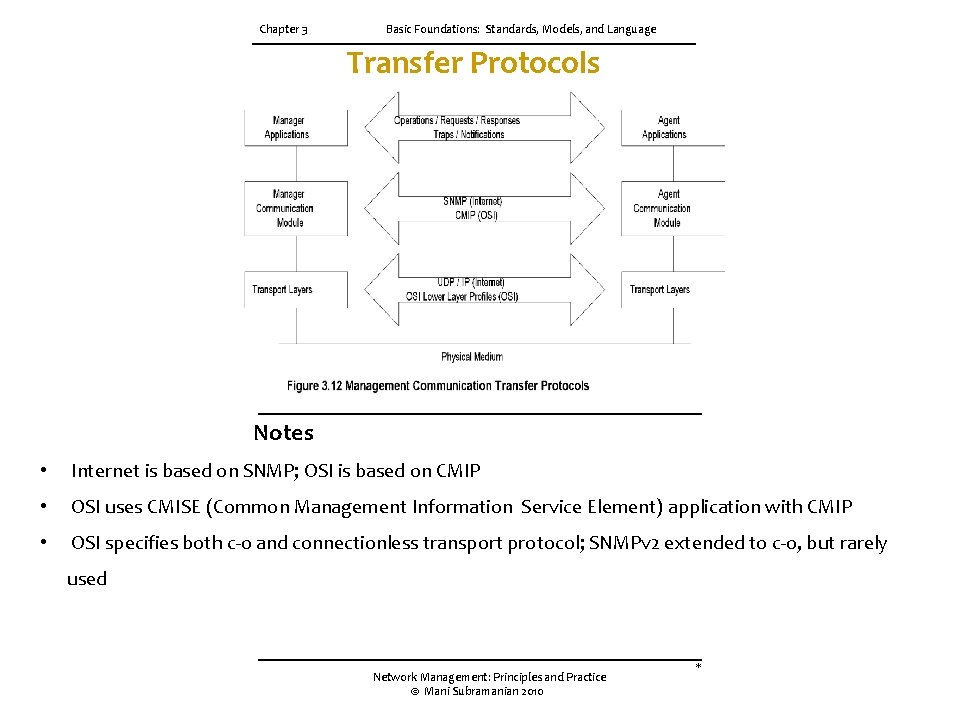
Chapter 3 Basic Foundations: Standards, Models, and Language Transfer Protocols Notes • Internet is based on SNMP; OSI is based on CMIP • OSI uses CMISE (Common Management Information Service Element) application with CMIP • OSI specifies both c-o and connectionless transport protocol; SNMPv 2 extended to c-o, but rarely used Network Management: Principles and Practice © Mani Subramanian 2010 *
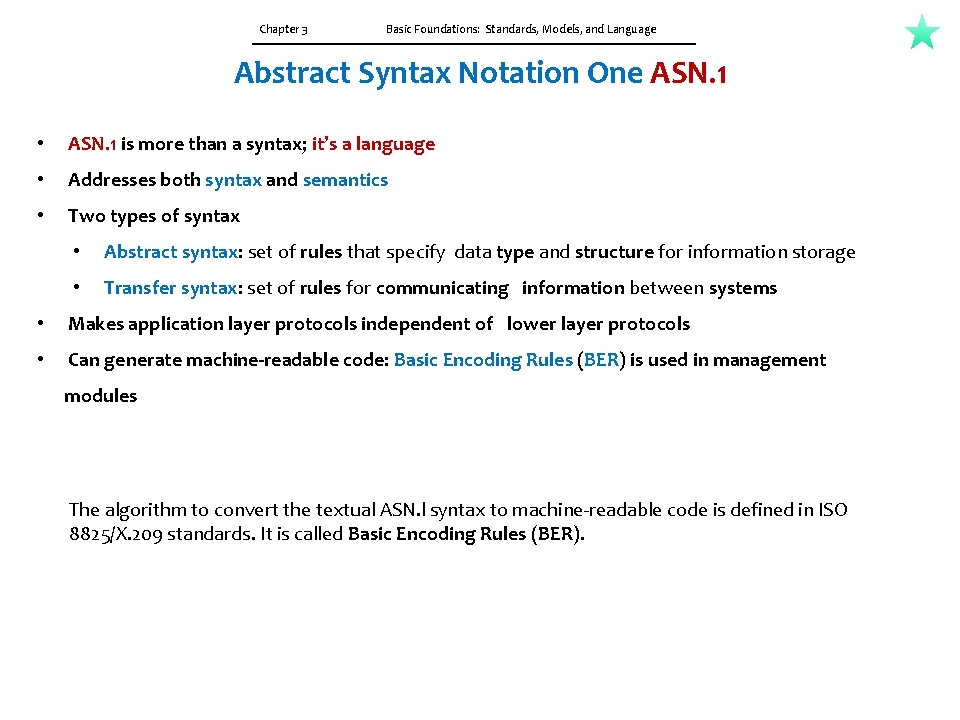
Chapter 3 Basic Foundations: Standards, Models, and Language Abstract Syntax Notation One ASN. 1 • ASN. 1 is more than a syntax; it’s a language • Addresses both syntax and semantics • Two types of syntax • Abstract syntax: set of rules that specify data type and structure for information storage • Transfer syntax: set of rules for communicating information between systems • Makes application layer protocols independent of lower layer protocols • Can generate machine-readable code: Basic Encoding Rules (BER) is used in management modules The algorithm to convert the textual ASN. l syntax to machine-readable code is defined in ISO 8825/X. 209 standards. It is called Basic Encoding Rules (BER).
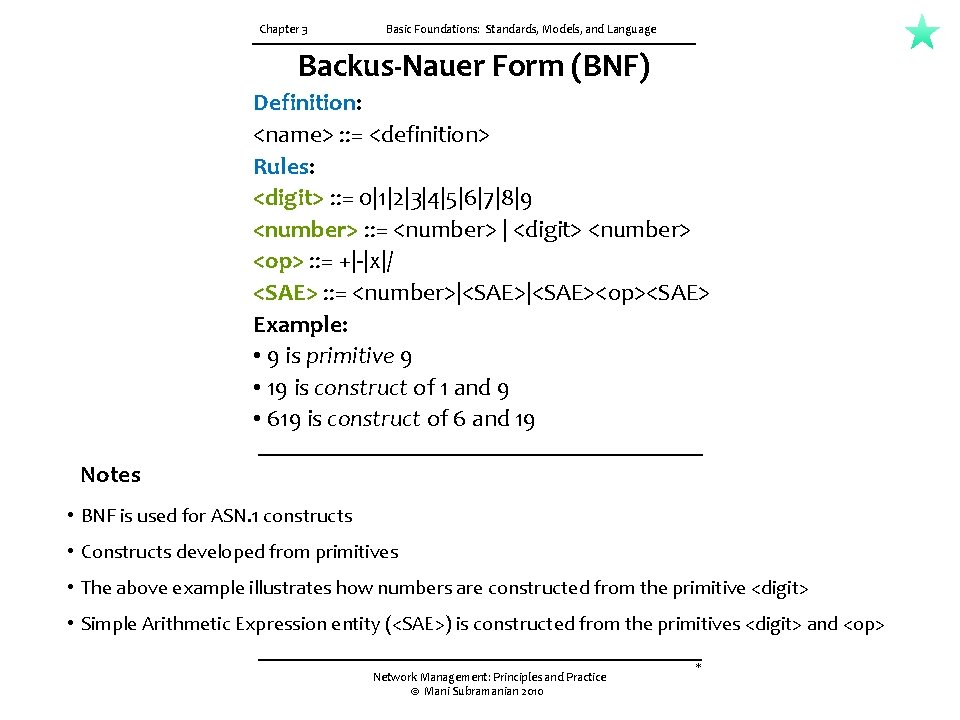
Chapter 3 Basic Foundations: Standards, Models, and Language Backus-Nauer Form (BNF) Definition: <name> : : = <definition> Rules: <digit> : : = 0|1|2|3|4|5|6|7|8|9 <number> : : = <number> | <digit> <number> <op> : : = +|-|x|/ <SAE> : : = <number>|<SAE><op><SAE> Example: • 9 is primitive 9 • 19 is construct of 1 and 9 • 619 is construct of 6 and 19 Notes • BNF is used for ASN. 1 constructs • Constructs developed from primitives • The above example illustrates how numbers are constructed from the primitive <digit> • Simple Arithmetic Expression entity (<SAE>) is constructed from the primitives <digit> and <op> Network Management: Principles and Practice © Mani Subramanian 2010 *
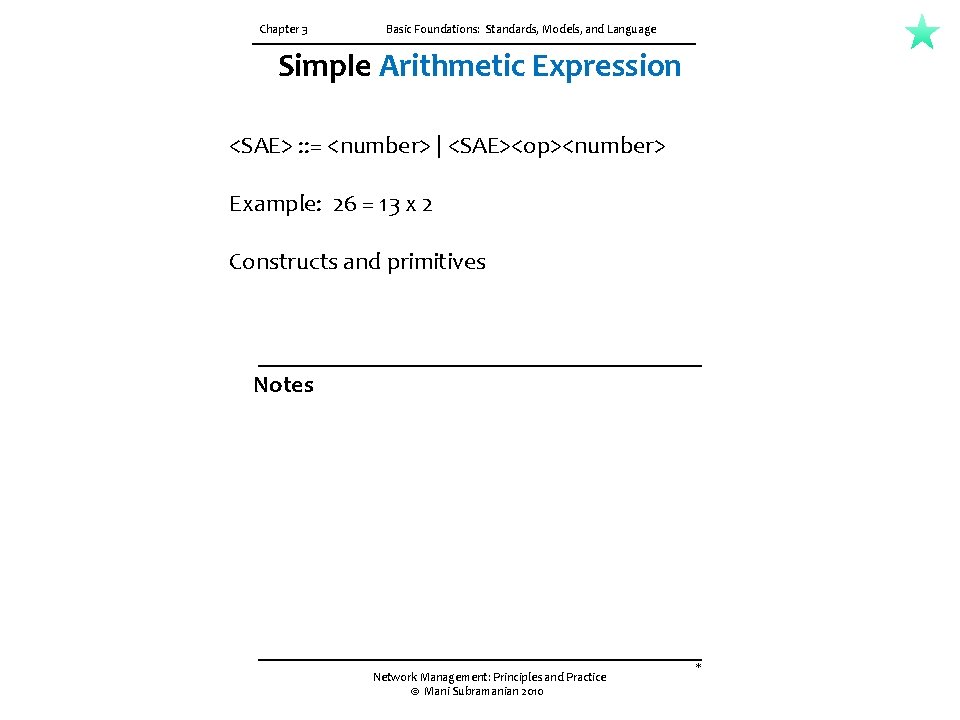
Chapter 3 Basic Foundations: Standards, Models, and Language Simple Arithmetic Expression <SAE> : : = <number> | <SAE><op><number> Example: 26 = 13 x 2 Constructs and primitives Notes Network Management: Principles and Practice © Mani Subramanian 2010 *
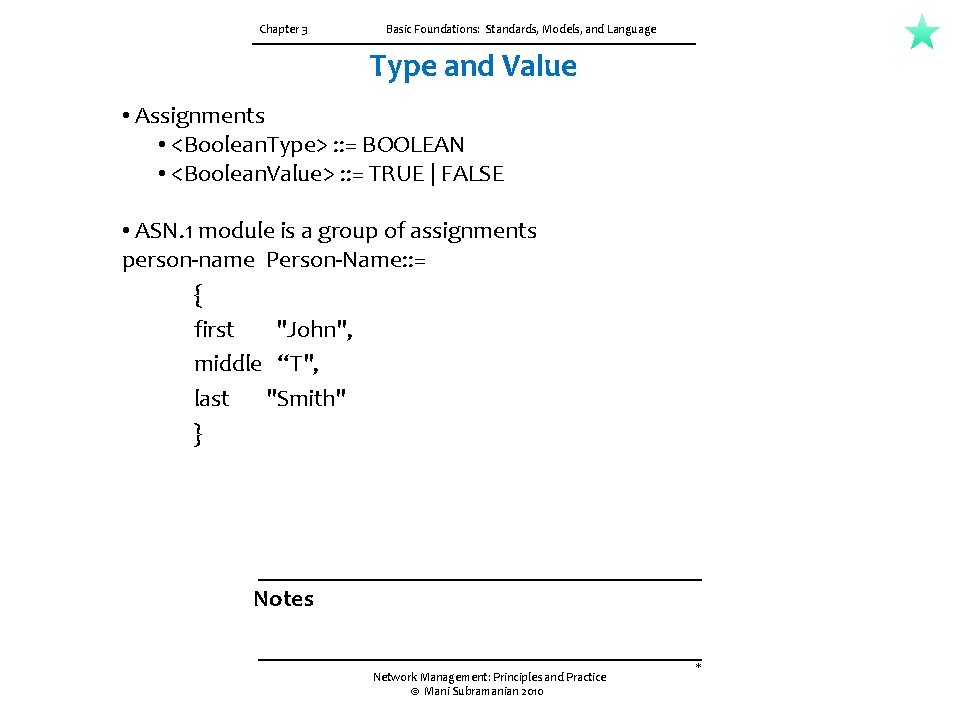
Chapter 3 Basic Foundations: Standards, Models, and Language Type and Value • Assignments • <Boolean. Type> : : = BOOLEAN • <Boolean. Value> : : = TRUE | FALSE • ASN. 1 module is a group of assignments person-name Person-Name: : = { first "John", middle “T", last "Smith" } Notes Network Management: Principles and Practice © Mani Subramanian 2010 *
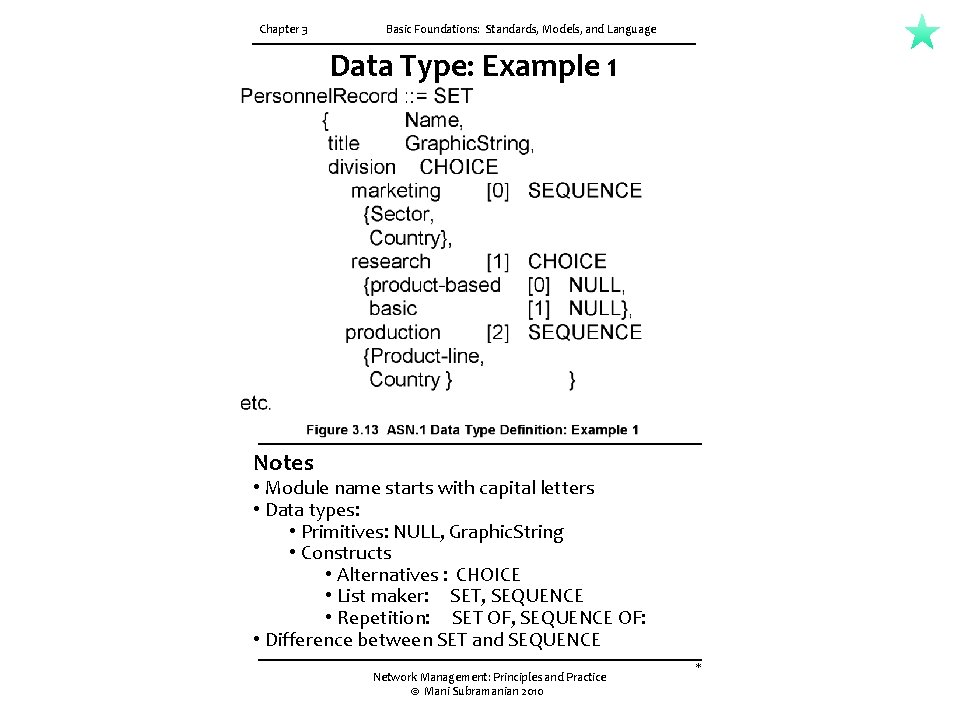
Chapter 3 Basic Foundations: Standards, Models, and Language Data Type: Example 1 Notes • Module name starts with capital letters • Data types: • Primitives: NULL, Graphic. String • Constructs • Alternatives : CHOICE • List maker: SET, SEQUENCE • Repetition: SET OF, SEQUENCE OF: • Difference between SET and SEQUENCE Network Management: Principles and Practice © Mani Subramanian 2010 *
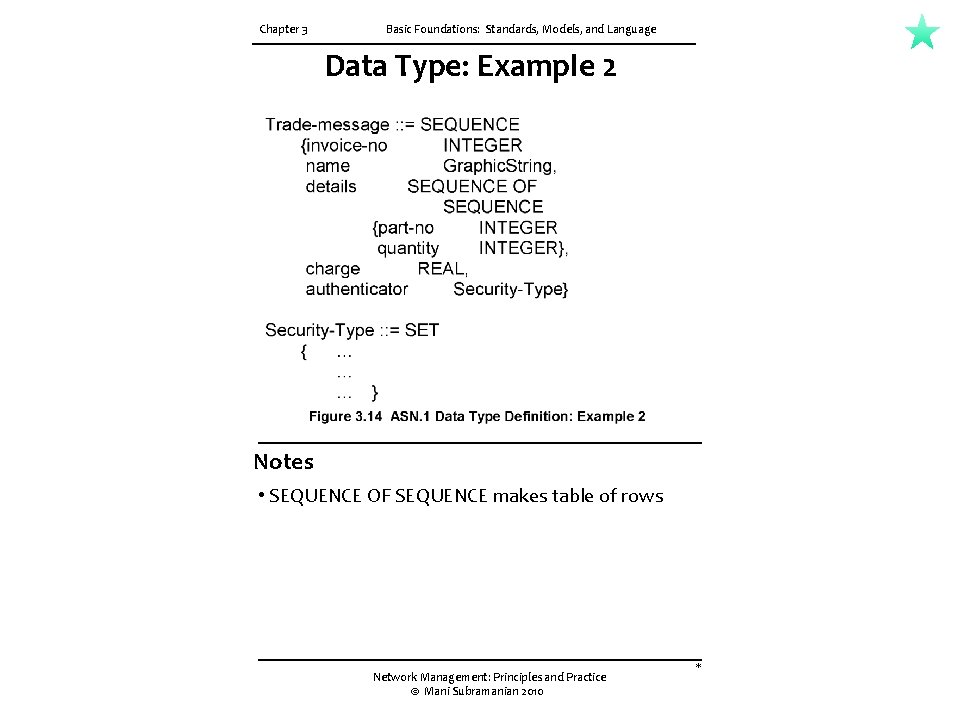
Chapter 3 Basic Foundations: Standards, Models, and Language Data Type: Example 2 Notes • SEQUENCE OF SEQUENCE makes table of rows Network Management: Principles and Practice © Mani Subramanian 2010 *
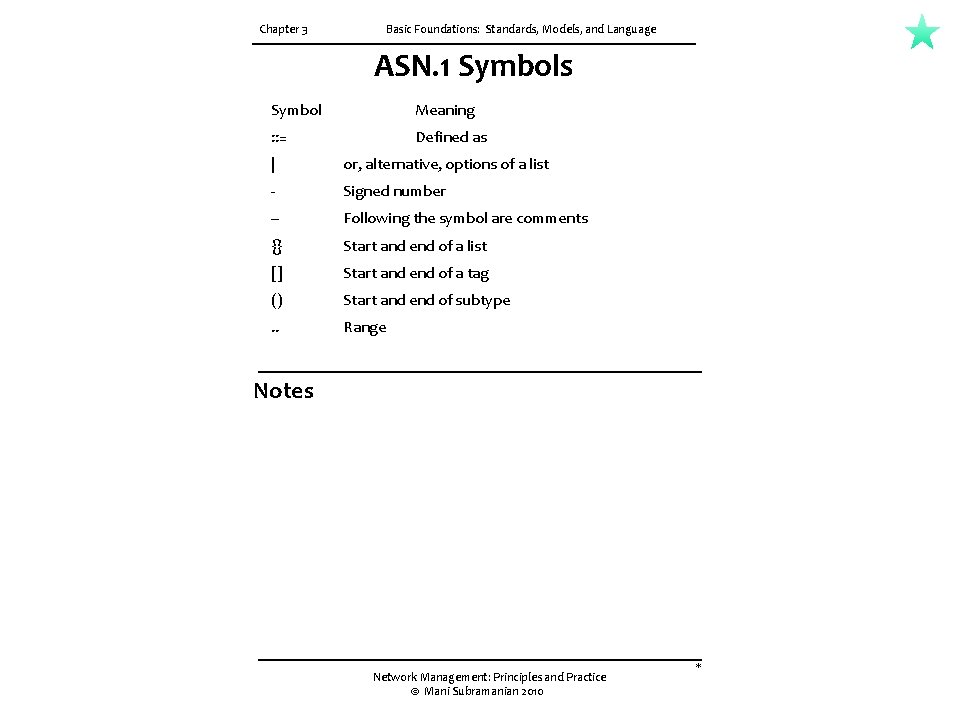
Chapter 3 Basic Foundations: Standards, Models, and Language ASN. 1 Symbols Symbol Meaning : : = Defined as | or, alternative, options of a list - Signed number -- Following the symbol are comments {} Start and end of a list [] Start and end of a tag () Start and end of subtype . . Range Notes Network Management: Principles and Practice © Mani Subramanian 2010 *
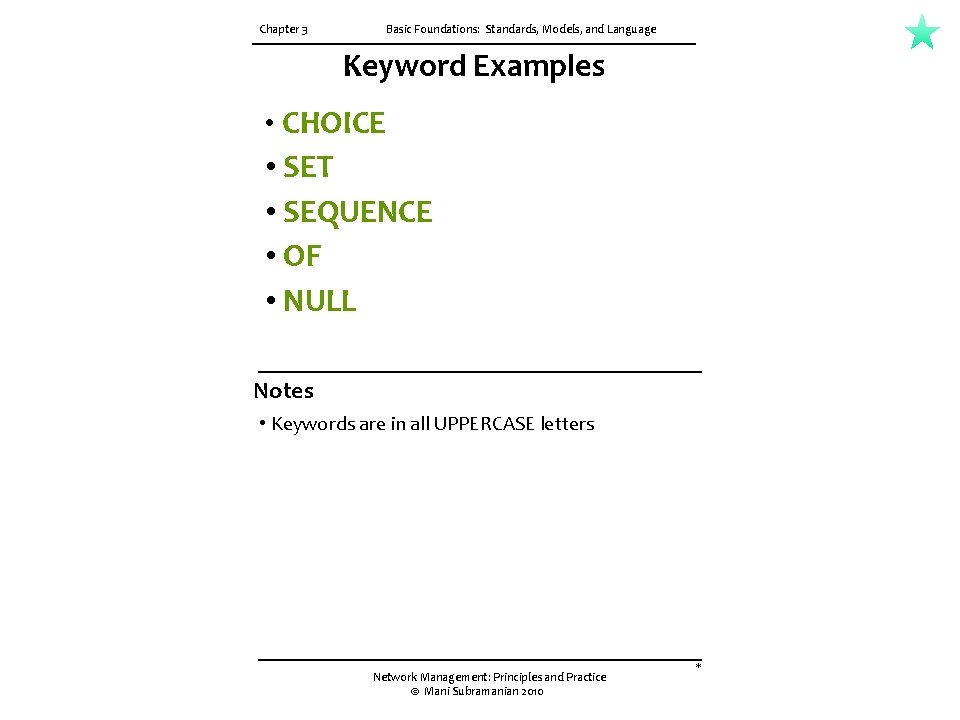
Chapter 3 Basic Foundations: Standards, Models, and Language Keyword Examples • CHOICE • SET • SEQUENCE • OF • NULL Notes • Keywords are in all UPPERCASE letters Network Management: Principles and Practice © Mani Subramanian 2010 *
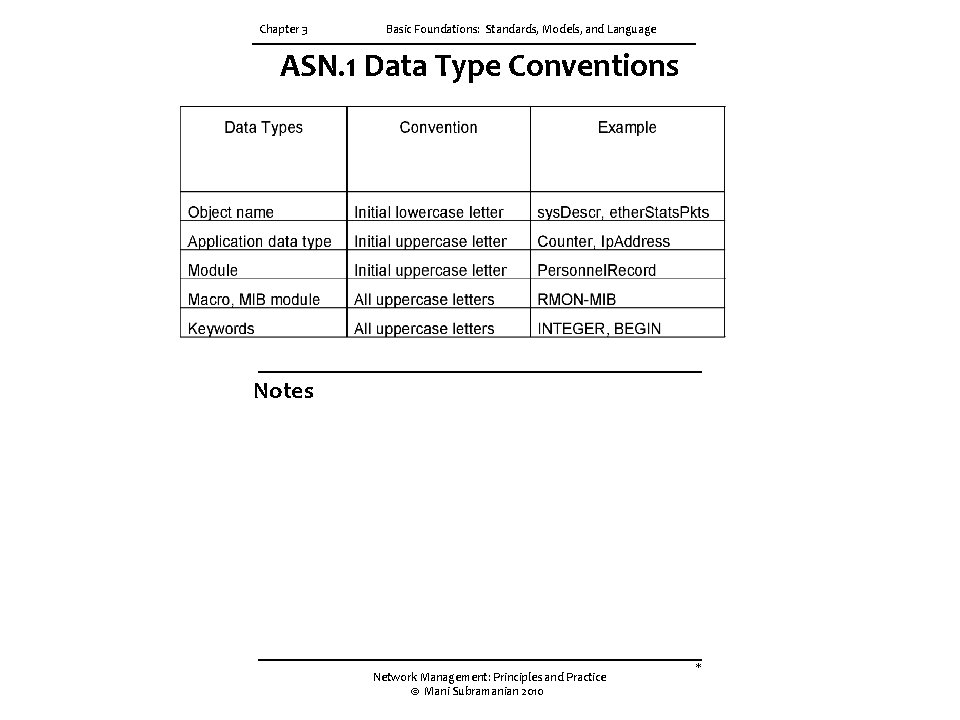
Chapter 3 Basic Foundations: Standards, Models, and Language ASN. 1 Data Type Conventions Notes Network Management: Principles and Practice © Mani Subramanian 2010 *
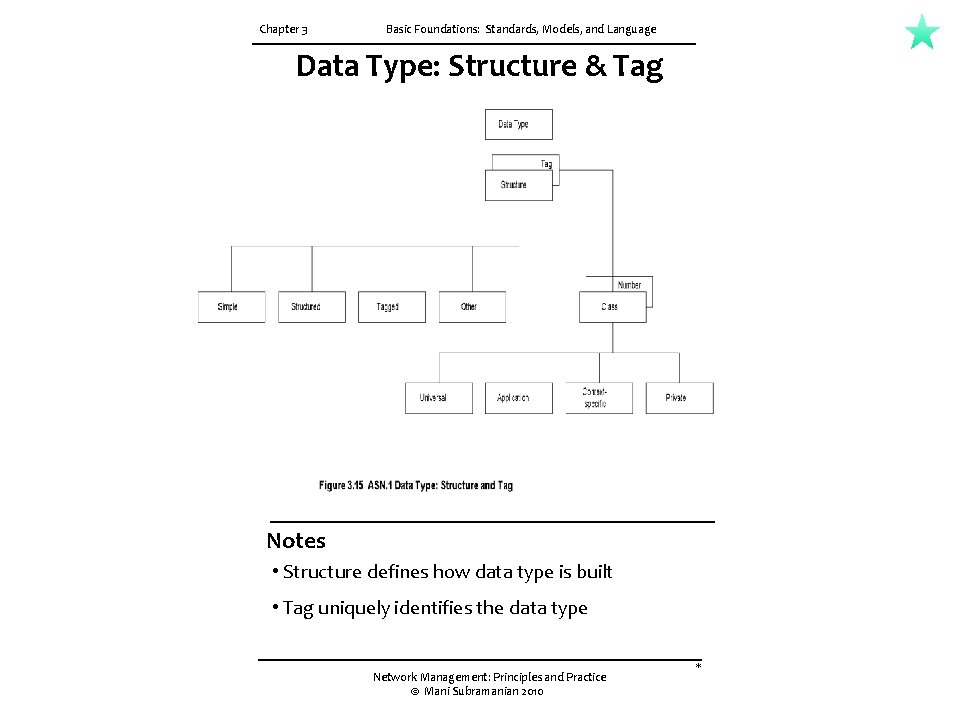
Chapter 3 Basic Foundations: Standards, Models, and Language Data Type: Structure & Tag Notes • Structure defines how data type is built • Tag uniquely identifies the data type Network Management: Principles and Practice © Mani Subramanian 2010 *
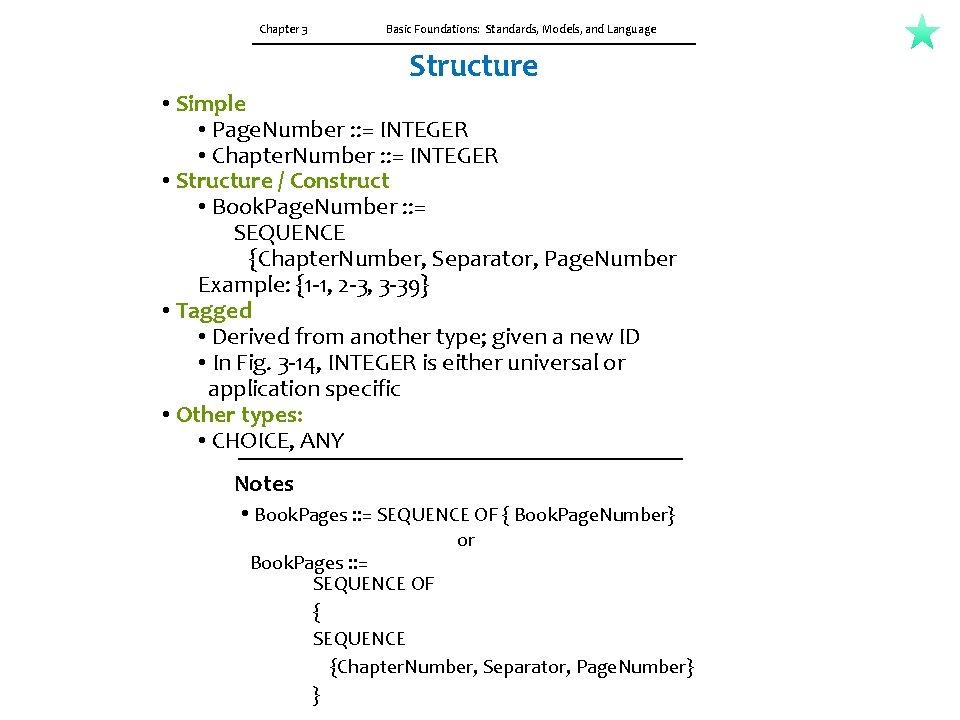
Chapter 3 Basic Foundations: Standards, Models, and Language Structure • Simple • Page. Number : : = INTEGER • Chapter. Number : : = INTEGER • Structure / Construct • Book. Page. Number : : = SEQUENCE {Chapter. Number, Separator, Page. Number Example: {1 -1, 2 -3, 3 -39} • Tagged • Derived from another type; given a new ID • In Fig. 3 -14, INTEGER is either universal or application specific • Other types: • CHOICE, ANY Notes • Book. Pages : : = SEQUENCE OF { Book. Page. Number} or Book. Pages : : = SEQUENCE OF { SEQUENCE {Chapter. Number, Separator, Page. Number} }
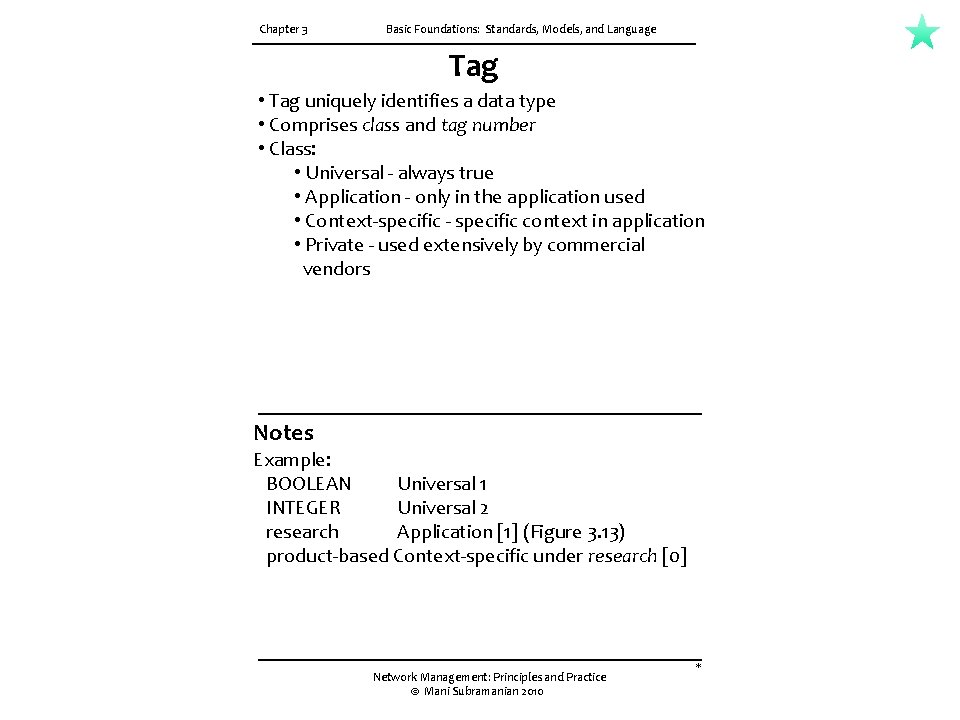
Chapter 3 Basic Foundations: Standards, Models, and Language Tag • Tag uniquely identifies a data type • Comprises class and tag number • Class: • Universal - always true • Application - only in the application used • Context-specific - specific context in application • Private - used extensively by commercial vendors Notes Example: BOOLEAN Universal 1 INTEGER Universal 2 research Application [1] (Figure 3. 13) product-based Context-specific under research [0] Network Management: Principles and Practice © Mani Subramanian 2010 *
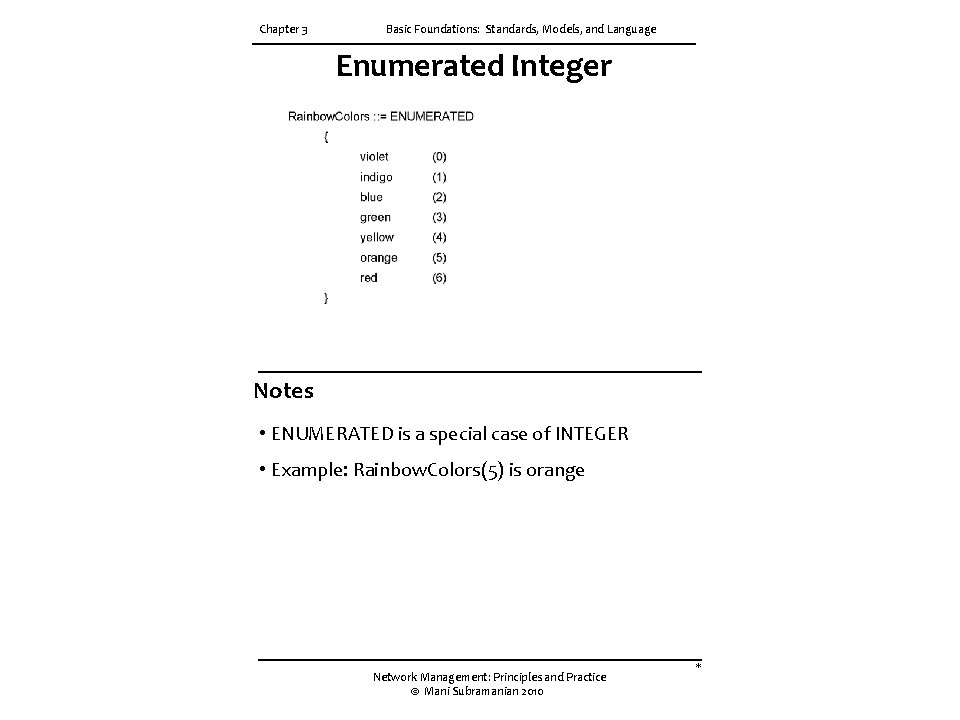
Chapter 3 Basic Foundations: Standards, Models, and Language Enumerated Integer Notes • ENUMERATED is a special case of INTEGER • Example: Rainbow. Colors(5) is orange Network Management: Principles and Practice © Mani Subramanian 2010 *
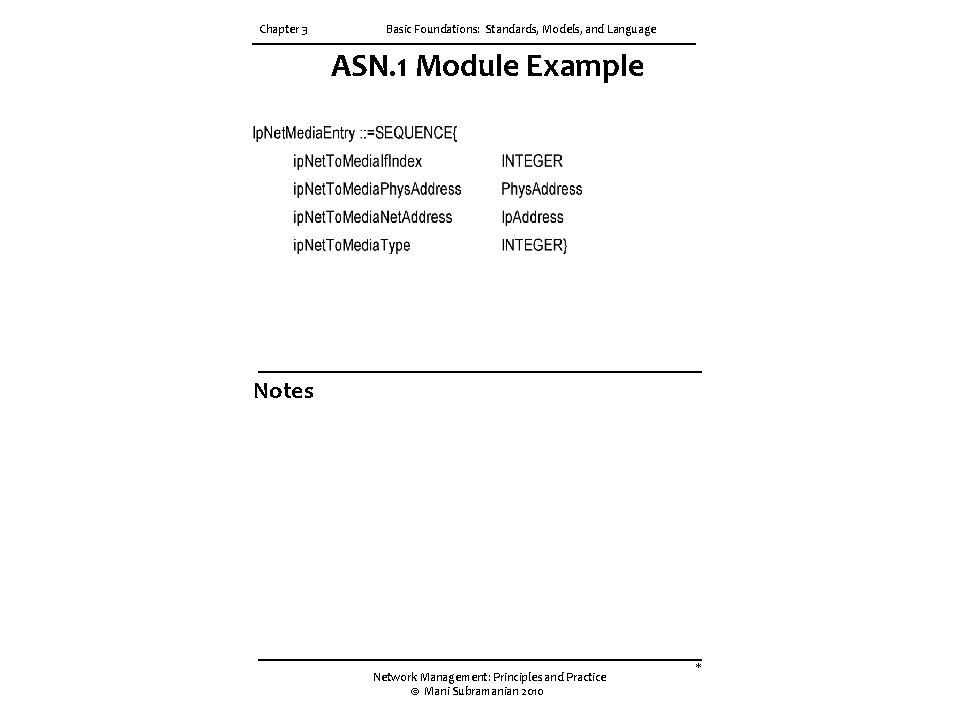
Chapter 3 Basic Foundations: Standards, Models, and Language ASN. 1 Module Example Notes Network Management: Principles and Practice © Mani Subramanian 2010 *
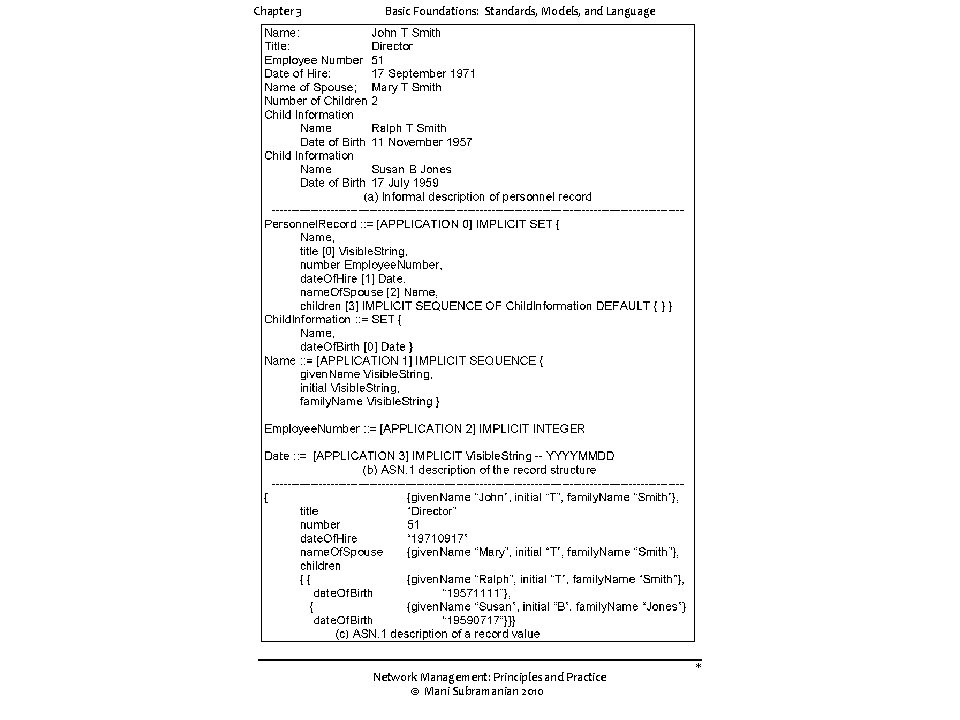
Chapter 3 Basic Foundations: Standards, Models, and Language Network Management: Principles and Practice © Mani Subramanian 2010 *
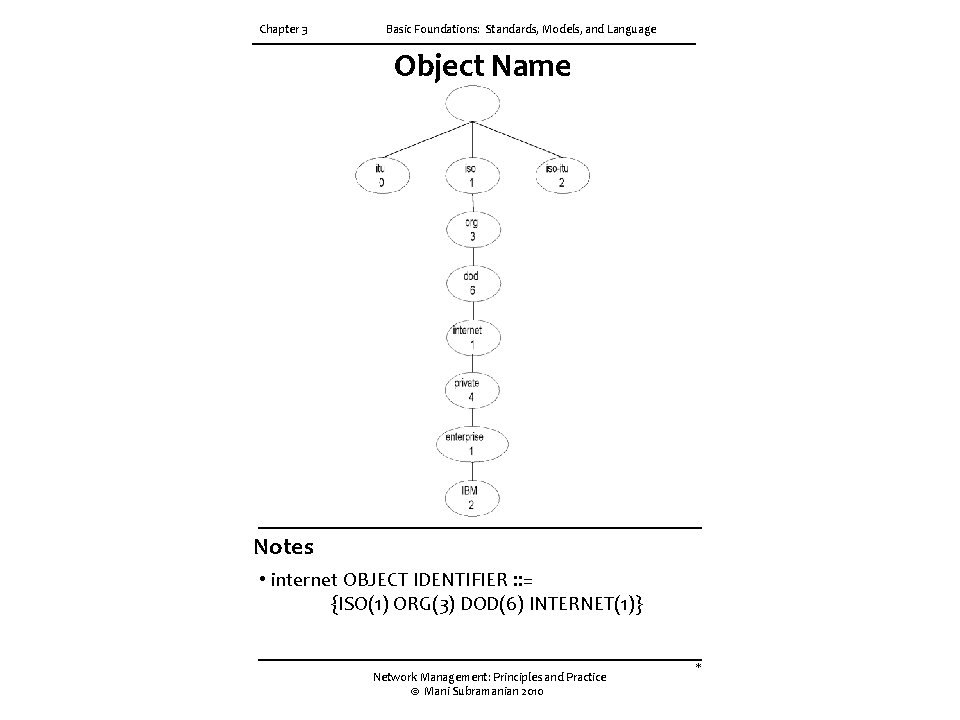
Chapter 3 Basic Foundations: Standards, Models, and Language Object Name Notes • internet OBJECT IDENTIFIER : : = {ISO(1) ORG(3) DOD(6) INTERNET(1)} Network Management: Principles and Practice © Mani Subramanian 2010 *
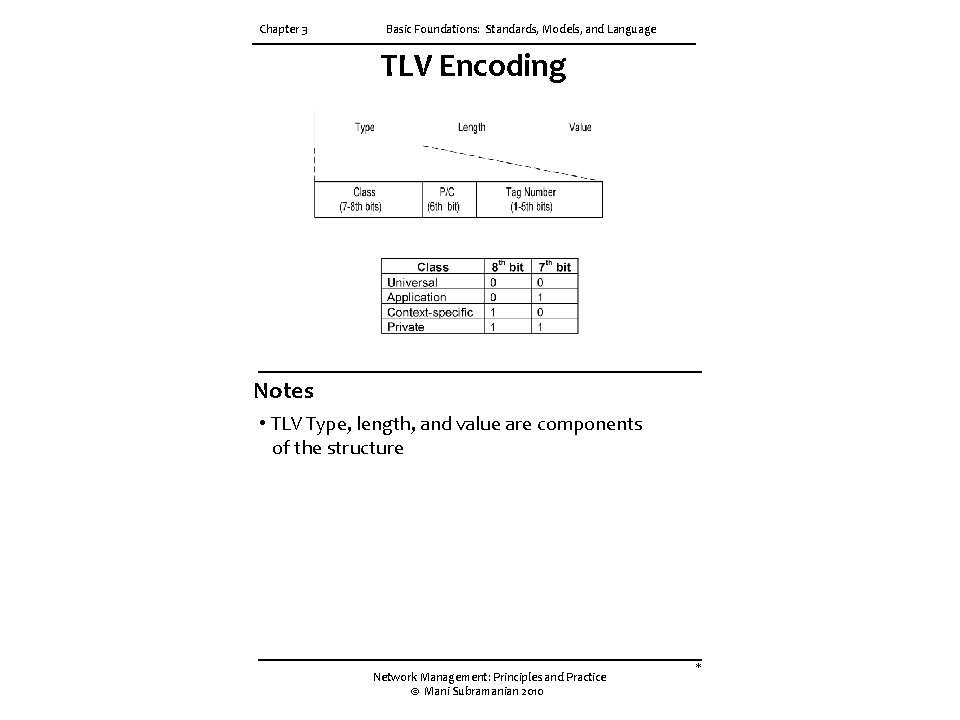
Chapter 3 Basic Foundations: Standards, Models, and Language TLV Encoding Notes • TLV Type, length, and value are components of the structure Network Management: Principles and Practice © Mani Subramanian 2010 *
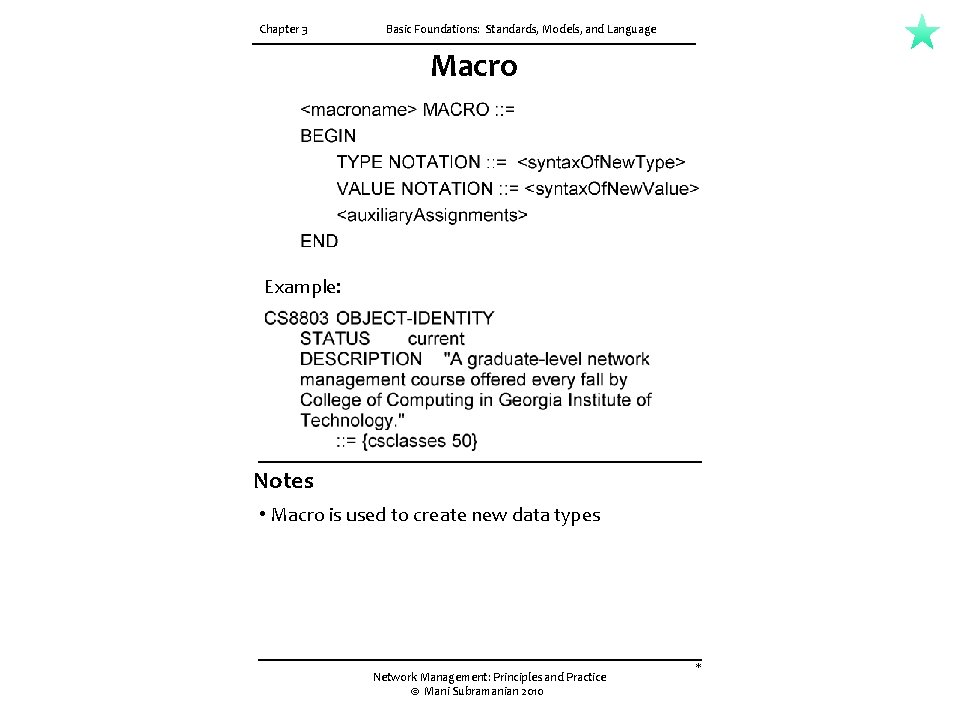
Chapter 3 Basic Foundations: Standards, Models, and Language Macro Example: Notes • Macro is used to create new data types Network Management: Principles and Practice © Mani Subramanian 2010 *
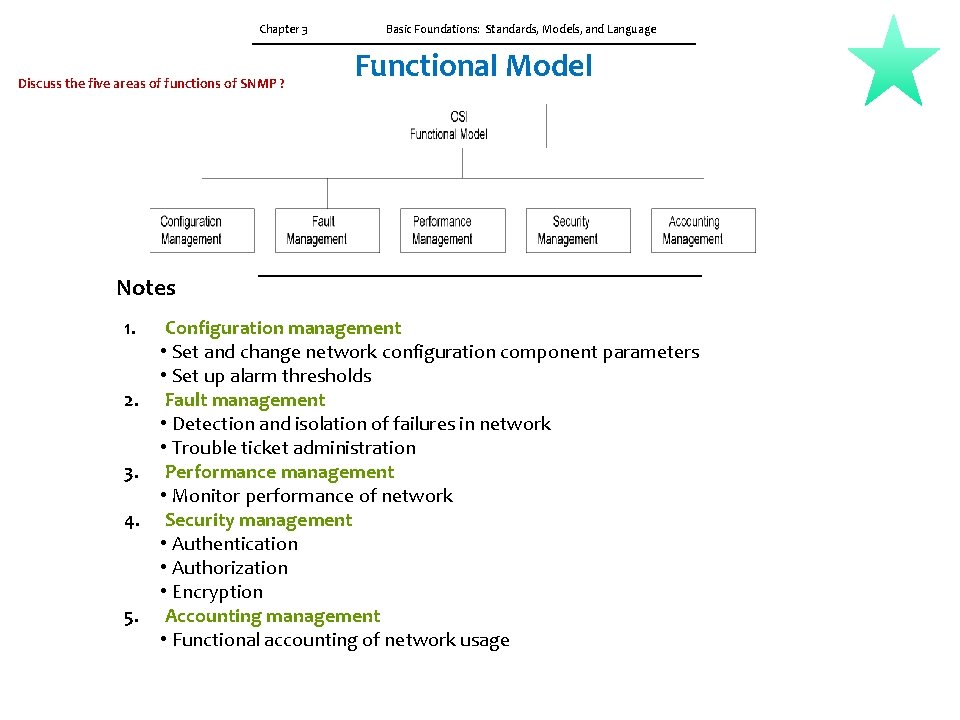
Chapter 3 Discuss the five areas of functions of SNMP ? Basic Foundations: Standards, Models, and Language Functional Model Notes 1. Configuration management • Set and change network configuration component parameters • Set up alarm thresholds 2. Fault management • Detection and isolation of failures in network • Trouble ticket administration 3. Performance management • Monitor performance of network 4. Security management • Authentication • Authorization • Encryption 5. Accounting management • Functional accounting of network usage
Discussion Board: You are establishing a small company with your network managed by a network management system. Give an example of each of the five functional applications that you would implement. 1. Configuration Management: Set the IP address and system description identify components, set up subnets, links to external network, etc. 2. Fault Management: Component failures, network alarms, etc. 3. Performance Management: Traffic on the LANs, packet loss on components and links, traffic delay. 4. Security Management: Set up security parameters, password and other security administration, security break-ins, etc. 5. Account Management: Utilization of the network resources by different users.
- Slides: 64