
Chapter 3 Averages and Variation Understanding Basic Statistics
Chapter 3 Averages and Variation Understanding Basic Statistics Fifth Edition By Brase and Brase Prepared by Jon Booze
Measures of Central Tendency • Average – a measure of the center value or central tendency of a distribution of values. • Three types of average: – Mode – Median – Mean Copyright © Cengage Learning. All rights reserved. 3|2
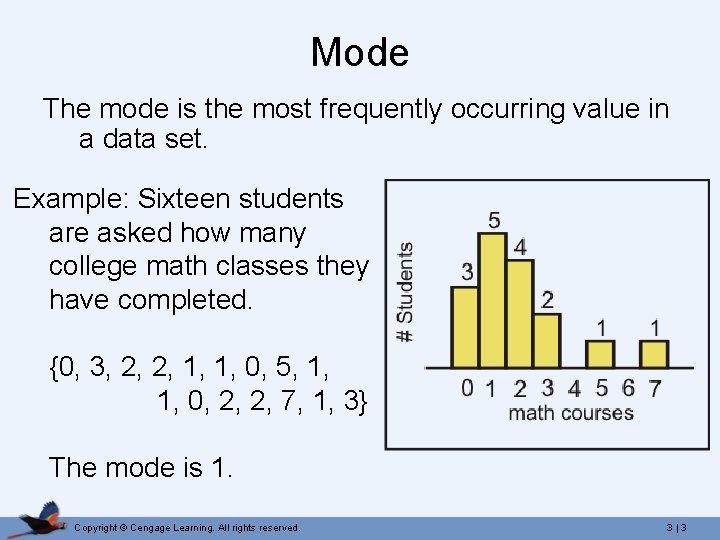
Mode The mode is the most frequently occurring value in a data set. Example: Sixteen students are asked how many college math classes they have completed. {0, 3, 2, 2, 1, 1, 0, 5, 1, 1, 0, 2, 2, 7, 1, 3} The mode is 1. Copyright © Cengage Learning. All rights reserved. 3|3
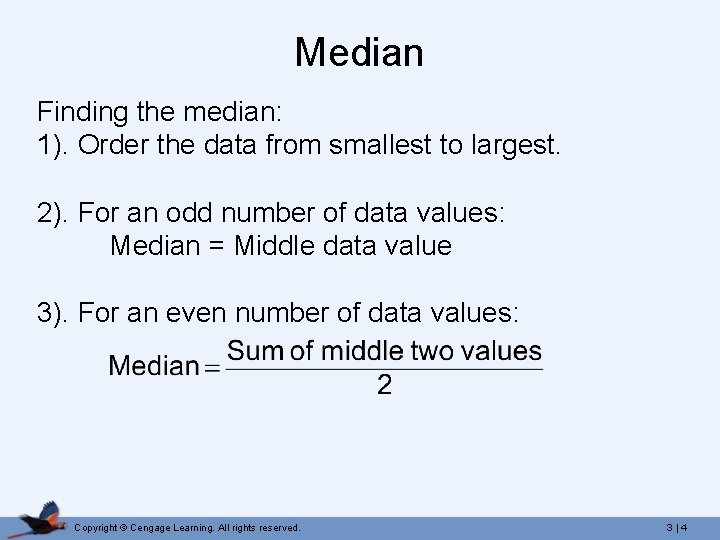
Median Finding the median: 1). Order the data from smallest to largest. 2). For an odd number of data values: Median = Middle data value 3). For an even number of data values: Copyright © Cengage Learning. All rights reserved. 3|4
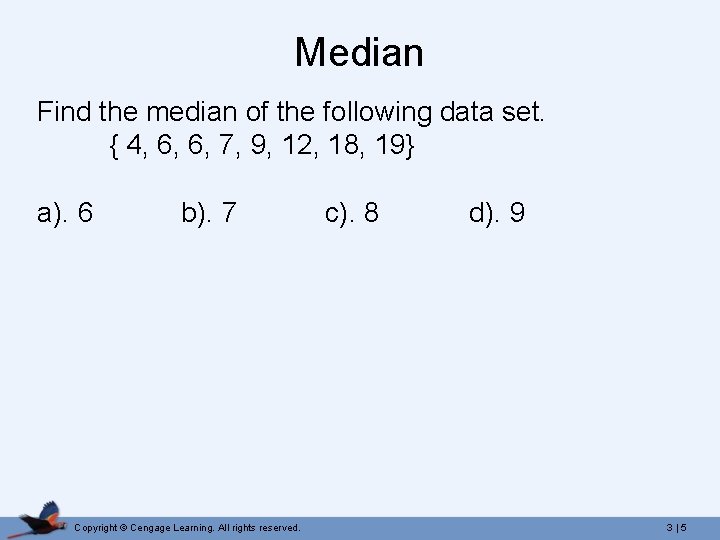
Median Find the median of the following data set. { 4, 6, 6, 7, 9, 12, 18, 19} a). 6 b). 7 Copyright © Cengage Learning. All rights reserved. c). 8 d). 9 3|5
Median Find the median of the following data set. {4, 6, 6, 7, 9, 12, 18, 19} a). 6 b). 7 Copyright © Cengage Learning. All rights reserved. c). 8 d). 9 3|6
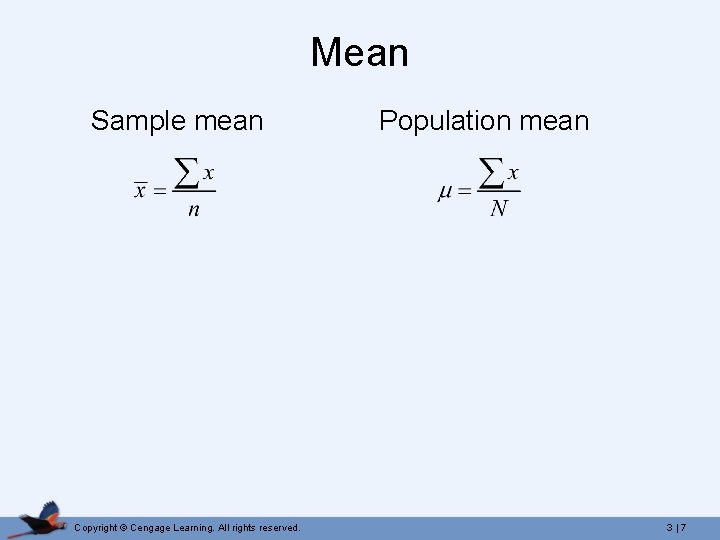
Mean Sample mean Copyright © Cengage Learning. All rights reserved. Population mean 3|7
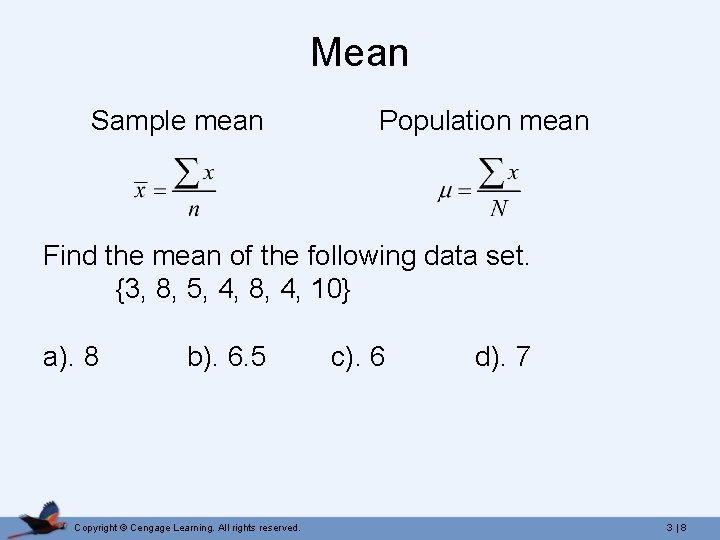
Mean Sample mean Population mean Find the mean of the following data set. {3, 8, 5, 4, 8, 4, 10} a). 8 b). 6. 5 Copyright © Cengage Learning. All rights reserved. c). 6 d). 7 3|8
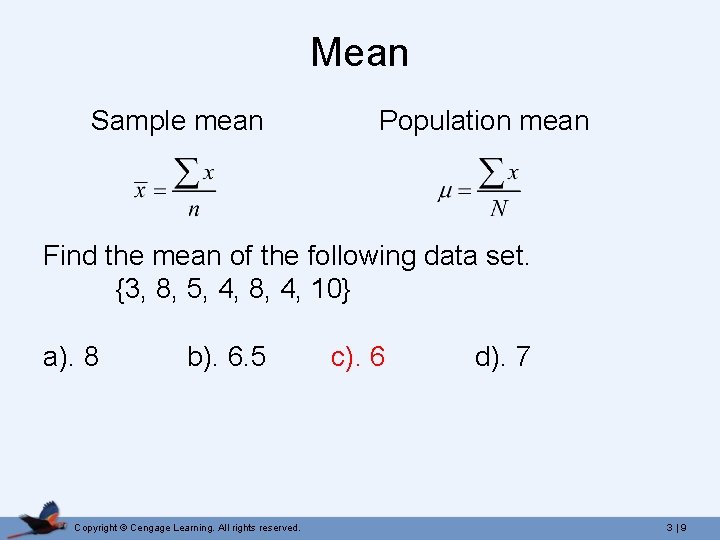
Mean Sample mean Population mean Find the mean of the following data set. {3, 8, 5, 4, 8, 4, 10} a). 8 b). 6. 5 Copyright © Cengage Learning. All rights reserved. c). 6 d). 7 3|9
Trimmed Mean • Order the data and remove k% of the data values from the bottom and top. • 5% and 10% trimmed means are common. • Then compute the mean with the remaining data values. Copyright © Cengage Learning. All rights reserved. 3 | 10
Resistant Measures of Central Tendency • A resistant measure will not be affected by extreme values in the data set. • The mean is not resistant to extreme values. • The median is resistant to extreme values. • A trimmed mean is also resistant. Copyright © Cengage Learning. All rights reserved. 3 | 11
Critical Thinking • Four levels of data – nominal, ordinal, interval, ratio (Chapter 1) • Mode – can be used with all four levels. • Median – may be used with ordinal, interval, of ratio level. • Mean – may be used with interval or ratio level. Copyright © Cengage Learning. All rights reserved. 3 | 12
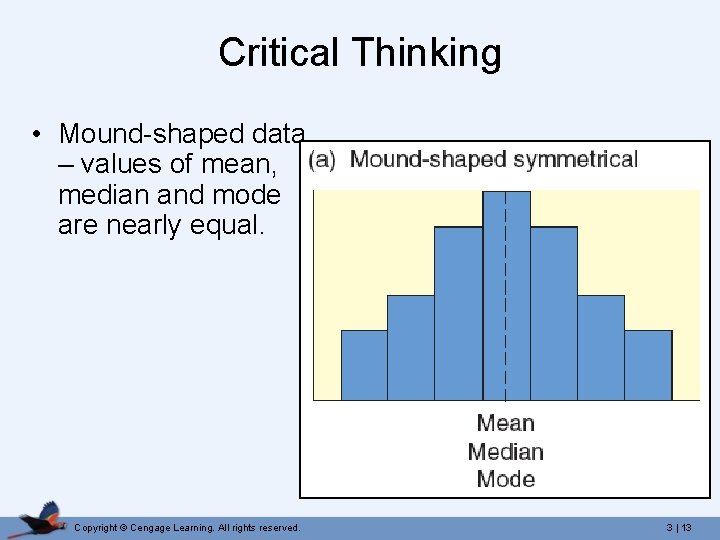
Critical Thinking • Mound-shaped data – values of mean, median and mode are nearly equal. Copyright © Cengage Learning. All rights reserved. 3 | 13
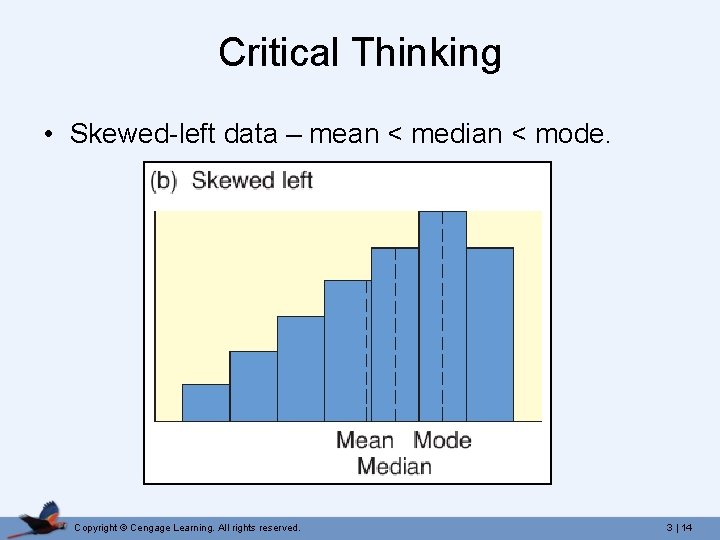
Critical Thinking • Skewed-left data – mean < median < mode. Copyright © Cengage Learning. All rights reserved. 3 | 14
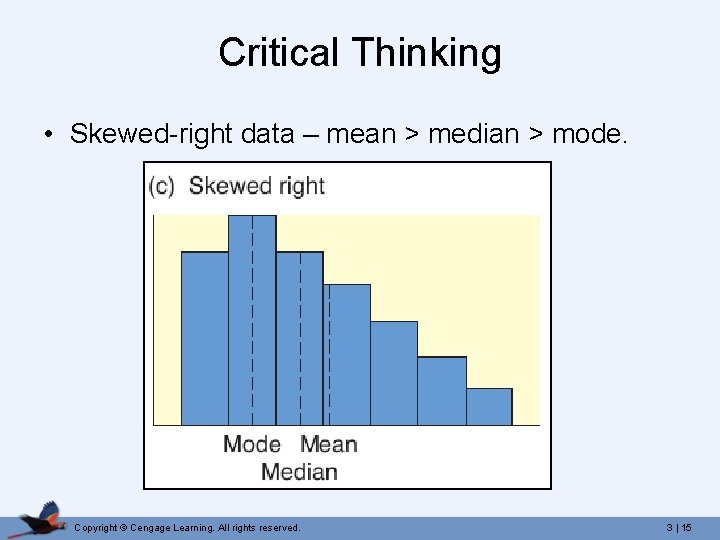
Critical Thinking • Skewed-right data – mean > median > mode. Copyright © Cengage Learning. All rights reserved. 3 | 15
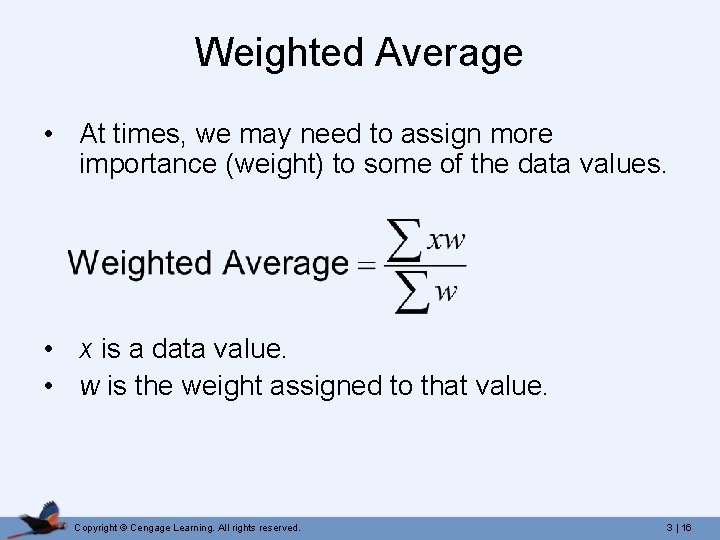
Weighted Average • At times, we may need to assign more importance (weight) to some of the data values. • x is a data value. • w is the weight assigned to that value. Copyright © Cengage Learning. All rights reserved. 3 | 16
Measures of Variation Three measures of variation: range variance standard deviation • Range = Largest value – smallest value Only two data values are used in the computation, so much of the information in the data is lost. Copyright © Cengage Learning. All rights reserved. 3 | 17
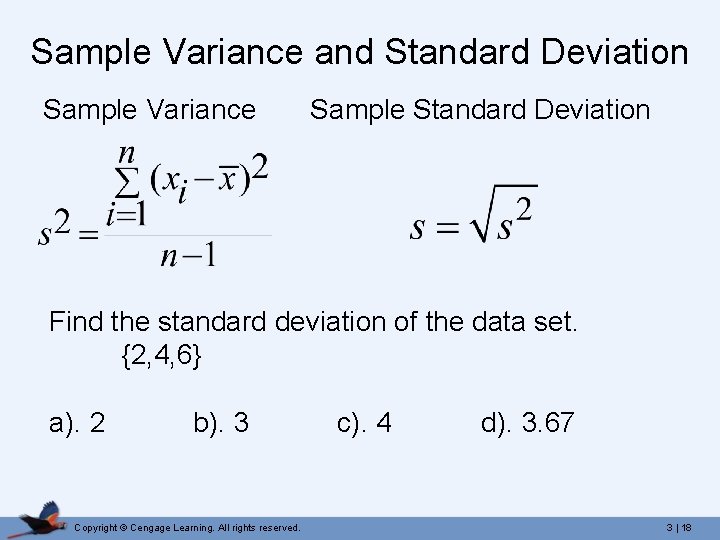
Sample Variance and Standard Deviation Sample Variance Sample Standard Deviation Find the standard deviation of the data set. {2, 4, 6} a). 2 b). 3 Copyright © Cengage Learning. All rights reserved. c). 4 d). 3. 67 3 | 18
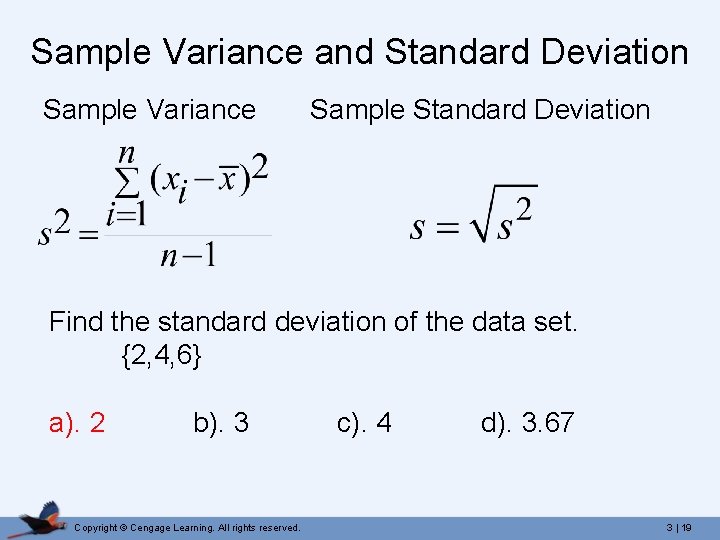
Sample Variance and Standard Deviation Sample Variance Sample Standard Deviation Find the standard deviation of the data set. {2, 4, 6} a). 2 b). 3 Copyright © Cengage Learning. All rights reserved. c). 4 d). 3. 67 3 | 19
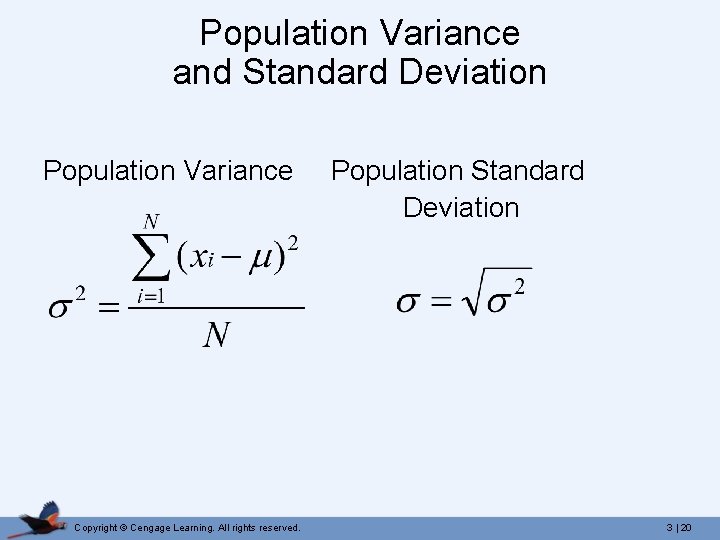
Population Variance and Standard Deviation Population Variance Copyright © Cengage Learning. All rights reserved. Population Standard Deviation 3 | 20
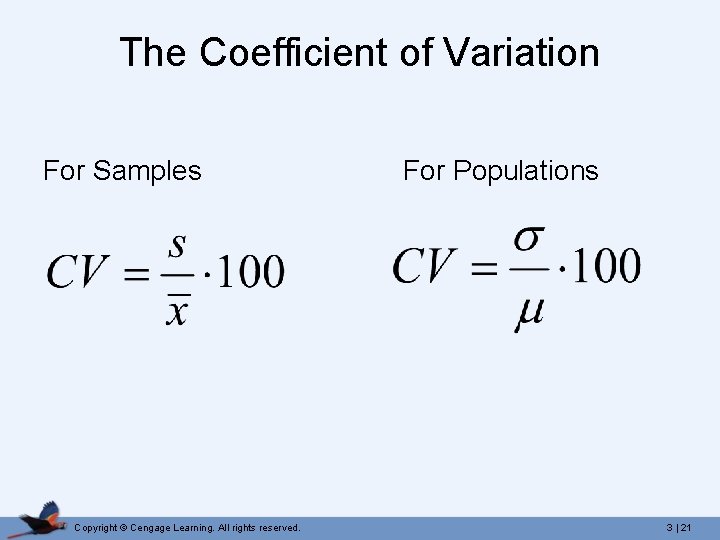
The Coefficient of Variation For Samples Copyright © Cengage Learning. All rights reserved. For Populations 3 | 21
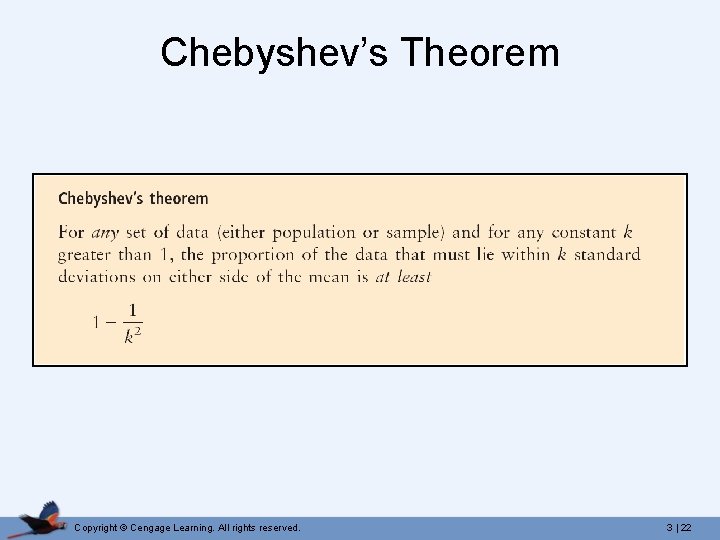
Chebyshev’s Theorem Copyright © Cengage Learning. All rights reserved. 3 | 22
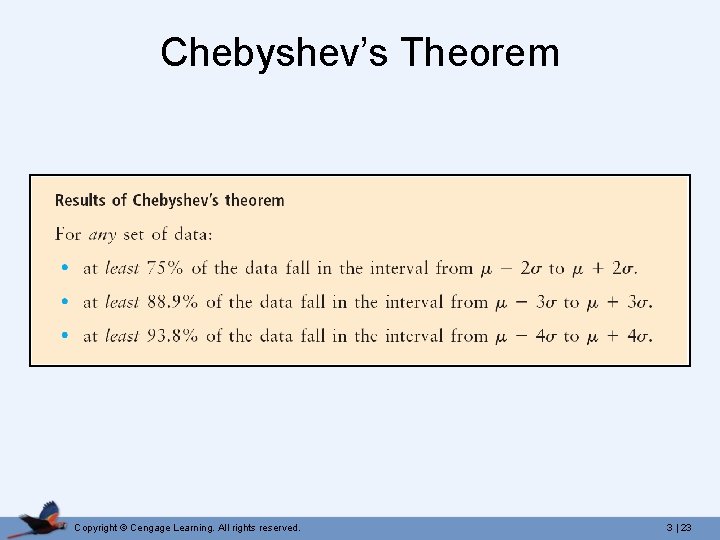
Chebyshev’s Theorem Copyright © Cengage Learning. All rights reserved. 3 | 23
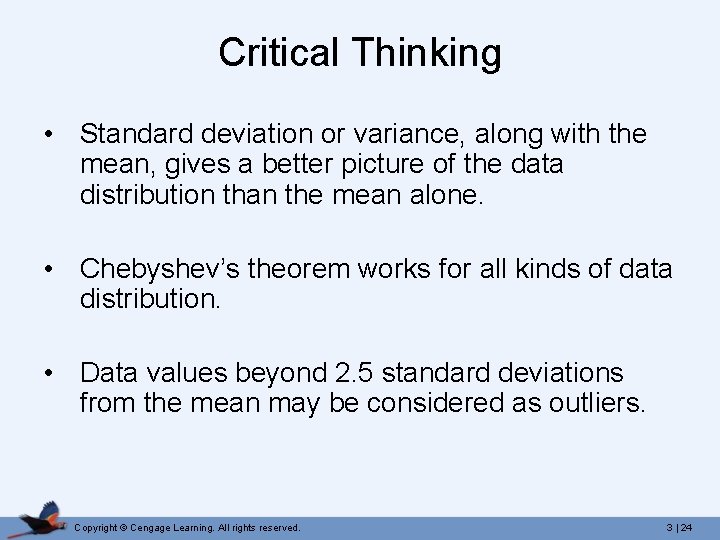
Critical Thinking • Standard deviation or variance, along with the mean, gives a better picture of the data distribution than the mean alone. • Chebyshev’s theorem works for all kinds of data distribution. • Data values beyond 2. 5 standard deviations from the mean may be considered as outliers. Copyright © Cengage Learning. All rights reserved. 3 | 24
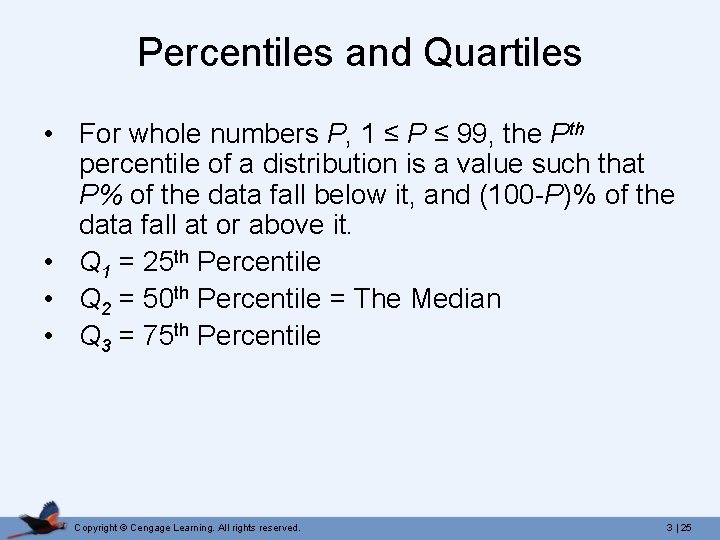
Percentiles and Quartiles • For whole numbers P, 1 ≤ P ≤ 99, the Pth percentile of a distribution is a value such that P% of the data fall below it, and (100 -P)% of the data fall at or above it. • Q 1 = 25 th Percentile • Q 2 = 50 th Percentile = The Median • Q 3 = 75 th Percentile Copyright © Cengage Learning. All rights reserved. 3 | 25
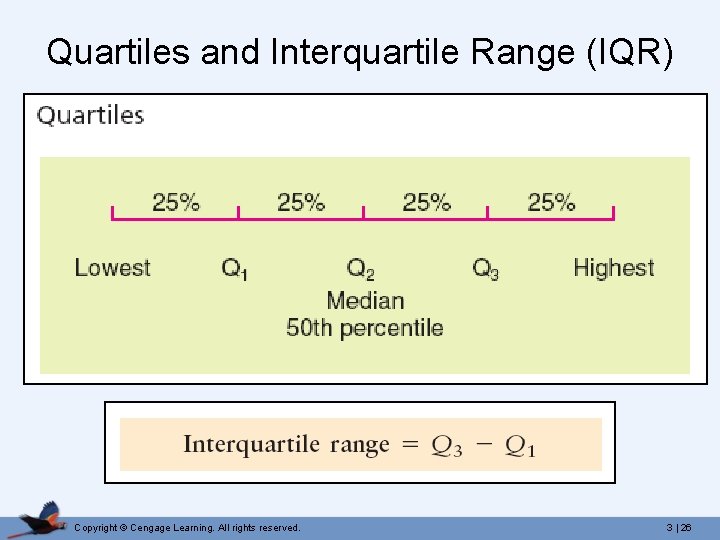
Quartiles and Interquartile Range (IQR) Copyright © Cengage Learning. All rights reserved. 3 | 26
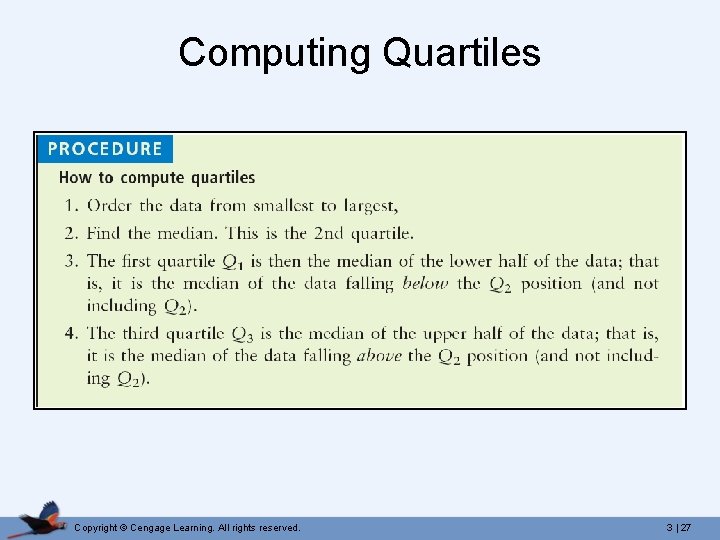
Computing Quartiles Copyright © Cengage Learning. All rights reserved. 3 | 27
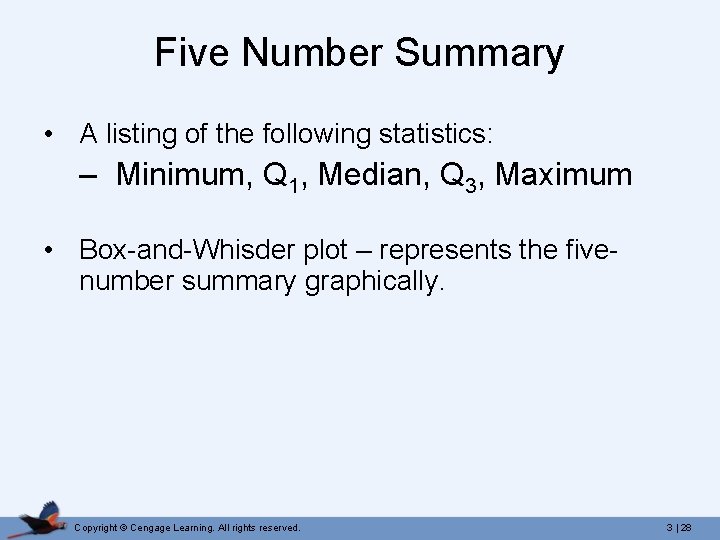
Five Number Summary • A listing of the following statistics: – Minimum, Q 1, Median, Q 3, Maximum • Box-and-Whisder plot – represents the fivenumber summary graphically. Copyright © Cengage Learning. All rights reserved. 3 | 28
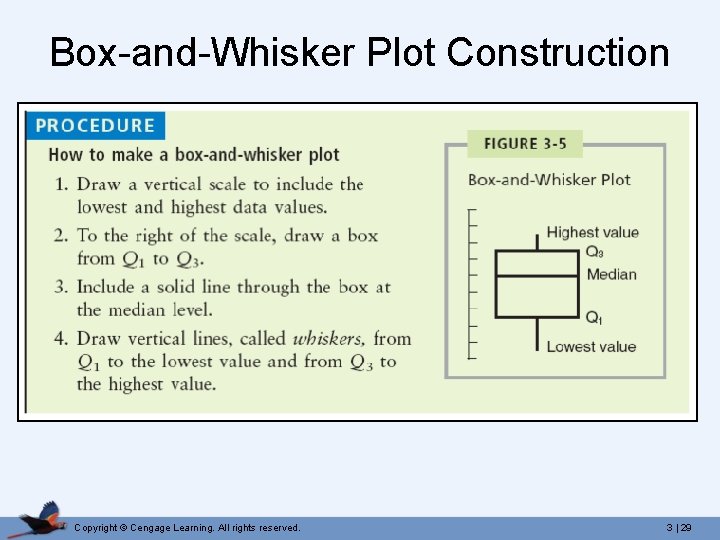
Box-and-Whisker Plot Construction Copyright © Cengage Learning. All rights reserved. 3 | 29
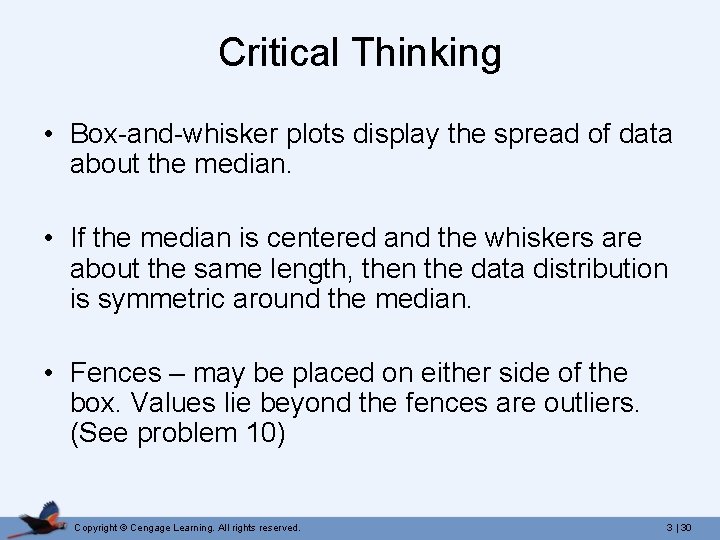
Critical Thinking • Box-and-whisker plots display the spread of data about the median. • If the median is centered and the whiskers are about the same length, then the data distribution is symmetric around the median. • Fences – may be placed on either side of the box. Values lie beyond the fences are outliers. (See problem 10) Copyright © Cengage Learning. All rights reserved. 3 | 30
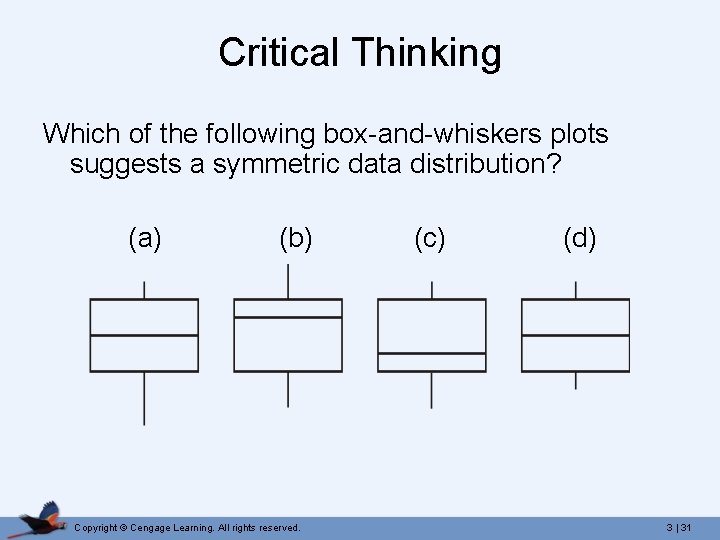
Critical Thinking Which of the following box-and-whiskers plots suggests a symmetric data distribution? (a) (b) Copyright © Cengage Learning. All rights reserved. (c) (d) 3 | 31
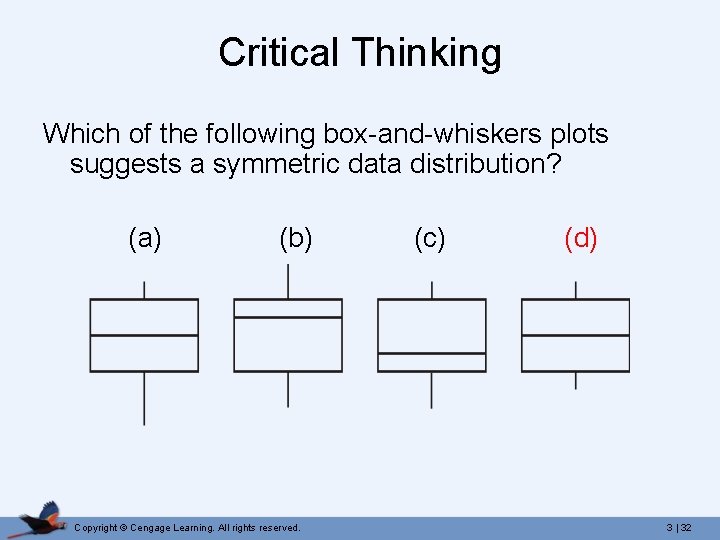
Critical Thinking Which of the following box-and-whiskers plots suggests a symmetric data distribution? (a) (b) Copyright © Cengage Learning. All rights reserved. (c) (d) 3 | 32
- Slides: 32