
Chapter 3 Atomic Mass amu Average Atomic Mass
- Slides: 48
Chapter 3
Atomic Mass § amu = Average Atomic Mass Unit § Based on 12 C as the standard. § 12 C = exactly 12 amu § The average atomic mass (weight) of an element is equal to the sum of the products of each isotope’s mass (in amu) multiplied by it’s relative abundance.
EXAMPLE OF AVERAGE ATOMIC MASS PROBLEM § Naturally occurring chlorine is 75. 53% 35 Cl which has an atomic mass of 34. 969 amu, and 24. 47% 37 Cl, which has an atomic mass of 36. 966 amu. § Calculate the average atomic mass of chlorine.
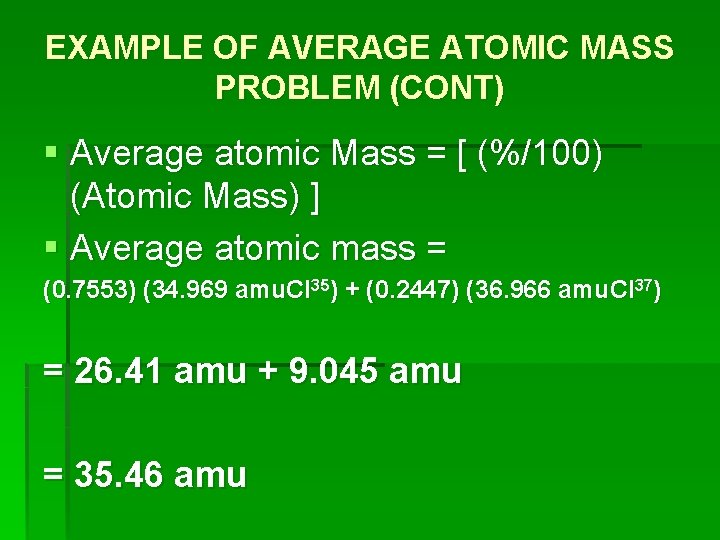
EXAMPLE OF AVERAGE ATOMIC MASS PROBLEM (CONT) § Average atomic Mass = [ (%/100) (Atomic Mass) ] § Average atomic mass = (0. 7553) (34. 969 amu. Cl 35) + (0. 2447) (36. 966 amu. Cl 37) = 26. 41 amu + 9. 045 amu = 35. 46 amu
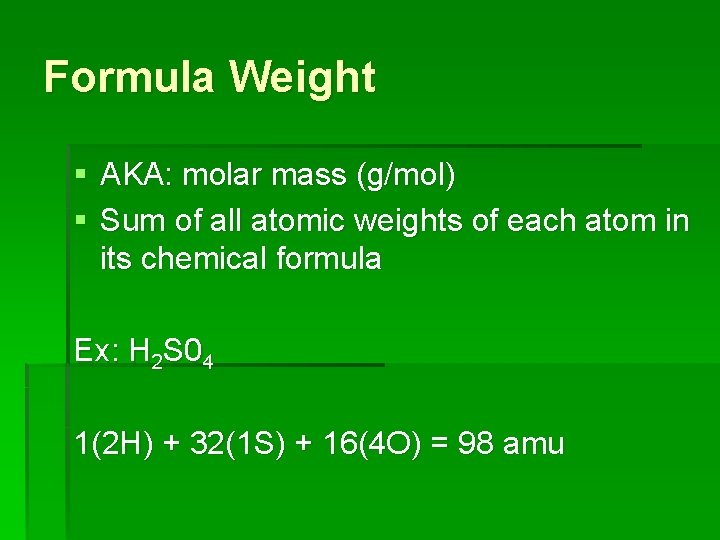
Formula Weight § AKA: molar mass (g/mol) § Sum of all atomic weights of each atom in its chemical formula Ex: H 2 S 04 1(2 H) + 32(1 S) + 16(4 O) = 98 amu
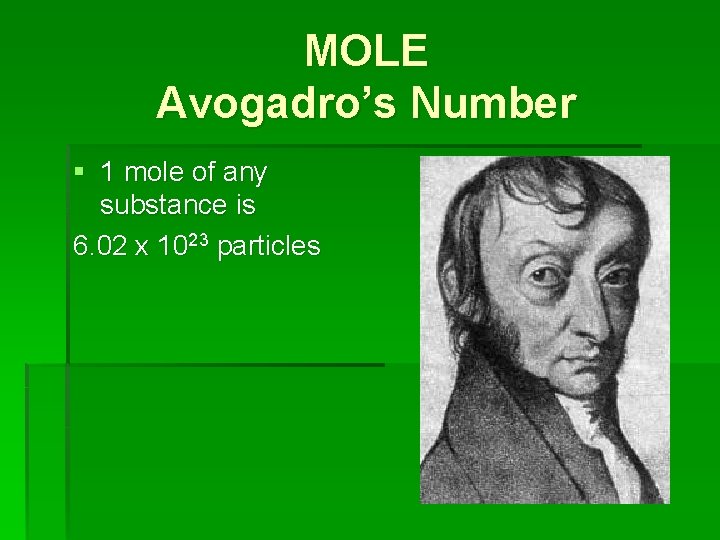
MOLE Avogadro’s Number § 1 mole of any substance is 6. 02 x 1023 particles
Question § How many nitrogen atoms are in 0. 25 mol of Ca(NO 3)2
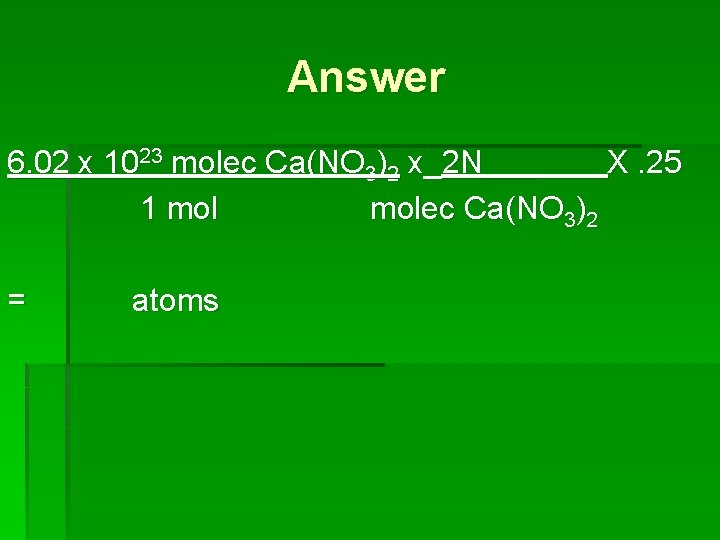
Answer 6. 02 x 1023 molec Ca(NO 3)2 x_2 N___ X. 25 1 molec Ca(NO 3)2 = atoms
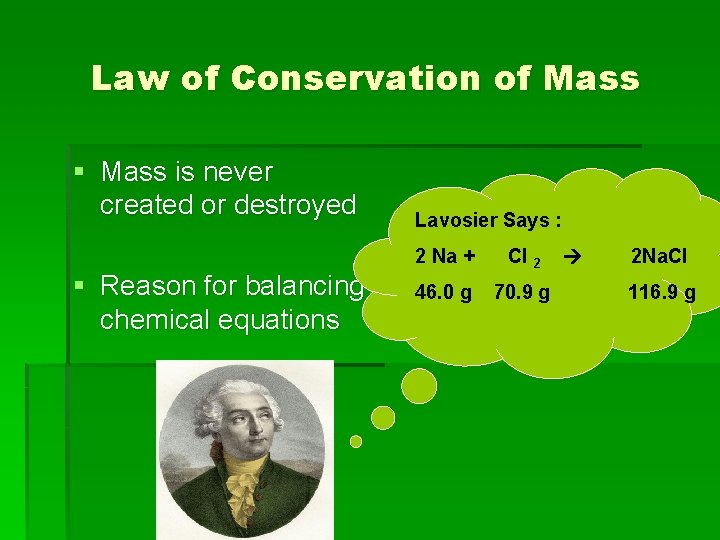
Law of Conservation of Mass § Mass is never created or destroyed § Reason for balancing chemical equations Lavosier Says : 2 Na + Cl 2 46. 0 g 70. 9 g 2 Na. Cl 116. 9 g
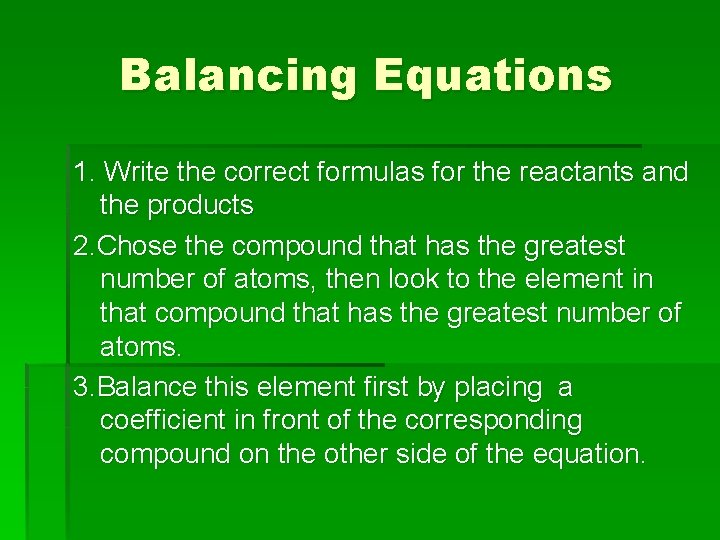
Balancing Equations 1. Write the correct formulas for the reactants and the products 2. Chose the compound that has the greatest number of atoms, then look to the element in that compound that has the greatest number of atoms. 3. Balance this element first by placing a coefficient in front of the corresponding compound on the other side of the equation.
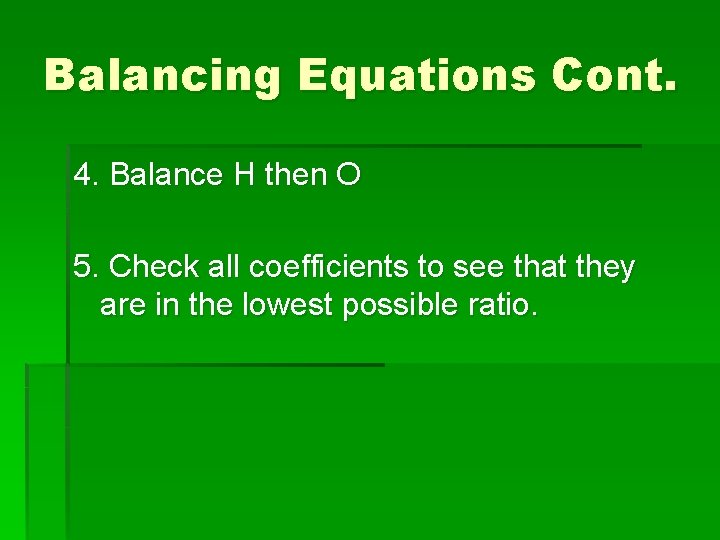
Balancing Equations Cont. 4. Balance H then O 5. Check all coefficients to see that they are in the lowest possible ratio.
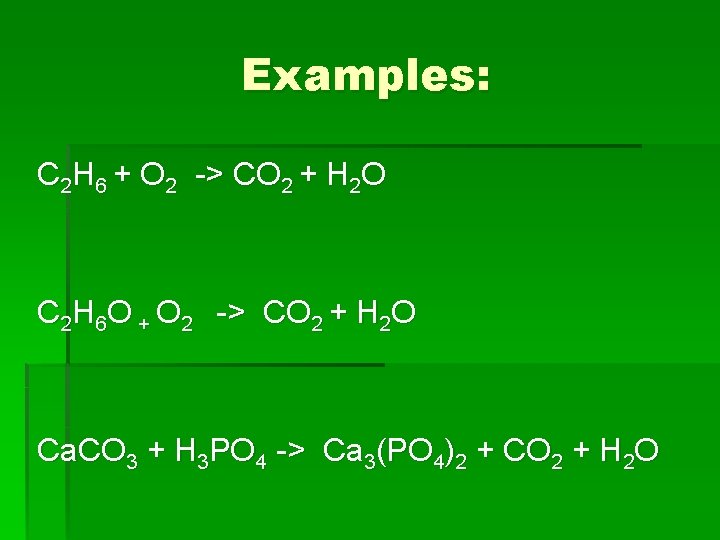
Examples: C 2 H 6 + O 2 -> CO 2 + H 2 O C 2 H 6 O + O 2 -> CO 2 + H 2 O Ca. CO 3 + H 3 PO 4 -> Ca 3(PO 4)2 + CO 2 + H 2 O
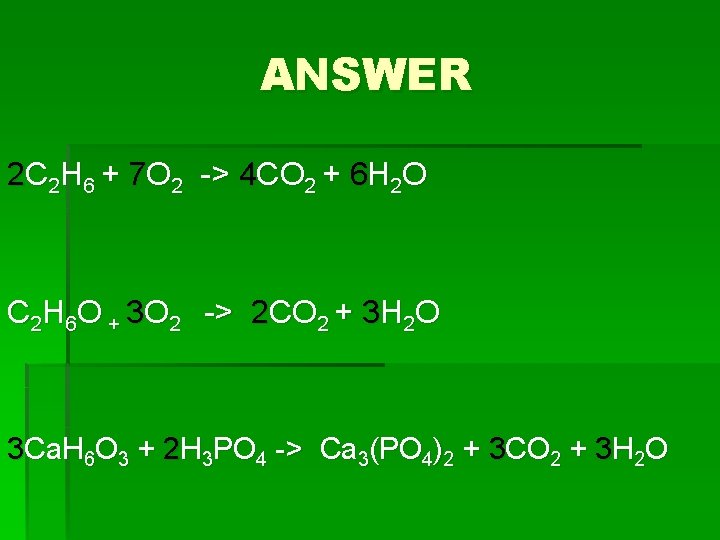
ANSWER 2 C 2 H 6 + 7 O 2 -> 4 CO 2 + 6 H 2 O C 2 H 6 O + 3 O 2 -> 2 CO 2 + 3 H 2 O 3 Ca. H 6 O 3 + 2 H 3 PO 4 -> Ca 3(PO 4)2 + 3 CO 2 + 3 H 2 O
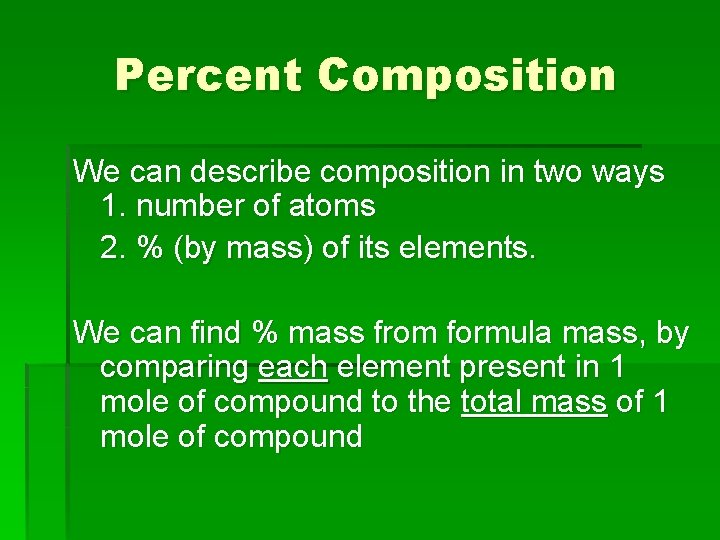
Percent Composition We can describe composition in two ways 1. number of atoms 2. % (by mass) of its elements. We can find % mass from formula mass, by comparing each element present in 1 mole of compound to the total mass of 1 mole of compound
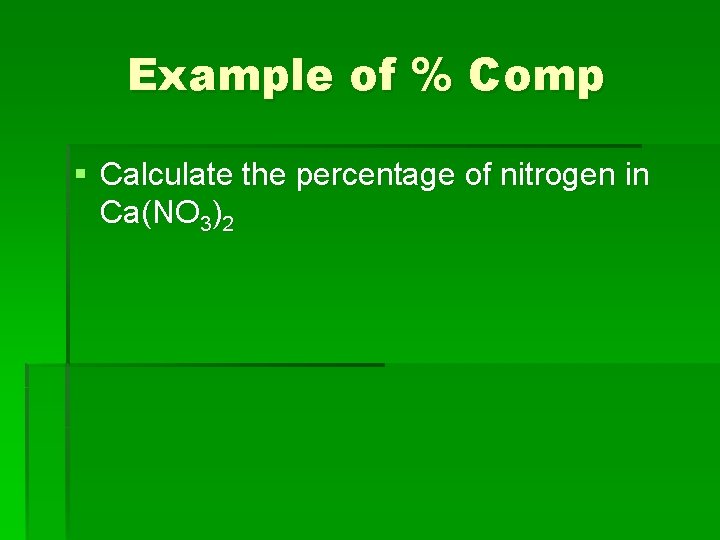
Example of % Comp § Calculate the percentage of nitrogen in Ca(NO 3)2
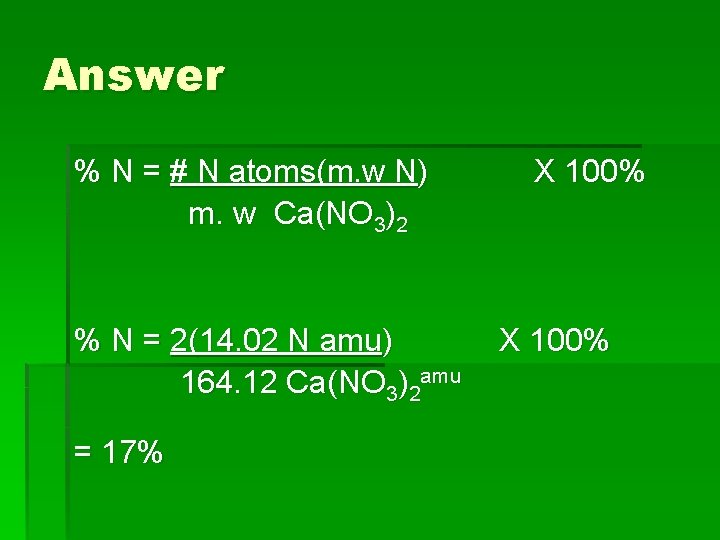
Answer % N = # N atoms(m. w N) m. w Ca(NO 3)2 % N = 2(14. 02 N amu) 164. 12 Ca(NO 3)2 amu = 17% X 100%
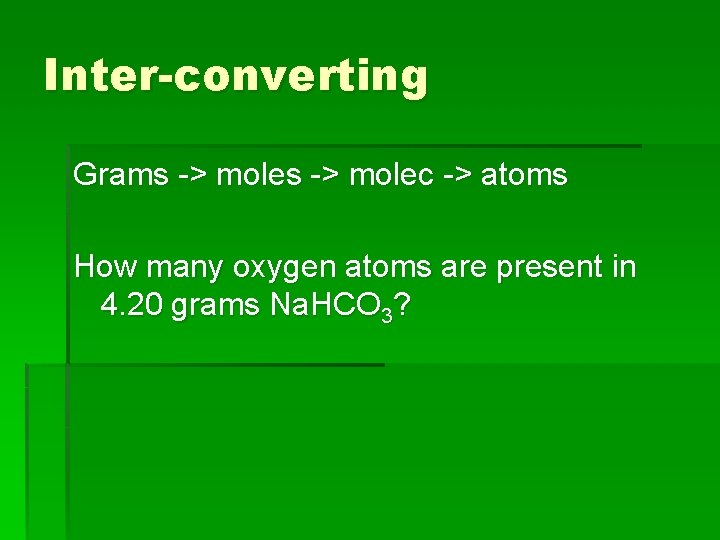
Inter-converting Grams -> molec -> atoms How many oxygen atoms are present in 4. 20 grams Na. HCO 3?
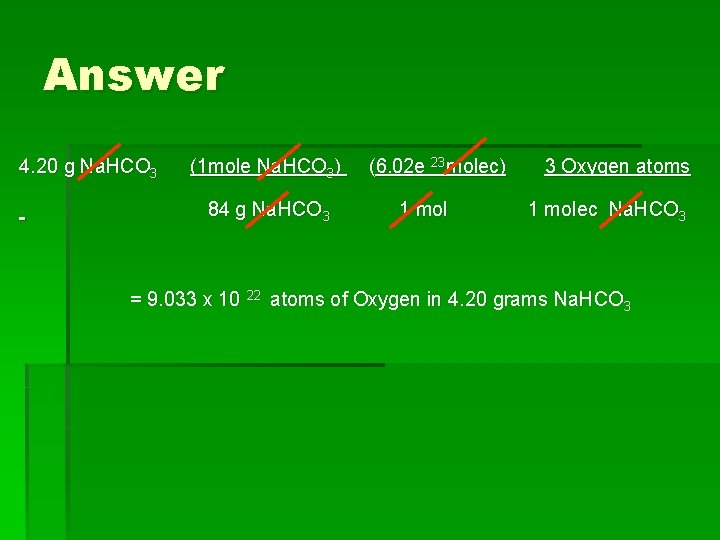
Answer 4. 20 g Na. HCO 3 (1 mole Na. HCO 3) 84 g Na. HCO 3 (6. 02 e 23 molec) 1 mol 3 Oxygen atoms 1 molec Na. HCO 3 = 9. 033 x 10 22 atoms of Oxygen in 4. 20 grams Na. HCO 3
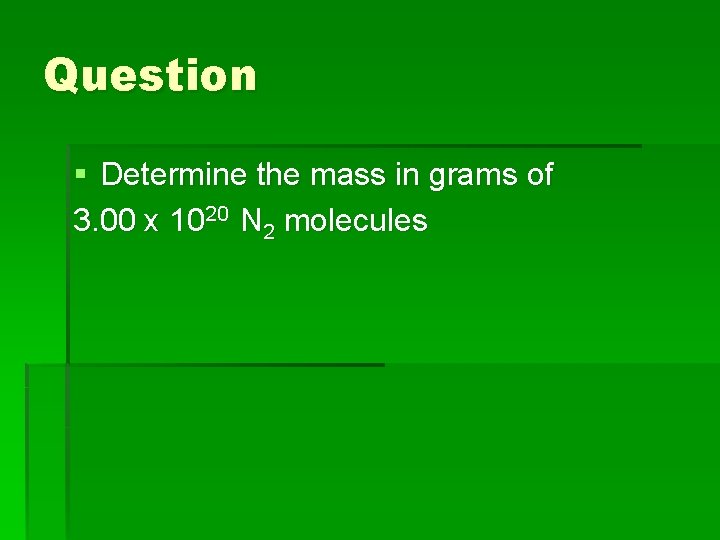
Question § Determine the mass in grams of 3. 00 x 1020 N 2 molecules
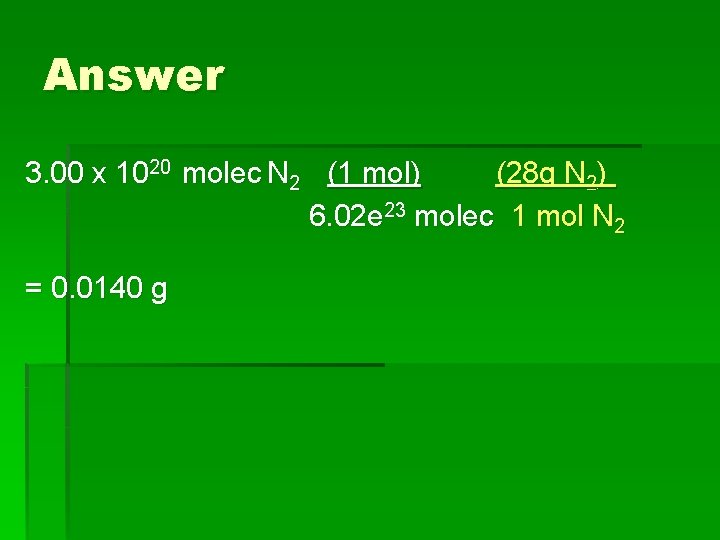
Answer 3. 00 x 1020 molec N 2 (1 mol) (28 g N 2) 6. 02 e 23 molec 1 mol N 2 = 0. 0140 g
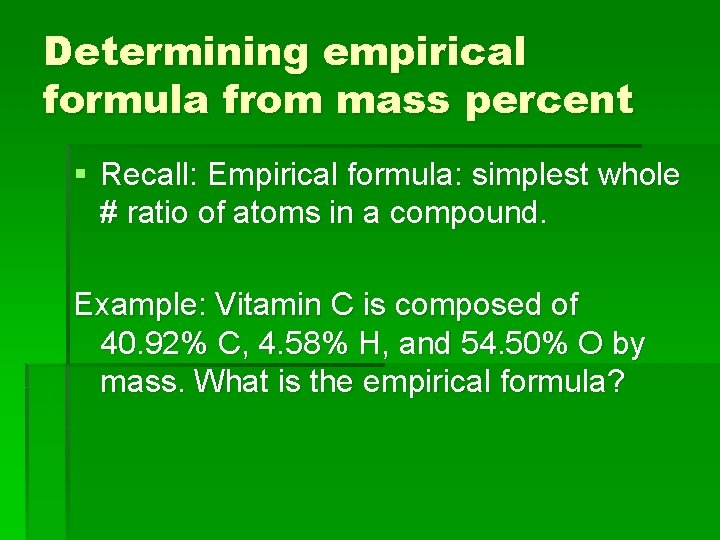
Determining empirical formula from mass percent § Recall: Empirical formula: simplest whole # ratio of atoms in a compound. Example: Vitamin C is composed of 40. 92% C, 4. 58% H, and 54. 50% O by mass. What is the empirical formula?
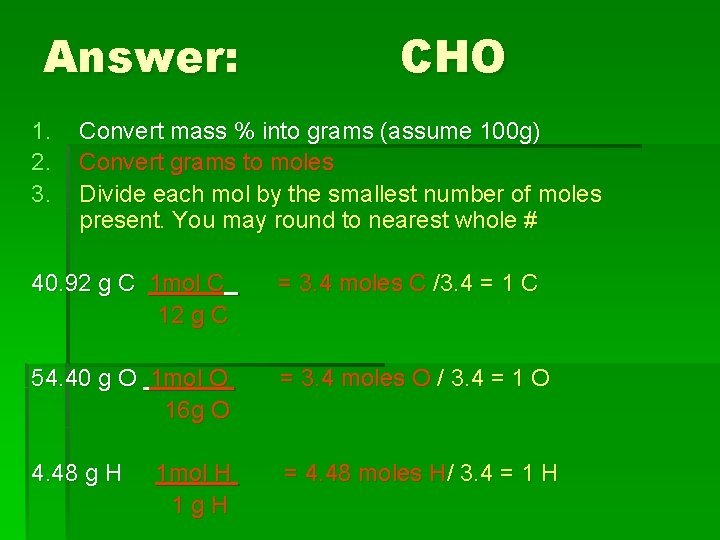
Answer: 1. 2. 3. CHO Convert mass % into grams (assume 100 g) Convert grams to moles Divide each mol by the smallest number of moles present. You may round to nearest whole # 40. 92 g C 1 mol C 12 g C = 3. 4 moles C /3. 4 = 1 C 54. 40 g O 1 mol O 16 g O = 3. 4 moles O / 3. 4 = 1 O 4. 48 g H = 4. 48 moles H/ 3. 4 = 1 H 1 mol H 1 g. H
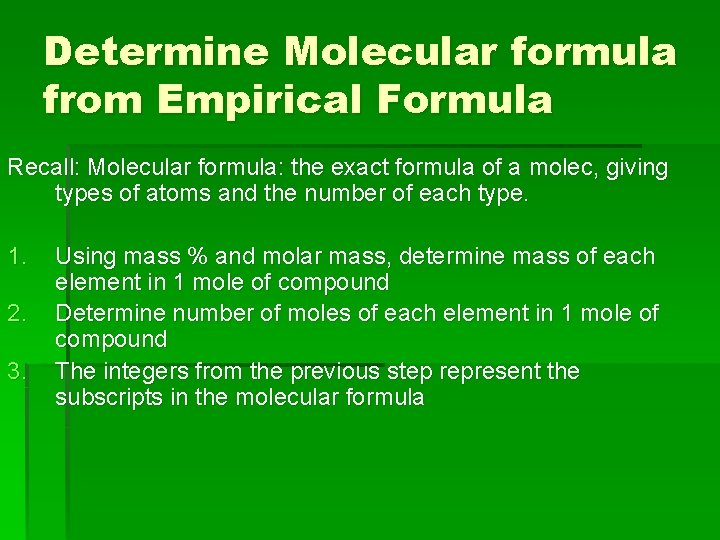
Determine Molecular formula from Empirical Formula Recall: Molecular formula: the exact formula of a molec, giving types of atoms and the number of each type. 1. 2. 3. Using mass % and molar mass, determine mass of each element in 1 mole of compound Determine number of moles of each element in 1 mole of compound The integers from the previous step represent the subscripts in the molecular formula
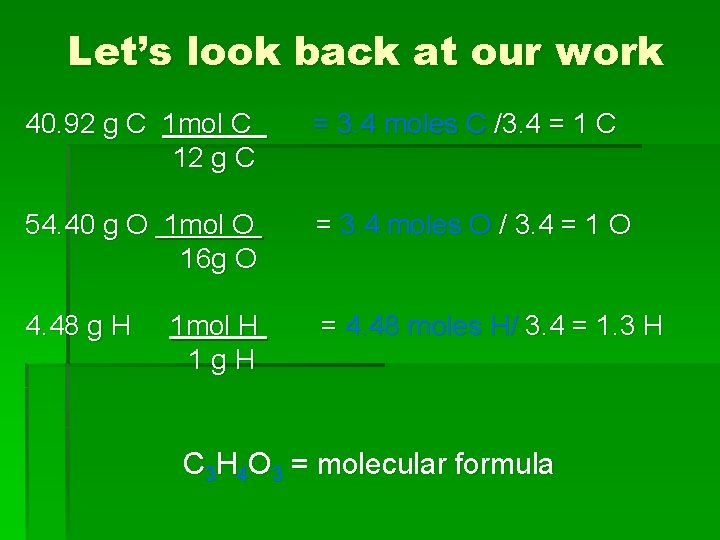
Let’s look back at our work 40. 92 g C 1 mol C 12 g C = 3. 4 moles C /3. 4 = 1 C 54. 40 g O 1 mol O 16 g O = 3. 4 moles O / 3. 4 = 1 O 4. 48 g H = 4. 48 moles H/ 3. 4 = 1. 3 H 1 mol H 1 g. H C 3 H 4 O 3 = molecular formula
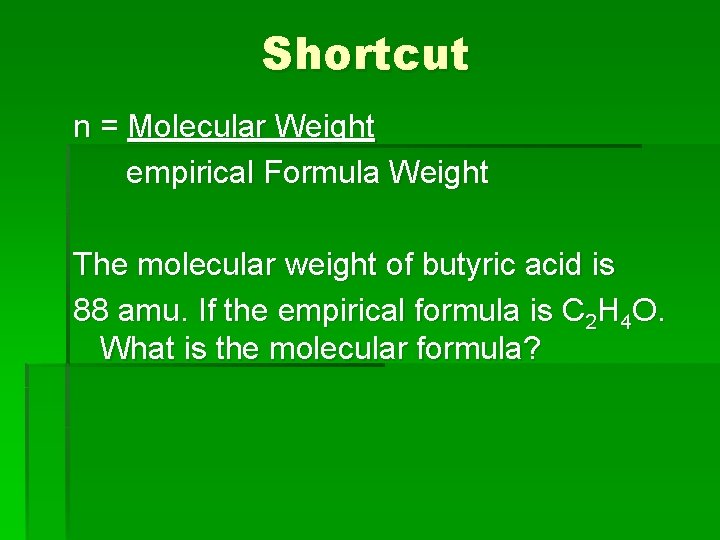
Shortcut n = Molecular Weight empirical Formula Weight The molecular weight of butyric acid is 88 amu. If the empirical formula is C 2 H 4 O. What is the molecular formula?
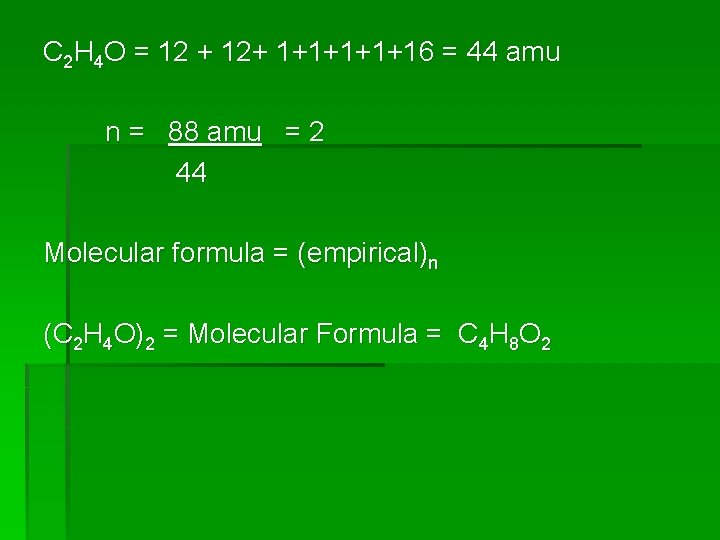
C 2 H 4 O = 12 + 12+ 1+1+16 = 44 amu n = 88 amu = 2 44 Molecular formula = (empirical)n (C 2 H 4 O)2 = Molecular Formula = C 4 H 8 O 2
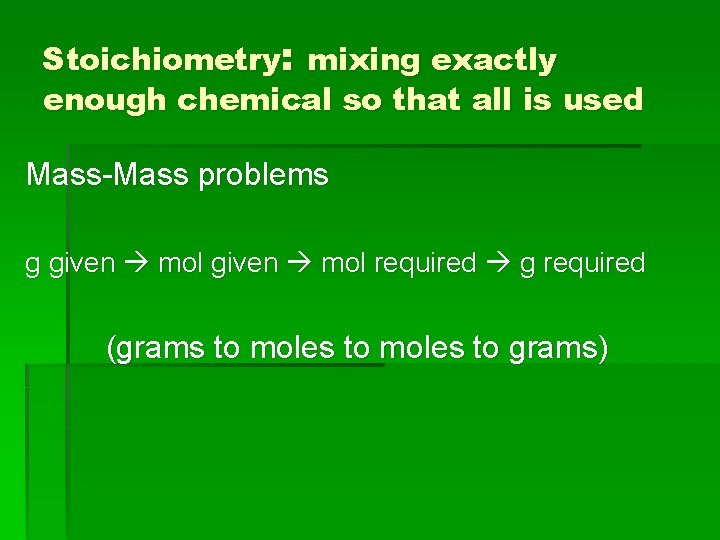
Stoichiometry: mixing exactly enough chemical so that all is used Mass-Mass problems g given mol required g required (grams to moles to grams)
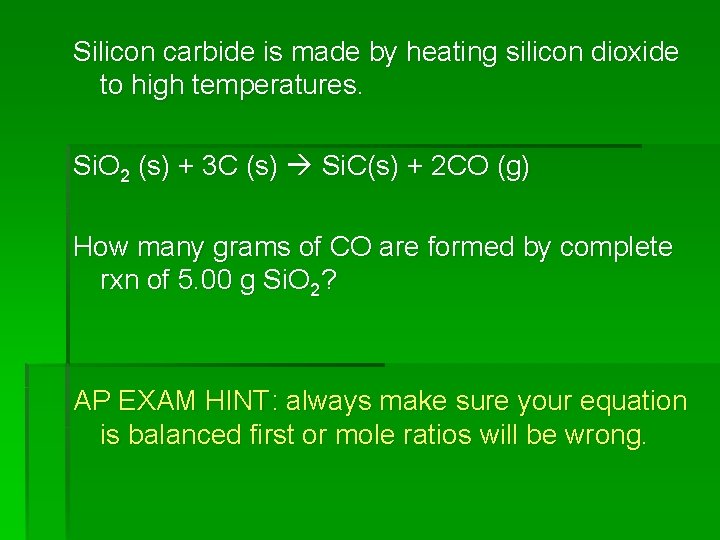
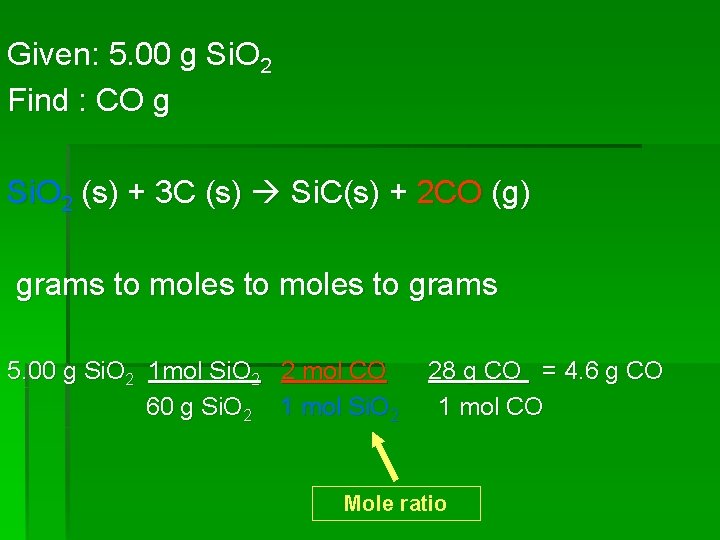
Silicon carbide is made by heating silicon dioxide to high temperatures. Si. O 2 (s) + 3 C (s) Si. C(s) + 2 CO (g) How many grams of CO are formed by complete rxn of 5. 00 g Si. O 2? AP EXAM HINT: always make sure your equation is balanced first or mole ratios will be wrong.
Given: 5. 00 g Si. O 2 Find : CO g Si. O 2 (s) + 3 C (s) Si. C(s) + 2 CO (g) grams to moles to grams 5. 00 g Si. O 2 1 mol Si. O 2 2 mol CO 60 g Si. O 2 1 mol Si. O 2 28 g CO = 4. 6 g CO 1 mol CO Mole ratio
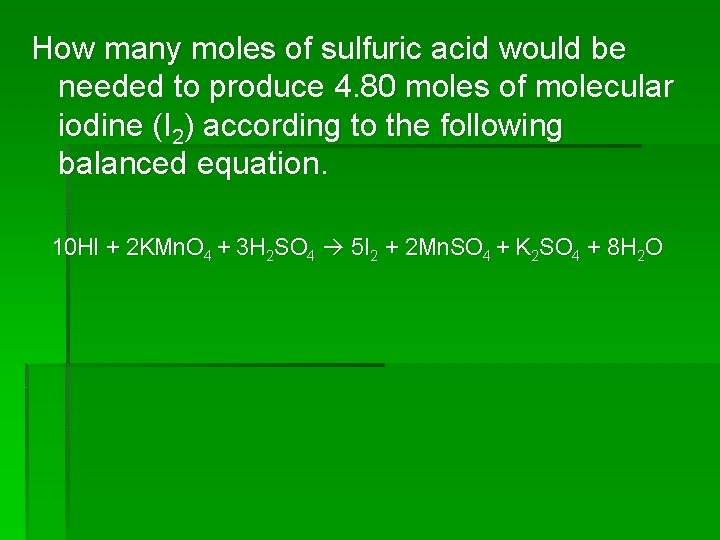
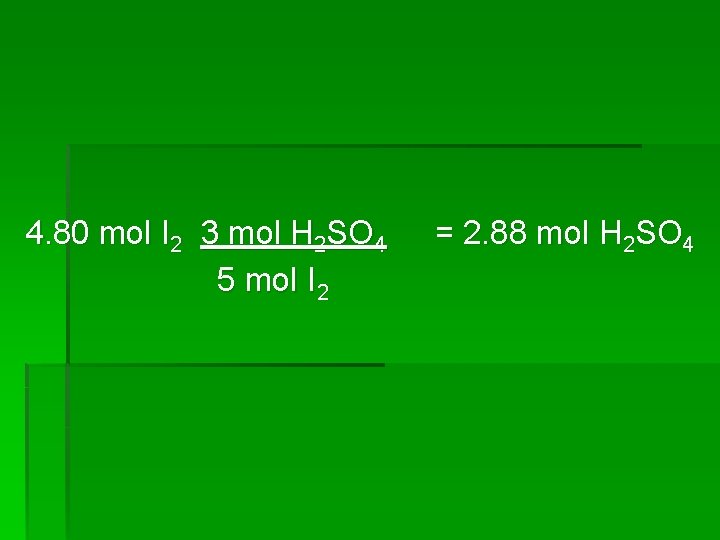
How many moles of sulfuric acid would be needed to produce 4. 80 moles of molecular iodine (I 2) according to the following balanced equation. 10 HI + 2 KMn. O 4 + 3 H 2 SO 4 5 I 2 + 2 Mn. SO 4 + K 2 SO 4 + 8 H 2 O
4. 80 mol I 2 3 mol H 2 SO 4 5 mol I 2 = 2. 88 mol H 2 SO 4
Limiting reagent This will be at least 1 AP question! The number of products that can form is limited by the amount of reactant present. The limiting reactant is the one that gives the least amount of product. Reactants Products
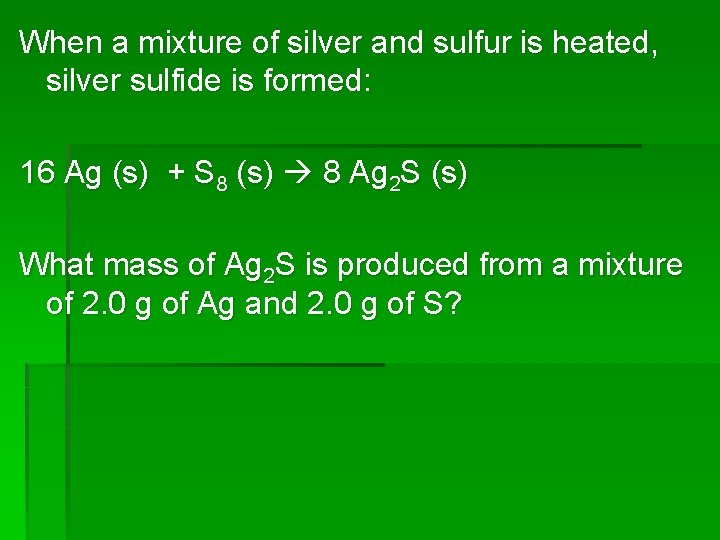
When a mixture of silver and sulfur is heated, silver sulfide is formed: 16 Ag (s) + S 8 (s) 8 Ag 2 S (s) What mass of Ag 2 S is produced from a mixture of 2. 0 g of Ag and 2. 0 g of S?
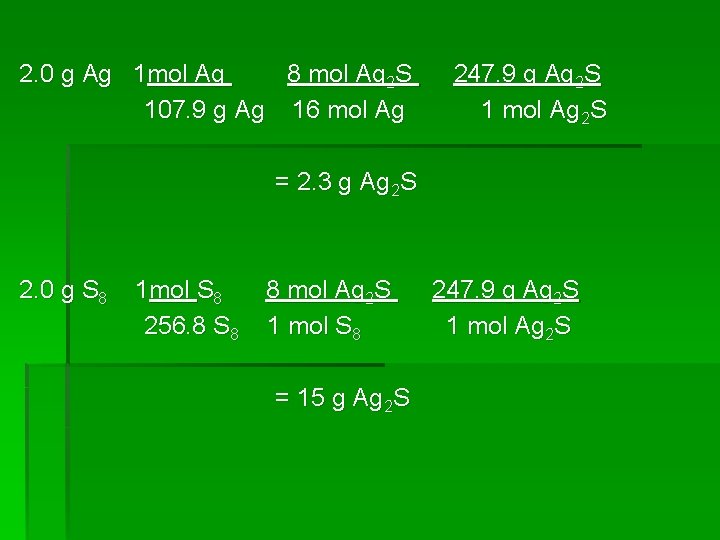
2. 0 g Ag 1 mol Ag 8 mol Ag 2 S 107. 9 g Ag 16 mol Ag 247. 9 g Ag 2 S 1 mol Ag 2 S = 2. 3 g Ag 2 S 2. 0 g S 8 1 mol S 8 256. 8 S 8 8 mol Ag 2 S 1 mol S 8 = 15 g Ag 2 S 247. 9 g Ag 2 S 1 mol Ag 2 S
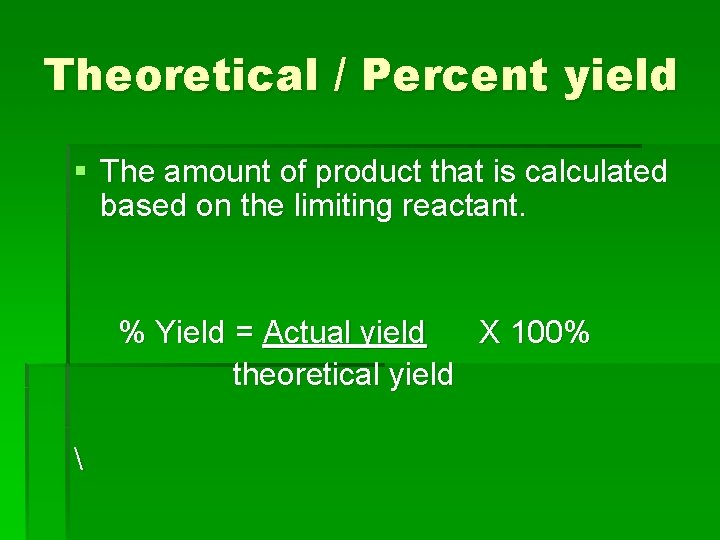
Theoretical / Percent yield § The amount of product that is calculated based on the limiting reactant. % Yield = Actual yield X 100% theoretical yield
HW § 7, 19, 21, 33 § 35, 56, 57, 58, 62, 63, 67, 69. 71, 74 81, 82, 83, 95, 98, 100 a-b, 105
Types of reactions
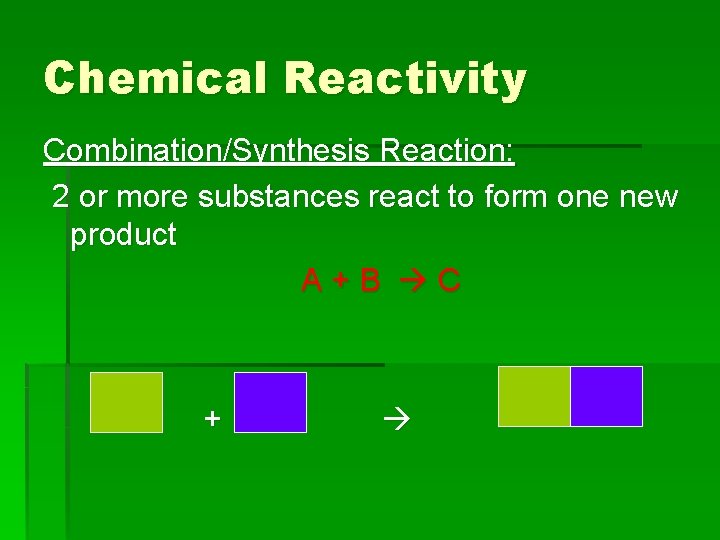
Chemical Reactivity Combination/Synthesis Reaction: 2 or more substances react to form one new product A+B C +
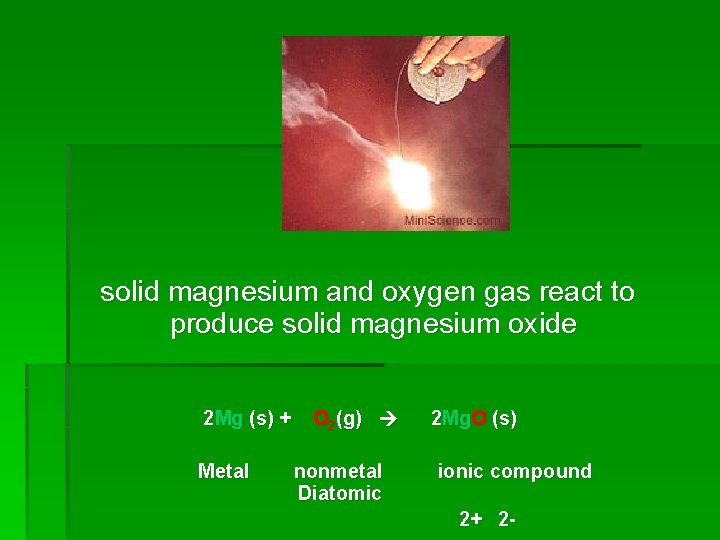
solid magnesium and oxygen gas react to produce solid magnesium oxide 2 Mg (s) + Metal O 2(g) nonmetal Diatomic 2 Mg. O (s) ionic compound 2+ 2 -
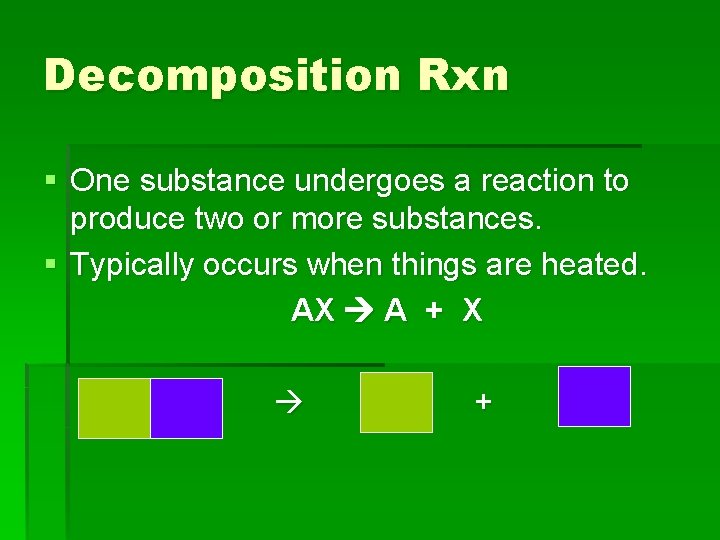
Decomposition Rxn § One substance undergoes a reaction to produce two or more substances. § Typically occurs when things are heated. AX A + X +
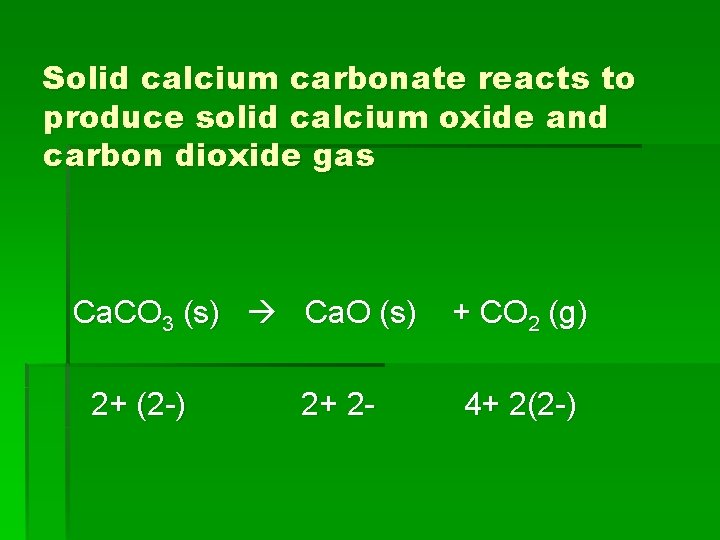
Solid calcium carbonate reacts to produce solid calcium oxide and carbon dioxide gas Ca. CO 3 (s) Ca. O (s) 2+ (2 -) 2+ 2 - + CO 2 (g) 4+ 2(2 -)
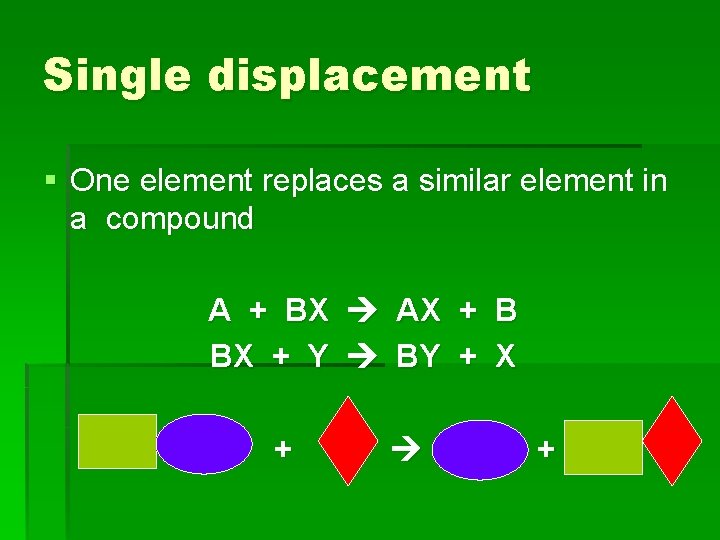
Single displacement § One element replaces a similar element in a compound A + BX AX + B BX + Y BY + X + +
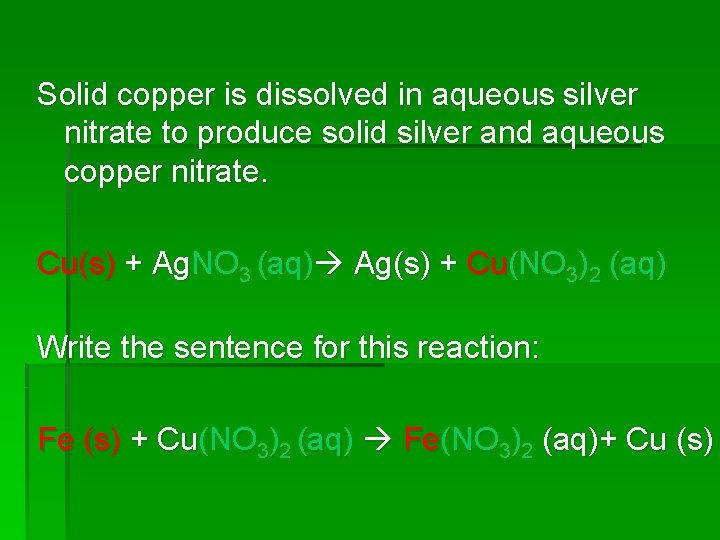
Solid copper is dissolved in aqueous silver nitrate to produce solid silver and aqueous copper nitrate. Cu(s) + Ag. NO 3 (aq) Ag(s) + Cu(NO 3)2 (aq) Write the sentence for this reaction: Fe (s) + Cu(NO 3)2 (aq) Fe(NO 3)2 (aq)+ Cu (s)
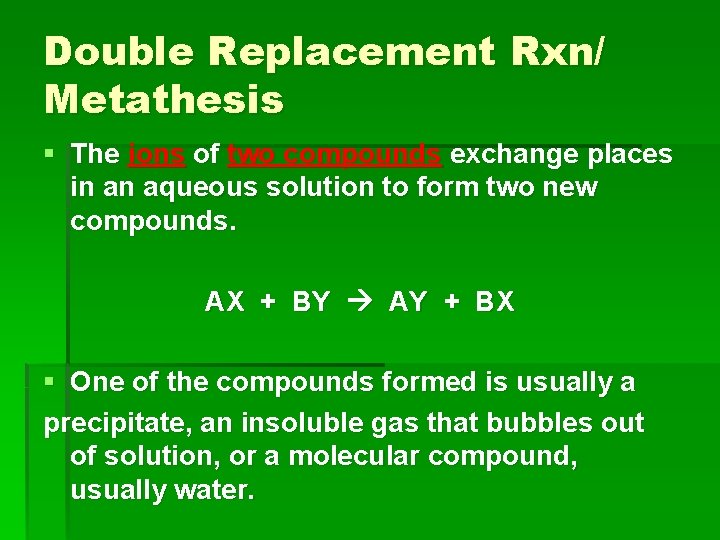
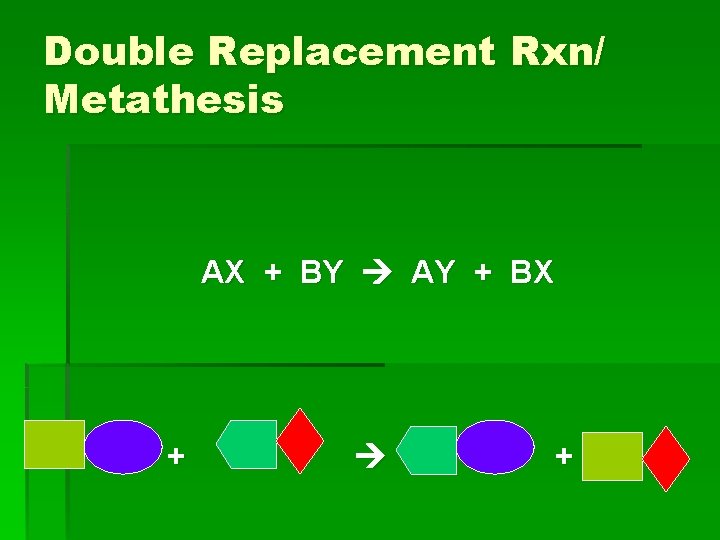
Double Replacement Rxn/ Metathesis § The ions of two compounds exchange places in an aqueous solution to form two new compounds. AX + BY AY + BX § One of the compounds formed is usually a precipitate, an insoluble gas that bubbles out of solution, or a molecular compound, usually water.
Double Replacement Rxn/ Metathesis AX + BY AY + BX + +
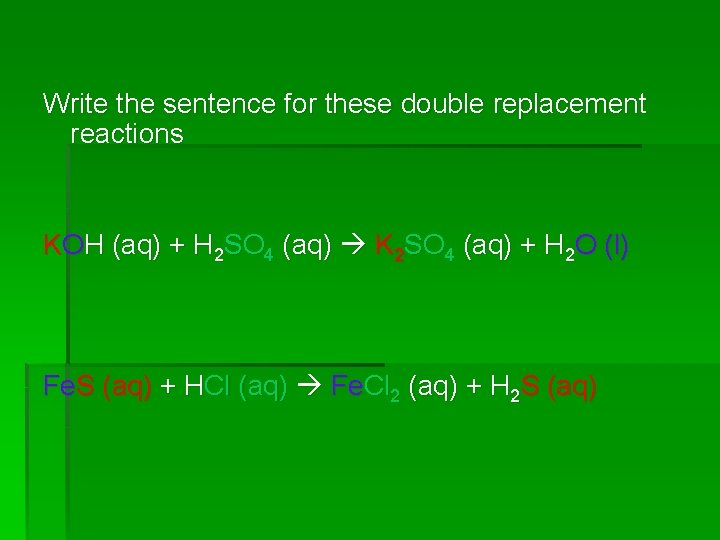
Write the sentence for these double replacement reactions KOH (aq) + H 2 SO 4 (aq) K 2 SO 4 (aq) + H 2 O (l) Fe. S (aq) + HCl (aq) Fe. Cl 2 (aq) + H 2 S (aq)
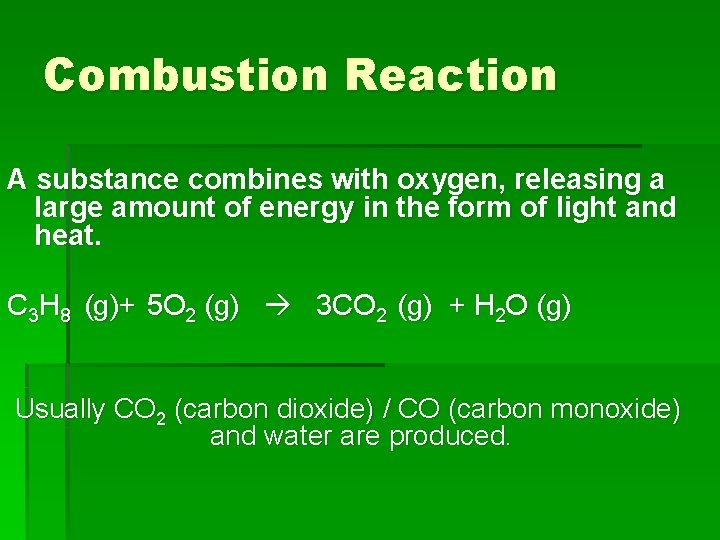
Combustion Reaction A substance combines with oxygen, releasing a large amount of energy in the form of light and heat. C 3 H 8 (g)+ 5 O 2 (g) 3 CO 2 (g) + H 2 O (g) Usually CO 2 (carbon dioxide) / CO (carbon monoxide) and water are produced.
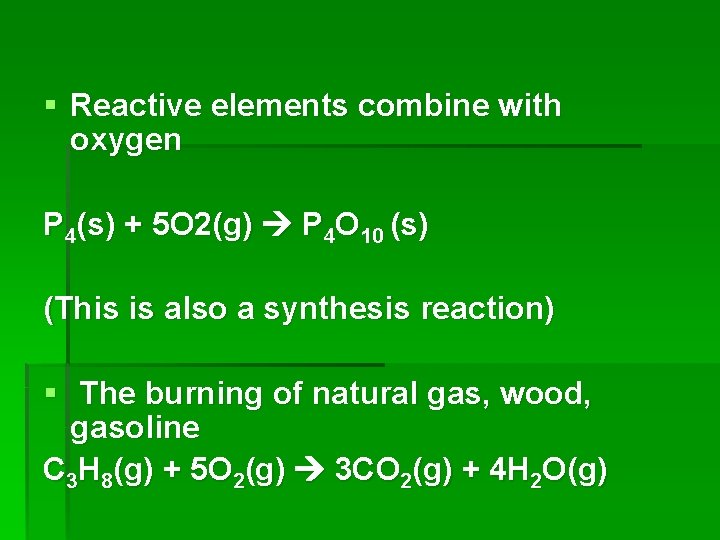
§ Reactive elements combine with oxygen P 4(s) + 5 O 2(g) P 4 O 10 (s) (This is also a synthesis reaction) § The burning of natural gas, wood, gasoline C 3 H 8(g) + 5 O 2(g) 3 CO 2(g) + 4 H 2 O(g)