
Chapter 3 Assembly Language Fundamentals Chapter Overview Basic
Chapter 3: Assembly Language Fundamentals
Chapter Overview • • • Basic Elements of Assembly Language Example: Adding and Subtracting Integers Assembling, Linking, and Running Programs Defining Data Symbolic Constants Real-Address Mode Programming Irvine, Kip R. Assembly Language for x 86 Processors 6/e, 2010. 2
Basic Elements of Assembly Language • • • Integer constants Integer expressions Character and string constants Reserved words and identifiers Directives and instructions Labels Mnemonics and Operands Comments Examples 3
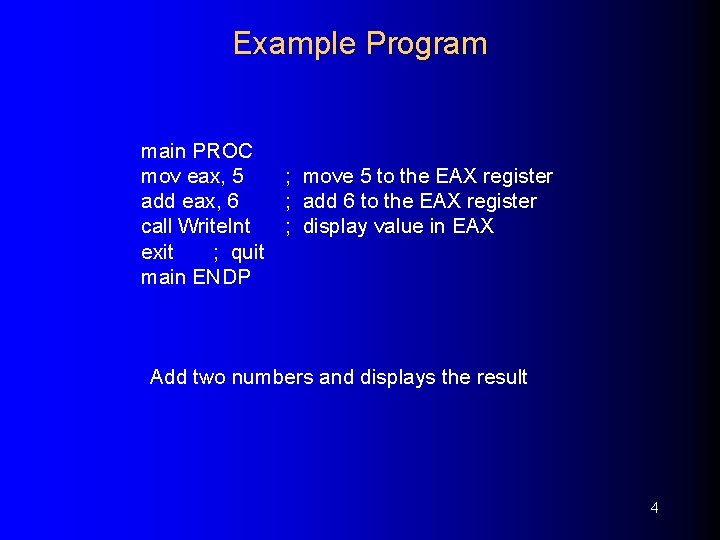
Example Program main PROC mov eax, 5 ; move 5 to the EAX register add eax, 6 ; add 6 to the EAX register call Write. Int ; display value in EAX exit ; quit main ENDP Add two numbers and displays the result 4
![Integer Constants • • [{+ | -}] digits [radix] Optional leading + or –](http://slidetodoc.com/presentation_image_h2/545ef5b3153420e3d93acb114376f9ea/image-5.jpg "Integer Constants • • [{+ | -}] digits [radix] Optional leading + or –")
Integer Constants • • [{+ | -}] digits [radix] Optional leading + or – sign binary, decimal, hexadecimal, or octal digits Common radix characters: • • • h – hexadecimal q | o – octal d – decimal b – binary r – encoded real r eithe 2. 0 s a +. ed sent ls (e. g 2 e r p a e are rcoded re s r e r b n num als or en ant i 3 F 80000 t l s a n e e o l: • R imal r c real oded rea a dec 5. ) y f ci nc 26. E can spel as an e • Youadecima hex • If no radix given, assumed to be decimal 5

Integer Expressions integer values and arithmetic operators • Operators and precedence levels: Must evaluate to an integer that can be stored in 32 bits These can be evaluated at assembly time – they are not runtime expressions • Examples: Precedence Examples: 4+5*2 Multiply, add 12 – 1 MOD 5 Modulus, subtract -5 + 2 Unary minus, add (4 + 2) * 6 Add, multiply 6
Real Number Constants • Represented as decimal real. • Decimal real contains optional sign followed by integer, decimal point, and optional integer that expresses a fractional and an optional exponent • [sign] integer. [integer] [exponent] • Sign {+, -} • Exponent E[{+, -}] integer • Examples • 2. • +3. 0 • -44. 2 E+05 7
Character and String Constants • Enclose character in single or double quotes • 'A', "x" • Enclose strings in single or double quotes • "ABC" • 'xyz' • Each character occupies a single byte • Embedded quotes: • 'Say "Goodnight, " Gracie' 8
Reserved Words • Reserved words cannot be used as identifiers • Instruction mnemonics soft o r c i m. M o r f • MOV, ADD, MUL, , … bler m e s s ro A c a • Register names M • Directives – tells MASM how to assemble programs to reserve space in the program (for variable for example). • type attributes – provides size and usage information for variables and operands. • BYTE, WORD • Operators – used in constant expressions • predefined symbols – @data, which return constant integer values 9
Identifiers • Programmer-chosen name to identify a variable, constant, procedure, or code label • 1 -247 characters, including digits • not case sensitive • first character must be a letter (A. . Z, a. . z), _, @, ? , or $ • Subsequent characters may also be digits • Cannot be the same as a reserved word • @ is used by assembler as a prefix for predefined symbols, so avoid it in your own identifiers. • Examples • Var 1, Count, $first, _main, MAX, open_file, my. File, x. Val, _12345 10
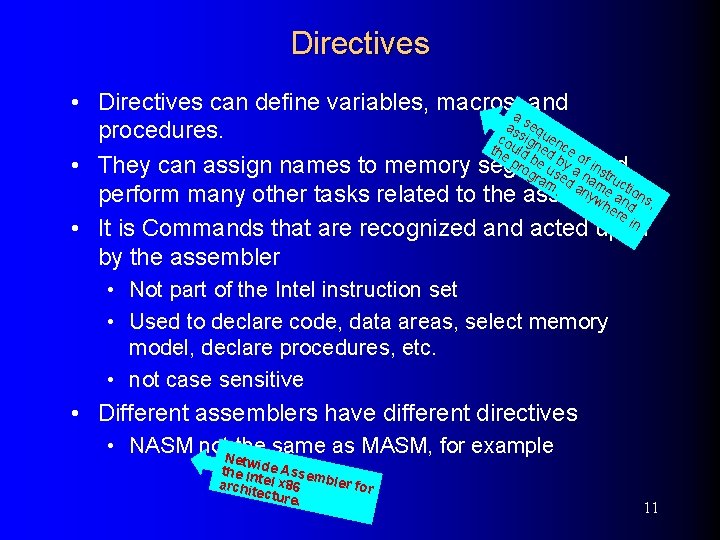
Directives • Directives can define variables, macros, a and as seq procedures. co sign uen the uld ed ce pro be u by of in • They can assign names to memory segments str gra se a naand m. d a me ucti ny a on perform many other tasks related to the assembler. wh nd s, ere in • It is Commands that are recognized and acted upon by the assembler • Not part of the Intel instruction set • Used to declare code, data areas, select memory model, declare procedures, etc. • not case sensitive • Different assemblers have different directives • NASM not. Nethe same as MASM, for example tw the Inide Assem bler f archi tel x 86 or tectu re. 11
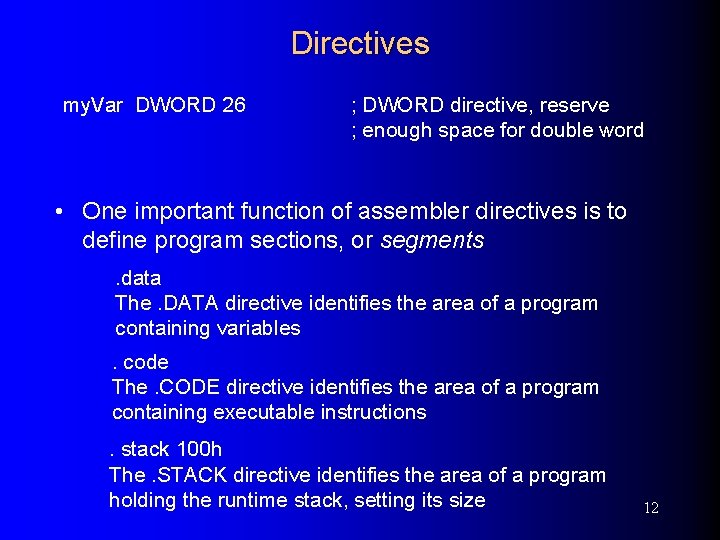
Directives my. Var DWORD 26 ; DWORD directive, reserve ; enough space for double word • One important function of assembler directives is to define program sections, or segments. data The. DATA directive identifies the area of a program containing variables. code The. CODE directive identifies the area of a program containing executable instructions. stack 100 h The. STACK directive identifies the area of a program holding the runtime stack, setting its size 12
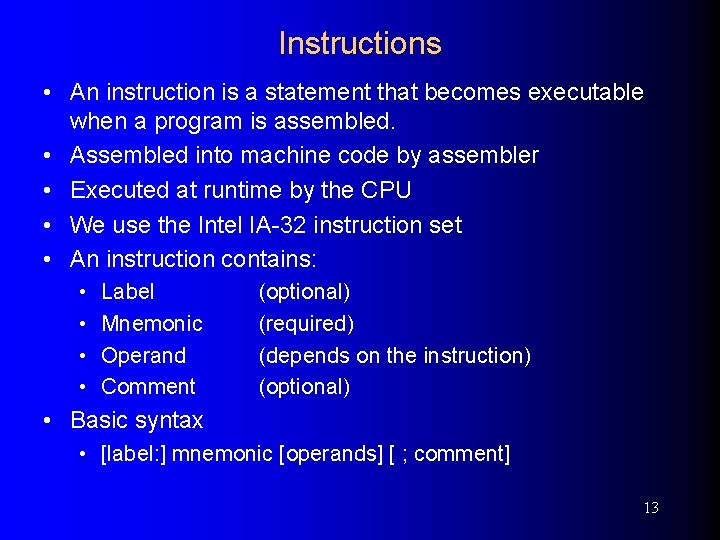
Instructions • An instruction is a statement that becomes executable when a program is assembled. • Assembled into machine code by assembler • Executed at runtime by the CPU • We use the Intel IA-32 instruction set • An instruction contains: • • Label Mnemonic Operand Comment (optional) (required) (depends on the instruction) (optional) • Basic syntax • [label: ] mnemonic [operands] [ ; comment] 13
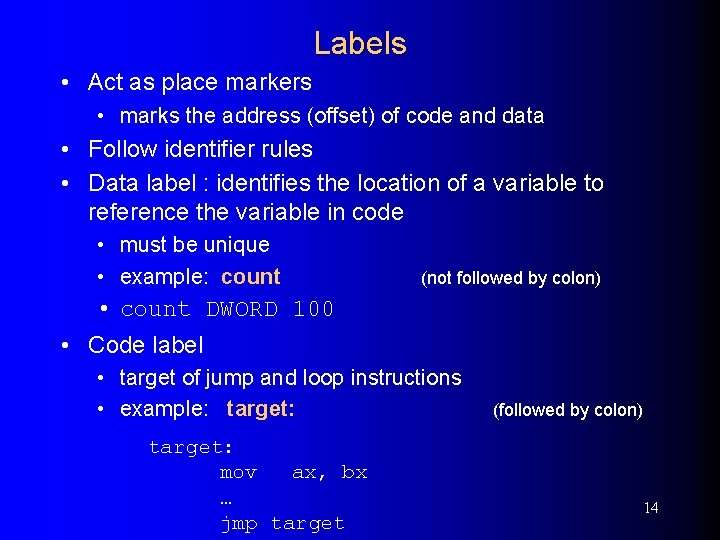
Labels • Act as place markers • marks the address (offset) of code and data • Follow identifier rules • Data label : identifies the location of a variable to reference the variable in code • must be unique • example: count (not followed by colon) • count DWORD 100 • Code label • target of jump and loop instructions • example: target: mov ax, bx … jmp target (followed by colon) 14
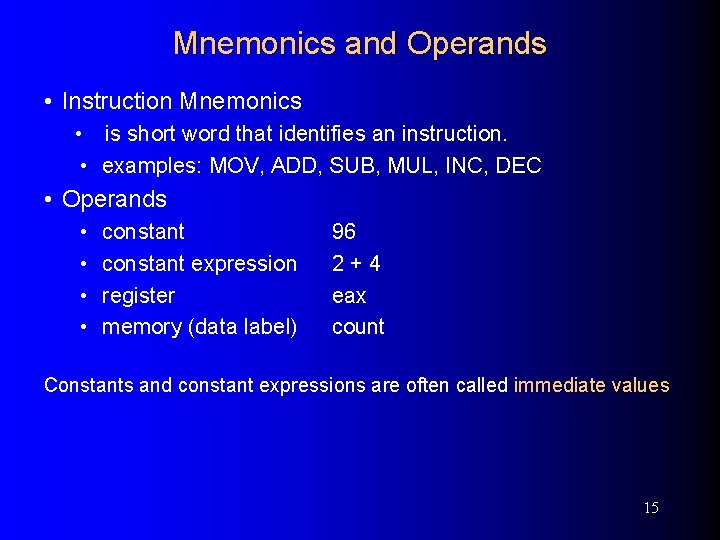
Mnemonics and Operands • Instruction Mnemonics • is short word that identifies an instruction. • examples: MOV, ADD, SUB, MUL, INC, DEC • Operands • • constant expression register memory (data label) 96 2+4 eax count Constants and constant expressions are often called immediate values 15
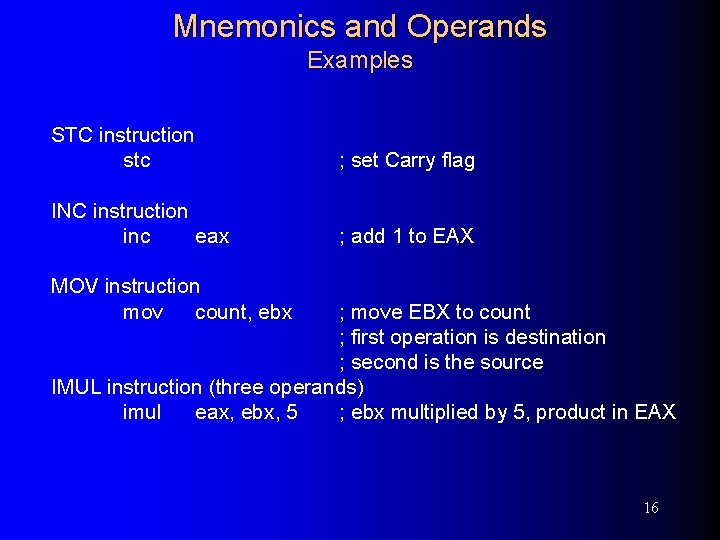
Mnemonics and Operands Examples STC instruction stc ; set Carry flag INC instruction inc eax ; add 1 to EAX MOV instruction mov count, ebx ; move EBX to count ; first operation is destination ; second is the source IMUL instruction (three operands) imul eax, ebx, 5 ; ebx multiplied by 5, product in EAX 16
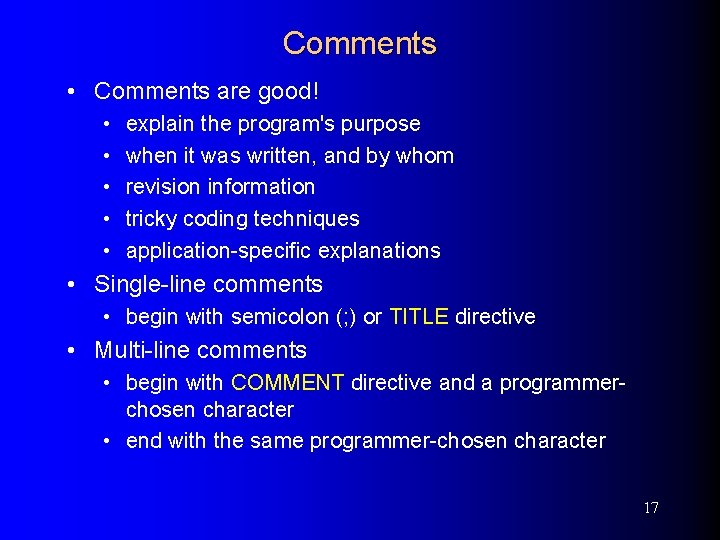
Comments • Comments are good! • • • explain the program's purpose when it was written, and by whom revision information tricky coding techniques application-specific explanations • Single-line comments • begin with semicolon (; ) or TITLE directive • Multi-line comments • begin with COMMENT directive and a programmerchosen character • end with the same programmer-chosen character 17
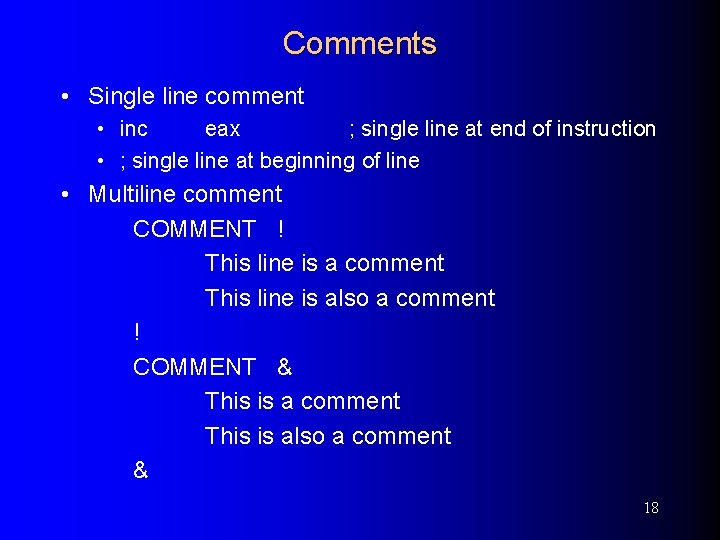
Comments • Single line comment • inc eax ; single line at end of instruction • ; single line at beginning of line • Multiline comment COMMENT ! This line is a comment This line is also a comment ! COMMENT & This is a comment This is also a comment & 18
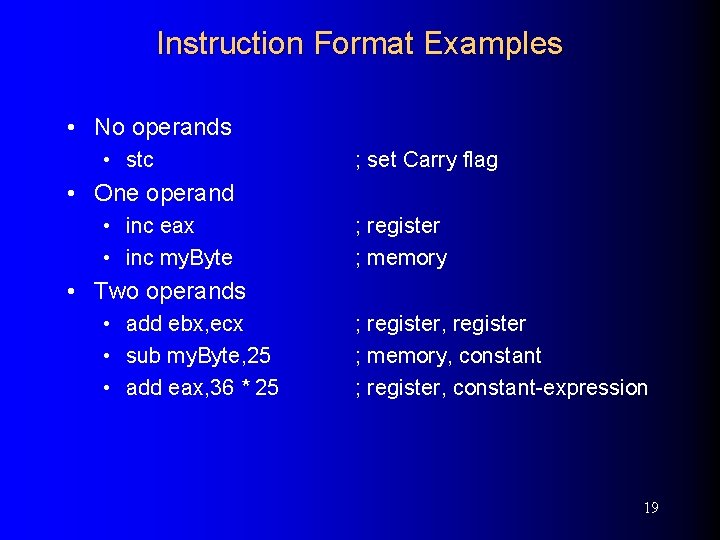
Instruction Format Examples • No operands • stc ; set Carry flag • One operand • inc eax • inc my. Byte ; register ; memory • Two operands • add ebx, ecx • sub my. Byte, 25 • add eax, 36 * 25 ; register, register ; memory, constant ; register, constant-expression 19
NOP instruction • Doesn’t do anything • Takes up one byte • An operation that does nothing is sometimes useful for timing or debugging, or as a placeholder for future code 20
What's Next • • • Basic Elements of Assembly Language Example: Adding and Subtracting Integers Assembling, Linking, and Running Programs Defining Data Symbolic Constants Real-Address Mode Programming 21
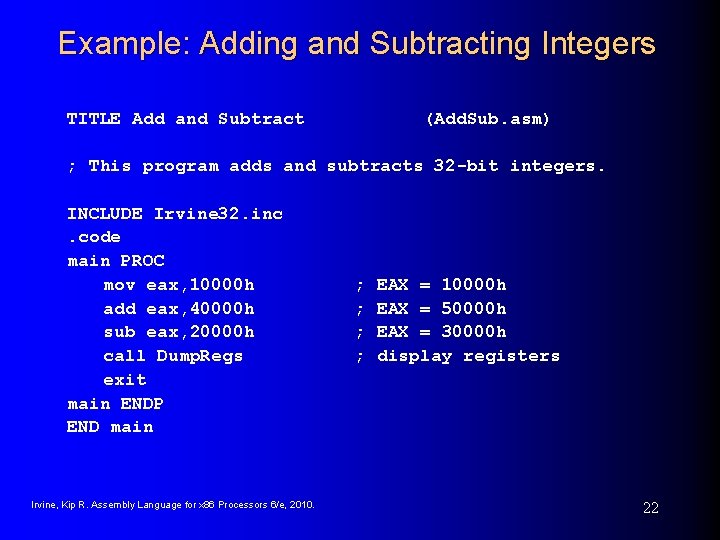
Example: Adding and Subtracting Integers TITLE Add and Subtract (Add. Sub. asm) ; This program adds and subtracts 32 -bit integers. INCLUDE Irvine 32. inc. code main PROC mov eax, 10000 h add eax, 40000 h sub eax, 20000 h call Dump. Regs exit main ENDP END main Irvine, Kip R. Assembly Language for x 86 Processors 6/e, 2010. ; ; EAX = 10000 h EAX = 50000 h EAX = 30000 h display registers 22
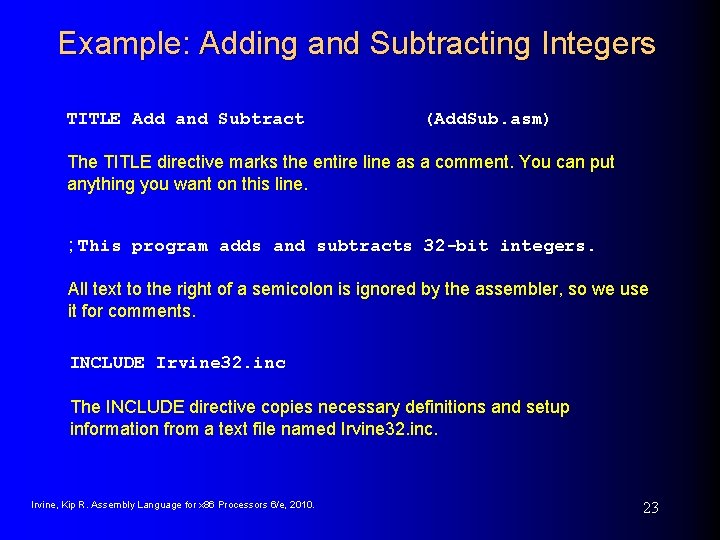
Example: Adding and Subtracting Integers TITLE Add and Subtract (Add. Sub. asm) The TITLE directive marks the entire line as a comment. You can put anything you want on this line. ; This program adds and subtracts 32 -bit integers. All text to the right of a semicolon is ignored by the assembler, so we use it for comments. INCLUDE Irvine 32. inc The INCLUDE directive copies necessary definitions and setup information from a text file named Irvine 32. inc. Irvine, Kip R. Assembly Language for x 86 Processors 6/e, 2010. 23
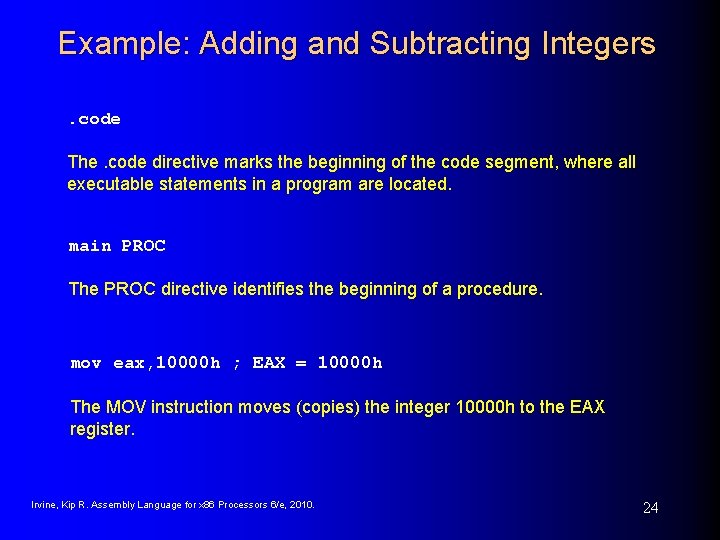
Example: Adding and Subtracting Integers. code The. code directive marks the beginning of the code segment, where all executable statements in a program are located. main PROC The PROC directive identifies the beginning of a procedure. mov eax, 10000 h ; EAX = 10000 h The MOV instruction moves (copies) the integer 10000 h to the EAX register. Irvine, Kip R. Assembly Language for x 86 Processors 6/e, 2010. 24
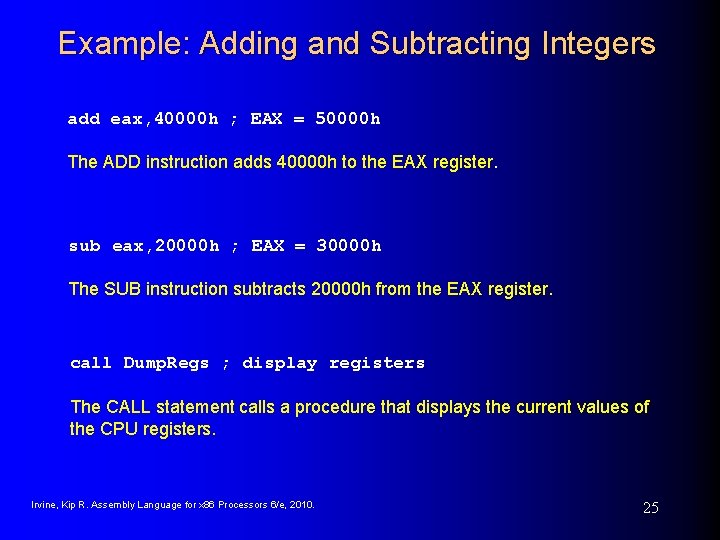
Example: Adding and Subtracting Integers add eax, 40000 h ; EAX = 50000 h The ADD instruction adds 40000 h to the EAX register. sub eax, 20000 h ; EAX = 30000 h The SUB instruction subtracts 20000 h from the EAX register. call Dump. Regs ; display registers The CALL statement calls a procedure that displays the current values of the CPU registers. Irvine, Kip R. Assembly Language for x 86 Processors 6/e, 2010. 25
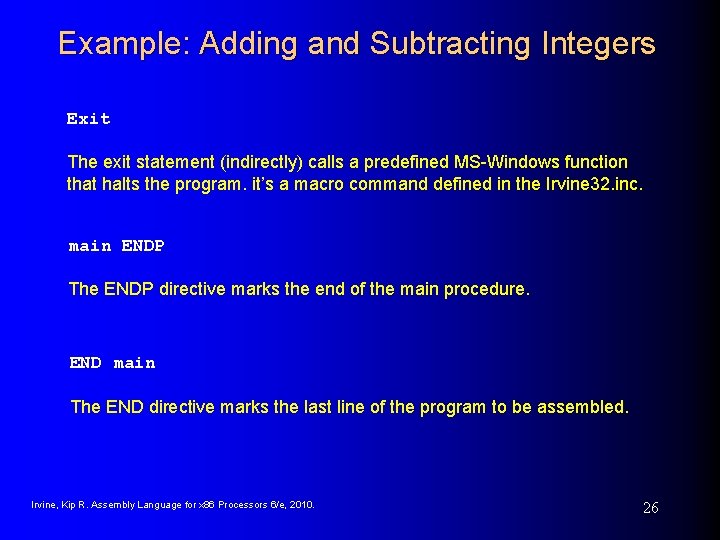
Example: Adding and Subtracting Integers Exit The exit statement (indirectly) calls a predefined MS-Windows function that halts the program. it’s a macro command defined in the Irvine 32. inc. main ENDP The ENDP directive marks the end of the main procedure. END main The END directive marks the last line of the program to be assembled. Irvine, Kip R. Assembly Language for x 86 Processors 6/e, 2010. 26
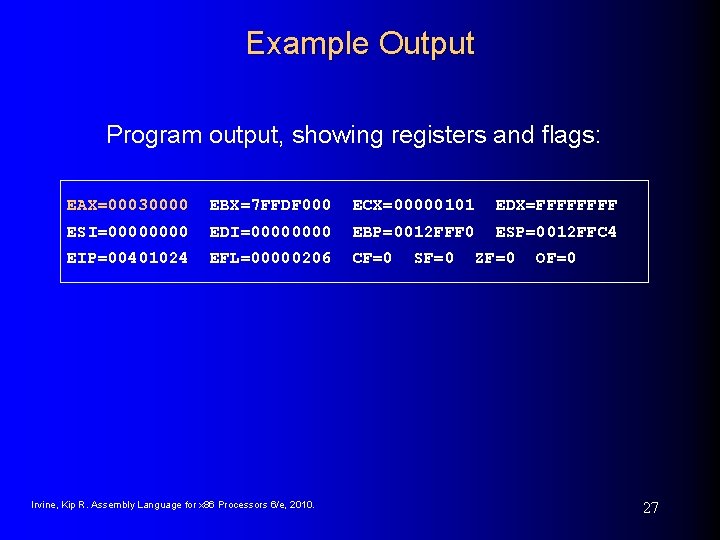
Example Output Program output, showing registers and flags: EAX=00030000 EBX=7 FFDF 000 ECX=00000101 EDX=FFFF ESI=0000 EDI=0000 EBP=0012 FFF 0 ESP=0012 FFC 4 EIP=00401024 EFL=00000206 CF=0 Irvine, Kip R. Assembly Language for x 86 Processors 6/e, 2010. SF=0 ZF=0 OF=0 27
Suggested Coding Standards (1 of 2) • Some approaches to capitalization • Use lowercase for keywords, mixed case for identifiers, and all capitals for constants. • capitalize all reserved words, including instruction mnemonics and register names • Capitalize directives and operators except that lowercase is used for the. code, . stack, . model, and. data directives. 28
Suggested Coding Standards (2 of 2) • Other suggestions • descriptive identifier names • spaces surrounding arithmetic operators • blank lines between procedures • Indentation and spacing • • code and data labels – no indentation executable instructions – indent 4 -5 spaces comments: right side of page, aligned vertically 1 -3 spaces between instruction and its operands • ex: mov ax, bx • 1 -2 blank lines between procedures 29
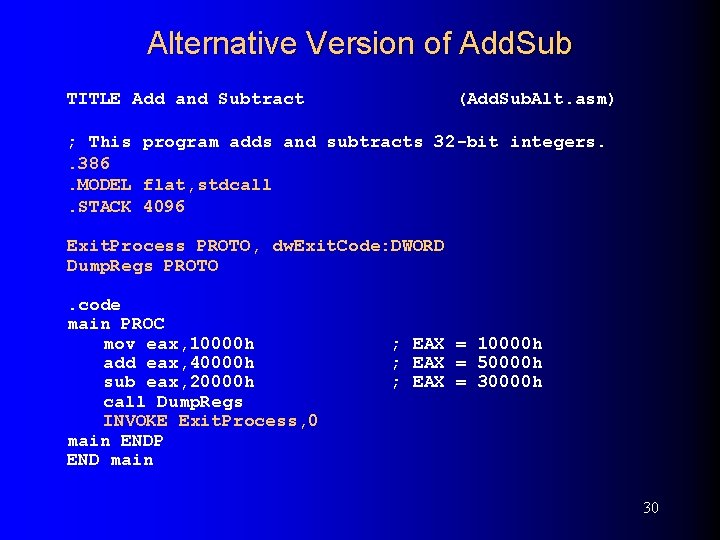
Alternative Version of Add. Sub TITLE Add and Subtract (Add. Sub. Alt. asm) ; This program adds and subtracts 32 -bit integers. . 386. MODEL flat, stdcall. STACK 4096 Exit. Process PROTO, dw. Exit. Code: DWORD Dump. Regs PROTO. code main PROC mov eax, 10000 h add eax, 40000 h sub eax, 20000 h call Dump. Regs INVOKE Exit. Process, 0 main ENDP END main ; EAX = 10000 h ; EAX = 50000 h ; EAX = 30000 h 30
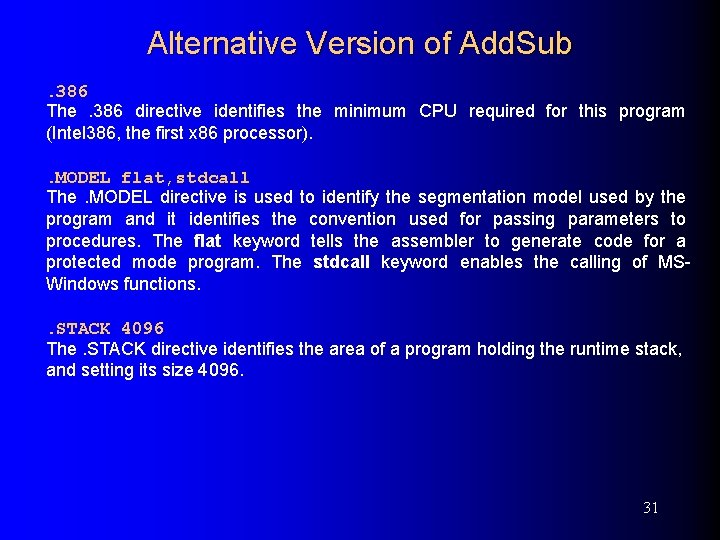
Alternative Version of Add. Sub. 386 The. 386 directive identifies the minimum CPU required for this program (Intel 386, the first x 86 processor). . MODEL flat, stdcall The. MODEL directive is used to identify the segmentation model used by the program and it identifies the convention used for passing parameters to procedures. The flat keyword tells the assembler to generate code for a protected mode program. The stdcall keyword enables the calling of MSWindows functions. . STACK 4096 The. STACK directive identifies the area of a program holding the runtime stack, and setting its size 4096. 31
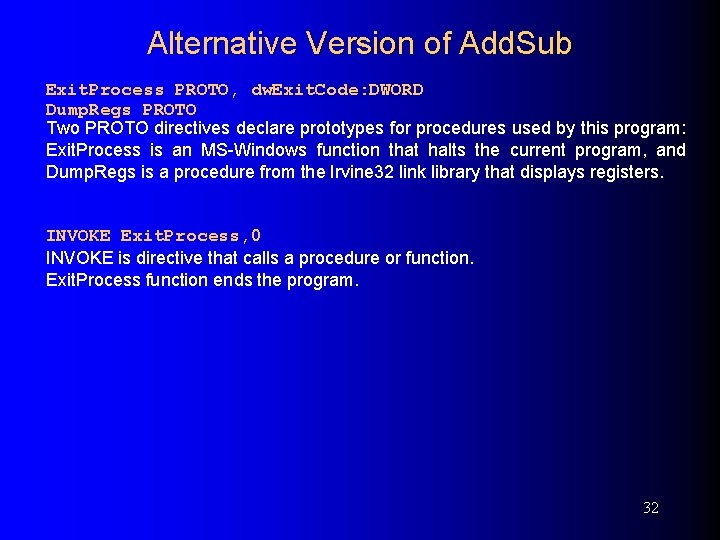
Alternative Version of Add. Sub Exit. Process PROTO, dw. Exit. Code: DWORD Dump. Regs PROTO Two PROTO directives declare prototypes for procedures used by this program: Exit. Process is an MS-Windows function that halts the current program, and Dump. Regs is a procedure from the Irvine 32 link library that displays registers. INVOKE Exit. Process, 0 INVOKE is directive that calls a procedure or function. Exit. Process function ends the program. 32
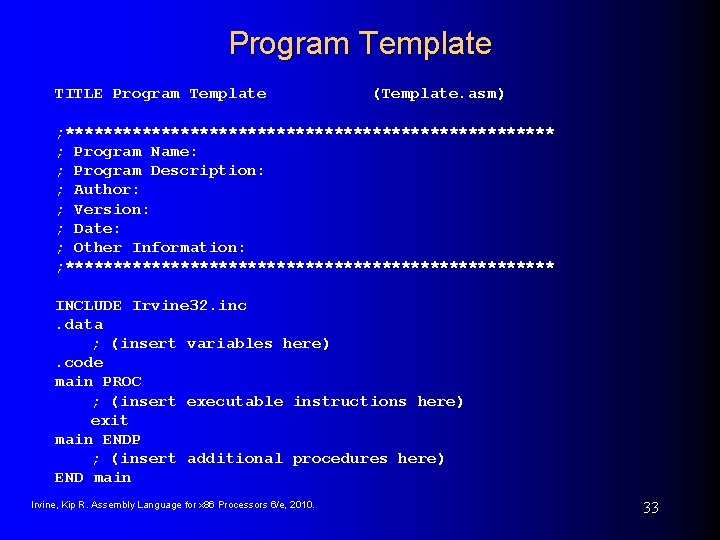
Program Template TITLE Program Template (Template. asm) ; ************************** ; Program Name: ; Program Description: ; Author: ; Version: ; Date: ; Other Information: ; ************************** INCLUDE Irvine 32. inc. data ; (insert variables here). code main PROC ; (insert executable instructions here) exit main ENDP ; (insert additional procedures here) END main Irvine, Kip R. Assembly Language for x 86 Processors 6/e, 2010. 33
What's Next • • • Basic Elements of Assembly Language Example: Adding and Subtracting Integers Assembling, Linking, and Running Programs Defining Data Symbolic Constants Real-Address Mode Programming Irvine, Kip R. Assembly Language for x 86 Processors 6/e, 2010. 34
Assembling, Linking, and Running Programs • Assemble-Link-Execute Cycle • Listing File • Map File Irvine, Kip R. Assembly Language for x 86 Processors 6/e, 2010. 35
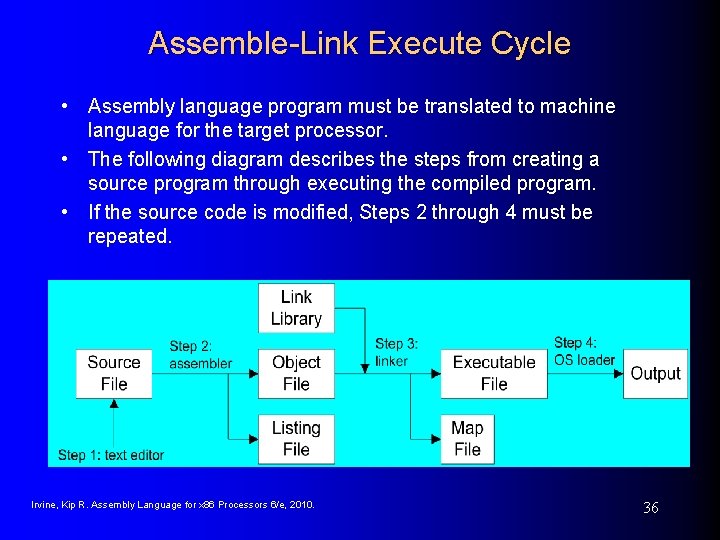
Assemble-Link Execute Cycle • Assembly language program must be translated to machine language for the target processor. • The following diagram describes the steps from creating a source program through executing the compiled program. • If the source code is modified, Steps 2 through 4 must be repeated. Irvine, Kip R. Assembly Language for x 86 Processors 6/e, 2010. 36
Assemble-Link-Execute Step 1: A programmer uses a text editor to create the source file. Step 2: The assembler reads the source file and produces an object file, and listing file. Step 3: The linker reads the object file and checks to see if the program contains any calls to procedures in a link library, combines them with the object file, and produces the executable file. Step 4: The operating system loader utility reads the executable file into memory and branches the CPU to the program’s starting address, and the program begins to execute. 37
Listing File • Use it to see how your program is compiled • Contains • • • source code addresses object code (machine language) segment names symbols (variables, procedures, and constants) Irvine, Kip R. Assembly Language for x 86 Processors 6/e, 2010. 38
Map File • Information about each program segment: • • starting address ending address size segment type Irvine, Kip R. Assembly Language for x 86 Processors 6/e, 2010. 39
What's Next • • • Basic Elements of Assembly Language Example: Adding and Subtracting Integers Assembling, Linking, and Running Programs Defining Data Symbolic Constants Real-Address Mode Programming Irvine, Kip R. Assembly Language for x 86 Processors 6/e, 2010. 40
Defining Data • • • Intrinsic Data Types Data Definition Statement Defining BYTE and SBYTE Data Defining WORD and SWORD Data Defining DWORD and SDWORD Data Defining QWORD Data Defining TBYTE Data Defining Real Number Data Little Endian Order Adding Variables to the Add. Sub Program Declaring Uninitialized Data Irvine, Kip R. Assembly Language for x 86 Processors 6/e, 2010. 41
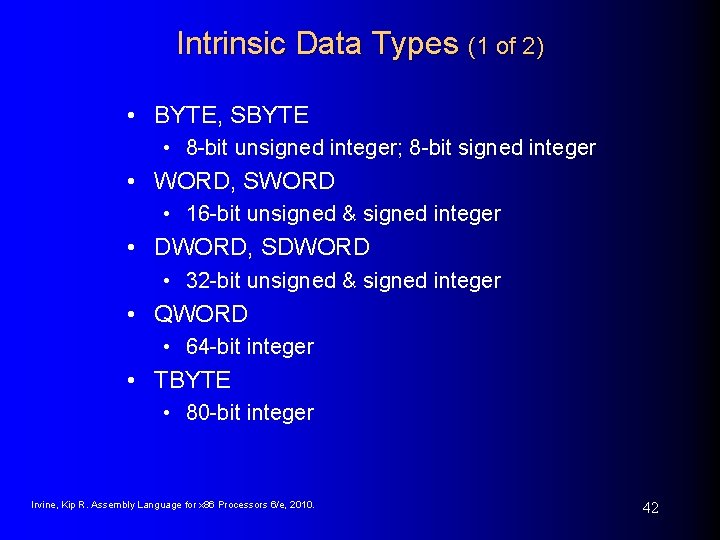
Intrinsic Data Types (1 of 2) • BYTE, SBYTE • 8 -bit unsigned integer; 8 -bit signed integer • WORD, SWORD • 16 -bit unsigned & signed integer • DWORD, SDWORD • 32 -bit unsigned & signed integer • QWORD • 64 -bit integer • TBYTE • 80 -bit integer Irvine, Kip R. Assembly Language for x 86 Processors 6/e, 2010. 42
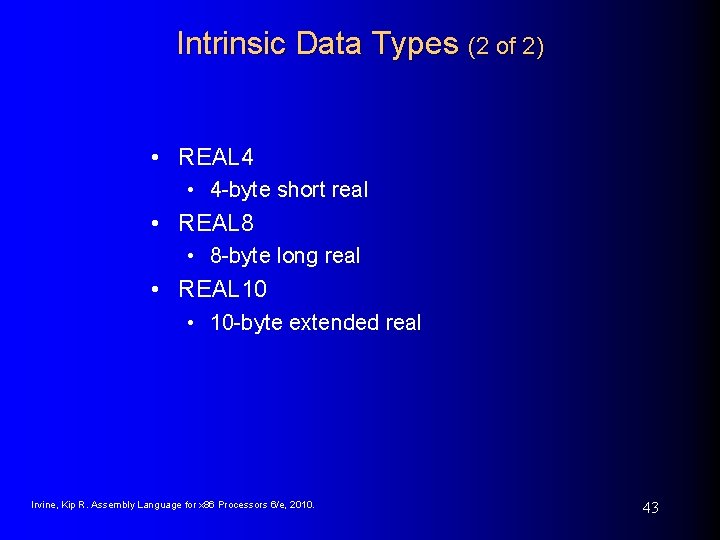
Intrinsic Data Types (2 of 2) • REAL 4 • 4 -byte short real • REAL 8 • 8 -byte long real • REAL 10 • 10 -byte extended real Irvine, Kip R. Assembly Language for x 86 Processors 6/e, 2010. 43
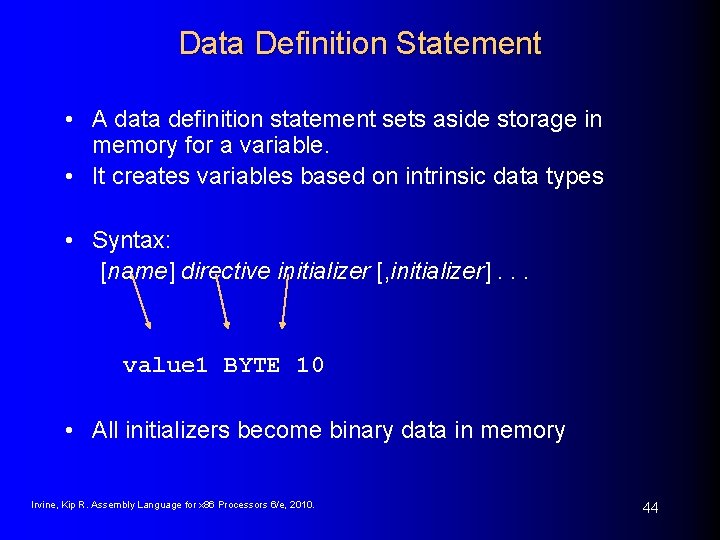
Data Definition Statement • A data definition statement sets aside storage in memory for a variable. • It creates variables based on intrinsic data types • Syntax: [name] directive initializer [, initializer]. . . value 1 BYTE 10 • All initializers become binary data in memory Irvine, Kip R. Assembly Language for x 86 Processors 6/e, 2010. 44
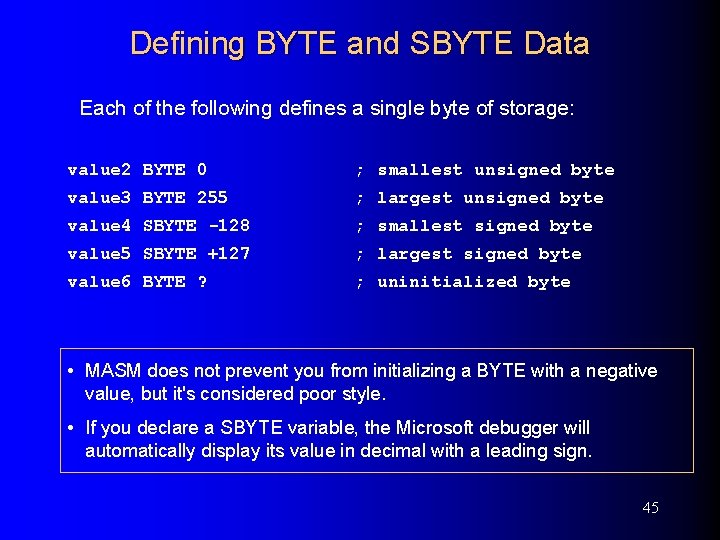
Defining BYTE and SBYTE Data Each of the following defines a single byte of storage: value 2 BYTE 0 ; smallest unsigned byte value 3 BYTE 255 ; largest unsigned byte value 4 SBYTE -128 ; smallest signed byte value 5 SBYTE +127 ; largest signed byte value 6 BYTE ? ; uninitialized byte • MASM does not prevent you from initializing a BYTE with a negative value, but it's considered poor style. • If you declare a SBYTE variable, the Microsoft debugger will automatically display its value in decimal with a leading sign. 45
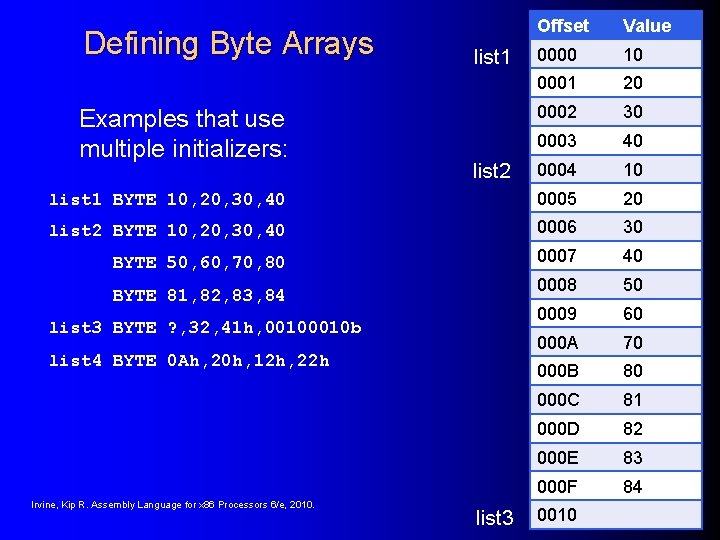
Offset Value 0000 10 0001 20 0002 30 0003 40 0004 10 list 1 BYTE 10, 20, 30, 40 0005 20 list 2 BYTE 10, 20, 30, 40 0006 30 BYTE 50, 60, 70, 80 0007 40 0008 50 0009 60 000 A 70 000 B 80 000 C 81 000 D 82 000 E 83 000 F 84 Defining Byte Arrays Examples that use multiple initializers: list 1 list 2 BYTE 81, 82, 83, 84 list 3 BYTE ? , 32, 41 h, 0010 b list 4 BYTE 0 Ah, 20 h, 12 h, 22 h Irvine, Kip R. Assembly Language for x 86 Processors 6/e, 2010. list 3 0010 46
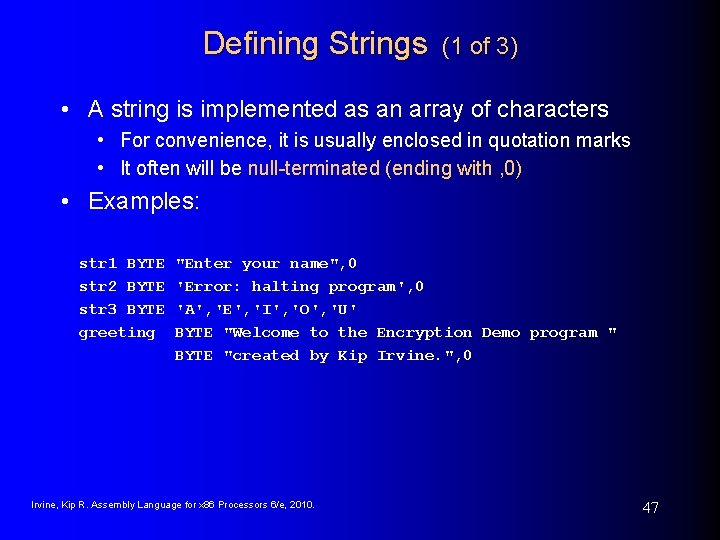
Defining Strings (1 of 3) • A string is implemented as an array of characters • For convenience, it is usually enclosed in quotation marks • It often will be null-terminated (ending with , 0) • Examples: str 1 BYTE str 2 BYTE str 3 BYTE greeting "Enter your name", 0 'Error: halting program', 0 'A', 'E', 'I', 'O', 'U' BYTE "Welcome to the Encryption Demo program " BYTE "created by Kip Irvine. ", 0 Irvine, Kip R. Assembly Language for x 86 Processors 6/e, 2010. 47
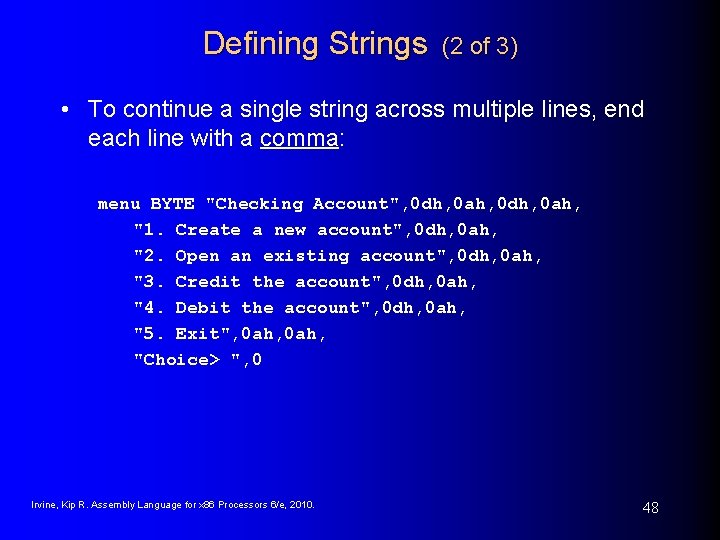
Defining Strings (2 of 3) • To continue a single string across multiple lines, end each line with a comma: menu BYTE "Checking Account", 0 dh, 0 ah, "1. Create a new account", 0 dh, 0 ah, "2. Open an existing account", 0 dh, 0 ah, "3. Credit the account", 0 dh, 0 ah, "4. Debit the account", 0 dh, 0 ah, "5. Exit", 0 ah, "Choice> ", 0 Irvine, Kip R. Assembly Language for x 86 Processors 6/e, 2010. 48
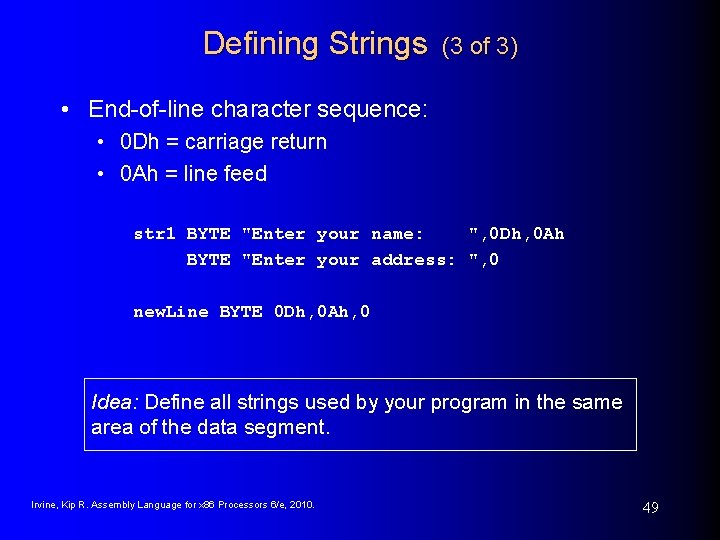
Defining Strings (3 of 3) • End-of-line character sequence: • 0 Dh = carriage return • 0 Ah = line feed str 1 BYTE "Enter your name: ", 0 Dh, 0 Ah BYTE "Enter your address: ", 0 new. Line BYTE 0 Dh, 0 Ah, 0 Idea: Define all strings used by your program in the same area of the data segment. Irvine, Kip R. Assembly Language for x 86 Processors 6/e, 2010. 49
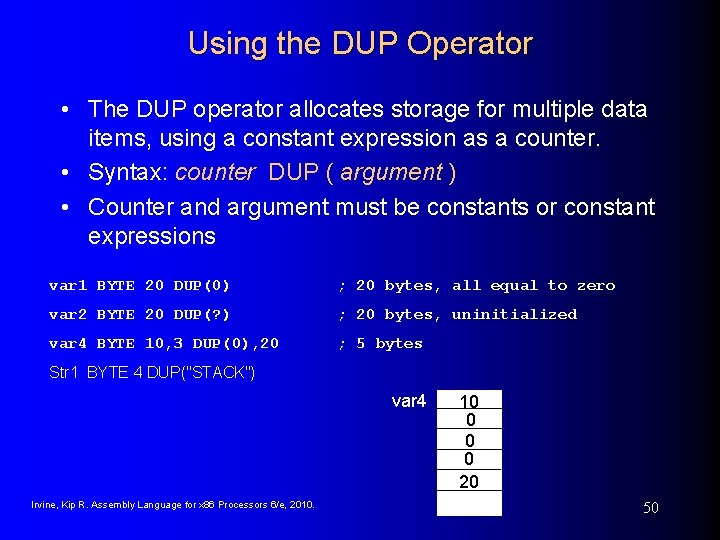
Using the DUP Operator • The DUP operator allocates storage for multiple data items, using a constant expression as a counter. • Syntax: counter DUP ( argument ) • Counter and argument must be constants or constant expressions var 1 BYTE 20 DUP(0) ; 20 bytes, all equal to zero var 2 BYTE 20 DUP(? ) ; 20 bytes, uninitialized var 4 BYTE 10, 3 DUP(0), 20 ; 5 bytes Str 1 BYTE 4 DUP("STACK") var 4 Irvine, Kip R. Assembly Language for x 86 Processors 6/e, 2010. 10 0 20 50
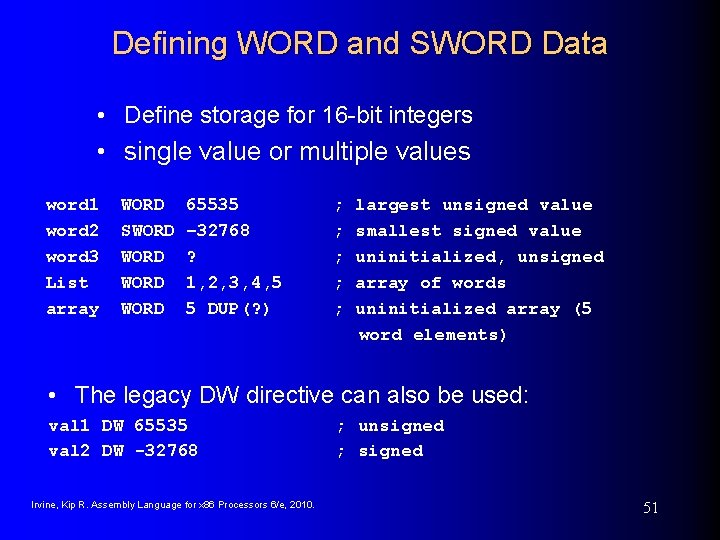
Defining WORD and SWORD Data • Define storage for 16 -bit integers • single value or multiple values word 1 word 2 word 3 List array WORD SWORD 65535 – 32768 ? 1, 2, 3, 4, 5 5 DUP(? ) ; ; ; largest unsigned value smallest signed value uninitialized, unsigned array of words uninitialized array (5 word elements) • The legacy DW directive can also be used: val 1 DW 65535 val 2 DW -32768 Irvine, Kip R. Assembly Language for x 86 Processors 6/e, 2010. ; unsigned ; signed 51
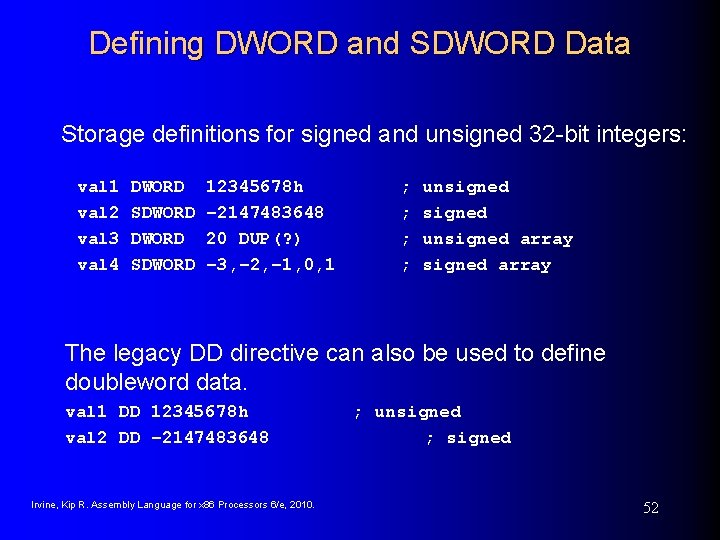
Defining DWORD and SDWORD Data Storage definitions for signed and unsigned 32 -bit integers: val 1 val 2 val 3 val 4 DWORD SDWORD 12345678 h – 2147483648 20 DUP(? ) – 3, – 2, – 1, 0, 1 ; ; unsigned array The legacy DD directive can also be used to define doubleword data. val 1 DD 12345678 h val 2 DD − 2147483648 Irvine, Kip R. Assembly Language for x 86 Processors 6/e, 2010. ; unsigned ; signed 52
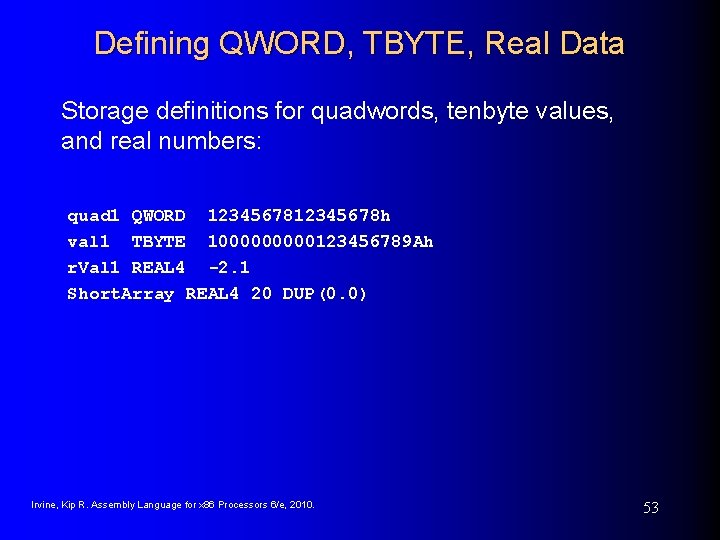
Defining QWORD, TBYTE, Real Data Storage definitions for quadwords, tenbyte values, and real numbers: quad 1 QWORD 12345678 h val 1 TBYTE 100000123456789 Ah r. Val 1 REAL 4 -2. 1 Short. Array REAL 4 20 DUP(0. 0) Irvine, Kip R. Assembly Language for x 86 Processors 6/e, 2010. 53
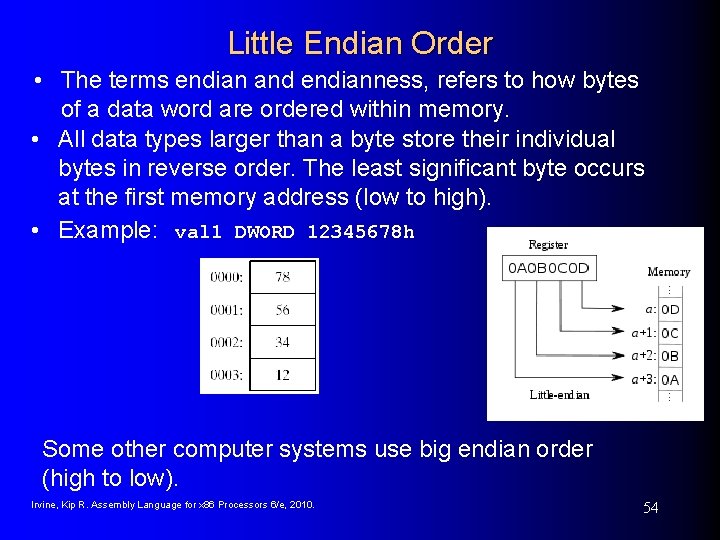
Little Endian Order • The terms endian and endianness, refers to how bytes of a data word are ordered within memory. • All data types larger than a byte store their individual bytes in reverse order. The least significant byte occurs at the first memory address (low to high). • Example: val 1 DWORD 12345678 h Some other computer systems use big endian order (high to low). Irvine, Kip R. Assembly Language for x 86 Processors 6/e, 2010. 54
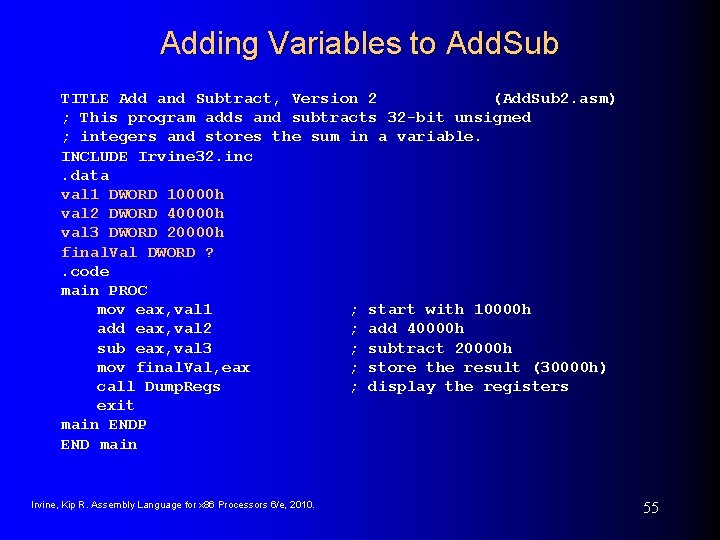
Adding Variables to Add. Sub TITLE Add and Subtract, Version 2 (Add. Sub 2. asm) ; This program adds and subtracts 32 -bit unsigned ; integers and stores the sum in a variable. INCLUDE Irvine 32. inc. data val 1 DWORD 10000 h val 2 DWORD 40000 h val 3 DWORD 20000 h final. Val DWORD ? . code main PROC mov eax, val 1 ; start with 10000 h add eax, val 2 ; add 40000 h sub eax, val 3 ; subtract 20000 h mov final. Val, eax ; store the result (30000 h) call Dump. Regs ; display the registers exit main ENDP END main Irvine, Kip R. Assembly Language for x 86 Processors 6/e, 2010. 55
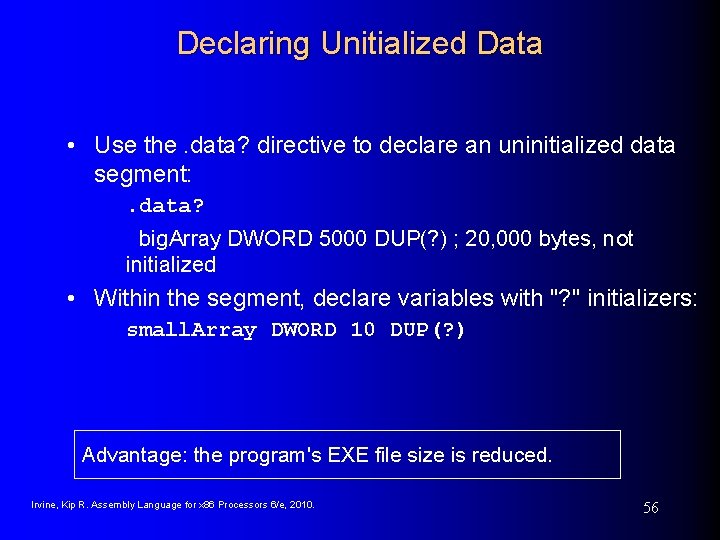
Declaring Unitialized Data • Use the. data? directive to declare an uninitialized data segment: . data? big. Array DWORD 5000 DUP(? ) ; 20, 000 bytes, not initialized • Within the segment, declare variables with "? " initializers: small. Array DWORD 10 DUP(? ) Advantage: the program's EXE file size is reduced. Irvine, Kip R. Assembly Language for x 86 Processors 6/e, 2010. 56
What's Next • • • Basic Elements of Assembly Language Example: Adding and Subtracting Integers Assembling, Linking, and Running Programs Defining Data Symbolic Constants Real-Address Mode Programming Irvine, Kip R. Assembly Language for x 86 Processors 6/e, 2010. 57
Symbolic Constants • • Equal-Sign Directive Calculating the Sizes of Arrays and Strings EQU Directive TEXTEQU Directive Irvine, Kip R. Assembly Language for x 86 Processors 6/e, 2010. 58
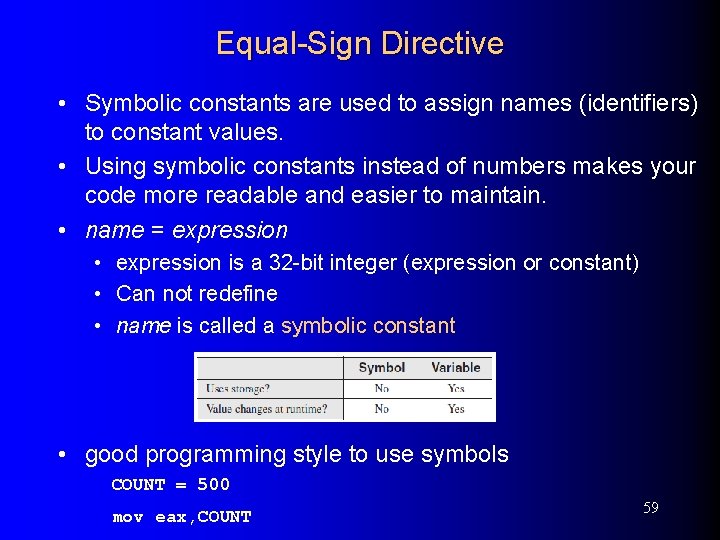
Equal-Sign Directive • Symbolic constants are used to assign names (identifiers) to constant values. • Using symbolic constants instead of numbers makes your code more readable and easier to maintain. • name = expression • expression is a 32 -bit integer (expression or constant) • Can not redefine • name is called a symbolic constant • good programming style to use symbols COUNT = 500 mov eax, COUNT 59
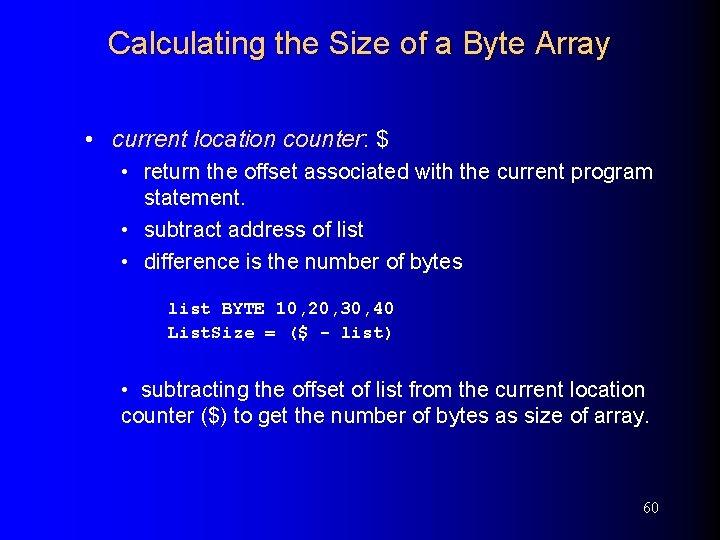
Calculating the Size of a Byte Array • current location counter: $ • return the offset associated with the current program statement. • subtract address of list • difference is the number of bytes list BYTE 10, 20, 30, 40 List. Size = ($ - list) • subtracting the offset of list from the current location counter ($) to get the number of bytes as size of array. 60
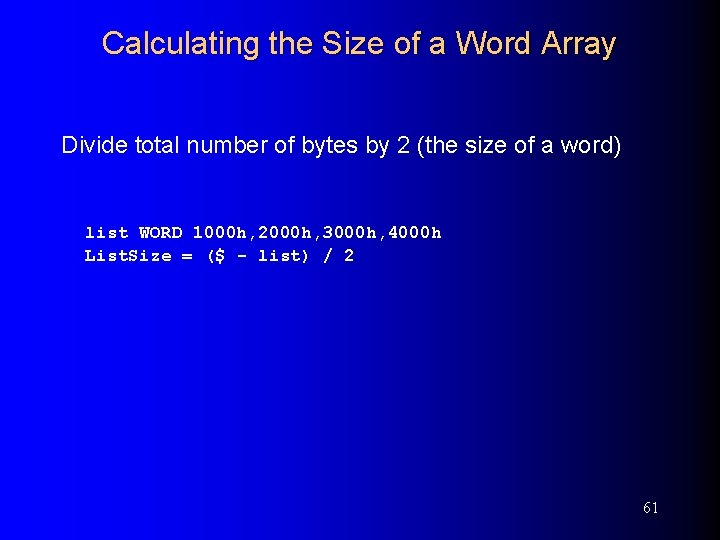
Calculating the Size of a Word Array Divide total number of bytes by 2 (the size of a word) list WORD 1000 h, 2000 h, 3000 h, 4000 h List. Size = ($ - list) / 2 61
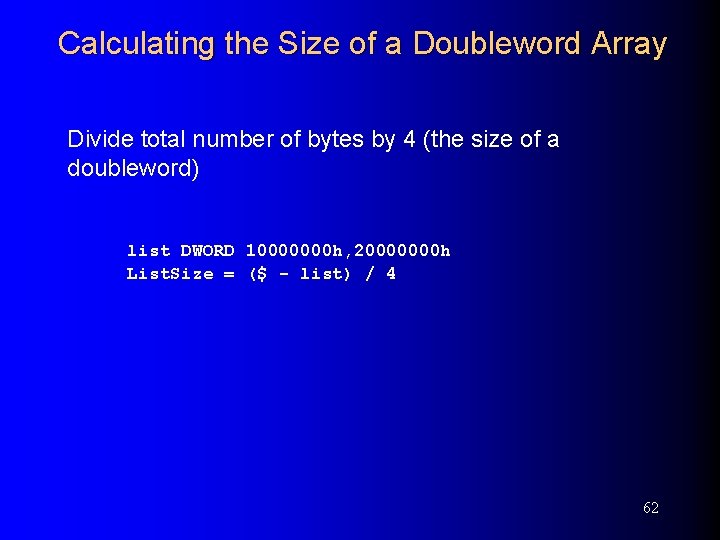
Calculating the Size of a Doubleword Array Divide total number of bytes by 4 (the size of a doubleword) list DWORD 10000000 h, 20000000 h List. Size = ($ - list) / 4 62
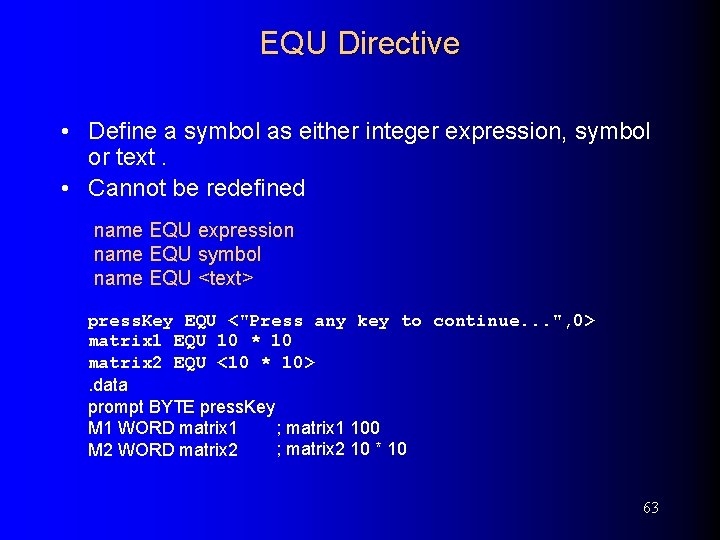
EQU Directive • Define a symbol as either integer expression, symbol or text. • Cannot be redefined name EQU expression name EQU symbol name EQU <text> press. Key EQU <"Press any key to continue. . . ", 0> matrix 1 EQU 10 * 10 matrix 2 EQU <10 * 10>. data prompt BYTE press. Key ; matrix 1 100 M 1 WORD matrix 1 ; matrix 2 10 * 10 M 2 WORD matrix 2 63
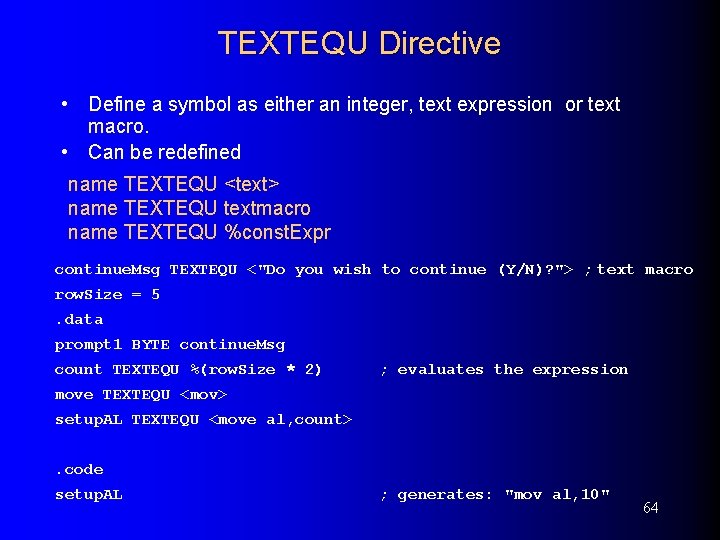
TEXTEQU Directive • Define a symbol as either an integer, text expression or text macro. • Can be redefined name TEXTEQU <text> name TEXTEQU textmacro name TEXTEQU %const. Expr continue. Msg TEXTEQU <"Do you wish to continue (Y/N)? "> ; text macro row. Size = 5. data prompt 1 BYTE continue. Msg count TEXTEQU %(row. Size * 2) ; evaluates the expression move TEXTEQU <mov> setup. AL TEXTEQU <move al, count>. code setup. AL ; generates: "mov al, 10" 64
What's Next • • • Basic Elements of Assembly Language Example: Adding and Subtracting Integers Assembling, Linking, and Running Programs Defining Data Symbolic Constants Real-Address Mode Programming 65
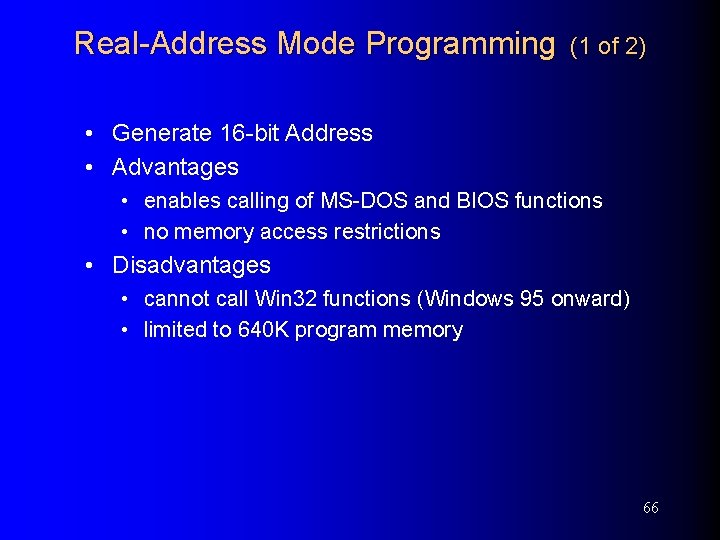
Real-Address Mode Programming (1 of 2) • Generate 16 -bit Address • Advantages • enables calling of MS-DOS and BIOS functions • no memory access restrictions • Disadvantages • cannot call Win 32 functions (Windows 95 onward) • limited to 640 K program memory 66
Real-Address Mode Programming (2 of 2) • Requirements • INCLUDE Irvine 16. inc • Initialize DS to the data segment: mov ax, @data ; starting location of the data segment mov ds, ax • MOV instruction does not permit a constant to be moved directly to data segment register (ds). 67
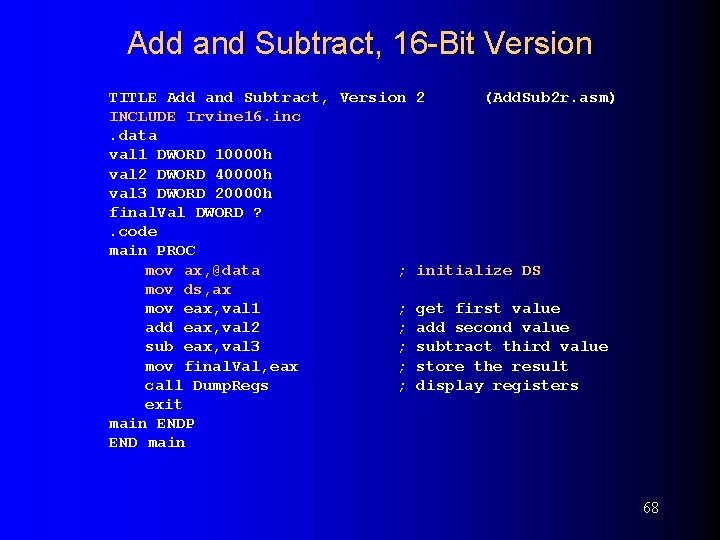
Add and Subtract, 16 -Bit Version TITLE Add and Subtract, Version 2 (Add. Sub 2 r. asm) INCLUDE Irvine 16. inc. data val 1 DWORD 10000 h val 2 DWORD 40000 h val 3 DWORD 20000 h final. Val DWORD ? . code main PROC mov ax, @data ; initialize DS mov ds, ax mov eax, val 1 ; get first value add eax, val 2 ; add second value sub eax, val 3 ; subtract third value mov final. Val, eax ; store the result call Dump. Regs ; display registers exit main ENDP END main 68
Summary • Integer expression, character constant • directive – interpreted by the assembler • instruction – executes at runtime • code, data, and stack segments • source, listing, object, map, executable files • Data definition directives: • BYTE, SBYTE, WORD, SWORD, DWORD, SDWORD, QWORD, TBYTE, REAL 4, REAL 8, and REAL 10 • DUP operator, location counter ($) • Symbolic constant • EQU and TEXTEQU 69
4 C 61 46 69 6 E 70
- Slides: 70