
Chapter 3 Additional Topics in Income Determination Source
- Slides: 77
Chapter 3: Additional Topics in Income Determination (Source: ACCT 303 Textbook) 1. When can revenue be recognized before or after the point of sale? 2. Revenue recognition for long-term construction contracts, agricultural commodities, and installment sales. 3. Revenue principles for franchise sales, sales with right of return, and “bundled” software sales with multiple deliverables. . 1 3 -1
Chapter 3: Additional Topics in Income Determination 4. 5. 6. 7. How GAAP income determination invites “earnings management”. The various techniques used to manage earnings. The SEC guidance intended to curtail earnings management. Key differences between IFRS and U. S. GAAP rules for revenue recognition. 2 3 -2
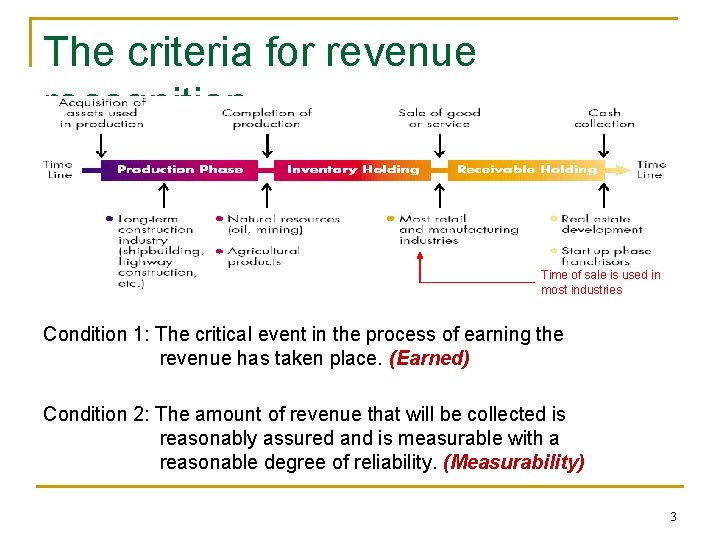
The criteria for revenue recognition Time of sale is used in most industries Condition 1: The critical event in the process of earning the revenue has taken place. (Earned) Condition 2: The amount of revenue that will be collected is reasonably assured and is measurable with a reasonable degree of reliability. (Measurability) 3
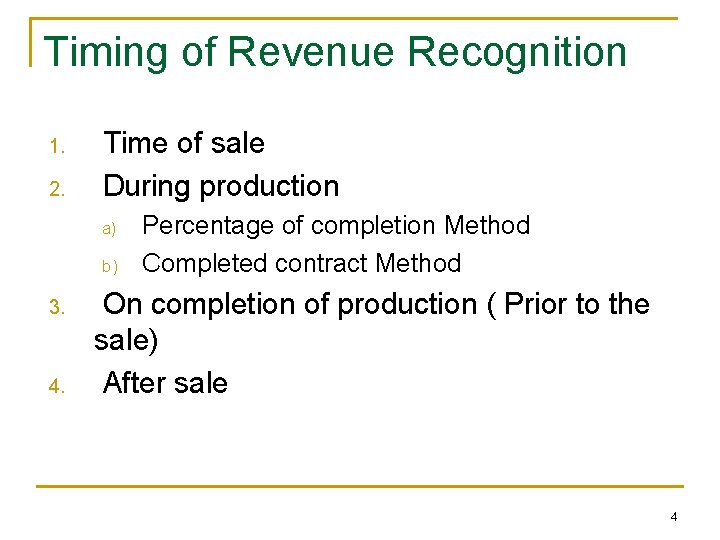
Timing of Revenue Recognition 1. 2. Time of sale During production a) b) 3. 4. Percentage of completion Method Completed contract Method On completion of production ( Prior to the sale) After sale 4
Learning Objective : Time of sale 5
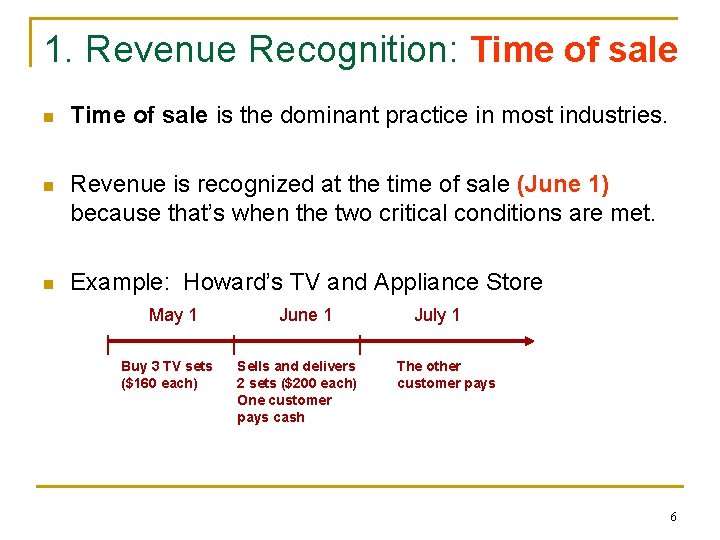
1. Revenue Recognition: Time of sale n Time of sale is the dominant practice in most industries. n Revenue is recognized at the time of sale (June 1) because that’s when the two critical conditions are met. n Example: Howard’s TV and Appliance Store May 1 Buy 3 TV sets ($160 each) June 1 Sells and delivers 2 sets ($200 each) One customer pays cash July 1 The other customer pays 6
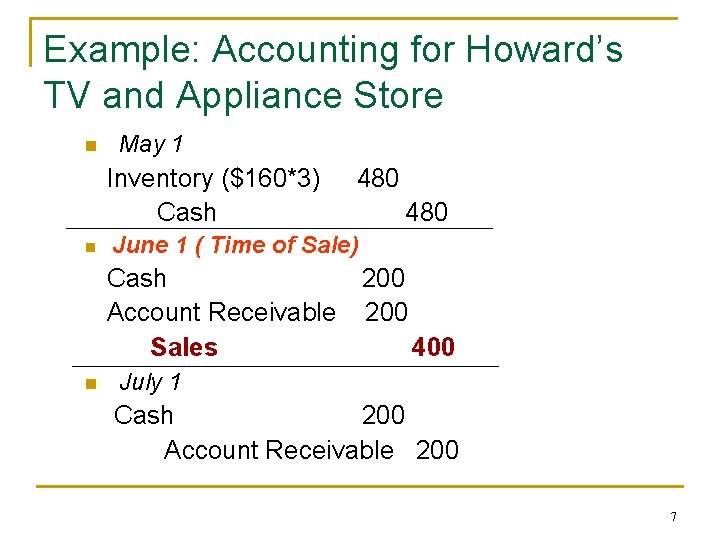
Example: Accounting for Howard’s TV and Appliance Store n May 1 Inventory ($160*3) Cash n 480 June 1 ( Time of Sale) Cash 200 Account Receivable 200 Sales 400 n July 1 Cash 200 Account Receivable 200 7
Learning Objective : During the production phase 8
Revenue Recognition: during production Criteria for recognizing revenue during production: n A customer must be identified an exchange price agrees upon (i. e. , a contract signed). n A significant portion of the agreed services has been performed , and the expected costs of future services can be reliably estimated. n Future payments from customers are expected (i. e. , reasonably assured). 9
Revenue Recognition: during production (contd. ) p In addition: p The contract clearly specifies the enforceable rights regarding goods or services by the parties, the consideration to be exchanged, and the manner and terms of settlement. p The buyer can be expected to satisfy all obligations. p The contractor can be expected to perform under the contract. 10
Revenues recognize during production phase Case Study: Long-term Construction Projects n Two Methods: q 1. Percentage-of-completion method q 2. Completed contract method ( Not allowed for IFRS) q If all the criteria listed above are met, the Percentage-of-completion method must be applied; otherwise the Completed contract method would be used. 11
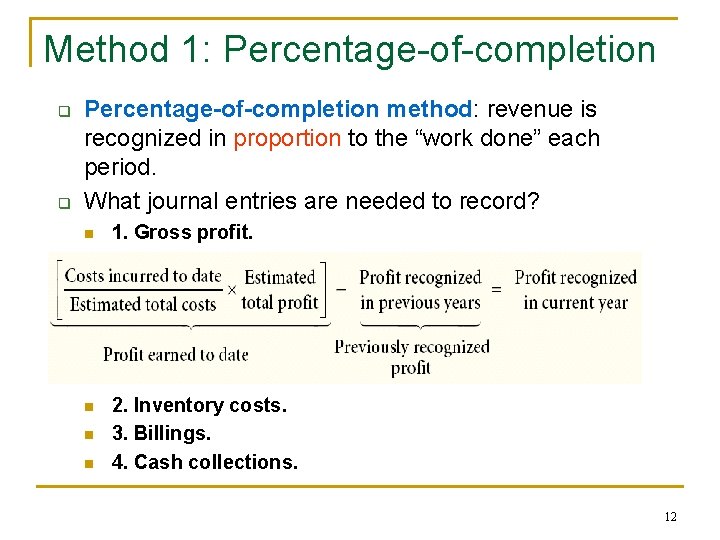
Method 1: Percentage-of-completion q q Percentage-of-completion method: revenue is recognized in proportion to the “work done” each period. What journal entries are needed to record? n 1. Gross profit. n 2. Inventory costs. 3. Billings. 4. Cash collections. n n 12
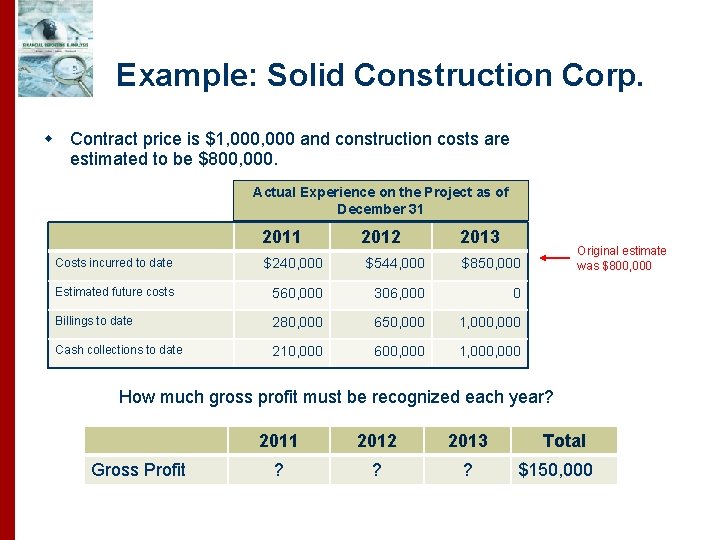
Example: Solid Construction Corp. w Contract price is $1, 000 and construction costs are estimated to be $800, 000. Actual Experience on the Project as of December 31 2012 2013 Costs incurred to date $240, 000 $544, 000 $850, 000 Estimated future costs 560, 000 306, 000 0 Billings to date 280, 000 650, 000 1, 000 Cash collections to date 210, 000 600, 000 1, 000 Original estimate was $800, 000 How much gross profit must be recognized each year? Gross Profit 2011 2012 2013 ? ? ? Total $150, 000
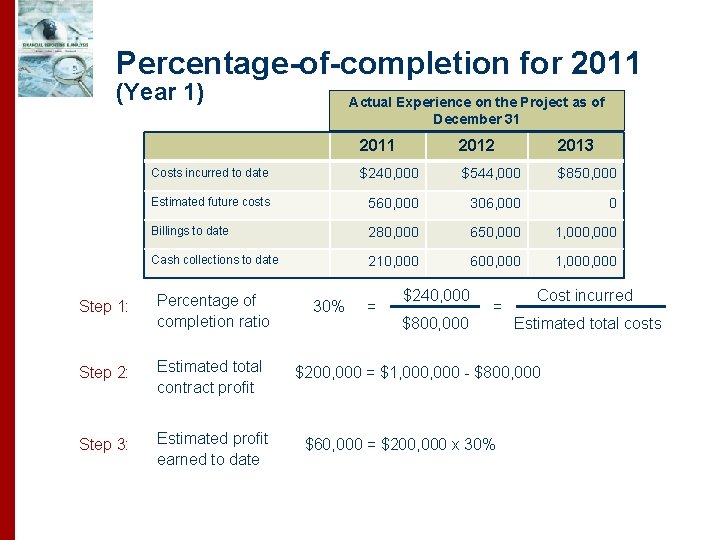
Percentage-of-completion for 2011 (Year 1) Actual Experience on the Project as of December 31 2012 2013 Costs incurred to date $240, 000 $544, 000 $850, 000 Estimated future costs 560, 000 306, 000 0 Billings to date 280, 000 650, 000 1, 000 Cash collections to date 210, 000 600, 000 1, 000 Step 1: Percentage of completion ratio Step 2: Estimated total contract profit Step 3: Estimated profit earned to date 30% = $240, 000 $800, 000 = Cost incurred Estimated total costs $200, 000 = $1, 000 - $800, 000 $60, 000 = $200, 000 x 30%
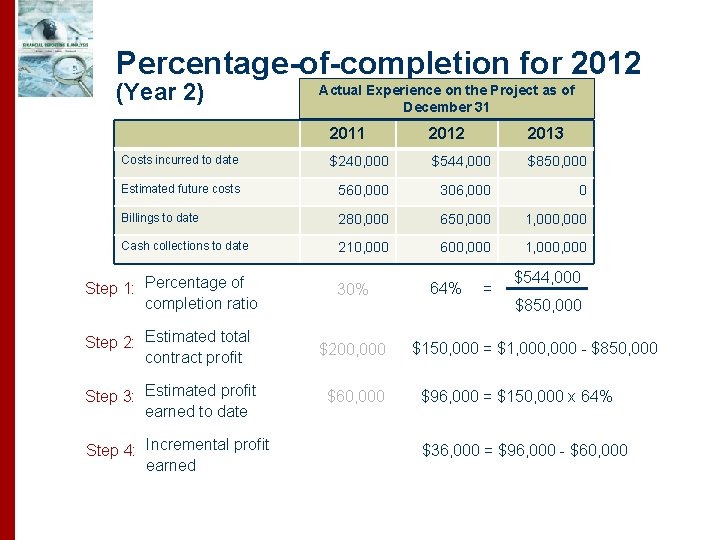
Percentage-of-completion for 2012 (Year 2) Actual Experience on the Project as of December 31 2012 2013 Costs incurred to date $240, 000 $544, 000 $850, 000 Estimated future costs 560, 000 306, 000 0 Billings to date 280, 000 650, 000 1, 000 Cash collections to date 210, 000 600, 000 1, 000 Step 1: Percentage of completion ratio 30% Step 2: Estimated total contract profit $200, 000 Step 3: Estimated profit earned to date $60, 000 Step 4: Incremental profit earned 64% = $544, 000 $850, 000 $150, 000 = $1, 000 - $850, 000 $96, 000 = $150, 000 x 64% $36, 000 = $96, 000 - $60, 000
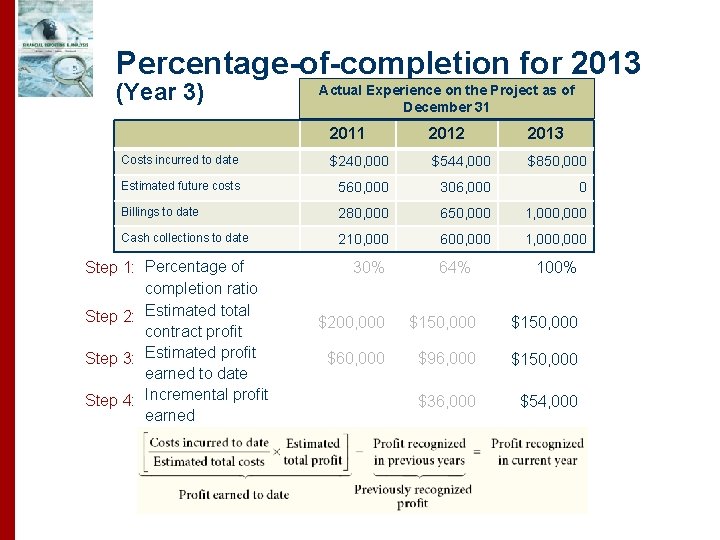
Percentage-of-completion for 2013 (Year 3) Actual Experience on the Project as of December 31 2012 2013 Costs incurred to date $240, 000 $544, 000 $850, 000 Estimated future costs 560, 000 306, 000 0 Billings to date 280, 000 650, 000 1, 000 Cash collections to date 210, 000 600, 000 1, 000 Step 1: Percentage of completion ratio Step 2: Estimated total contract profit Step 3: Estimated profit earned to date Step 4: Incremental profit earned 30% 64% 100% $200, 000 $150, 000 $60, 000 $96, 000 $150, 000 $36, 000 $54, 000
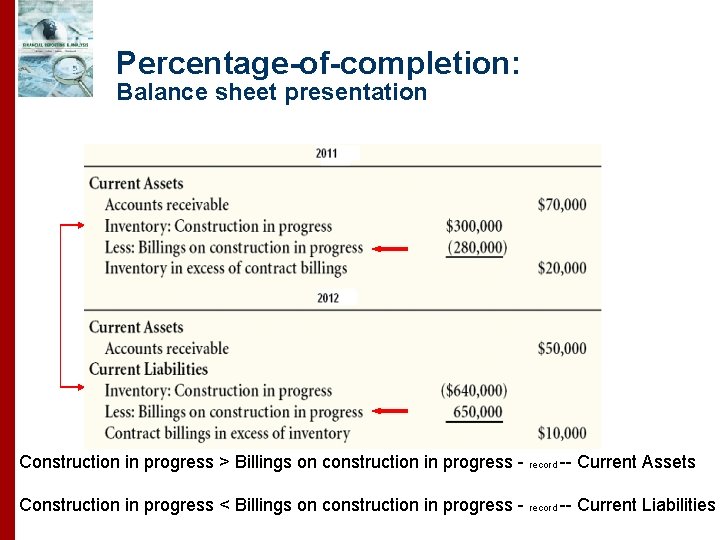
Percentage-of-completion: Balance sheet presentation Construction in progress > Billings on construction in progress - record -- Current Assets Construction in progress < Billings on construction in progress - record -- Current Liabilities
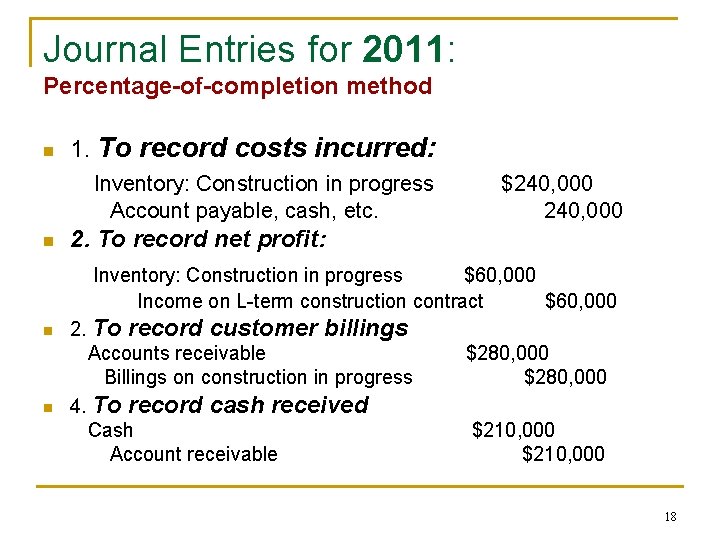
Journal Entries for 2011: Percentage-of-completion method n 1. To record costs incurred: Inventory: Construction in progress Account payable, cash, etc. n $240, 000 2. To record net profit: Inventory: Construction in progress $60, 000 Income on L-term construction contract $60, 000 n n 2. To record customer billings Accounts receivable Billings on construction in progress 4. To record cash received Cash Account receivable $280, 000 $210, 000 18
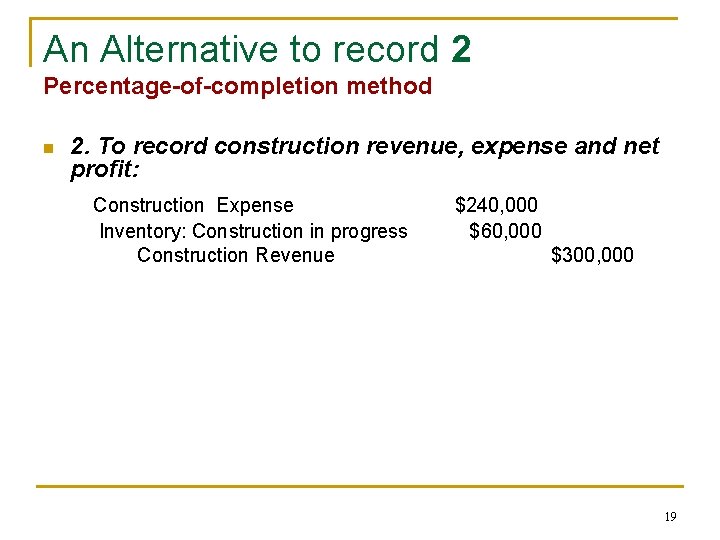
An Alternative to record 2 Percentage-of-completion method n 2. To record construction revenue, expense and net profit: Construction Expense Inventory: Construction in progress Construction Revenue $240, 000 $60, 000 $300, 000 19
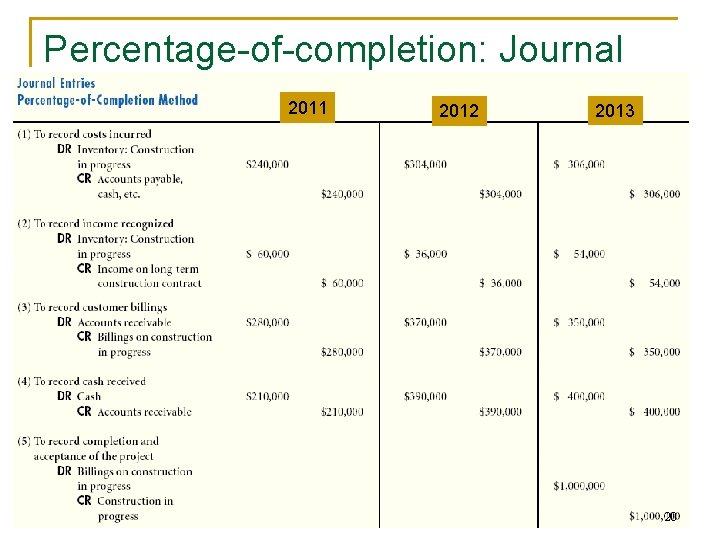
Percentage-of-completion: Journal entries 2011 2012 2013 20
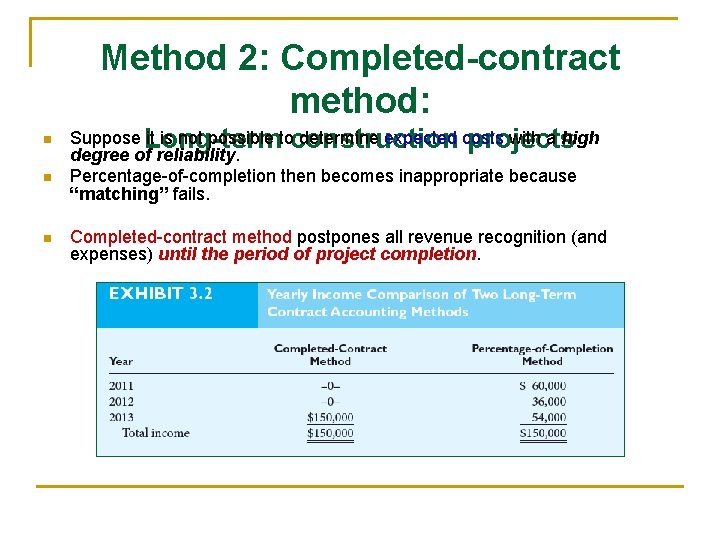
Method 2: Completed-contract method: n n n Suppose Long-term it is not possible toconstruction determine expected costs with a high projects degree of reliability. Percentage-of-completion then becomes inappropriate because “matching” fails. Completed-contract method postpones all revenue recognition (and expenses) until the period of project completion.
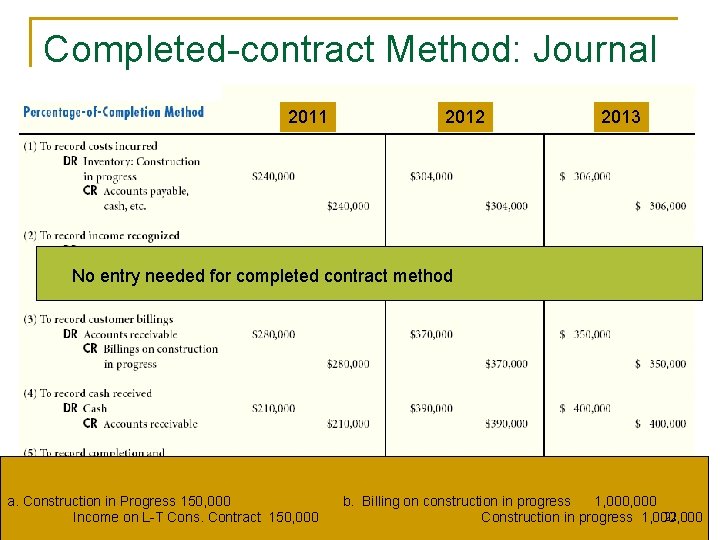
Completed-contract Method: Journal entries 2011 2012 2013 No entry needed for completed contract method a. Construction in Progress 150, 000 Income on L-T Cons. Contract 150, 000 b. Billing on construction in progress 1, 000 22 Construction in progress 1, 000
Loss on an Unprofitable Contract q Under both percentage-ofcompletion and completed-contract methods, the company must recognize in the current period the entire expected contract loss. 23
Learning Objective : On completion of production Prior to Sale: Revenue recognition on Commodities 24
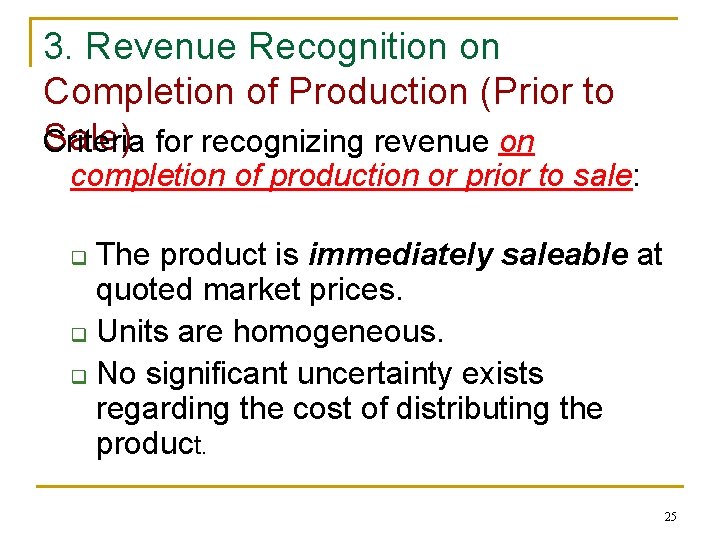
3. Revenue Recognition on Completion of Production (Prior to Sale) Criteria for recognizing revenue on completion of production or prior to sale: The product is immediately saleable at quoted market prices. q Units are homogeneous. q No significant uncertainty exists regarding the cost of distributing the product. q 25
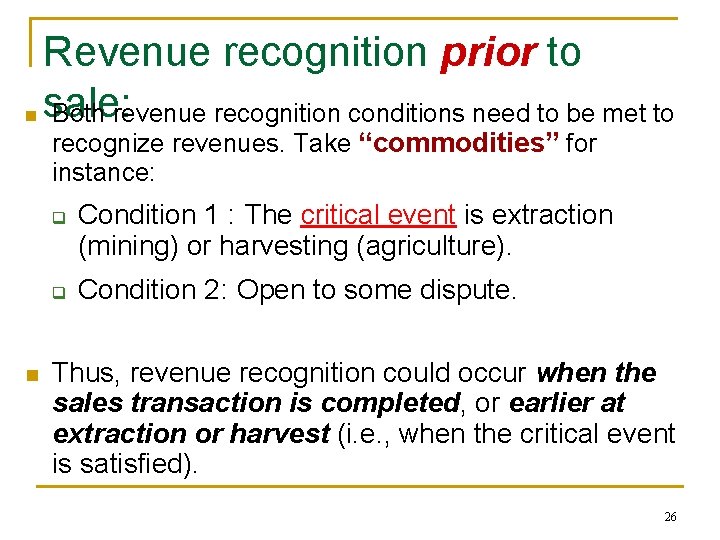
Revenue recognition prior to n sale: Both revenue recognition conditions need to be met to recognize revenues. Take “commodities” for instance: q q n Condition 1 : The critical event is extraction (mining) or harvesting (agriculture). Condition 2: Open to some dispute. Thus, revenue recognition could occur when the sales transaction is completed, or earlier at extraction or harvest (i. e. , when the critical event is satisfied). 26
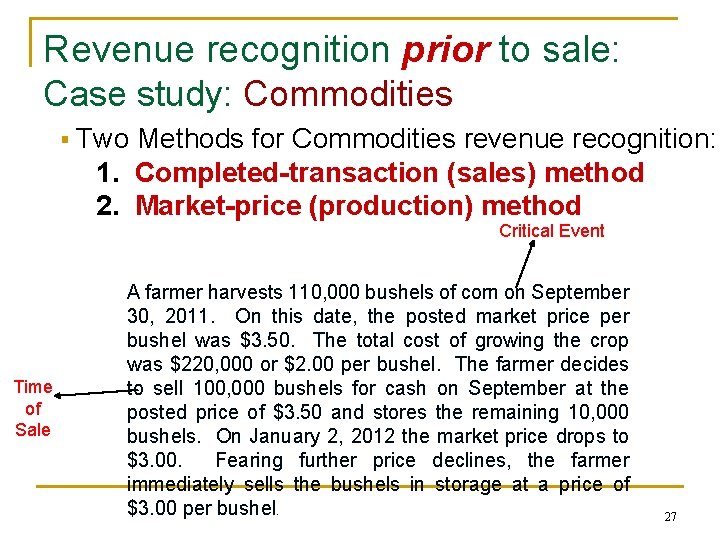
Revenue recognition prior to sale: Case study: Commodities § Two Methods for Commodities revenue recognition: 1. Completed-transaction (sales) method 2. Market-price (production) method Critical Event Time of Sale A farmer harvests 110, 000 bushels of corn on September 30, 2011. On this date, the posted market price per bushel was $3. 50. The total cost of growing the crop was $220, 000 or $2. 00 per bushel. The farmer decides to sell 100, 000 bushels for cash on September at the posted price of $3. 50 and stores the remaining 10, 000 bushels. On January 2, 2012 the market price drops to $3. 00. Fearing further price declines, the farmer immediately sells the bushels in storage at a price of $3. 00 per bushel. 27
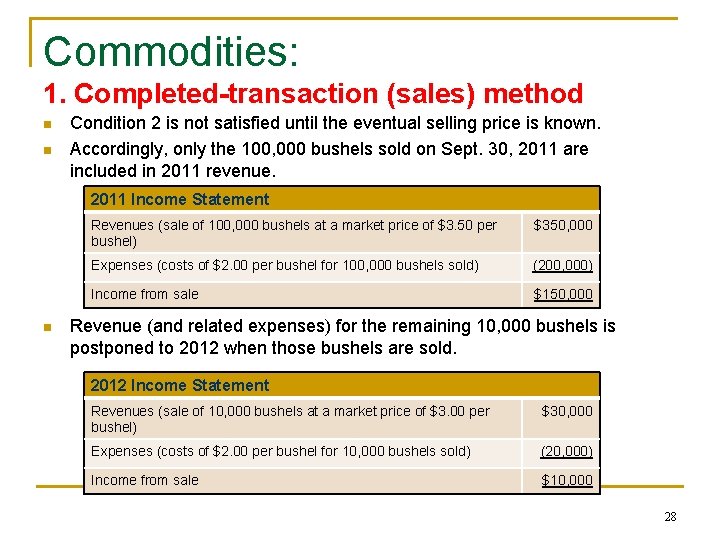
Commodities: 1. Completed-transaction (sales) method n n Condition 2 is not satisfied until the eventual selling price is known. Accordingly, only the 100, 000 bushels sold on Sept. 30, 2011 are included in 2011 revenue. 2011 Income Statement n Revenues (sale of 100, 000 bushels at a market price of $3. 50 per bushel) $350, 000 Expenses (costs of $2. 00 per bushel for 100, 000 bushels sold) (200, 000) Income from sale $150, 000 Revenue (and related expenses) for the remaining 10, 000 bushels is postponed to 2012 when those bushels are sold. 2012 Income Statement Revenues (sale of 10, 000 bushels at a market price of $3. 00 per bushel) $30, 000 Expenses (costs of $2. 00 per bushel for 10, 000 bushels sold) (20, 000) Income from sale $10, 000 28
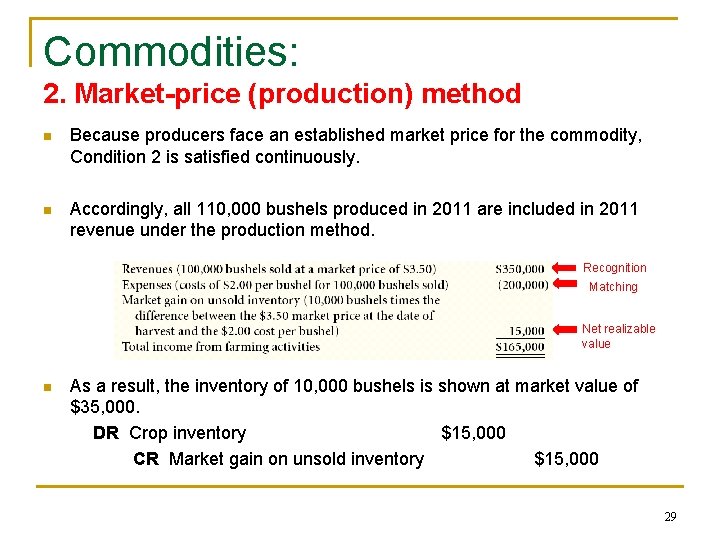
Commodities: 2. Market-price (production) method n Because producers face an established market price for the commodity, Condition 2 is satisfied continuously. n Accordingly, all 110, 000 bushels produced in 2011 are included in 2011 revenue under the production method. Recognition Matching Net realizable value n As a result, the inventory of 10, 000 bushels is shown at market value of $35, 000. DR Crop inventory $15, 000 CR Market gain on unsold inventory $15, 000 29
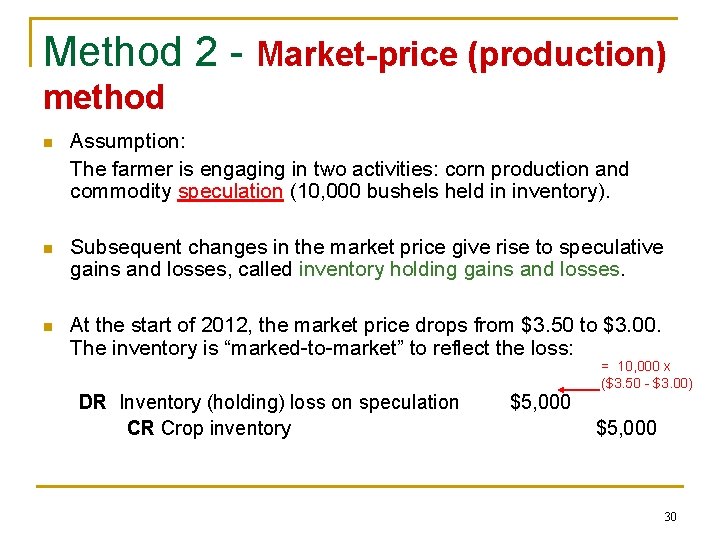
Method 2 - Market-price (production) method n Assumption: The farmer is engaging in two activities: corn production and commodity speculation (10, 000 bushels held in inventory). n Subsequent changes in the market price give rise to speculative gains and losses, called inventory holding gains and losses. n At the start of 2012, the market price drops from $3. 50 to $3. 00. The inventory is “marked-to-market” to reflect the loss: DR Inventory (holding) loss on speculation CR Crop inventory $5, 000 = 10, 000 x ($3. 50 - $3. 00) $5, 000 30
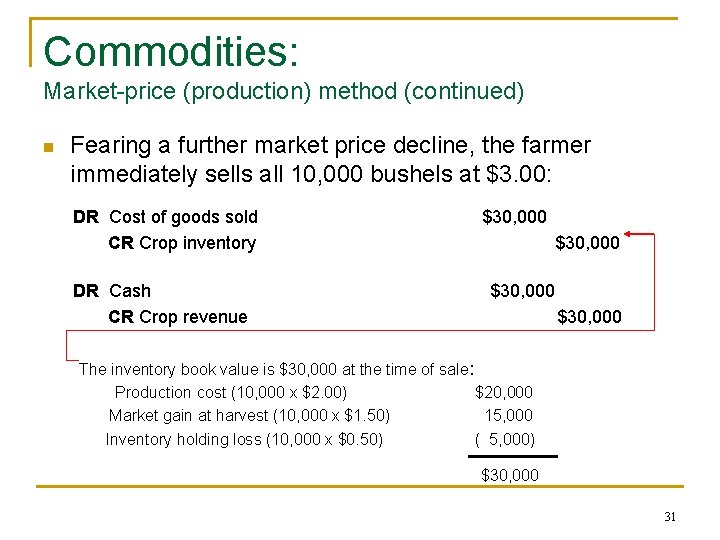
Commodities: Market-price (production) method (continued) n Fearing a further market price decline, the farmer immediately sells all 10, 000 bushels at $3. 00: DR Cost of goods sold CR Crop inventory DR Cash CR Crop revenue $30, 000 The inventory book value is $30, 000 at the time of sale: Production cost (10, 000 x $2. 00) $20, 000 Market gain at harvest (10, 000 x $1. 50) 15, 000 Inventory holding loss (10, 000 x $0. 50) ( 5, 000) $30, 000 31
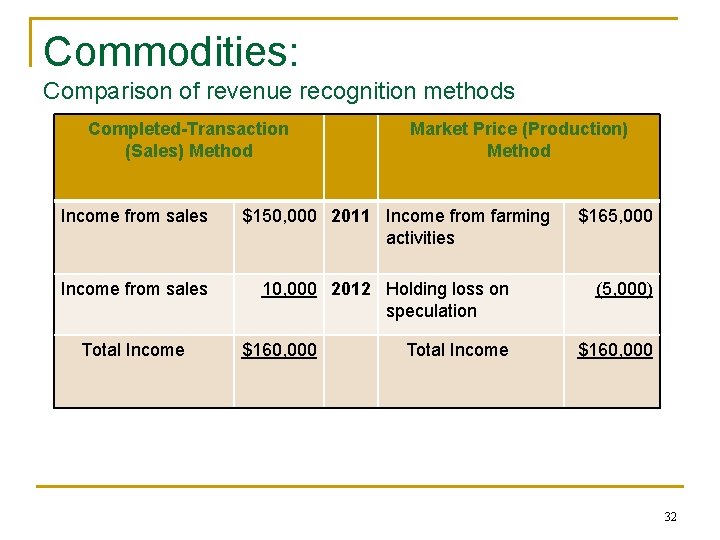
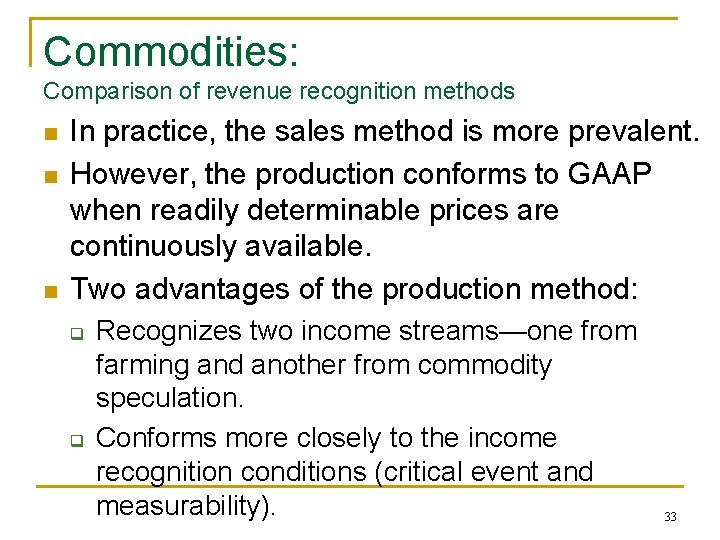
Commodities: Comparison of revenue recognition methods Completed-Transaction (Sales) Method Income from sales Total Income Market Price (Production) Method $150, 000 2011 Income from farming activities 10, 000 2012 Holding loss on speculation $160, 000 Total Income $165, 000 (5, 000) $160, 000 32
Commodities: Comparison of revenue recognition methods n n n In practice, the sales method is more prevalent. However, the production conforms to GAAP when readily determinable prices are continuously available. Two advantages of the production method: q q Recognizes two income streams—one from farming and another from commodity speculation. Conforms more closely to the income recognition conditions (critical event and measurability). 33
Learning Objective : Revenue Recognition After the Sale 34
Revenue recognition after the sale: Method 1: Installment sales method n Sometimes revenue is not recognized at the point of sale even though a valid sale has taken place, because. q q q n Cash collection extends to a long period of time, High risk of not receiving cash from the buyer. No reasonable basis for estimating uncollectible accounts. Conditions 1 and 2 are both satisfied over time as cash collections take place and revenue is recognized as cash is collected. 35
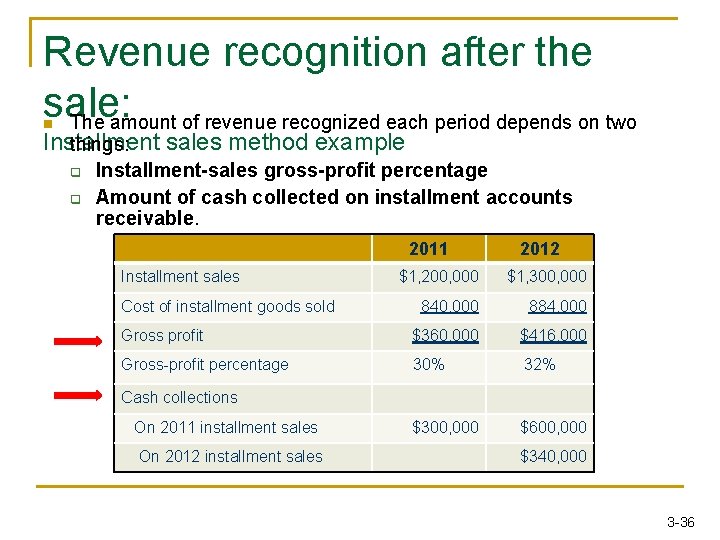
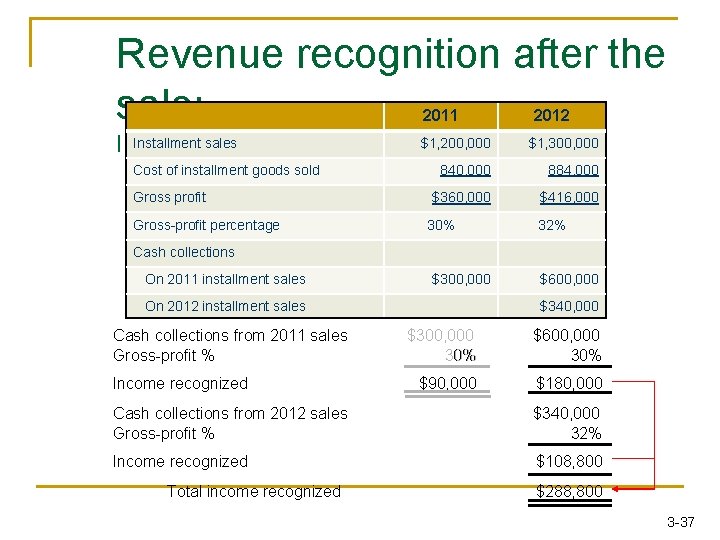
Revenue recognition after the sale: The amount of revenue recognized each period depends on two n Installment sales method example things: q q Installment-sales gross-profit percentage Amount of cash collected on installment accounts receivable. 2011 Installment sales 2012 $1, 200, 000 $1, 300, 000 840, 000 884, 000 Gross profit $360, 000 $416, 000 Gross-profit percentage 30% 32% $300, 000 $600, 000 Cost of installment goods sold Cash collections On 2011 installment sales On 2012 installment sales $340, 000 3 -36
Revenue recognition after the sale: 2011 Installment sales calculations$1, 200, 000 Installment Cost of installment goods sold Gross profit Gross-profit percentage 2012 $1, 300, 000 840, 000 884, 000 $360, 000 $416, 000 30% 32% Cash collections On 2011 installment sales $300, 000 On 2012 installment sales Cash collections from 2011 sales Gross-profit % Income recognized $600, 000 $340, 000 $300, 000 30% $600, 000 30% $90, 000 $180, 000 Cash collections from 2012 sales Gross-profit % $340, 000 32% Income recognized $108, 800 Total income recognized $288, 800 3 -37
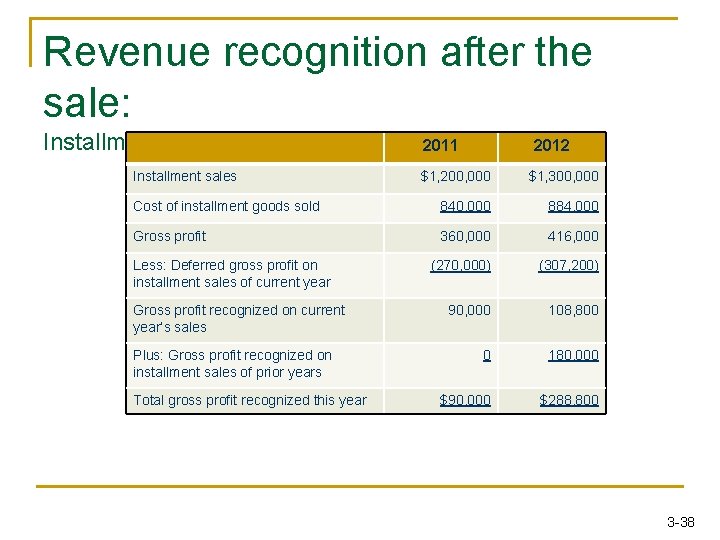
Revenue recognition after the sale: Installment sales income statement 2011 Installment sales 2012 $1, 200, 000 $1, 300, 000 Cost of installment goods sold 840, 000 884, 000 Gross profit 360, 000 416, 000 (270, 000) (307, 200) 90, 000 108, 800 0 180, 000 $90, 000 $288, 800 Less: Deferred gross profit on installment sales of current year Gross profit recognized on current year’s sales Plus: Gross profit recognized on installment sales of prior years Total gross profit recognized this year 3 -38
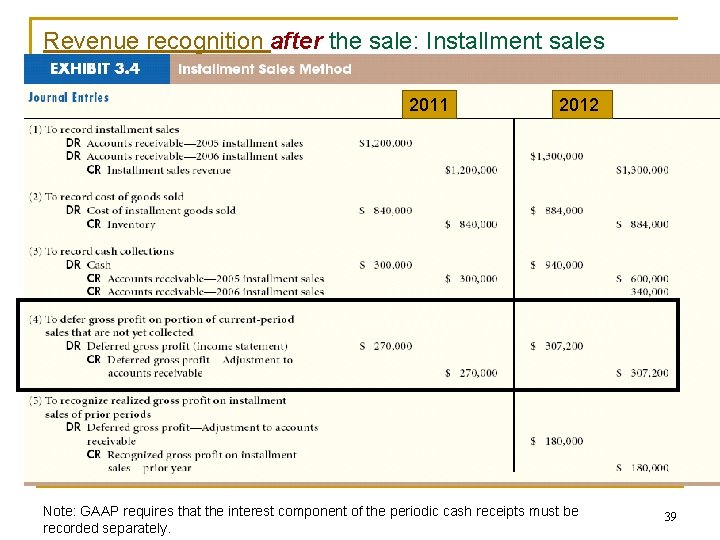
Revenue recognition after the sale: Installment sales journal entries 2011 2012 Note: GAAP requires that the interest component of the periodic cash receipts must be recorded separately. 39
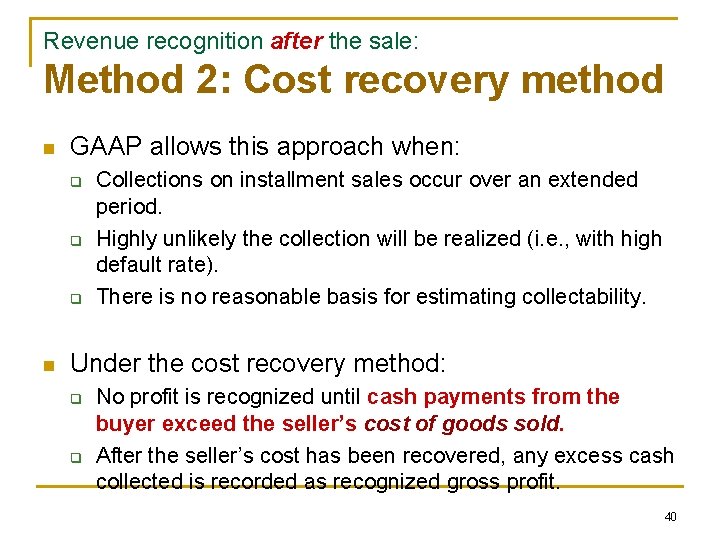
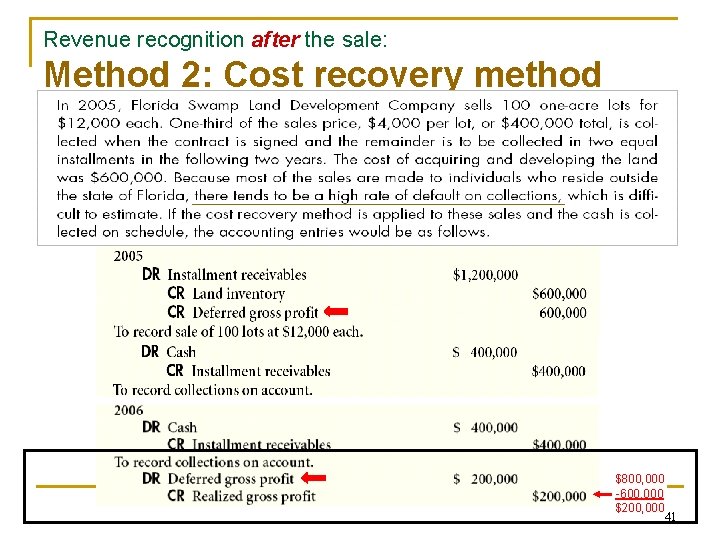
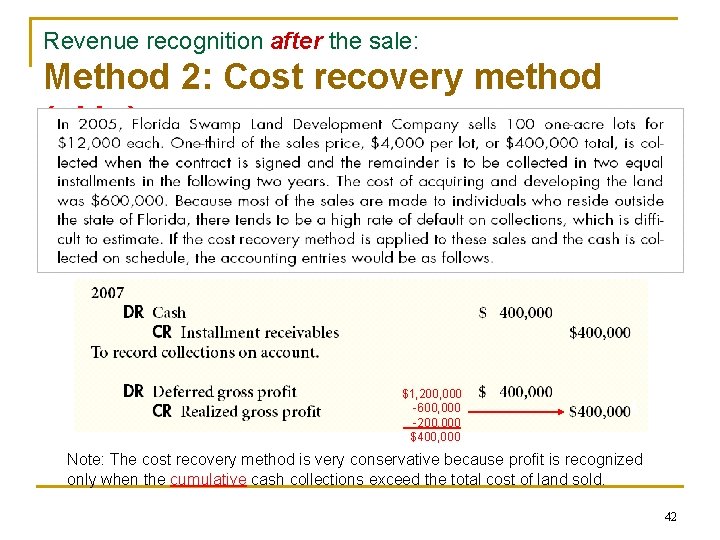
Revenue recognition after the sale: Method 2: Cost recovery method n GAAP allows this approach when: q q q n Collections on installment sales occur over an extended period. Highly unlikely the collection will be realized (i. e. , with high default rate). There is no reasonable basis for estimating collectability. Under the cost recovery method: q q No profit is recognized until cash payments from the buyer exceed the seller’s cost of goods sold. After the seller’s cost has been recovered, any excess cash collected is recorded as recognized gross profit. 40
Revenue recognition after the sale: Method 2: Cost recovery method (skip) $800, 000 -600, 000 $200, 000 41
Revenue recognition after the sale: Method 2: Cost recovery method (skip) $1, 200, 000 -600, 000 -200, 000 $400, 000 Note: The cost recovery method is very conservative because profit is recognized only when the cumulative cash collections exceed the total cost of land sold. 42
Learning Objective : Specialized transactions 1. Franchise sales 2. Sales with Significant Return 3. “bundled” software sales with multiple deliverables 43
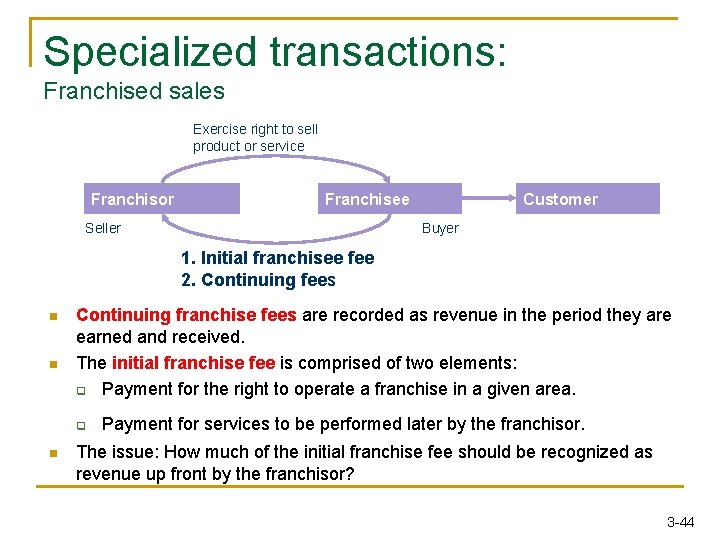
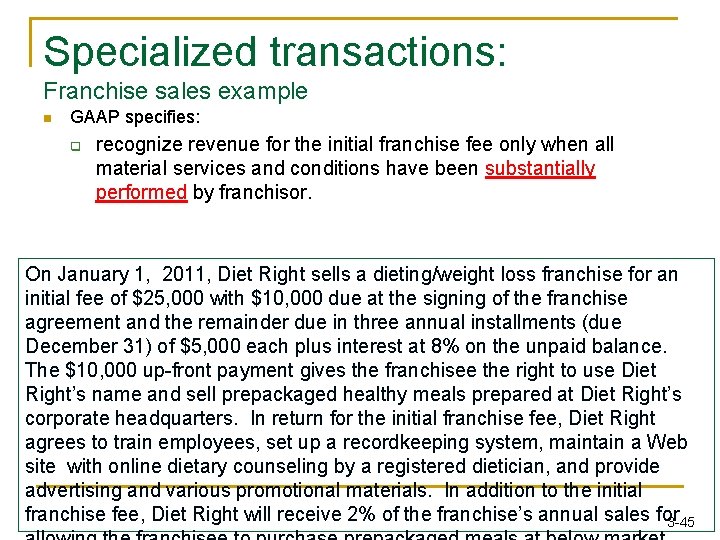
Specialized transactions: Franchised sales Exercise right to sell product or service Franchisor Franchisee Seller Customer Buyer 1. Initial franchisee fee 2. Continuing fees n n Continuing franchise fees are recorded as revenue in the period they are earned and received. The initial franchise fee is comprised of two elements: q Payment for the right to operate a franchise in a given area. q n Payment for services to be performed later by the franchisor. The issue: How much of the initial franchise fee should be recognized as revenue up front by the franchisor? 3 -44
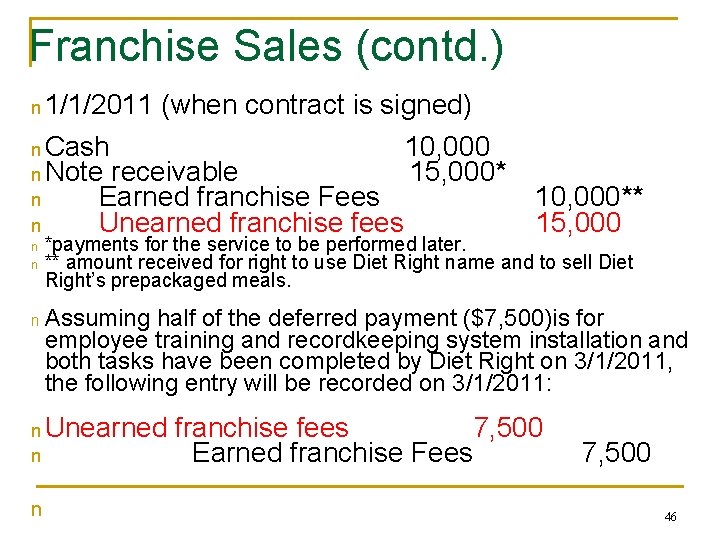
Specialized transactions: Franchise sales example n GAAP specifies: q recognize revenue for the initial franchise fee only when all material services and conditions have been substantially performed by franchisor. On January 1, 2011, Diet Right sells a dieting/weight loss franchise for an initial fee of $25, 000 with $10, 000 due at the signing of the franchise agreement and the remainder due in three annual installments (due December 31) of $5, 000 each plus interest at 8% on the unpaid balance. The $10, 000 up-front payment gives the franchisee the right to use Diet Right’s name and sell prepackaged healthy meals prepared at Diet Right’s corporate headquarters. In return for the initial franchise fee, Diet Right agrees to train employees, set up a recordkeeping system, maintain a Web site with online dietary counseling by a registered dietician, and provide advertising and various promotional materials. In addition to the initial franchise fee, Diet Right will receive 2% of the franchise’s annual sales for 3 -45
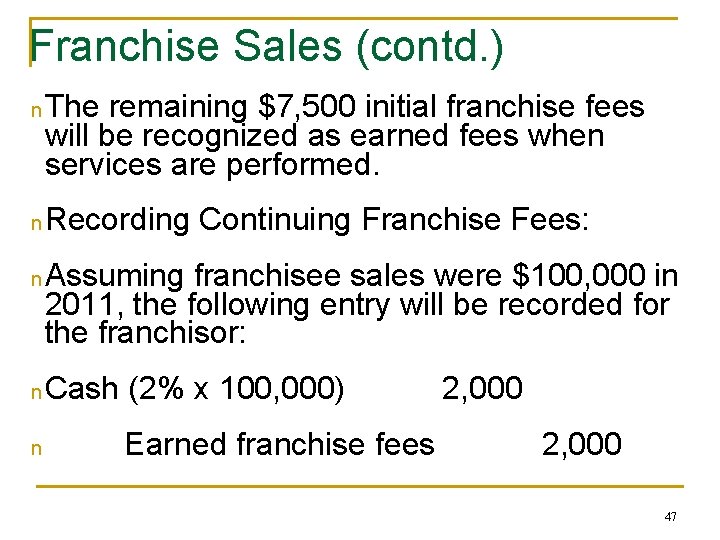
Franchise Sales (contd. ) n 1/1/2011 (when contract is signed) n Cash 10, 000 n Note receivable 15, 000* n Earned franchise Fees n Unearned franchise fees n n 10, 000** 15, 000 *payments for the service to be performed later. ** amount received for right to use Diet Right name and to sell Diet Right’s prepackaged meals. n Assuming half of the deferred payment ($7, 500)is for employee training and recordkeeping system installation and both tasks have been completed by Diet Right on 3/1/2011, the following entry will be recorded on 3/1/2011: n Unearned n n franchise fees 7, 500 Earned franchise Fees 7, 500 46
Franchise Sales (contd. ) n The remaining $7, 500 initial franchise fees will be recognized as earned fees when services are performed. n Recording Continuing Franchise Fees: n Assuming franchisee sales were $100, 000 in 2011, the following entry will be recorded for the franchisor: n Cash (2% x 100, 000) n Earned franchise fees 2, 000 47
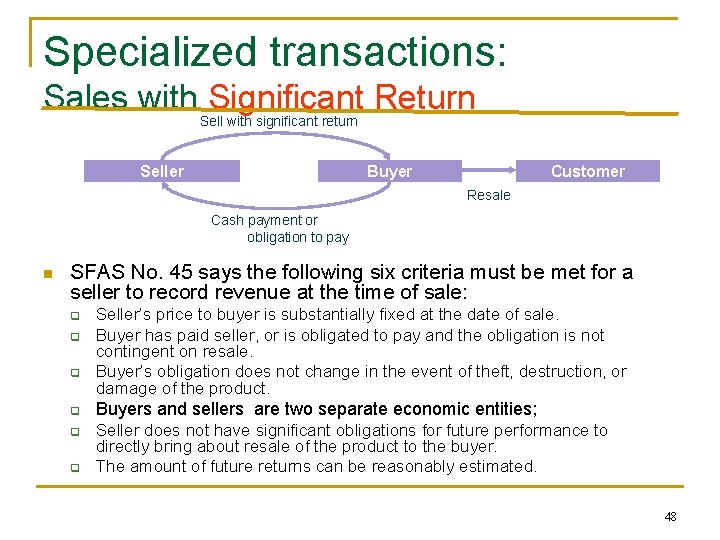
Specialized transactions: Sales with Significant Return Sell with significant return Seller Buyer Customer Resale Cash payment or obligation to pay n SFAS No. 45 says the following six criteria must be met for a seller to record revenue at the time of sale: q q q Seller’s price to buyer is substantially fixed at the date of sale. Buyer has paid seller, or is obligated to pay and the obligation is not contingent on resale. Buyer’s obligation does not change in the event of theft, destruction, or damage of the product. Buyers and sellers are two separate economic entities; Seller does not have significant obligations for future performance to directly bring about resale of the product to the buyer. The amount of future returns can be reasonably estimated. 48
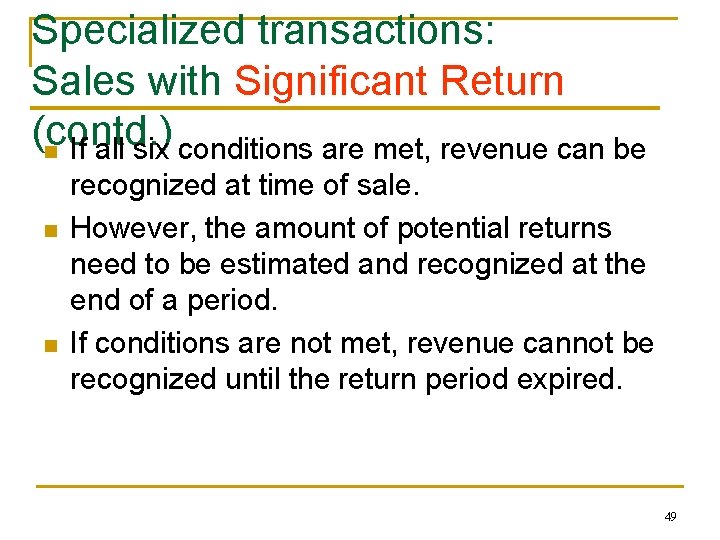
Specialized transactions: Sales with Significant Return (contd. ) n If all six conditions are met, revenue can be n n recognized at time of sale. However, the amount of potential returns need to be estimated and recognized at the end of a period. If conditions are not met, revenue cannot be recognized until the return period expired. 49
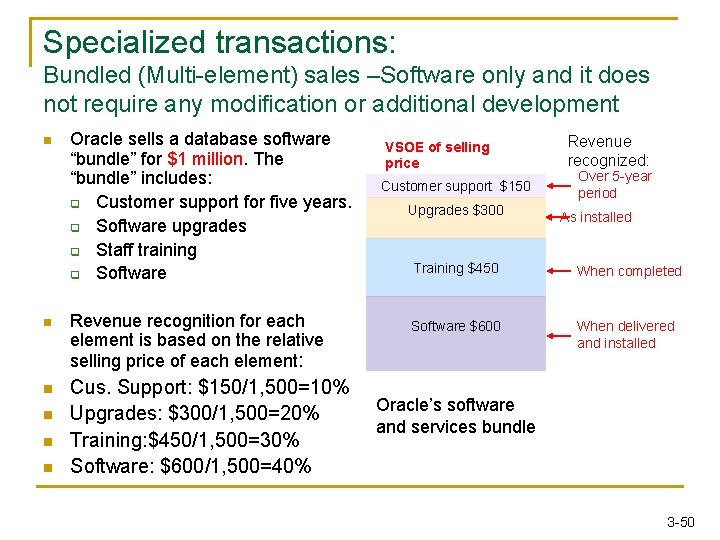
Specialized transactions: Bundled (Multi-element) sales –Software only and it does not require any modification or additional development n Oracle sells a database software “bundle” for $1 million. The “bundle” includes: q Customer support for five years. q Software upgrades q Staff training q Software n Revenue recognition for each element is based on the relative selling price of each element: n Cus. Support: $150/1, 500=10% Upgrades: $300/1, 500=20% Training: $450/1, 500=30% Software: $600/1, 500=40% n n n VSOE of selling price Customer support $150 Upgrades $300 Revenue recognized: Over 5 -year period As installed Training $450 When completed Software $600 When delivered and installed Oracle’s software and services bundle 3 -50
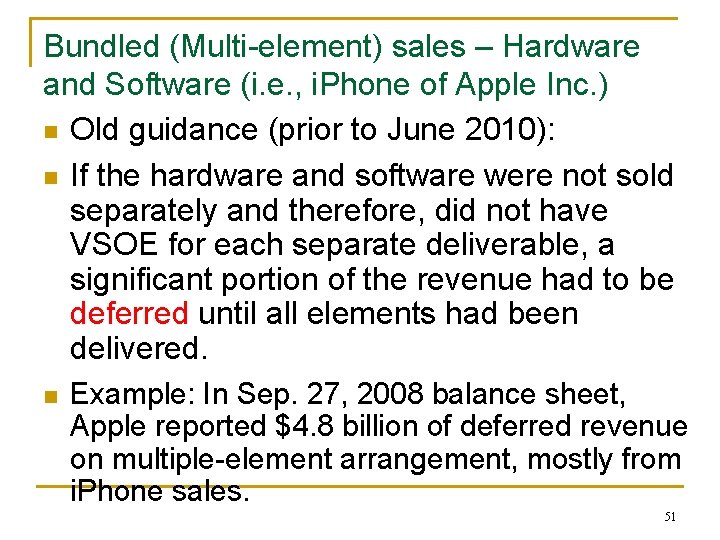
Bundled (Multi-element) sales – Hardware and Software (i. e. , i. Phone of Apple Inc. ) n Old guidance (prior to June 2010): n If the hardware and software were not sold separately and therefore, did not have VSOE for each separate deliverable, a significant portion of the revenue had to be deferred until all elements had been delivered. n Example: In Sep. 27, 2008 balance sheet, Apple reported $4. 8 billion of deferred revenue on multiple-element arrangement, mostly from i. Phone sales. 51
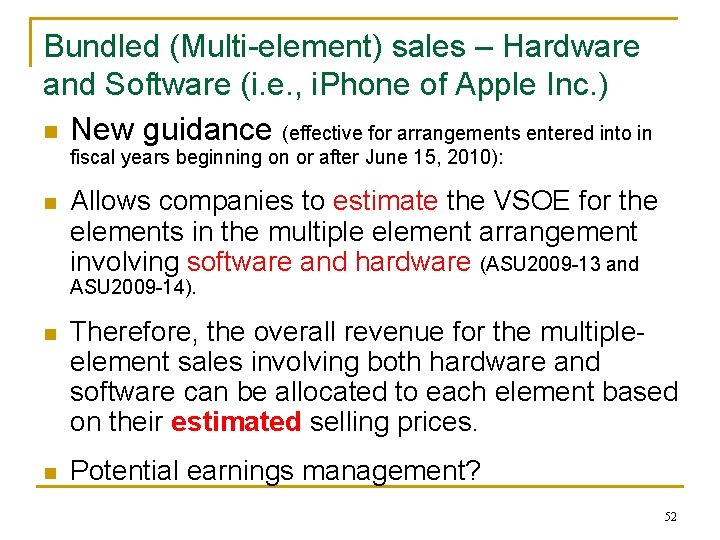
Bundled (Multi-element) sales – Hardware and Software (i. e. , i. Phone of Apple Inc. ) n New guidance (effective for arrangements entered into in fiscal years beginning on or after June 15, 2010): n Allows companies to estimate the VSOE for the elements in the multiple element arrangement involving software and hardware (ASU 2009 -13 and ASU 2009 -14). n Therefore, the overall revenue for the multipleelement sales involving both hardware and software can be allocated to each element based on their estimated selling prices. n Potential earnings management? 52
Learning Objective : Earnings Mangement 53
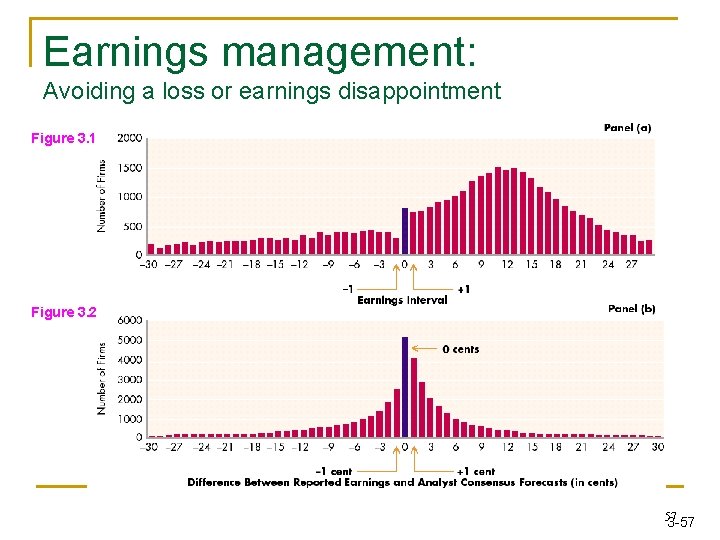
Earnings management n Earnings management is: “earnings reported reflect the desires of management rather than the underlying financial performance of the firm”. - Arthur Levitt, the former SEC chairman 54
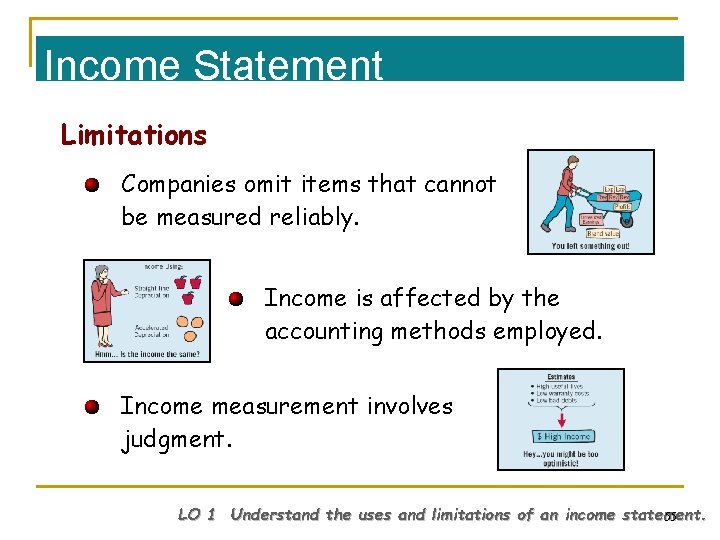
Income Statement Limitations Companies omit items that cannot be measured reliably. Income is affected by the accounting methods employed. Income measurement involves judgment. LO 1 Understand the uses and limitations of an income statement. 55
Why Can Earnings be Managed? n Determining when revenue has been earned (critical event) and is realized (measurability)— the two revenue recognition conditions—often requires management judgment. n Managers can sometimes exploit the flexibility in GAAP to manipulate reported earnings in ways that mask the company’s underlying economic performance. n Some managers have achieved earnings management by financial frauds (that’s illegal). 56
Earnings management: Avoiding a loss or earnings disappointment Figure 3. 1 Figure 3. 2 57 3 -57
n n Popular Earnings Management Devices “Big bath” restructuring charges: Excessive restructuring write-offs that overstate estimated charges for future expenditures. Why are companies tempted to overstate restructuring charges? Creative acquisition accounting: Abuses linked to purchased “in-process R&D” that SFAS No. 2 requires to be expensed at the date of acquisition. 58
Popular Earnings Management Devices n “Cookie jar reserves” for bad debts, loan losses, warranties and other accruals: q q n Reserve more in good times and cut reverse previous charges, in bad times. A convenient income smoothing device. Intentional errors deemed to be “immaterial” and intentional bias in estimates. 59
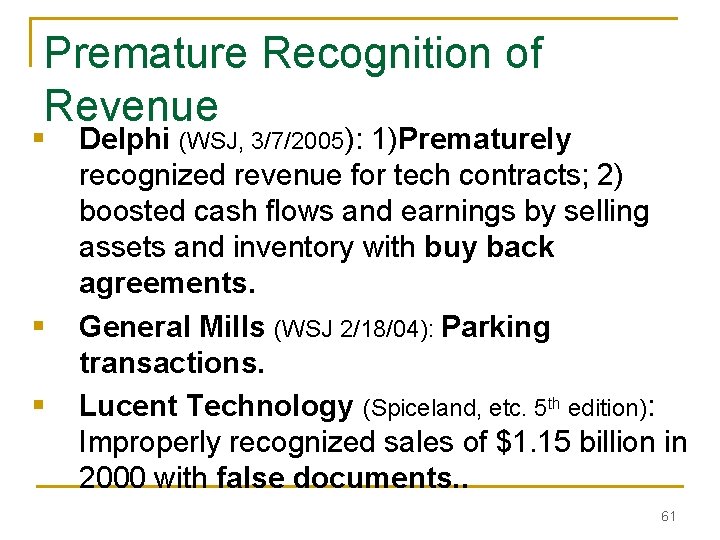
Popular Earnings Management Devices (contd. ) § Income shifting including: ØPremature or aggressive revenue recognition (i. e. , Delphi, General Mills, and Lucent Technology) ØDelay recognition of expenses (i. e. , World. Com and AOL). 60
Premature Recognition of Revenue § § § Delphi (WSJ, 3/7/2005): 1)Prematurely recognized revenue for tech contracts; 2) boosted cash flows and earnings by selling assets and inventory with buy back agreements. General Mills (WSJ 2/18/04): Parking transactions. Lucent Technology (Spiceland, etc. 5 th edition): Improperly recognized sales of $1. 15 billion in 2000 with false documents. . 61
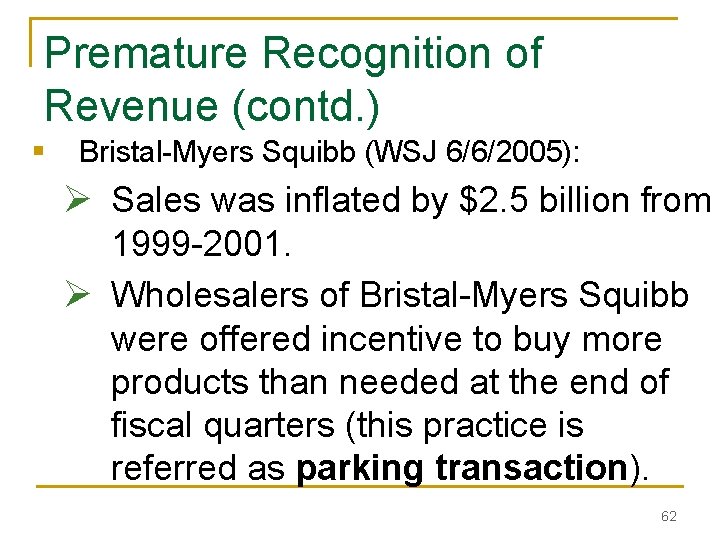
Premature Recognition of Revenue (contd. ) § Bristal-Myers Squibb (WSJ 6/6/2005): Ø Sales was inflated by $2. 5 billion from 1999 -2001. Ø Wholesalers of Bristal-Myers Squibb were offered incentive to buy more products than needed at the end of fiscal quarters (this practice is referred as parking transaction). 62
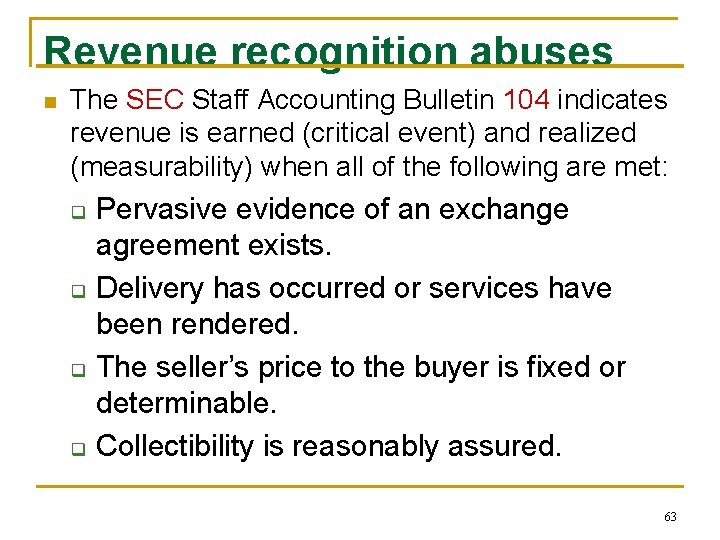
Revenue recognition abuses n The SEC Staff Accounting Bulletin 104 indicates revenue is earned (critical event) and realized (measurability) when all of the following are met: q q Pervasive evidence of an exchange agreement exists. Delivery has occurred or services have been rendered. The seller’s price to the buyer is fixed or determinable. Collectibility is reasonably assured. 63
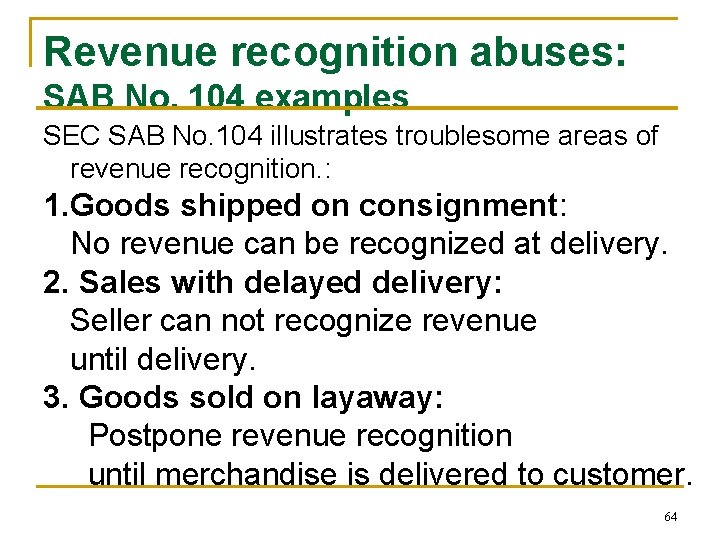
Revenue recognition abuses: SAB No. 104 examples SEC SAB No. 104 illustrates troublesome areas of revenue recognition. : 1. Goods shipped on consignment: No revenue can be recognized at delivery. 2. Sales with delayed delivery: Seller can not recognize revenue until delivery. 3. Goods sold on layaway: Postpone revenue recognition until merchandise is delivered to customer. 64
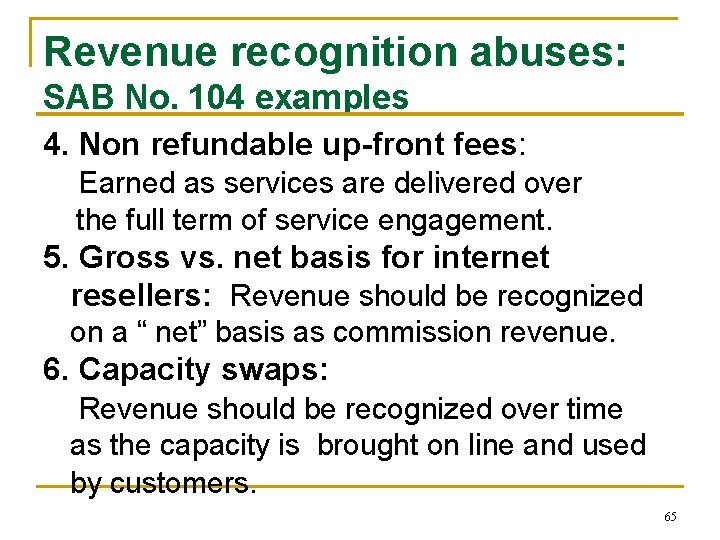
Revenue recognition abuses: SAB No. 104 examples 4. Non refundable up-front fees: Earned as services are delivered over the full term of service engagement. 5. Gross vs. net basis for internet resellers: Revenue should be recognized on a “ net” basis as commission revenue. 6. Capacity swaps: Revenue should be recognized over time as the capacity is brought on line and used by customers. 65
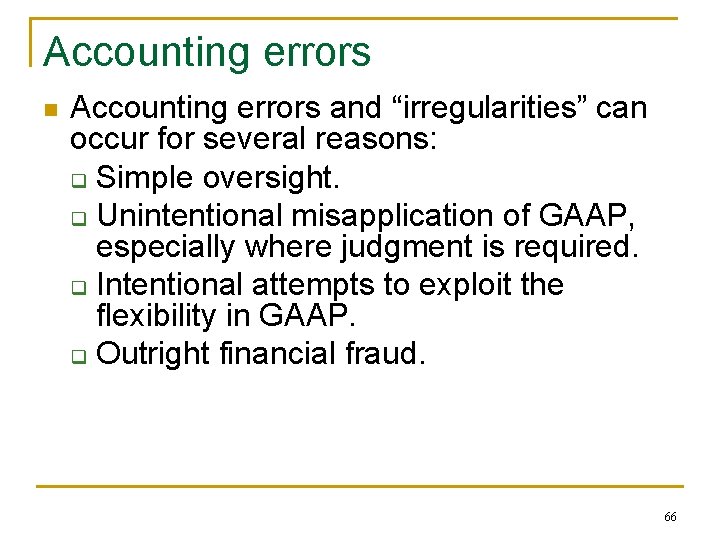
Accounting errors n Accounting errors and “irregularities” can occur for several reasons: q Simple oversight. q Unintentional misapplication of GAAP, especially where judgment is required. q Intentional attempts to exploit the flexibility in GAAP. q Outright financial fraud. 66
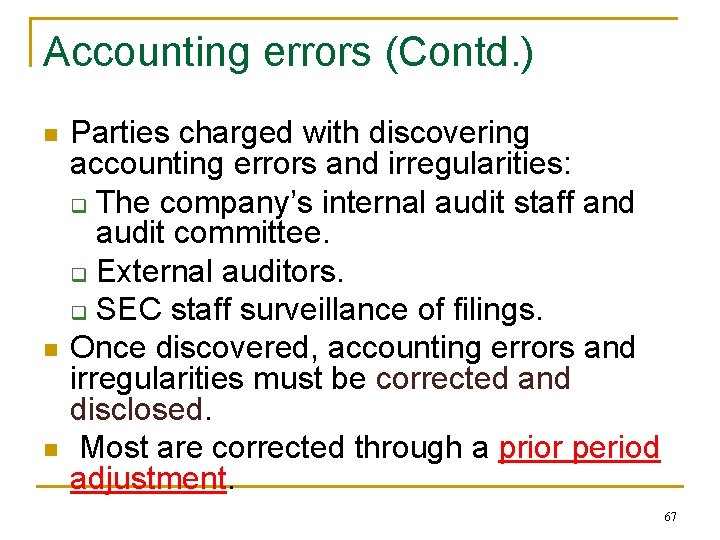
Accounting errors (Contd. ) n n n Parties charged with discovering accounting errors and irregularities: q The company’s internal audit staff and audit committee. q External auditors. q SEC staff surveillance of filings. Once discovered, accounting errors and irregularities must be corrected and disclosed. Most are corrected through a prior period adjustment. 67
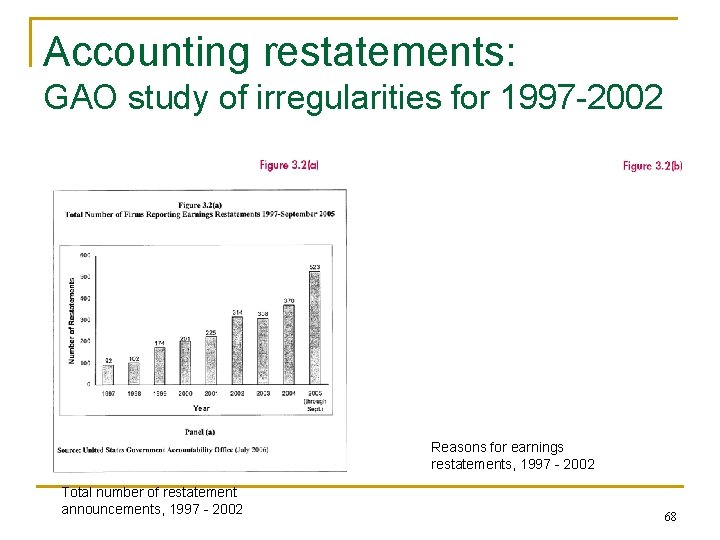
Accounting restatements: GAO study of irregularities for 1997 -2002 Reasons for earnings restatements, 1997 - 2002 Total number of restatement announcements, 1997 - 2002 68
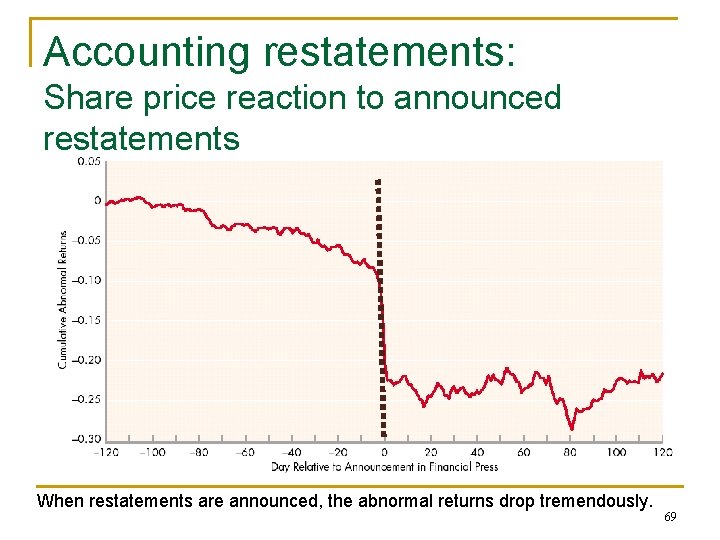
Accounting restatements: Share price reaction to announced restatements When restatements are announced, the abnormal returns drop tremendously. 69
Accounting restatement disclosures: An example 70
Global Vantage Point n IFRS and U. S. GAAP rules for revenue recognition and measurement largely overlap, although the U. S. GAAP standards are much more detailed.
IFRS Revenue Recognition and Measurement n International Accounting Standard (IAS) 18 requires that the following two conditions be met before an entity can recognize revenue on the sale of goods: q q The seller has transferred significant risks and rewards of ownership of the goods to the buyer The seller retains neither continuing management involvement associated with ownership nor effective control of the goods being sold 72
Global Vantage Point n Differences between IFRS and U. S. GAAP are in two areas q Long-term construction contracts q Installment sales method of accounting
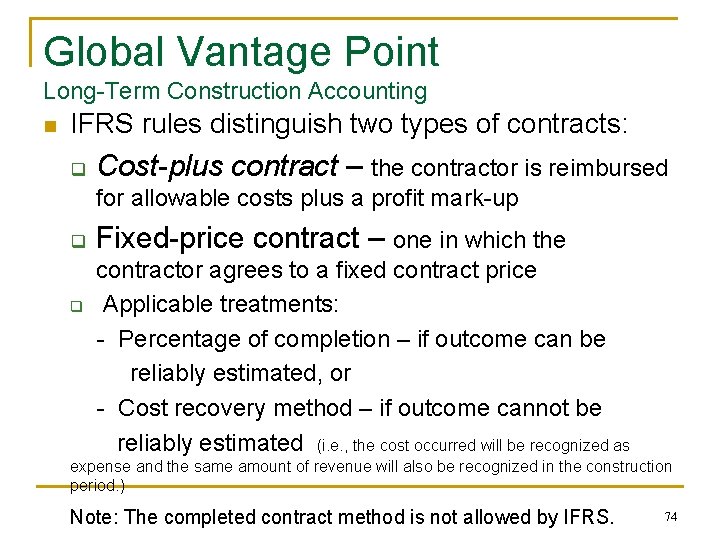
Global Vantage Point Long-Term Construction Accounting n IFRS rules distinguish two types of contracts: q Cost-plus contract – the contractor is reimbursed for allowable costs plus a profit mark-up q q Fixed-price contract – one in which the contractor agrees to a fixed contract price Applicable treatments: - Percentage of completion – if outcome can be reliably estimated, or - Cost recovery method – if outcome cannot be reliably estimated (i. e. , the cost occurred will be recognized as expense and the same amount of revenue will also be recognized in the construction period. ) Note: The completed contract method is not allowed by IFRS. 74
Global Vantage Point Installment Sales Method n n IRFS rules do not permit entities to use the installment sales method, the cost recovery method is required. As installment receivables are collected, cost recovery takes place equal to the amount of cash collected that period. Revenues and expenses would be recognized equal to the amount of cash collected each period up to the point where costs have been fully recovered. Only after the cumulative amount of cash collected exceeds the cost of the installment sale 75
Summary n n n The “critical event” and “measurability” conditions for revenue recognition are typically satisfied at the point of sale. There are circumstances—long-term construction contracts, production of natural resources and agricultural commodities—where it is appropriate to recognize revenue prior to the sale. There also circumstances where revenue recognition may be delayed until after the sale— installment sales and cost recovery methods: q There is considerable uncertainty about collectibility. q There are significant costs that will be incurred after the sale that are difficult to predict. 76
Summary concluded n n Franchise sales, sales with right of return, and bundled (multielement) sales pose challenging revenue recognition issues. Management can sometimes exploit the flexibility in GAAP revenue recognition rules to hide or misrepresent economic performance. Once discovered, accounting errors and irregularities must be corrected and disclosed. Most are corrected through a prior period adjustment. IFRS and U. S. GAAP rules for revenue recognition largely overlap but important differences exist for long-term construction contracts and installment sales. 77 3 -77