
Chapter 3 Accruals and Deferrals Agenda t t


- Slides: 48
Chapter 3: Accruals and Deferrals Agenda t t t Accrual Accounting Accrued Revenue Accrued Expenses Deferred Revenue Deferred Expenses
Agenda t Accrual Accounting
More About Accruals Accrual Accounting: Recording the financial transactions of a business in the period in which they occur, rather than in the period in which cash is exchanged. The economic substance of the transaction signals the recording…not disbursing or receiving cash.
Examples of Accrual Events t t t Sales made “on account” Purchases made “on credit” Wages expense for employees vwhen they’ve worked but you haven’t yet paid them Interest on money borrowed or lent vwhen time has passed (so interest has been earned by the lender) but the actual cash for the interest has not changed hands Income tax expense vwhen you owe it but haven’t yet paid
Examples of Accrual Events t Prepaid Rent / Insurance Supplies t Deprecations t Unearned Revenue t
Accounts Receivable: Amounts owed by customers for goods and services received t Recognition of event versus realization of cash urecognizing a revenue or expense means to record it in the accounting records so that it shows up on the income statement t When is revenue recognized? uwhen the amounts are earned (required activities are complete)
Accounts Payable: Amounts you owe creditors for the purchase of goods and services When are costs recognized as expenses? u when the “matching” revenue is recognized, or u when the benefits of the expenditures are received INVOICE
Accruals that need to be made before the financial statements are prepared --adjustments to the 1. “books” Any revenue earned that has not been 2. 3. 4. billed (no receivable has been recorded) Any interest revenue that has been earned on investments that has not been recorded Any expense that has been incurred (used) but has not been recorded (a common one is salary expense) Income tax expense incurred but not recorded
Agenda t Accrued Revenue
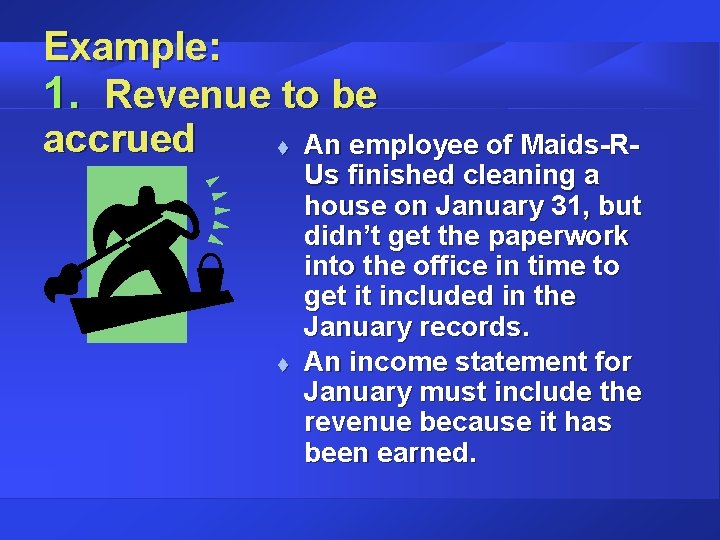
Example: 1. Revenue to be accrued t An employee of Maids-R- t Us finished cleaning a house on January 31, but didn’t get the paperwork into the office in time to get it included in the January records. An income statement for January must include the revenue because it has been earned.
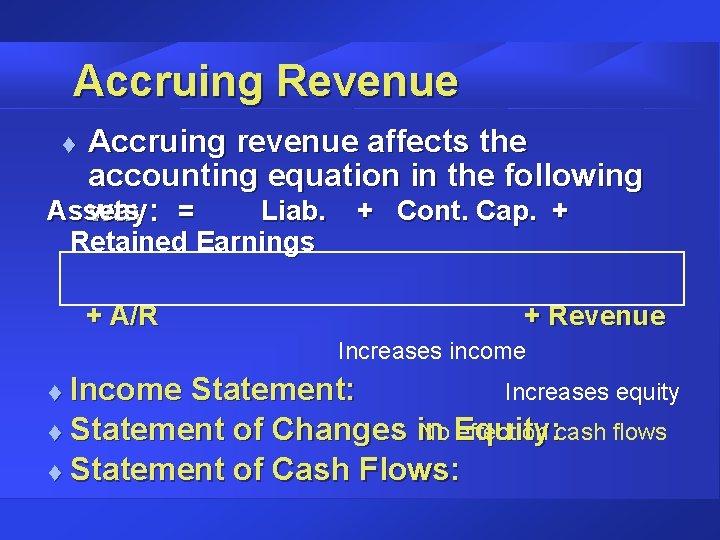
Accruing Revenue Accruing revenue affects the accounting equation in the following Assets Liab. + Cont. Cap. + way: = t Retained Earnings + A/R + Revenue Increases income Increases equity Income Statement: t Statement of Changes in No Equity: effect on cash flows t Statement of Cash Flows: t
What happens when the customer pays? t t When the customer pays, the accounting equation is affected on the asset side only. u. A/R is decreased by the amount of the payment u. Cash is increased by the amount of the payment The revenue has
2. Accruing Interest (Revenue or expense) t The most common accrual is for interest--the cost of borrowing money. u. If you loaned the money or purchased a CD, you’d be dealing with interest revenue. u. If you borrowed the money, you’d be dealing with interest expense.
Interest Revenue t t t You have a 6 -month, $100 CD that earns 12%, (always given as an annual rate), purchased on January 1. The natural recording of this interest revenue will happen when you receive the money. An income statement for January needs to show the amount of interest revenue for January.
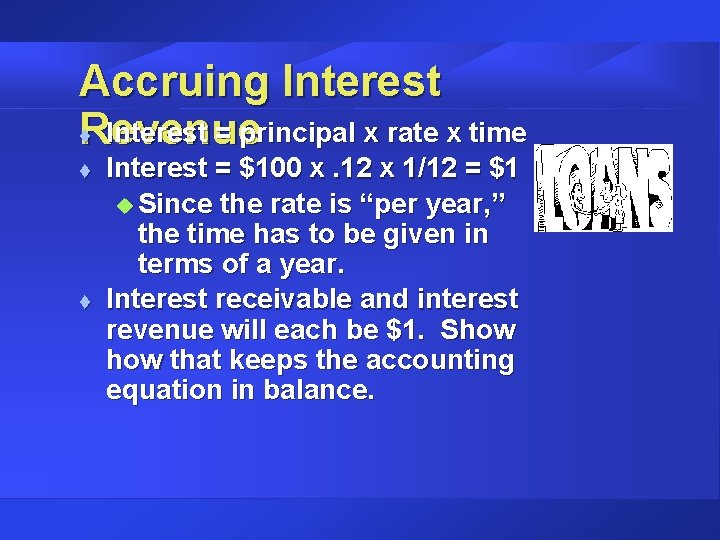
Accruing Interest = principal x rate x time Revenue t t t Interest = $100 x. 12 x 1/12 = $1 u Since the rate is “per year, ” the time has to be given in terms of a year. Interest receivable and interest revenue will each be $1. Show that keeps the accounting equation in balance.
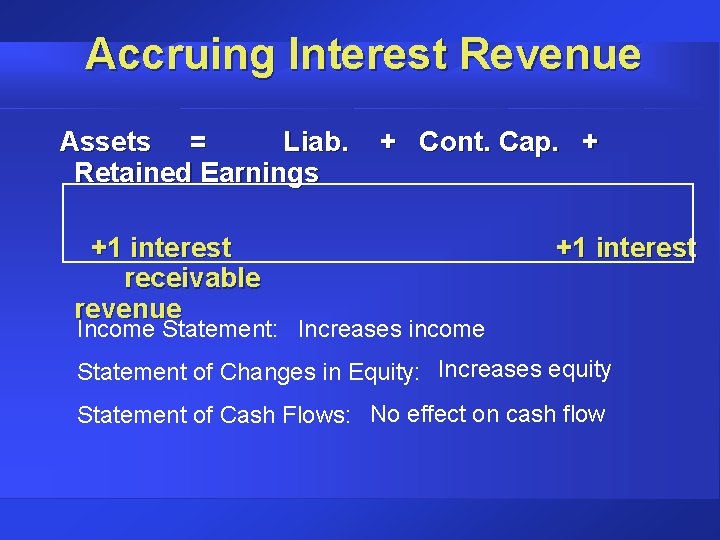
Accruing Interest Revenue Assets = Liab. Retained Earnings +1 interest receivable revenue + Cont. Cap. + +1 interest Income Statement: Increases income Statement of Changes in Equity: Increases equity Statement of Cash Flows: No effect on cash flow
Agenda t Accrued Expenses
Accrued Salaries t t t Salary expense is a common expense that needs to be accrued before financial statements are prepared. Suppose employees work five days per week and are paid every Friday, but January 31 falls on a Tuesday. The salary expense for the week from January 30 to February 3 will not be paid until Friday, February 3.
Accruing Salary Expense t The income statement for January should have the expense for January 30 and 31, while the February income statement will have the expense for February 1, 2, and 3.
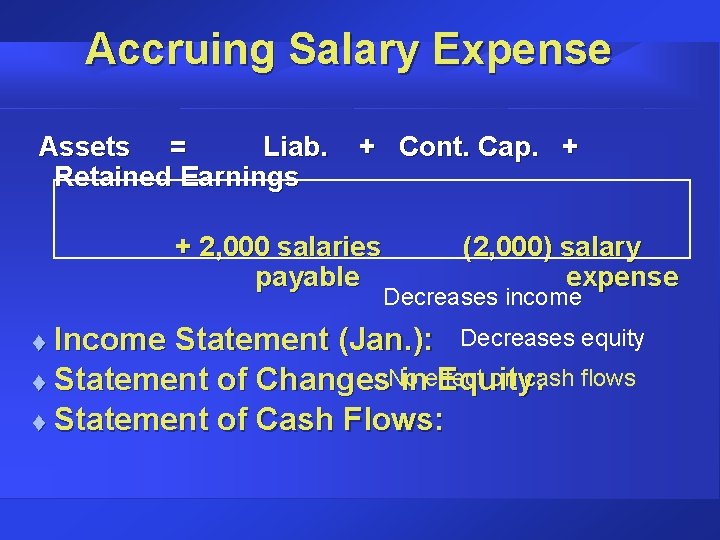
Accruing Salary Expense t t Suppose a week’s payroll is $5, 000. On January 31, the company should accrue $2, 000 worth of salary expense. i. e. , 2 out of 5 days’ worth of the salary must be a January expense. How is this reflected in the accounting equation?
Accruing Salary Expense Assets = Liab. Retained Earnings + Cont. Cap. + + 2, 000 salaries payable (2, 000) salary expense Decreases income Income Statement (Jan. ): Decreases equity on cash flows t Statement of Changes. No ineffect Equity: t Statement of Cash Flows: t
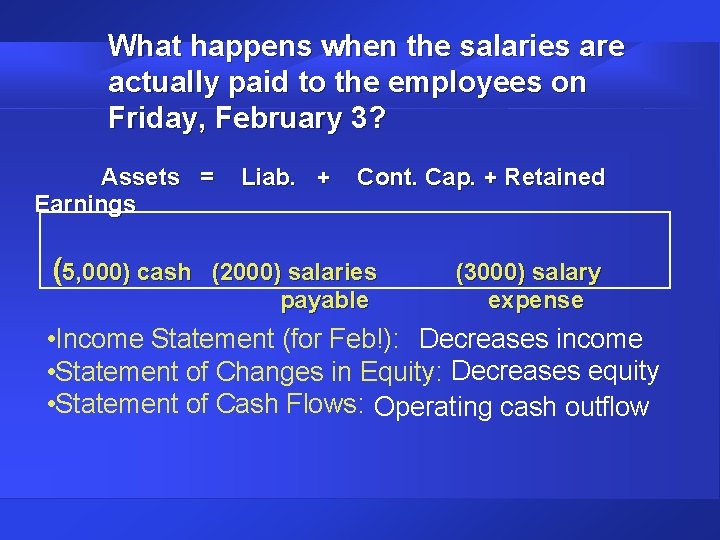
What happens when the salaries are actually paid to the employees on Friday, February 3? Assets = Earnings (5, 000) cash Liab. + Cont. Cap. + Retained (2000) salaries payable (3000) salary expense • Income Statement (for Feb!): Decreases income • Statement of Changes in Equity: Decreases equity • Statement of Cash Flows: Operating cash outflow
Taxes to be accrued t t t Tax expense is a common expense that needs to be accrued when financial statements are prepared. The income statement for January needs to include the income taxes for January, even though they will not be paid until several months later. WHY? ?
Agenda t Deferred Revenue
What is a Deferral? t t A deferral event occurs when cash is received or paid before revenue is earned or an expense is incurred. Deferral events are a part of the accrual basis of accounting
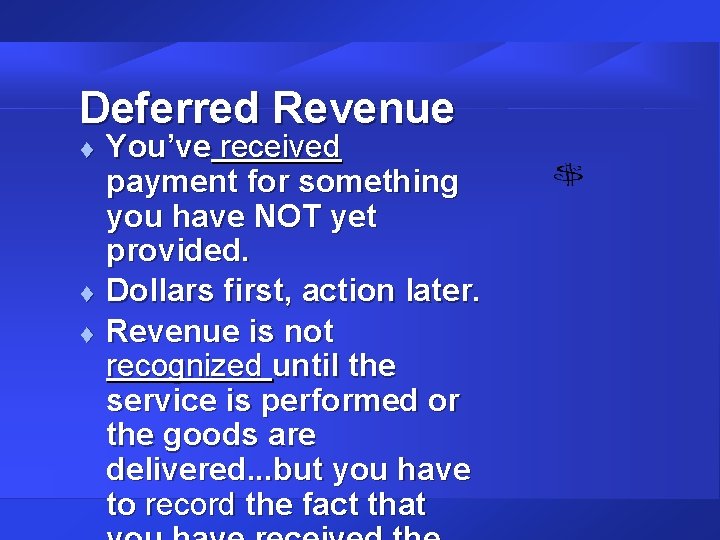
Deferred Revenue t t t You’ve received payment for something you have NOT yet provided. Dollars first, action later. Revenue is not recognized until the service is performed or the goods are delivered. . . but you have to record the fact that
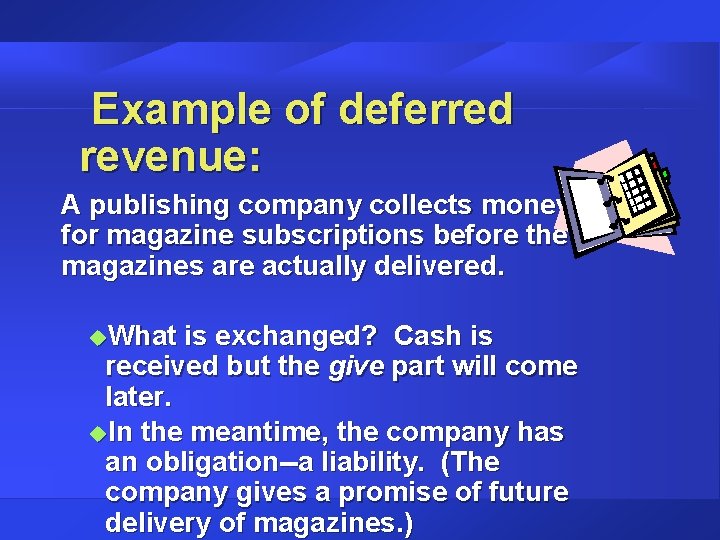
Example of deferred revenue: A publishing company collects money for magazine subscriptions before the magazines are actually delivered. u. What is exchanged? Cash is received but the give part will come later. u. In the meantime, the company has an obligation--a liability. (The company gives a promise of future delivery of magazines. )
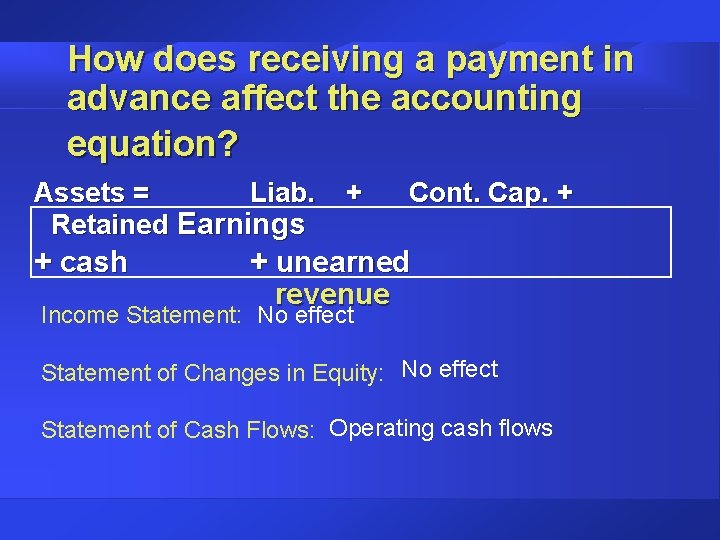
How does receiving a payment in advance affect the accounting equation? Assets = Liab. Retained Earnings + cash + Cont. Cap. + + unearned revenue Income Statement: No effect Statement of Changes in Equity: No effect Statement of Cash Flows: Operating cash flows
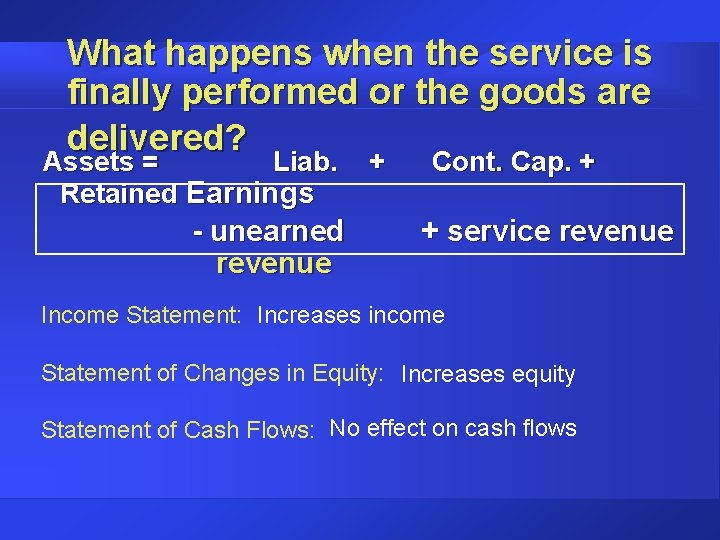
What happens when the service is finally performed or the goods are delivered? Assets = Liab. Retained Earnings - unearned revenue + Cont. Cap. + + service revenue Income Statement: Increases income Statement of Changes in Equity: Increases equity Statement of Cash Flows: No effect on cash flows
Agenda t Deferred Expenses
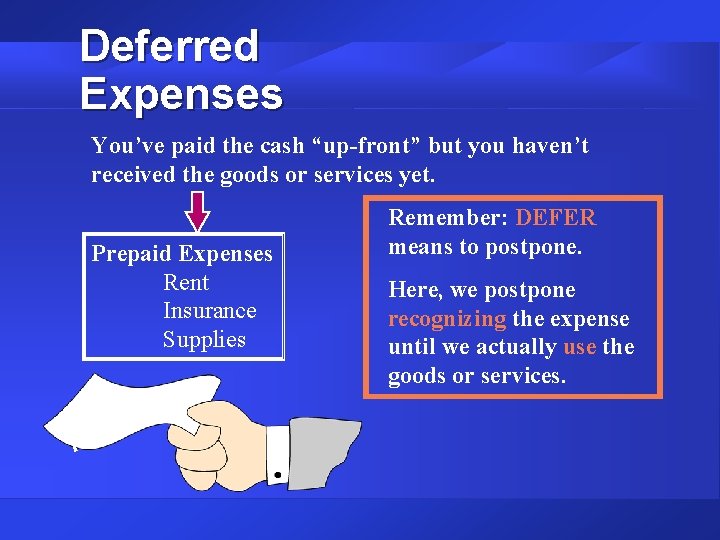
Deferred Expenses You’ve paid the cash “up-front” but you haven’t received the goods or services yet. Prepaid Expenses Rent Insurance Supplies pa a n i id ce n a dv Remember: DEFER means to postpone. Here, we postpone recognizing the expense until we actually use the goods or services.
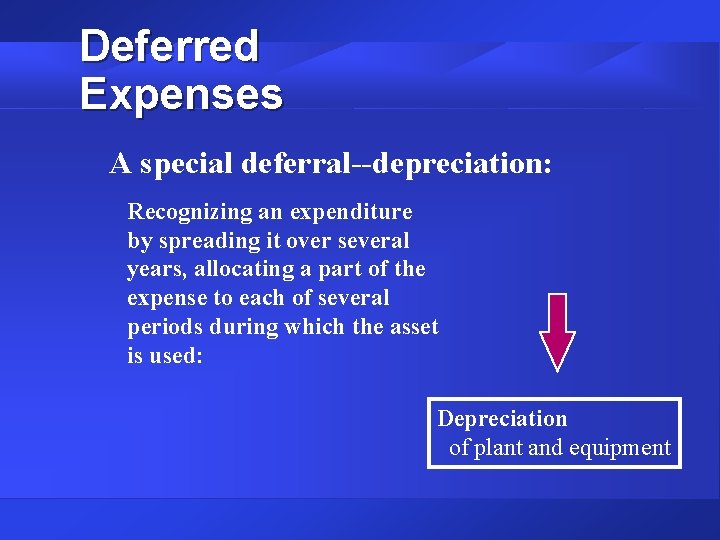
Deferred Expenses A special deferral--depreciation: Recognizing an expenditure by spreading it over several years, allocating a part of the expense to each of several periods during which the asset is used: Depreciation of plant and equipment
PREPAID RENT t Often companies pay rent in advance. t t t When the cash is paid, the company has Dollars first--action later. What’s the action that triggers recognitio Passing of the time to which the rent a
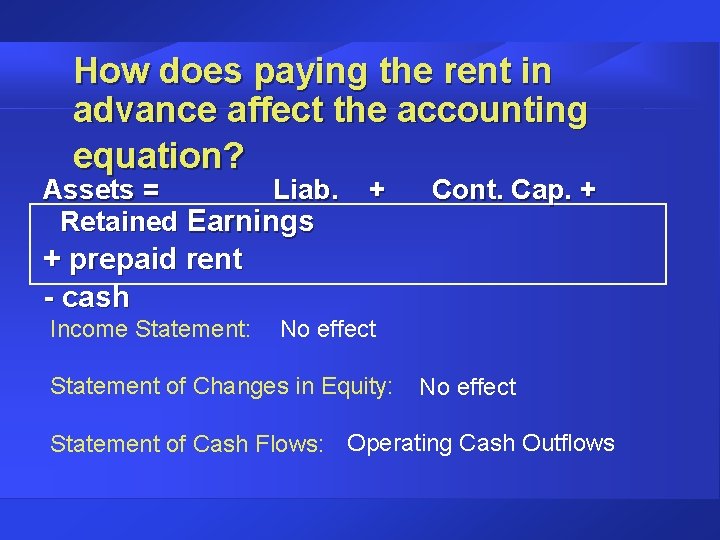
How does paying the rent in advance affect the accounting equation? Assets = Liab. Retained Earnings + Cont. Cap. + + prepaid rent - cash Income Statement: No effect Statement of Changes in Equity: No effect Statement of Cash Flows: Operating Cash Outflows
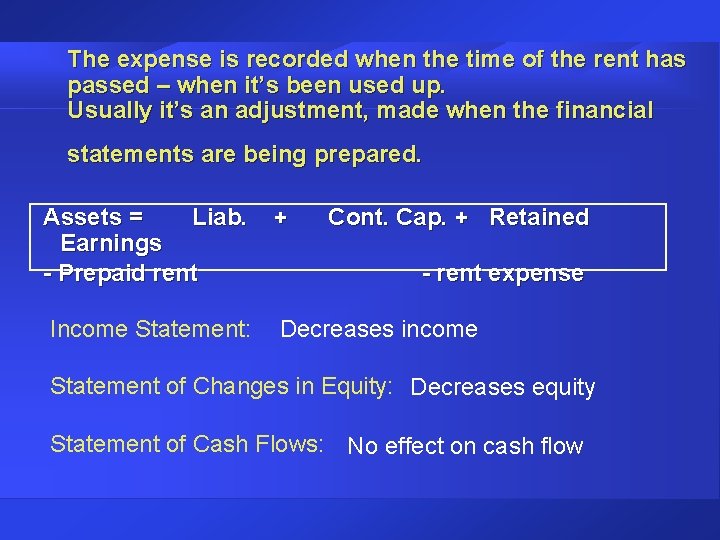
The expense is recorded when the time of the rent has passed – when it’s been used up. Usually it’s an adjustment, made when the financial statements are being prepared. Assets = Liab. Earnings - Prepaid rent + Cont. Cap. + Retained Income Statement: Decreases income - rent expense Statement of Changes in Equity: Decreases equity Statement of Cash Flows: No effect on cash flow
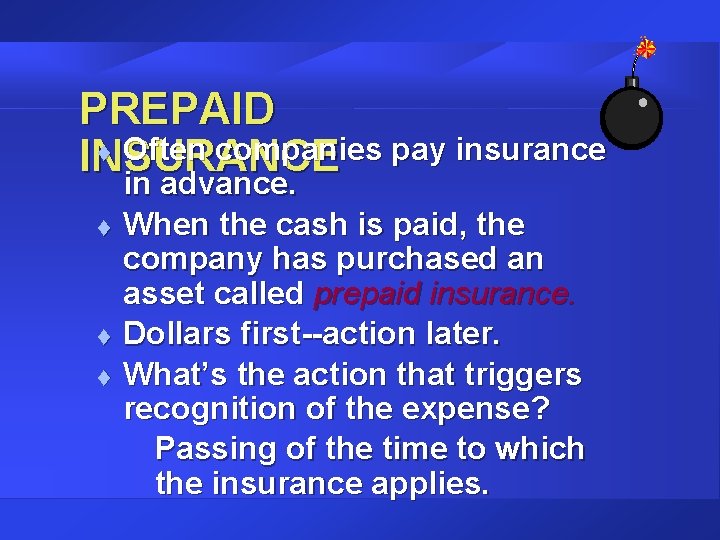
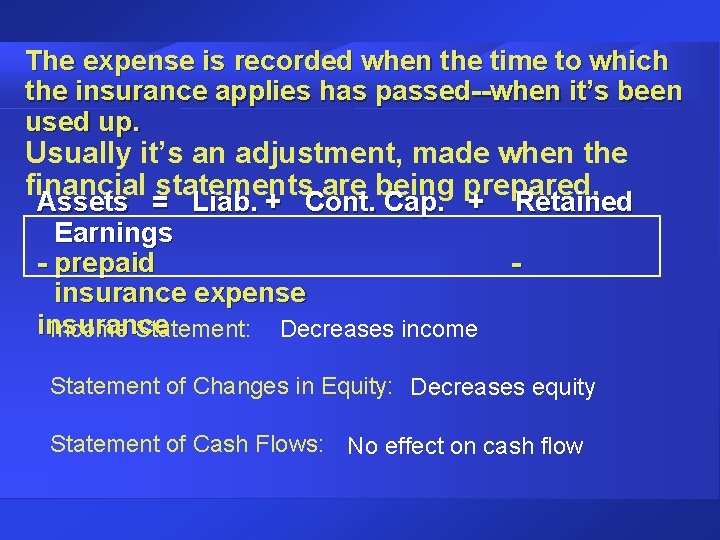
PREPAID t Often companies pay insurance INSURANCE in advance. t t t in advance. When the cash is paid, the company has purchased an asset called prepaid insurance. Dollars first--action later. What’s the action that triggers recognition of the expense? Passing of the time to which the insurance applies.
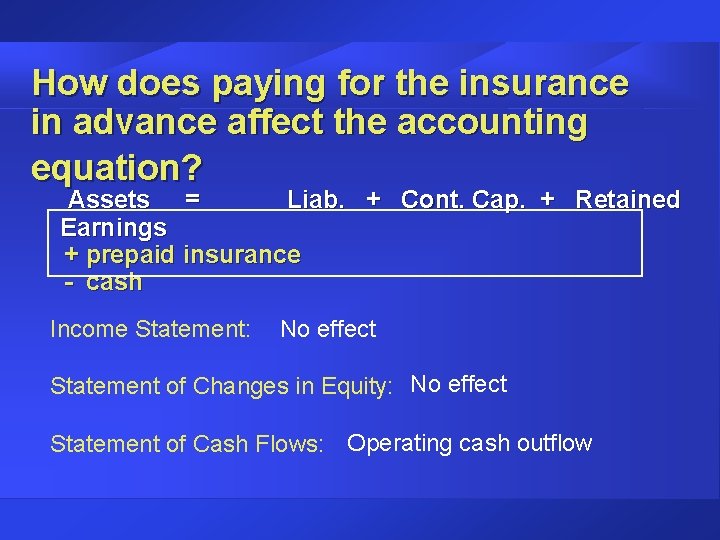
How does paying for the insurance in advance affect the accounting equation? Assets = Liab. + Cont. Cap. + Retained Earnings + prepaid insurance - cash Income Statement: No effect Statement of Changes in Equity: No effect Statement of Cash Flows: Operating cash outflow
The expense is recorded when the time to which the insurance applies has passed--when it’s been used up. Usually it’s an adjustment, made when the financial statements are being prepared. Assets = Liab. + Cont. Cap. + Retained Earnings - prepaid insurance expense insurance Income Statement: Decreases income Statement of Changes in Equity: Decreases equity Statement of Cash Flows: No effect on cash flow
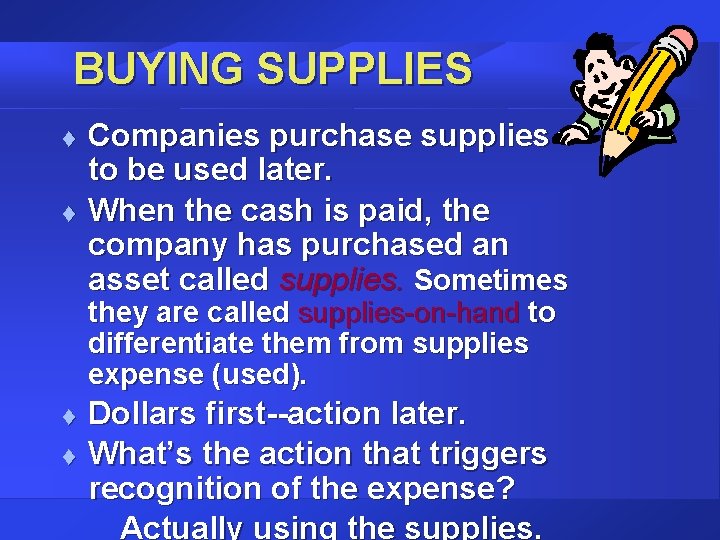
BUYING SUPPLIES t t Companies purchase supplies to be used later. When the cash is paid, the company has purchased an asset called supplies. Sometimes they are called supplies-on-hand to differentiate them from supplies expense (used). t t Dollars first--action later. What’s the action that triggers recognition of the expense? Actually using the supplies.
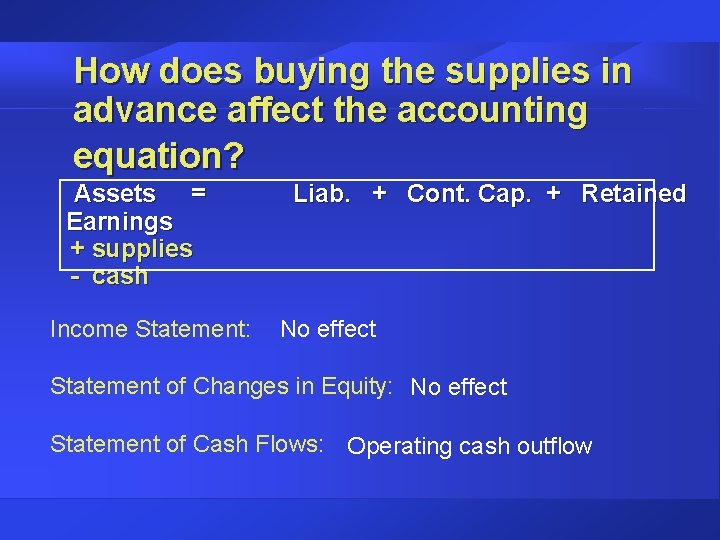
How does buying the supplies in advance affect the accounting equation? Assets = Earnings + supplies - cash Income Statement: Liab. + Cont. Cap. + Retained No effect Statement of Changes in Equity: No effect Statement of Cash Flows: Operating cash outflow
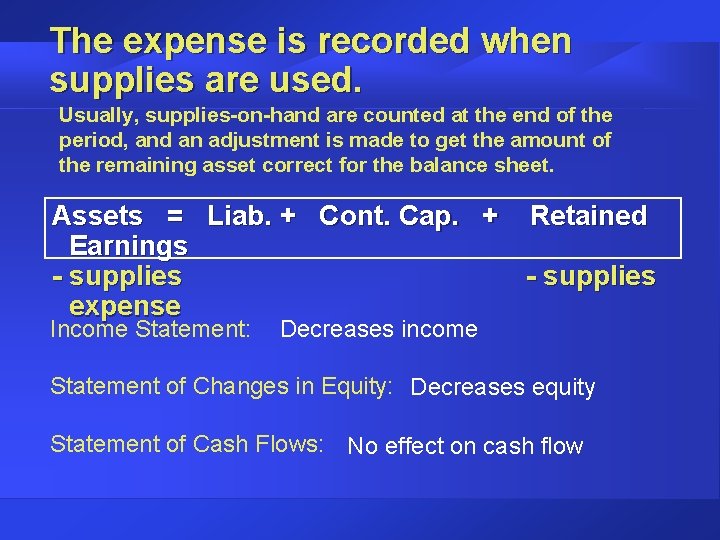
The expense is recorded when supplies are used. Usually, supplies-on-hand are counted at the end of the period, and an adjustment is made to get the amount of the remaining asset correct for the balance sheet. Assets = Liab. + Cont. Cap. + Retained Earnings - supplies expense Income Statement: Decreases income Statement of Changes in Equity: Decreases equity Statement of Cash Flows: No effect on cash flow
DEPRECIATION t When a company buys an asset that is used up in the business (i. e. , they didn’t buy it to resell it) AND it will be useful for more than one year, GAAP says that the expense must be spread over the accounting periods during the useful life
DEPRECIATION t t The portion of the cost of an asset allocated to any one accounting period-DEPRECIATION EXPENSE Depreciation of an asset is an allocation process--spreading the cost of an asset that benefits more than one accounting period over the estimated useful life of the asset.
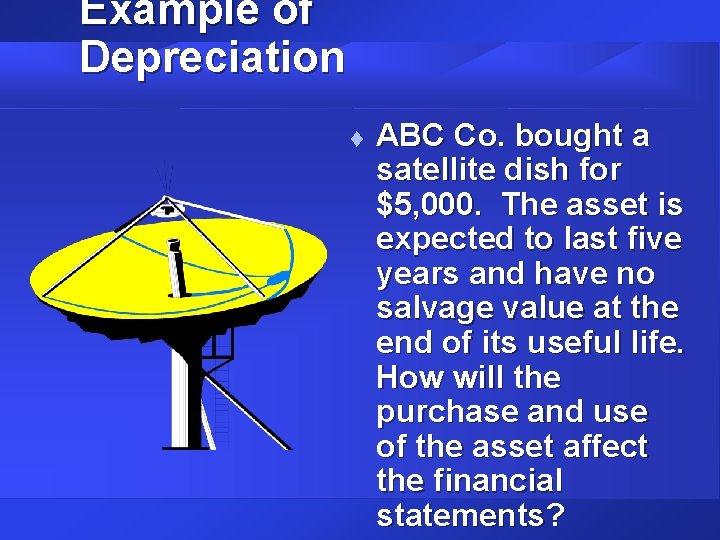
Example of Depreciation t ABC Co. bought a satellite dish for $5, 000. The asset is expected to last five years and have no salvage value at the end of its useful life. How will the purchase and use of the asset affect the financial statements?
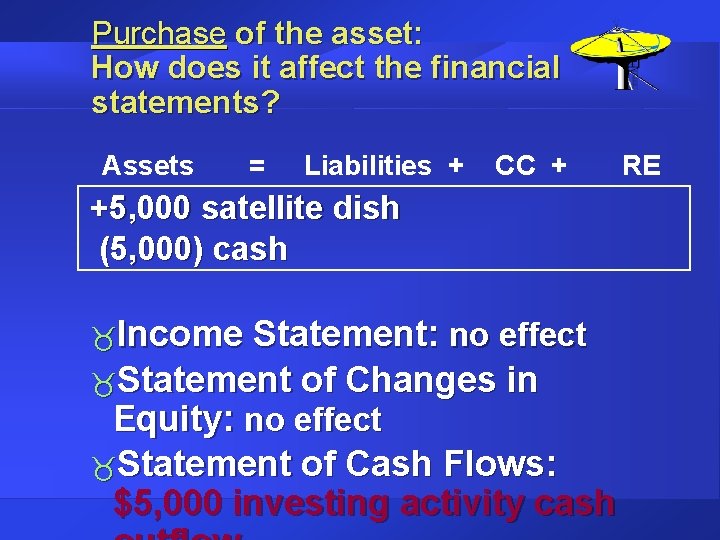
Purchase of the asset: How does it affect the financial statements? Assets = Liabilities + CC + +5, 000 satellite dish (5, 000) cash _Income Statement: no effect _Statement of Changes in Equity: no effect _Statement of Cash Flows: $5, 000 investing activity cash RE
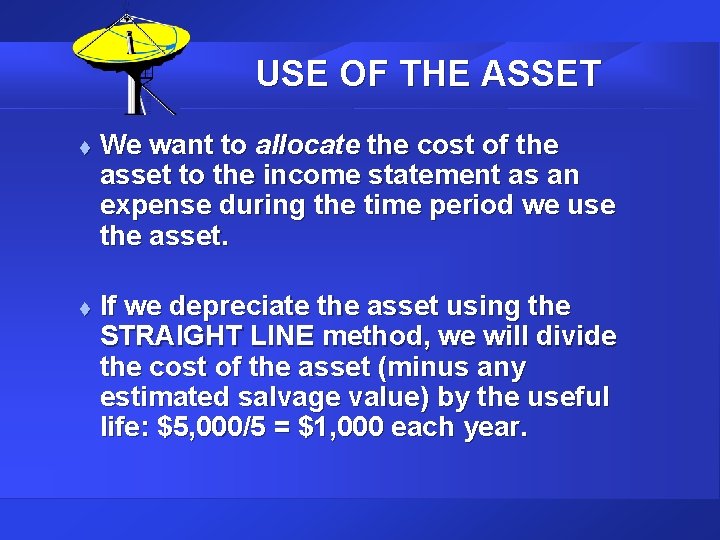
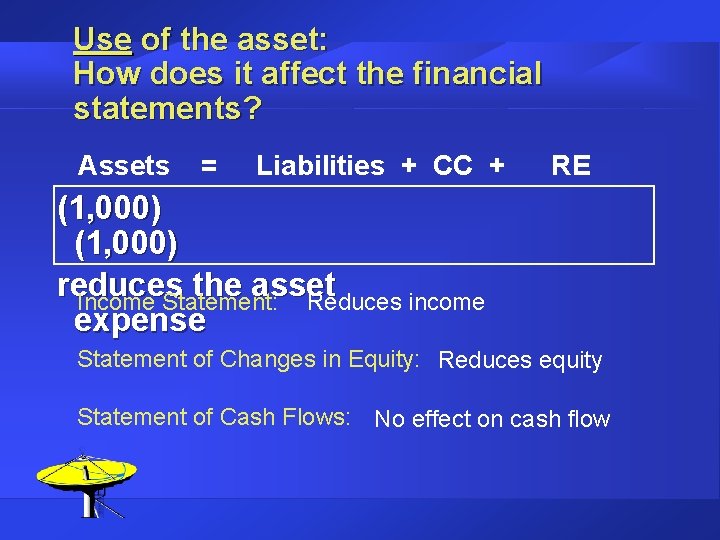
USE OF THE ASSET t t We want to allocate the cost of the asset to the income statement as an expense during the time period we use the asset. If we depreciate the asset using the STRAIGHT LINE method, we will divide the cost of the asset (minus any estimated salvage value) by the useful life: $5, 000/5 = $1, 000 each year.
Use of the asset: How does it affect the financial statements? Assets = Liabilities + CC + RE (1, 000) reduces the asset Income Statement: Reduces income expense Statement of Changes in Equity: Reduces equity Statement of Cash Flows: No effect on cash flow
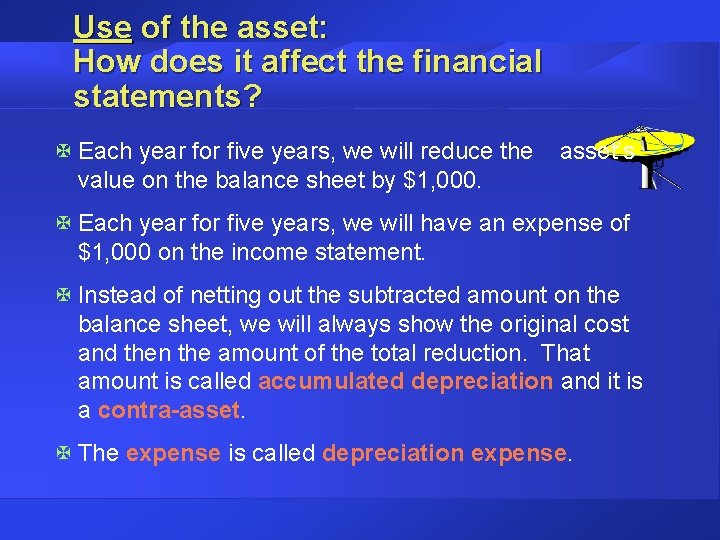
Use of the asset: How does it affect the financial statements? X Each year for five years, we will reduce the value on the balance sheet by $1, 000. asset’s X Each year for five years, we will have an expense of $1, 000 on the income statement. X Instead of netting out the subtracted amount on the balance sheet, we will always show the original cost and then the amount of the total reduction. That amount is called accumulated depreciation and it is a contra-asset. X The expense is called depreciation expense.