
Chapter 3 Accounting Systems and Internal Control Slide
- Slides: 20
Chapter 3 Accounting Systems and Internal Control Slide 3. 1 Presented by: Mr. Raziq
Chapter 3 Learning Objectives • Define an accounting system and identify its principal elements. • Briefly describe how an accounting system is used to record accounting data for a business each accounting period. • Identify the key components of internal control. • Identify the principal differences between manual and computer-based processing of accounting data and the related internal control implications. • Discuss recent trends in computer processing and the related implications for organizations’ accounting and control functions. • Identify internal control issues stemming from the growing trend toward multinational business operations. Slide 3. 2 Presented by: Mr. Raziq
What is a “system? “A coordinated network of plans and procedures designed to achieve a stated goal in an orderly, effective, and efficient manner. ” Slide 3. 3 Presented by: Mr. Raziq
Okay, what is an “accounting system”? “A systematic approach to collecting, processing, and communicating financial information to decision makers. ” Slide 3. 4 Presented by: Mr. Raziq
Principal Elements of an Accounting System • • Accounts Chart of accounts Journals and ledgers The accounting cycle Slide 3. 5 Presented by: Mr. Raziq
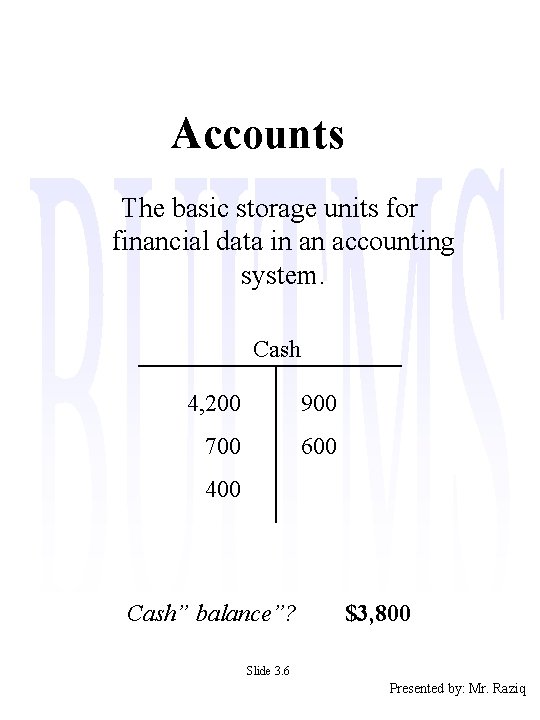
Accounts The basic storage units for financial data in an accounting system. Cash 4, 200 900 700 600 400 Cash” balance”? $3, 800 Slide 3. 6 Presented by: Mr. Raziq
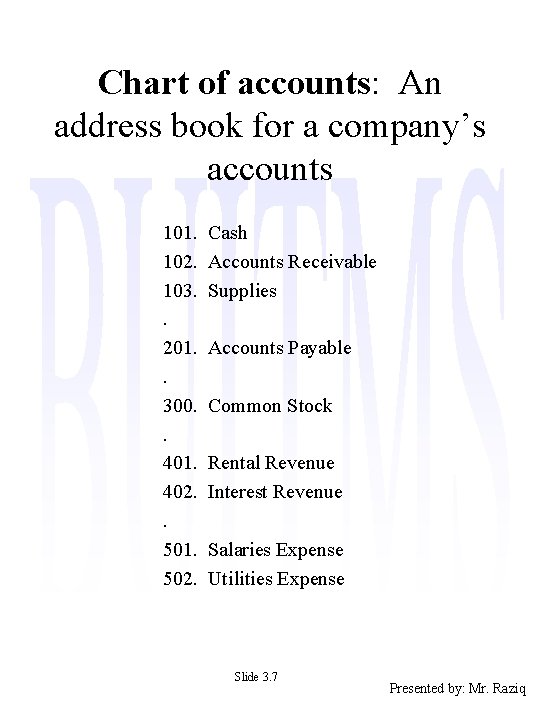
Chart of accounts: An address book for a company’s accounts 101. 102. 103. . 201. . 300. . 401. 402. . 501. 502. Cash Accounts Receivable Supplies Accounts Payable Common Stock Rental Revenue Interest Revenue Salaries Expense Utilities Expense Slide 3. 7 Presented by: Mr. Raziq
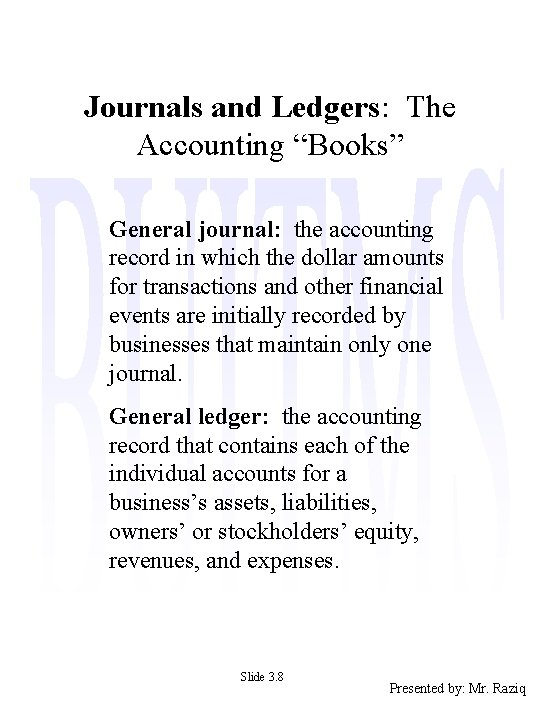
Journals and Ledgers: The Accounting “Books” General journal: the accounting record in which the dollar amounts for transactions and other financial events are initially recorded by businesses that maintain only one journal. General ledger: the accounting record that contains each of the individual accounts for a business’s assets, liabilities, owners’ or stockholders’ equity, revenues, and expenses. Slide 3. 8 Presented by: Mr. Raziq
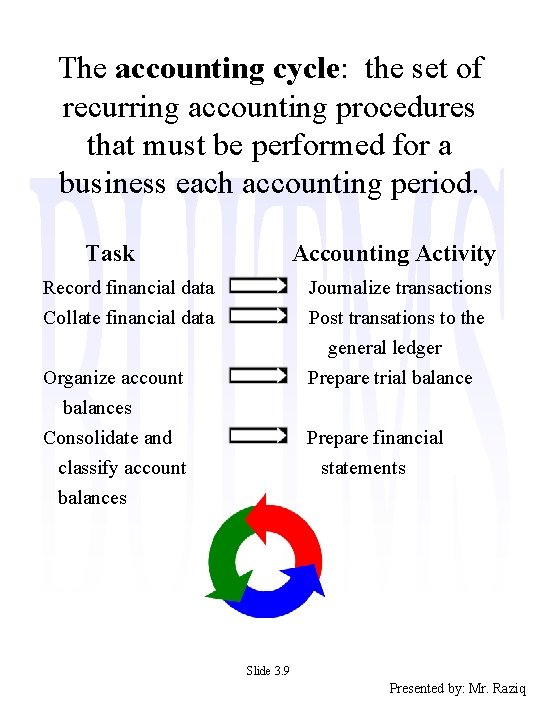
The accounting cycle: the set of recurring accounting procedures that must be performed for a business each accounting period. Task Accounting Activity Record financial data Journalize transactions Collate financial data Post transations to the Organize account general ledger Prepare trial balances Consolidate and classify account balances Prepare financial statements Slide 3. 9 Presented by: Mr. Raziq
Internal Control for Business Organizations An accounting system is one element of a larger system that business executives use to maintain effective control over their organizations. Slide 3. 10 Presented by: Mr. Raziq
Internal control is a process-effected by an entity’s board of directors, management, and other personnel-designed to provide reasonable assurance that key entity objectives will be accomplished. Slide 3. 11 Presented by: Mr. Raziq
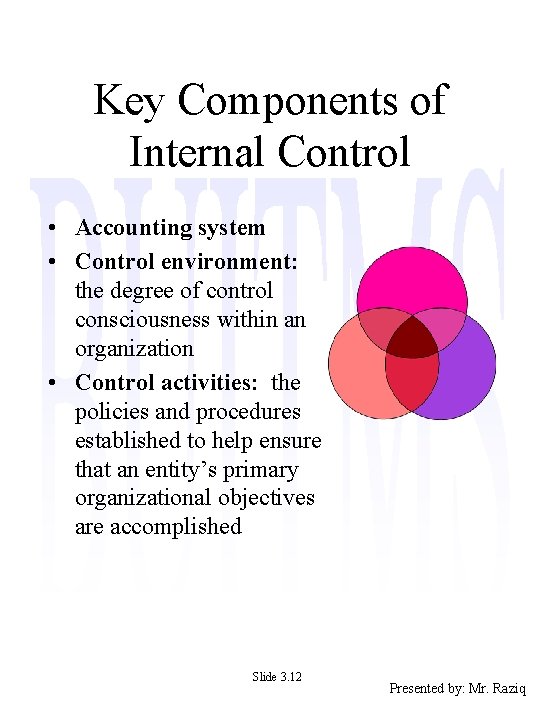
Key Components of Internal Control • Accounting system • Control environment: the degree of control consciousness within an organization • Control activities: the policies and procedures established to help ensure that an entity’s primary organizational objectives are accomplished Slide 3. 12 Presented by: Mr. Raziq
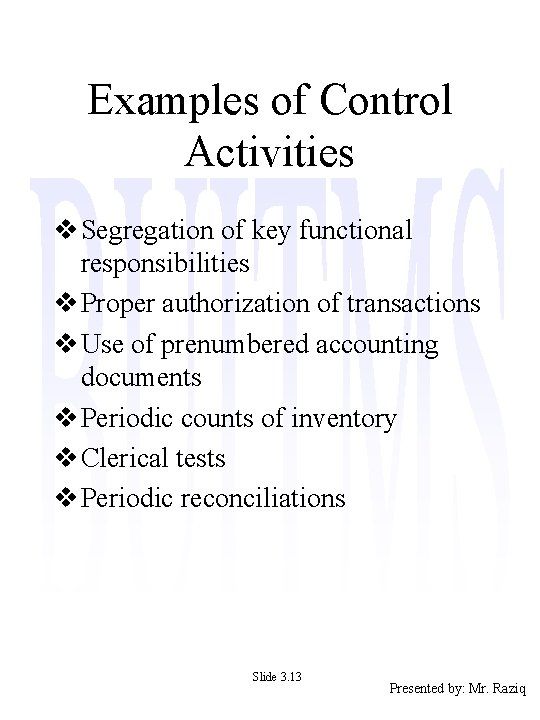
Examples of Control Activities v Segregation of key functional responsibilities v Proper authorization of transactions v Use of prenumbered accounting documents v Periodic counts of inventory v Clerical tests v Periodic reconciliations Slide 3. 13 Presented by: Mr. Raziq
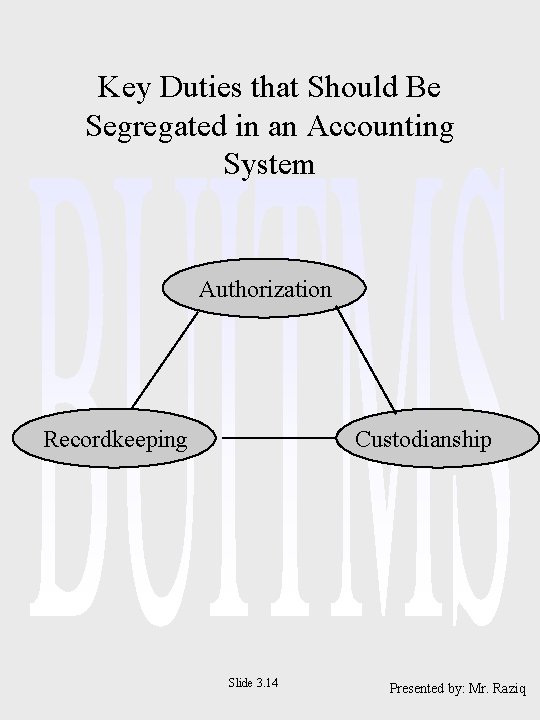
Key Duties that Should Be Segregated in an Accounting System Authorization Recordkeeping Custodianship Slide 3. 14 Presented by: Mr. Raziq
Internal Control and Computer Processing Businesses, large and small, can benefit significantly by integrating computer processing into their accounting and control functions. Slide 3. 15 Presented by: Mr. Raziq
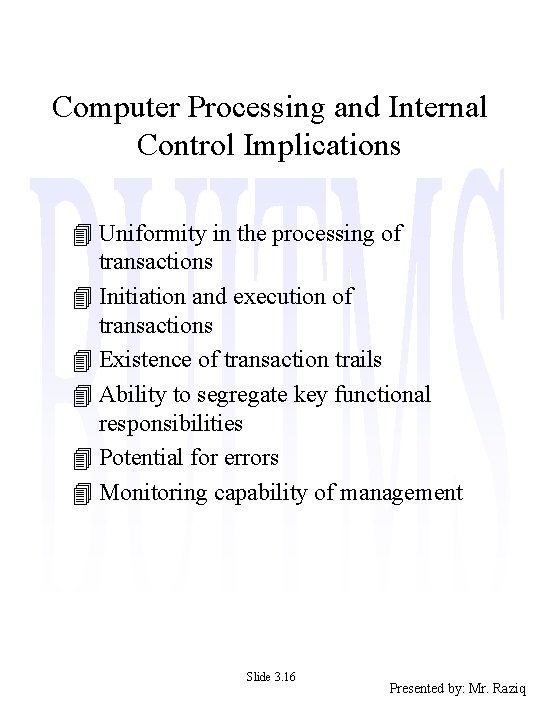
Computer Processing and Internal Control Implications 4 Uniformity in the processing of transactions 4 Initiation and execution of transactions 4 Existence of transaction trails 4 Ability to segregate key functional responsibilities 4 Potential for errors 4 Monitoring capability of management Slide 3. 16 Presented by: Mr. Raziq
Examples of Control Activities in Computer-based Accounting Systems o Maintain back-up copies of key computer programs o Periodically process “test” transactions o Data input controls o Limit access to computers o Establish procedures to identify parties accessing and operating each computer o Limit access to key data files and computer programs Slide 3. 17 Presented by: Mr. Raziq
Two Key Trends in Information Processing Technology. . . and Their Implications for Accountants • Outsourcing of information systems • Electronic data interchange (EDI) Slide 3. 18 Presented by: Mr. Raziq
Internal Control: An International (Multinational) Perspective • Recent years have seen a dramatic increase in multinational business operations • This trend poses significant challenges for accountants • Among these challenges is designing an internal control process for a business organization that cuts across several cultures Slide 3. 19 Presented by: Mr. Raziq
The Foreign Corrupt Practices Act of 1977 has Important Implications for U. S. Companies *Prohibits payments of bribes and related inducements to establish/maintain business relationships in foreign countries *Requires all public companies to establish internal controls that have a high likelihood of preventing and detecting bribes and similar payments Slide 3. 20 Presented by: Mr. Raziq