
Chapter 3 A Behavioral Framework for Compensation References
Chapter 3 A Behavioral Framework for Compensation References: Ø Strategic Compensation in Canada (4 th Edition), Richard J. Long, Nelson Education Ltd. Resource Person: Furqan-ul-haq Siddiqui

Types of Reward Problems 1. Ø Ø Failure to produce desired behavior When reward system simply has no impact on behavior In some cases reward system not only fails to produce the desired behavior, but also produces undesirable behavior, or behaviors that leads to negative consequences
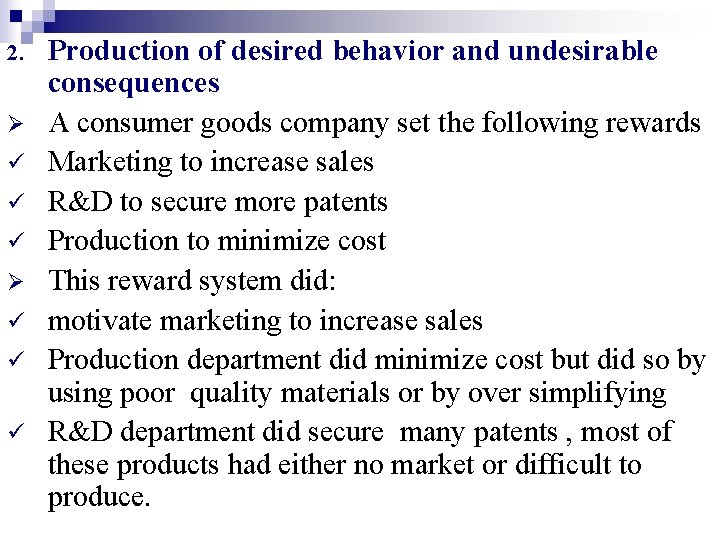
2. Ø ü ü ü Production of desired behavior and undesirable consequences A consumer goods company set the following rewards Marketing to increase sales R&D to secure more patents Production to minimize cost This reward system did: motivate marketing to increase sales Production department did minimize cost but did so by using poor quality materials or by over simplifying R&D department did secure many patents , most of these products had either no market or difficult to produce.
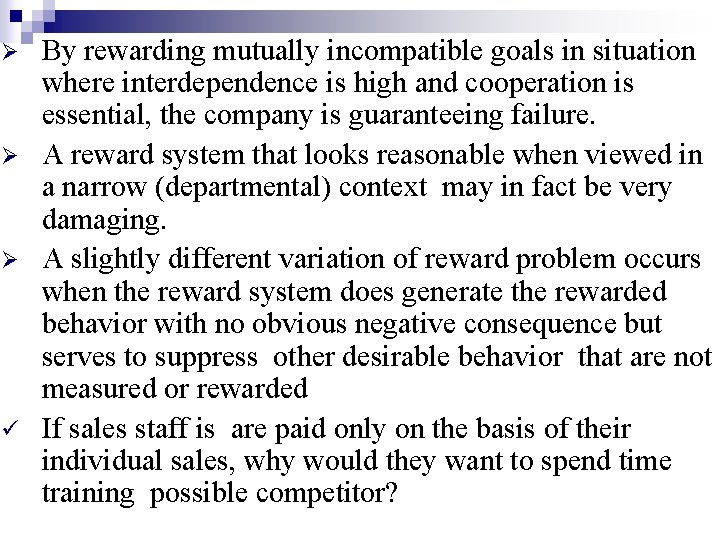
Ø Ø Ø ü By rewarding mutually incompatible goals in situation where interdependence is high and cooperation is essential, the company is guaranteeing failure. A reward system that looks reasonable when viewed in a narrow (departmental) context may in fact be very damaging. A slightly different variation of reward problem occurs when the reward system does generate the rewarded behavior with no obvious negative consequence but serves to suppress other desirable behavior that are not measured or rewarded If sales staff is are paid only on the basis of their individual sales, why would they want to spend time training possible competitor?

3. Ø ü ü ü ü Production of Reward Dissatisfaction When employees believe that the rewards they receive: are not consistent with the contribution they are making to the organization, Are unfair. Reward dissatisfaction can result in a variety of negative consequences such as: Poor work performance High turnover Poor customer service dishonesty

Desired Reward Outcomes a. b. n 1. Ø 2. Ø What outcomes should the reward system produce? How can we produce them? Three Key Employee Behaviors Membership Behavior When employee decides to join and remain with the firm. Task Behavior When employees produce the specific task that an organization has assigned to them
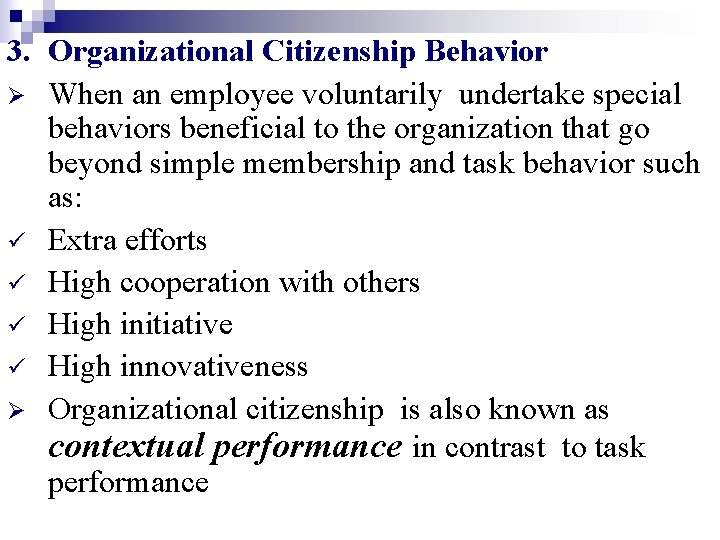
3. Organizational Citizenship Behavior Ø When an employee voluntarily undertake special behaviors beneficial to the organization that go beyond simple membership and task behavior such as: ü Extra efforts ü High cooperation with others ü High initiative ü High innovativeness Ø Organizational citizenship is also known as contextual performance in contrast to task performance

How to create reward system that create these behaviors? Ø Reward system does not affect human behavior directly. it: i. Affects employee perception and attitudes, ii. Which drive their behavior. Ø Three Key attitudes 1. Job satisfaction: Ø The attitude one holds towards one’s job and work place either positive or negative. 2. Work Motivation: Ø The attitude one holds towards good job performance either positive or negative Ø It is an strength of an employee’s desire to perform his or her duties well n
Organizational Identification • Organizational Identification (OID) is the sense of oneness individuals have with an organization and the degree to which individuals define themselves as organization members. Ø Consists of three interrelated elements i. A sense of shared goals and values with the organization ii. A sense of membership or belongingness iii. An intention to remain a member of the organization. This element is sometimes known as “organization Commitment” 3.

Causes of Reward Dissatisfaction Violation of Psychological Contract Perceived Inequity Relative Deprivation Lack of organizational justice Reward Dissatisfaction
Causes of Reward Dissatisfaction 1. n Ø ü ü ü Violation of the Psychological Contract Expectations about the rewards offered by a given job and the contributions necessary to perform the job Research has shown that violation of psychological contract can cause employees to have: Less trust on their employers Decreased job satisfaction Reduced citizenship behavior Decreased work performance Increased turnover, theft Even sabotage

2. Ø i. ii. Ø Perceived Inequity Individuals use at-least two perceptual screens An internal calculus, based on their own variations and the rewards received and contributions made Comparison with rewards/ contribution ratio of relevant others The essence of equity theory is simple: people make comparison s between the ratio contributions they make and the rewards they receive and the ratios of relevant others.
3. Ø I. III. IV. V. VI. Relative Deprivation Employees experience dissatisfaction with their pay level under six conditions, when There is a discrepancy between the outcome they want and what actually they receive They see that a comparison ”other” receives more than they do Past experience has led them to expect more than they now receive Future expectancies for achieving better outcomes are low They feel they are entitled for more They absolve themselves of personal responsibility for the lack of better outcomes
4. Ø a. Ø b. Ø n Lack of Organizational Justice Organizational justice has two main components Distributive justice The perception that overall reward outcomes are fair, which is what equity theory is all about Procedural justice The perception that the process through which rewards are determined is fair Unless people believe that both of these are fair, they will not feel that the reward is fair
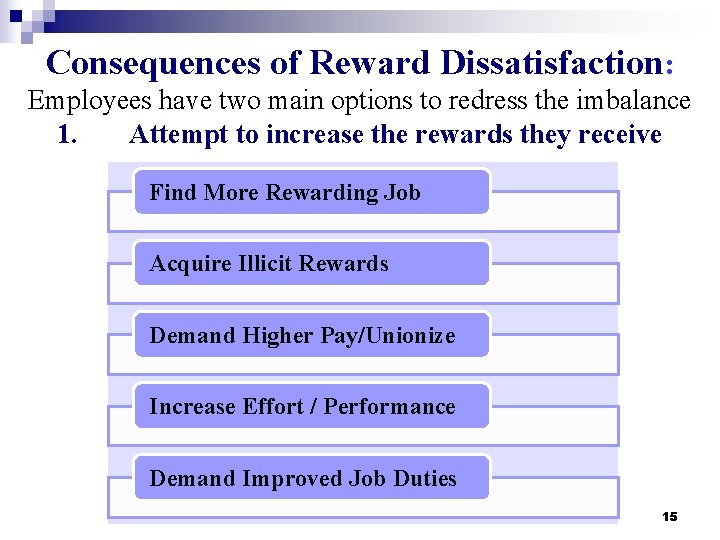
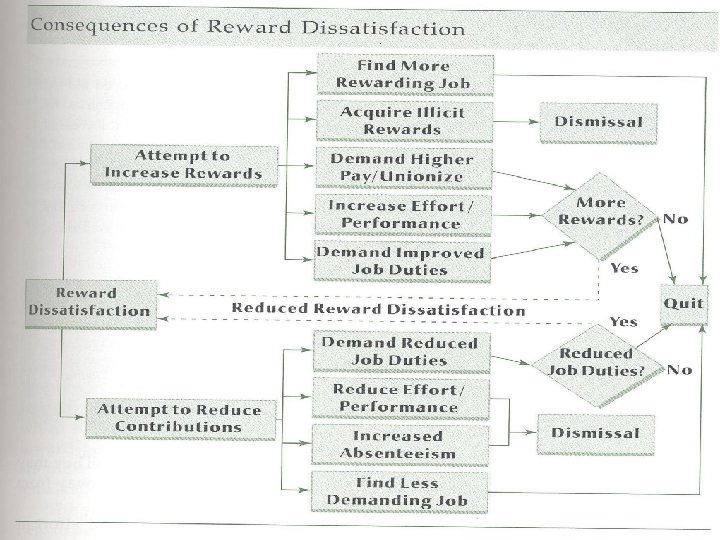
Consequences of Reward Dissatisfaction: Employees have two main options to redress the imbalance 1. Attempt to increase the rewards they receive Find More Rewarding Job Acquire Illicit Rewards Demand Higher Pay/Unionize Increase Effort / Performance Demand Improved Job Duties 15 Copyright (c) 2010 by Nelson Education Ltd
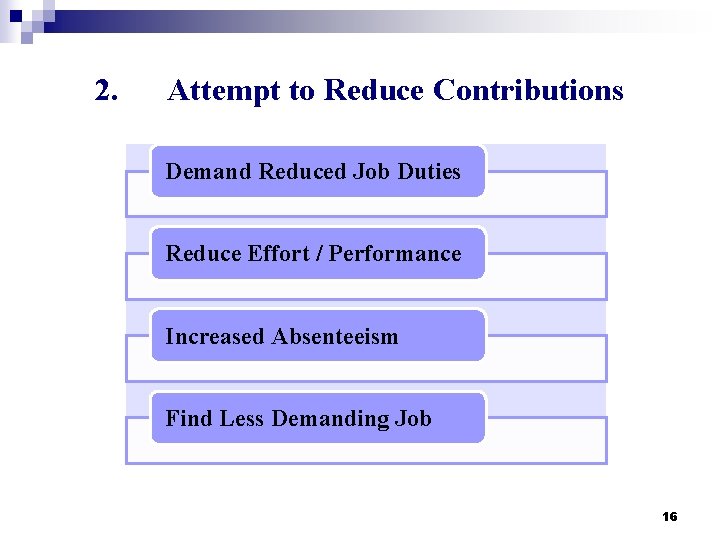
2. Attempt to Reduce Contributions Demand Reduced Job Duties Reduce Effort / Performance Increased Absenteeism Find Less Demanding Job 16 Copyright (c) 2010 by Nelson Education Ltd
Understanding Membership Behavior Why do people work? Ø People accept employment I. They have unsatisfied needs II. If employment is seen the best vehicle to satisfy these needs III. If they are able and willing to do things that the employment require Ø Put another way people accept a job if the inducements or rewards associated with the job exceed the costs of contributions they have to make to secure and retain the job Ø People can value the same rewards, contribution differently, depending on their personal characteristics and circumstances n
Causes of Membership Behavior Ø Factors that determine whether an employee is going to stay with an employer on long term basis. Ø Two job attitudes play an important role in causing membership behavior. 1. Job Satisfaction 2. Organizational Commitment n
1. Job Satisfaction It occurs when one’s important needs are satisfied through job. Ø there are five dimensions of job satisfaction I. Satisfaction with pay II. Satisfaction with Promotion III. Satisfaction with supervision IV. Satisfaction with coworkers V. Satisfaction with the Job Ø
2. Ø Ø a. Organizational Commitment The strength of individual attachment to his or her organization There are three main types of commitment Affective Commitment Ø Attachment to the organization based on positive feeling towards the organization b. Normative Commitment Ø Commitment to a organization based on an ideology or a sense of obligation. For example, the organization may have invested resources in training an employee who then feels a 'moral' obligation to put forth effort on the job and stay with the organization to 'repay the debt. It may also reflect an internalized norm, developed before the person joins the organization through family or other socialization processes, that one should be loyal to one's organization. The employee stays with the organization because he/she "ought to".
c. Ø Ø Continuance Commitment Attachment to the organization based on perceived lack of better alternatives Continuance commitment implies nothing about an employee’s level of emotional attachment or that of employees level of job satisfaction It is simply a hardheaded calculation that, “ I have no better alternative available to me. ” It is even possible that an employee might have high continuance commitment but extremely low levels of job satisfaction and affective commitment
Rewards, Satisfaction, and Commitment The role reward system can play in generating job satisfaction and organizational commitment Ø Since rewards is any thing provided by the organization that satisfies person’s needs Ø Reward has a direct impact on job satisfaction Ø To generate organizational commitment the key issue is the relationship between employees and the organization as whole. Ø Psychological contract, trust, and organizational justice – especially procedural justice play a major role organizational commitment Ø Job security has also been found to relate to both job satisfaction and affective commitment. n
Money as a Motivator Ø Ø Ø Human behavior is driven by needs, money itself is not technically a need, but rather a generalized resource that can be exchanged for things that will satisfy needs For those persons whose underlying needs are satisfied , money might not be much of a motivator, at least in its instrumental role as a vehicle for satisfaction of underlying need. In its role a generalized resource gives them control over their needs will be satisfied. This sense of control is in fact an important intrinsic human need. Money also has symbolic value and represent status and accomplishment to many people. Money can also be seen as a source of social comparison where it is the relative amount, not absolute amount that is important to people.
- Slides: 24