
CHAPTER 3 1 TEMPERATURE KINETIC THEORY OF GASES

- Slides: 47
CHAPTER 3. 1: TEMPERATURE &KINETIC THEORY OF GASES Dr Syarifah Norfaezah Sabki School of Microelectronic norfaezah@unimap. edu. my or faiesns@gmail. com This lecture note was prepared by, Dr Ramzan Mat Ayub
Contents • Overview • Temperature and the Zeroth Law of Thermodynamics • Thermometers and the Celsius Temperature Scale • The Constant-Volume Gas Thermometer • Absolute Temperature Scale • Thermal Expansion of Solids and Liquids • Macroscopic Description of an Ideal Gas
1 • Overview
What is Thermodynamics? § Thermodynamics is a branch of natural science concerned with heat and its relation to energy and work. It defines macroscopic variables (such as temperature, internal energy, entropy, and pressure) that characterize materials and radiation, and explains how they are related and by what laws they change with time. Thermodynamics describes the average behavior of very large numbers of microscopic constituents, and its laws can be derived from statistical mechanics.
§ Thermodynamics applies to a wide variety of topics in science and engineering—such as engines, phase transitions, chemical reactions, transport phenomena, and even black holes. Results of thermodynamic calculations are essential for other fields of physics and for chemistry, chemical engineering, aerospace engineering, mechanical engineering, cell biology, biomedical engineering, and materials science—and useful in other fields such as economics.
§ Much of the empirical content of thermodynamics is contained in the four laws. § The first law asserts the existence of a quantity called the internal energy of a system, which is distinguishable from the kinetic energy of bulk movement of the system and from its potential energy with respect to its surroundings. The first law distinguishes transfers of energy between closed systems as heat and as work. § The second law concerns two quantities called temperature and entropy. Entropy expresses the limitations, arising from what is known as irreversibility, on the amount of thermodynamic work that can be delivered to an external system by a thermodynamic process. § Entropy - a thermodynamic quantity representing the unavailability of a system's thermal energy for conversion into mechanical work, often interpreted as the degree of disorder or randomness in the system.
THERMO heat DYNAMIC motion
2 • Temperature and the Zeroth Law of Thermodynamics
Thermal contact Two objects are in thermal contact with each other if energy can be exchanged between them due to a temperature difference. Thermal equilibrium is a situation in which two objects would not exchange energy by heat or electromagnetic radiation if they were placed in thermal contact.
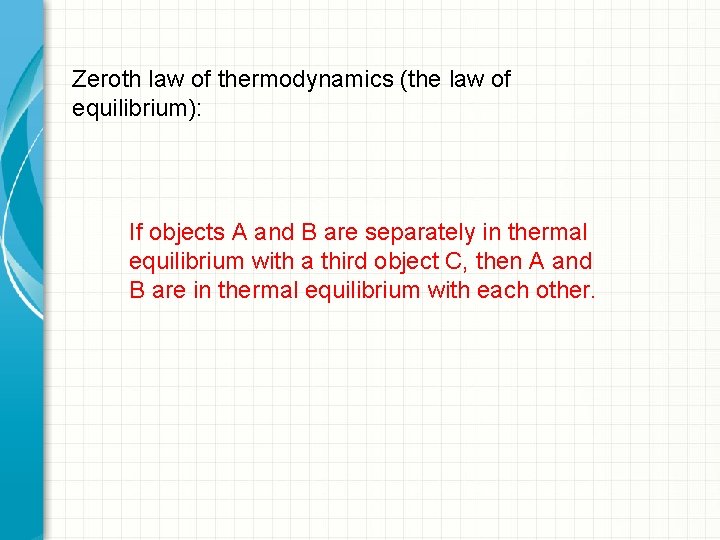
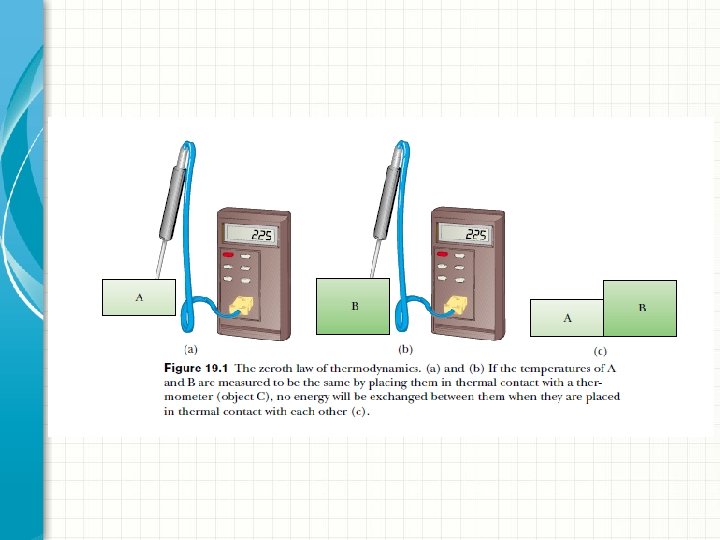
Zeroth law of thermodynamics (the law of equilibrium): If objects A and B are separately in thermal equilibrium with a third object C, then A and B are in thermal equilibrium with each other.
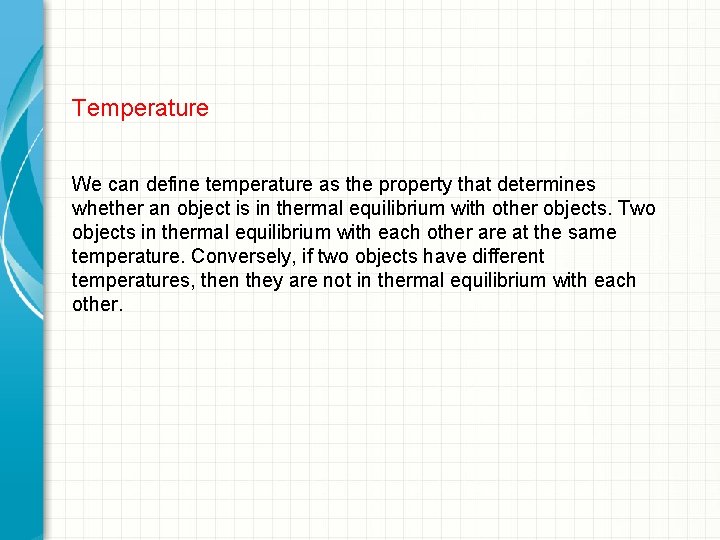
Temperature We can define temperature as the property that determines whether an object is in thermal equilibrium with other objects. Two objects in thermal equilibrium with each other are at the same temperature. Conversely, if two objects have different temperatures, then they are not in thermal equilibrium with each other.
3 • Thermometers and the Celsius Temperature Scale
Thermometer § Thermometers are devices that are used to measure the temperature of a system. § All thermometers are based on the principle that some physical property of a system changes as the system’s temperature changes. Some physical properties that change with temperature are § (1) the volume of a liquid, § (2) the dimensions of a solid, § (3) the pressure of a gas at constant volume, § (4) the volume of a gas at constant pressure, § (5) the electric resistance of a conductor, and § (6) the colour of an object. A temperature scale can be established on the basis of any one of these physical properties.
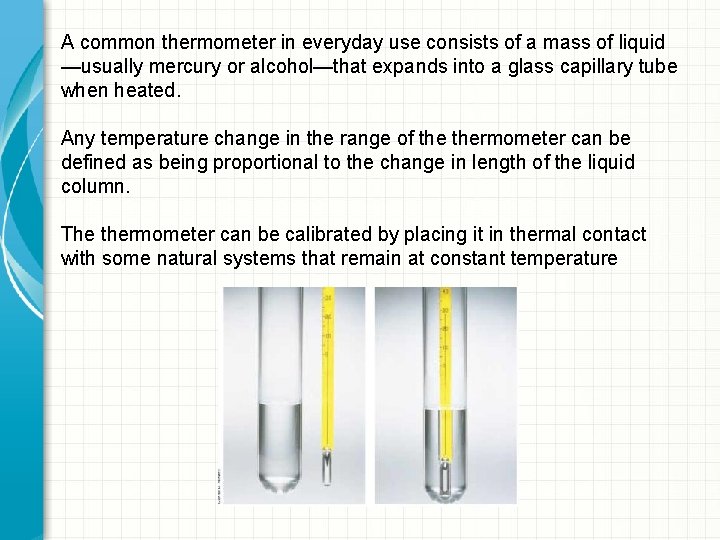
A common thermometer in everyday use consists of a mass of liquid —usually mercury or alcohol—that expands into a glass capillary tube when heated. Any temperature change in the range of thermometer can be defined as being proportional to the change in length of the liquid column. The thermometer can be calibrated by placing it in thermal contact with some natural systems that remain at constant temperature
One such system is a mixture of water and ice in thermal equilibrium at atmospheric pressure On the Celsius temperature scale, this mixture is defined to have a temperature of zero degrees Celsius, which is written as 0°C; this temperature is called the ice point of water. Another commonly used system is a mixture of water and steam in thermal equilibrium at atmospheric pressure; its temperature is 100°C, which is the steam point of water Once the liquid levels in thermometer have been established at these two points, the length of the liquid column between the two points is divided into 100 equal segments to create the Celsius scale. Thus, each segment denotes a change in temperature of one Celsius degree.
Limitations § Thermometers calibrated in this way present problems when extremely accurate readings are needed. § For instance, the readings given by an alcohol thermometer calibrated at the ice and steam points of water might agree with those given by a mercury thermometer only at the calibration points. § Because mercury and alcohol have different thermal expansion properties, when one thermometer reads a temperature of, for example, 50°C, the other may indicate a slightly different value.
4 • The Constant-Volume Gas Thermometer
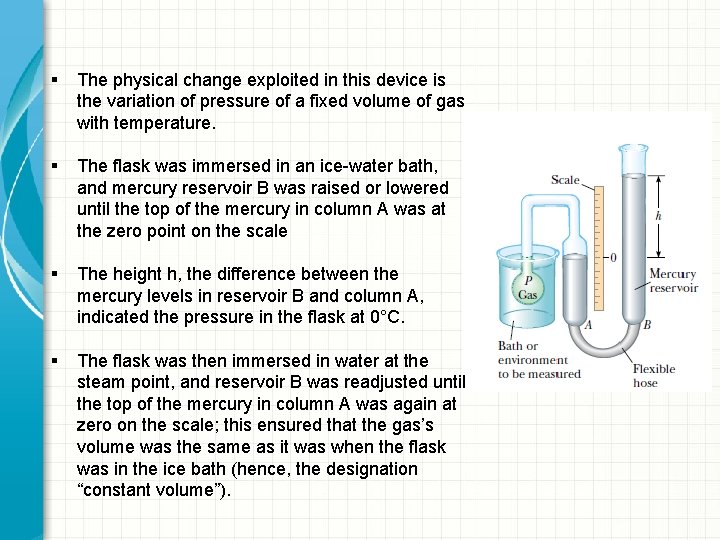
§ The physical change exploited in this device is the variation of pressure of a fixed volume of gas with temperature. § The flask was immersed in an ice-water bath, and mercury reservoir B was raised or lowered until the top of the mercury in column A was at the zero point on the scale § The height h, the difference between the mercury levels in reservoir B and column A, indicated the pressure in the flask at 0°C. § The flask was then immersed in water at the steam point, and reservoir B was readjusted until the top of the mercury in column A was again at zero on the scale; this ensured that the gas’s volume was the same as it was when the flask was in the ice bath (hence, the designation “constant volume”).
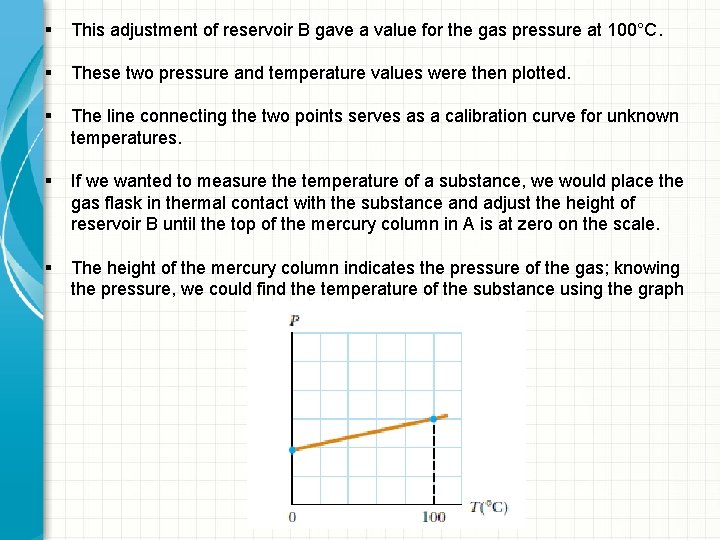
§ This adjustment of reservoir B gave a value for the gas pressure at 100°C. § These two pressure and temperature values were then plotted. § The line connecting the two points serves as a calibration curve for unknown temperatures. § If we wanted to measure the temperature of a substance, we would place the gas flask in thermal contact with the substance and adjust the height of reservoir B until the top of the mercury column in A is at zero on the scale. § The height of the mercury column indicates the pressure of the gas; knowing the pressure, we could find the temperature of the substance using the graph
5 • Absolute Temperature Scale
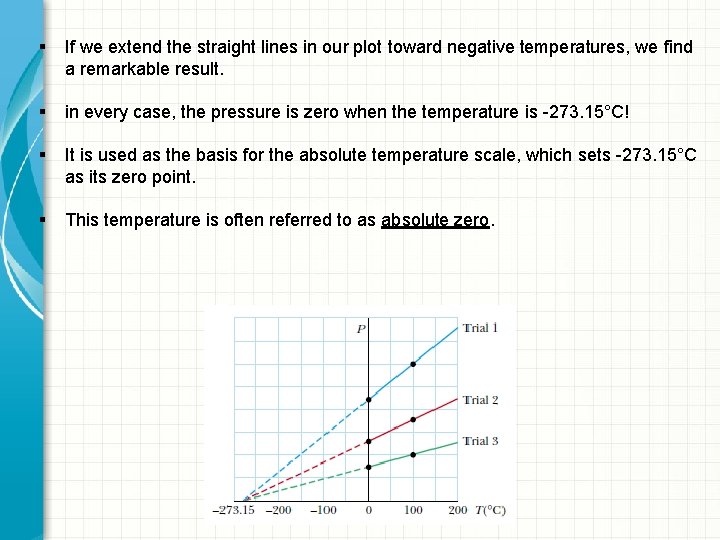
§ Let us suppose that temperatures are measured with gas thermometers containing different gases at different initial pressures. § Experiments show that thermometer readings are nearly independent of the type of gas used, as long as the gas pressure is low and the temperature is well above the point at which the gas liquefies
§ If we extend the straight lines in our plot toward negative temperatures, we find a remarkable result. § in every case, the pressure is zero when the temperature is -273. 15°C! § It is used as the basis for the absolute temperature scale, which sets -273. 15°C as its zero point. § This temperature is often referred to as absolute zero.
Kelvin Scale § Because the ice and steam points are experimentally difficult to duplicate, an absolute temperature scale based on two new fixed points was adopted in 1954 by the International Committee on Weights and Measures. § The first point is absolute zero § The second reference temperature for this new scale was chosen as the triple point of water, which is the single combination of temperature and pressure at which liquid water, gaseous water, and ice (solid water) coexist in equilibrium § This triple point occurs at a temperature of 0. 01°C and a pressure of 4. 58 mm of mercury. On the new scale, which uses the unit kelvin, the temperature of water at the triple point was set at 273. 16 kelvins, abbreviated 273. 16 K.
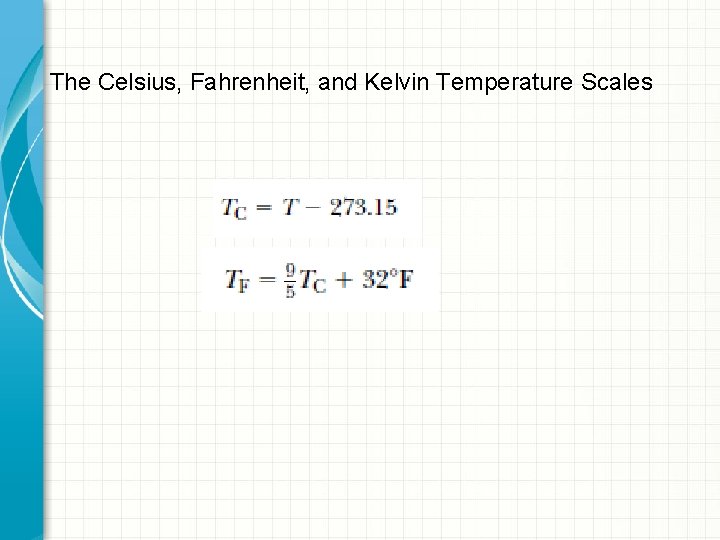
The Celsius, Fahrenheit, and Kelvin Temperature Scales
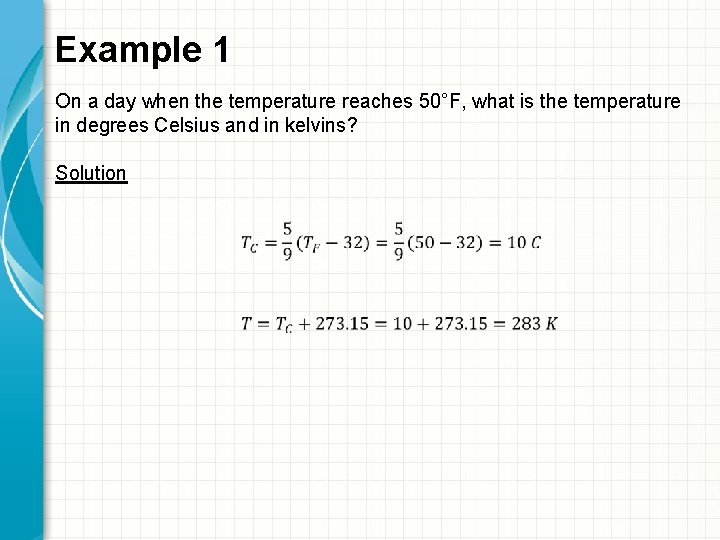
Example 1 On a day when the temperature reaches 50°F, what is the temperature in degrees Celsius and in kelvins? Solution
6 • Thermal Expansion of Solids and Liquids
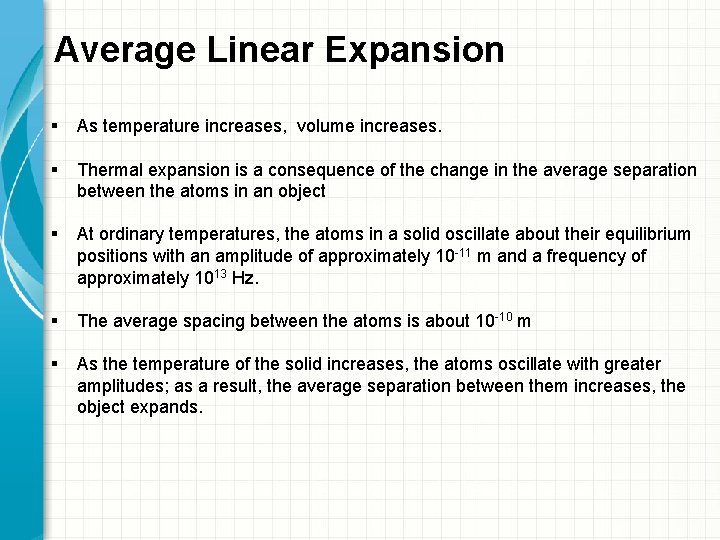
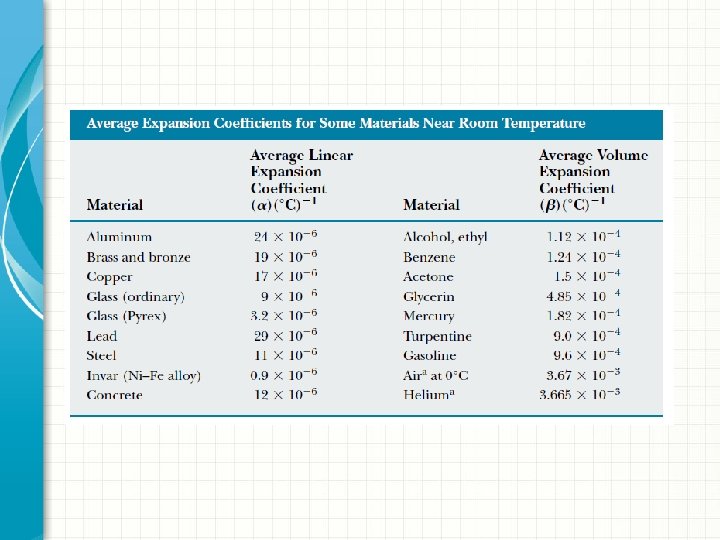
Average Linear Expansion § As temperature increases, volume increases. § Thermal expansion is a consequence of the change in the average separation between the atoms in an object § At ordinary temperatures, the atoms in a solid oscillate about their equilibrium positions with an amplitude of approximately 10 -11 m and a frequency of approximately 1013 Hz. § The average spacing between the atoms is about 10 -10 m § As the temperature of the solid increases, the atoms oscillate with greater amplitudes; as a result, the average separation between them increases, the object expands.
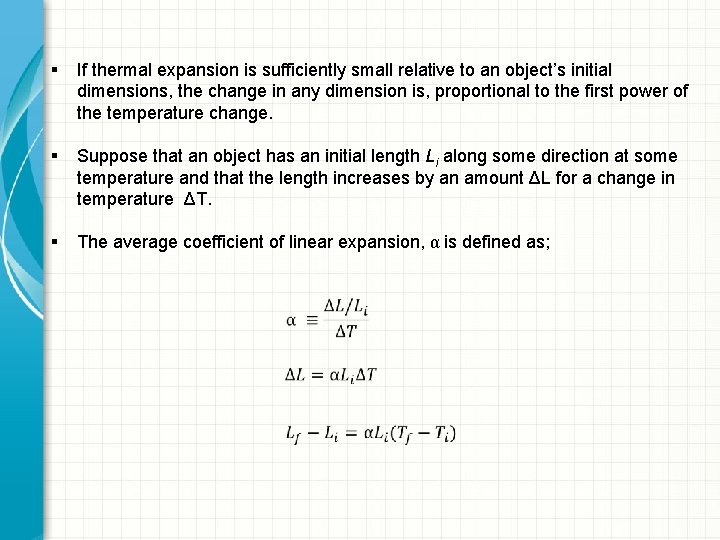
§ If thermal expansion is sufficiently small relative to an object’s initial dimensions, the change in any dimension is, proportional to the first power of the temperature change. § Suppose that an object has an initial length Li along some direction at some temperature and that the length increases by an amount ΔL for a change in temperature ΔT. § The average coefficient of linear expansion, α is defined as;
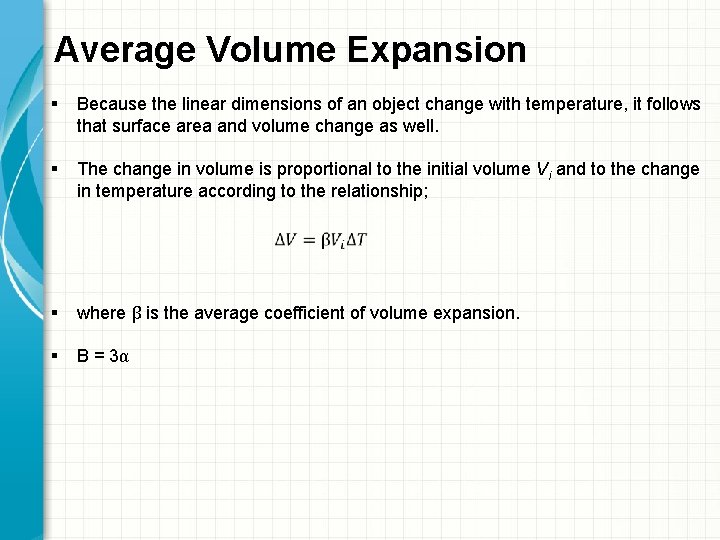
Average Volume Expansion § Because the linear dimensions of an object change with temperature, it follows that surface area and volume change as well. § The change in volume is proportional to the initial volume Vi and to the change in temperature according to the relationship; § where β is the average coefficient of volume expansion. § Β = 3α
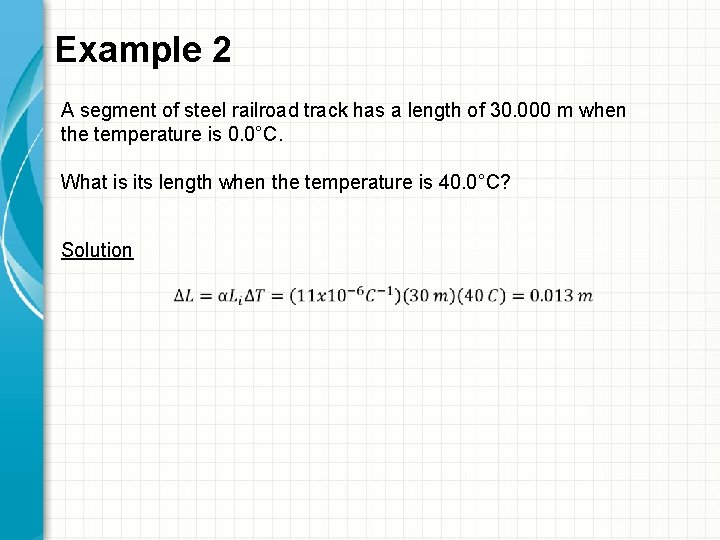
Example 2 A segment of steel railroad track has a length of 30. 000 m when the temperature is 0. 0°C. What is its length when the temperature is 40. 0°C? Solution
7 • Macroscopic Description of an Ideal Gas
§ The volume expansion for solids and liquids is based on the assumption that the material has an initial volume Vi before the temperature change occurs. § The interatomic forces within gases are very weak, and, in many cases, we can imagine these forces to be non-existent. § There is no equilibrium separation for the atoms and, thus, no “standard” volume at a given temperature. § For a gas, the volume is entirely determined by the container holding the gas. § For a gas, it is useful to know how the quantities volume V, pressure P, and temperature T are related for a sample of gas of mass m – ideal gas condition (low density, low pressure)
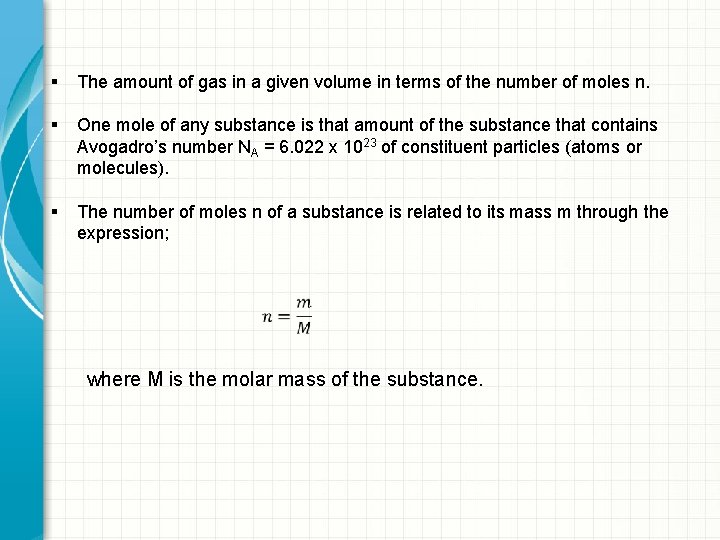
§ The amount of gas in a given volume in terms of the number of moles n. § One mole of any substance is that amount of the substance that contains Avogadro’s number NA = 6. 022 x 1023 of constituent particles (atoms or molecules). § The number of moles n of a substance is related to its mass m through the expression; where M is the molar mass of the substance.
§ The molar mass of each chemical element is the atomic mass (from the periodic table) expressed in g/mol. § For example, the mass of one He atom is 4. 00 u (atomic mass units), so the molar mass of He is 4. 00 g/mol. § For a molecular substance or a chemical compound, you can add up the molar mass from its molecular formula. The molar mass of stable diatomic oxygen (O 2) is 32. 0 g/mol.
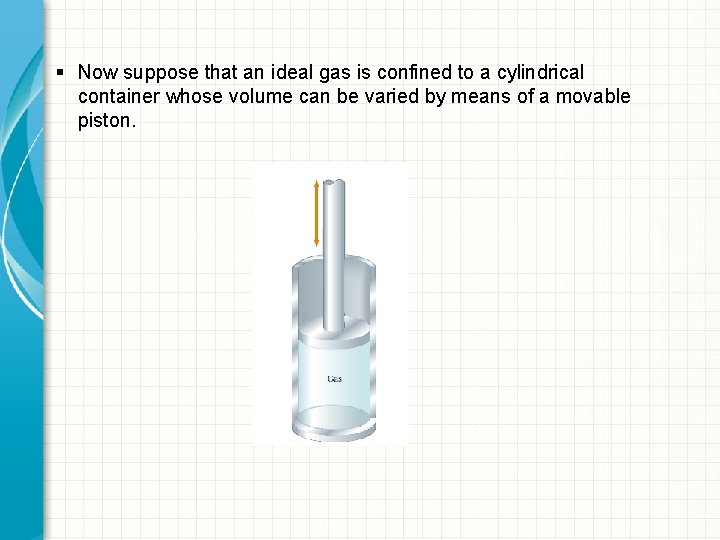
§ Now suppose that an ideal gas is confined to a cylindrical container whose volume can be varied by means of a movable piston.
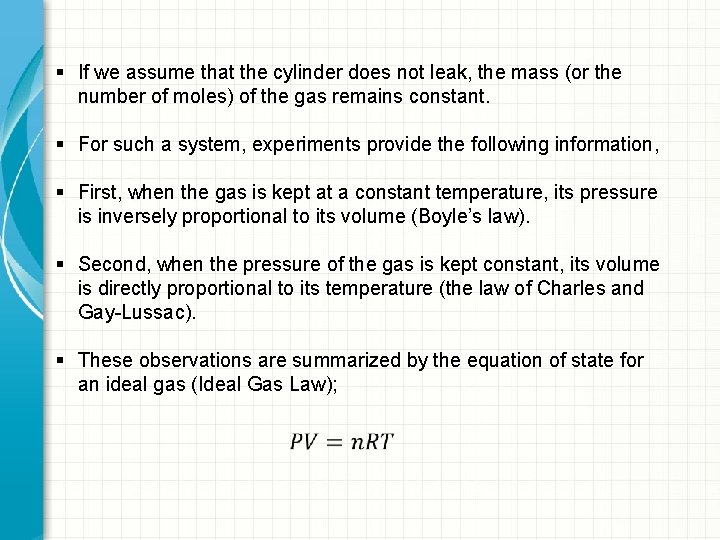
§ If we assume that the cylinder does not leak, the mass (or the number of moles) of the gas remains constant. § For such a system, experiments provide the following information, § First, when the gas is kept at a constant temperature, its pressure is inversely proportional to its volume (Boyle’s law). § Second, when the pressure of the gas is kept constant, its volume is directly proportional to its temperature (the law of Charles and Gay-Lussac). § These observations are summarized by the equation of state for an ideal gas (Ideal Gas Law);
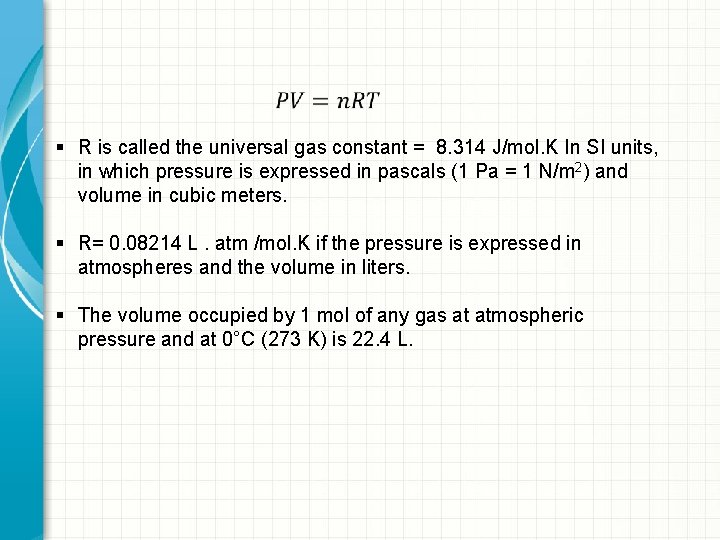
§ R is called the universal gas constant = 8. 314 J/mol. K In SI units, in which pressure is expressed in pascals (1 Pa = 1 N/m 2) and volume in cubic meters. § R= 0. 08214 L. atm /mol. K if the pressure is expressed in atmospheres and the volume in liters. § The volume occupied by 1 mol of any gas at atmospheric pressure and at 0°C (273 K) is 22. 4 L.
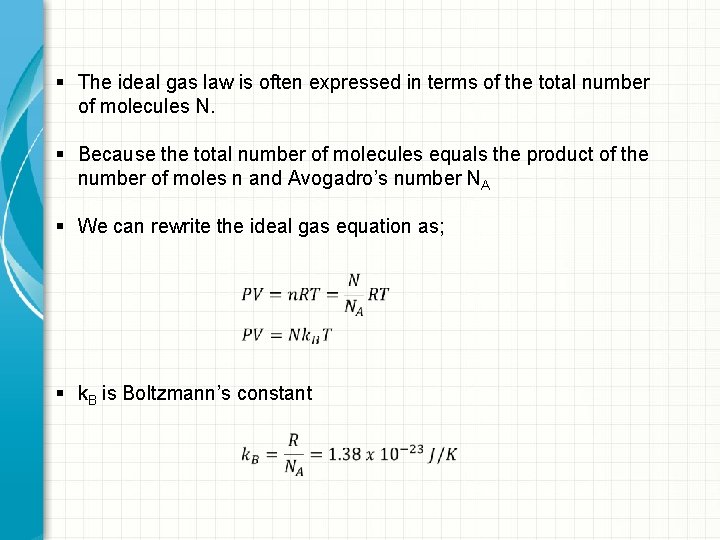
§ The ideal gas law is often expressed in terms of the total number of molecules N. § Because the total number of molecules equals the product of the number of moles n and Avogadro’s number NA § We can rewrite the ideal gas equation as; § k. B is Boltzmann’s constant
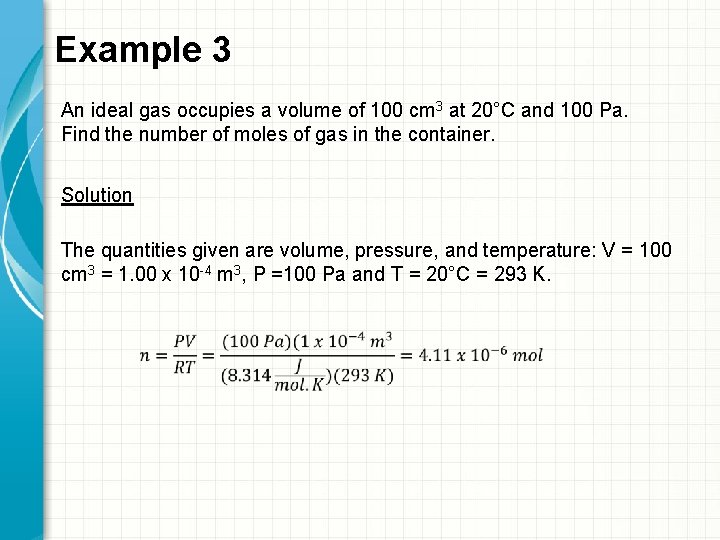
Example 3 An ideal gas occupies a volume of 100 cm 3 at 20°C and 100 Pa. Find the number of moles of gas in the container. Solution The quantities given are volume, pressure, and temperature: V = 100 cm 3 = 1. 00 x 10 -4 m 3, P =100 Pa and T = 20°C = 293 K.
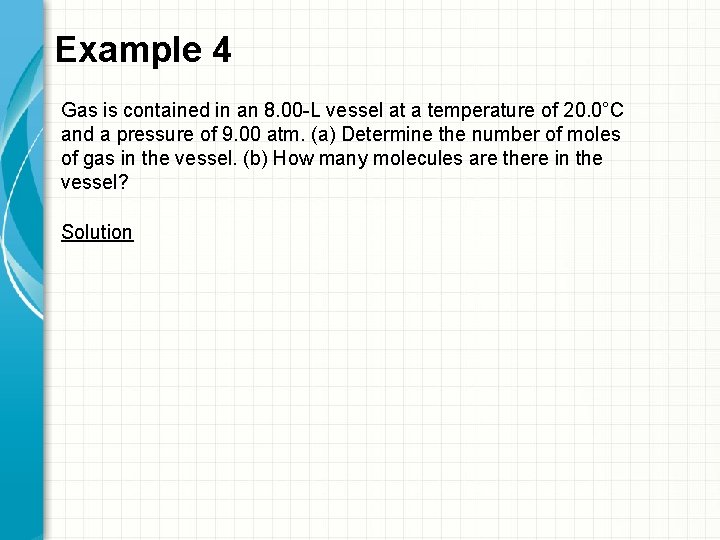
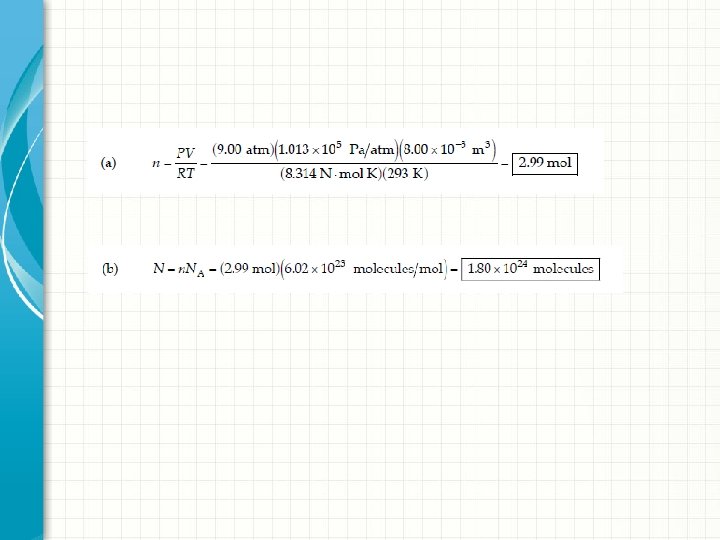
Example 4 Gas is contained in an 8. 00 -L vessel at a temperature of 20. 0°C and a pressure of 9. 00 atm. (a) Determine the number of moles of gas in the vessel. (b) How many molecules are there in the vessel? Solution
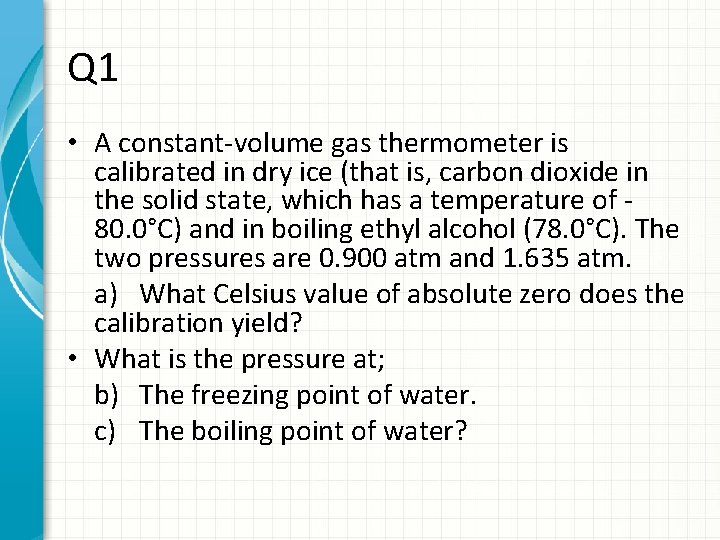
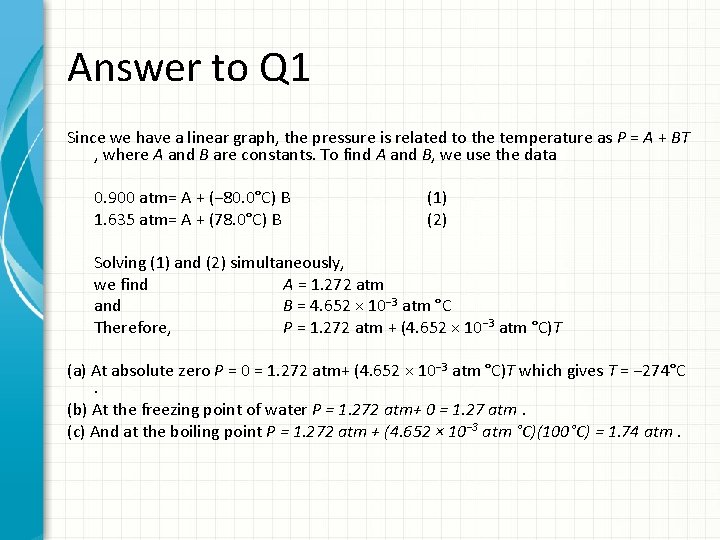
Q 1 • A constant-volume gas thermometer is calibrated in dry ice (that is, carbon dioxide in the solid state, which has a temperature of 80. 0°C) and in boiling ethyl alcohol (78. 0°C). The two pressures are 0. 900 atm and 1. 635 atm. a) What Celsius value of absolute zero does the calibration yield? • What is the pressure at; b) The freezing point of water. c) The boiling point of water?
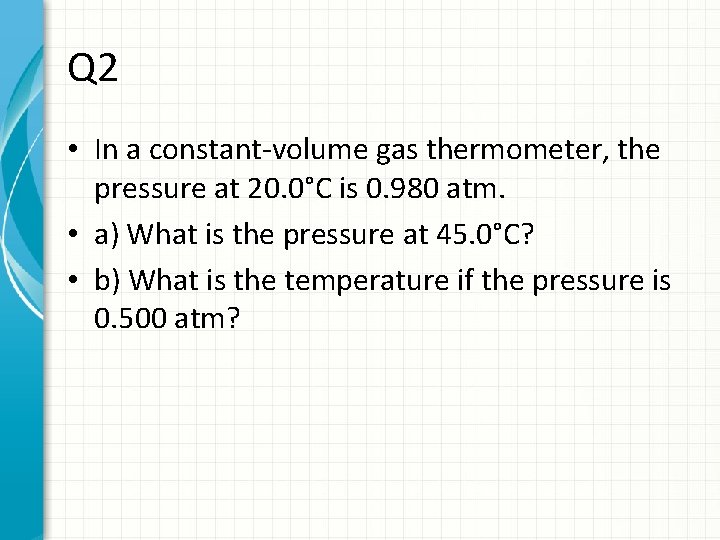
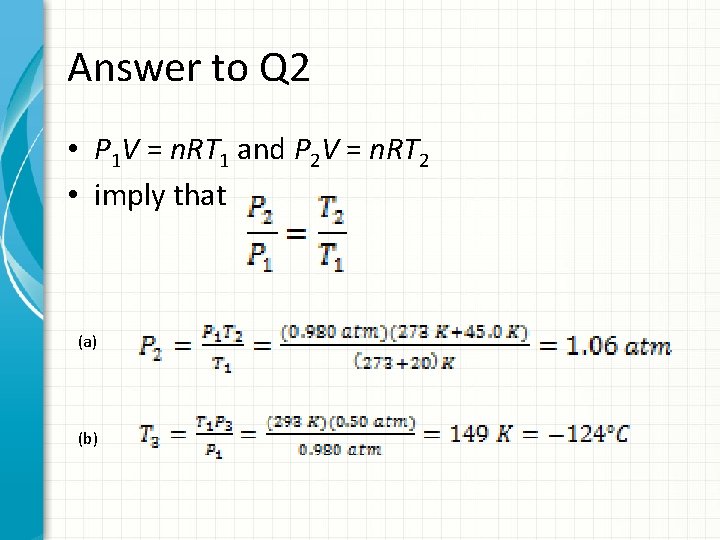
Q 2 • In a constant-volume gas thermometer, the pressure at 20. 0°C is 0. 980 atm. • a) What is the pressure at 45. 0°C? • b) What is the temperature if the pressure is 0. 500 atm?
Answer to Q 1 Since we have a linear graph, the pressure is related to the temperature as P = A + BT , where A and B are constants. To find A and B, we use the data 0. 900 atm= A + (− 80. 0°C) B 1. 635 atm= A + (78. 0°C) B (1) (2) Solving (1) and (2) simultaneously, we find A = 1. 272 atm and B = 4. 652 × 10− 3 atm °C Therefore, P = 1. 272 atm + (4. 652 × 10− 3 atm °C)T (a) At absolute zero P = 0 = 1. 272 atm+ (4. 652 × 10− 3 atm °C)T which gives T = − 274°C. (b) At the freezing point of water P = 1. 272 atm+ 0 = 1. 27 atm. (c) And at the boiling point P = 1. 272 atm + (4. 652 × 10− 3 atm °C)(100°C) = 1. 74 atm.
Answer to Q 2 • P 1 V = n. RT 1 and P 2 V = n. RT 2 • imply that (a) (b)