
Chapter 29 How Do Ecosystems Work Lectures by
Chapter 29 How Do Ecosystems Work? Lectures by Gregory Ahearn University of North Florida Copyright © 2009 Pearson Education, Inc. .
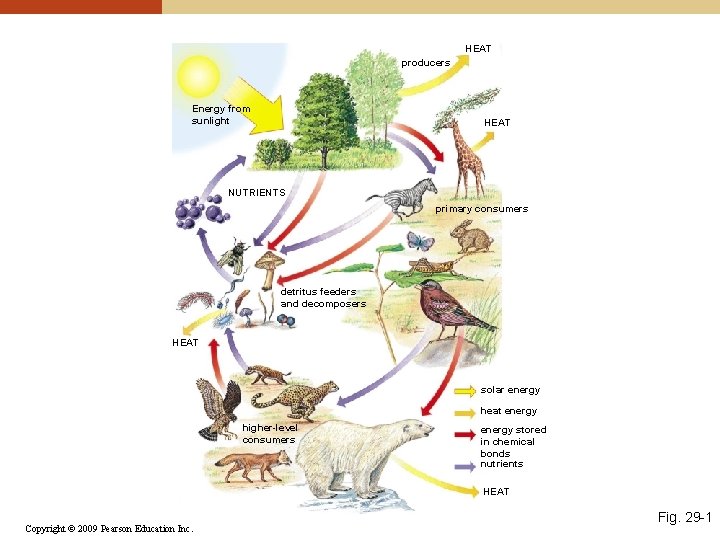
HEAT producers Energy from sunlight HEAT NUTRIENTS primary consumers detritus feeders and decomposers HEAT solar energy heat energy higher-level consumers energy stored in chemical bonds nutrients HEAT Copyright © 2009 Pearson Education Inc. Fig. 29 -1
29. 2 How Does Energy Flow Through Ecosystems? § Energy enters ecosystems mainly through ________. • During photosynthesis, solar energy powers reactions that store energy in the chemical bonds of sugar and other high-energy molecules. • Photosynthetic organisms produce food for themselves, using nonliving nutrients and sunlight. • Organisms that can produce their own food are called autotrophs, or ______. Copyright © 2009 Pearson Education Inc.
29. 2 How Does Energy Flow Through Ecosystems? § As producers manufacture food for themselves, they directly or indirectly produce food for nearly all other organisms as well. • Organisms that cannot produce their own food are called heterotrophs, or _______. • Heterotrophs must acquire energy and many of their nutrients from the bodies of other organisms. Copyright © 2009 Pearson Education Inc.
29. 2 How Does Energy Flow Through Ecosystems? § Energy passes from one trophic level to another. • Energy flows through communities from producers, which are the first trophic level, through several levels of consumers. • Primary consumers, or herbivores, feed directly on the producers and form the second trophic level. • The third and fourth trophic levels are the secondary and tertiary consumers, and consist of meat-eating predators. Copyright © 2009 Pearson Education Inc.
29. 2 How Does Energy Flow Through Ecosystems? § Feeding relationships within ecosystems form chains and webs. • It is common to identify a representative of each trophic level such that each representative species eats another on the level below it. • This linear feeding relationship is called a ________. • Different ecosystems have radically different food chains. Copyright © 2009 Pearson Education Inc.
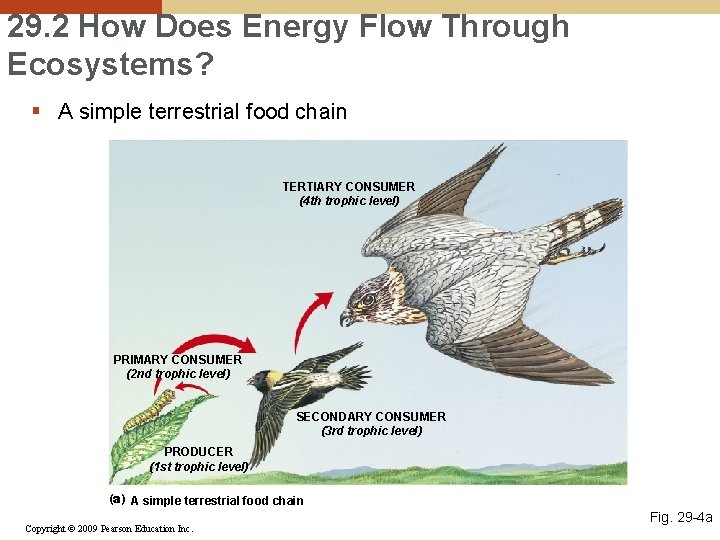
29. 2 How Does Energy Flow Through Ecosystems? § A simple terrestrial food chain TERTIARY CONSUMER (4 th trophic level) PRIMARY CONSUMER (2 nd trophic level) SECONDARY CONSUMER (3 rd trophic level) PRODUCER (1 st trophic level) (a) A simple terrestrial food chain Copyright © 2009 Pearson Education Inc. Fig. 29 -4 a
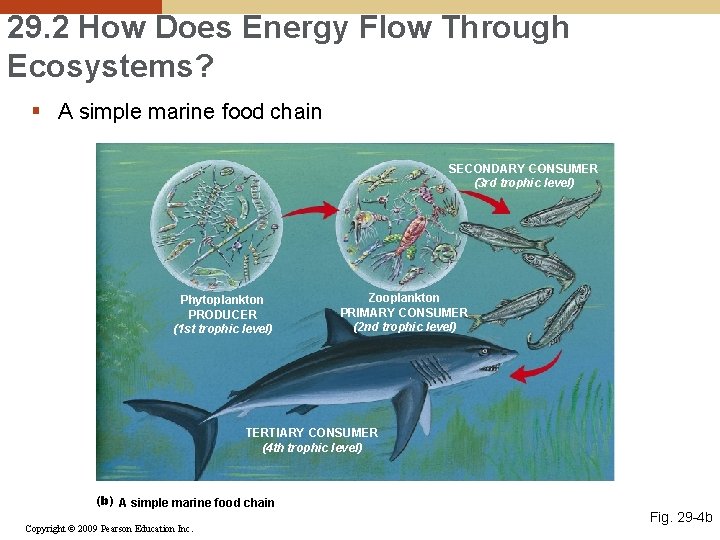
29. 2 How Does Energy Flow Through Ecosystems? § A simple marine food chain SECONDARY CONSUMER (3 rd trophic level) Phytoplankton PRODUCER (1 st trophic level) Zooplankton PRIMARY CONSUMER (2 nd trophic level) TERTIARY CONSUMER (4 th trophic level) (b) A simple marine food chain Copyright © 2009 Pearson Education Inc. Fig. 29 -4 b
29. 3 How Do Nutrients Move Within And Among Ecosystems? § Carbon cycles through the atmosphere, oceans, and communities. • Carbon enters the living part of the ecosystem when producers capture CO 2 during _______ and incorporate its carbon atoms in organic molecules. • Primary consumers, such as rabbits, shrimp, and grasshoppers, eat the producers and acquire the carbon stored in their tissues. • Producers and consumers die, and the carbon in their bodies is returned to the reservoirs by ________. Copyright © 2009 Pearson Education Inc.
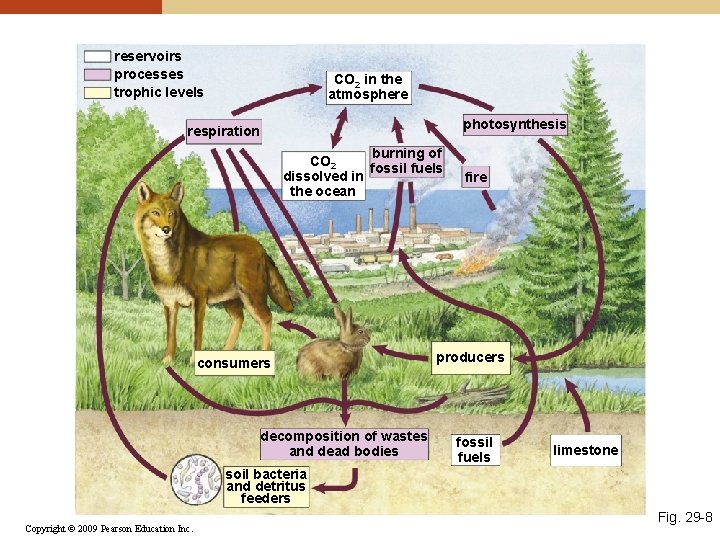
reservoirs processes trophic levels CO 2 in the atmosphere photosynthesis respiration burning of CO 2 fossil fuels dissolved in the ocean consumers decomposition of wastes and dead bodies fire producers fossil fuels limestone soil bacteria and detritus feeders Copyright © 2009 Pearson Education Inc. Fig. 29 -8
29. 4 What Happens When Humans Disrupt Nutrient Cycles? § Overloading the carbon cycle contributes to global warming. • Much of Earth’s carbon is in long-term storage in reservoirs such as __________, which are formed from the buried remains of plants and animals. • Over millions of years, the carbon in the organic molecules of these organisms is transformed by high temperature and pressure into _____, or ______. • _____ fossil fuels transfers the carbon locked in these reservoirs into atmospheric CO 2. Copyright © 2009 Pearson Education Inc.
29. 4 What Happens When Humans Disrupt Nutrient Cycles? • Since the Industrial Revolution, humans have increasingly relied on the energy stored in fossil fuels. • When we burn them in our power plants, factories, and cars, CO 2 is released into the atmosphere. • The amount of CO 2 in the atmosphere has increased by more than 36% since 1850, from 280 parts per million (ppm) to 381 ppm. • Deforestation also adds CO 2 to the atmosphere. • When forests are cut and burned, the carbon stored in the bodies of the trees returns to the atmosphere. • Altogether, humans release almost 7 billion tons of CO 2 into the atmosphere each year, much of which fuels global warming. Copyright © 2009 Pearson Education Inc.
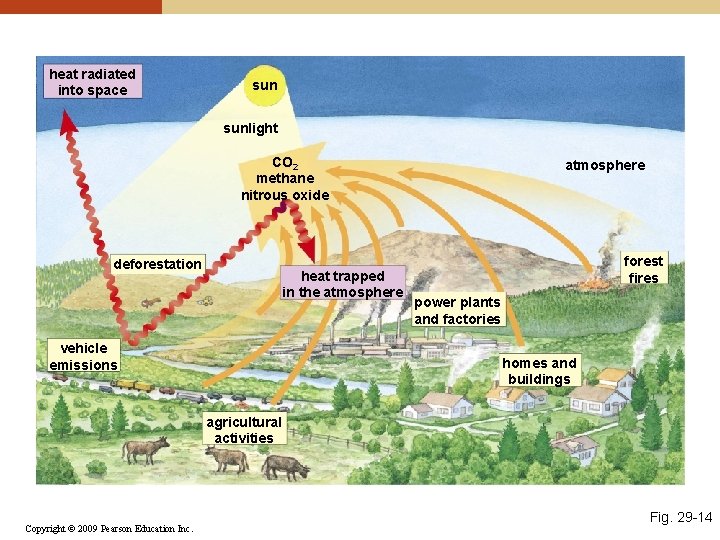
heat radiated into space sunlight CO 2 methane nitrous oxide deforestation heat trapped in the atmosphere vehicle emissions atmosphere forest fires power plants and factories homes and buildings agricultural activities Copyright © 2009 Pearson Education Inc. Fig. 29 -14
29. 4 What Happens When Humans Disrupt Nutrient Cycles? § _______ gases trap heat in the atmosphere. • Atmospheric CO 2 acts like glass in a greenhouse—it allows solar energy to pass through it to reach Earth’s surface, but does not allow much of it to be released back into space, thus increasing the heat content of the atmosphere as a result. • Most climate scientists have concluded that this greenhouse effect has been intensified by human activities that produce CO 2 and other greenhouse gases, such as methane. Copyright © 2009 Pearson Education Inc.
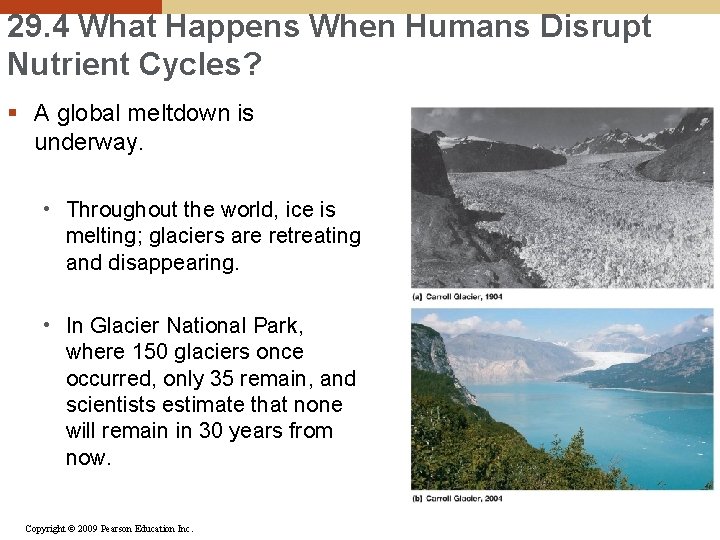
29. 4 What Happens When Humans Disrupt Nutrient Cycles? § A global meltdown is underway. • Throughout the world, ice is melting; glaciers are retreating and disappearing. • In Glacier National Park, where 150 glaciers once occurred, only 35 remain, and scientists estimate that none will remain in 30 years from now. Copyright © 2009 Pearson Education Inc.
29. 4 What Happens When Humans Disrupt Nutrient Cycles? § Weather is growing more extreme. • Scientists predict that global warming will increase the severity of extreme weather events. • During the past 35 years, both the intensity and duration of hurricanes has increased by 50%. • As the world warms further, droughts in certain areas will last longer and be more severe, disrupting agriculture. Copyright © 2009 Pearson Education Inc.
29. 4 What Happens When Humans Disrupt Nutrient Cycles? § Our decisions make a difference. • What can individuals do to help reduce the impact of global warming? • • Use fuel-efficient vehicles, car pools, and public transportation. Conserve electricity. Improve the energy-efficiency of housing. Recycle. Copyright © 2009 Pearson Education Inc.
- Slides: 17