
Chapter 2829 Relative Clauses Hee Sun Chang Rose



- Slides: 25
Chapter 28~29 Relative Clauses Hee Sun Chang Rose Zhang
Setting High school EFL class Intermediate Level
Definition of Relative Clauses A clause that generally modifies a noun or noun phrase and is introduced by a relative pronoun (which, that, whom, whose) or a relative adverb (where, when, why). Also known as an adjective clause.
Types of Relative Clauses Restrictive Relative Clauses Nonrestrictive Relative Clauses Adverbial Relative Clauses
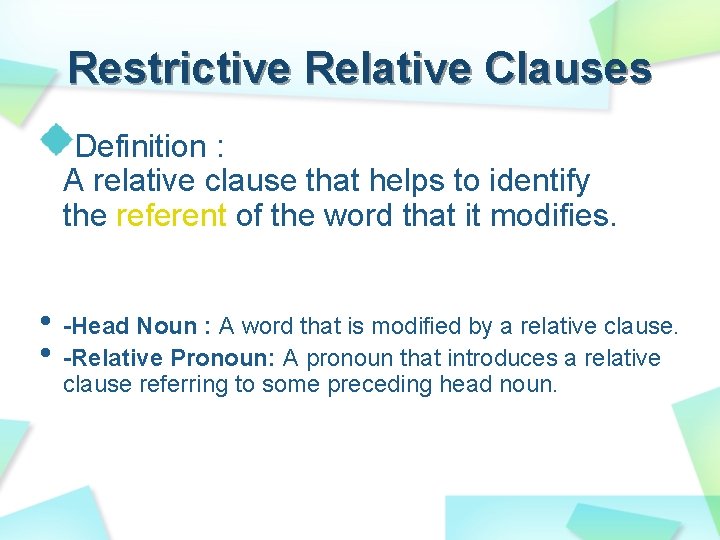
Restrictive Relative Clauses Definition : A relative clause that helps to identify the referent of the word that it modifies. • -Head Noun : A word that is modified by a relative clause. • -Relative Pronoun: A pronoun that introduces a relative clause referring to some preceding head noun.
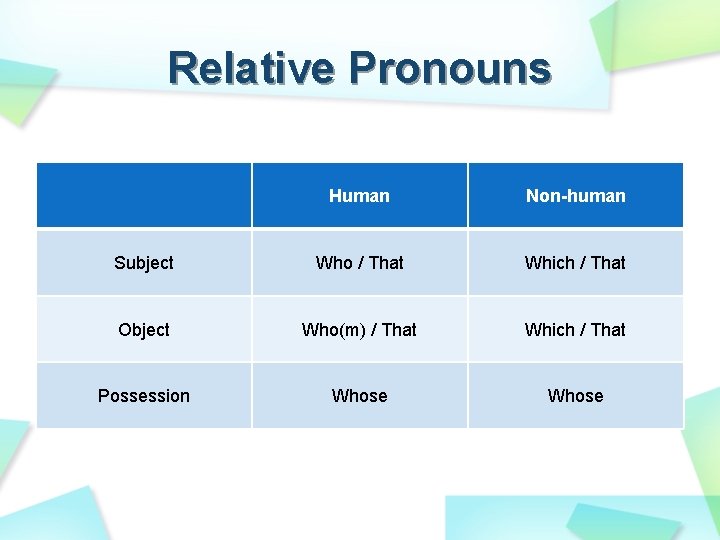
Relative Pronouns Human Non-human Subject Who / That Which / That Object Who(m) / That Which / That Possession Whose
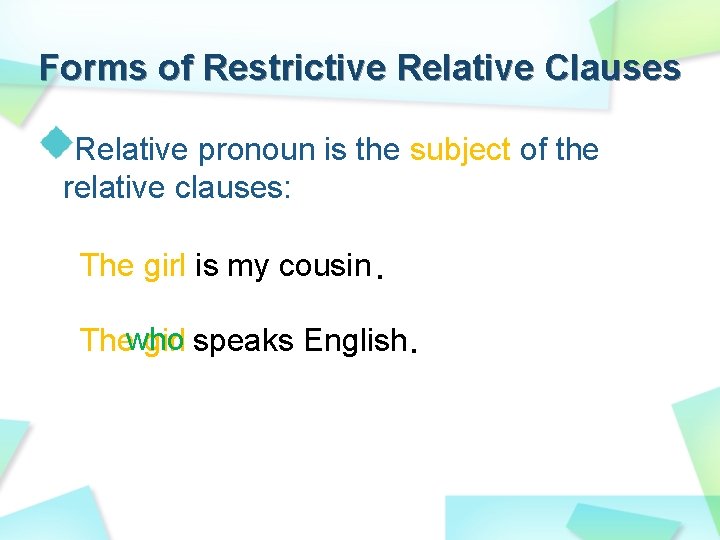
Forms of Restrictive Relative Clauses Relative pronoun is the subject of the relative clauses: The girl is my cousin. who speaks English. The girl
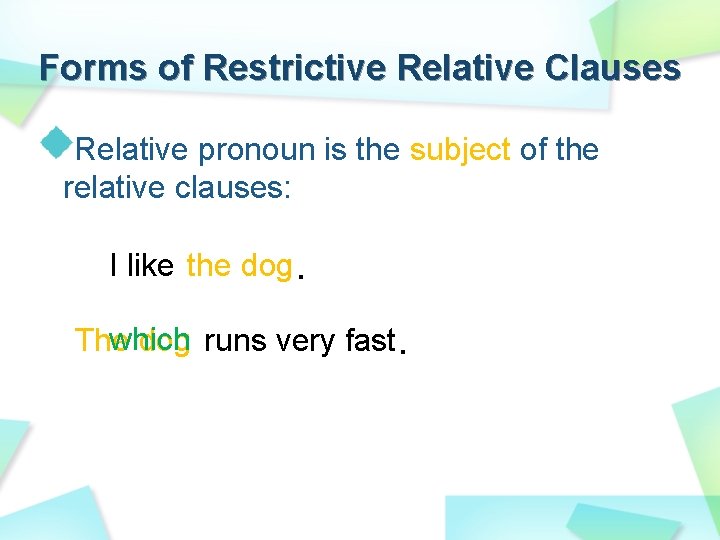
Forms of Restrictive Relative Clauses Relative pronoun is the subject of the relative clauses: I like the dog. which runs very fast. The dog
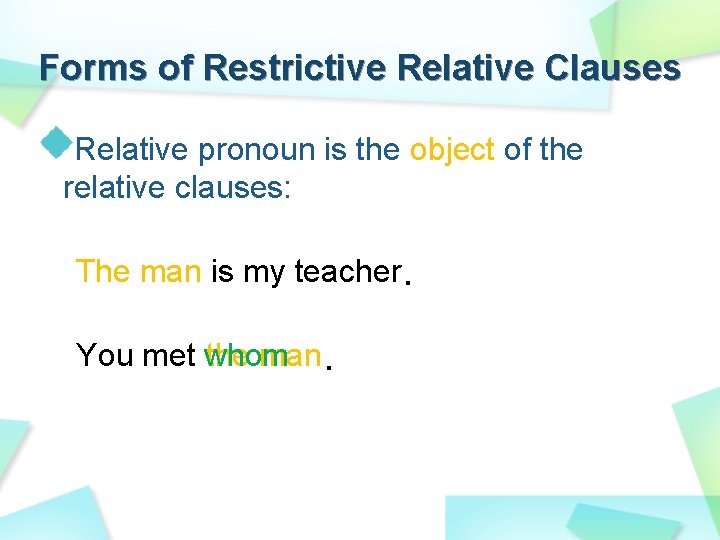
Forms of Restrictive Relative Clauses Relative pronoun is the object of the relative clauses: The man is my teacher. You met whom the man.
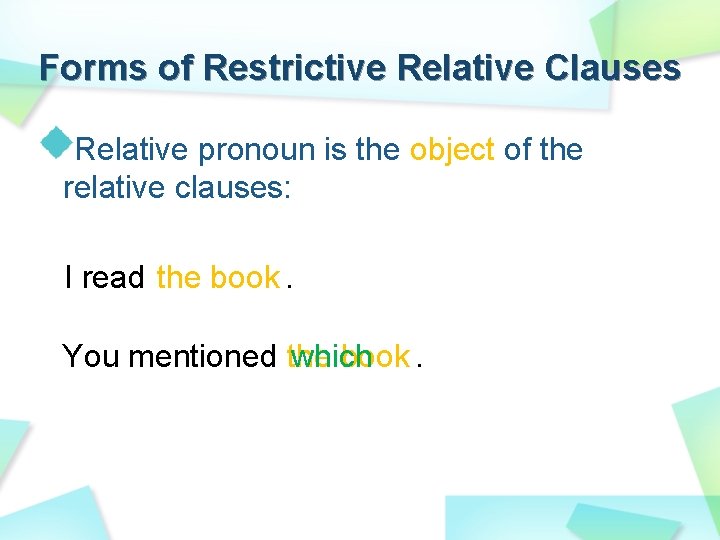
Forms of Restrictive Relative Clauses Relative pronoun is the object of the relative clauses: I read the book. You mentioned the book which.
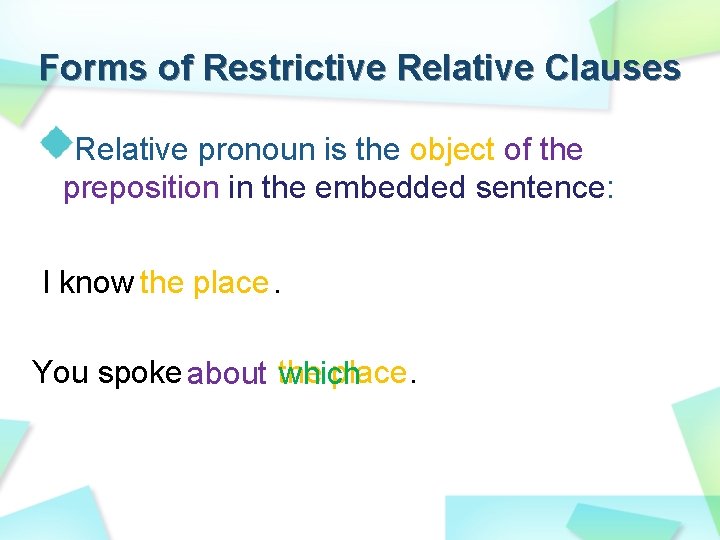
Forms of Restrictive Relative Clauses Relative pronoun is the object of the preposition in the embedded sentence: I know the place. You spoke about the place. which
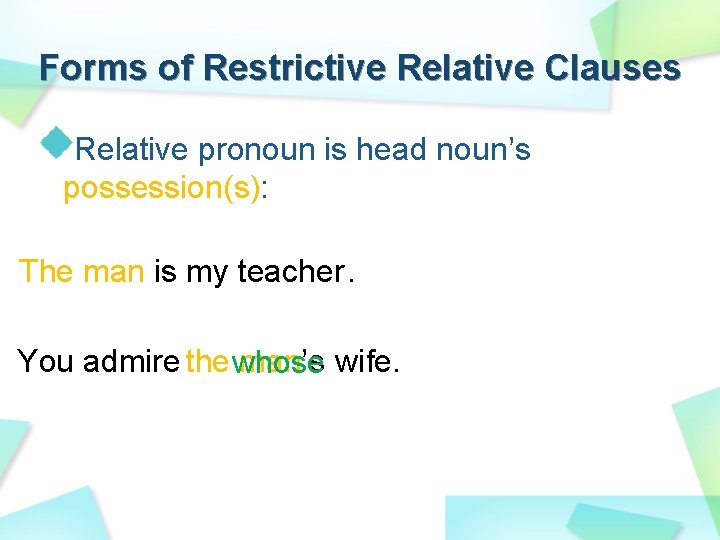
Forms of Restrictive Relative Clauses Relative pronoun is head noun’s possession(s): The man is my teacher. You admire the man’s whose wife.
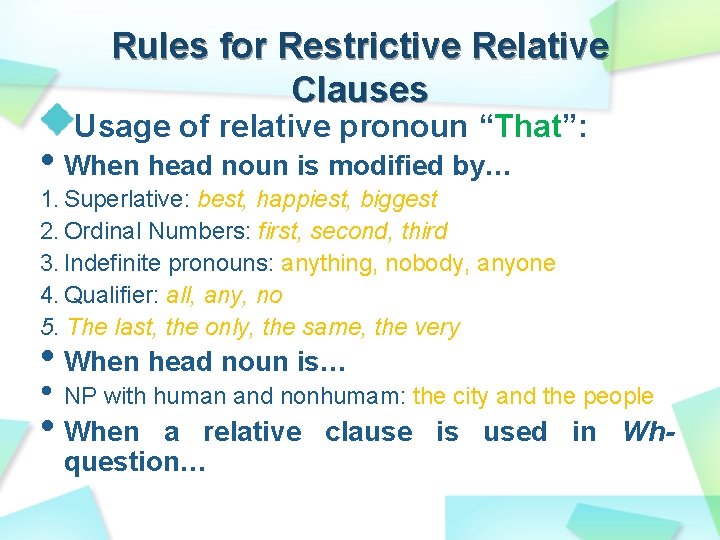
Rules for Restrictive Relative Clauses Usage of relative pronoun “That”: • When head noun is modified by… 1. Superlative: best, happiest, biggest 2. Ordinal Numbers: first, second, third 3. Indefinite pronouns: anything, nobody, anyone 4. Qualifier: all, any, no 5. The last, the only, the same, the very • When head noun is… • NP with human and nonhumam: the city and the people • When a relative clause is used in Whquestion…
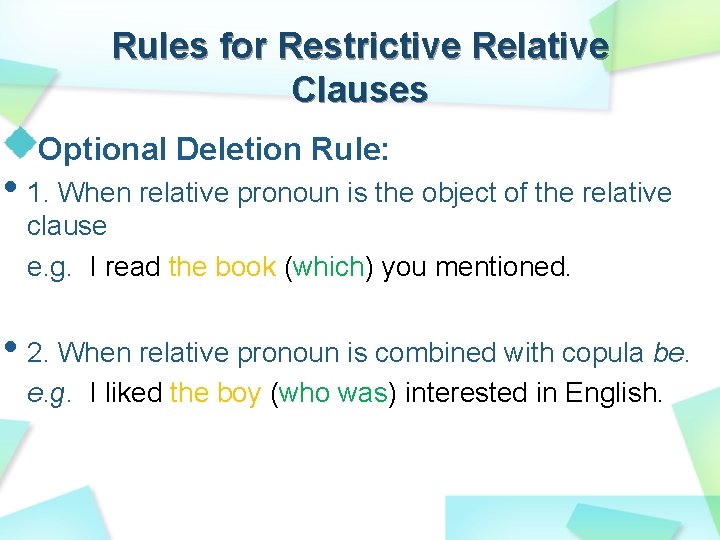
Rules for Restrictive Relative Clauses Optional Deletion Rule: • 1. When relative pronoun is the object of the relative clause e. g. I read the book (which) you mentioned. • 2. When relative pronoun is combined with copula be. e. g. I liked the boy (who was) interested in English.
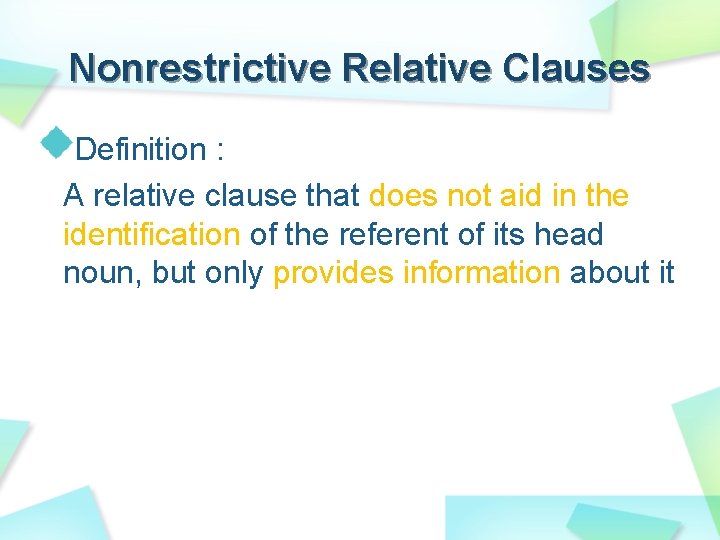
Nonrestrictive Relative Clauses Definition : A relative clause that does not aid in the identification of the referent of its head noun, but only provides information about it
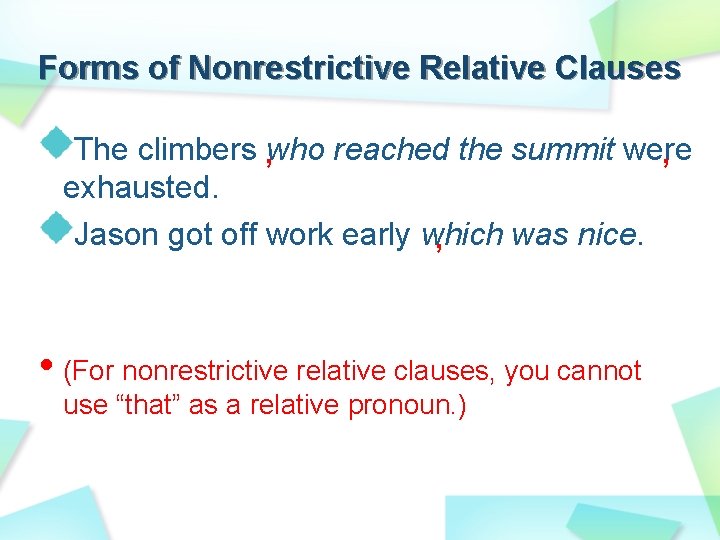
Forms of Nonrestrictive Relative Clauses The climbers who reached the summit were , , exhausted. Jason got off work early which was nice. , • (For nonrestrictive relative clauses, you cannot use “that” as a relative pronoun. )
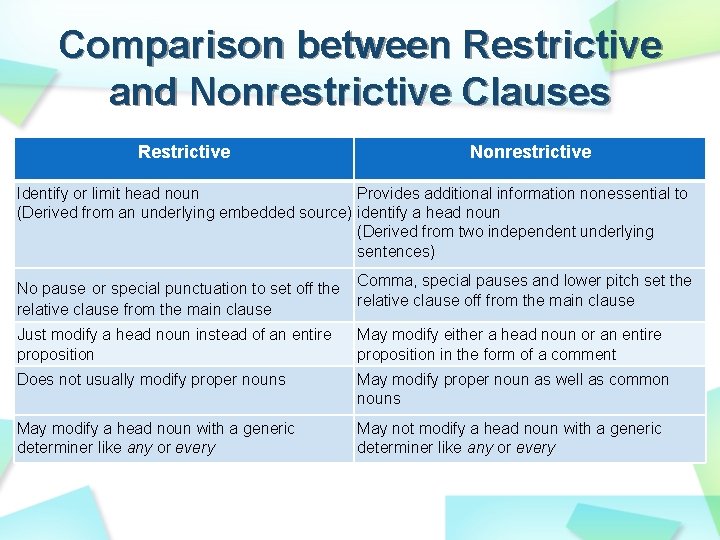
Comparison between Restrictive and Nonrestrictive Clauses Restrictive Nonrestrictive Identify or limit head noun Provides additional information nonessential to (Derived from an underlying embedded source) identify a head noun (Derived from two independent underlying sentences) No pause or special punctuation to set off the Comma, special pauses and lower pitch set the relative clause off from the main clause relative clause from the main clause Just modify a head noun instead of an entire proposition May modify either a head noun or an entire proposition in the form of a comment Does not usually modify proper nouns May modify proper noun as well as common nouns May modify a head noun with a generic determiner like any or every May not modify a head noun with a generic determiner like any or every
First Activity!
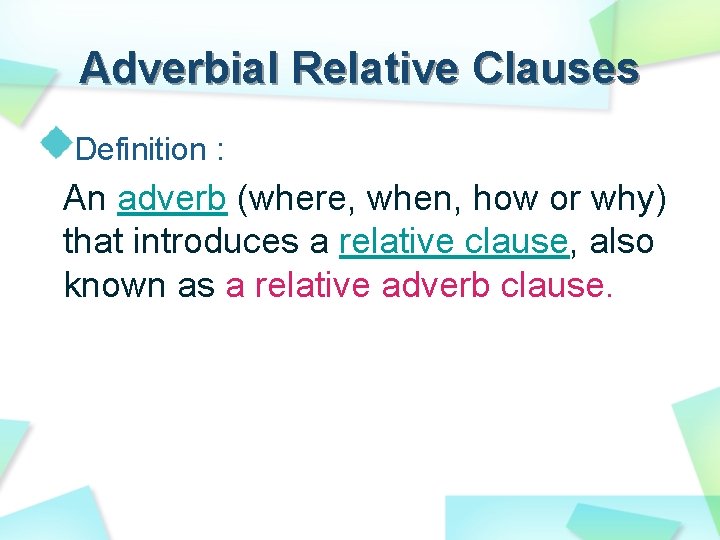
Adverbial Relative Clauses Definition : An adverb (where, when, how or why) that introduces a relative clause, also known as a relative adverb clause.
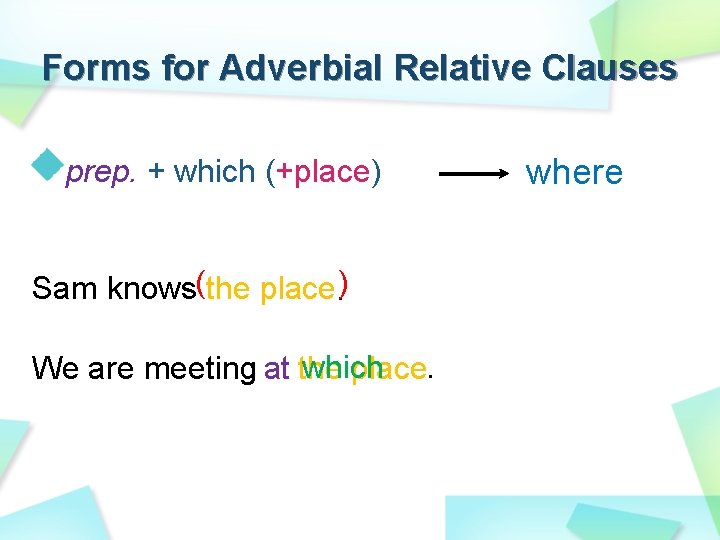
Forms for Adverbial Relative Clauses prep. + which (+place) ( ). Sam knows the place which. We are meeting at the place where
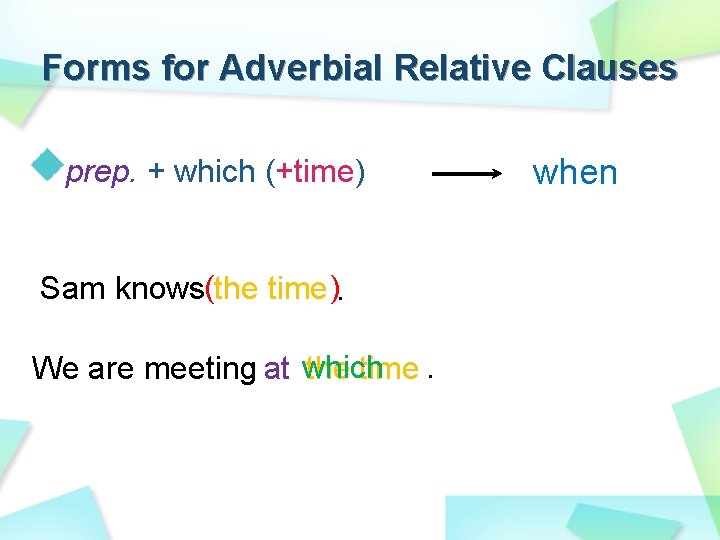
Forms for Adverbial Relative Clauses prep. + which (+time) ( ). Sam knows the time We are meeting at which the time. when
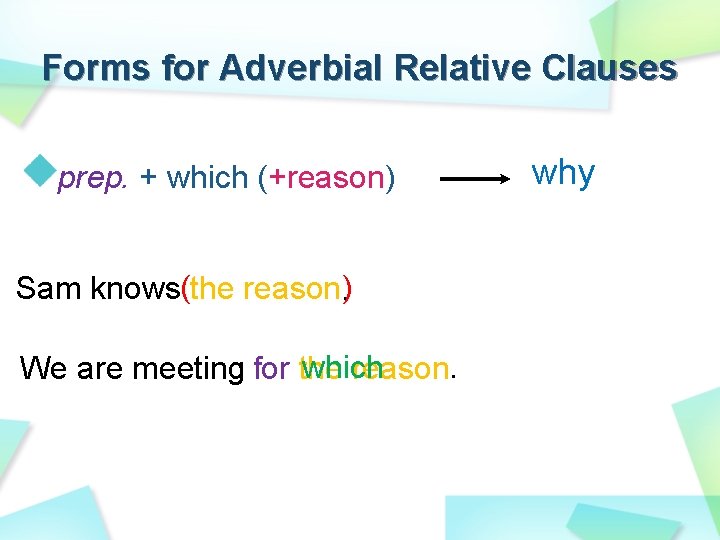
Forms for Adverbial Relative Clauses prep. + which (+reason) ( ). Sam knows the reason which. We are meeting for the reason why
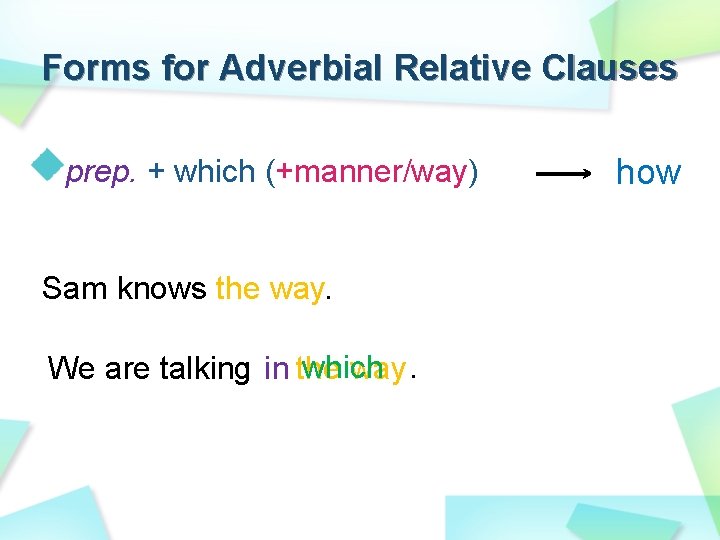
Forms for Adverbial Relative Clauses prep. + which (+manner/way) Sam knows the way. which. We are talking in the way how
Final Activity!