
Chapter 28 The Reproductive System Embryology and Human
Chapter 28 The Reproductive System Embryology and Human Development Lecture Presentation by Steven Bassett Southeast Community College © 2015 Pearson Education, Inc.
An Overview of Development • Development involves: • Differentiation of cells • Reorganization of cells • Development can be characterized by different periods of time • Prenatal development • Embryology • Postnatal development © 2015 Pearson Education, Inc.
An Overview of Development • Development can be characterized by different periods of time • Prenatal development • Conception to delivery • Involves embryology (development during the prenatal period) • Postnatal development • Development from birth to maturity © 2015 Pearson Education, Inc.
An Overview of Development • Prenatal development can be further subdivided • Pre-embryonic development • Fertilization to implantation • Embryonic development • Implantation to the end of the eighth week of pregnancy • Fetal development • Ninth week of pregnancy to birth © 2015 Pearson Education, Inc.
Fertilization • Fertilization is the joining of two haploid cells to create a diploid cell • Function of the haploid cells • Spermatozoon • Delivers the paternal chromosomes to the ovum • Ovum • Provides the maternal chromosomes • Provides nourishment for embryonic development © 2015 Pearson Education, Inc.
Fertilization • Fertilization occurs in the ampulla of the uterine tube • 200 million sperm cells enter the vaginal canal • Only about 10, 000 make it to the uterine tubes • Less than 100 actually contact the egg • Only one will fertilize the egg © 2015 Pearson Education, Inc.
Fertilization • The Oocyte at Ovulation • When the egg is ovulated, it is surrounded by the corona radiata • Protects the egg as it is being ovulated • Numerous sperm cells release hyaluronidase from their acrosomal cap • Hyaluronidase decomposes the corona radiata • A sperm cell can now penetrate the egg © 2015 Pearson Education, Inc.
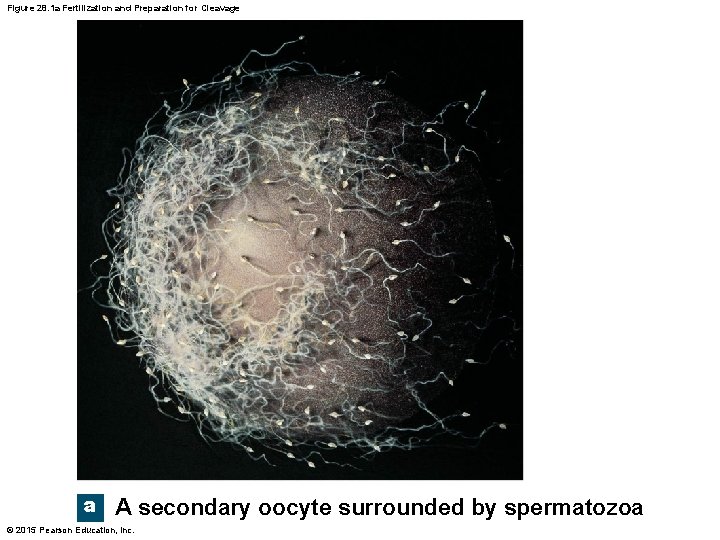
Figure 28. 1 a Fertilization and Preparation for Cleavage a A secondary oocyte surrounded by spermatozoa © 2015 Pearson Education, Inc.
Fertilization • Pronucleus Formation and Amphimixis • The nuclear material in the egg is the female pronucleus • The nuclear material in the sperm is the male pronucleus • Amphimixis • The fusion of the two pronuclei • A zygote is now formed © 2015 Pearson Education, Inc.
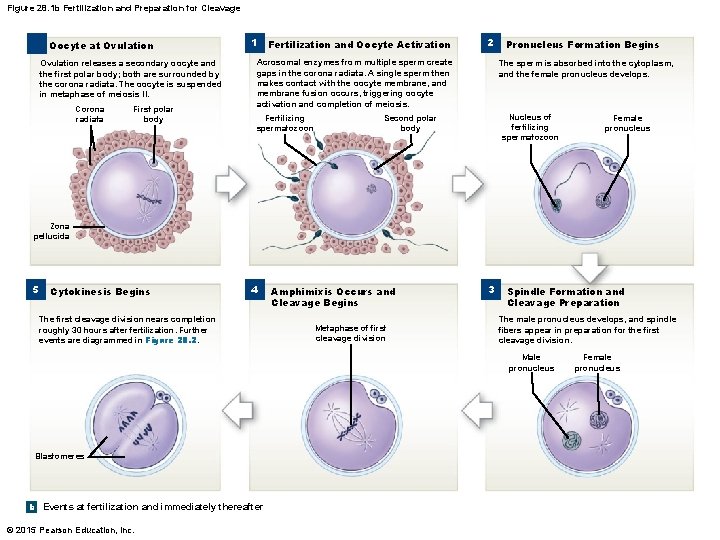
Figure 28. 1 b Fertilization and Preparation for Cleavage Oocyte at Ovulation releases a secondary oocyte and the first polar body; both are surrounded by the corona radiata. The oocyte is suspended in metaphase of meiosis II. Corona radiata First polar body 1 Fertilization and Oocyte Activation 2 Acrosomal enzymes from multiple sperm create gaps in the corona radiata. A single sperm then makes contact with the oocyte membrane, and membrane fusion occurs, triggering oocyte activation and completion of meiosis. Fertilizing spermatozoon Pronucleus Formation Begins The sperm is absorbed into the cytoplasm, and the female pronucleus develops. Nucleus of fertilizing spermatozoon Second polar body Female pronucleus Zona pellucida 5 Cytokinesis Begins 4 The first cleavage division nears completion roughly 30 hours after fertilization. Further events are diagrammed in Figure 28. 2. Amphimixis Occurs and Cleavage Begins Metaphase of first cleavage division 3 Spindle Formation and Cleavage Preparation The male pronucleus develops, and spindle fibers appear in preparation for the first cleavage division. Male pronucleus Blastomeres b Events at fertilization and immediately thereafter © 2015 Pearson Education, Inc. Female pronucleus
Prenatal Development • Prenatal development is known as the gestation period (nine months) • Prenatal development is divided into trimesters • First trimester • Second trimester • Third trimester © 2015 Pearson Education, Inc.
Prenatal Development • The Trimesters • First trimester • Rudiments of all organs appear • Second trimester • Fetus looks like a human • Third trimester • Organs become functional • Rapid growth © 2015 Pearson Education, Inc.
Prenatal Development • The First Trimester • 1 to 12 weeks • Four events within the first trimester • Cleavage (sequence of cell divisions) • A blastocyst forms • Implantation (implantation into endometrial lining) • Placentation (formation of the placenta) • Embryogenesis (development of the embryo) © 2015 Pearson Education, Inc.
Prenatal Development • Cleavage and Blastocyst Formation • Cell division results in the formation of blastomeres • A solid ball of cells eventually develops—this is a morula • Some cells migrate to one “edge” of the morula creating a mass of cells and a hollow cavity called the blastocoele • The ball of cells is now called the blastocyst • The outer layer of the blastocyst consists of cells called the trophoblast © 2015 Pearson Education, Inc.
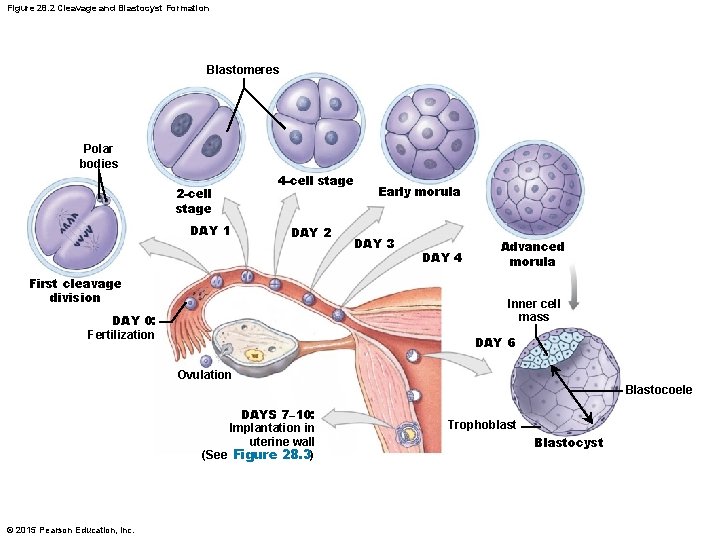
Figure 28. 2 Cleavage and Blastocyst Formation Blastomeres Polar bodies 2 -cell stage DAY 1 4 -cell stage DAY 2 First cleavage division Early morula DAY 3 DAY 4 Advanced morula Inner cell mass DAY 0: Fertilization DAY 6 Ovulation Blastocoele DAYS 7– 10: Implantation in uterine wall (See Figure 28. 3) © 2015 Pearson Education, Inc. Trophoblast Blastocyst
Prenatal Development • Cleavage and Blastocyst Formation (continued) • Trophoblast cells provide nutrients to the developing embryo • The inner cell mass consists of stem cells that will develop into all the cells of the body © 2015 Pearson Education, Inc.
Prenatal Development • Implantation • Upon contact with the endometrial lining, the trophoblast cells divide rapidly • The trophoblast cells “fuse” with the endometrial lining forming a syncytial trophoblast • This layer of cells releases hyaluronidase to erode away more of the endometrial lining so the mass can implant © 2015 Pearson Education, Inc.
Prenatal Development • Implantation (continued) • Upon implantation, the inner cell mass separates from the trophoblast area • When the inner cell mass separates from the trophoblast, two cavities form: • Amnionic cavity • Blastocoele cavity © 2015 Pearson Education, Inc.
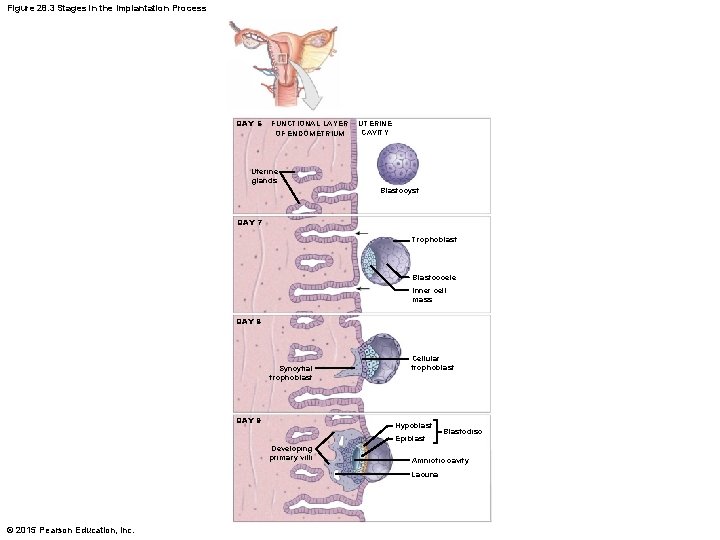
Figure 28. 3 Stages in the Implantation Process DAY 6 FUNCTIONAL LAYER OF ENDOMETRIUM UTERINE CAVITY Uterine glands Blastocyst DAY 7 Trophoblast Blastocoele Inner cell mass DAY 8 Syncytial trophoblast DAY 9 Cellular trophoblast Hypoblast Epiblast Developing primary villi Amniotic cavity Lacuna © 2015 Pearson Education, Inc. Blastodisc
Prenatal Development • Formation of the Blastodisc • A layer of cells forms between the amnionic cavity and the blastocoele cavity • The layers are called: • Epiblast • Hypoblast © 2015 Pearson Education, Inc.
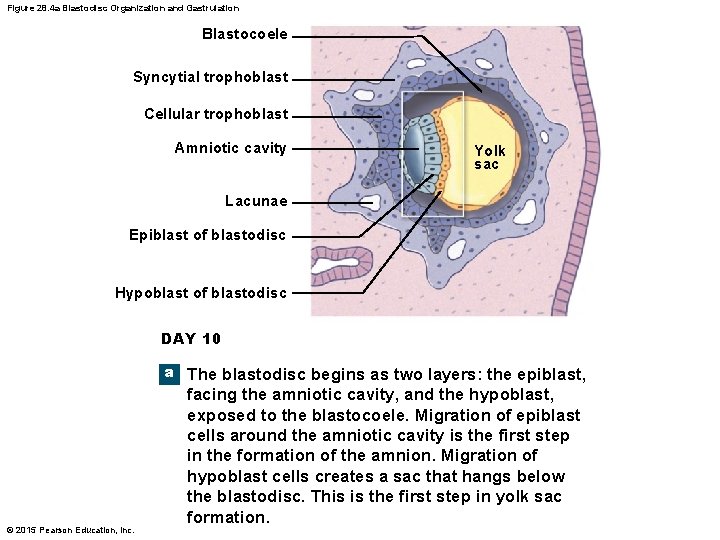
Figure 28. 4 a Blastodisc Organization and Gastrulation Blastocoele Syncytial trophoblast Cellular trophoblast Amniotic cavity Yolk sac Lacunae Epiblast of blastodisc Hypoblast of blastodisc DAY 10 a The blastodisc begins as two layers: the epiblast, © 2015 Pearson Education, Inc. facing the amniotic cavity, and the hypoblast, exposed to the blastocoele. Migration of epiblast cells around the amniotic cavity is the first step in the formation of the amnion. Migration of hypoblast cells creates a sac that hangs below the blastodisc. This is the first step in yolk sac formation.
Prenatal Development • Gastrulation and Germ Layer Formation • Eventually some cells of the epiblast move toward the center of the blastodisc creating a primitive streak • This movement is called gastrulation • As the cells move toward the primitive streak area, they begin to migrate between the epiblast and hypoblast layers • This creates three distinct layers of cells © 2015 Pearson Education, Inc.
Prenatal Development • Gastrulation and Germ Layer Formation • The three layers of cells are: • Ectoderm • Derived from the epiblast layer • Mesoderm • New layer between the epiblast and hypoblast • Endoderm • Derived from the hypoblast layer © 2015 Pearson Education, Inc.
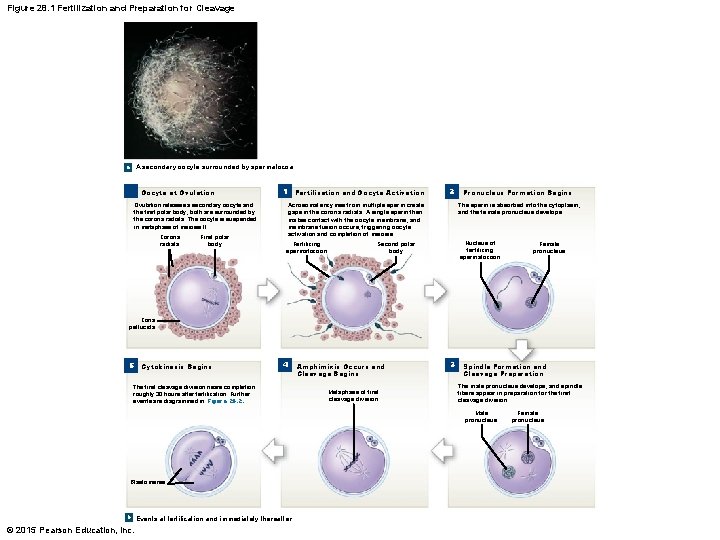
Figure 28. 1 Fertilization and Preparation for Cleavage a A secondary oocyte surrounded by spermatozoa Oocyte at Ovulation 1 Fertilization and Oocyte Activation Corona radiata First polar body 2 Pronucleus Formation Begins Acrosomal enzymes from multiple sperm create gaps in the corona radiata. A single sperm then makes contact with the oocyte membrane, and membrane fusion occurs, triggering oocyte activation and completion of meiosis. The sperm is absorbed into the cytoplasm, and the female pronucleus develops. Fertilizing spermatozoon Nucleus of fertilizing spermatozoon Ovulation releases a secondary oocyte and the first polar body; both are surrounded by the corona radiata. The oocyte is suspended in metaphase of meiosis II. Second polar body Female pronucleus Zona pellucida 5 Cytokinesis Begins 4 The first cleavage division nears completion roughly 30 hours after fertilization. Further events are diagrammed in Figure 28. 2. Amphimixis Occurs and Cleavage Begins Metaphase of first cleavage division 3 Spindle Formation and Cleavage Preparation The male pronucleus develops, and spindle fibers appear in preparation for the first cleavage division. Male pronucleus Blastomeres b Events at fertilization and immediately thereafter © 2015 Pearson Education, Inc. Female pronucleus
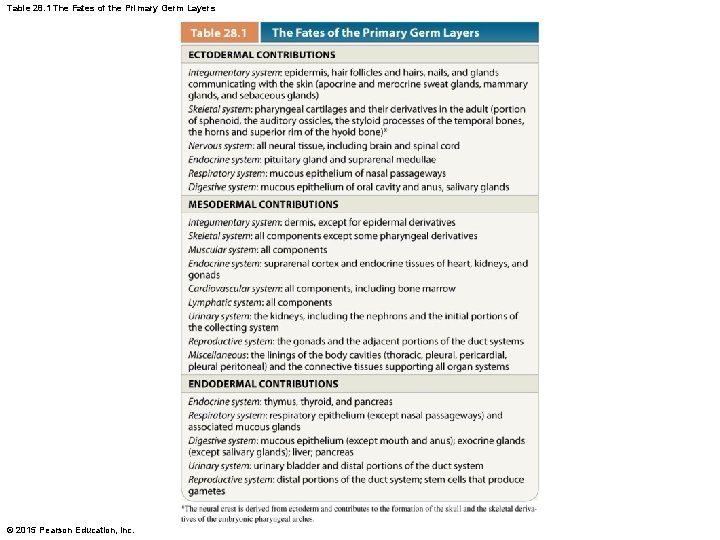
Table 28. 1 The Fates of the Primary Germ Layers © 2015 Pearson Education, Inc.
Prenatal Development • Formation of Extraembryonic Membranes • The ectoderm, mesoderm, and endoderm are collectively known as the germ layers • Each layer will form specific tissues and organs of the body • Germ layers will also form structures involved in embryonic survival called extraembryonic membranes © 2015 Pearson Education, Inc.
Prenatal Development • Formation of Extraembryonic Membranes • There are four major extraembryonic membranes • • Yolk sac Amnion Allantois Chorion © 2015 Pearson Education, Inc.
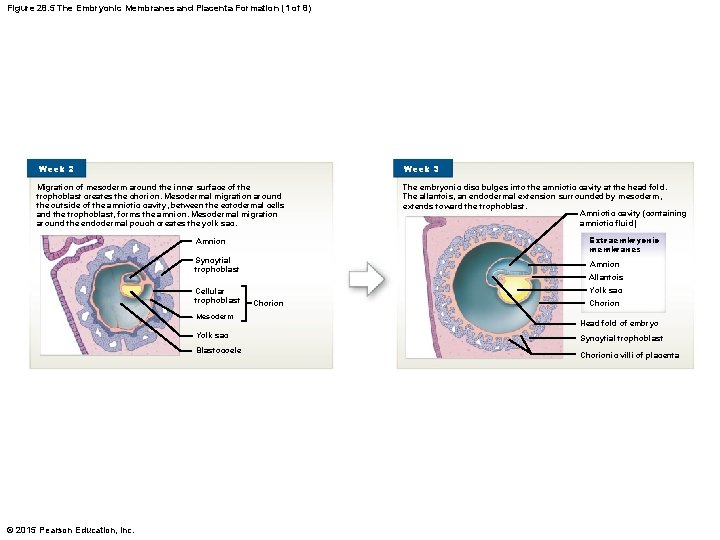
Figure 28. 5 The Embryonic Membranes and Placenta Formation (1 of 8) Week 2 Week 3 Migration of mesoderm around the inner surface of the trophoblast creates the chorion. Mesodermal migration around the outside of the amniotic cavity, between the ectodermal cells and the trophoblast, forms the amnion. Mesodermal migration around the endodermal pouch creates the yolk sac. The embryonic disc bulges into the amniotic cavity at the head fold. The allantois, an endodermal extension surrounded by mesoderm, extends toward the trophoblast. Amniotic cavity (containing amniotic fluid) Amnion Extraembryonic membranes Syncytial trophoblast Amnion Cellular trophoblast Mesoderm Yolk sac Blastocoele © 2015 Pearson Education, Inc. Allantois Yolk sac Chorion Head fold of embryo Syncytial trophoblast Chorionic villi of placenta
Prenatal Development • Formation of Extraembryonic Membranes • Yolk sac • This is a pouch that extends from the hypoblast cells into the blastocoele • It is the early site for blood cell formation • Amnion • Amniotic fluid fills the amniotic cavity, which surrounds and cushions the embryo and fetus © 2015 Pearson Education, Inc.
Prenatal Development • Formation of Extraembryonic Membranes (continued) • Allantois • Eventually gives rise to the urinary bladder • Chorion • The mesoderm and trophoblast layers together form the chorion • The chorion will eventually develop extensions into the endometrium © 2015 Pearson Education, Inc.
Prenatal Development • Placentation • The placenta begins to form when the chorion produces villi (chorionic villi) that extend into the endometrial lining • The body stalk connects the embryo to the chorion • As the fetus develops and moves farther into the uterus, it obtains its nutrients via the umbilical cord © 2015 Pearson Education, Inc.
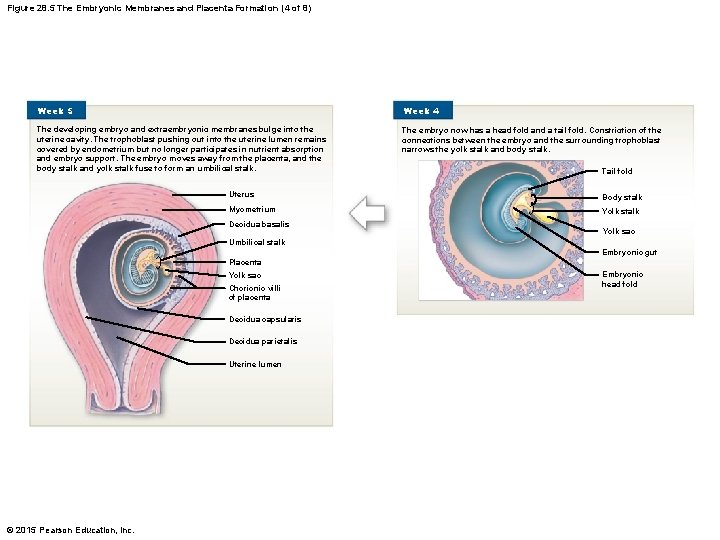
Figure 28. 5 The Embryonic Membranes and Placenta Formation (4 of 8) Week 5 Week 4 The developing embryo and extraembryonic membranes bulge into the uterine cavity. The trophoblast pushing out into the uterine lumen remains covered by endometrium but no longer participates in nutrient absorption and embryo support. The embryo moves away from the placenta, and the body stalk and yolk stalk fuse to form an umbilical stalk. The embryo now has a head fold and a tail fold. Constriction of the connections between the embryo and the surrounding trophoblast narrows the yolk stalk and body stalk. Tail fold Uterus Body stalk Myometrium Yolk stalk Decidua basalis Yolk sac Umbilical stalk Embryonic gut Placenta Yolk sac Chorionic villi of placenta Decidua capsularis Decidua parietalis Uterine lumen © 2015 Pearson Education, Inc. Embryonic head fold
Prenatal Development • Placental Circulation • Blood flows from the fetus to the placenta in the paired umbilical arteries • Blood returns via a single umbilical vein © 2015 Pearson Education, Inc.
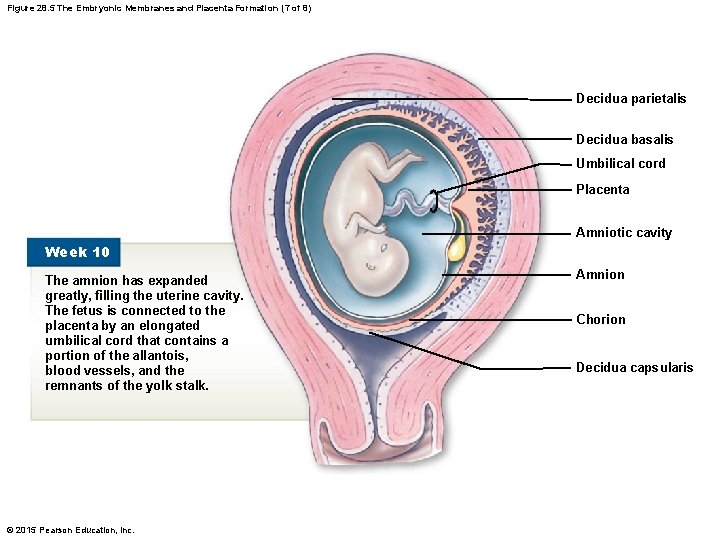
Figure 28. 5 The Embryonic Membranes and Placenta Formation (7 of 8) Decidua parietalis Decidua basalis Umbilical cord Placenta Amniotic cavity Week 10 The amnion has expanded greatly, filling the uterine cavity. The fetus is connected to the placenta by an elongated umbilical cord that contains a portion of the allantois, blood vessels, and the remnants of the yolk stalk. © 2015 Pearson Education, Inc. Amnion Chorion Decidua capsularis
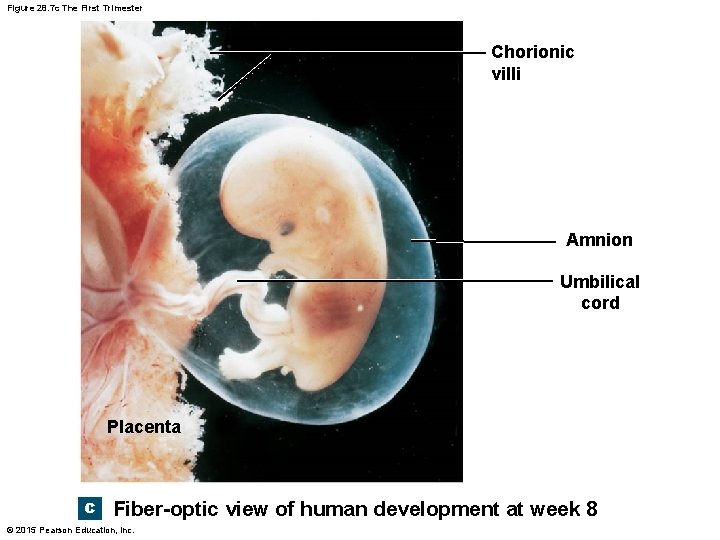
Figure 28. 7 c The First Trimester Chorionic villi Amnion Umbilical cord Placenta c Fiber-optic view of human development at week 8 © 2015 Pearson Education, Inc.
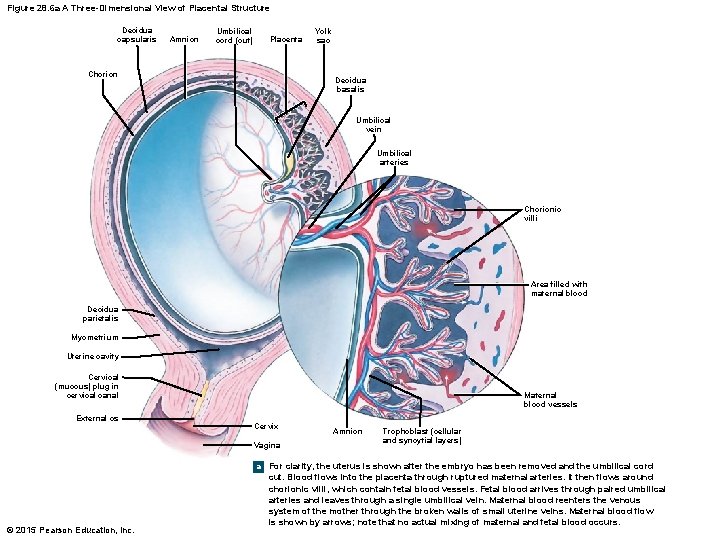
Figure 28. 6 a A Three-Dimensional View of Placental Structure Decidua capsularis Amnion Umbilical cord (cut) Placenta Chorion Yolk sac Decidua basalis Umbilical vein Umbilical arteries Chorionic villi Area filled with maternal blood Decidua parietalis Myometrium Uterine cavity Cervical (mucous) plug in cervical canal External os Maternal blood vessels Cervix Vagina Amnion Trophoblast (cellular and syncytial layers) a For clarity, the uterus is shown after the embryo has been removed and the umbilical cord © 2015 Pearson Education, Inc. cut. Blood flows into the placenta through ruptured maternal arteries. It then flows around chorionic villi, which contain fetal blood vessels. Fetal blood arrives through paired umbilical arteries and leaves through a single umbilical vein. Maternal blood reenters the venous system of the mother through the broken walls of small uterine veins. Maternal blood flow is shown by arrows; note that no actual mixing of maternal and fetal blood occurs.
Prenatal Development • Embryogenesis • Shortly after gastrulation, embryogenesis begins • By week 4, a head fold and tail fold develop • The embryo is separated from the blastodisc area © 2015 Pearson Education, Inc.
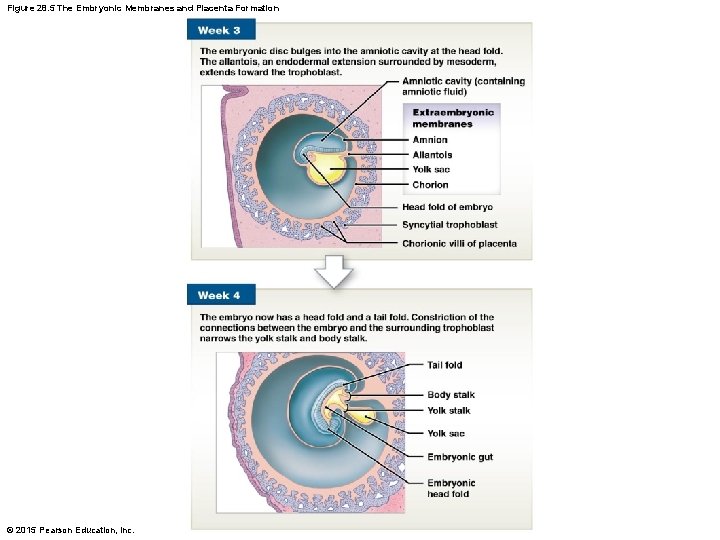
Figure 28. 5 The Embryonic Membranes and Placenta Formation © 2015 Pearson Education, Inc.
Prenatal Development • Embryogenesis • At about 12 weeks, organs begin to form • This is called organogenesis © 2015 Pearson Education, Inc.
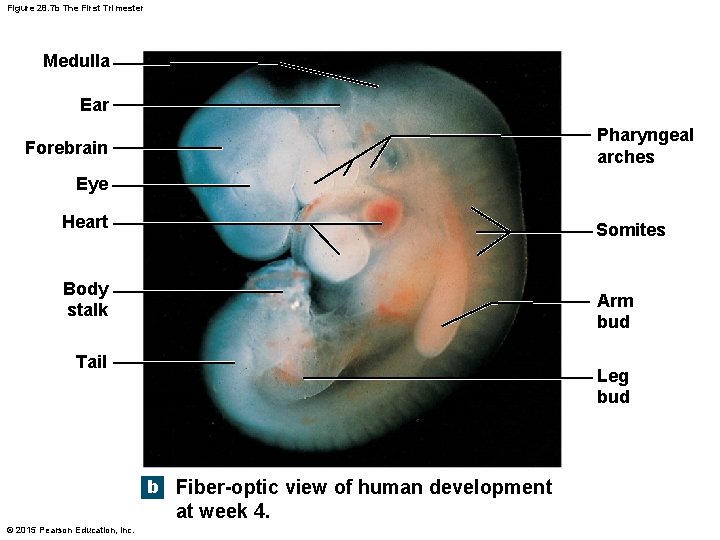
Figure 28. 7 b The First Trimester Medulla Ear Pharyngeal arches Forebrain Eye Heart Somites Body stalk Arm bud Tail Leg bud b Fiber-optic view of human development at week 4. © 2015 Pearson Education, Inc.
Prenatal Development • Second Trimester and Third Trimesters • Second trimester • Fetus is covered by the amnion • Fetus grows faster than the placenta • Third Trimester • All fetal organs become functional © 2015 Pearson Education, Inc.
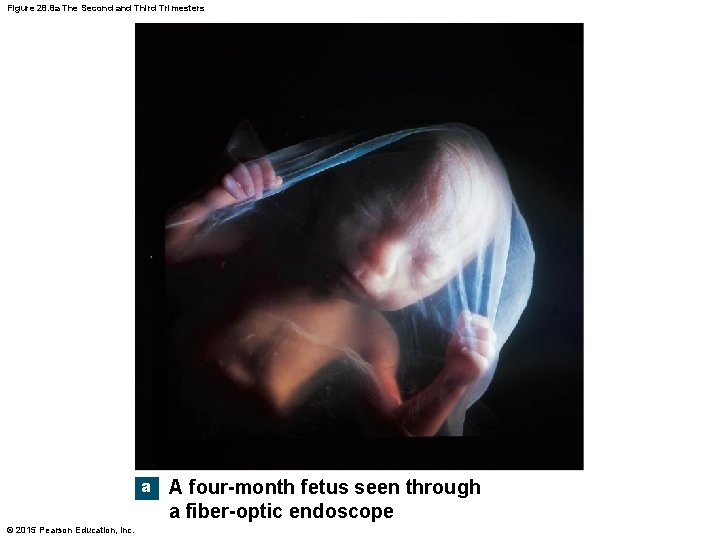
Figure 28. 8 a The Second and Third Trimesters a A four-month fetus seen through a fiber-optic endoscope © 2015 Pearson Education, Inc.
Prenatal Development • Changes in the Uterus during Gestation • • Uterus will increase in length from 7. 5 cm to 30 cm Contains almost 5 L of fluid The uterus and contents weigh about 22 pounds Abdominal organs are pushed out of their normal positions © 2015 Pearson Education, Inc.
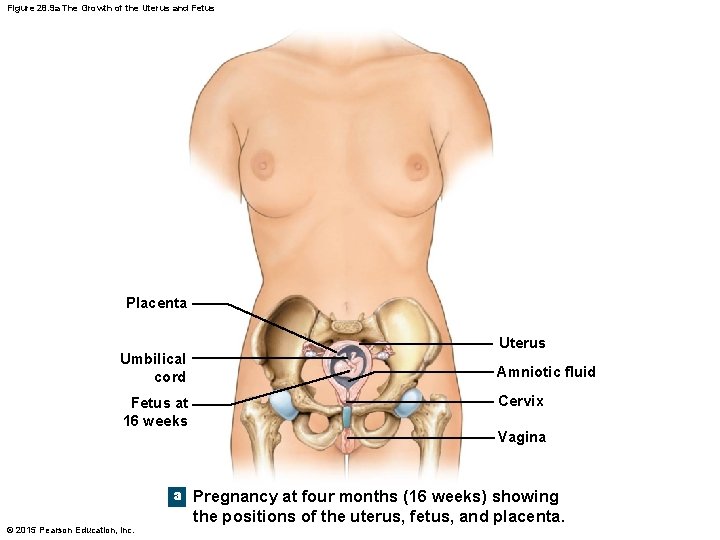
Figure 28. 9 a The Growth of the Uterus and Fetus Placenta Umbilical cord Fetus at 16 weeks Uterus Amniotic fluid Cervix Vagina a Pregnancy at four months (16 weeks) showing © 2015 Pearson Education, Inc. the positions of the uterus, fetus, and placenta.
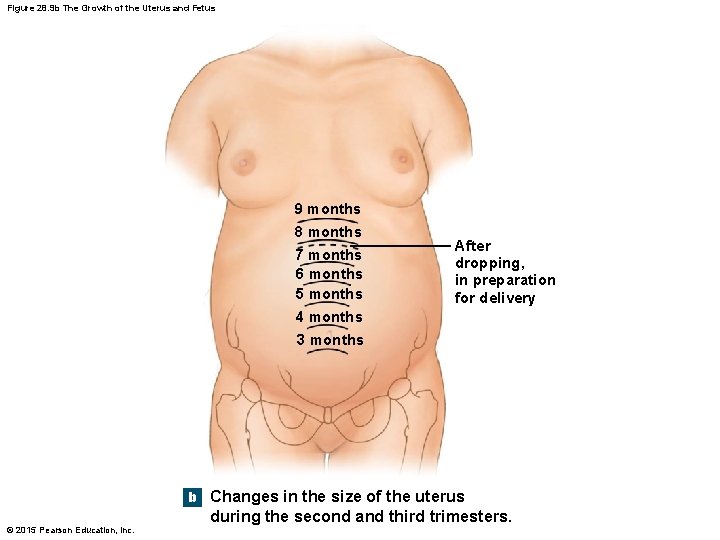
Figure 28. 9 b The Growth of the Uterus and Fetus 9 months 8 months 7 months 6 months 5 months After dropping, in preparation for delivery 4 months 3 months b Changes in the size of the uterus © 2015 Pearson Education, Inc. during the second and third trimesters.
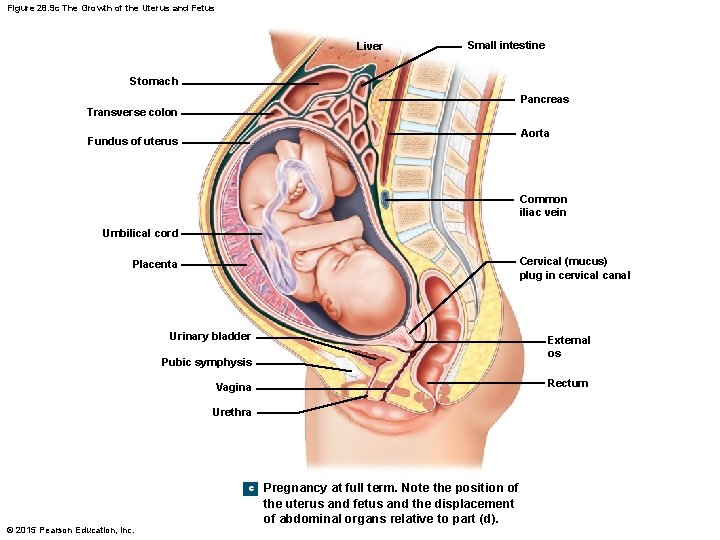
Figure 28. 9 c The Growth of the Uterus and Fetus Liver Small intestine Stomach Pancreas Transverse colon Aorta Fundus of uterus Common iliac vein Umbilical cord Cervical (mucus) plug in cervical canal Placenta Urinary bladder External os Pubic symphysis Rectum Vagina Urethra c © 2015 Pearson Education, Inc. Pregnancy at full term. Note the position of the uterus and fetus and the displacement of abdominal organs relative to part (d).
Labor and Delivery • The goal of labor is parturition (expulsion of the fetus) • There are three stages of labor • Dilation stage • Expulsion stage • Placental stage © 2015 Pearson Education, Inc.
Labor and Delivery • The dilation stage • The fetus begins to move down the cervical canal • The cervix dilates • The amnion ruptures • The expulsion stage • The birth of the child • The placental stage • Ejection of the placenta © 2015 Pearson Education, Inc.
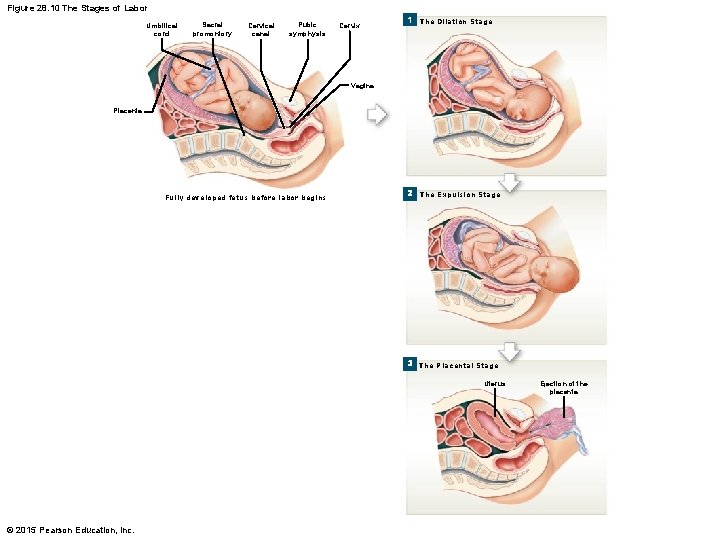
Figure 28. 10 The Stages of Labor Umbilical cord Sacral promontory Cervical canal Pubic symphysis Cervix 1 The Dilation Stage Vagina Placenta Fully developed fetus before labor begins 2 The Expulsion Stage 3 The Placental Stage Uterus © 2015 Pearson Education, Inc. Ejection of the placenta
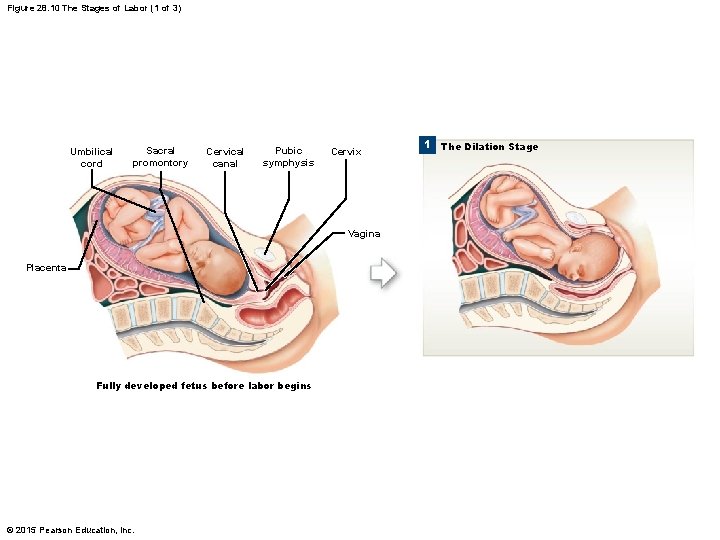
Figure 28. 10 The Stages of Labor (1 of 3) Umbilical cord Sacral promontory Cervical canal Pubic symphysis Cervix Vagina Placenta Fully developed fetus before labor begins © 2015 Pearson Education, Inc. 1 The Dilation Stage
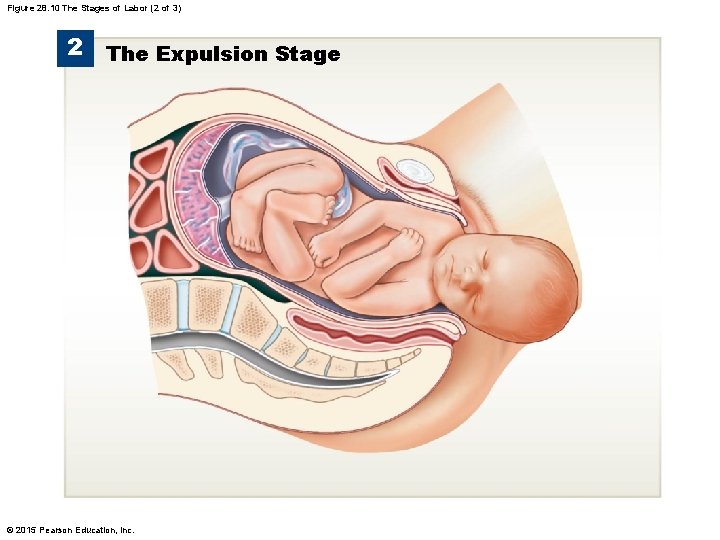
Figure 28. 10 The Stages of Labor (2 of 3) 2 The Expulsion Stage © 2015 Pearson Education, Inc.
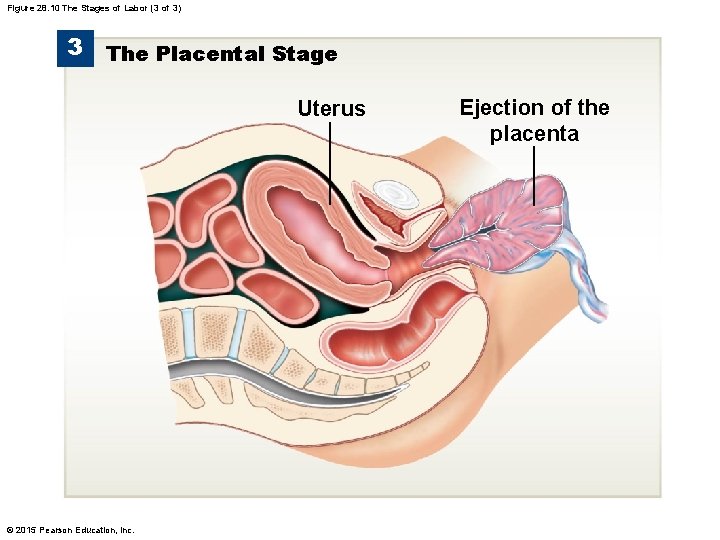
Figure 28. 10 The Stages of Labor (3 of 3) 3 The Placental Stage Uterus © 2015 Pearson Education, Inc. Ejection of the placenta
Labor and Delivery • Premature Labor • This is labor that begins before the fetus has completed normal development • The line between spontaneous abortion and immature delivery is usually set at 17. 6 oz. • Prior to this weight • Respiratory / cardiovascular / urinary systems have not developed enough to support life © 2015 Pearson Education, Inc.
The Neonatal Period • This is the period from birth to one month • Events that occur during this time are: • Lungs fill with air • Blood circulation changes with the closing of the ductus arteriosus and the foramen ovale of the heart • Heart rate drops from 120– 140 beats per minute to about 70 • Breathing rate drops from 30 per minute to the normal rate © 2015 Pearson Education, Inc.
The Neonatal Period • Events that occur from birth to one month are (continued): • Kidneys filter the infant’s own blood • Digestive system becomes active • Metabolic rate is increased to maintain warmth for a few days after birth © 2015 Pearson Education, Inc.
Embryology of Organ Systems • Overview of Embryology • The development of the: • • • Integumentary system Skull Vertebral column Appendicular skeleton Muscles Nervous system Spinal cord Brain Special sense organs © 2015 Pearson Education, Inc. • • Endocrine system Heart Cardiovascular system Lymphatic system Respiratory system Digestive system Urinary system Reproductive system
Embryology of Organ Systems • The Development of the Integumentary System • 1 month • Epithelium overlies mesenchyme • 3 months • Epithelium multiplies to form layers • Mesenchyme becomes dermal connective tissue • 4 months • Epidermis grows into the dermis forming columns of cells, which become: hair follicles, sweat glands, and sebaceous glands © 2015 Pearson Education, Inc.
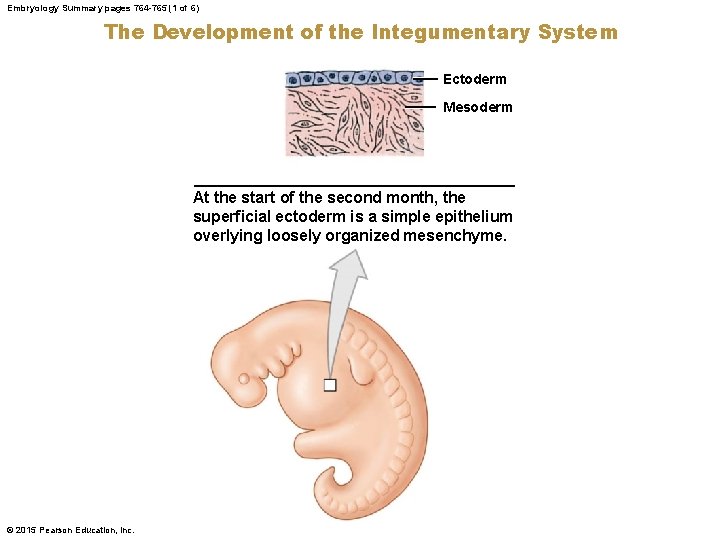
Embryology Summary pages 764 -765 (1 of 6) The Development of the Integumentary System Ectoderm Mesoderm At the start of the second month, the superficial ectoderm is a simple epithelium overlying loosely organized mesenchyme. © 2015 Pearson Education, Inc.
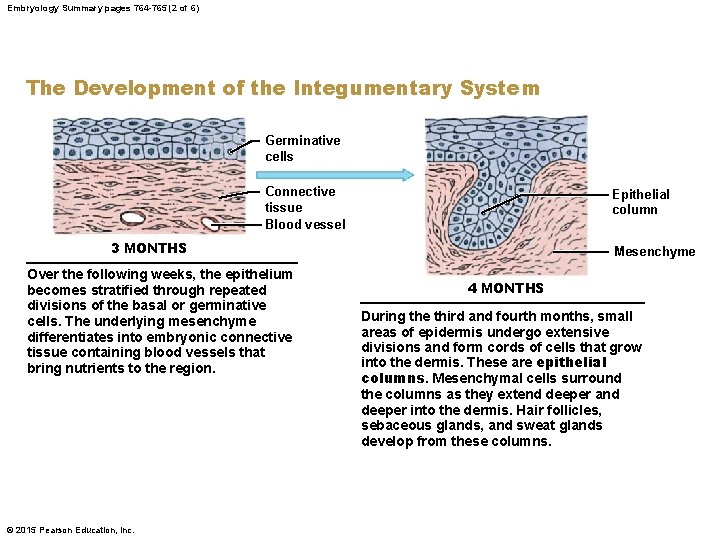
Embryology Summary pages 764 -765 (2 of 6) The Development of the Integumentary System Germinative cells Connective tissue Blood vessel Epithelial column 3 MONTHS Over the following weeks, the epithelium becomes stratified through repeated divisions of the basal or germinative cells. The underlying mesenchyme differentiates into embryonic connective tissue containing blood vessels that bring nutrients to the region. © 2015 Pearson Education, Inc. Mesenchyme 4 MONTHS During the third and fourth months, small areas of epidermis undergo extensive divisions and form cords of cells that grow into the dermis. These are epithelial columns. Mesenchymal cells surround the columns as they extend deeper and deeper into the dermis. Hair follicles, sebaceous glands, and sweat glands develop from these columns.
Embryology of Organ Systems • The Development of the Integumentary System (continued) • Skin • At 4 months, the epithelium continues to thicken • Melanocytes migrate into the stratum basale layer • Nails • Develop from the thickening of the epidermis © 2015 Pearson Education, Inc.
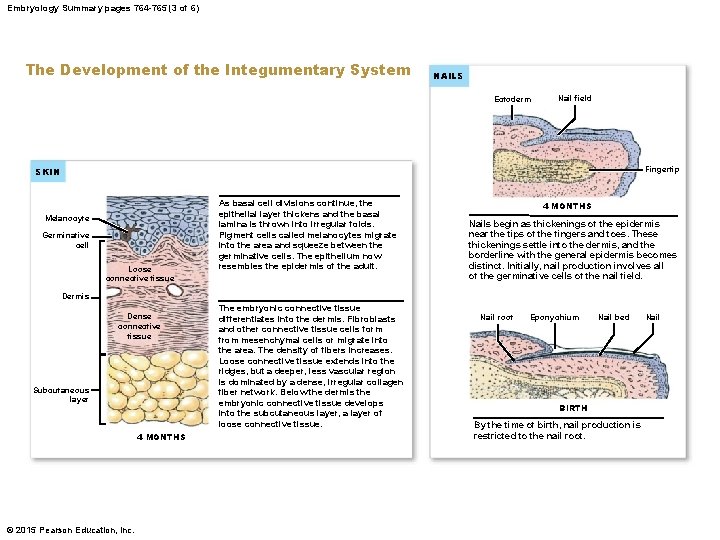
Embryology Summary pages 764 -765 (3 of 6) The Development of the Integumentary System NAILS Ectoderm Nail field SKIN Fingertip Melanocyte Germinative cell Loose connective tissue As basal cell divisions continue, the epithelial layer thickens and the basal lamina is thrown into irregular folds. Pigment cells called melanocytes migrate into the area and squeeze between the germinative cells. The epithelium now resembles the epidermis of the adult. 4 MONTHS Nails begin as thickenings of the epidermis near the tips of the fingers and toes. These thickenings settle into the dermis, and the borderline with the general epidermis becomes distinct. Initially, nail production involves all of the germinative cells of the nail field. Dermis Dense connective tissue Subcutaneous layer 4 MONTHS © 2015 Pearson Education, Inc. The embryonic connective tissue differentiates into the dermis. Fibroblasts and other connective tissue cells form from mesenchymal cells or migrate into the area. The density of fibers increases. Loose connective tissue extends into the ridges, but a deeper, less vascular region is dominated by a dense, irregular collagen fiber network. Below the dermis the embryonic connective tissue develops into the subcutaneous layer, a layer of loose connective tissue. Nail root Eponychium Nail bed BIRTH By the time of birth, nail production is restricted to the nail root. Nail
Embryology of Organ Systems • The Development of the Integumentary System (continued) • Hair follicles • Develops as a deep column of cells surround a papilla • Exocrine glands • Develops as the epithelial column elongates and coils • Mammary glands • Develop from the thickening of the epidermis © 2015 Pearson Education, Inc.
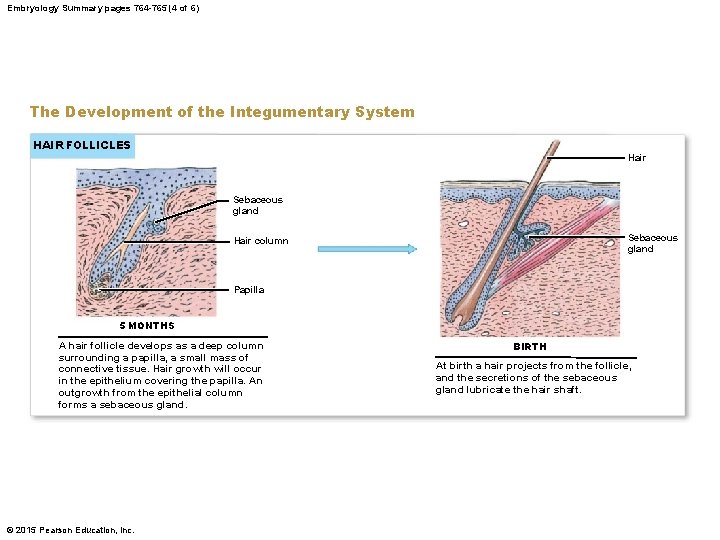
Embryology Summary pages 764 -765 (4 of 6) The Development of the Integumentary System HAIR FOLLICLES Hair Sebaceous gland Hair column Papilla 5 MONTHS A hair follicle develops as a deep column surrounding a papilla, a small mass of connective tissue. Hair growth will occur in the epithelium covering the papilla. An outgrowth from the epithelial column forms a sebaceous gland. © 2015 Pearson Education, Inc. BIRTH At birth a hair projects from the follicle, and the secretions of the sebaceous gland lubricate the hair shaft.
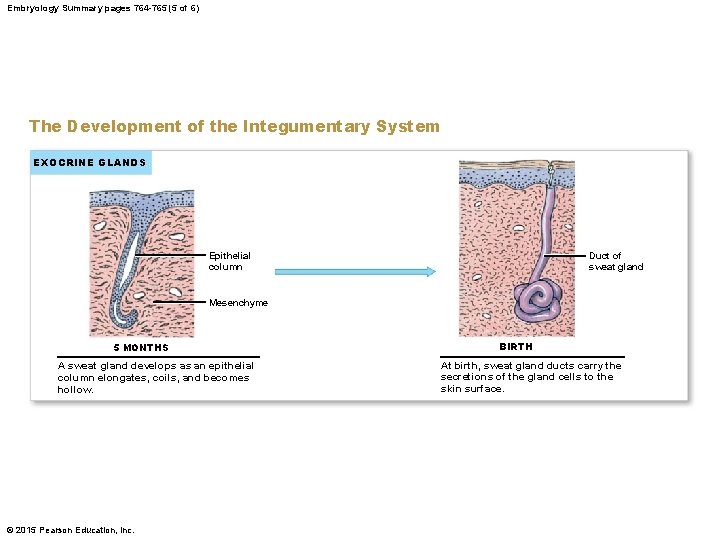
Embryology Summary pages 764 -765 (5 of 6) The Development of the Integumentary System EXOCRINE GLANDS Duct of sweat gland Epithelial column Mesenchyme 5 MONTHS A sweat gland develops as an epithelial column elongates, coils, and becomes hollow. © 2015 Pearson Education, Inc. BIRTH At birth, sweat gland ducts carry the secretions of the gland cells to the skin surface.
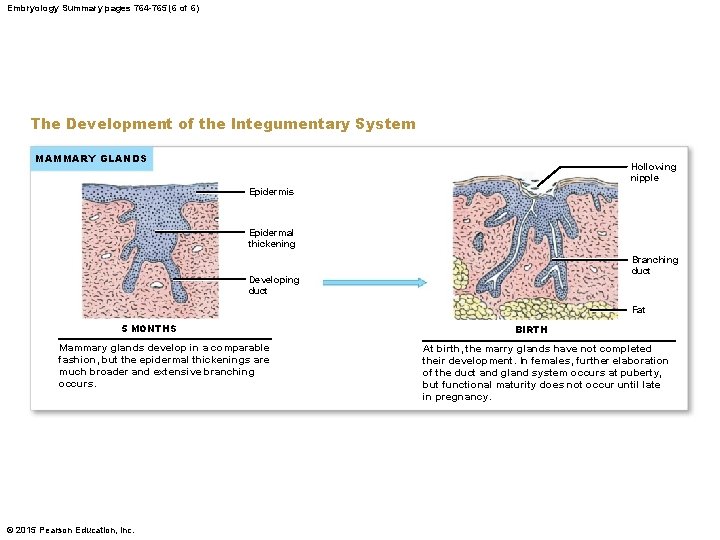
Embryology Summary pages 764 -765 (6 of 6) The Development of the Integumentary System MAMMARY GLANDS Hollowing nipple Epidermis Epidermal thickening Branching duct Developing duct Fat 5 MONTHS Mammary glands develop in a comparable fashion, but the epidermal thickenings are much broader and extensive branching occurs. © 2015 Pearson Education, Inc. BIRTH At birth, the marry glands have not completed their development. In females, further elaboration of the duct and gland system occurs at puberty, but functional maturity does not occur until late in pregnancy.
Embryology of Organ Systems • The Development of the Skull • 5 to 8 weeks • Cartilage begins to appear • Cartilage within the brain area enlarges to form the chondrocranium • Skull walls and floor are beginning but no roof • 9 weeks • Endochondral ossification appears; frontal and parietal structures appear © 2015 Pearson Education, Inc.
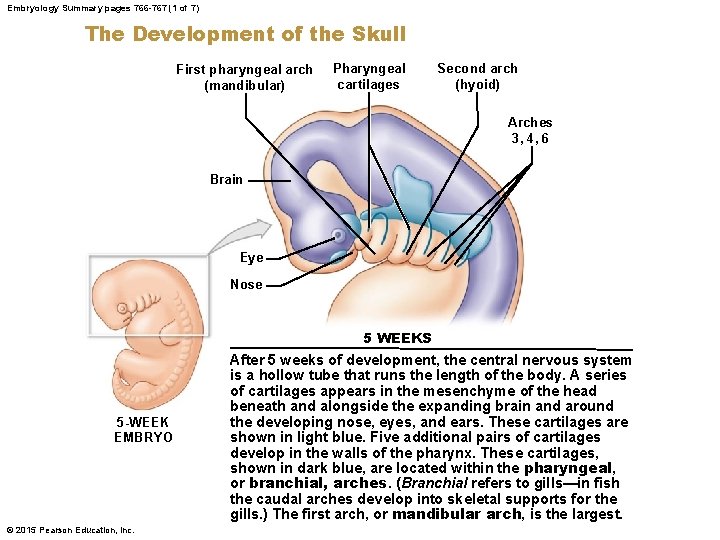
Embryology Summary pages 766 -767 (1 of 7) The Development of the Skull First pharyngeal arch (mandibular) Pharyngeal cartilages Second arch (hyoid) Arches 3, 4, 6 Brain Eye Nose 5 WEEKS 5 -WEEK EMBRYO © 2015 Pearson Education, Inc. After 5 weeks of development, the central nervous system is a hollow tube that runs the length of the body. A series of cartilages appears in the mesenchyme of the head beneath and alongside the expanding brain and around the developing nose, eyes, and ears. These cartilages are shown in light blue. Five additional pairs of cartilages develop in the walls of the pharynx. These cartilages, shown in dark blue, are located within the pharyngeal, or branchial, arches. (Branchial refers to gills—in fish the caudal arches develop into skeletal supports for the gills. ) The first arch, or mandibular arch, is the largest.
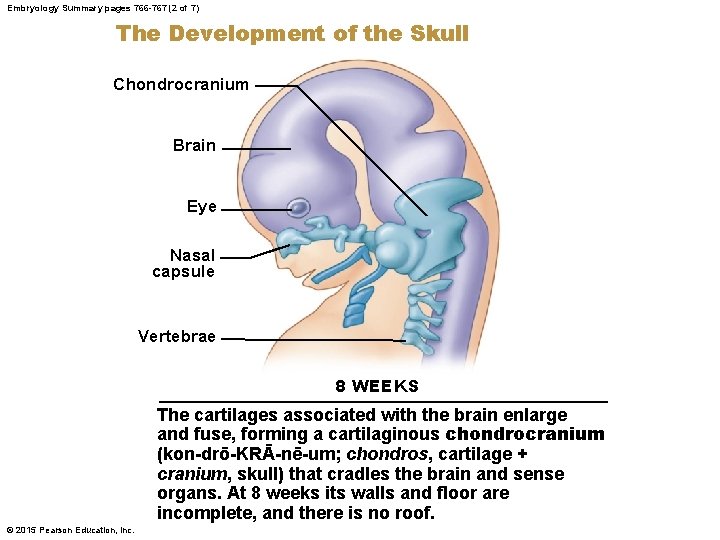
Embryology Summary pages 766 -767 (2 of 7) The Development of the Skull Chondrocranium Brain Eye Nasal capsule Vertebrae 8 WEEKS The cartilages associated with the brain enlarge and fuse, forming a cartilaginous chondrocranium (kon-drō-KRĀ-nē-um; chondros, cartilage + cranium, skull) that cradles the brain and sense organs. At 8 weeks its walls and floor are incomplete, and there is no roof. © 2015 Pearson Education, Inc.
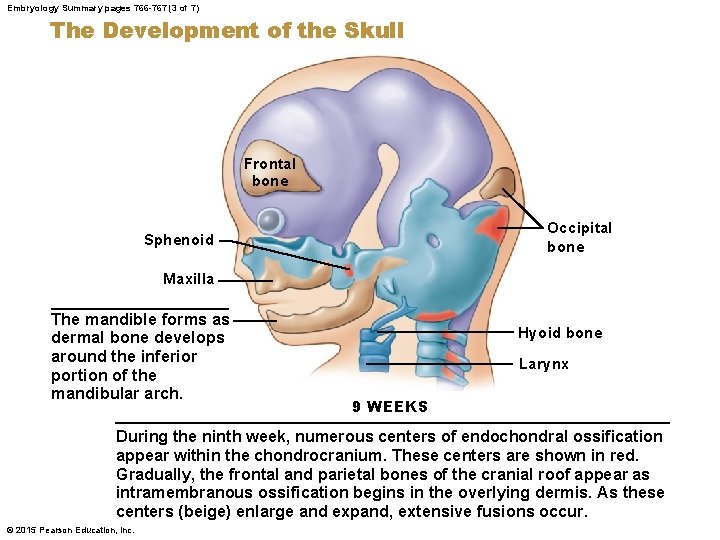
Embryology Summary pages 766 -767 (3 of 7) The Development of the Skull Frontal bone Occipital bone Sphenoid Maxilla The mandible forms as dermal bone develops around the inferior portion of the mandibular arch. Hyoid bone Larynx 9 WEEKS During the ninth week, numerous centers of endochondral ossification appear within the chondrocranium. These centers are shown in red. Gradually, the frontal and parietal bones of the cranial roof appear as intramembranous ossification begins in the overlying dermis. As these centers (beige) enlarge and expand, extensive fusions occur. © 2015 Pearson Education, Inc.
Embryology Summary • The Development of the Skull (continued) • 10 weeks • Mandibular arch fuses with the chondrocranium • Hyoid arch begins to form • 12 weeks • Ossification is well under way • Birth • Cranial roof remains incomplete • The anterior and posterior fontanels are present © 2015 Pearson Education, Inc.
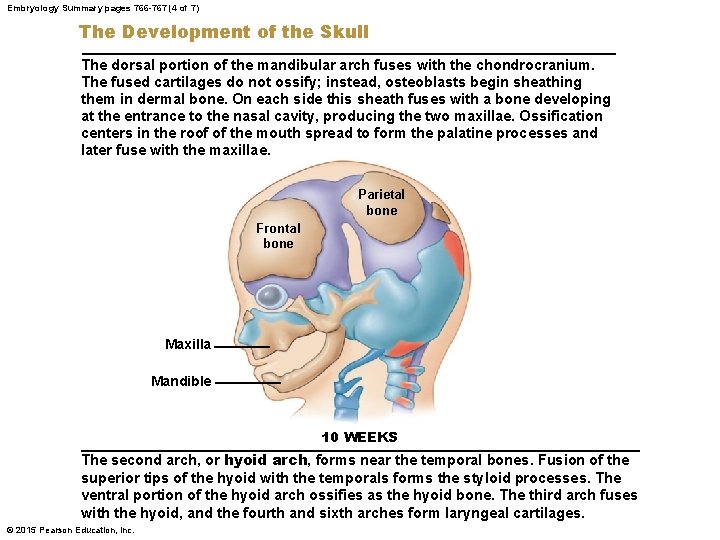
Embryology Summary pages 766 -767 (4 of 7) The Development of the Skull The dorsal portion of the mandibular arch fuses with the chondrocranium. The fused cartilages do not ossify; instead, osteoblasts begin sheathing them in dermal bone. On each side this sheath fuses with a bone developing at the entrance to the nasal cavity, producing the two maxillae. Ossification centers in the roof of the mouth spread to form the palatine processes and later fuse with the maxillae. Parietal bone Frontal bone Maxilla Mandible 10 WEEKS The second arch, or hyoid arch, forms near the temporal bones. Fusion of the superior tips of the hyoid with the temporals forms the styloid processes. The ventral portion of the hyoid arch ossifies as the hyoid bone. The third arch fuses with the hyoid, and the fourth and sixth arches form laryngeal cartilages. © 2015 Pearson Education, Inc.
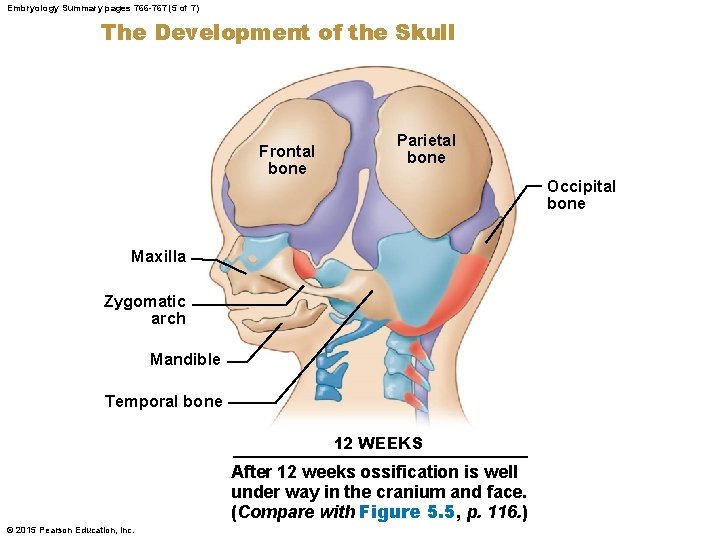
Embryology Summary pages 766 -767 (5 of 7) The Development of the Skull Frontal bone Parietal bone Occipital bone Maxilla Zygomatic arch Mandible Temporal bone 12 WEEKS After 12 weeks ossification is well under way in the cranium and face. (Compare with Figure 5. 5, p. 116. ) © 2015 Pearson Education, Inc.
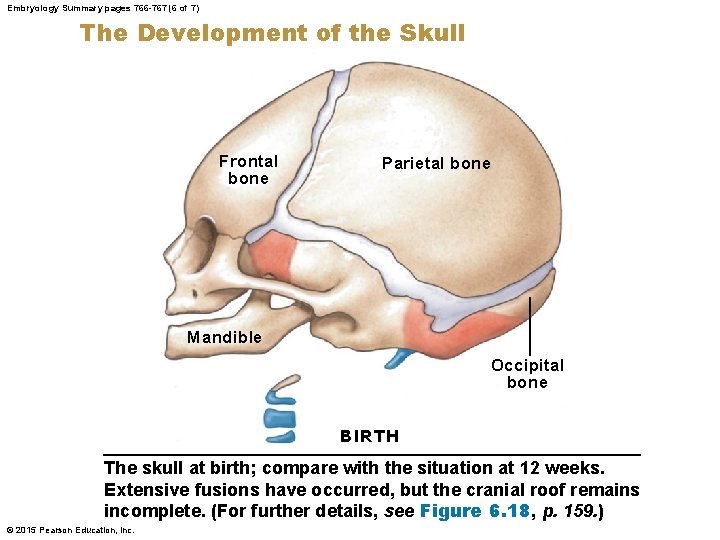
Embryology Summary pages 766 -767 (6 of 7) The Development of the Skull Frontal bone Parietal bone Mandible Occipital bone BIRTH The skull at birth; compare with the situation at 12 weeks. Extensive fusions have occurred, but the cranial roof remains incomplete. (For further details, see Figure 6. 18, p. 159. ) © 2015 Pearson Education, Inc.
Embryology of Organ Systems • The Development of the Vertebral Column • 4 weeks • On either side of the developing spinal cord are blocks of mesenchymal tissue called somites • The medial side of the somites produces the vertebral column • 8 weeks • Vertebral cartilage forms around the spinal cord • The sacrum and coccyx are fused together © 2015 Pearson Education, Inc.
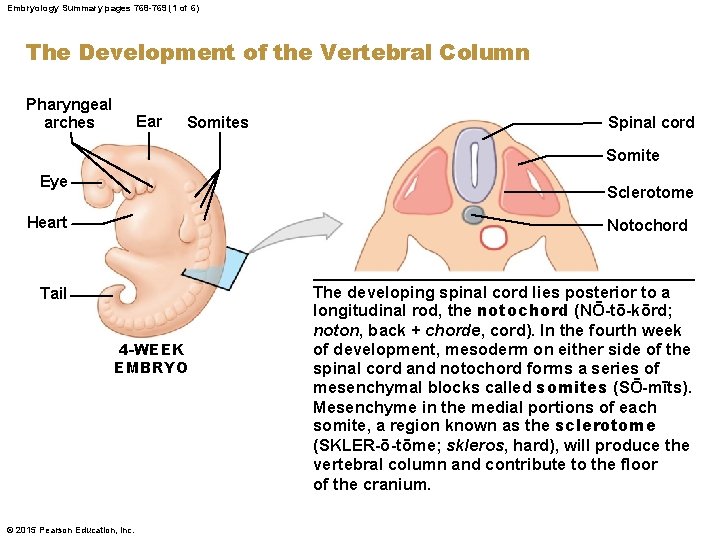
Embryology Summary pages 768 -769 (1 of 6) The Development of the Vertebral Column Pharyngeal arches Ear Somites Spinal cord Somite Eye Sclerotome Heart Notochord Tail The developing spinal cord lies posterior to a longitudinal rod, the notochord (NŌ-tō-kōrd; noton, back + chorde, cord). In the fourth week of development, mesoderm on either side of the spinal cord and notochord forms a series of mesenchymal blocks called somites (SŌ-mīts). Mesenchyme in the medial portions of each somite, a region known as the sclerotome (SKLER-ō-tōme; skleros, hard), will produce the vertebral column and contribute to the floor of the cranium. 4 -WEEK EMBRYO © 2015 Pearson Education, Inc.
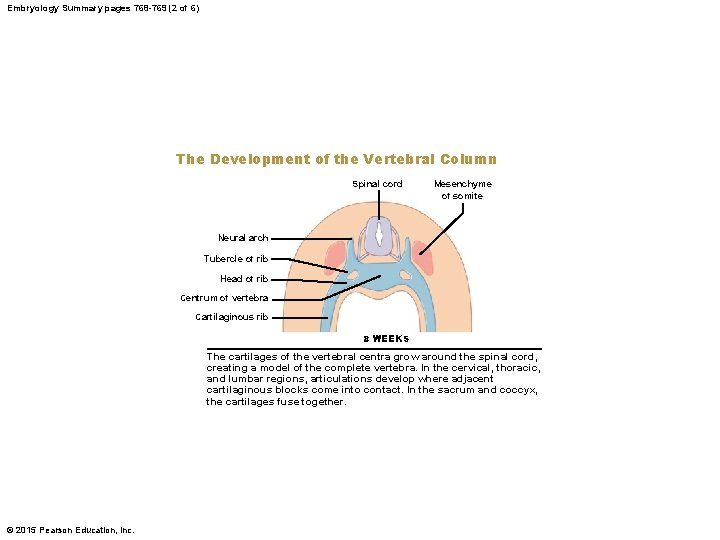
Embryology Summary pages 768 -769 (2 of 6) The Development of the Vertebral Column Spinal cord Mesenchyme of somite Neural arch Tubercle of rib Head of rib Centrum of vertebra Cartilaginous rib 8 WEEKS The cartilages of the vertebral centra grow around the spinal cord, creating a model of the complete vertebra. In the cervical, thoracic, and lumbar regions, articulations develop where adjacent cartilaginous blocks come into contact. In the sacrum and coccyx, the cartilages fuse together. © 2015 Pearson Education, Inc.
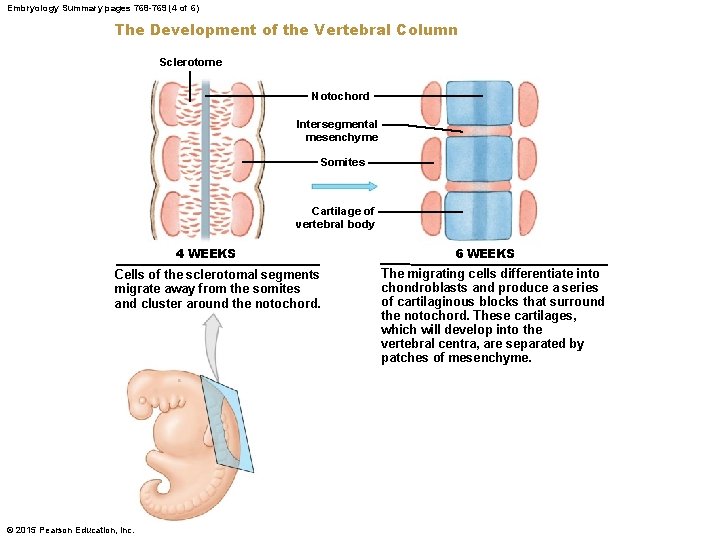
Embryology Summary pages 768 -769 (4 of 6) The Development of the Vertebral Column Sclerotome Notochord Intersegmental mesenchyme Somites Cartilage of vertebral body 4 WEEKS Cells of the sclerotomal segments migrate away from the somites and cluster around the notochord. © 2015 Pearson Education, Inc. 6 WEEKS The migrating cells differentiate into chondroblasts and produce a series of cartilaginous blocks that surround the notochord. These cartilages, which will develop into the vertebral centra, are separated by patches of mesenchyme.
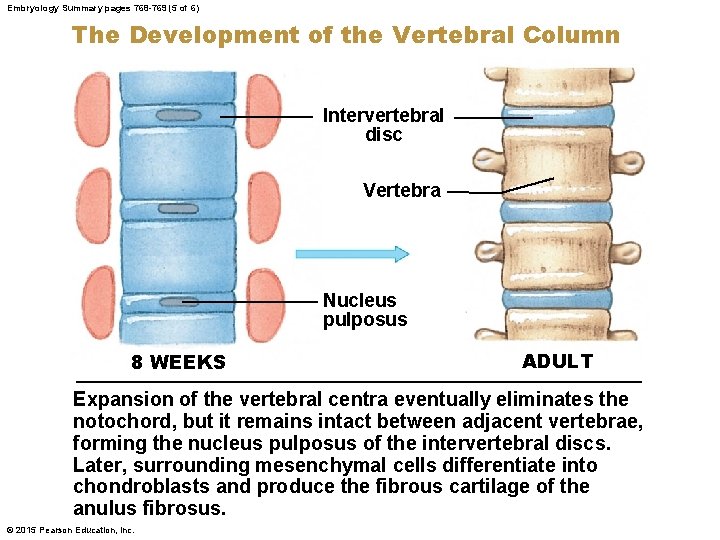
Embryology Summary pages 768 -769 (5 of 6) The Development of the Vertebral Column Intervertebral disc Vertebra Nucleus pulposus 8 WEEKS ADULT Expansion of the vertebral centra eventually eliminates the notochord, but it remains intact between adjacent vertebrae, forming the nucleus pulposus of the intervertebral discs. Later, surrounding mesenchymal cells differentiate into chondroblasts and produce the fibrous cartilage of the anulus fibrosus. © 2015 Pearson Education, Inc.
Embryology Summary • The Development of the Vertebral Column (continued) • 12 weeks • Ribs and sternum undergo ossification • The tips of the longer ribs do not ossify; they remain as cartilage thus forming the costal cartilages © 2015 Pearson Education, Inc.
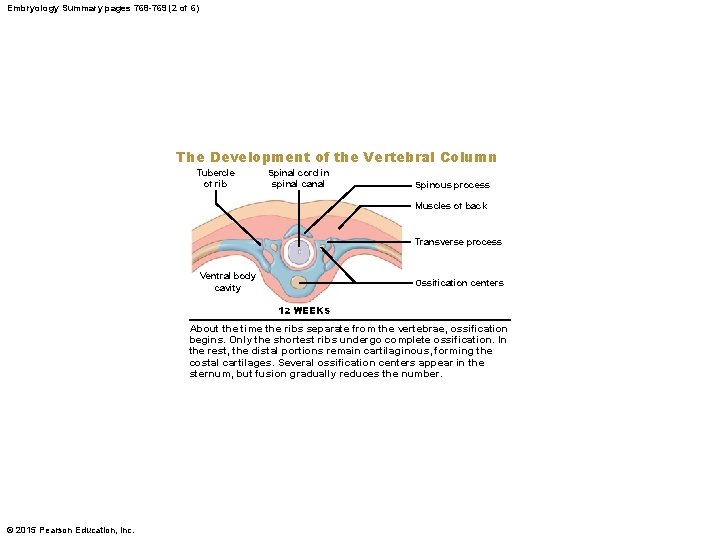
Embryology Summary pages 768 -769 (2 of 6) The Development of the Vertebral Column Tubercle of rib Spinal cord in spinal canal Spinous process Muscles of back Transverse process Ventral body cavity Ossification centers 12 WEEKS About the time the ribs separate from the vertebrae, ossification begins. Only the shortest ribs undergo complete ossification. In the rest, the distal portions remain cartilaginous, forming the costal cartilages. Several ossification centers appear in the sternum, but fusion gradually reduces the number. © 2015 Pearson Education, Inc.
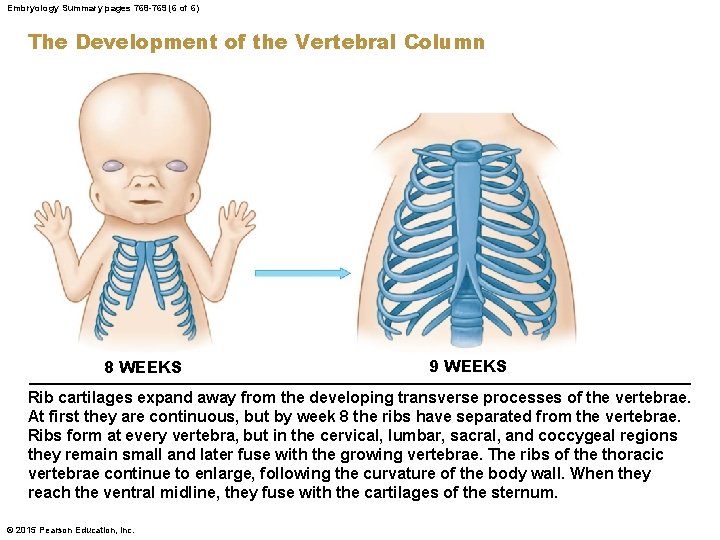
Embryology Summary pages 768 -769 (6 of 6) The Development of the Vertebral Column 8 WEEKS 9 WEEKS Rib cartilages expand away from the developing transverse processes of the vertebrae. At first they are continuous, but by week 8 the ribs have separated from the vertebrae. Ribs form at every vertebra, but in the cervical, lumbar, sacral, and coccygeal regions they remain small and later fuse with the growing vertebrae. The ribs of the thoracic vertebrae continue to enlarge, following the curvature of the body wall. When they reach the ventral midline, they fuse with the cartilages of the sternum. © 2015 Pearson Education, Inc.
Embryology of Organ Systems • The Development of the Appendicular Skeleton • 4 weeks • Ridges appear along the length of the embryo • An accumulation of ridges at the superior end and the inferior end form pairs of limb buds • 5 weeks • Limb buds develop a core of cartilaginous tissue • Cartilaginous models develop between 5 and 8 weeks © 2015 Pearson Education, Inc.
Embryology of Organ Systems • The Development of the Appendicular Skeleton • 5. 5– 8 weeks • Upper limbs • Bends develop at the location of the shoulder and elbow • Lateral rotation of the apical ridge occurs to create the correct position for the elbow • Hands originate as paddles but eventually individual fingers form • Surfaces within the joints remain covered with cartilage © 2015 Pearson Education, Inc.
Embryology of Organ Systems • The Development of the Appendicular Skeleton • 5. 5– 8 weeks • Lower limbs • Bends develop at the location of the hip and knee • Medial rotation of the apical ridge occurs to create the correct position for the knee • Feet originate as paddles but eventually individual toes form • Surfaces within the joints remain covered with cartilage © 2015 Pearson Education, Inc.
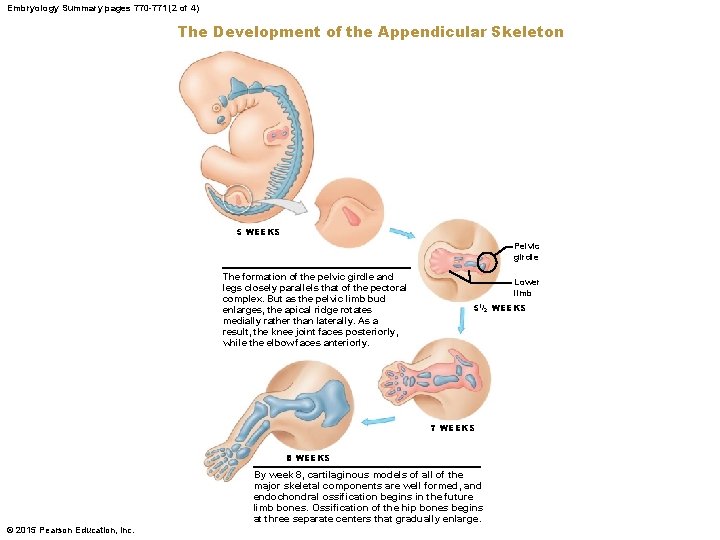
Embryology Summary pages 770 -771 (2 of 4) The Development of the Appendicular Skeleton 5 WEEKS Pelvic girdle The formation of the pelvic girdle and legs closely parallels that of the pectoral complex. But as the pelvic limb bud enlarges, the apical ridge rotates medially rather than laterally. As a result, the knee joint faces posteriorly, while the elbow faces anteriorly. Lower limb 51/2 WEEKS 7 WEEKS 8 WEEKS By week 8, cartilaginous models of all of the major skeletal components are well formed, and endochondral ossification begins in the future limb bones. Ossification of the hip bones begins at three separate centers that gradually enlarge. © 2015 Pearson Education, Inc.
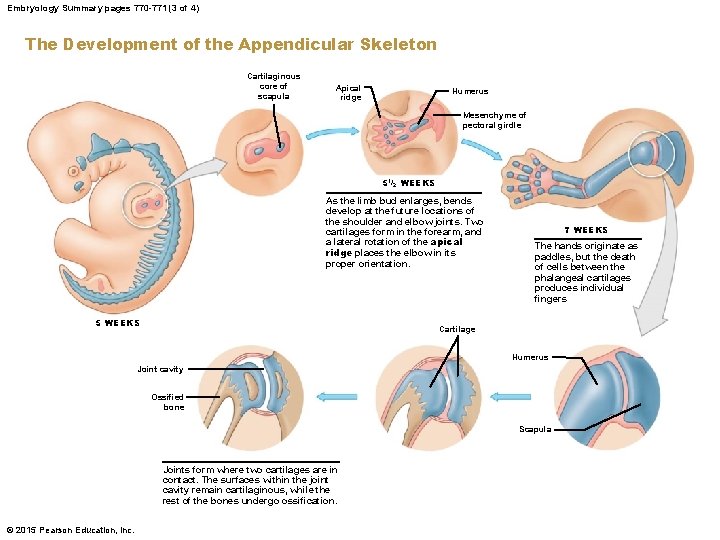
Embryology Summary pages 770 -771 (3 of 4) The Development of the Appendicular Skeleton Cartilaginous core of scapula Apical ridge Humerus Mesenchyme of pectoral girdle 51/2 WEEKS As the limb bud enlarges, bends develop at the future locations of the shoulder and elbow joints. Two cartilages form in the forearm, and a lateral rotation of the apical ridge places the elbow in its proper orientation. 5 WEEKS 7 WEEKS The hands originate as paddles, but the death of cells between the phalangeal cartilages produces individual fingers Cartilage Humerus Joint cavity Ossified bone Scapula Joints form where two cartilages are in contact. The surfaces within the joint cavity remain cartilaginous, while the rest of the bones undergo ossification. © 2015 Pearson Education, Inc.
Embryology of Organ Systems • The Development of the Appendicular Skeleton • 10 weeks • Continued ossification occurs • Distal bones of the carpus and tarsus remain cartilaginous • Birth • Consists of extensive areas of cartilage © 2015 Pearson Education, Inc.
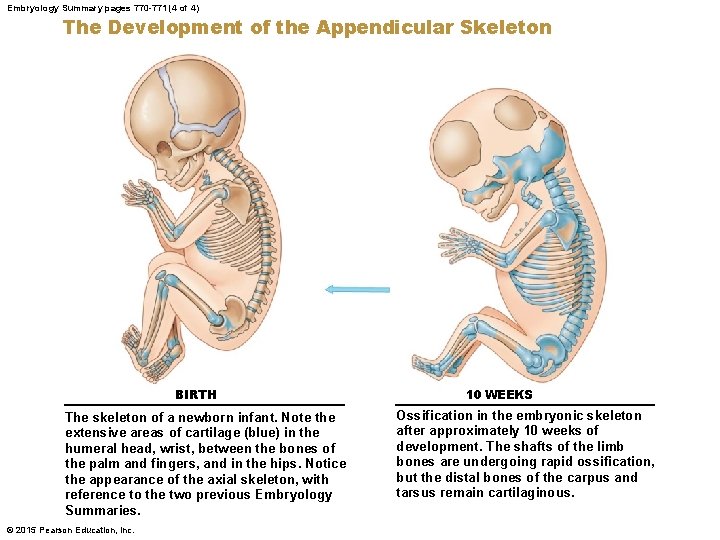
Embryology Summary pages 770 -771 (4 of 4) The Development of the Appendicular Skeleton BIRTH The skeleton of a newborn infant. Note the extensive areas of cartilage (blue) in the humeral head, wrist, between the bones of the palm and fingers, and in the hips. Notice the appearance of the axial skeleton, with reference to the two previous Embryology Summaries. © 2015 Pearson Education, Inc. 10 WEEKS Ossification in the embryonic skeleton after approximately 10 weeks of development. The shafts of the limb bones are undergoing rapid ossification, but the distal bones of the carpus and tarsus remain cartilaginous.
Embryology of Organ Systems • The Development of Muscles • 4 weeks • Mesoderm on either side of the notochord forms somites • The medial portion of each somite forms skeletal muscles; this region is called the myotome • 6 weeks • Myotome area develops into posterior muscles called epaxial muscles and anterior muscles called hypaxial muscles © 2015 Pearson Education, Inc.
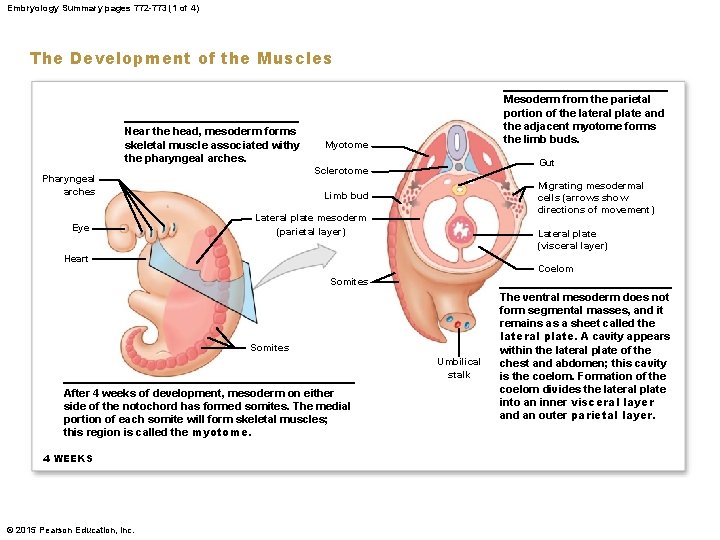
Embryology Summary pages 772 -773 (1 of 4) The Development of the Muscles Near the head, mesoderm forms skeletal muscle associated withy the pharyngeal arches. Myotome Gut Sclerotome Pharyngeal arches Eye Mesoderm from the parietal portion of the lateral plate and the adjacent myotome forms the limb buds. Migrating mesodermal cells (arrows show directions of movement) Limb bud Lateral plate mesoderm (parietal layer) Lateral plate (visceral layer) Heart Coelom Somites Umbilical stalk After 4 weeks of development, mesoderm on either side of the notochord has formed somites. The medial portion of each somite will form skeletal muscles; this region is called the myotome. 4 WEEKS © 2015 Pearson Education, Inc. The ventral mesoderm does not form segmental masses, and it remains as a sheet called the lateral plate. A cavity appears within the lateral plate of the chest and abdomen; this cavity is the coelom. Formation of the coelom divides the lateral plate into an inner visceral layer and an outer parietal layer.
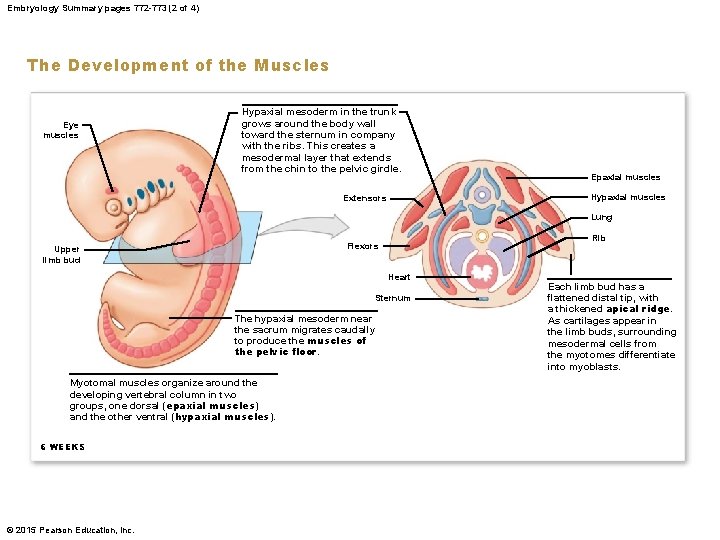
Embryology Summary pages 772 -773 (2 of 4) The Development of the Muscles Eye muscles Hypaxial mesoderm in the trunk grows around the body wall toward the sternum in company with the ribs. This creates a mesodermal layer that extends from the chin to the pelvic girdle. Epaxial muscles Hypaxial muscles Extensors Lung Rib Flexors Upper limb bud Heart Sternum The hypaxial mesoderm near the sacrum migrates caudally to produce the muscles of the pelvic floor. Myotomal muscles organize around the developing vertebral column in two groups, one dorsal (epaxial muscles) and the other ventral (hypaxial muscles). 6 WEEKS © 2015 Pearson Education, Inc. Each limb bud has a flattened distal tip, with a thickened apical ridge. As cartilages appear in the limb buds, surrounding mesodermal cells from the myotomes differentiate into myoblasts.
Embryology of Organ Systems • The Development of Muscles (continued) • 7 weeks • Muscles of the face, back, and abdomen develop • 8 weeks • Limbs enlarge and muscles continue to develop © 2015 Pearson Education, Inc.
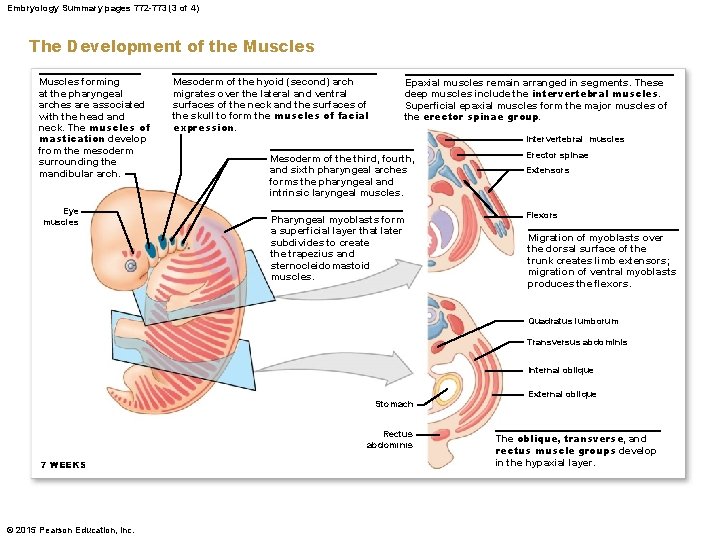
Embryology Summary pages 772 -773 (3 of 4) The Development of the Muscles forming at the pharyngeal arches are associated with the head and neck. The muscles of mastication develop from the mesoderm surrounding the mandibular arch. Eye muscles Mesoderm of the hyoid (second) arch migrates over the lateral and ventral surfaces of the neck and the surfaces of the skull to form the muscles of facial expression. Epaxial muscles remain arranged in segments. These deep muscles include the intervertebral muscles. Superficial epaxial muscles form the major muscles of the erector spinae group. Intervertebral muscles Mesoderm of the third, fourth, and sixth pharyngeal arches forms the pharyngeal and intrinsic laryngeal muscles. Erector spinae Pharyngeal myoblasts form a superficial layer that later subdivides to create the trapezius and sternocleidomastoid muscles. Flexors Extensors Migration of myoblasts over the dorsal surface of the trunk creates limb extensors; migration of ventral myoblasts produces the flexors. Quadratus lumborum Transversus abdominis Internal oblique Stomach Rectus abdominis 7 WEEKS © 2015 Pearson Education, Inc. External oblique The oblique, transverse, and rectus muscle groups develop in the hypaxial layer.
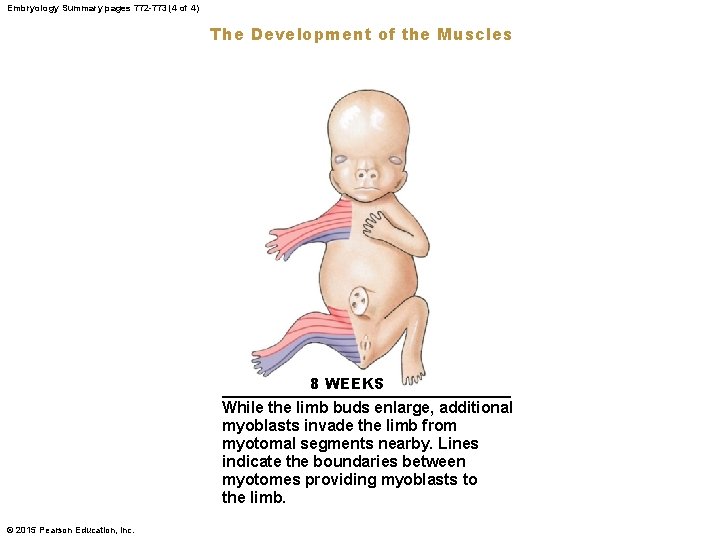
Embryology Summary pages 772 -773 (4 of 4) The Development of the Muscles 8 WEEKS While the limb buds enlarge, additional myoblasts invade the limb from myotomal segments nearby. Lines indicate the boundaries between myotomes providing myoblasts to the limb. © 2015 Pearson Education, Inc.
Embryology of Organ Systems • The Development of Muscles (continued) • Birth • Rotation of the upper limb and lower limb creates the muscles of: • Flexion • Extension © 2015 Pearson Education, Inc.
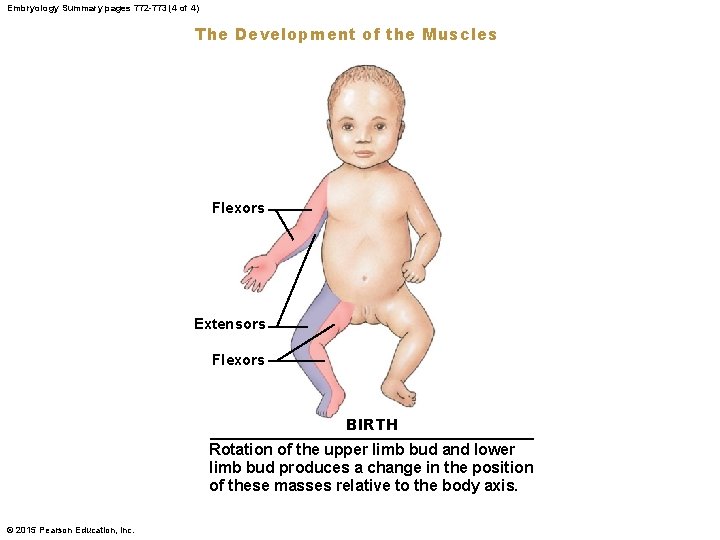
Embryology Summary pages 772 -773 (4 of 4) The Development of the Muscles Flexors Extensors Flexors BIRTH Rotation of the upper limb bud and lower limb bud produces a change in the position of these masses relative to the body axis. © 2015 Pearson Education, Inc.
Embryology of Organ Systems • The Development of the Nervous System • 20– 23 days • Somites appear on either side of the notochord • A neural plate is formed • A crease develops along the length of the neural plate • The edges of the crease are the neural folds • The neural folds “fold” to form a tube (neural tube) • The neural tube becomes the CNS • Axons extending from the neural tube become the PNS © 2015 Pearson Education, Inc.
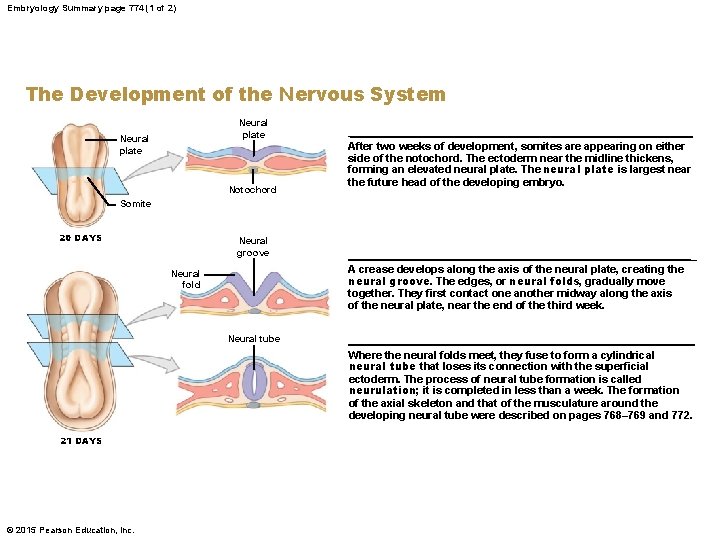
Embryology Summary page 774 (1 of 2) The Development of the Nervous System Neural plate Notochord After two weeks of development, somites are appearing on either side of the notochord. The ectoderm near the midline thickens, forming an elevated neural plate. The neural plate is largest near the future head of the developing embryo. Somite 20 DAYS Neural groove A crease develops along the axis of the neural plate, creating the neural groove. The edges, or neural folds, gradually move together. They first contact one another midway along the axis of the neural plate, near the end of the third week. Neural fold Neural tube Where the neural folds meet, they fuse to form a cylindrical neural tube that loses its connection with the superficial ectoderm. The process of neural tube formation is called neurulation; it is completed in less than a week. The formation of the axial skeleton and that of the musculature around the developing neural tube were described on pages 768– 769 and 772. 21 DAYS © 2015 Pearson Education, Inc.
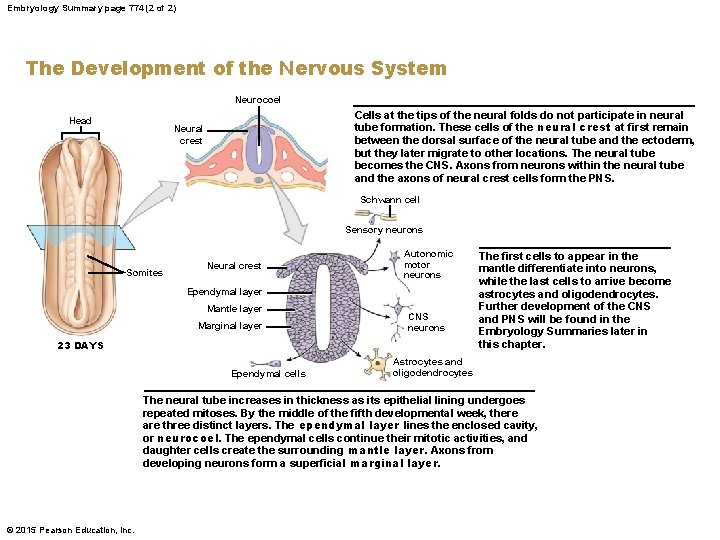
Embryology Summary page 774 (2 of 2) The Development of the Nervous System Neurocoel Head Cells at the tips of the neural folds do not participate in neural tube formation. These cells of the neural crest at first remain between the dorsal surface of the neural tube and the ectoderm, but they later migrate to other locations. The neural tube becomes the CNS. Axons from neurons within the neural tube and the axons of neural crest cells form the PNS. Neural crest Schwann cell Sensory neurons Somites Neural crest Autonomic motor neurons Ependymal layer Mantle layer Marginal layer CNS neurons 23 DAYS Ependymal cells The first cells to appear in the mantle differentiate into neurons, while the last cells to arrive become astrocytes and oligodendrocytes. Further development of the CNS and PNS will be found in the Embryology Summaries later in this chapter. Astrocytes and oligodendrocytes The neural tube increases in thickness as its epithelial lining undergoes repeated mitoses. By the middle of the fifth developmental week, there are three distinct layers. The ependymal layer lines the enclosed cavity, or neurocoel. The ependymal cells continue their mitotic activities, and daughter cells create the surrounding mantle layer. Axons from developing neurons form a superficial marginal layer. © 2015 Pearson Education, Inc.
Embryology of Organ Systems • The Development of the Spinal Cord • 22– 28 days • The neural tube is closed thus producing three layers • Ependymal layer • Mantle layer • Marginal layer • Neurons develop in the mantle layer • Axons grow from the mantle layer to the marginal layer • Axons form bundles, or tracts, in the spinal cord © 2015 Pearson Education, Inc.
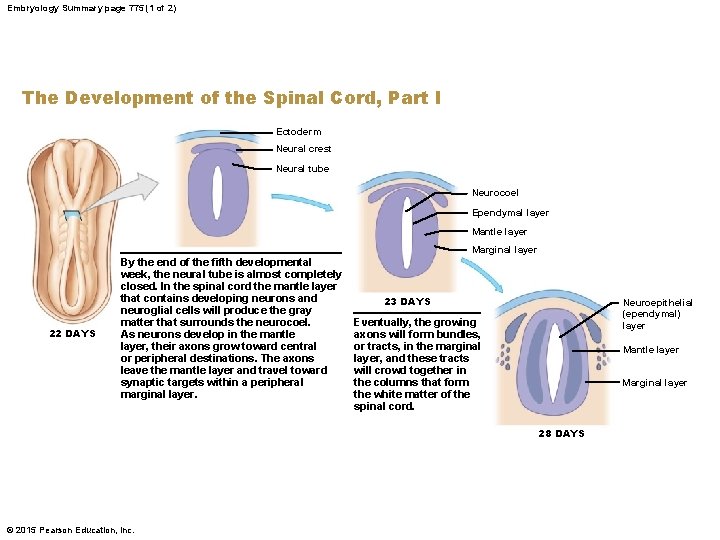
Embryology Summary page 775 (1 of 2) The Development of the Spinal Cord, Part I Ectoderm Neural crest Neural tube Neurocoel Ependymal layer Mantle layer Marginal layer 22 DAYS By the end of the fifth developmental week, the neural tube is almost completely closed. In the spinal cord the mantle layer that contains developing neurons and neuroglial cells will produce the gray matter that surrounds the neurocoel. As neurons develop in the mantle layer, their axons grow toward central or peripheral destinations. The axons leave the mantle layer and travel toward synaptic targets within a peripheral marginal layer. 23 DAYS Neuroepithelial (ependymal) layer Eventually, the growing axons will form bundles, or tracts, in the marginal layer, and these tracts will crowd together in the columns that form the white matter of the spinal cord. Mantle layer Marginal layer 28 DAYS © 2015 Pearson Education, Inc.
Embryology of Organ Systems • The Development of the Spinal Cord (continued) • 7 weeks • • Ventral roots and dorsal roots develop Glial cells develop Spinal and cranial meninges develop Spinal nerves develop © 2015 Pearson Education, Inc.
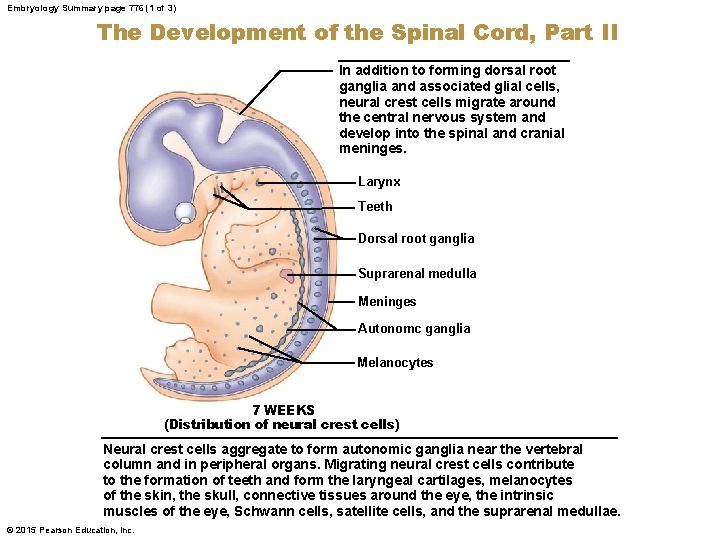
Embryology Summary page 776 (1 of 3) The Development of the Spinal Cord, Part II In addition to forming dorsal root ganglia and associated glial cells, neural crest cells migrate around the central nervous system and develop into the spinal and cranial meninges. Larynx Teeth Dorsal root ganglia Suprarenal medulla Meninges Autonomc ganglia Melanocytes 7 WEEKS (Distribution of neural crest cells) Neural crest cells aggregate to form autonomic ganglia near the vertebral column and in peripheral organs. Migrating neural crest cells contribute to the formation of teeth and form the laryngeal cartilages, melanocytes of the skin, the skull, connective tissues around the eye, the intrinsic muscles of the eye, Schwann cells, satellite cells, and the suprarenal medullae. © 2015 Pearson Education, Inc.
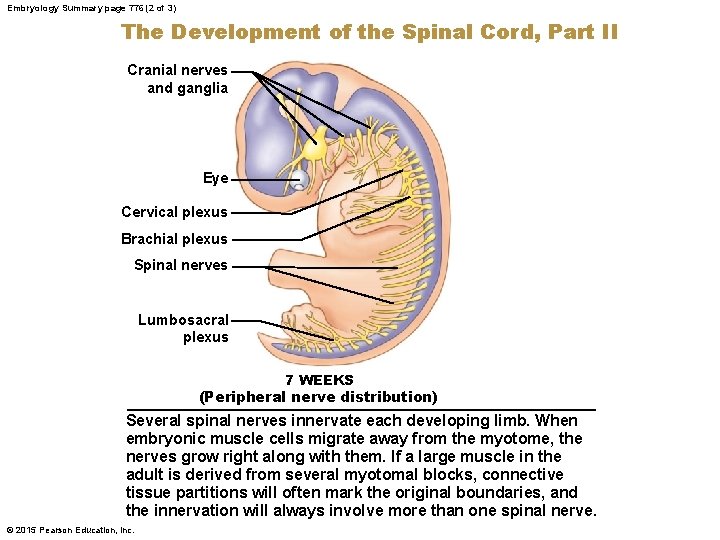
Embryology Summary page 776 (2 of 3) The Development of the Spinal Cord, Part II Cranial nerves and ganglia Eye Cervical plexus Brachial plexus Spinal nerves Lumbosacral plexus 7 WEEKS (Peripheral nerve distribution) Several spinal nerves innervate each developing limb. When embryonic muscle cells migrate away from the myotome, the nerves grow right along with them. If a large muscle in the adult is derived from several myotomal blocks, connective tissue partitions will often mark the original boundaries, and the innervation will always involve more than one spinal nerve. © 2015 Pearson Education, Inc.
Embryology of Organ Systems • Developmental Abnormalities • Spina Bifida • The vertebral laminae fail to unite • The neural arch is incomplete • The spinal meninges bulge outward • Neural Tube Defect • A portion of the spinal cord develops as a broad plate © 2015 Pearson Education, Inc.
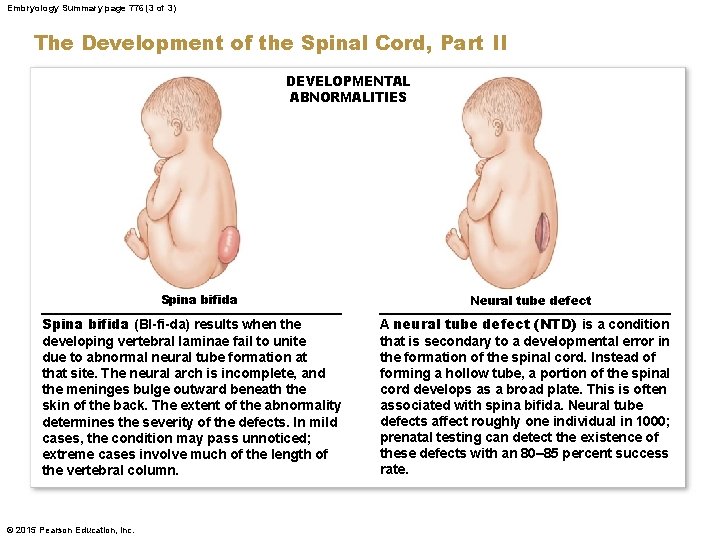
Embryology Summary page 776 (3 of 3) The Development of the Spinal Cord, Part II DEVELOPMENTAL ABNORMALITIES Spina bifida (BI-fi-da) results when the developing vertebral laminae fail to unite due to abnormal neural tube formation at that site. The neural arch is incomplete, and the meninges bulge outward beneath the skin of the back. The extent of the abnormality determines the severity of the defects. In mild cases, the condition may pass unnoticed; extreme cases involve much of the length of the vertebral column. © 2015 Pearson Education, Inc. Neural tube defect A neural tube defect (NTD) is a condition that is secondary to a developmental error in the formation of the spinal cord. Instead of forming a hollow tube, a portion of the spinal cord develops as a broad plate. This is often associated with spina bifida. Neural tube defects affect roughly one individual in 1000; prenatal testing can detect the existence of these defects with an 80– 85 percent success rate.
Embryology of Organ Systems • The Development of the Brain • 23 days • The cephalic extension forms three brain vesicles • Prosencephalon • Mesencephalon • Rhombencephalon © 2015 Pearson Education, Inc.
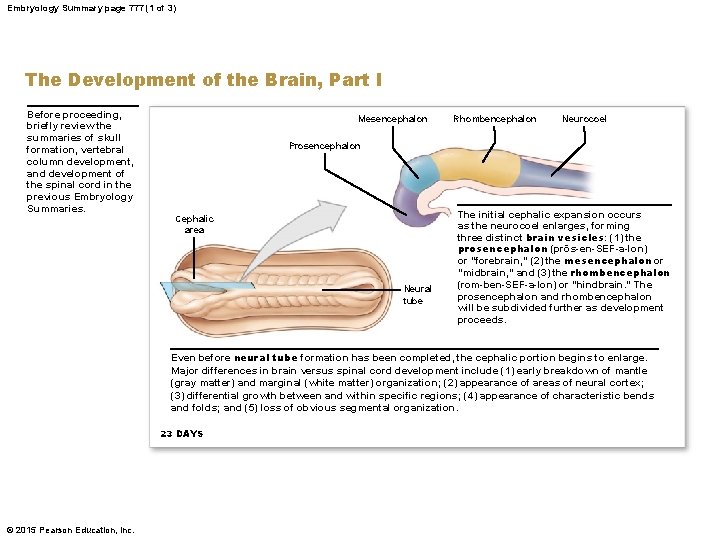
Embryology Summary page 777 (1 of 3) The Development of the Brain, Part I Before proceeding, briefly review the summaries of skull formation, vertebral column development, and development of the spinal cord in the previous Embryology Summaries. Mesencephalon Rhombencephalon Neurocoel Prosencephalon Cephalic area Neural tube The initial cephalic expansion occurs as the neurocoel enlarges, forming three distinct brain vesicles: (1) the prosencephalon (prōs-en-SEF-a-lon) or “forebrain, ” (2) the mesencephalon or “midbrain, ” and (3) the rhombencephalon (rom-ben-SEF-a-lon) or “hindbrain. ” The prosencephalon and rhombencephalon will be subdivided further as development proceeds. Even before neural tube formation has been completed, the cephalic portion begins to enlarge. Major differences in brain versus spinal cord development include (1) early breakdown of mantle (gray matter) and marginal (white matter) organization; (2) appearance of areas of neural cortex; (3) differential growth between and within specific regions; (4) appearance of characteristic bends and folds; and (5) loss of obvious segmental organization. 23 DAYS © 2015 Pearson Education, Inc.
Embryology of Organ Systems • The Development of the Brain (continued) • 4 weeks • The rhombencephalon subdivides to form: • Metencephalon • Myelencephalon • The prosencephalon subdivides to form: • Telencephalon • Diencephalon © 2015 Pearson Education, Inc.
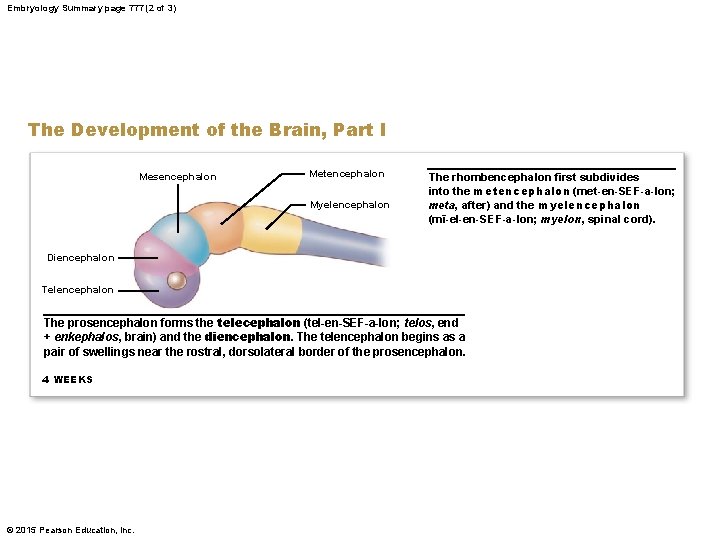
Embryology Summary page 777 (2 of 3) The Development of the Brain, Part I Mesencephalon Metencephalon Myelencephalon The rhombencephalon first subdivides into the metencephalon (met-en-SEF-a-lon; meta, after) and the myelencephalon (mī-el-en-SEF-a-lon; myelon, spinal cord). Diencephalon Telencephalon The prosencephalon forms the telecephalon (tel-en-SEF-a-lon; telos, end + enkephalos, brain) and the diencephalon. The telencephalon begins as a pair of swellings near the rostral, dorsolateral border of the prosencephalon. 4 WEEKS © 2015 Pearson Education, Inc.
Embryology Summary • The Development of the Brain (continued) • 5 weeks • Mesencephalon develops • Cranial nerves begin to develop • 8 weeks • Choroid plexus develops • Cerebral hemispheres expand • 11 weeks • Cerebellum develops © 2015 Pearson Education, Inc.
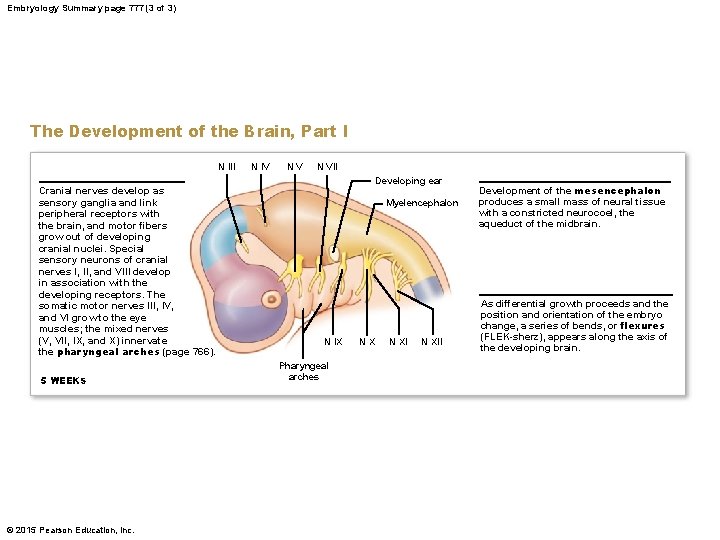
Embryology Summary page 777 (3 of 3) The Development of the Brain, Part I N III Cranial nerves develop as sensory ganglia and link peripheral receptors with the brain, and motor fibers grow out of developing cranial nuclei. Special sensory neurons of cranial nerves I, II, and VIII develop in association with the developing receptors. The somatic motor nerves III, IV, and VI grow to the eye muscles; the mixed nerves (V, VII, IX, and X) innervate the pharyngeal arches (page 766). 5 WEEKS © 2015 Pearson Education, Inc. N IV NV N VII Developing ear Myelencephalon N IX Pharyngeal arches NX N XII Development of the mesencephalon produces a small mass of neural tissue with a constricted neurocoel, the aqueduct of the midbrain. As differential growth proceeds and the position and orientation of the embryo change, a series of bends, or flexures (FLEK-sherz), appears along the axis of the developing brain.
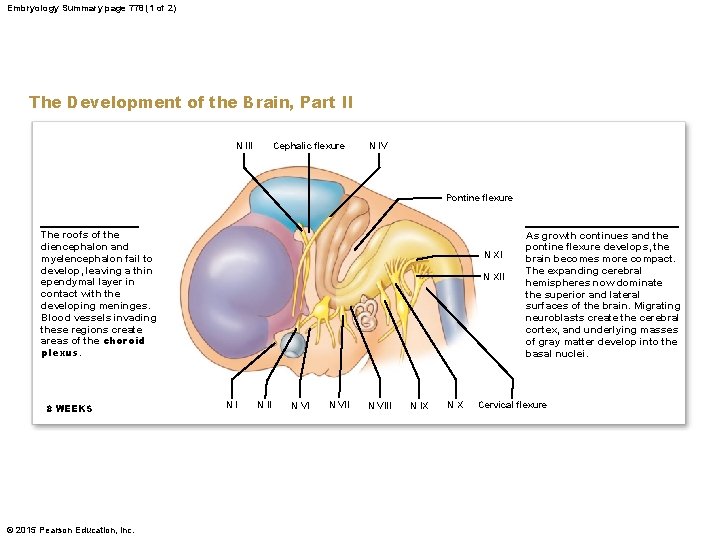
Embryology Summary page 778 (1 of 2) The Development of the Brain, Part II N III Cephalic flexure N IV Pontine flexure The roofs of the diencephalon and myelencephalon fail to develop, leaving a thin ependymal layer in contact with the developing meninges. Blood vessels invading these regions create areas of the choroid plexus. 8 WEEKS © 2015 Pearson Education, Inc. N XII NI N II N VIII N IX NX As growth continues and the pontine flexure develops, the brain becomes more compact. The expanding cerebral hemispheres now dominate the superior and lateral surfaces of the brain. Migrating neuroblasts create the cerebral cortex, and underlying masses of gray matter develop into the basal nuclei. Cervical flexure
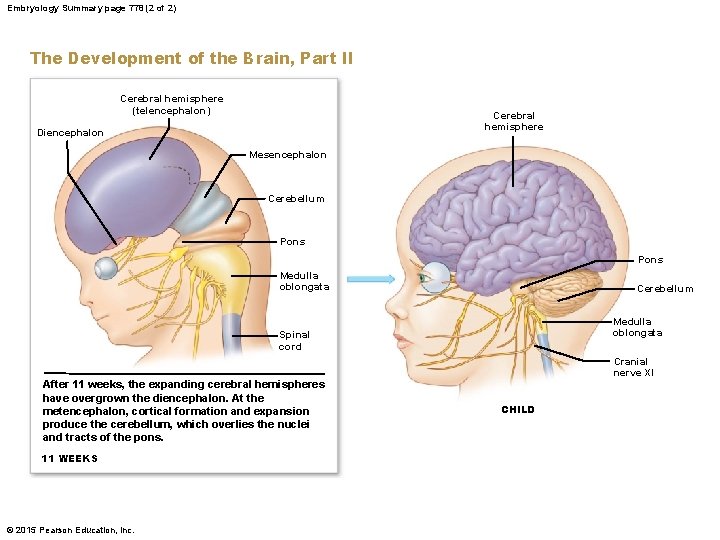
Embryology Summary page 778 (2 of 2) The Development of the Brain, Part II Cerebral hemisphere (telencephalon) Cerebral hemisphere Diencephalon Mesencephalon Cerebellum Pons Medulla oblongata Cerebellum Medulla oblongata Spinal cord Cranial nerve XI After 11 weeks, the expanding cerebral hemispheres have overgrown the diencephalon. At the metencephalon, cortical formation and expansion produce the cerebellum, which overlies the nuclei and tracts of the pons. 11 WEEKS © 2015 Pearson Education, Inc. CHILD
Embryology of Organ Systems • The Development of Special Sense Organs • Vision • 4 weeks • Optic vesicles appear in the lateral walls of the prosencephalon • The bulges indent forming the optic cup • The epidermis covering the optic cup forms the lens © 2015 Pearson Education, Inc.
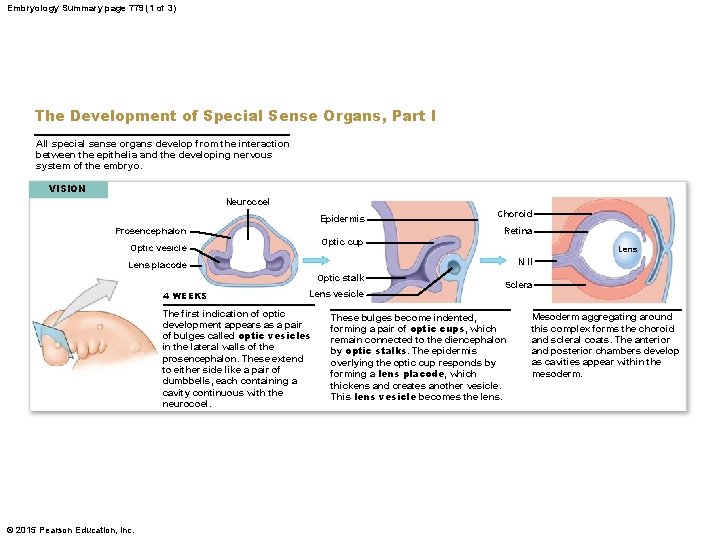
Embryology Summary page 779 (1 of 3) The Development of Special Sense Organs, Part I All special sense organs develop from the interaction between the epithelia and the developing nervous system of the embryo. VISION Neurocoel Epidermis Prosencephalon Choroid Retina Optic cup Optic vesicle Lens N II Lens placode Optic stalk 4 WEEKS Lens vesicle The first indication of optic development appears as a pair of bulges called optic vesicles in the lateral walls of the prosencephalon. These extend to either side like a pair of dumbbells, each containing a cavity continuous with the neurocoel. © 2015 Pearson Education, Inc. Sclera These bulges become indented, forming a pair of optic cups, which remain connected to the diencephalon by optic stalks. The epidermis overlying the optic cup responds by forming a lens placode, which thickens and creates another vesicle. This lens vesicle becomes the lens. Mesoderm aggregating around this complex forms the choroid and scleral coats. The anterior and posterior chambers develop as cavities appear within the mesoderm.
Embryology of Organ Systems • The Development of Special Sense Organs • Olfaction • 5 weeks • A pair of thickened areas in the front of the prosencephalon form the olfactory receptors • Olfactory receptors begin as thickened tissue called nasal placodes © 2015 Pearson Education, Inc.
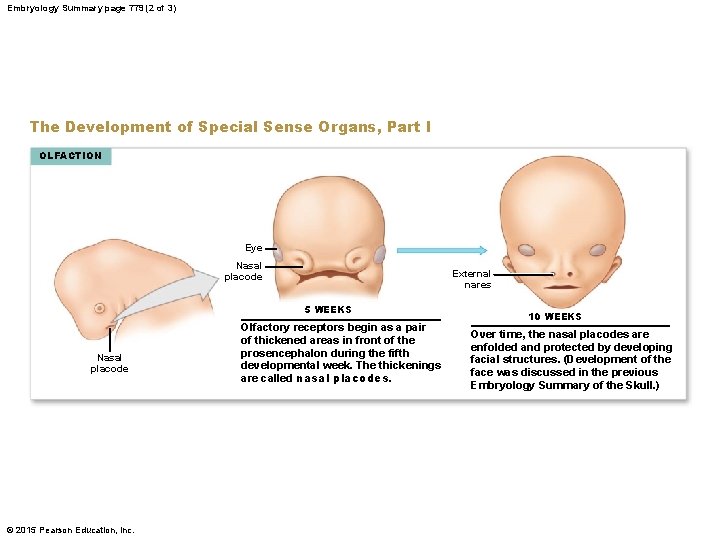
Embryology Summary page 779 (2 of 3) The Development of Special Sense Organs, Part I OLFACTION Eye Nasal placode External nares 5 WEEKS Nasal placode © 2015 Pearson Education, Inc. Olfactory receptors begin as a pair of thickened areas in front of the prosencephalon during the fifth developmental week. The thickenings are called nasal placodes. 10 WEEKS Over time, the nasal placodes are enfolded and protected by developing facial structures. (Development of the face was discussed in the previous Embryology Summary of the Skull. )
Embryology of Organ Systems • The Development of Special Sense Organs • Gustation • 5 weeks • Taste buds develop as nerve fibers grow into the mouth and pharynx areas • When nerves innervate the tongue, the epithelial cells differentiate to form gustatory cells © 2015 Pearson Education, Inc.
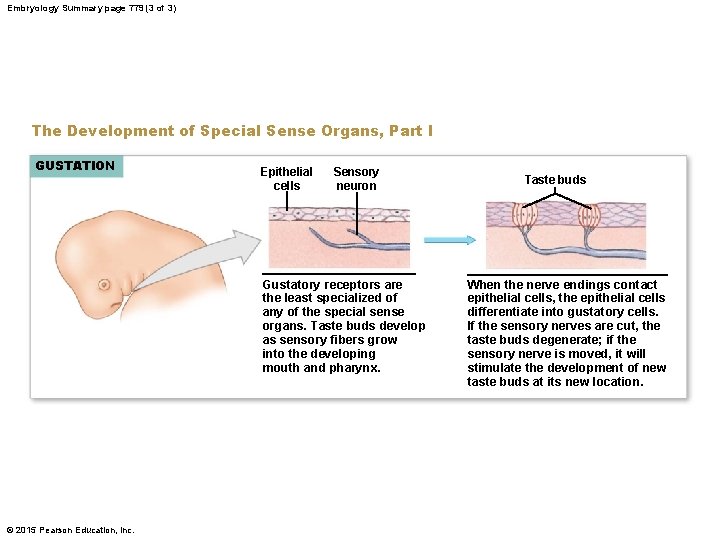
Embryology Summary page 779 (3 of 3) The Development of Special Sense Organs, Part I GUSTATION Epithelial cells Sensory neuron Gustatory receptors are the least specialized of any of the special sense organs. Taste buds develop as sensory fibers grow into the developing mouth and pharynx. © 2015 Pearson Education, Inc. Taste buds When the nerve endings contact epithelial cells, the epithelial cells differentiate into gustatory cells. If the sensory nerves are cut, the taste buds degenerate; if the sensory nerve is moved, it will stimulate the development of new taste buds at its new location.
Embryology of Organ Systems • The Development of Special Sense Organs • Equilibrium and hearing • 3 weeks • Otic placodes begin to appear on the lateral sides of the rhombencephalon • 4 weeks • Deep pockets form in the otic regions, creating otic vesicles • 6– 7 weeks • The vesicles form the bony labyrinth © 2015 Pearson Education, Inc.
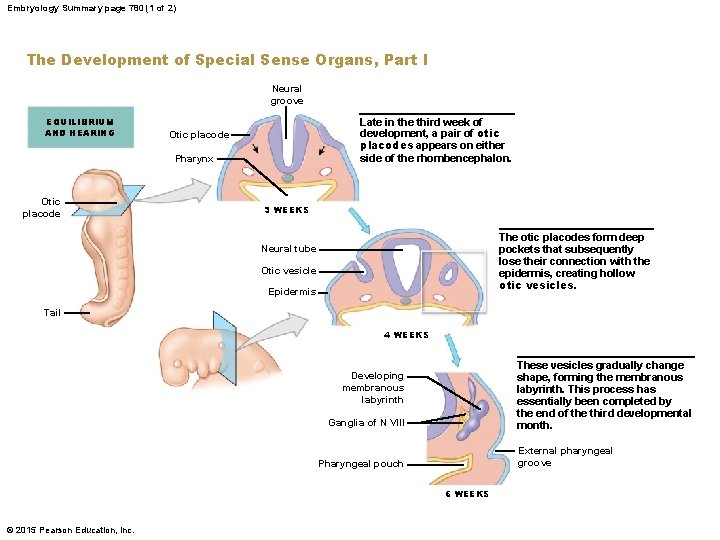
Embryology Summary page 780 (1 of 2) The Development of Special Sense Organs, Part I Neural groove EQUILIBRIUM AND HEARING Late in the third week of development, a pair of otic placodes appears on either side of the rhombencephalon. Otic placode Pharynx Otic placode 3 WEEKS The otic placodes form deep pockets that subsequently lose their connection with the epidermis, creating hollow otic vesicles. Neural tube Otic vesicle Epidermis Tail 4 WEEKS These vesicles gradually change shape, forming the membranous labyrinth. This process has essentially been completed by the end of the third developmental month. Developing membranous labyrinth Ganglia of N VIII External pharyngeal groove Pharyngeal pouch 6 WEEKS © 2015 Pearson Education, Inc.
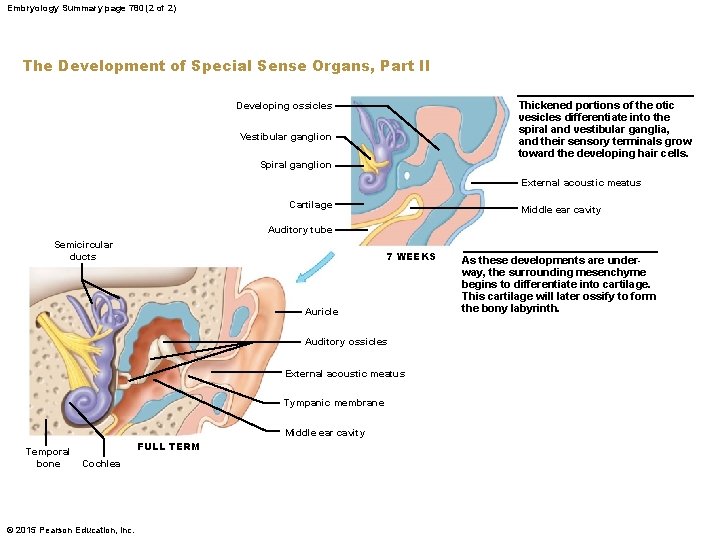
Embryology Summary page 780 (2 of 2) The Development of Special Sense Organs, Part II Thickened portions of the otic vesicles differentiate into the spiral and vestibular ganglia, and their sensory terminals grow toward the developing hair cells. Developing ossicles Vestibular ganglion Spiral ganglion External acoustic meatus Cartilage Middle ear cavity Auditory tube Semicircular ducts 7 WEEKS Auricle Auditory ossicles External acoustic meatus Tympanic membrane Middle ear cavity Temporal bone FULL TERM Cochlea © 2015 Pearson Education, Inc. As these developments are underway, the surrounding mesenchyme begins to differentiate into cartilage. This cartilage will later ossify to form the bony labyrinth.
Embryology of Organ Systems • The Development of the Endocrine System • Week 5 • Several pharyngeal pouches are formed • The pouches form: • Thymus gland • Parathyroid gland • Thyroid gland © 2015 Pearson Education, Inc.
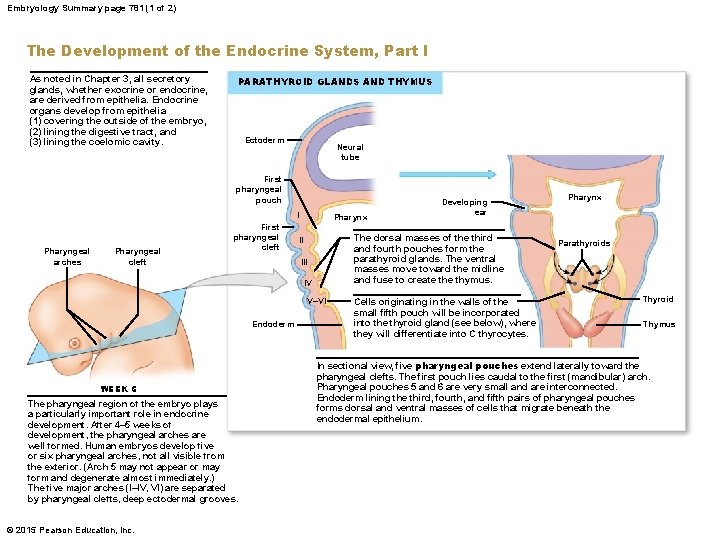
Embryology Summary page 781 (1 of 2) The Development of the Endocrine System, Part I As noted in Chapter 3, all secretory glands, whether exocrine or endocrine, are derived from epithelia. Endocrine organs develop from epithelia (1) covering the outside of the embryo, (2) lining the digestive tract, and (3) lining the coelomic cavity. PARATHYROID GLANDS AND THYMUS Ectoderm Neural tube First pharyngeal pouch I Pharyngeal arches Pharyngeal cleft First pharyngeal cleft Pharynx The dorsal masses of the third and fourth pouches form the parathyroid glands. The ventral masses move toward the midline and fuse to create thymus. II IV V–VI Endoderm WEEK 5 The pharyngeal region of the embryo plays a particularly important role in endocrine development. After 4– 5 weeks of development, the pharyngeal arches are well formed. Human embryos develop five or six pharyngeal arches, not all visible from the exterior. (Arch 5 may not appear or may form and degenerate almost immediately. ) The five major arches (I–IV, VI) are separated by pharyngeal clefts, deep ectodermal grooves. © 2015 Pearson Education, Inc. Developing ear Cells originating in the walls of the small fifth pouch will be incorporated into the thyroid gland (see below), where they will differentiate into C thyrocytes. Pharynx Parathyroids Thyroid Thymus In sectional view, five pharyngeal pouches extend laterally toward the pharyngeal clefts. The first pouch lies caudal to the first (mandibular) arch. Pharyngeal pouches 5 and 6 are very small and are interconnected. Endoderm lining the third, fourth, and fifth pairs of pharyngeal pouches forms dorsal and ventral masses of cells that migrate beneath the endodermal epithelium.
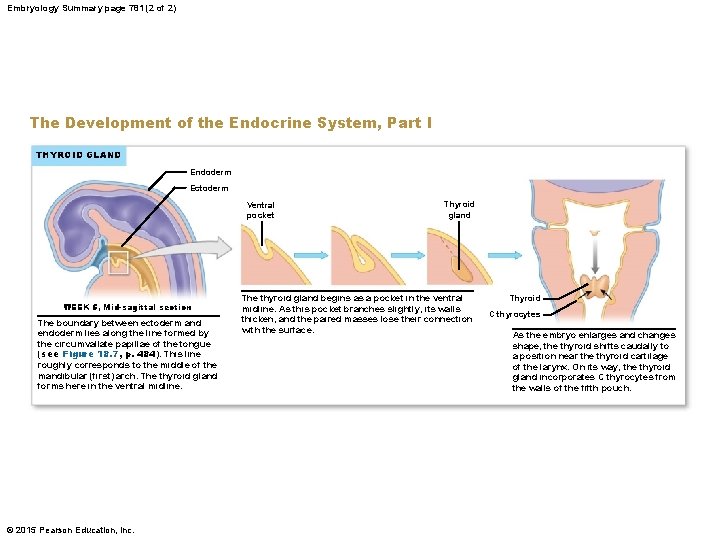
Embryology Summary page 781 (2 of 2) The Development of the Endocrine System, Part I THYROID GLAND Endoderm Ectoderm Ventral pocket WEEK 5, Mid-sagittal section The boundary between ectoderm and endoderm lies along the line formed by the circumvallate papillae of the tongue (see Figure 18. 7, p. 484). This line roughly corresponds to the middle of the mandibular (first) arch. The thyroid gland forms here in the ventral midline. © 2015 Pearson Education, Inc. Thyroid gland The thyroid gland begins as a pocket in the ventral midline. As this pocket branches slightly, its walls thicken, and the paired masses lose their connection with the surface. Thyroid C thyrocytes As the embryo enlarges and changes shape, the thyroid shifts caudally to a position near the thyroid cartilage of the larynx. On its way, the thyroid gland incorporates C thyrocytes from the walls of the fifth pouch.
Embryology of Organ Systems • The Development of the Endocrine System • Week 5 • The pituitary gland forms as a pocket in the pharyngeal area; this ectodermal pocket breaks away from the pharyngeal area and develops just superior to the thyroid gland area © 2015 Pearson Education, Inc.
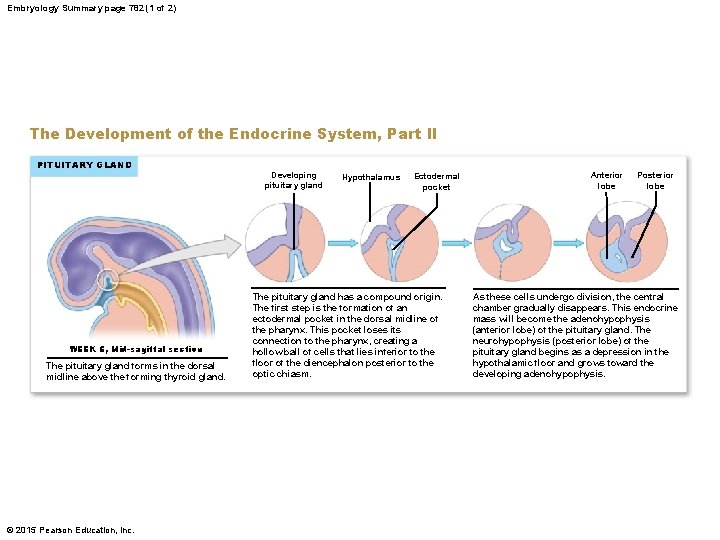
Embryology Summary page 782 (1 of 2) The Development of the Endocrine System, Part II PITUITARY GLAND WEEK 5, Mid-sagittal section The pituitary gland forms in the dorsal midline above the forming thyroid gland. © 2015 Pearson Education, Inc. Developing pituitary gland Hypothalamus Ectodermal pocket The pituitary gland has a compound origin. The first step is the formation of an ectodermal pocket in the dorsal midline of the pharynx. This pocket loses its connection to the pharynx, creating a hollow ball of cells that lies inferior to the floor of the diencephalon posterior to the optic chiasm. Anterior lobe Posterior lobe As these cells undergo division, the central chamber gradually disappears. This endocrine mass will become the adenohypophysis (anterior lobe) of the pituitary gland. The neurohypophysis (posterior lobe) of the pituitary gland begins as a depression in the hypothalamic floor and grows toward the developing adenohypophysis.
Embryology of Organ Systems • The Development of the Endocrine System • Week 5 (continued) • After the formation of the neural tube, some neural cells migrate away from the CNS and form an aggregate of cells that become the suprarenal glands © 2015 Pearson Education, Inc.
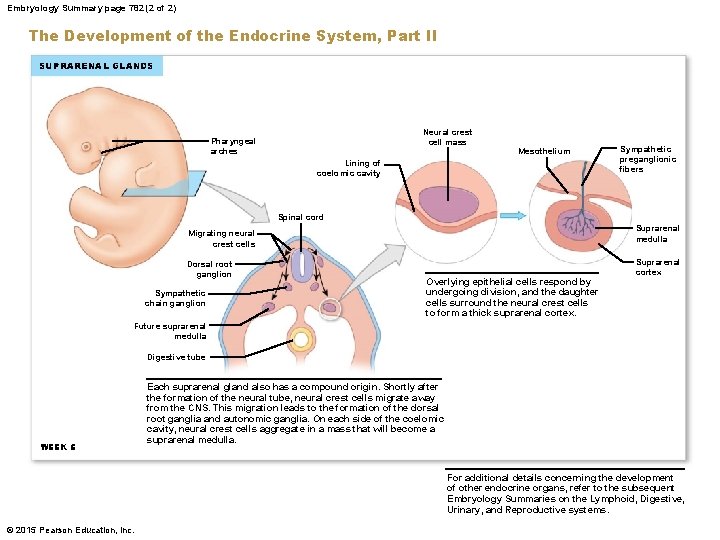
Embryology Summary page 782 (2 of 2) The Development of the Endocrine System, Part II SUPRARENAL GLANDS Neural crest cell mass Pharyngeal arches Mesothelium Lining of coelomic cavity Sympathetic preganglionic fibers Spinal cord Suprarenal medulla Migrating neural crest cells Dorsal root ganglion Sympathetic chain ganglion Overlying epithelial cells respond by undergoing division, and the daughter cells surround the neural crest cells to form a thick suprarenal cortex. Suprarenal cortex Future suprarenal medulla Digestive tube WEEK 5 Each suprarenal gland also has a compound origin. Shortly after the formation of the neural tube, neural crest cells migrate away from the CNS. This migration leads to the formation of the dorsal root ganglia and autonomic ganglia. On each side of the coelomic cavity, neural crest cells aggregate in a mass that will become a suprarenal medulla. For additional details concerning the development of other endocrine organs, refer to the subsequent Embryology Summaries on the Lymphoid, Digestive, Urinary, and Reproductive systems. © 2015 Pearson Education, Inc.
Embryology of Organ Systems • The Development of the Heart • Week 2 • The heart begins as a pair of tubes in the pharynx area • Week 3 • • The heart begins to pump The tubes fuse forming a one-chambered heart Two large veins bring blood to the heart One large artery carries blood away from the heart; the artery is called the truncus arteriosus © 2015 Pearson Education, Inc.
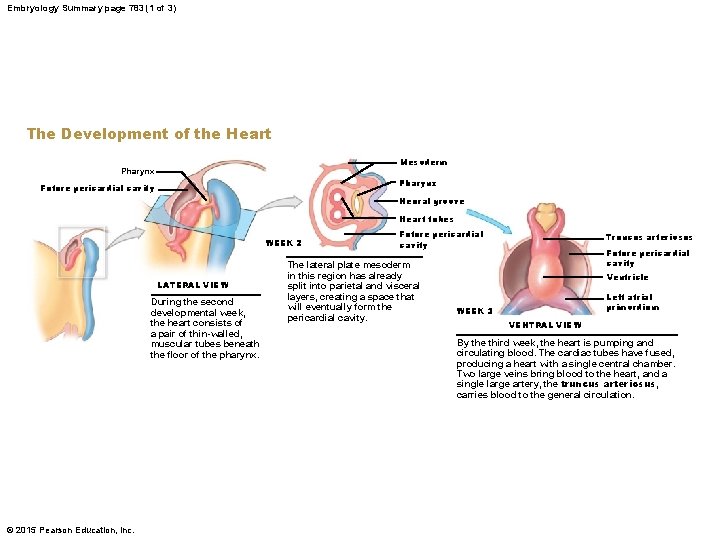
Embryology Summary page 783 (1 of 3) The Development of the Heart Mesoderm Pharynx Future pericardial cavity Neural groove Heart tubes WEEK 2 LATERAL VIEW During the second developmental week, the heart consists of a pair of thin-walled, muscular tubes beneath the floor of the pharynx. © 2015 Pearson Education, Inc. Future pericardial cavity The lateral plate mesoderm in this region has already split into parietal and visceral layers, creating a space that will eventually form the pericardial cavity. Truncus arteriosus Future pericardial cavity Ventricle Left atrial primordium WEEK 3 VENTRAL VIEW By the third week, the heart is pumping and circulating blood. The cardiac tubes have fused, producing a heart with a single central chamber. Two large veins bring blood to the heart, and a single large artery, the truncus arteriosus, carries blood to the general circulation.
Embryology Summary • The Development of the Heart (continued) • Week 4 to 5 • The interatrial and interventricular septa begin to form, ultimately forming the four chambers of the heart • The foramen ovale and ductus arteriosum form • 1 year • The foramen ovale and ductus arteriosum have closed (at birth) • The remnant of the foramen ovale is the fossa ovalis • The remnant of the ductus arteriosum is the ductus ligamentum © 2015 Pearson Education, Inc.
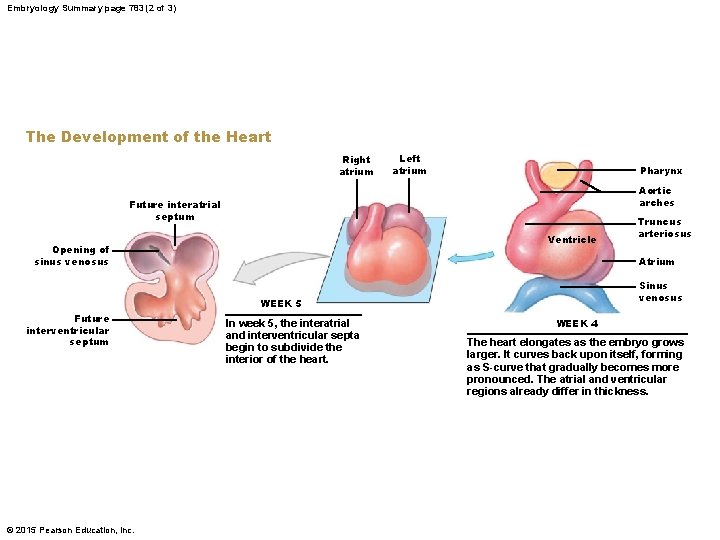
Embryology Summary page 783 (2 of 3) The Development of the Heart Right atrium Left atrium Pharynx Aortic arches Future interatrial septum Ventricle Opening of sinus venosus Atrium Sinus venosus WEEK 5 Future interventricular septum © 2015 Pearson Education, Inc. Truncus arteriosus In week 5, the interatrial and interventricular septa begin to subdivide the interior of the heart. WEEK 4 The heart elongates as the embryo grows larger. It curves back upon itself, forming as S-curve that gradually becomes more pronounced. The atrial and ventricular regions already differ in thickness.
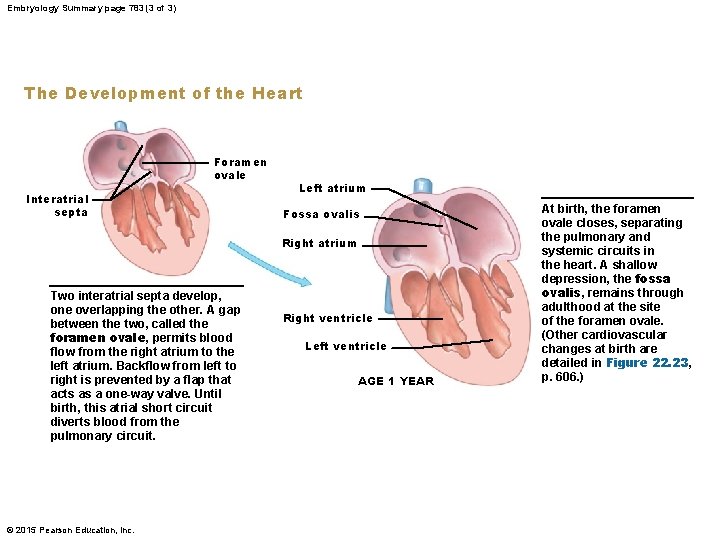
Embryology Summary page 783 (3 of 3) The Development of the Heart Foramen ovale Interatrial septa Left atrium Fossa ovalis Right atrium Two interatrial septa develop, one overlapping the other. A gap between the two, called the foramen ovale, permits blood flow from the right atrium to the left atrium. Backflow from left to right is prevented by a flap that acts as a one-way valve. Until birth, this atrial short circuit diverts blood from the pulmonary circuit. © 2015 Pearson Education, Inc. Right ventricle Left ventricle AGE 1 YEAR At birth, the foramen ovale closes, separating the pulmonary and systemic circuits in the heart. A shallow depression, the fossa ovalis, remains through adulthood at the site of the foramen ovale. (Other cardiovascular changes at birth are detailed in Figure 22. 23, p. 606. )
Embryology of Organ Systems • The Development of the Cardiovascular System • The aortic arches • Week 4 • Several aortic arches form and fuse together to form the dorsal aorta • Some of the aortic arches disintegrate leaving ultimately just one aortic arch © 2015 Pearson Education, Inc.
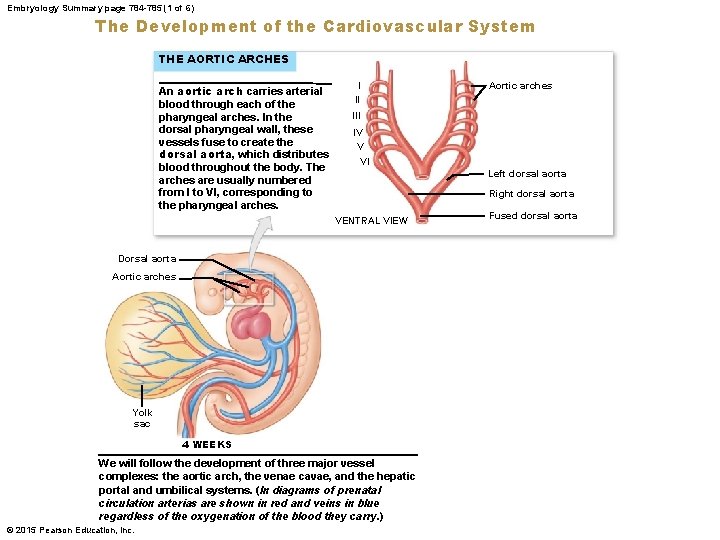
Embryology Summary page 784 -785 (1 of 6) The Development of the Cardiovascular System THE AORTIC ARCHES An aortic arch carries arterial blood through each of the pharyngeal arches. In the dorsal pharyngeal wall, these vessels fuse to create the dorsal aorta, which distributes blood throughout the body. The arches are usually numbered from I to VI, corresponding to the pharyngeal arches. I II IV V VI Left dorsal aorta Right dorsal aorta VENTRAL VIEW Dorsal aorta Aortic arches Yolk sac 4 WEEKS We will follow the development of three major vessel complexes: the aortic arch, the venae cavae, and the hepatic portal and umbilical systems. (In diagrams of prenatal circulation arterias are shown in red and veins in blue regardless of the oxygenation of the blood they carry. ) © 2015 Pearson Education, Inc. Aortic arches Fused dorsal aorta
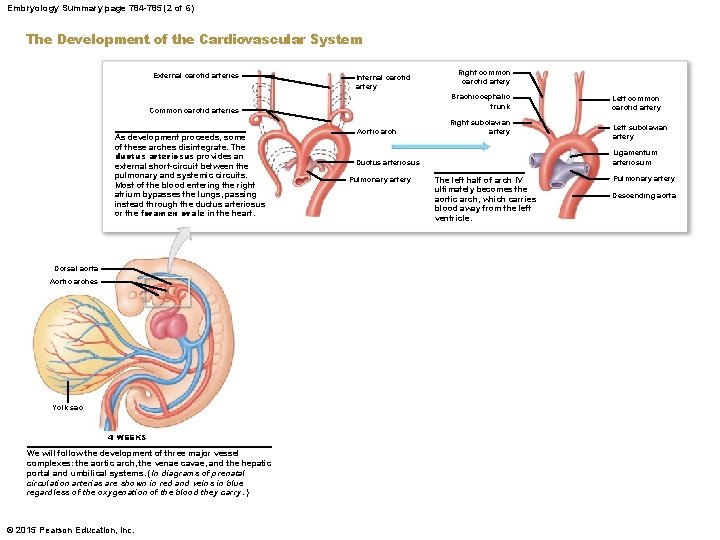
Embryology Summary page 784 -785 (2 of 6) The Development of the Cardiovascular System External carotid arteries Internal carotid artery Brachiocephalic trunk Common carotid arteries As development proceeds, some of these arches disintegrate. The ductus arteriosus provides an external short-circuit between the pulmonary and systemic circuits. Most of the blood entering the right atrium bypasses the lungs, passing instead through the ductus arteriosus or the foramen ovale in the heart. Dorsal aorta Aortic arches Yolk sac 4 WEEKS We will follow the development of three major vessel complexes: the aortic arch, the venae cavae, and the hepatic portal and umbilical systems. (In diagrams of prenatal circulation arterias are shown in red and veins in blue regardless of the oxygenation of the blood they carry. ) © 2015 Pearson Education, Inc. Right common carotid artery Aortic arch Right subclavian artery Left subclavian artery Ligamentum arteriosum Ductus arteriosus Pulmonary artery Left common carotid artery The left half of arch IV ultimately becomes the aortic arch, which carries blood away from the left ventricle. Pulmonary artery Descending aorta
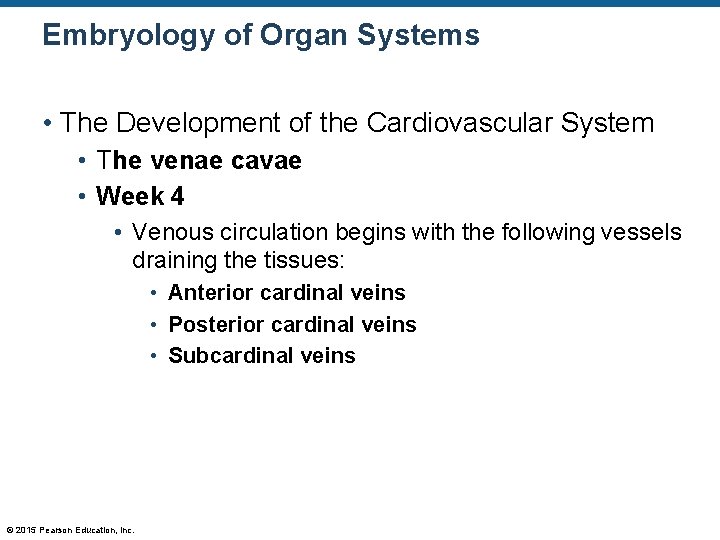
Embryology of Organ Systems • The Development of the Cardiovascular System • The venae cavae • Week 4 • Venous circulation begins with the following vessels draining the tissues: • Anterior cardinal veins • Posterior cardinal veins • Subcardinal veins © 2015 Pearson Education, Inc.
Embryology of Organ Systems • The Development of the Cardiovascular System • The venae cavae • Week 4 • The fusion and disintegration of the paired vessels on the previous slide ultimately form • Superior vena cava • Inferior vena cava © 2015 Pearson Education, Inc.
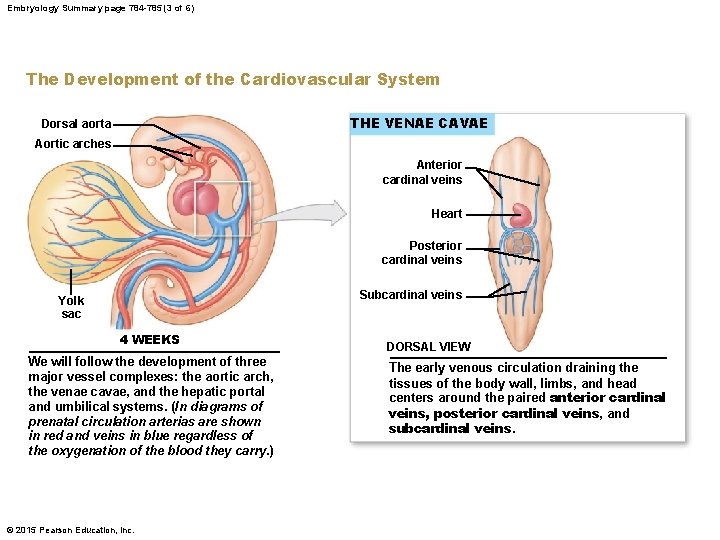
Embryology Summary page 784 -785 (3 of 6) The Development of the Cardiovascular System THE VENAE CAVAE Dorsal aorta Aortic arches Anterior cardinal veins Heart Posterior cardinal veins Subcardinal veins Yolk sac 4 WEEKS We will follow the development of three major vessel complexes: the aortic arch, the venae cavae, and the hepatic portal and umbilical systems. (In diagrams of prenatal circulation arterias are shown in red and veins in blue regardless of the oxygenation of the blood they carry. ) © 2015 Pearson Education, Inc. DORSAL VIEW The early venous circulation draining the tissues of the body wall, limbs, and head centers around the paired anterior cardinal veins, posterior cardinal veins, and subcardinal veins.
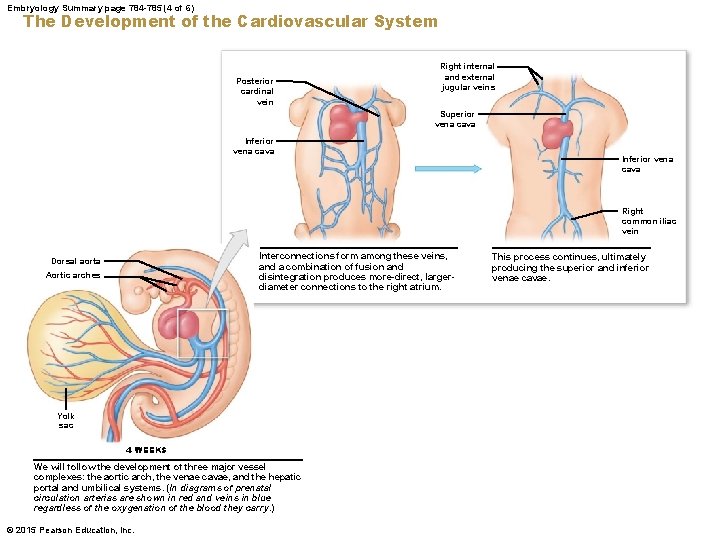
Embryology Summary page 784 -785 (4 of 6) The Development of the Cardiovascular System Posterior cardinal vein Right internal and external jugular veins Superior vena cava Inferior vena cava Right common iliac vein Interconnections form among these veins, and a combination of fusion and disintegration produces more-direct, largerdiameter connections to the right atrium. Dorsal aorta Aortic arches Yolk sac 4 WEEKS We will follow the development of three major vessel complexes: the aortic arch, the venae cavae, and the hepatic portal and umbilical systems. (In diagrams of prenatal circulation arterias are shown in red and veins in blue regardless of the oxygenation of the blood they carry. ) © 2015 Pearson Education, Inc. This process continues, ultimately producing the superior and inferior venae cavae.
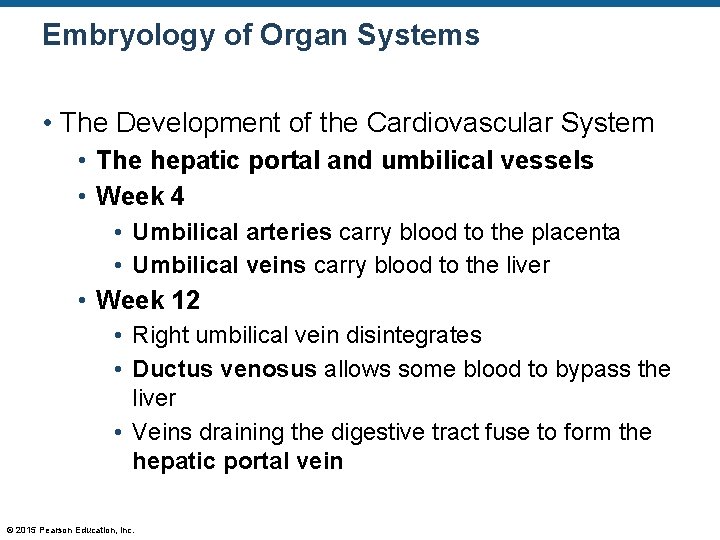
Embryology of Organ Systems • The Development of the Cardiovascular System • The hepatic portal and umbilical vessels • Week 4 • Umbilical arteries carry blood to the placenta • Umbilical veins carry blood to the liver • Week 12 • Right umbilical vein disintegrates • Ductus venosus allows some blood to bypass the liver • Veins draining the digestive tract fuse to form the hepatic portal vein © 2015 Pearson Education, Inc.
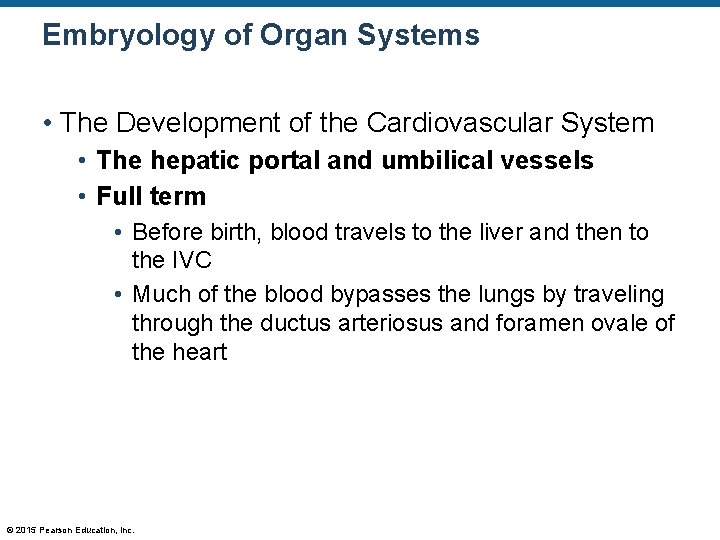
Embryology of Organ Systems • The Development of the Cardiovascular System • The hepatic portal and umbilical vessels • Full term • Before birth, blood travels to the liver and then to the IVC • Much of the blood bypasses the lungs by traveling through the ductus arteriosus and foramen ovale of the heart © 2015 Pearson Education, Inc.
Embryology of Organ Systems • The Development of the Cardiovascular System • The hepatic portal and umbilical vessels • Newborn • At birth • Pulmonary vessels dilate • Foramen ovale closes • Ductus arteriosus forms the ligamentum arteriosum © 2015 Pearson Education, Inc.
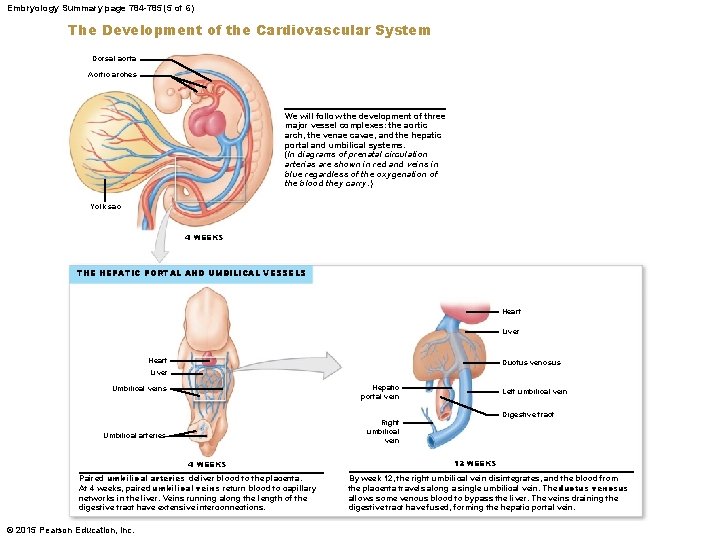
Embryology Summary page 784 -785 (5 of 6) The Development of the Cardiovascular System Dorsal aorta Aortic arches We will follow the development of three major vessel complexes: the aortic arch, the venae cavae, and the hepatic portal and umbilical systems. (In diagrams of prenatal circulation arterias are shown in red and veins in blue regardless of the oxygenation of the blood they carry. ) Yolk sac 4 WEEKS THE HEPATIC PORTAL AND UMBILICAL VESSELS Heart Liver Heart Ductus venosus Liver Hepatic portal vein Umbilical veins Digestive tract Right umbilical vein Umbilical arteries 4 WEEKS Paired umbilical arteries deliver blood to the placenta. At 4 weeks, paired umbilical veins return blood to capillary networks in the liver. Veins running along the length of the digestive tract have extensive interconnections. © 2015 Pearson Education, Inc. Left umbilical vein 12 WEEKS By week 12, the right umbilical vein disintegrates, and the blood from the placenta travels along a single umbilical vein. The ductus venosus allows some venous blood to bypass the liver. The veins draining the digestive tract have fused, forming the hepatic portal vein.
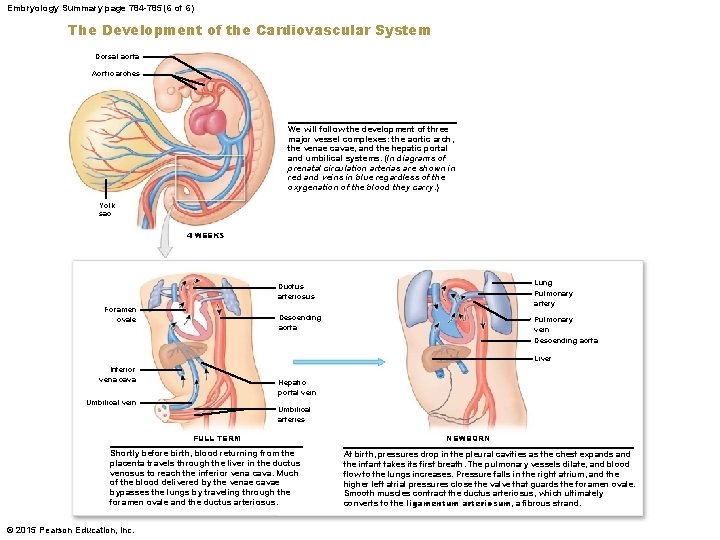
Embryology Summary page 784 -785 (6 of 6) The Development of the Cardiovascular System Dorsal aorta Aortic arches We will follow the development of three major vessel complexes: the aortic arch, the venae cavae, and the hepatic portal and umbilical systems. (In diagrams of prenatal circulation arterias are shown in red and veins in blue regardless of the oxygenation of the blood they carry. ) Yolk sac 4 WEEKS Lung Ductus arteriosus Foramen ovale Pulmonary artery Descending aorta Pulmonary vein Descending aorta Liver Inferior vena cava Hepatic portal vein Umbilical arteries FULL TERM Shortly before birth, blood returning from the placenta travels through the liver in the ductus venosus to reach the inferior vena cava. Much of the blood delivered by the venae cavae bypasses the lungs by traveling through the foramen ovale and the ductus arteriosus. © 2015 Pearson Education, Inc. NEWBORN At birth, pressures drop in the pleural cavities as the chest expands and the infant takes its first breath. The pulmonary vessels dilate, and blood flow to the lungs increases. Pressure falls in the right atrium, and the higher left atrial pressures close the valve that guards the foramen ovale. Smooth muscles contract the ductus arteriosus, which ultimately converts to the ligamentum arteriosum, a fibrous strand.
Embryology of Organ Systems • The Development of the Lymphatic System • Week 6– 8 • The thymus gland forms from a pharyngeal pouch • The cells lose their attachment and form just inferior to the thyroid gland area • Formation of • Jugular lymph sacs • Primordial lymph sacs • Median lymph sac—will become the cisterna chyli • Right lymphatic duct • Thoracic duct • Lymph nodes • Numerous lymphatic sacs form throughout the body © 2015 Pearson Education, Inc.
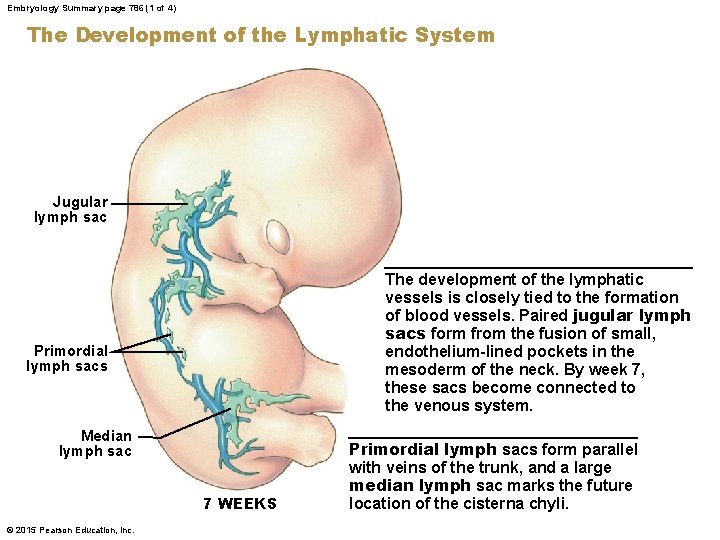
Embryology Summary page 786 (1 of 4) The Development of the Lymphatic System Jugular lymph sac The development of the lymphatic vessels is closely tied to the formation of blood vessels. Paired jugular lymph sacs form from the fusion of small, endothelium-lined pockets in the mesoderm of the neck. By week 7, these sacs become connected to the venous system. Primordial lymph sacs Median lymph sac 7 WEEKS © 2015 Pearson Education, Inc. Primordial lymph sacs form parallel with veins of the trunk, and a large median lymph sac marks the future location of the cisterna chyli.
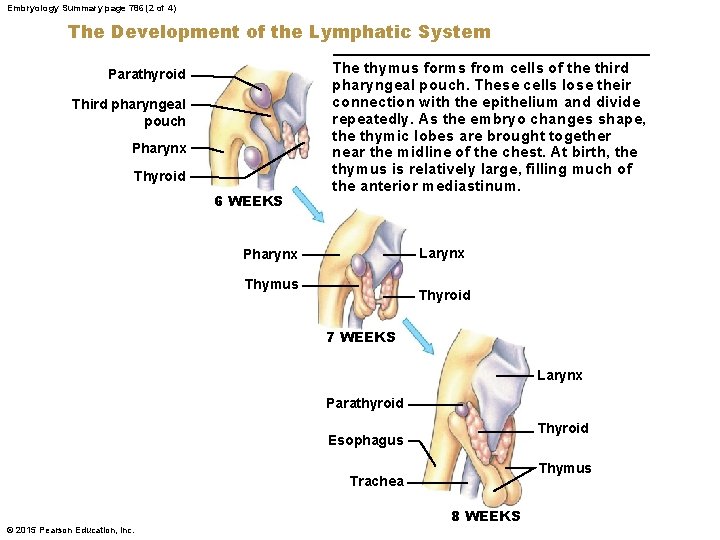
Embryology Summary page 786 (2 of 4) The Development of the Lymphatic System Parathyroid Third pharyngeal pouch Pharynx Thyroid 6 WEEKS The thymus forms from cells of the third pharyngeal pouch. These cells lose their connection with the epithelium and divide repeatedly. As the embryo changes shape, the thymic lobes are brought together near the midline of the chest. At birth, the thymus is relatively large, filling much of the anterior mediastinum. Larynx Pharynx Thymus Thyroid 7 WEEKS Larynx Parathyroid Thyroid Esophagus Thymus Trachea © 2015 Pearson Education, Inc. 8 WEEKS
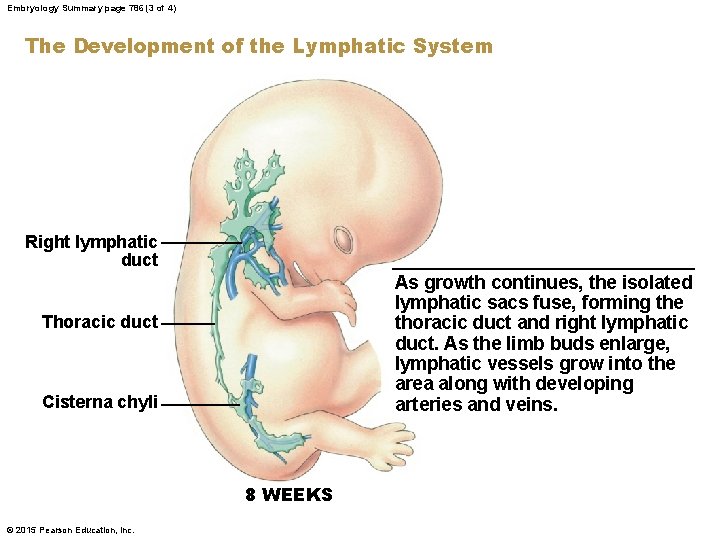
Embryology Summary page 786 (3 of 4) The Development of the Lymphatic System Right lymphatic duct As growth continues, the isolated lymphatic sacs fuse, forming the thoracic duct and right lymphatic duct. As the limb buds enlarge, lymphatic vessels grow into the area along with developing arteries and veins. Thoracic duct Cisterna chyli 8 WEEKS © 2015 Pearson Education, Inc.
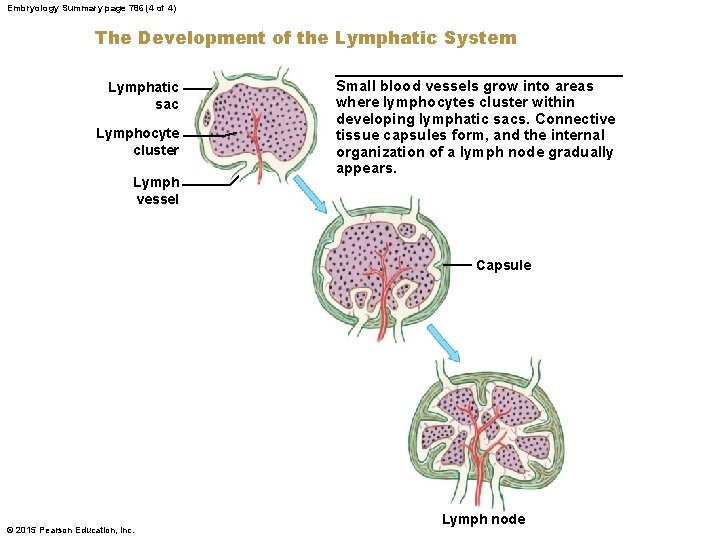
Embryology Summary page 786 (4 of 4) The Development of the Lymphatic System Lymphatic sac Lymphocyte cluster Lymph vessel Small blood vessels grow into areas where lymphocytes cluster within developing lymphatic sacs. Connective tissue capsules form, and the internal organization of a lymph node gradually appears. Capsule © 2015 Pearson Education, Inc. Lymph node
Embryology of Organ Systems • The Development of the Respiratory System • Week 3 • A pulmonary groove forms in the pharynx area • Week 4 • This groove forms deeper and then forms two blind pouches at the end of the groove • The groove forms a tube, which becomes the trachea, and the two blind pouches become the lungs • Week 9 • The diaphragm forms © 2015 Pearson Education, Inc.
Embryology Summary • The Development of the Respiratory System (continued) • 3 months • The lung buds continue to branch numerous times • 6 months • There a million branches • All the bronchioles are formed • Alveoli begin to form © 2015 Pearson Education, Inc.
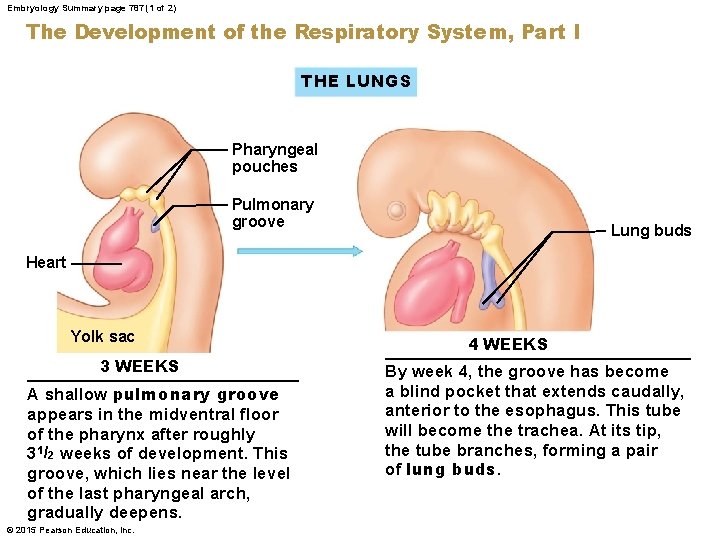
Embryology Summary page 787 (1 of 2) The Development of the Respiratory System, Part I THE LUNGS Pharyngeal pouches Pulmonary groove Lung buds Heart Yolk sac 3 WEEKS A shallow pulmonary groove appears in the midventral floor of the pharynx after roughly 3 1/2 weeks of development. This groove, which lies near the level of the last pharyngeal arch, gradually deepens. © 2015 Pearson Education, Inc. 4 WEEKS By week 4, the groove has become a blind pocket that extends caudally, anterior to the esophagus. This tube will become the trachea. At its tip, the tube branches, forming a pair of lung buds.
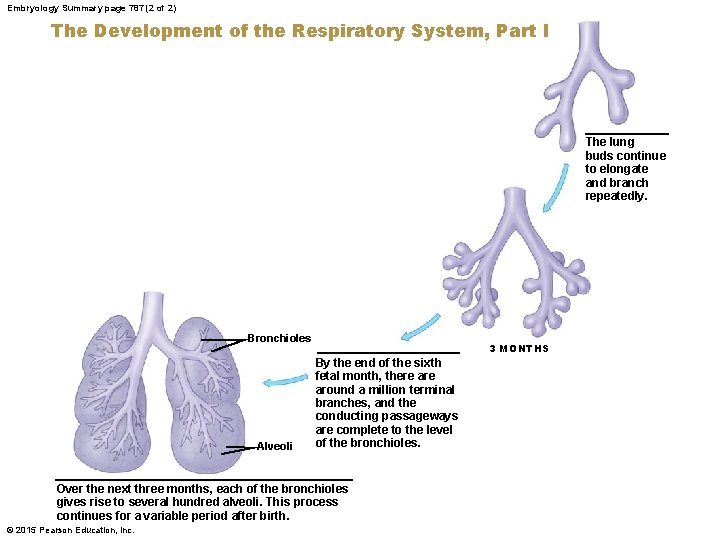
Embryology Summary page 787 (2 of 2) The Development of the Respiratory System, Part I The lung buds continue to elongate and branch repeatedly. Bronchioles Alveoli 3 MONTHS By the end of the sixth fetal month, there around a million terminal branches, and the conducting passageways are complete to the level of the bronchioles. Over the next three months, each of the bronchioles gives rise to several hundred alveoli. This process continues for a variable period after birth. © 2015 Pearson Education, Inc.
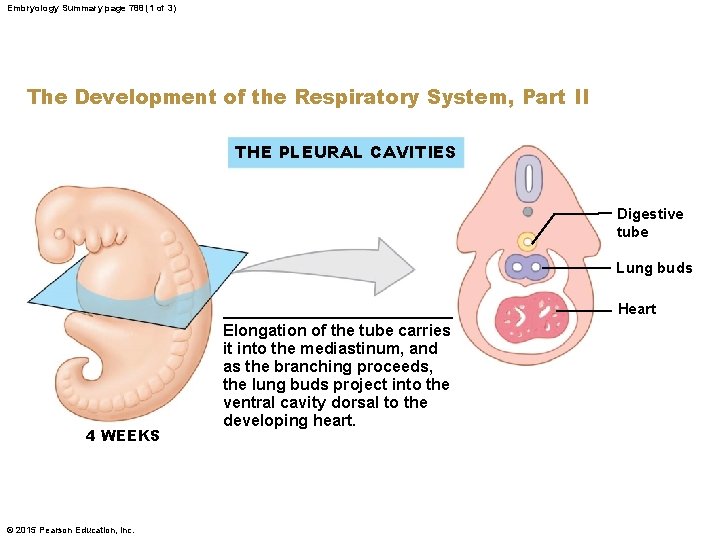
Embryology Summary page 788 (1 of 3) The Development of the Respiratory System, Part II THE PLEURAL CAVITIES Digestive tube Lung buds Heart 4 WEEKS © 2015 Pearson Education, Inc. Elongation of the tube carries it into the mediastinum, and as the branching proceeds, the lung buds project into the ventral cavity dorsal to the developing heart.
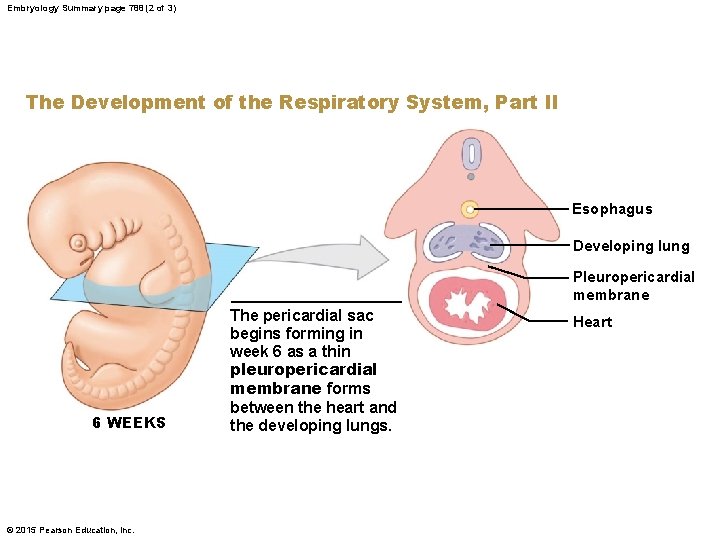
Embryology Summary page 788 (2 of 3) The Development of the Respiratory System, Part II Esophagus Developing lung Pleuropericardial membrane 6 WEEKS © 2015 Pearson Education, Inc. The pericardial sac begins forming in week 6 as a thin pleuropericardial membrane forms between the heart and the developing lungs. Heart
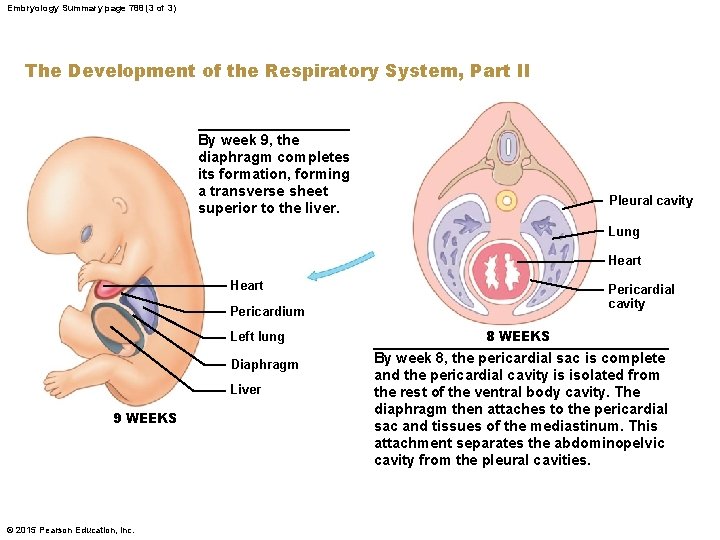
Embryology Summary page 788 (3 of 3) The Development of the Respiratory System, Part II By week 9, the diaphragm completes its formation, forming a transverse sheet superior to the liver. Pleural cavity Lung Heart Pericardial cavity Pericardium Left lung Diaphragm Liver 9 WEEKS © 2015 Pearson Education, Inc. 8 WEEKS By week 8, the pericardial sac is complete and the pericardial cavity is isolated from the rest of the ventral body cavity. The diaphragm then attaches to the pericardial sac and tissues of the mediastinum. This attachment separates the abdominopelvic cavity from the pleural cavities.
Embryology of Organ Systems • The Development of the Digestive System • Week 3 • Yolk sac is formed • The layer between the yolk sac and the amniotic sac develops a hindgut and a foregut • The hindgut and the foregut form the digestive tube • Week 4 • Lateral to the digestive tube are cavities called the coelomic cavities • The digestive tube is held in position within the midline of the coelomic cavities by the dorsal mesentery and ventral mesentery © 2015 Pearson Education, Inc.
Embryology Summary • The Development of the Digestive System • Week 4 (continued) • The pancreas is formed within the dorsal mesentery area • The liver is formed within the ventral mesentery area • Part of the ventral mesentery becomes the falciform ligament of the liver • The remaining mesenteric tissue becomes the greater omentum and lesser omentum © 2015 Pearson Education, Inc.
Embryology Summary • The Development of the Digestive System (continued) • Week 6 • The intestines elongate and coil • The yolk sac and the body stalk fuse to form the umbilical cord © 2015 Pearson Education, Inc.
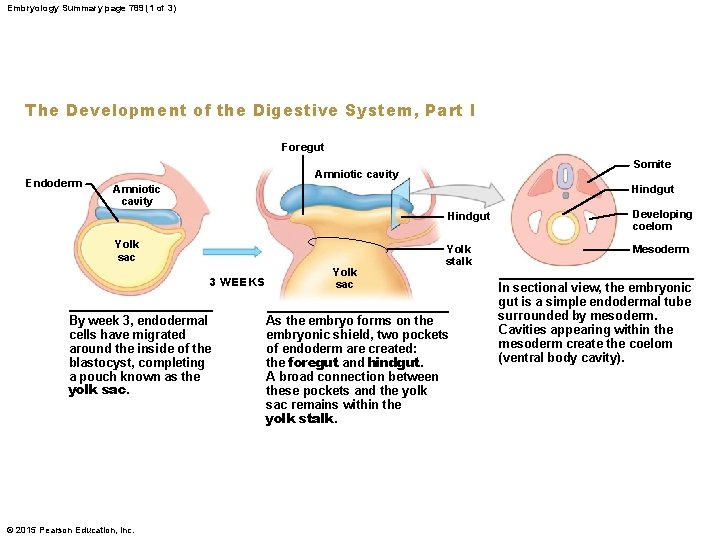
Embryology Summary page 789 (1 of 3) The Development of the Digestive System, Part I Foregut Endoderm Somite Amniotic cavity Hindgut Yolk sac 3 WEEKS By week 3, endodermal cells have migrated around the inside of the blastocyst, completing a pouch known as the yolk sac. © 2015 Pearson Education, Inc. Yolk sac Hindgut Developing coelom Yolk stalk Mesoderm As the embryo forms on the embryonic shield, two pockets of endoderm are created: the foregut and hindgut. A broad connection between these pockets and the yolk sac remains within the yolk stalk. In sectional view, the embryonic gut is a simple endodermal tube surrounded by mesoderm. Cavities appearing within the mesoderm create the coelom (ventral body cavity).
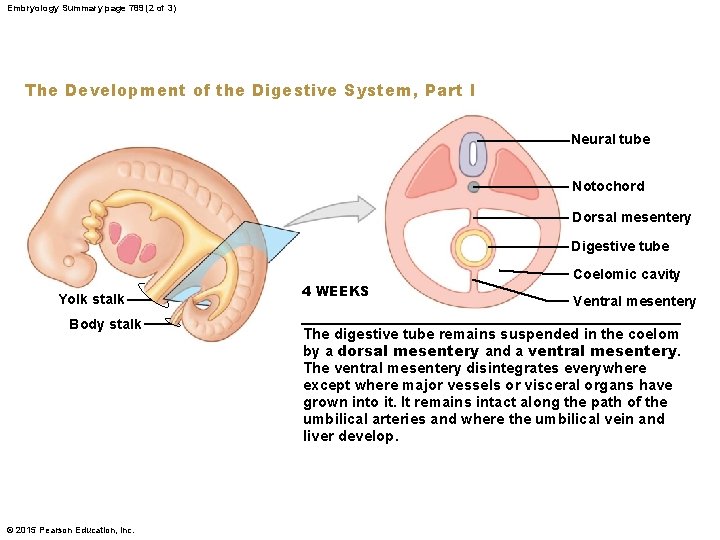
Embryology Summary page 789 (2 of 3) The Development of the Digestive System, Part I Neural tube Notochord Dorsal mesentery Digestive tube Yolk stalk Body stalk © 2015 Pearson Education, Inc. 4 WEEKS Coelomic cavity Ventral mesentery The digestive tube remains suspended in the coelom by a dorsal mesentery and a ventral mesentery. The ventral mesentery disintegrates everywhere except where major vessels or visceral organs have grown into it. It remains intact along the path of the umbilical arteries and where the umbilical vein and liver develop.
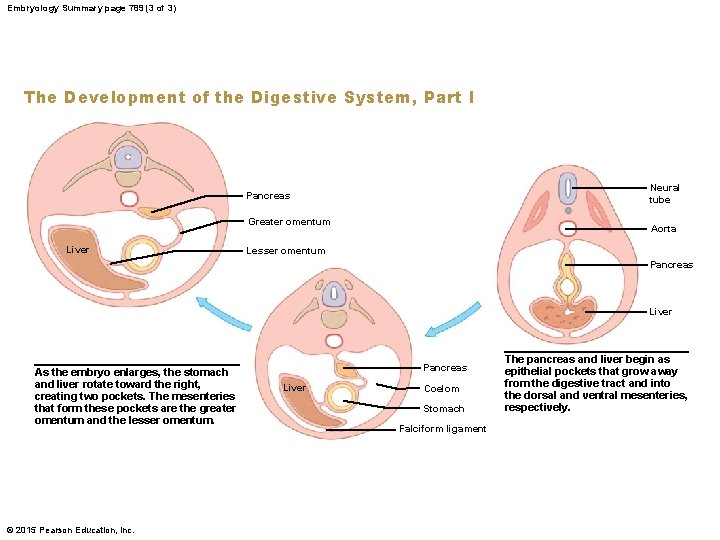
Embryology Summary page 789 (3 of 3) The Development of the Digestive System, Part I Neural tube Pancreas Greater omentum Liver Aorta Lesser omentum Pancreas Liver As the embryo enlarges, the stomach and liver rotate toward the right, creating two pockets. The mesenteries that form these pockets are the greater omentum and the lesser omentum. © 2015 Pearson Education, Inc. Pancreas Liver Coelom Stomach Falciform ligament The pancreas and liver begin as epithelial pockets that grow away from the digestive tract and into the dorsal and ventral mesenteries, respectively.
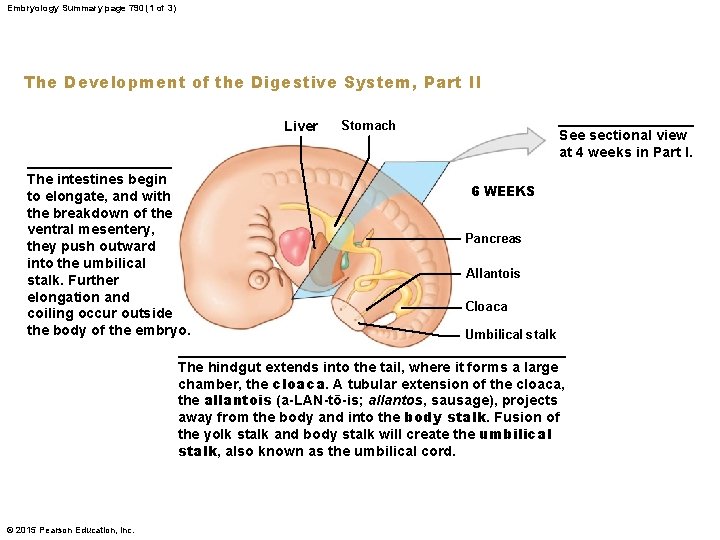
Embryology Summary page 790 (1 of 3) The Development of the Digestive System, Part II Liver The intestines begin to elongate, and with the breakdown of the ventral mesentery, they push outward into the umbilical stalk. Further elongation and coiling occur outside the body of the embryo. Stomach See sectional view at 4 weeks in Part I. 6 WEEKS Pancreas Allantois Cloaca Umbilical stalk The hindgut extends into the tail, where it forms a large chamber, the cloaca. A tubular extension of the cloaca, the allantois (a-LAN-tō-is; allantos, sausage), projects away from the body and into the body stalk. Fusion of the yolk stalk and body stalk will create the umbilical stalk, also known as the umbilical cord. © 2015 Pearson Education, Inc.
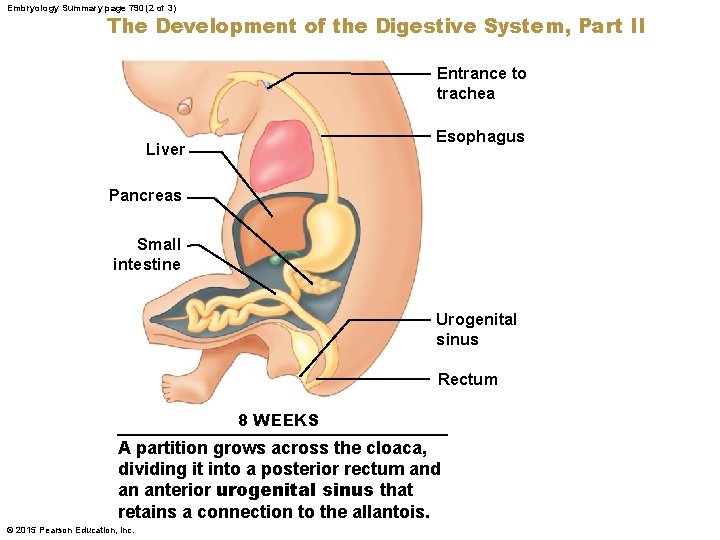
Embryology Summary page 790 (2 of 3) The Development of the Digestive System, Part II Entrance to trachea Esophagus Liver Pancreas Small intestine Urogenital sinus Rectum 8 WEEKS A partition grows across the cloaca, dividing it into a posterior rectum and an anterior urogenital sinus that retains a connection to the allantois. © 2015 Pearson Education, Inc.
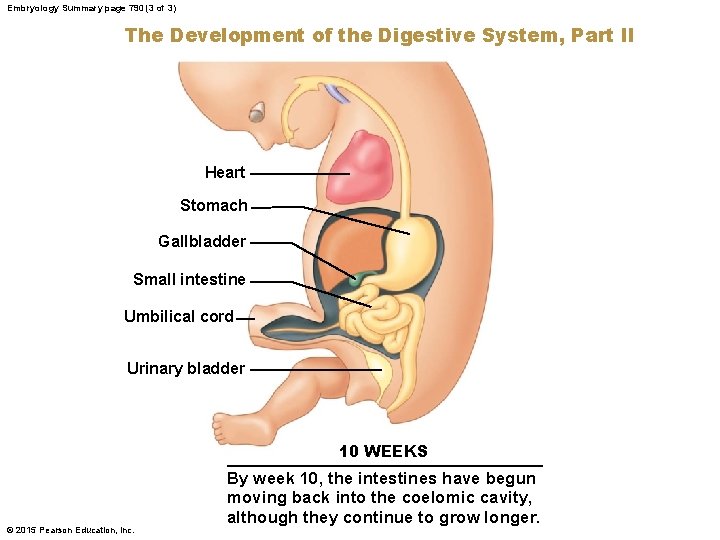
Embryology Summary page 790 (3 of 3) The Development of the Digestive System, Part II Heart Stomach Gallbladder Small intestine Umbilical cord Urinary bladder 10 WEEKS © 2015 Pearson Education, Inc. By week 10, the intestines have begun moving back into the coelomic cavity, although they continue to grow longer.
Embryology of Organ Systems • The Development of the Urinary System • Along the urogenital ridge are: • • Pronephros Mesonephros Metanephros Cloaca • Week 3. 5 • The kidneys begin as seven pairs of tubules called pronephric tubules in the pronephros region © 2015 Pearson Education, Inc.
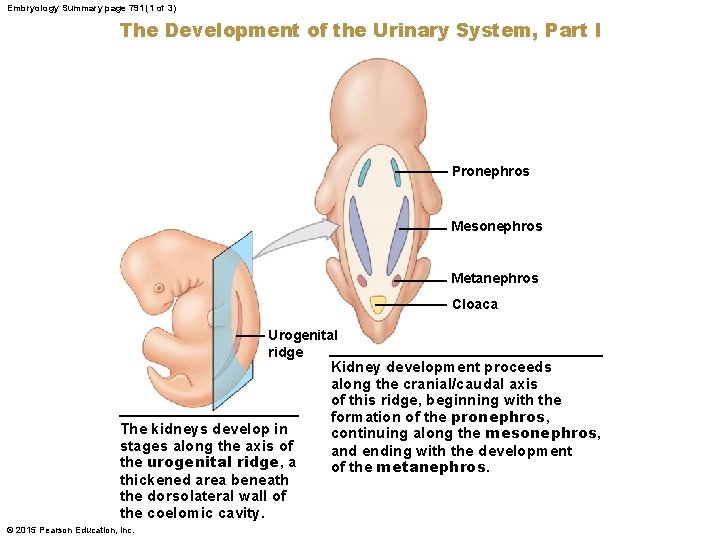
Embryology Summary page 791 (1 of 3) The Development of the Urinary System, Part I Pronephros Mesonephros Metanephros Cloaca Urogenital ridge The kidneys develop in stages along the axis of the urogenital ridge, a thickened area beneath the dorsolateral wall of the coelomic cavity. © 2015 Pearson Education, Inc. Kidney development proceeds along the cranial/caudal axis of this ridge, beginning with the formation of the pronephros, continuing along the mesonephros, and ending with the development of the metanephros.
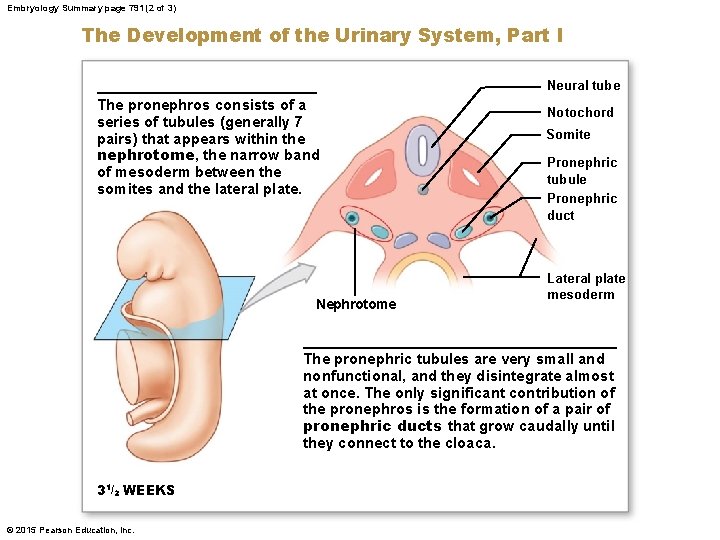
Embryology Summary page 791 (2 of 3) The Development of the Urinary System, Part I Neural tube The pronephros consists of a series of tubules (generally 7 pairs) that appears within the nephrotome, the narrow band of mesoderm between the somites and the lateral plate. Nephrotome Notochord Somite Pronephric tubule Pronephric duct Lateral plate mesoderm The pronephric tubules are very small and nonfunctional, and they disintegrate almost at once. The only significant contribution of the pronephros is the formation of a pair of pronephric ducts that grow caudally until they connect to the cloaca. 31/2 WEEKS © 2015 Pearson Education, Inc.
Embryology of Organ Systems • The Development of the Urinary System • Week 4 • Metanephros forms a dense mass and will eventually become the kidneys • Week 6 • Ureteric bud forms in the wall of the mesonephric ducts • Large glomeruli and nephrons are formed • These will eventually diminish in size © 2015 Pearson Education, Inc.
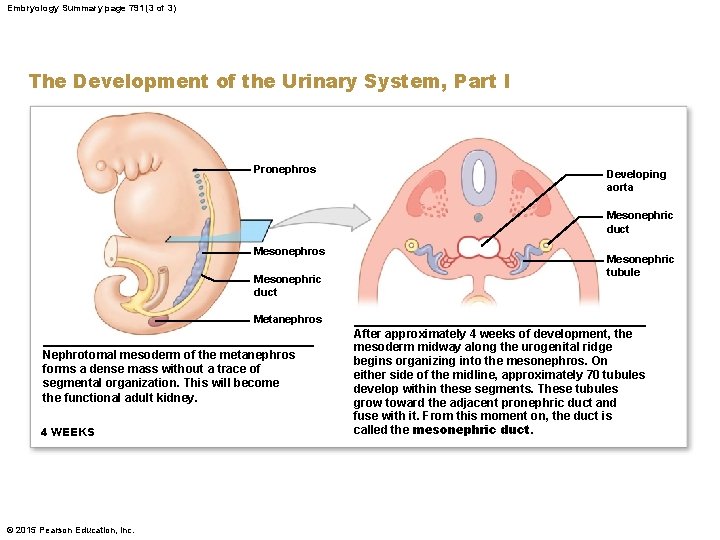
Embryology Summary page 791 (3 of 3) The Development of the Urinary System, Part I Pronephros Developing aorta Mesonephric duct Mesonephros Mesonephric duct Mesonephric tubule Metanephros Nephrotomal mesoderm of the metanephros forms a dense mass without a trace of segmental organization. This will become the functional adult kidney. 4 WEEKS © 2015 Pearson Education, Inc. After approximately 4 weeks of development, the mesoderm midway along the urogenital ridge begins organizing into the mesonephros. On either side of the midline, approximately 70 tubules develop within these segments. These tubules grow toward the adjacent pronephric duct and fuse with it. From this moment on, the duct is called the mesonephric duct.
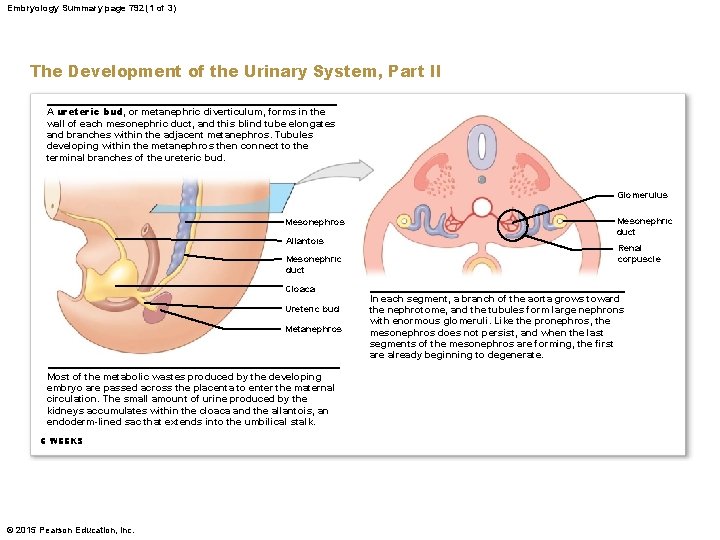
Embryology Summary page 792 (1 of 3) The Development of the Urinary System, Part II A ureteric bud, or metanephric diverticulum, forms in the wall of each mesonephric duct, and this blind tube elongates and branches within the adjacent metanephros. Tubules developing within the metanephros then connect to the terminal branches of the ureteric bud. Glomerulus Mesonephros Allantois Mesonephric duct Cloaca Ureteric bud Metanephros Most of the metabolic wastes produced by the developing embryo are passed across the placenta to enter the maternal circulation. The small amount of urine produced by the kidneys accumulates within the cloaca and the allantois, an endoderm-lined sac that extends into the umbilical stalk. 6 WEEKS © 2015 Pearson Education, Inc. Mesonephric duct Renal corpuscle In each segment, a branch of the aorta grows toward the nephrotome, and the tubules form large nephrons with enormous glomeruli. Like the pronephros, the mesonephros does not persist, and when the last segments of the mesonephros are forming, the first are already beginning to degenerate.
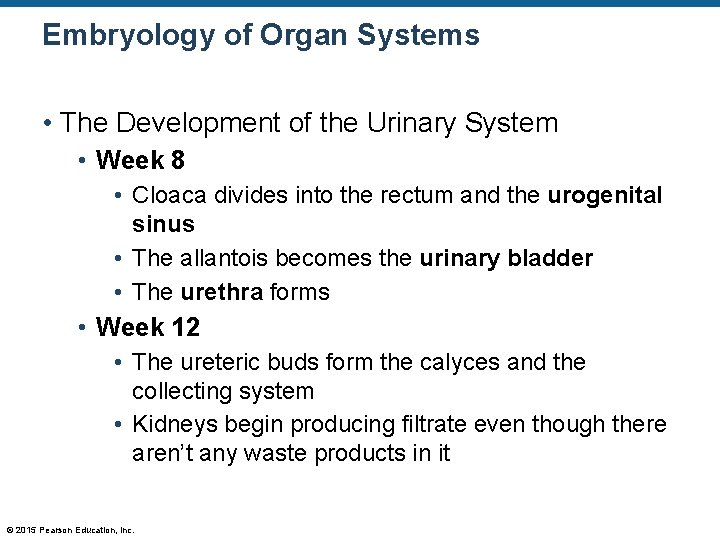
Embryology of Organ Systems • The Development of the Urinary System • Week 8 • Cloaca divides into the rectum and the urogenital sinus • The allantois becomes the urinary bladder • The urethra forms • Week 12 • The ureteric buds form the calyces and the collecting system • Kidneys begin producing filtrate even though there aren’t any waste products in it © 2015 Pearson Education, Inc.
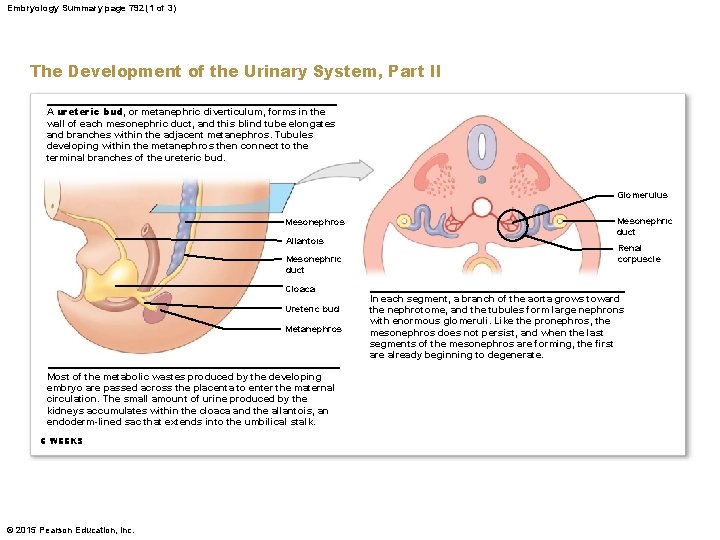
Embryology Summary page 792 (1 of 3) The Development of the Urinary System, Part II A ureteric bud, or metanephric diverticulum, forms in the wall of each mesonephric duct, and this blind tube elongates and branches within the adjacent metanephros. Tubules developing within the metanephros then connect to the terminal branches of the ureteric bud. Glomerulus Mesonephros Allantois Mesonephric duct Cloaca Ureteric bud Metanephros Most of the metabolic wastes produced by the developing embryo are passed across the placenta to enter the maternal circulation. The small amount of urine produced by the kidneys accumulates within the cloaca and the allantois, an endoderm-lined sac that extends into the umbilical stalk. 6 WEEKS © 2015 Pearson Education, Inc. Mesonephric duct Renal corpuscle In each segment, a branch of the aorta grows toward the nephrotome, and the tubules form large nephrons with enormous glomeruli. Like the pronephros, the mesonephros does not persist, and when the last segments of the mesonephros are forming, the first are already beginning to degenerate.
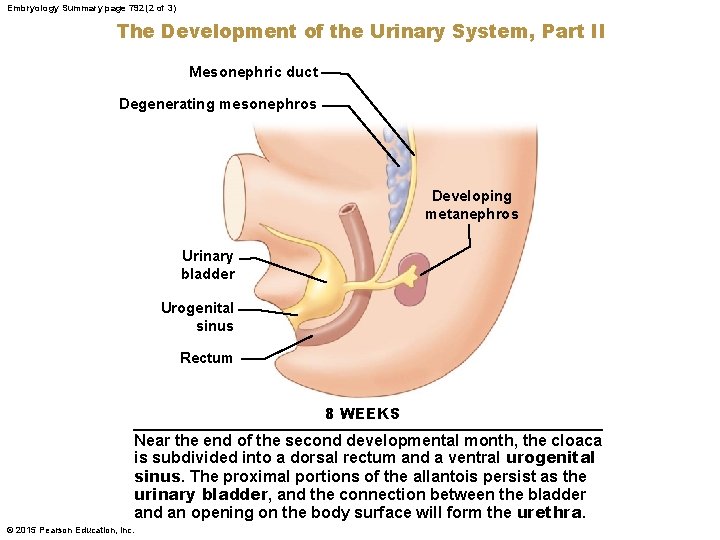
Embryology Summary page 792 (2 of 3) The Development of the Urinary System, Part II Mesonephric duct Degenerating mesonephros Developing metanephros Urinary bladder Urogenital sinus Rectum 8 WEEKS Near the end of the second developmental month, the cloaca is subdivided into a dorsal rectum and a ventral urogenital sinus. The proximal portions of the allantois persist as the urinary bladder, and the connection between the bladder and an opening on the body surface will form the urethra. © 2015 Pearson Education, Inc.
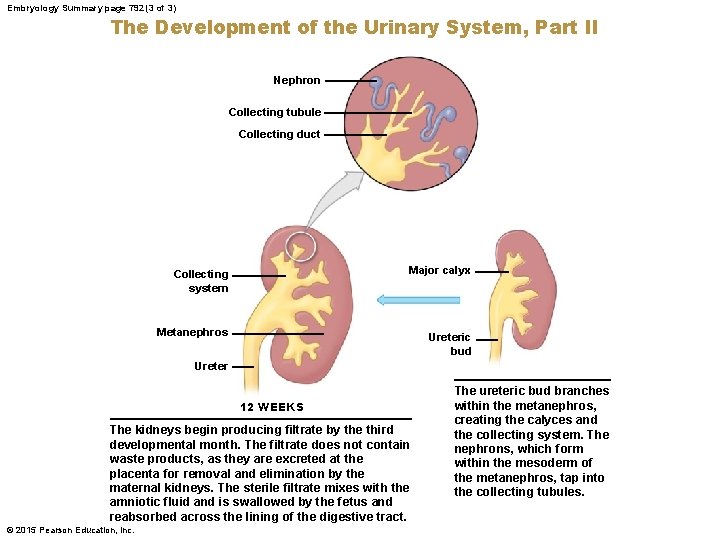
Embryology Summary page 792 (3 of 3) The Development of the Urinary System, Part II Nephron Collecting tubule Collecting duct Collecting system Major calyx Metanephros Ureteric bud Ureter 12 WEEKS The kidneys begin producing filtrate by the third developmental month. The filtrate does not contain waste products, as they are excreted at the placenta for removal and elimination by the maternal kidneys. The sterile filtrate mixes with the amniotic fluid and is swallowed by the fetus and reabsorbed across the lining of the digestive tract. © 2015 Pearson Education, Inc. The ureteric bud branches within the metanephros, creating the calyces and the collecting system. The nephrons, which form within the mesoderm of the metanephros, tap into the collecting tubules.
Embryology of Organ Systems • The Development of the Reproductive System • Development of the gonads • Week 3 • Endodermal cells of the yolk sac migrate to the genital ridges in the abdominal cavity • Each ridge consists of columns of cells called primary sex cords; these will further develop into gonads © 2015 Pearson Education, Inc.
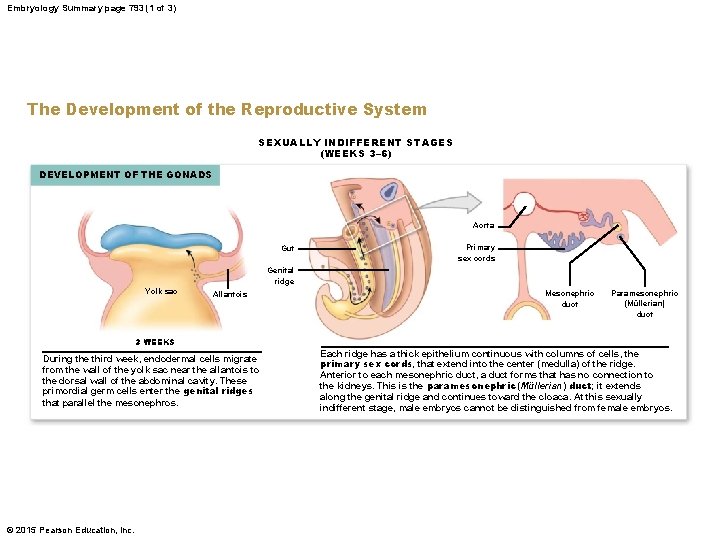
Embryology Summary page 793 (1 of 3) The Development of the Reproductive System SEXUALLY INDIFFERENT STAGES (WEEKS 3– 6) DEVELOPMENT OF THE GONADS Aorta Gut Primary sex cords Genital ridge Yolk sac Allantois Mesonephric duct Paramesonephric (Müllerian) duct 3 WEEKS During the third week, endodermal cells migrate from the wall of the yolk sac near the allantois to the dorsal wall of the abdominal cavity. These primordial germ cells enter the genital ridges that parallel the mesonephros. © 2015 Pearson Education, Inc. Each ridge has a thick epithelium continuous with columns of cells, the primary sex cords, that extend into the center (medulla) of the ridge. Anterior to each mesonephric duct, a duct forms that has no connection to the kidneys. This is the paramesonephric (Müllerian) duct; it extends along the genital ridge and continues toward the cloaca. At this sexually indifferent stage, male embryos cannot be distinguished from female embryos.
Embryology of Organ Systems • The Development of the Reproductive System • Development of ducts and accessory organs • Week 3 • If not exposed to androgens, a female will develop • If exposed to androgens, a male will develop • The genital ridge begins producing testosterone after week 6 © 2015 Pearson Education, Inc.
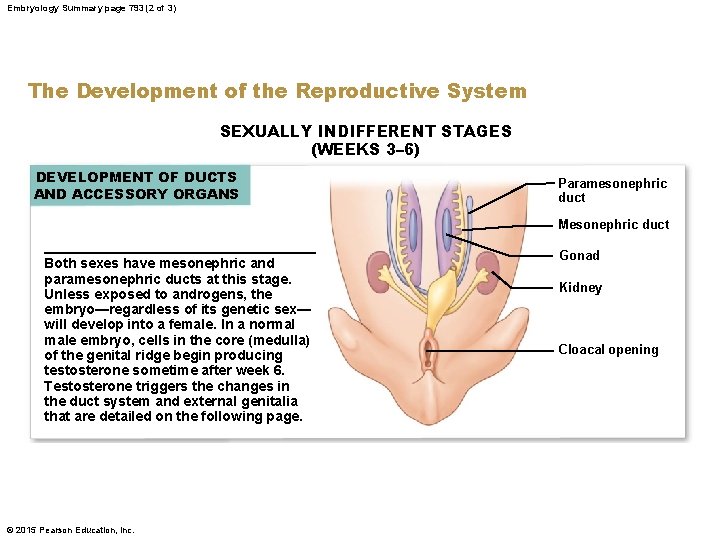
Embryology Summary page 793 (2 of 3) The Development of the Reproductive System SEXUALLY INDIFFERENT STAGES (WEEKS 3– 6) DEVELOPMENT OF DUCTS AND ACCESSORY ORGANS Paramesonephric duct Mesonephric duct Both sexes have mesonephric and paramesonephric ducts at this stage. Unless exposed to androgens, the embryo—regardless of its genetic sex— will develop into a female. In a normal male embryo, cells in the core (medulla) of the genital ridge begin producing testosterone sometime after week 6. Testosterone triggers the changes in the duct system and external genitalia that are detailed on the following page. © 2015 Pearson Education, Inc. Gonad Kidney Cloacal opening
Embryology of Organ Systems • Development of External Genitalia • Week 4 • There are mesenchymal swellings • Cloacal folds • Genital tubercle (forms the glans penis and clitoris) • Week 6 • Cloaca divides to form • Anal fold • Urethral fold © 2015 Pearson Education, Inc.
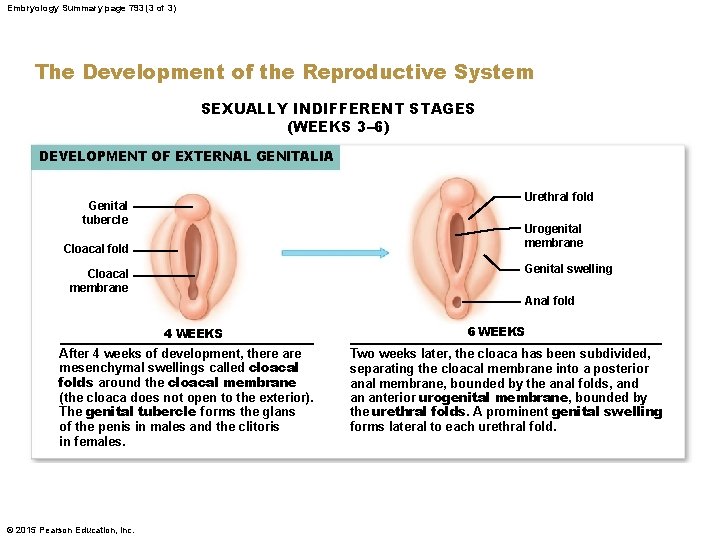
Embryology Summary page 793 (3 of 3) The Development of the Reproductive System SEXUALLY INDIFFERENT STAGES (WEEKS 3– 6) DEVELOPMENT OF EXTERNAL GENITALIA Urethral fold Genital tubercle Urogenital membrane Cloacal fold Genital swelling Cloacal membrane Anal fold 4 WEEKS After 4 weeks of development, there are mesenchymal swellings called cloacal folds around the cloacal membrane (the cloaca does not open to the exterior). The genital tubercle forms the glans of the penis in males and the clitoris in females. © 2015 Pearson Education, Inc. 6 WEEKS Two weeks later, the cloaca has been subdivided, separating the cloacal membrane into a posterior anal membrane, bounded by the anal folds, and an anterior urogenital membrane, bounded by the urethral folds. A prominent genital swelling forms lateral to each urethral fold.
Embryology of Organ Systems • Development of the Male Reproductive System • Development of the testes • Week 7– 12 • The primary sex cords proliferate and eventually form the seminiferous tubules within the developing testes © 2015 Pearson Education, Inc.
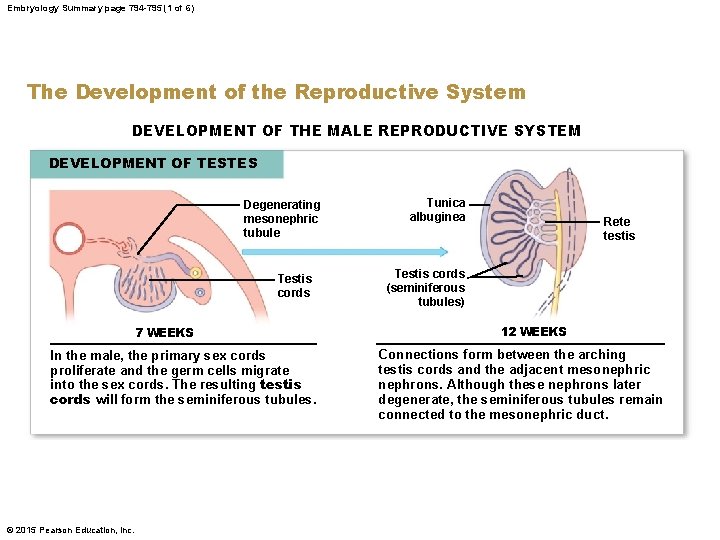
Embryology Summary page 794 -795 (1 of 6) The Development of the Reproductive System DEVELOPMENT OF THE MALE REPRODUCTIVE SYSTEM DEVELOPMENT OF TESTES Degenerating mesonephric tubule Testis cords 7 WEEKS In the male, the primary sex cords proliferate and the germ cells migrate into the sex cords. The resulting testis cords will form the seminiferous tubules. © 2015 Pearson Education, Inc. Tunica albuginea Rete testis Testis cords (seminiferous tubules) 12 WEEKS Connections form between the arching testis cords and the adjacent mesonephric nephrons. Although these nephrons later degenerate, the seminiferous tubules remain connected to the mesonephric duct.
Embryology of Organ Systems • Development of the Male Reproductive System • Development of male ducts and accessory organs • 4 months • The testis cords connect to the remnants of the mesonephric tubules via the rete testis • 7 months • The testes descend into the scrotum © 2015 Pearson Education, Inc.
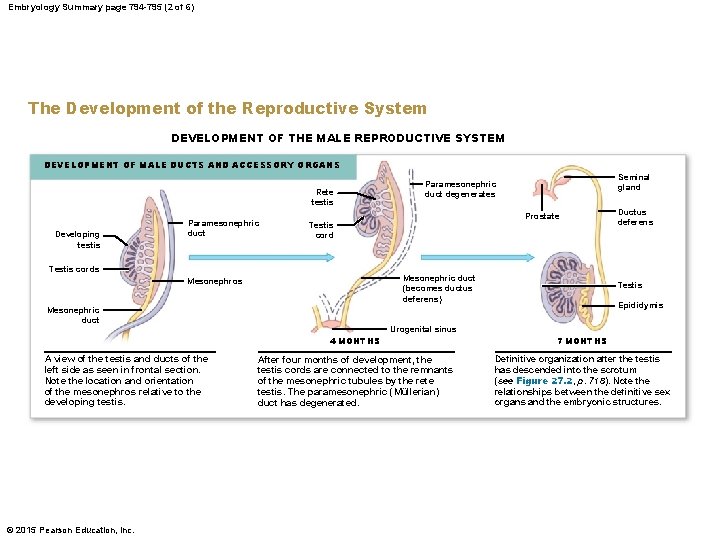
Embryology Summary page 794 -795 (2 of 6) The Development of the Reproductive System DEVELOPMENT OF THE MALE REPRODUCTIVE SYSTEM DEVELOPMENT OF MALE DUCTS AND ACCESSORY ORGANS Rete testis Developing testis Paramesonephric duct Seminal gland Paramesonephric duct degenerates Prostate Testis cord Ductus deferens Testis cords Mesonephric duct (becomes ductus deferens) Mesonephros Mesonephric duct A view of the testis and ducts of the left side as seen in frontal section. Note the location and orientation of the mesonephros relative to the developing testis. © 2015 Pearson Education, Inc. Testis Epididymis Urogenital sinus 4 MONTHS 7 MONTHS After four months of development, the testis cords are connected to the remnants of the mesonephric tubules by the rete testis. The paramesonephric (Müllerian) duct has degenerated. Definitive organization after the testis has descended into the scrotum (see Figure 27. 2, p. 718). Note the relationships between the definitive sex organs and the embryonic structures.
Embryology of Organ Systems • Development of the Male Reproductive System • Development of male external genitalia • 10 weeks • Urethral folds move together to form the spongy urethra • Scrotal sac develops © 2015 Pearson Education, Inc.
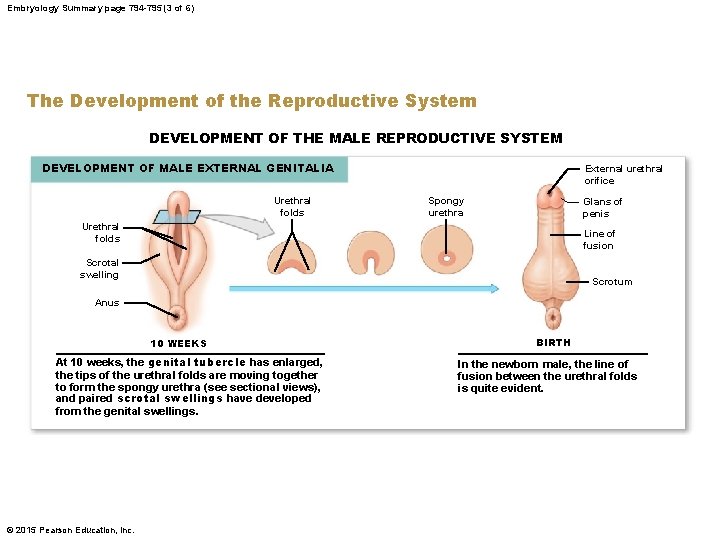
Embryology Summary page 794 -795 (3 of 6) The Development of the Reproductive System DEVELOPMENT OF THE MALE REPRODUCTIVE SYSTEM DEVELOPMENT OF MALE EXTERNAL GENITALIA Urethral folds External urethral orifice Spongy urethra Glans of penis Urethral folds Line of fusion Scrotal swelling Scrotum Anus 10 WEEKS At 10 weeks, the genital tubercle has enlarged, the tips of the urethral folds are moving together to form the spongy urethra (see sectional views), and paired scrotal swellings have developed from the genital swellings. © 2015 Pearson Education, Inc. BIRTH In the newborn male, the line of fusion between the urethral folds is quite evident.
Embryology of Organ Systems • Development of the Female Reproductive System • Development of the ovaries • Weeks 7– 12 • Primary sex cords degenerate • Primordial germ cells migrate to the genital ridge © 2015 Pearson Education, Inc.
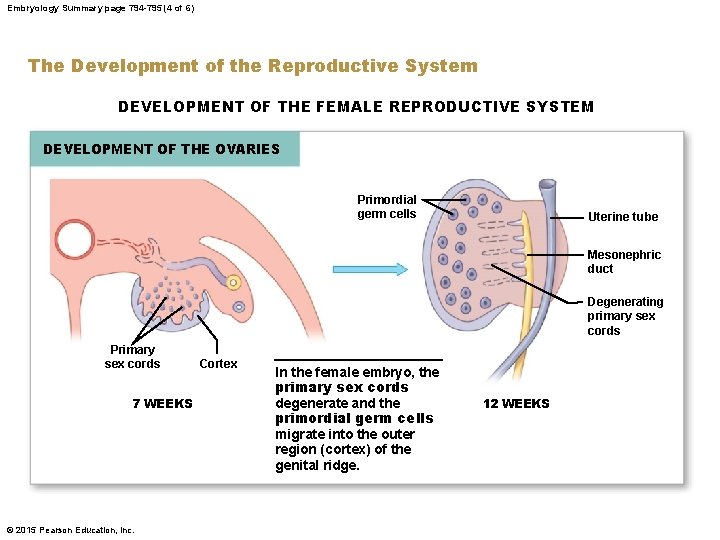
Embryology Summary page 794 -795 (4 of 6) The Development of the Reproductive System DEVELOPMENT OF THE FEMALE REPRODUCTIVE SYSTEM DEVELOPMENT OF THE OVARIES Primordial germ cells Uterine tube Mesonephric duct Degenerating primary sex cords Primary sex cords 7 WEEKS © 2015 Pearson Education, Inc. Cortex In the female embryo, the primary sex cords degenerate and the primordial germ cells migrate into the outer region (cortex) of the genital ridge. 12 WEEKS
Embryology of Organ Systems • Development of the Female Reproductive System • Development of the female ducts and accessory organs • Weeks 7– 10 • Mesonephric tubules and ducts degenerate • Paramesonephric duct develops into the peritoneal cavity • The urogenital sinus forms the uterus © 2015 Pearson Education, Inc.
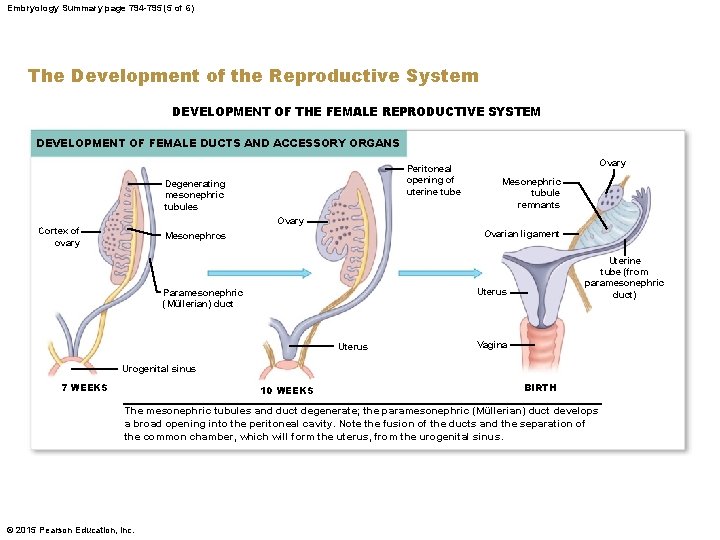
Embryology Summary page 794 -795 (5 of 6) The Development of the Reproductive System DEVELOPMENT OF THE FEMALE REPRODUCTIVE SYSTEM DEVELOPMENT OF FEMALE DUCTS AND ACCESSORY ORGANS Peritoneal opening of uterine tube Degenerating mesonephric tubules Ovary Mesonephric tubule remnants Ovary Cortex of ovary Ovarian ligament Mesonephros Uterine tube (from paramesonephric duct) Uterus Paramesonephric (Müllerian) duct Uterus Vagina Urogenital sinus 7 WEEKS 10 WEEKS BIRTH The mesonephric tubules and duct degenerate; the paramesonephric (Müllerian) duct develops a broad opening into the peritoneal cavity. Note the fusion of the ducts and the separation of the common chamber, which will form the uterus, from the urogenital sinus. © 2015 Pearson Education, Inc.
Embryology of Organ Systems • Development of the Female Reproductive System • Development of female external genitalia • Week 7 • • Urethral folds do not fuse Urethral folds form the labia minora Genital swellings will form the labia majora Genital tubercle forms the clitoris © 2015 Pearson Education, Inc.
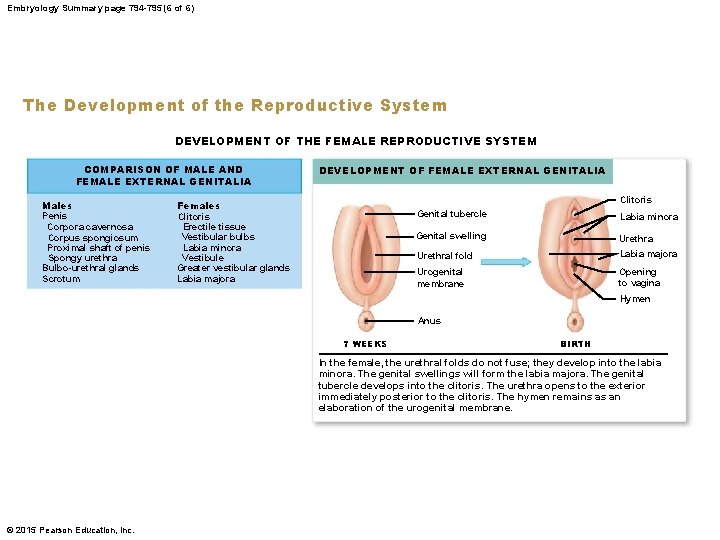
Embryology Summary page 794 -795 (6 of 6) The Development of the Reproductive System DEVELOPMENT OF THE FEMALE REPRODUCTIVE SYSTEM COMPARISON OF MALE AND FEMALE EXTERNAL GENITALIA Males Penis Corpora cavernosa Corpus spongiosum Proximal shaft of penis Spongy urethra Bulbo-urethral glands Scrotum DEVELOPMENT OF FEMALE EXTERNAL GENITALIA Clitoris Females Clitoris Erectile tissue Vestibular bulbs Labia minora Vestibule Greater vestibular glands Labia majora Genital tubercle Labia minora Genital swelling Urethral fold Labia majora Urogenital membrane Opening to vagina Hymen Anus 7 WEEKS BIRTH In the female, the urethral folds do not fuse; they develop into the labia minora. The genital swellings will form the labia majora. The genital tubercle develops into the clitoris. The urethra opens to the exterior immediately posterior to the clitoris. The hymen remains as an elaboration of the urogenital membrane. © 2015 Pearson Education, Inc.
- Slides: 196