
Chapter 28 Sources of Magnetic Field Power Point
- Slides: 21
Chapter 28 Sources of Magnetic Field Power. Point® Lectures for University Physics, Thirteenth Edition – Hugh D. Young and Roger A. Freedman Lectures by Wayne Anderson Copyright © 2012 Pearson Education Inc.
Goals for Chapter 28 • To determine the magnetic field produced by a moving charge • To study the magnetic field of an element of a current-carrying conductor • To calculate the magnetic field of a long, straight, current-carrying conductor • To study the magnetic force between currentcarrying wires • To determine the magnetic field of a circular loop • To use Ampere’s Law to calculate magnetic fields Copyright © 2012 Pearson Education Inc.
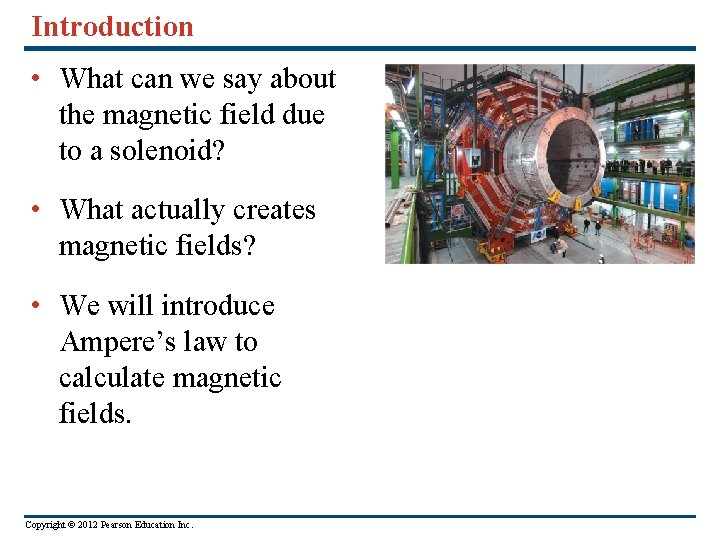
Introduction • What can we say about the magnetic field due to a solenoid? • What actually creates magnetic fields? • We will introduce Ampere’s law to calculate magnetic fields. Copyright © 2012 Pearson Education Inc.
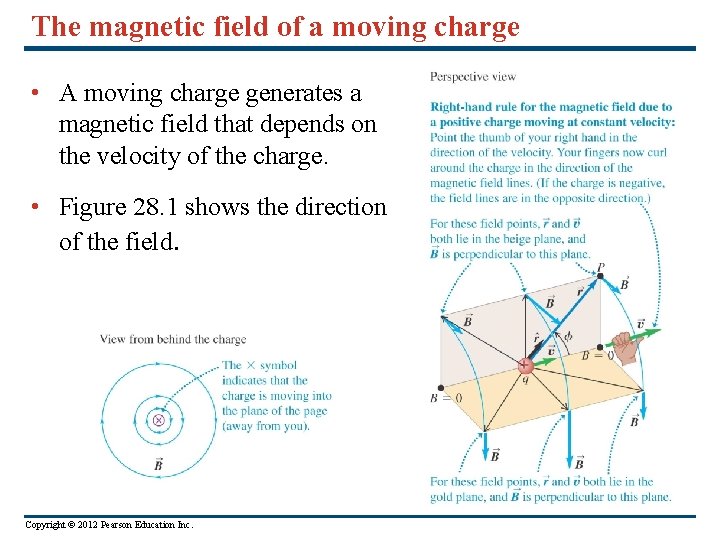
The magnetic field of a moving charge • A moving charge generates a magnetic field that depends on the velocity of the charge. • Figure 28. 1 shows the direction of the field. Copyright © 2012 Pearson Education Inc.
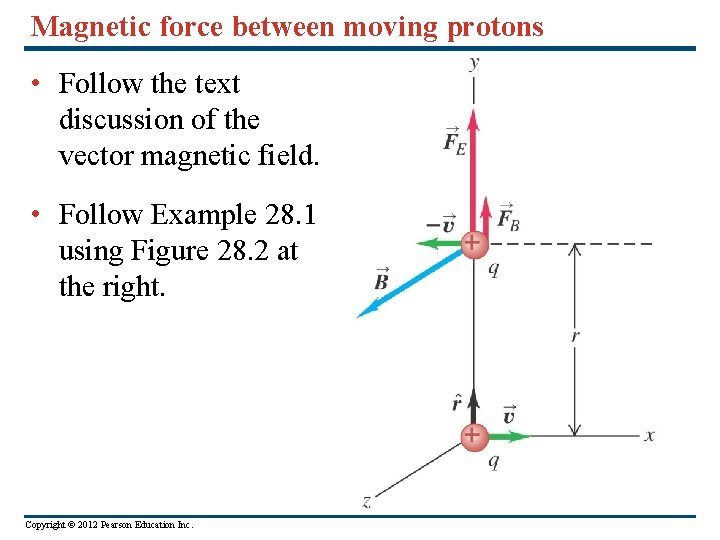
Magnetic force between moving protons • Follow the text discussion of the vector magnetic field. • Follow Example 28. 1 using Figure 28. 2 at the right. Copyright © 2012 Pearson Education Inc.
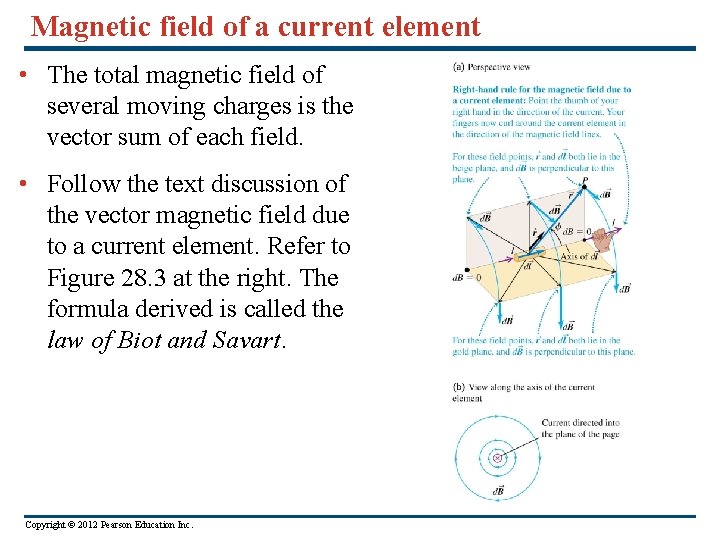
Magnetic field of a current element • The total magnetic field of several moving charges is the vector sum of each field. • Follow the text discussion of the vector magnetic field due to a current element. Refer to Figure 28. 3 at the right. The formula derived is called the law of Biot and Savart. Copyright © 2012 Pearson Education Inc.
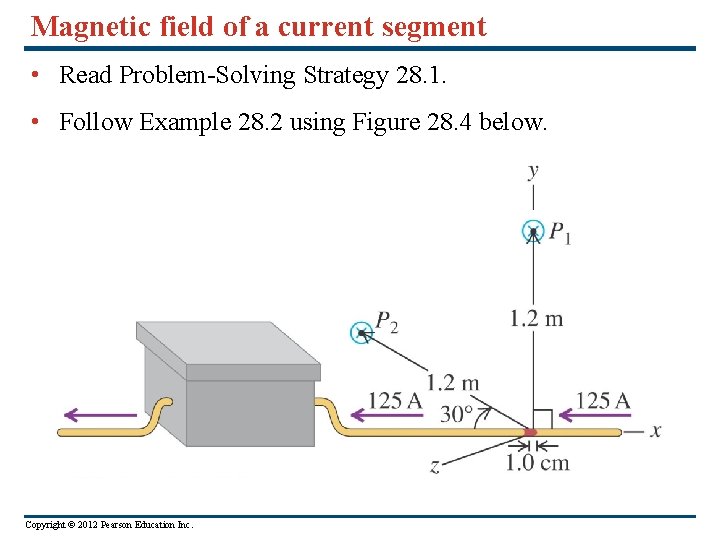
Magnetic field of a current segment • Read Problem-Solving Strategy 28. 1. • Follow Example 28. 2 using Figure 28. 4 below. Copyright © 2012 Pearson Education Inc.
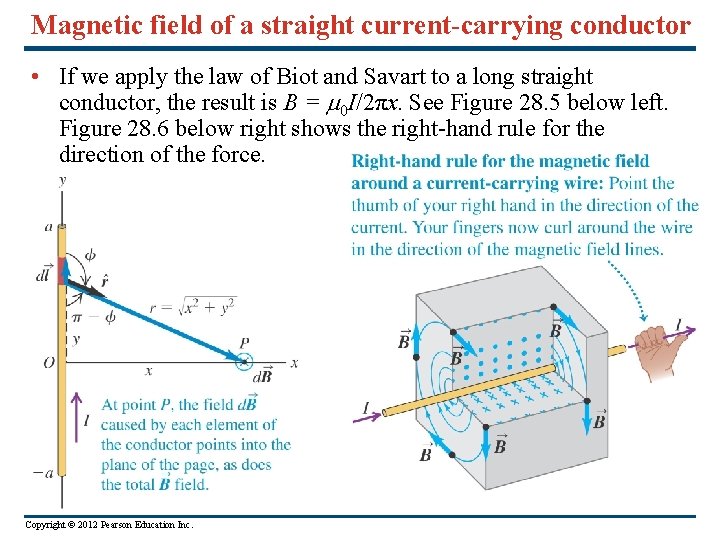
Magnetic field of a straight current-carrying conductor • If we apply the law of Biot and Savart to a long straight conductor, the result is B = 0 I/2πx. See Figure 28. 5 below left. Figure 28. 6 below right shows the right-hand rule for the direction of the force. Copyright © 2012 Pearson Education Inc.
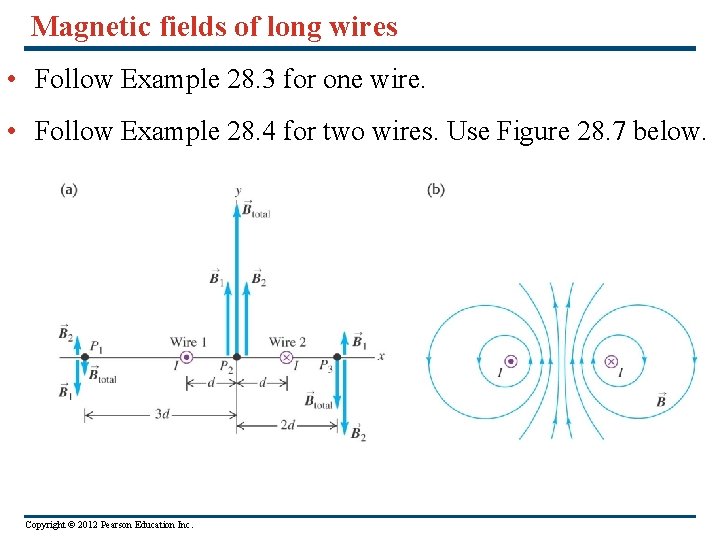
Magnetic fields of long wires • Follow Example 28. 3 for one wire. • Follow Example 28. 4 for two wires. Use Figure 28. 7 below. Copyright © 2012 Pearson Education Inc.
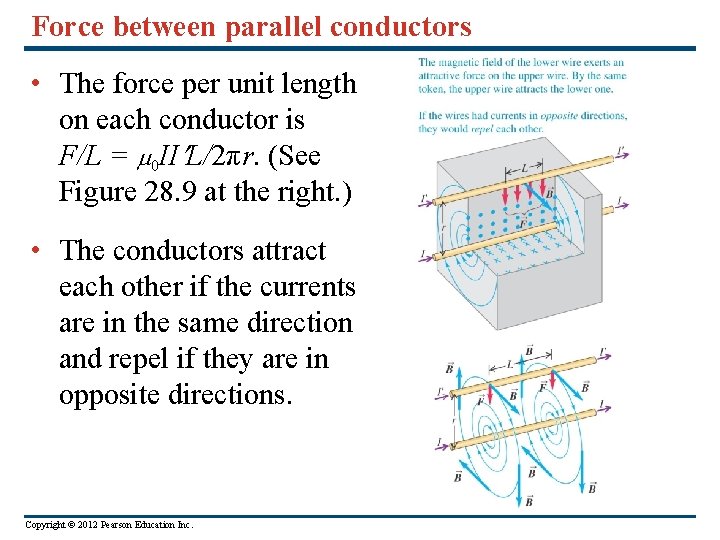
Force between parallel conductors • The force per unit length on each conductor is F/L = 0 II L/2πr. (See Figure 28. 9 at the right. ) • The conductors attract each other if the currents are in the same direction and repel if they are in opposite directions. Copyright © 2012 Pearson Education Inc.
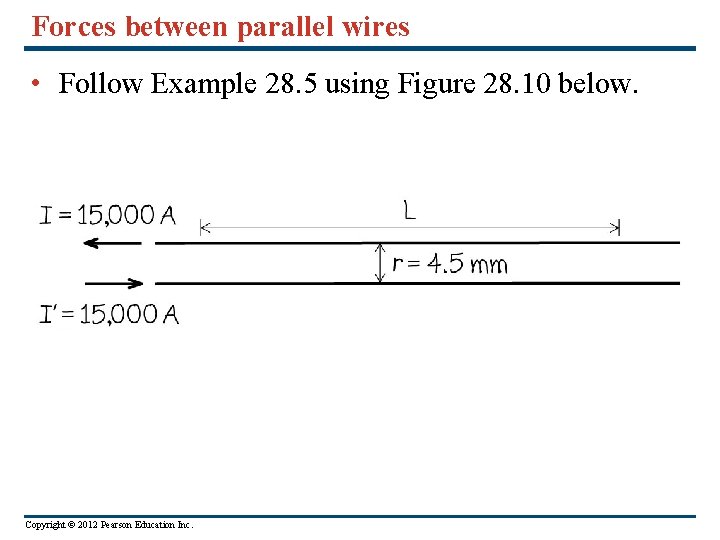
Forces between parallel wires • Follow Example 28. 5 using Figure 28. 10 below. Copyright © 2012 Pearson Education Inc.
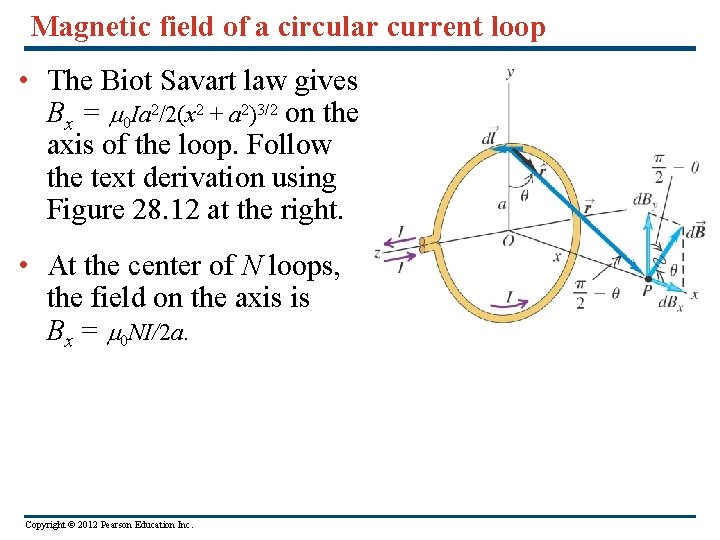
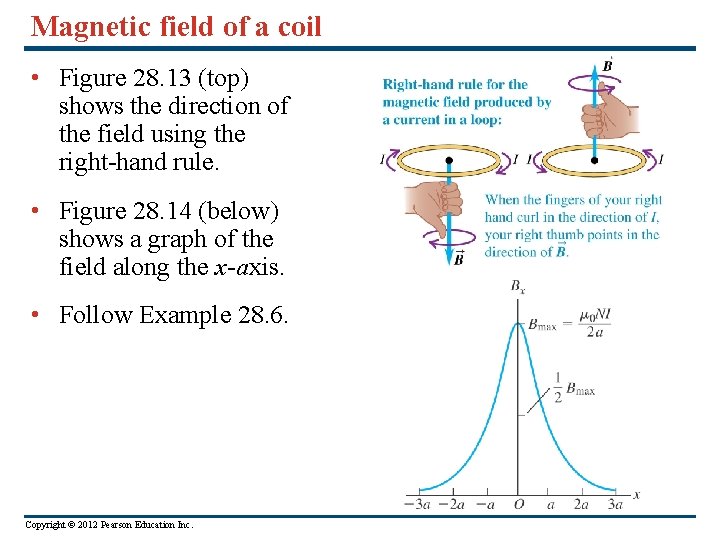
Magnetic field of a circular current loop • The Biot Savart law gives Bx = 0 Ia 2/2(x 2 + a 2)3/2 on the axis of the loop. Follow the text derivation using Figure 28. 12 at the right. • At the center of N loops, the field on the axis is Bx = 0 NI/2 a. Copyright © 2012 Pearson Education Inc.
Magnetic field of a coil • Figure 28. 13 (top) shows the direction of the field using the right-hand rule. • Figure 28. 14 (below) shows a graph of the field along the x-axis. • Follow Example 28. 6. Copyright © 2012 Pearson Education Inc.
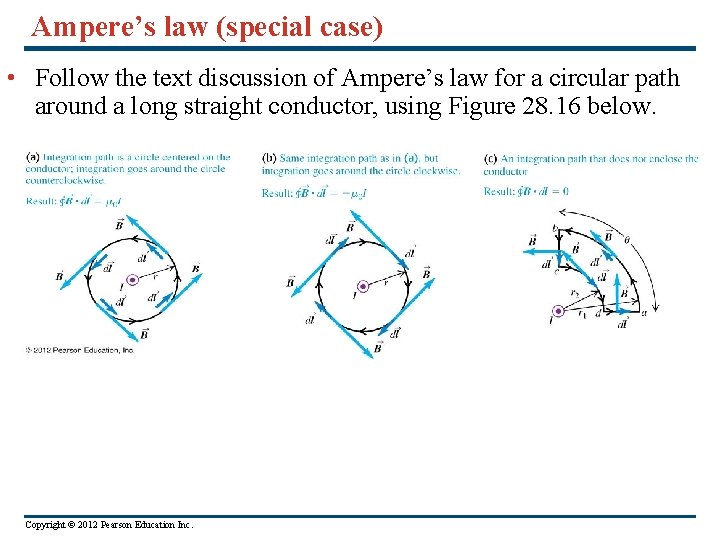
Ampere’s law (special case) • Follow the text discussion of Ampere’s law for a circular path around a long straight conductor, using Figure 28. 16 below. Copyright © 2012 Pearson Education Inc.
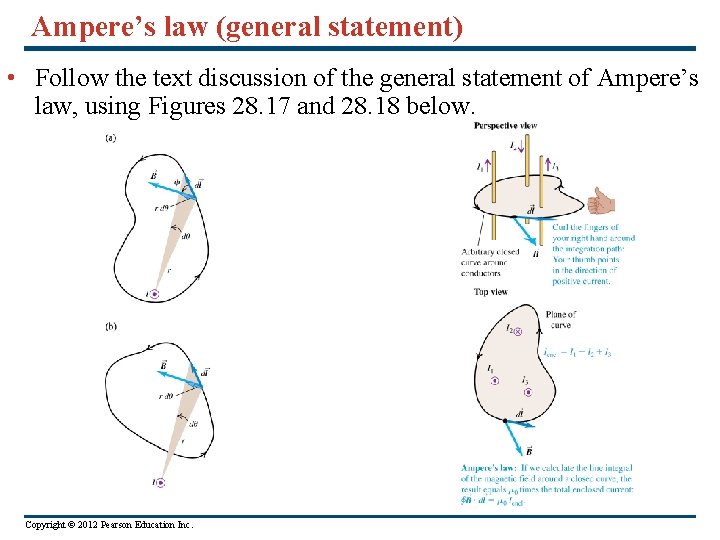
Ampere’s law (general statement) • Follow the text discussion of the general statement of Ampere’s law, using Figures 28. 17 and 28. 18 below. Copyright © 2012 Pearson Education Inc.
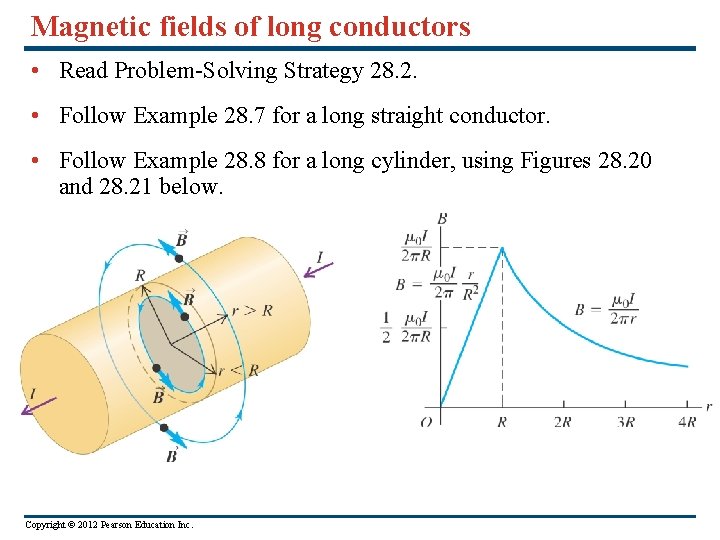
Magnetic fields of long conductors • Read Problem-Solving Strategy 28. 2. • Follow Example 28. 7 for a long straight conductor. • Follow Example 28. 8 for a long cylinder, using Figures 28. 20 and 28. 21 below. Copyright © 2012 Pearson Education Inc.
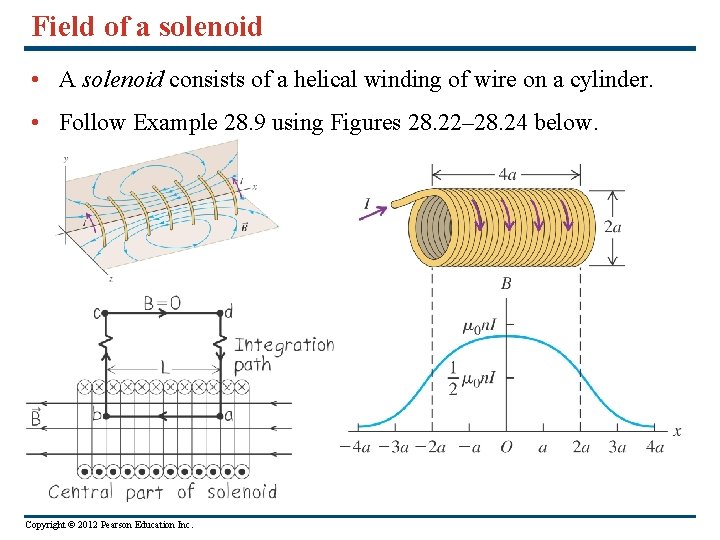
Field of a solenoid • A solenoid consists of a helical winding of wire on a cylinder. • Follow Example 28. 9 using Figures 28. 22– 28. 24 below. Copyright © 2012 Pearson Education Inc.
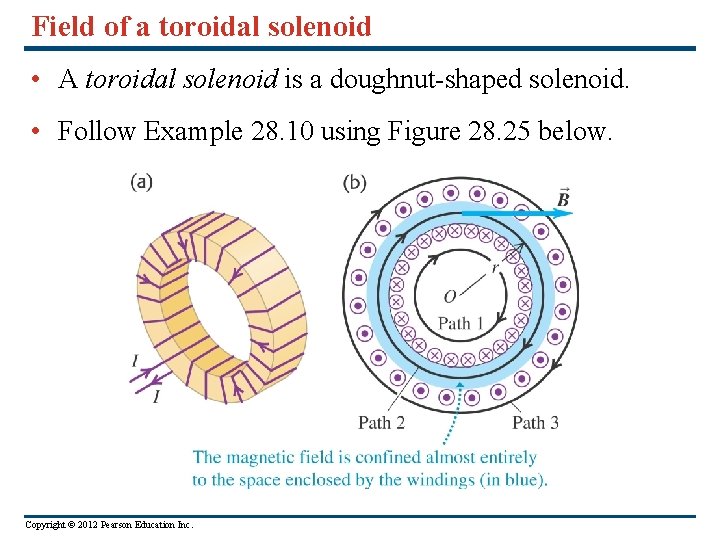
Field of a toroidal solenoid • A toroidal solenoid is a doughnut-shaped solenoid. • Follow Example 28. 10 using Figure 28. 25 below. Copyright © 2012 Pearson Education Inc.
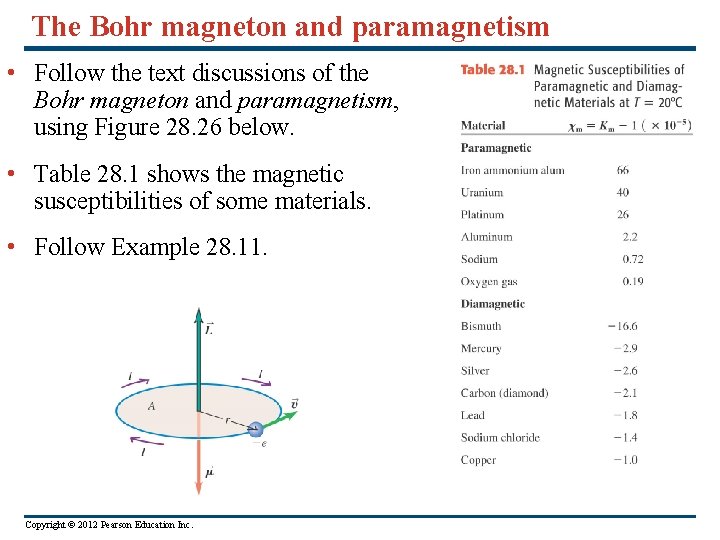
The Bohr magneton and paramagnetism • Follow the text discussions of the Bohr magneton and paramagnetism, using Figure 28. 26 below. • Table 28. 1 shows the magnetic susceptibilities of some materials. • Follow Example 28. 11. Copyright © 2012 Pearson Education Inc.
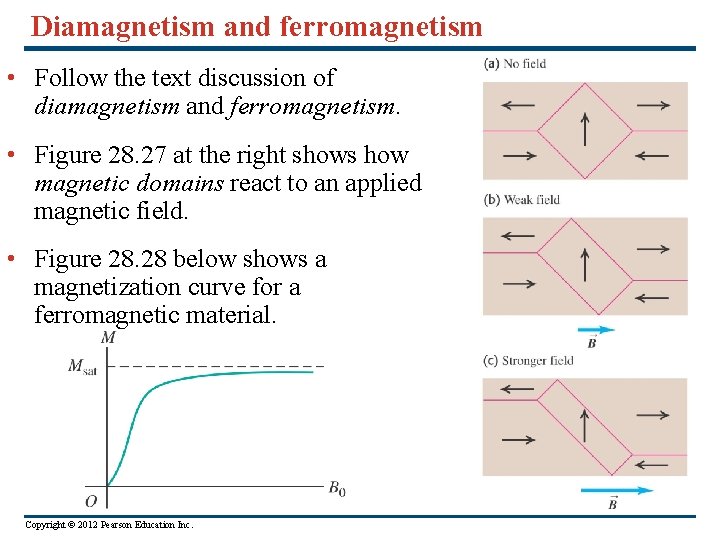
Diamagnetism and ferromagnetism • Follow the text discussion of diamagnetism and ferromagnetism. • Figure 28. 27 at the right shows how magnetic domains react to an applied magnetic field. • Figure 28. 28 below shows a magnetization curve for a ferromagnetic material. Copyright © 2012 Pearson Education Inc.
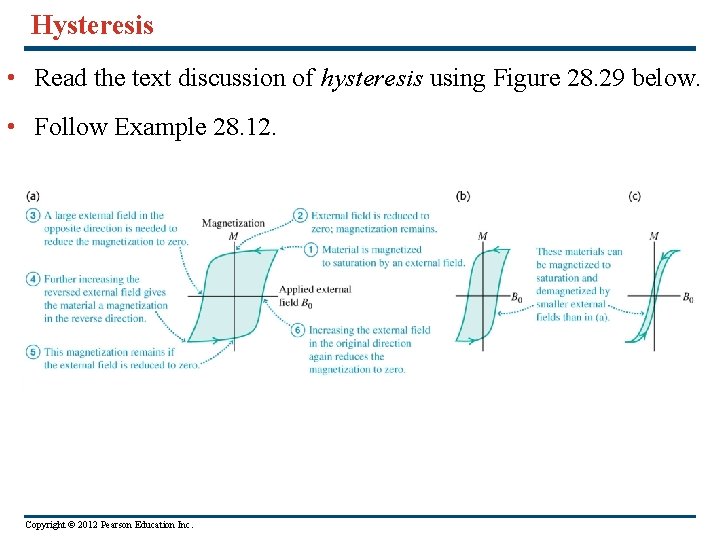
Hysteresis • Read the text discussion of hysteresis using Figure 28. 29 below. • Follow Example 28. 12. Copyright © 2012 Pearson Education Inc.