
Chapter 28 Management of Patients With Myocardial Infarction

- Slides: 29
Chapter 28 Management of Patients With Myocardial Infarction Dr. Maysoon S. Abdalrahim Copyright © 2010 Wolters Kluwer Health | Lippincott Williams & Wilkins
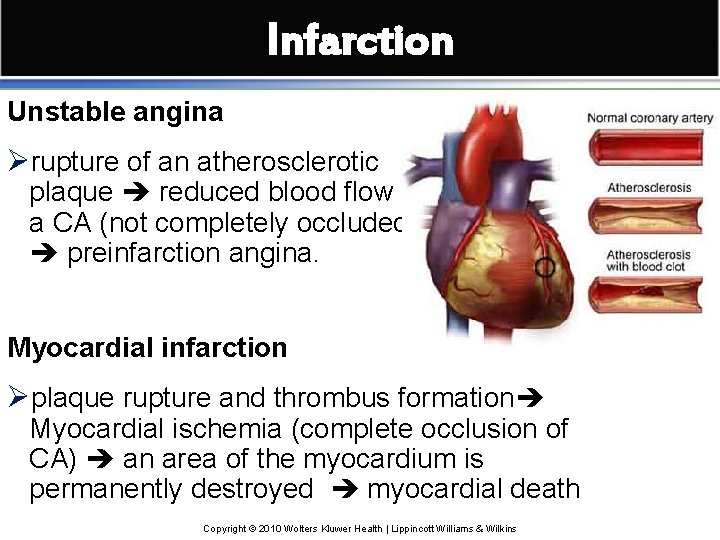
Infarction Unstable angina Ørupture of an atherosclerotic plaque reduced blood flow in a CA (not completely occluded) preinfarction angina. Myocardial infarction Øplaque rupture and thrombus formation Myocardial ischemia (complete occlusion of CA) an area of the myocardium is permanently destroyed myocardial death Copyright © 2010 Wolters Kluwer Health | Lippincott Williams & Wilkins
Infarction Other causes of MI= intense imbalance between myocardial O 2 supply and O 2 demand ØVasospasm of a CA Ødecreased O 2 supply (bleeding, anemia, or low BP) ØIncreased O 2 demand (tacky cardia, thyrotoxicosis, cocaine) Copyright © 2010 Wolters Kluwer Health | Lippincott Williams & Wilkins
Infarction ØThe area of infarction develops over minutes to hours. Ø“time is muscle”: muscle the urgency of appropriate treatment to improve patient outcomes. ØThe ECG identifies the type (STEMI, NSTEMI)and location of the MI(ant- inf- post- lat), and the timing (acute- evolving- old). Ø the goals of therapy are to prevent or minimize myocardial tissue death and prevent complications Copyright © 2010 Wolters Kluwer Health | Lippincott Williams & Wilkins
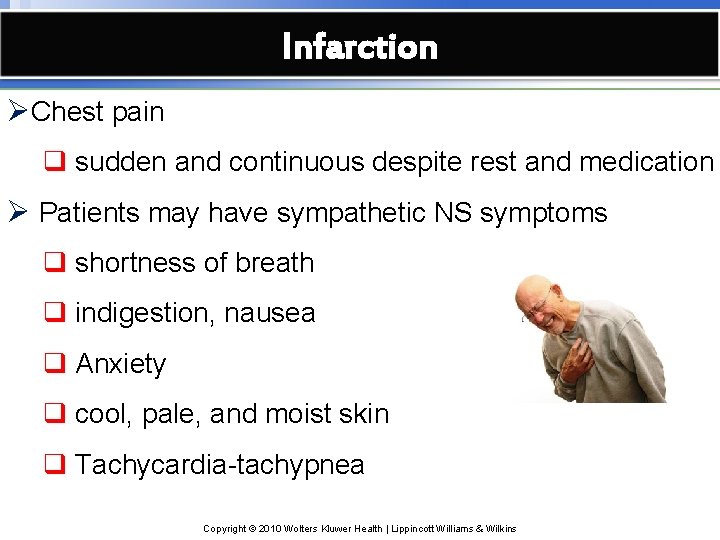
Infarction ØChest pain q sudden and continuous despite rest and medication Ø Patients may have sympathetic NS symptoms q shortness of breath q indigestion, nausea q Anxiety q cool, pale, and moist skin q Tachycardia-tachypnea Copyright © 2010 Wolters Kluwer Health | Lippincott Williams & Wilkins
Diagnostic Findings: Myocardial Infarction Patient History ØThe symptom ØHistory of previous cardiac and other illnesses ØFamily history of heart disease. ØThe risk factors for heart disease Copyright © 2010 Wolters Kluwer Health | Lippincott Williams & Wilkins
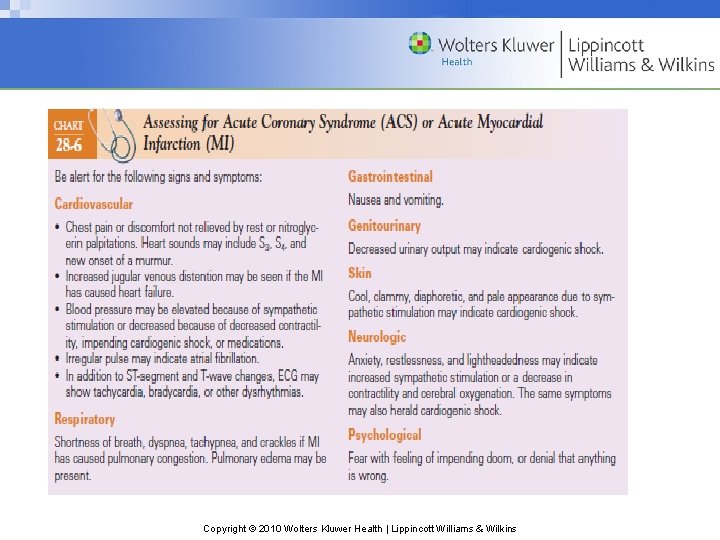
Copyright © 2010 Wolters Kluwer Health | Lippincott Williams & Wilkins
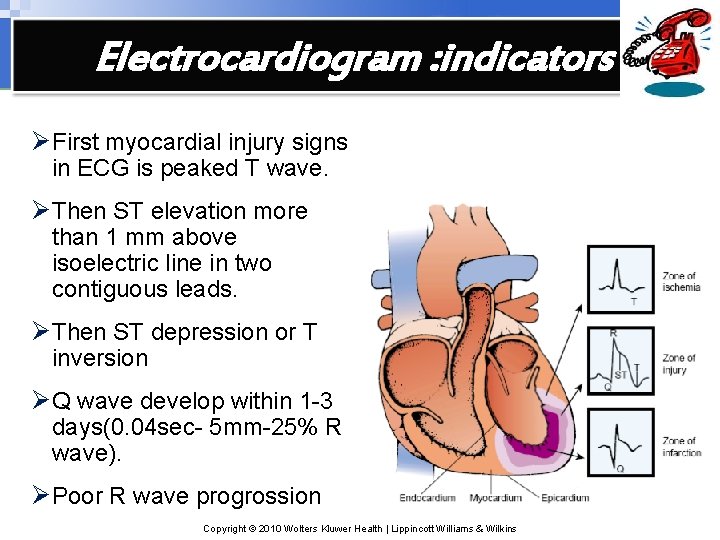
Diagnostic Findings: Myocardial Infarction Electrocardiogram ØFor diagnosing an acute MI. ØIt should be obtained within 10 minutes from the time a patient reports pain or arrives in the ED. Øserial ECG changes over time, the location, and resolution of an MI. ØThe classic ECG changes are q T-wave inversion q ST-segment elevation q an abnormal Q wave Copyright © 2010 Wolters Kluwer Health | Lippincott Williams & Wilkins
Electrocardiogram : indicators Ø First myocardial injury signs in ECG is peaked T wave. Ø Then ST elevation more than 1 mm above isoelectric line in two contiguous leads. Ø Then ST depression or T inversion Ø Q wave develop within 1 -3 days(0. 04 sec- 5 mm-25% R wave). Ø Poor R wave progrossion Copyright © 2010 Wolters Kluwer Health | Lippincott Williams & Wilkins
Diagnostic Findings: Myocardial Infarction Ø patients are diagnosed with one of the forms of ACS: q Unstable angina : typical symptoms, but ECG & cardiac markers shows no evidence of acute MI. q STEMI: ECG evidence of acute MI(changes in two leads) q NSTEMI: elevated cardiac biomarkers but no definite ECG evidence of acute MI. Ø During recovery from an MI, the ST segment is the first ECG indicator to return to normal (1 to 6 weeks). Ø Q-wave changes are permanent. Ø T large for 24 hr then inverts within 1 -3 days to 2 weeks Copyright © 2010 Wolters Kluwer Health | Lippincott Williams & Wilkins
Diagnostic Findings: Myocardial Infarction Echocardiogram Øto evaluate ventricular function when the ECG is nondiagnostic. ØDetect hypokinetic and akinetic wall motion ØDetermine EF% Copyright © 2010 Wolters Kluwer Health | Lippincott Williams & Wilkins
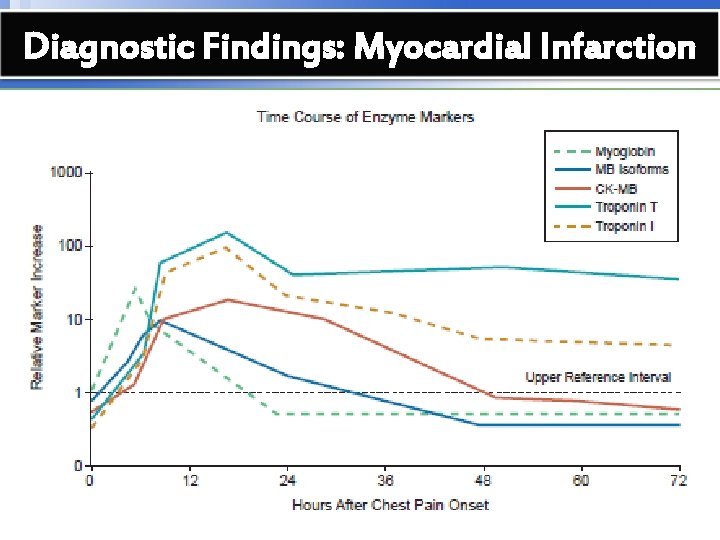
Diagnostic Findings: Myocardial Infarction Laboratory Tests Ø Cardiac enzymes and biomarkers to diagnose an AMI. q myoglobin and troponin: analyzed rapidly q Creatine Kinase and Its Isoenzymes: CK-MB increase within a few hrs and peaks within 24 hrs q Myoglobin: a heme protein (transport O 2). starts to increase within 1 to 3 hrs and peaks within 12 hrs, not very specific for cardiac. q Troponin: a protein regulates the myocardial contraction that have 3 isomers : C, I, and T. (I&T)reliable and critical markers of MI. detected within a few hrs and remains elevated for 3 weeks Copyright © 2010 Wolters Kluwer Health | Lippincott Williams & Wilkins
Diagnostic Findings: Myocardial Infarction Copyright © 2010 Wolters Kluwer Health | Lippincott Williams & Wilkins
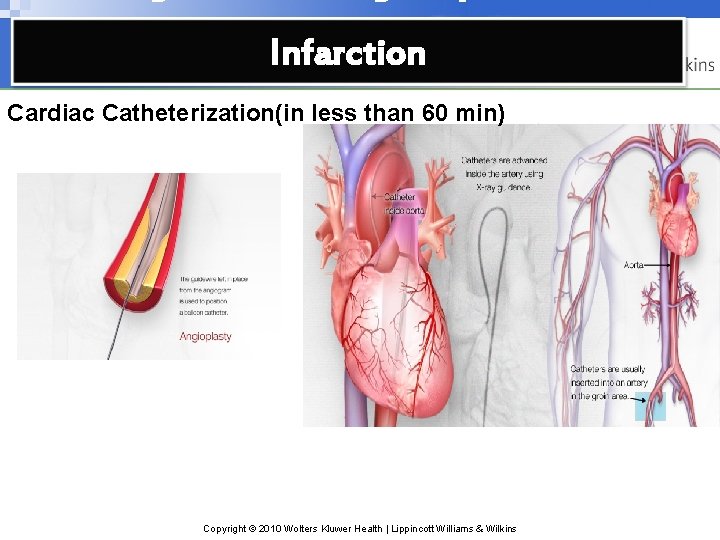
Infarction Cardiac Catheterization(in less than 60 min) Copyright © 2010 Wolters Kluwer Health | Lippincott Williams & Wilkins
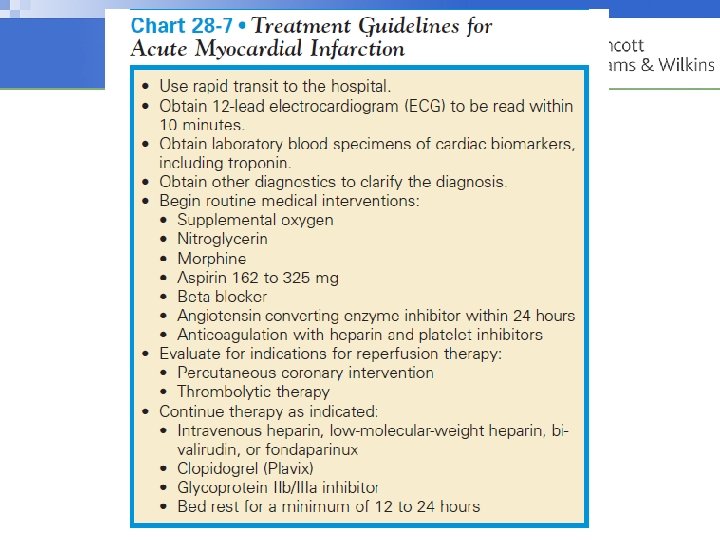
Medical Management: Myocardial Infarction ØThe goals are to minimize myocardial damage, preserve myocardial function, and prevent complications. ØThese goals are facilitated by the use of guidelines developed by the American College of Cardiology (ACC) and the AHA (Chart 28 -7). Copyright © 2010 Wolters Kluwer Health | Lippincott Williams & Wilkins
Copyright © 2010 Wolters Kluwer Health | Lippincott Williams & Wilkins
Medical Management: Myocardial Infarction Pharmacologic Therapy Øaspirin, nitroglycerin, morphine, an IV beta-blocker, and other medications ØPatients should continue the beta-blocker throughout hospitalization ØLMWH + platelet-inhibiting agents to prevent further clot formation. ØNSAIDS may be discontinued because of SE on heart. ØAnalgesics: morphine in IV boluses : reduce pain& anxiety, preload & afterload, which decrease load on heart & relax bronchioles(↓BP, ↓RR) Copyright © 2010 Wolters Kluwer Health | Lippincott Williams & Wilkins
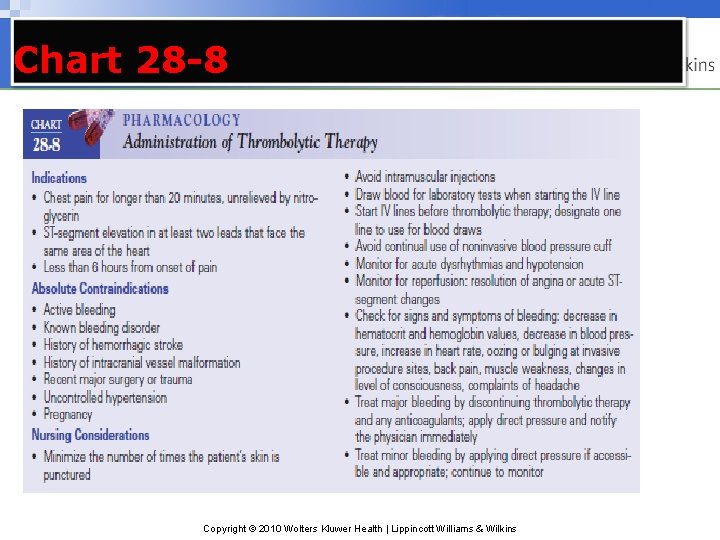
Medical Management: Myocardial Infarction Pharmacologic Therapy ØAngiotensin-Converting Enzyme Inhibitors (ACE) inhibitors prevent the conversion of angiotensin I to angiotensin II BP decreases and diuresis (decrease O 2 demand). so check BP-↑K-fluid balance-↓Na-UOPKFT. ØThrombolytics: IV in a specific protocol (Chart 28 -8). The purpose is to dissolve thrombus in a CA q must be administered within 3 to 6 hours for patients with ECG evidence of acute MI, and should be initiated within 30 minutes of presentation to the hospital (door-to-needle time). time Copyright © 2010 Wolters Kluwer Health | Lippincott Williams & Wilkins
Chart 28 -8 Copyright © 2010 Wolters Kluwer Health | Lippincott Williams & Wilkins
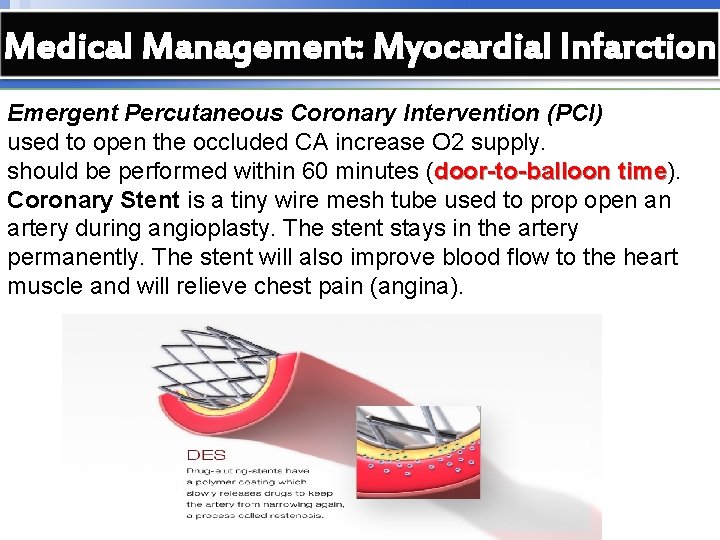
Medical Management: Myocardial Infarction Emergent Percutaneous Coronary Intervention (PCI) used to open the occluded CA increase O 2 supply. should be performed within 60 minutes (door-to-balloon time). time Coronary Stent is a tiny wire mesh tube used to prop open an artery during angioplasty. The stent stays in the artery permanently. The stent will also improve blood flow to the heart muscle and will relieve chest pain (angina). Copyright © 2010 Wolters Kluwer Health | Lippincott Williams & Wilkins
Cardiac Rehabilitation: Myocardial Infarction ØAfter the patient with an MI is free of symptoms q education, individual and group support, and physical activity. ØThe goal: to improve the quality of life. q limit the effects and progression of atherosclerosis q return to work and pre illness lifestyle q enhance psychosocial and vocational status q prevent another cardiac event. Copyright © 2010 Wolters Kluwer Health | Lippincott Williams & Wilkins
Ng diagnoses ØIneffective cardiac tissue perfusion RT reduced coronary blood flow ØRisk for imbalanced fluid volume ØRisk for ineffective peripheral tissue perfusion RT decreased COP ØAnxiety RT cardiac event ØKnowledge deficiency about ACS self-care Copyright © 2010 Wolters Kluwer Health | Lippincott Williams & Wilkins
Nursing Interventions: Myocardial Infarction Relieving Pain and Symptoms of Ischemia ØBalancing O 2 supply with O 2 demand q relief of chest pain is the top priority q O 2 by nasal cannula in a rate of 2 to 4 L/min, saturation levels of 96% to 100% q Medication therapy ØVital signs Copyright © 2010 Wolters Kluwer Health | Lippincott Williams & Wilkins
Nursing Interventions: Myocardial Infarction Relieving Pain and Symptoms of Ischemia ØPhysical rest in bed with the back elevated to decrease chest discomfort and dyspnea. q Tidal volume improves q Drainage of the upper lung lobes improves. q venous return to the heart (preload) decreases Copyright © 2010 Wolters Kluwer Health | Lippincott Williams & Wilkins
Nursing Interventions: Myocardial Infarction Improving Respiratory Function ØRegular assessment to detect early signs of pulmonary complications. ØMonitor fluid volume status to prevent overloading ØEncourage deeply breathing exercises ØChange position frequently ØPulse oximetry Copyright © 2010 Wolters Kluwer Health | Lippincott Williams & Wilkins
Nursing Interventions: Myocardial Infarction Promoting Adequate Tissue Perfusion ØBed or chair rest to reduce O 2 oxygen demand remain until the patient is pain free and stable. Øcheck skin temperature and peripheral pulses frequently to monitor tissue perfusion. Copyright © 2010 Wolters Kluwer Health | Lippincott Williams & Wilkins
Nursing Interventions: Myocardial Infarction Reducing Anxiety ØTo reduce the sympathetic stress decrease O 2 demand relieve pain ØDevelop a trust and caring relationship ØProvide information ØEnsure a quiet environment, promote sleep, using caring touch, relaxation techniques, using humor, and providing spiritual support ØAn atmosphere of acceptance ØMusic therapy and pet therapy Copyright © 2010 Wolters Kluwer Health | Lippincott Williams & Wilkins
Nursing Interventions: Myocardial Infarction Monitoring and Managing Complications Øthe Plan of Nursing Care in Chart 28 -10. Ømonitor the patient closely for changes in cardiac rate and rhythm, heart sounds, BP, chest pain, respiratory status, urinary output, skin color and temperature, sensorium, ECG changes, and laboratory values. ØReport rapidly any changes in the patient's condition Copyright © 2010 Wolters Kluwer Health | Lippincott Williams & Wilkins
Nursing Interventions: Myocardial Infarction Teaching patients self-care. Øprovide adequate education about heart-healthy living Øfacilitate the patient’s involvement in a cardiac rehabilitation program Copyright © 2010 Wolters Kluwer Health | Lippincott Williams & Wilkins