
Chapter 28 International Trade and Finance Key Concepts
- Slides: 62
Chapter 28 International Trade and Finance • Key Concepts • Summary • Practice Quiz • Internet Exercises © 2002 South-Western College Publishing 1
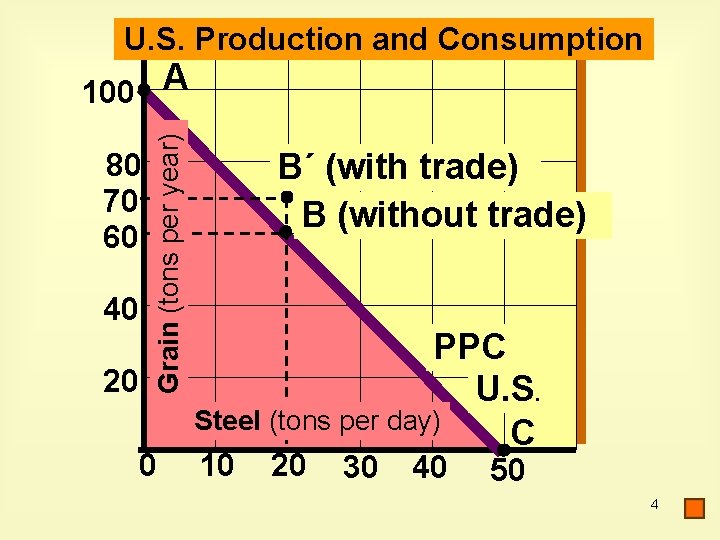
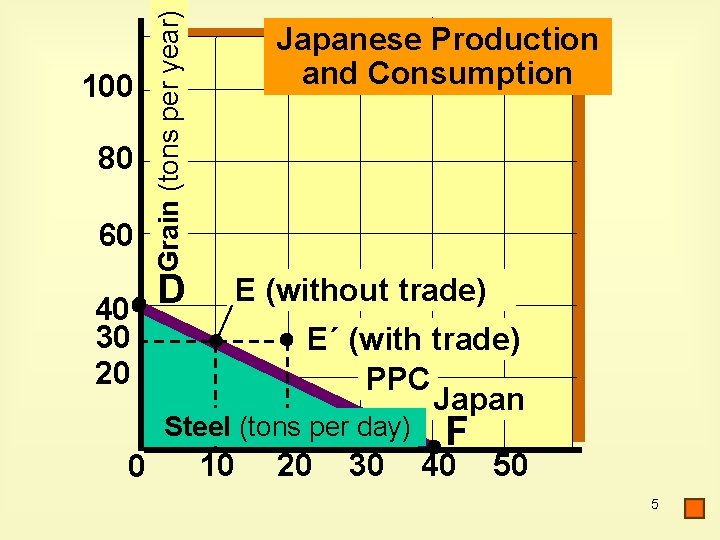
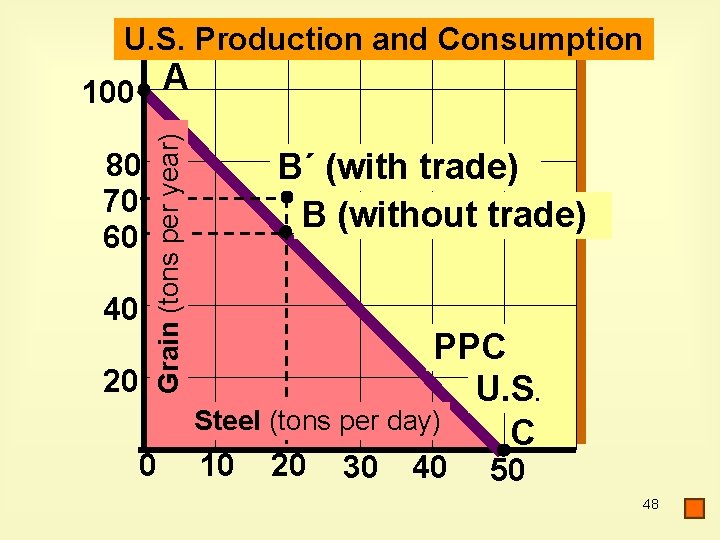
Why do countries trade? International trade allows a country to consume a combination of goods and services that exceeds its production possibilities curve 2
3
U. S. Production and Consumption 80 70 60 40 20 Grain (tons per year) 100 A 0 B´ (with trade) B (without trade) PPC U. S. Steel (tons per day) C 10 20 30 40 50 4
80 60 40 30 20 Grain (tons per year) 100 D Japanese Production and Consumption E (without trade) E´ (with trade) PPC Japan Steel (tons per day) 0 10 20 30 F 40 50 5
Why should countries specialize and trade? Total world output increases, and therefore, the potential for greater total world consumption also increases 6
If countries should specialize, in what should they specialize? They should produce those goods and services in which they have a comparative advantage 7
What is comparative advantage? The ability of a country to produce a good at a lower opportunity cost than another country 8
What is absolute advantage? The ability of a country to produce a good using fewer resources than another country 9
What is free trade? The flow of goods between countries without restrictions or special taxes 10
What is protectionism? The government’s use of embargoes, tariffs, quotas, and other restrictions to protect domestic producers from foreign competition 11
What is an embargo? A law that bars trade with another country 12
What is a tariff? A tax on an import 13
What is a quota? A limit on the quantity of a good that may be imported in a given time period 14
What are the arguments for protectionism? • Infant industry argument • National security argument • Employment argument • Cheap foreign labor argument • Free trade agreements 15
What is a recent free trade agreement? North America Free Trade Agreement (NAFTA) 16
What is NAFTA? A 1993 free trade agreement between the U. S. , Canada, and Mexico 17
What is the balance of payments? A bookkeeping record of all the international transactions between a country and other countries during a given period of time 18
What is the current account? The first section of the balance of payments, which includes trade in currently produced goods and services 19
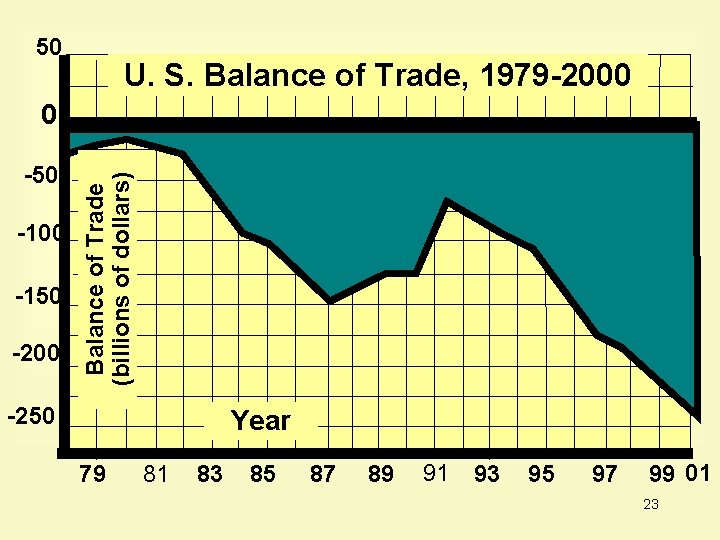
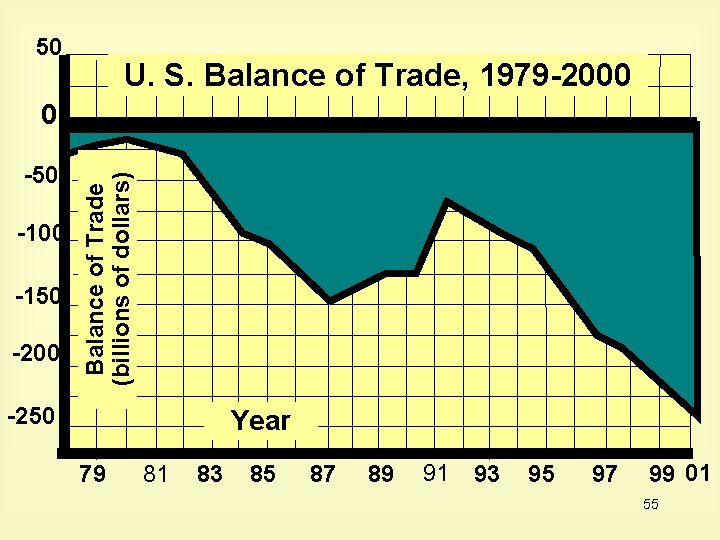
What is the balance of trade? The most widely reported and largest part of the current account defined as the value of a nation’s merchandise imports subtracted from its merchandise exports 20
How is a current account deficit financed? By a capital account surplus 21
What is the capital account? The second section of the balance of payments, which records payment flows for financial capital 22
50 U. S. Balance of Trade, 1979 -2000 -50 -100 -150 -200 Balance of Trade (billions of dollars) 0 -250 Year 79 81 83 85 87 89 91 93 95 97 99 01 23
What does the balance of payments always equal? Zero; the current account deficit should equal the capital account surplus 24
How could the US have a balance of payments problem? The problem is with the composition of the balance of payments 25
What is an exchange rate? The number of one nation’s currency that equals one unit of another nation’s currency 26
If 1. 81 dollars is exchangeable for 1 British pound, what is the exchange rate? 1 / 1. 81 =. 552 pounds per dollar 27
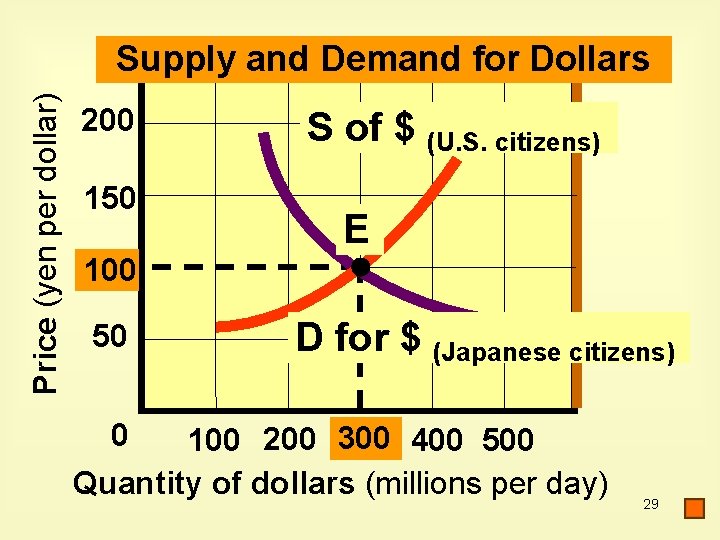
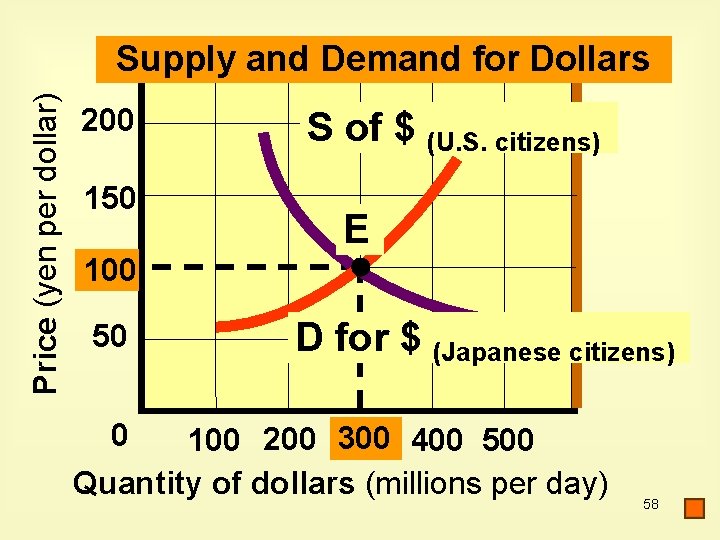
How is the exchange rate determined? Supply and demand foreign exchange 28
Price (yen per dollar) Supply and Demand for Dollars 200 150 S of $ (U. S. citizens) E 100 50 D for $ (Japanese citizens) 0 100 200 300 400 500 Quantity of dollars (millions per day) 29
What happens when a currency depreciates? The price of the currency falls in relation to another currency 30
What happens when a currency appreciates? The price of the currency rises in relation to another currency 31
What can cause a currency to change value? The demand and/or supply of the currency can change 32
What can cause a change in demand of a currency? There can be a change in • tastes and preferences • relative price levels • relative interest rates 33
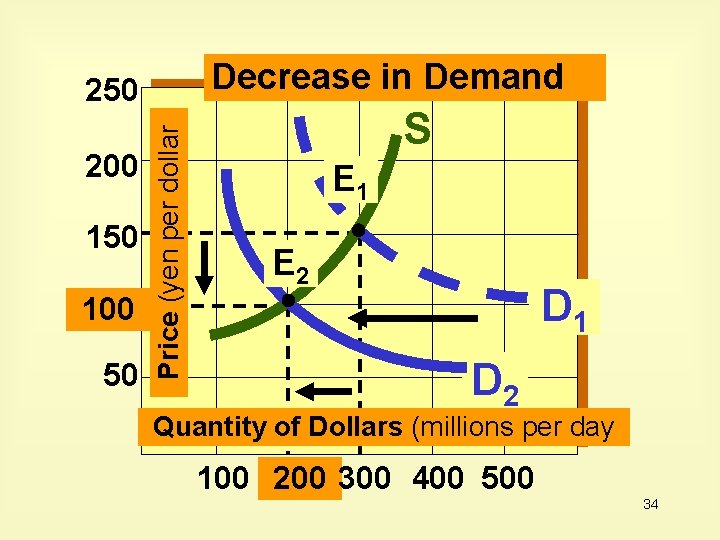
Decrease in Demand 200 150 100 50 Price (yen per dollar 250 S E 1 E 2 D 1 D 2 Quantity of Dollars (millions per day 100 200 300 400 500 34
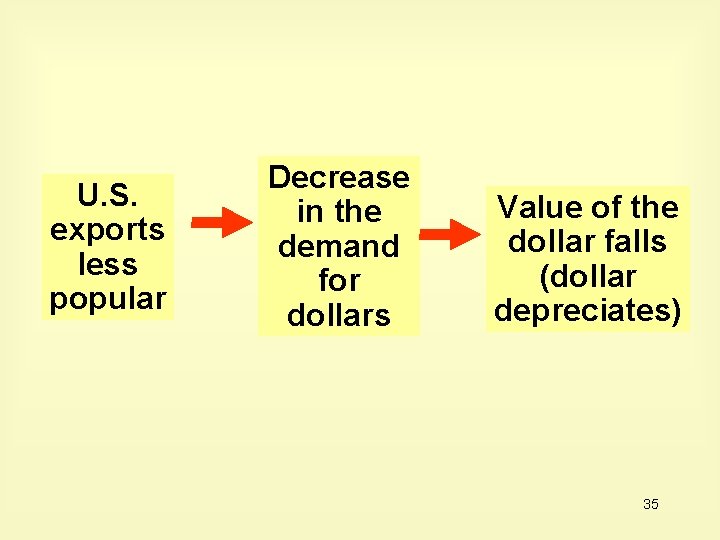
U. S. exports less popular Decrease in the demand for dollars Value of the dollar falls (dollar depreciates) 35
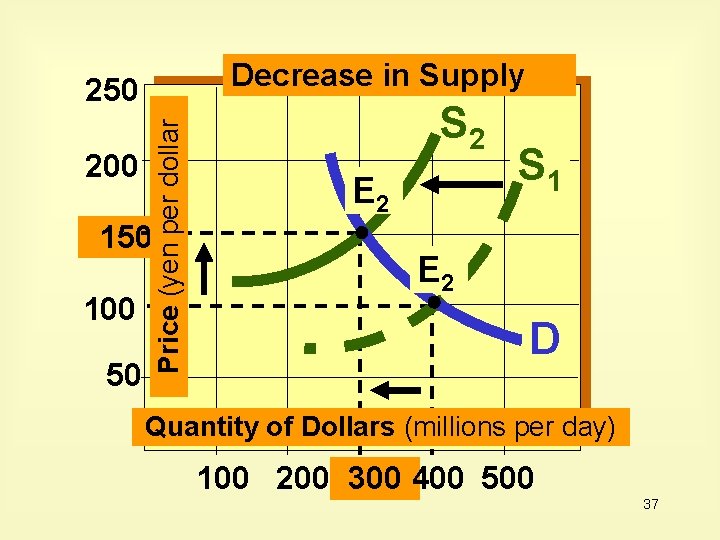
What can cause a change in supply of a currency? There can be a change in • relative incomes • relative price levels • relative interest rates 36
Decrease in Supply 200 150 100 50 Price (yen per dollar 250 S 2 E 2 S 1 E 2 D Quantity of Dollars (millions per day) 100 200 300 400 500 37
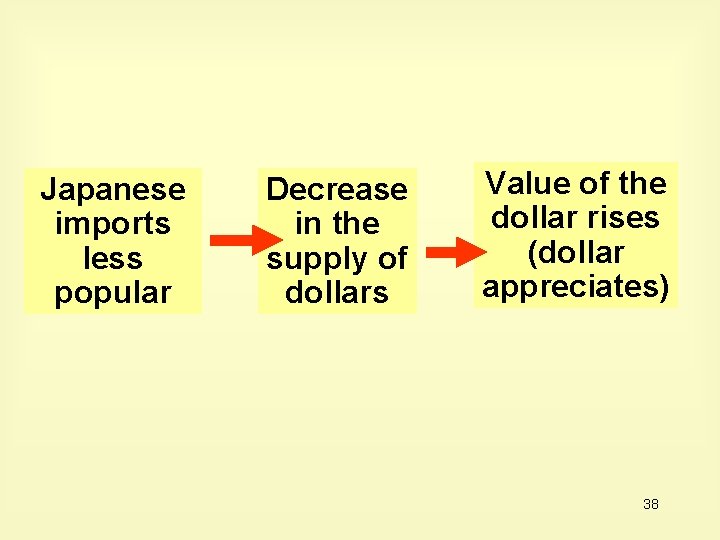
Japanese imports less popular Decrease in the supply of dollars Value of the dollar rises (dollar appreciates) 38
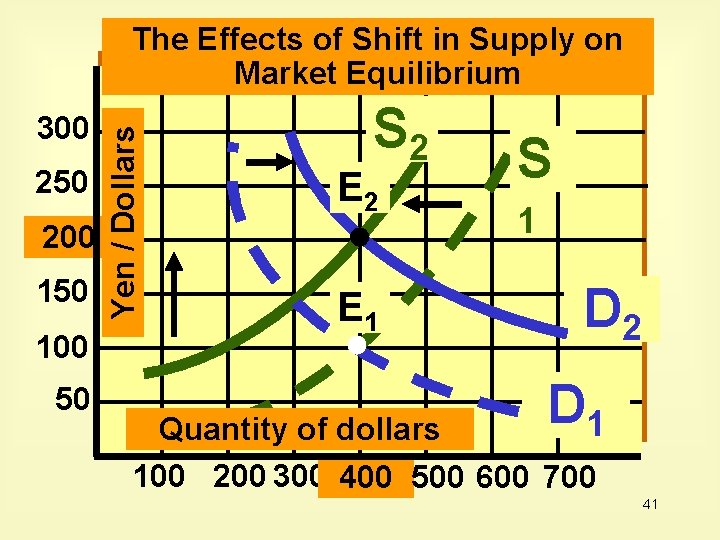
What happens when demand and/or supply changes? The currency seeks a new equilibrium; the value changes 39
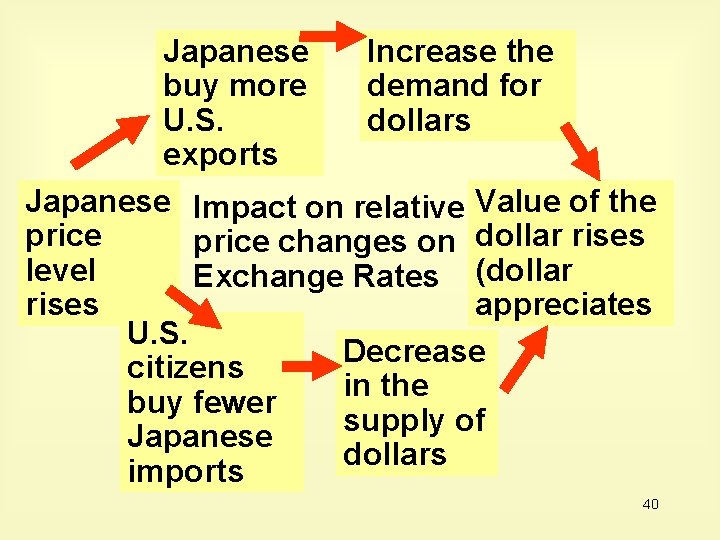
Japanese Increase the buy more demand for U. S. dollars exports Japanese Impact on relative Value of the price changes on dollar rises level Exchange Rates (dollar rises appreciates U. S. Decrease citizens in the buy fewer supply of Japanese dollars imports 40
300 250 200 150 100 50 Yen / Dollars The Effects of Shift in Supply on Market Equilibrium S 2 E 1 S 1 D 2 D 1 Quantity of dollars 100 200 300 400 500 600 700 41
Key Concepts 42
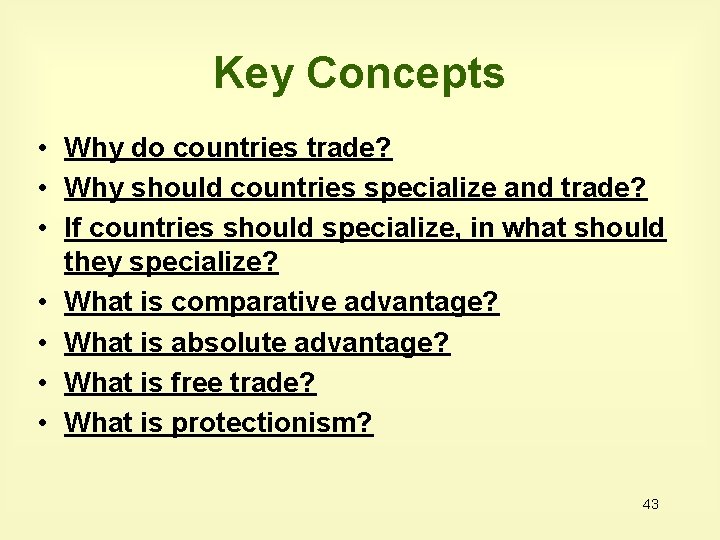
Key Concepts • Why do countries trade? • Why should countries specialize and trade? • If countries should specialize, in what should they specialize? • What is comparative advantage? • What is absolute advantage? • What is free trade? • What is protectionism? 43
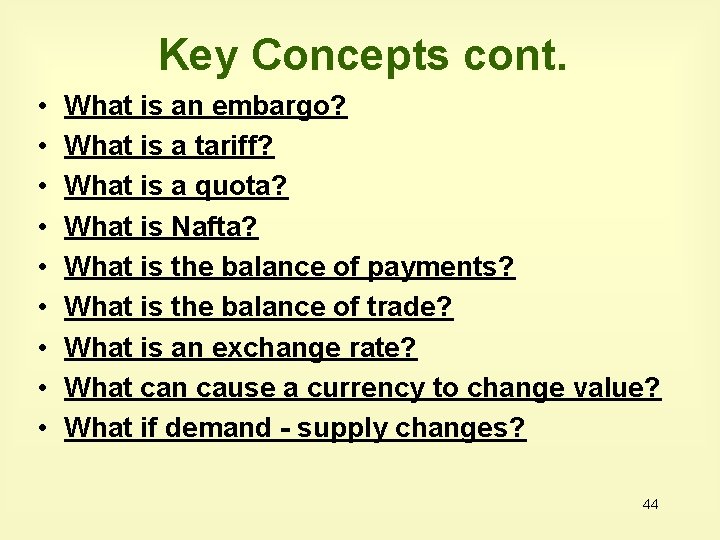
Key Concepts cont. • • • What is an embargo? What is a tariff? What is a quota? What is Nafta? What is the balance of payments? What is the balance of trade? What is an exchange rate? What can cause a currency to change value? What if demand - supply changes? 44
Summary 45
Comparative advantage is a principle that allows nations to gain from trade. Comparative advantage means that each nation specializes in a product for which its opportunity cost is lower in terms of the production of another product and then nations trade. 46
When nations follow the principle of comparative advantage, they gain. The reason is that world output increases and each nation ends up with a higher standard of living by consuming more goods and services than possible without specialization and trade. 47
U. S. Production and Consumption 80 70 60 40 20 Grain (tons per year) 100 A 0 B´ (with trade) B (without trade) PPC U. S. Steel (tons per day) C 10 20 30 40 50 48
Free trade benefits a nation as a whole, but individuals may lose jobs and incomes from the competition from foreign goods and services. 49
Protectionism is a government’s use of embargoes, tariffs, quotas, and other methods t impose barriers intended to both reduce imports and protect particular domestic industries. 50
Embargoes prohibit the import of export of particular goods. Tariffs discourage imports by making them more expensive. Quotas limit the quantity of imports or exports of certain goods. These trade barriers often result primarily from domestic groups that exert political pressure to gain from these barriers. 51
The balance of payments is a summary bookkeeping record of all the international transactions a country makes during a year. It is divided into different accounts, including the current account, the capital account and the statistical discrepancy. 52
The current account summarizes all transactions in currently produced goods and services. The overall balance of payments is always zero after an adjustment for the statistical discrepancy. 53
The balance of trade measures only goods (not services) that a nation exports and imports. A balance of trade can be in deficit or in surplus. The balance of trade is the most widely reported and largest part of the current account. Since 1975, the U. S. has experienced balance of trade deficits. 54
50 U. S. Balance of Trade, 1979 -2000 -50 -100 -150 -200 Balance of Trade (billions of dollars) 0 -250 Year 79 81 83 85 87 89 91 93 95 97 99 01 55
An exchange rate is the price of one nation’s currency in terms of another nation’s currency. Foreigners who wish to purchase U. S. goods, services, and financial assets demand dollars. The supply of dollars reflects the desire of U. S. citizens to purchase foreign goods, services and financial assets. 56
The intersection of the supply and demand curves for dollars determines the number of units of a foreign currency per dollar. 57
Price (yen per dollar) Supply and Demand for Dollars 200 150 S of $ (U. S. citizens) E 100 50 D for $ (Japanese citizens) 0 100 200 300 400 500 Quantity of dollars (millions per day) 58
Shifts in supply and demand foreign exchange result from changes in such factors as tastes, relative price levels, relative real interest rates, and relative income levels. 59
Depreciation of currency occurs when one currency becomes worth fewer units of another currency. If a currency depreciates, it becomes weaker. Depreciation of a nation’s currency increases its exports and decreases its imports. 60
Appreciation of currency occurs when one currency becomes worth more units of another currency. If a currency appreciates, it becomes stronger. Appreciation of a nation’s currency decreases its exports and increases its imports. 61
END 62