
Chapter 27 The Phillips Curve and Expectations Theory


- Slides: 64
Chapter 27 The Phillips Curve and Expectations Theory • Key Concepts • Summary • Practice Quiz • Internet Exercises © 2002 South-Western College Publishing 1
What is the Phillips Curve? A curve showing an inverse relationship between the inflation rate and the unemployment rate 2
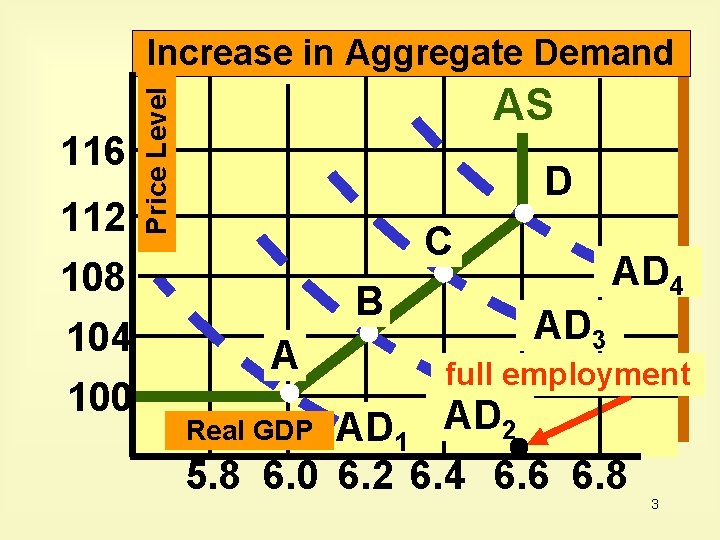
Increase in Aggregate Demand 112 108 104 100 Price Level 116 AS D C B A AD 4 AD 3 full employment AD 1 AD 2 5. 8 6. 0 6. 2 6. 4 6. 6 6. 8 Real GDP 3
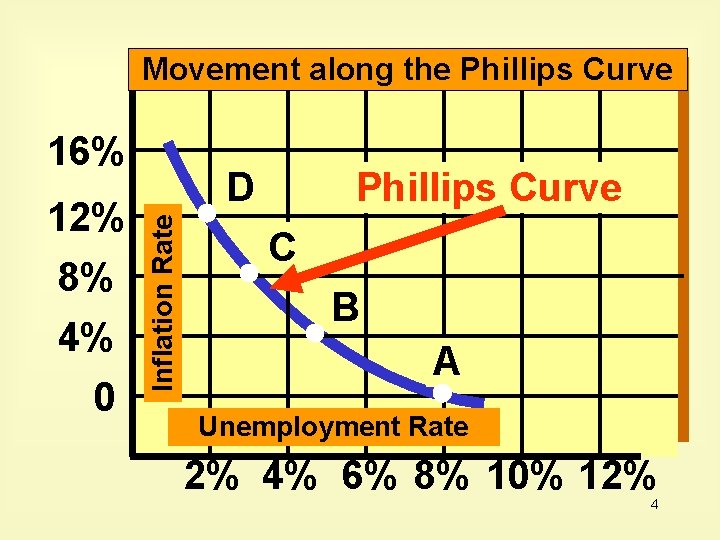
Movement along the Phillips Curve 16% 4% 0 Inflation Rate 12% 8% D Phillips Curve C B A Unemployment Rate 2% 4% 6% 8% 10% 12% 4
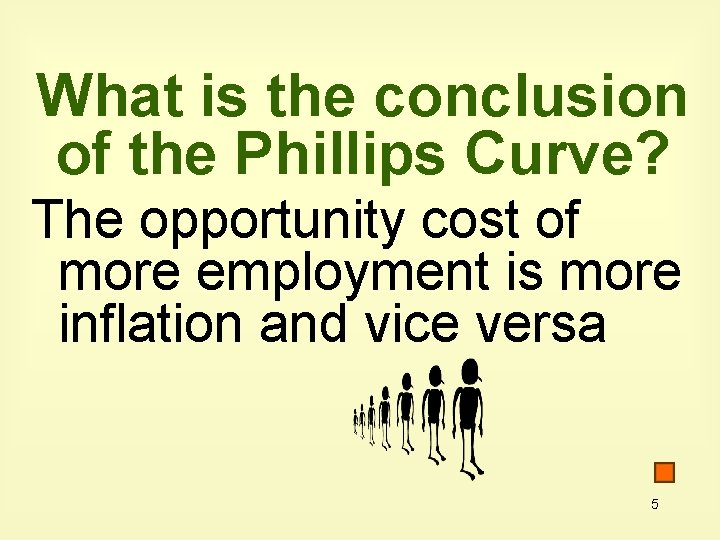
What is the conclusion of the Phillips Curve? The opportunity cost of more employment is more inflation and vice versa 5
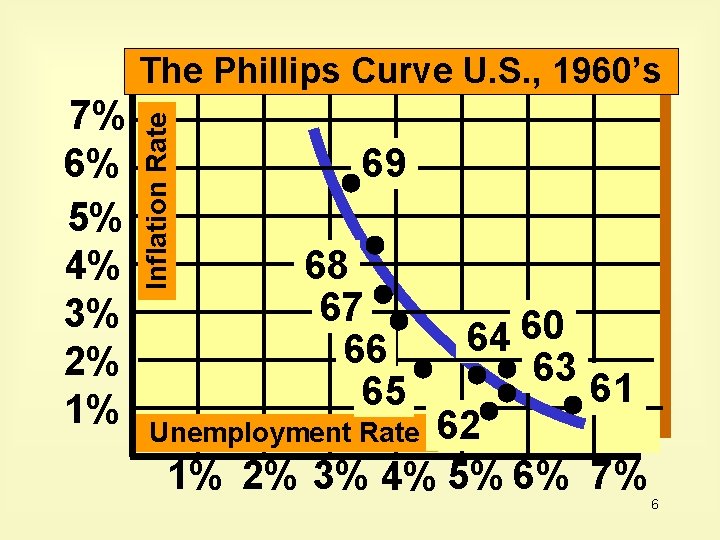
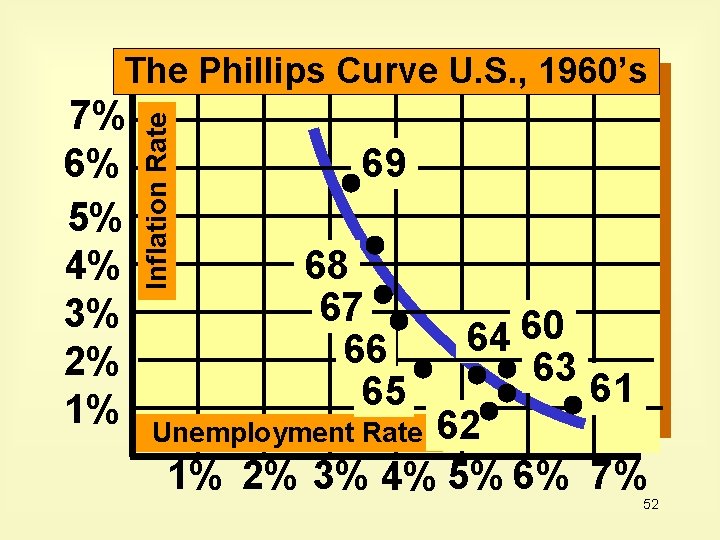
7% 6% 5% 4% 3% 2% 1% Inflation Rate The Phillips Curve U. S. , 1960’s 69 68 67 66 65 64 60 63 61 Unemployment Rate 62 1% 2% 3% 4% 5% 6% 7% 6
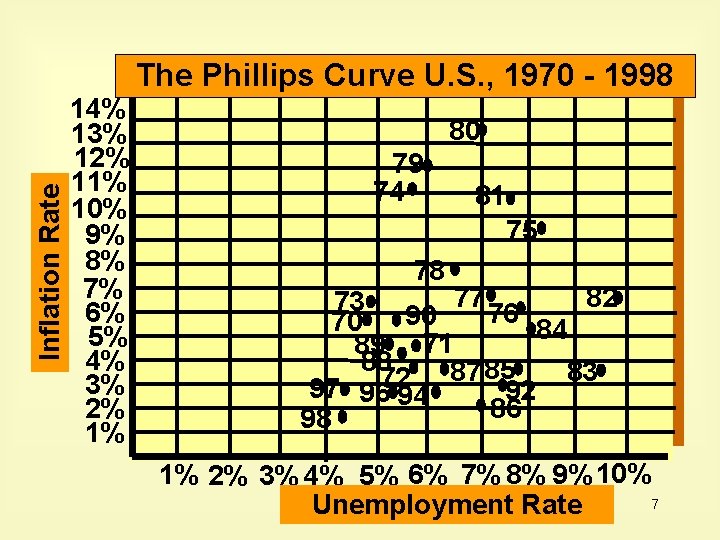
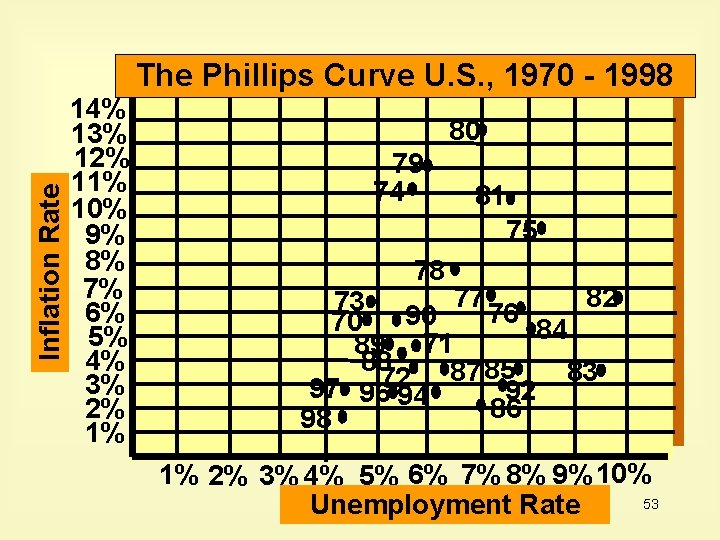
Inflation Rate 14% 13% 12% 11% 10% 9% 8% 7% 6% 5% 4% 3% 2% 1% The Phillips Curve U. S. , 1970 - 1998 80 79 74 81 75 78 77 82 73 76 90 70 84 89 71 88 87 85 83 72 97 96 94 92 86 98 1% 2% 3% 4% 5% 6% 7% 8% 9% 10% 7 Unemployment Rate
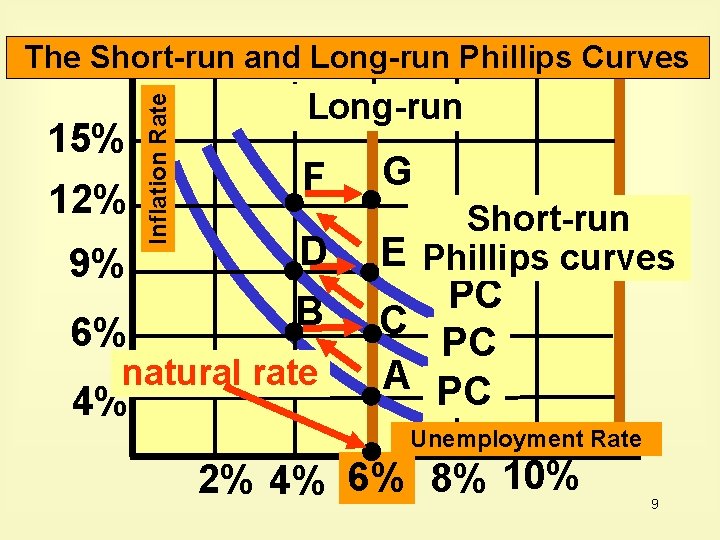
What does the long-run Phillips curve look like according to the Natural Rate Hypothesis? It is a vertical line at the natural rate of unemployment 8
15% 12% 9% 6% Inflation Rate The Short-run and Long-run Phillips Curves Long-run F D B natural rate 4% G Short-run E Phillips curves PC C 3 PC A PC 2 1 Unemployment Rate 2% 4% 6% 8% 10% 9
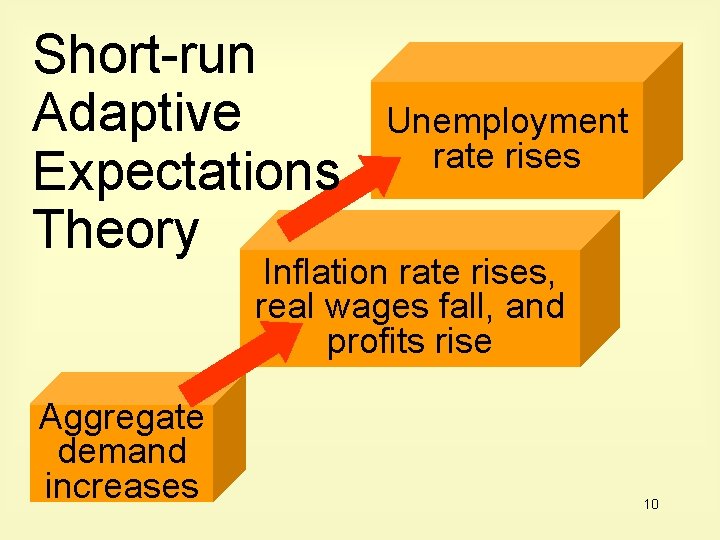
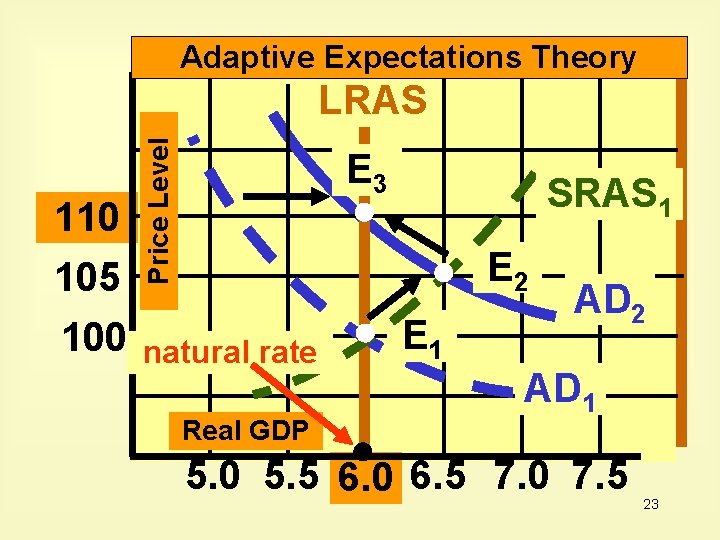
Short-run Adaptive Expectations Theory Unemployment rate rises Inflation rate rises, real wages fall, and profits rise Aggregate demand increases 10
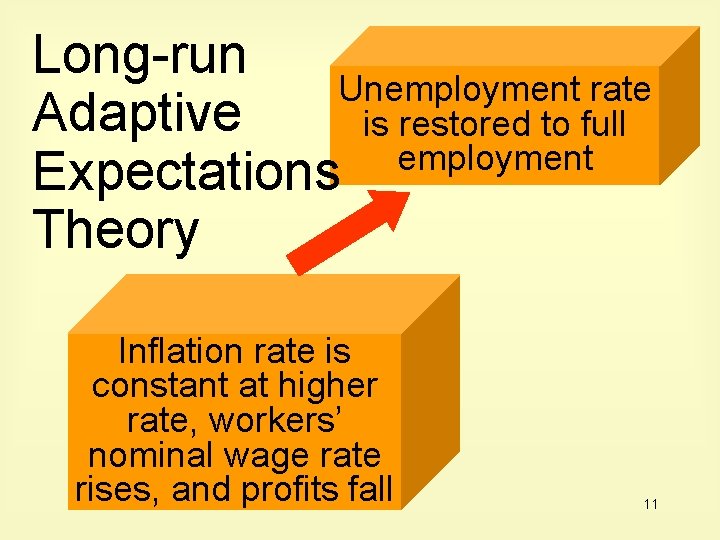
Long-run Unemployment rate Adaptive is restored to full employment Expectations Theory Inflation rate is constant at higher rate, workers’ nominal wage rate rises, and profits fall 11
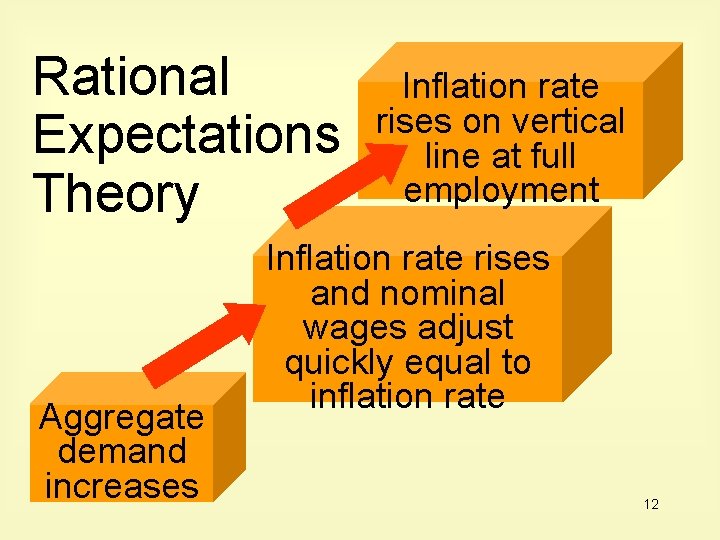
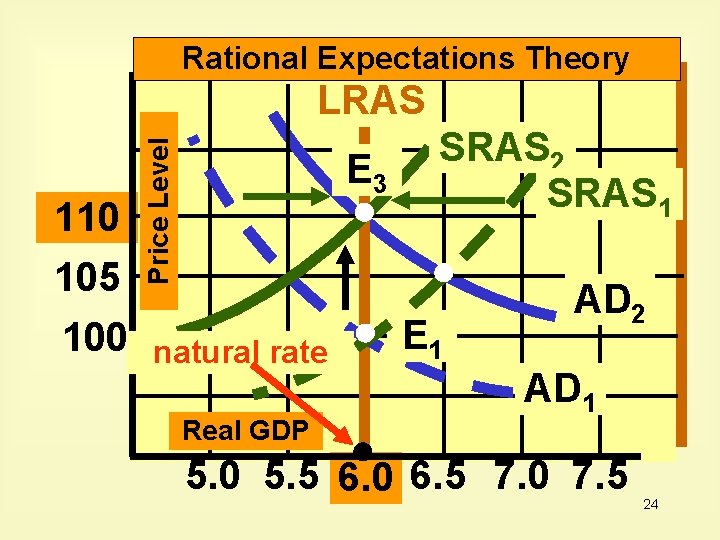
Rational Expectations Theory Aggregate demand increases Inflation rate rises on vertical line at full employment Inflation rate rises and nominal wages adjust quickly equal to inflation rate 12
What two versions of Expectations Theory explain the Natural Rate Model? Adaptive expectations Rational expectations 13
What is the Adaptive Expectations Theory? People believe the best indicator of the future is recent information 14
What is the conclusion of the Adaptive Theory? Expansionary monetary and fiscal policies to reduce unemployment are useless in the long-run 15
Why are monetary and fiscal polices useless in the long-run? After a short-run reduction in unemployment, the economy will self-correct to the natural rate of unemployment, but at a higher inflation rate 16
What is the Rational Expectations Theory? People will use all available information to predict the future, including future monetary and fiscal policies 17
What conclusion rational expectations? Systematic and predictable macroeconomic policies can be negated when businesses and workers anticipate the effects of these policies 18
According to the Rational Expectations Theory, can macroeconomic policies make things worse? People acting on their expectations of expansionary monetary and fiscal policies that are predictable can cause inflation 19
What happens if macroeconomic policies are not predictable? The economy’s selfcorrection mechanism will restore the economy to full employment 20
What is the best way to lower inflation? Preannounced, stable policies to achieve a low and constant money supply growth and a balanced federal budget 21
How can a distinction be made between the two theories? By analyzing the aggregate demand supply model 22
Adaptive Expectations Theory 110 105 100 Price Level LRAS E 3 SRAS 1 E 2 natural rate Real GDP E 1 AD 2 AD 1 5. 0 5. 5 6. 0 6. 5 7. 0 7. 5 23
Rational Expectations Theory 110 105 100 Price Level LRAS E 3 natural rate Real GDP SRAS 2 SRAS 1 E 1 AD 2 AD 1 5. 0 5. 5 6. 0 6. 5 7. 0 7. 5 24
What is an alternative way to fight inflation? Use incomes policies 25
What are incomes policies? Federal government policies designed to affect the real incomes of workers by controlling nominal wages and prices 26
What are examples of incomes policies? • Jawboning • Wage and price guidelines • Wage and price controls 27
What is jawboning? Oratory intended to pressure unions and businesses to reduce wage and price increases 28
What are wage and price guidelines? Voluntary standards set by the government for “permissible” wage and price increases 29
What are wage and price controls? Legal restrictions on wage and price increases. Violations can result in fines and imprisonment 30
How do different macroeconomic models cure inflation? 31
Monetarism Monetarists see the cause of inflation as “too much money chasing too few goods, ” based on the quantity of money theory (MV = PQ). To cure inflation, they would cut the money supply and force the Fed to stick to a fixed money supply growth rate. In the short run, the unemployment rate will rise, but in the long-run, it selfcorrects to the natural rate. 32
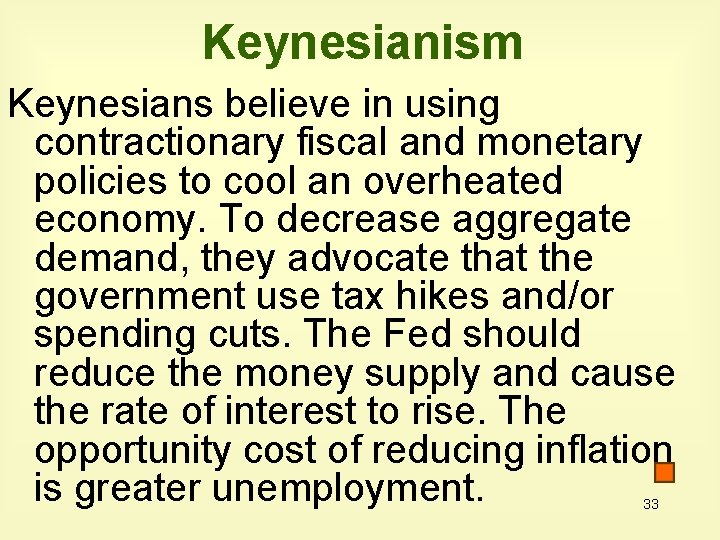
Keynesianism Keynesians believe in using contractionary fiscal and monetary policies to cool an overheated economy. To decrease aggregate demand, they advocate that the government use tax hikes and/or spending cuts. The Fed should reduce the money supply and cause the rate of interest to rise. The opportunity cost of reducing inflation is greater unemployment. 33
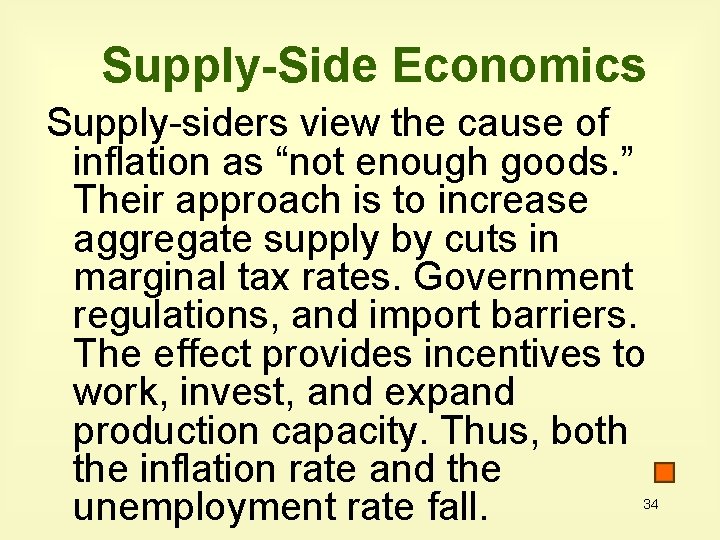
Supply-Side Economics Supply-siders view the cause of inflation as “not enough goods. ” Their approach is to increase aggregate supply by cuts in marginal tax rates. Government regulations, and import barriers. The effect provides incentives to work, invest, and expand production capacity. Thus, both the inflation rate and the unemployment rate fall. 34
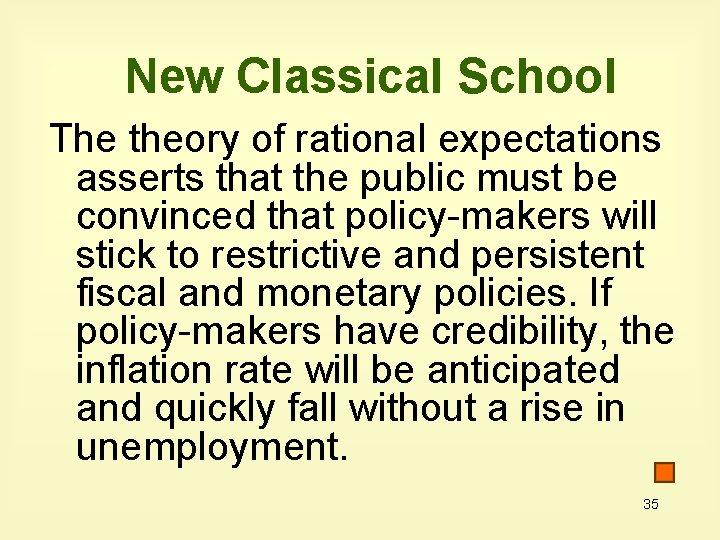
New Classical School The theory of rational expectations asserts that the public must be convinced that policy-makers will stick to restrictive and persistent fiscal and monetary policies. If policy-makers have credibility, the inflation rate will be anticipated and quickly fall without a rise in unemployment. 35
Key Concepts 36
Key Concepts • What is the Phillips Curve? • What is the conclusion of the Phillips Curve? • What two versions of Expectations Theory explain the Natural Rate Model? • What is the Adaptive Expectations Theory? • What is the Rational Expectations Theory? 37
Key Concepts cont. • How can a distinction be made between the two theories? • What are incomes policies? • What are examples of incomes policies? • What is jawboning? • What are wage and price guidelines? • What are wage and price controls? 38
Summary 39
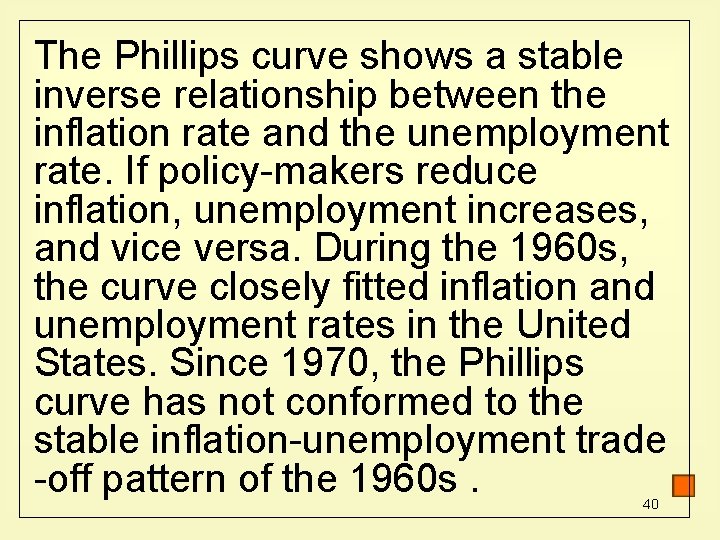
The Phillips curve shows a stable inverse relationship between the inflation rate and the unemployment rate. If policy-makers reduce inflation, unemployment increases, and vice versa. During the 1960 s, the curve closely fitted inflation and unemployment rates in the United States. Since 1970, the Phillips curve has not conformed to the stable inflation-unemployment trade -off pattern of the 1960 s. 40
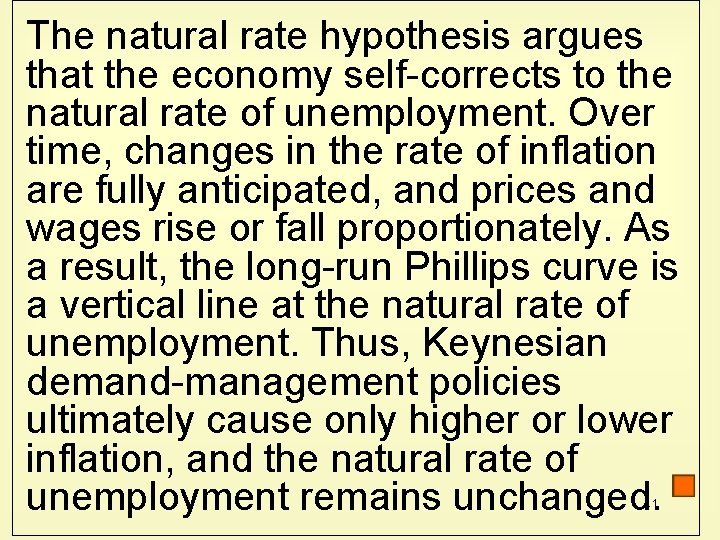
The natural rate hypothesis argues that the economy self-corrects to the natural rate of unemployment. Over time, changes in the rate of inflation are fully anticipated, and prices and wages rise or fall proportionately. As a result, the long-run Phillips curve is a vertical line at the natural rate of unemployment. Thus, Keynesian demand-management policies ultimately cause only higher or lower inflation, and the natural rate of unemployment remains unchanged. 41
Adaptive expectations theory is the proposition that people base their forecasts on recent past information, rather than future information. Once the government causes the inflation rate to rise or fall, people adapt their inflationary expectations to the current inflation rate. The result is a short-run Phillips curve that intersects the vertical long-run Phillips curve. Over time, the economy self-corrects to the natural rate of unemployment. 42
The political business cycle is a business cycle is created by the incentive for politicians to manipulate the economy to get re-elected. Using expansionary policies, officeholders can stimulate the economy before the election. Unemployment falls, and the price level rises. After the election, the strategy is to contract the economy to fight inflation and unemployment rises. 43
Rational expectations theory argues that it is naïve to believe that people change their inflationary expectations based only on the current inflation rate. Rational expectationists belong to the new classical school. 44
The rational expectation theory is based on people’s expectations. For example, if government policies are predictable, people immediately anticipate higher or lower inflation. Workers quickly change their nominal wages as businesses change prices. Consequently, inflation worsens or improves, and unemployment remains unchanged at the natural rate. Thus, there is no short-run Phillips curve, and the long-run Phillips curve is vertical 45
Incomes policies are a variety of federal government programs aimed at directly controlling wages and prices. Incomes policies include jawboning, wage-price guidelines, and wage-price controls. Over time, incomes policies tend to be ineffective. 46
Wage and price controls are legal restrictions on wages and prices. Most economists do not favor wage and price controls in peacetime. Such controls are expensive to administer, destroy efficiency, and intrude on economic freedom. 47
Chapter 27 Quiz © 2002 South-Western College Publishing 48
1. The Phillips curve depicts the relationship between the a. unemployment rate and the change in GDP. b. inflation rate and the interest rate. c. level of investment spending and the interest rate. d. inflation rate and the unemployment rate. D. The Phillips curve is a theory developed by A. W. Phillip in 1958. 49
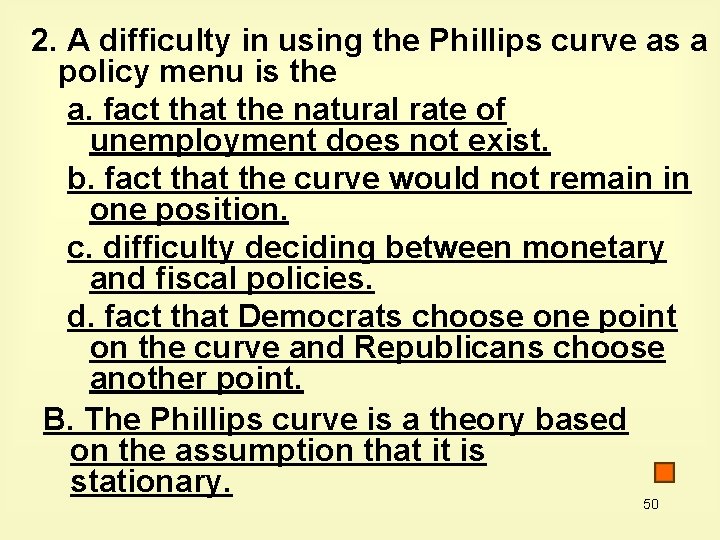
2. A difficulty in using the Phillips curve as a policy menu is the a. fact that the natural rate of unemployment does not exist. b. fact that the curve would not remain in one position. c. difficulty deciding between monetary and fiscal policies. d. fact that Democrats choose one point on the curve and Republicans choose another point. B. The Phillips curve is a theory based on the assumption that it is stationary. 50
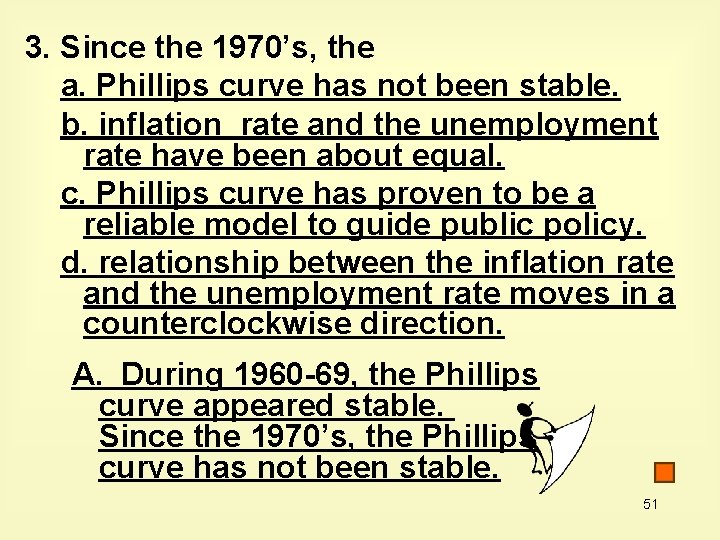
3. Since the 1970’s, the a. Phillips curve has not been stable. b. inflation rate and the unemployment rate have been about equal. c. Phillips curve has proven to be a reliable model to guide public policy. d. relationship between the inflation rate and the unemployment rate moves in a counterclockwise direction. A. During 1960 -69, the Phillips curve appeared stable. Since the 1970’s, the Phillips curve has not been stable. 51
7% 6% 5% 4% 3% 2% 1% Inflation Rate The Phillips Curve U. S. , 1960’s 69 68 67 66 65 64 60 63 61 Unemployment Rate 62 1% 2% 3% 4% 5% 6% 7% 52
Inflation Rate 14% 13% 12% 11% 10% 9% 8% 7% 6% 5% 4% 3% 2% 1% The Phillips Curve U. S. , 1970 - 1998 80 79 74 81 75 78 77 82 73 76 90 70 84 89 71 88 87 85 83 72 97 96 94 92 86 98 1% 2% 3% 4% 5% 6% 7% 8% 9% 10% 53 Unemployment Rate
4. According to natural rate hypothesis theory, a. the Phillips curve is quite flat, so that a large reduction in employment can be achieved without inflation. . b. workers only adapt their wage demands to inflation after a considerable time lag. c. the Phillips curve is vertical in the long run at full employment. d. workers cannot anticipate the inflationary effects of expansionary public policies. C. Natural rate hypothesis argues that the economy will self-correct to the full 54 employment unemployment rate.
5. Adaptive expectations theory a. argues that the best indicator of the future is recent information. b. underestimates inflation when it is accelerating. c. overestimates inflation when it is slowing down. d. none of the above. e. all of the above. E. According to adaptive expectations theory, expansionary monetary and fiscal policies to reduce the unemployment rate are useless in the 55 long run.
6. The conclusion of adaptive expectations theory is that expansionary monetary and fiscal policies intended to reduce the unemployment rate are a. effective in the long-run. b. effective in the short-run. c. unnecessary and cause inflation in the long-run. d. necessary and reduce inflation in the long-run. C. This theory believes, after a short-run reduction in unemployment, that the economy self-corrects to the natural rate of unemployment, but at a higher inflation rate. 56
7. Most macroeconomic policy changes, say the rational expectations theorists, are a. unpredictable. b. predictable. c. slow to take place. d. irrational. B. Rational expectations theory argues that people are intelligent and informed. They not only consider past changes, but also use all available information to predict the future, including future monetary and fiscal policies. 57
8. Rational expectations theorists advise the federal government to a. change policy often. b. pursue stable policies. c. do the opposite of what the public expects. d. ignore future economic predictions. C. Rational expectations argues that systematic and predictable expansionary monetary and fiscal policies are not only useless, but also harmful because the only result is higher inflation. 58
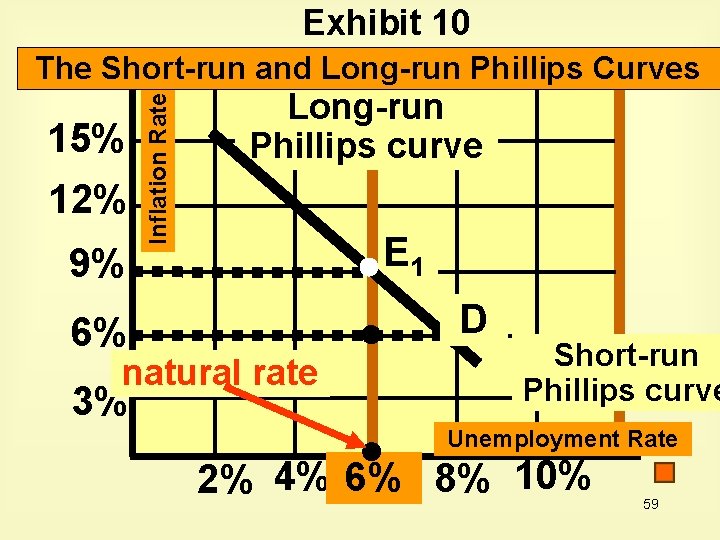
Exhibit 10 15% 12% 9% 6% Inflation Rate The Short-run and Long-run Phillips Curves Long-run Phillips curve E 1 D natural rate 3% Short-run Phillips curve Unemployment Rate 2% 4% 6% 8% 10% 59
9. Suppose the government shown in Exhibit 10 uses contractionary monetary policy to reduce inflation from 9 to 6 percent. If people have adaptive expectations, then a. the economy will remain stuck at point E 1 b. the natural rate will permanently increase to 8 percent. c. unemployment will rise to 8 percent in the short run. d. unemployment will remain at 6 percent as the inflation rate rises. C. The unemployment rate will rise to 8% as people adapt their inflationary expectations to the current inflation rate. Over time, however, the economy self-corrects to the natural unemployment rate. 60
10. Suppose the government shown in Exhibit 10 uses contractionary monetary policy to reduce inflation from 9 to 6 percent. If people have rational expectations, then a. the economy will remain stuck at point E 1 b. the natural rate will permanently increase to 8 percent. c. unemployment will rise to 8 percent in the short run. d. unemployment will remain at 6 percent as the inflation rate falls. D. Assuming the impact of government policy is predictable, people immediately anticipate higher of lower inflation. Workers quickly change their nominal wages and businesses change prices. The price level changes but the unemployment 61 remains unchanged at the natural rate.
11. Voluntary wage-price restraints are known as a. wage-price controls. b. price rollbacks. c. wage-price guidelines. d. anti-inflation commitments. C. Wage-price guidelines are voluntary standards set by government rather than wage-price controls which are legal restrictions. 62
12. Which of the following government policies is an incomes policy? a. A reduction in welfare expenditures. b. The publication of a list of guidelines suggesting maximum wage and price increases. c. An increase in the money supply. d. All of the above answers are correct. B. Income policies include presidential jawboning, wageprice guidelines, and wage-price controls. 63
END 64