
CHAPTER 27 The Expansion of the Empire IMPERIALISM
- Slides: 44
CHAPTER 27 The Expansion of the Empire IMPERIALISM
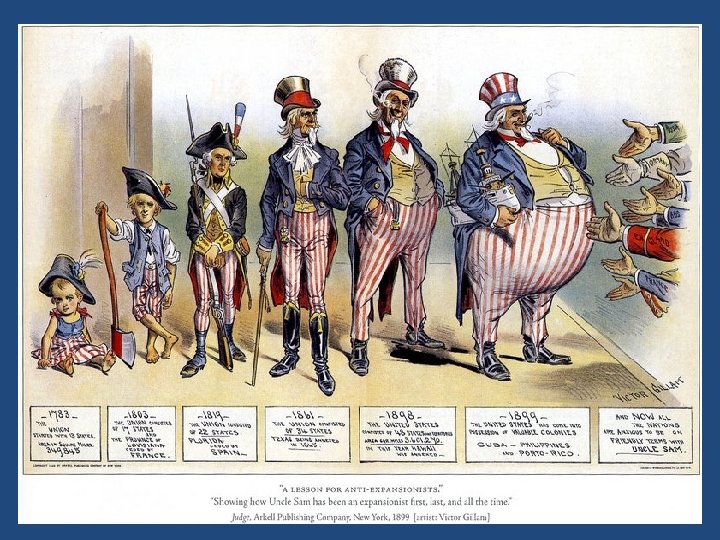
Keys to the Chapter • America looks for overseas markets to sell its products from a growing economy and to improve standing in the world. Europe races to establish additional colonies and America joins the race. • Hawaii • Cuba {Teller Amendment and later Platt} • Philippines
• • • Puerto Rico China Colombia / Panama Canal Roosevelt Corollary Dominican Republic Caribbean = “Yankee Lake” or “Lake America” Japan-Russian War (1904) Yellow Press (Sensationalism)
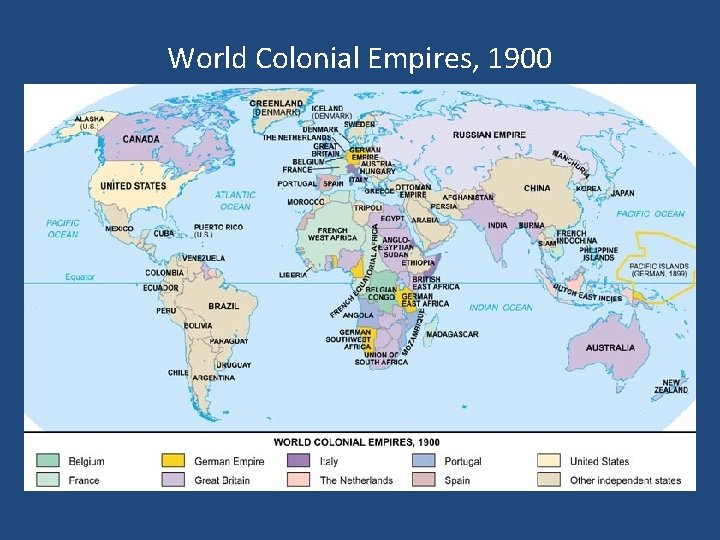
World Colonial Empires, 1900
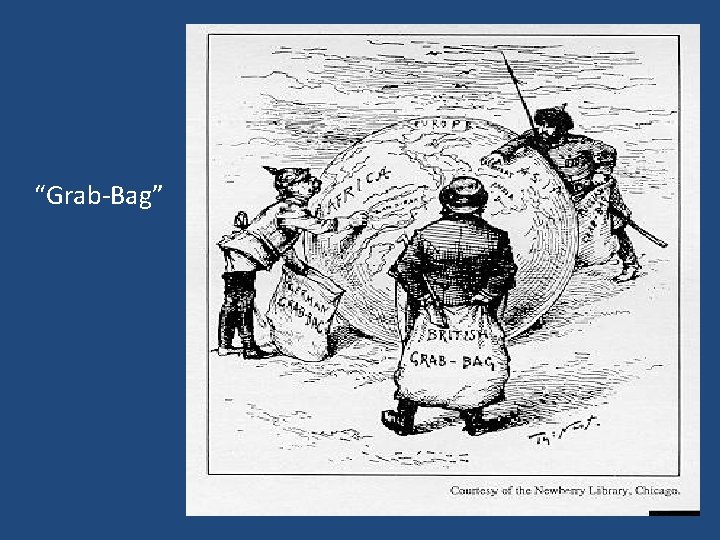
“Grab-Bag”
HAWAII Asians imported to work on white plantations; came to greatly outnumber both whites and natives – 1890 – Mc. Kinley Tariff raised on sugar and hurt white planters in Hawaii who, led by Sanford Dole, push for annexation to make them exempt from tariffs. – Annexation opposed by Queen Liliuokalani and huge majority of Hawaiian people • 1893 – whites revolt against queen with aid from US military. • Cleveland refused to annex Hawaii but Mc. Kinley will later say okay
Cuba • 1895 – Cuban people rebel against Spanish – Economy crippled by 1894 US tariff against sugar – US had $50 million invested and $100 million in annual trade with Cuba so aligns with rebels – Cuba seen as critical for controlling Gulf of Mexico (and therefore area of future Panama Canal)
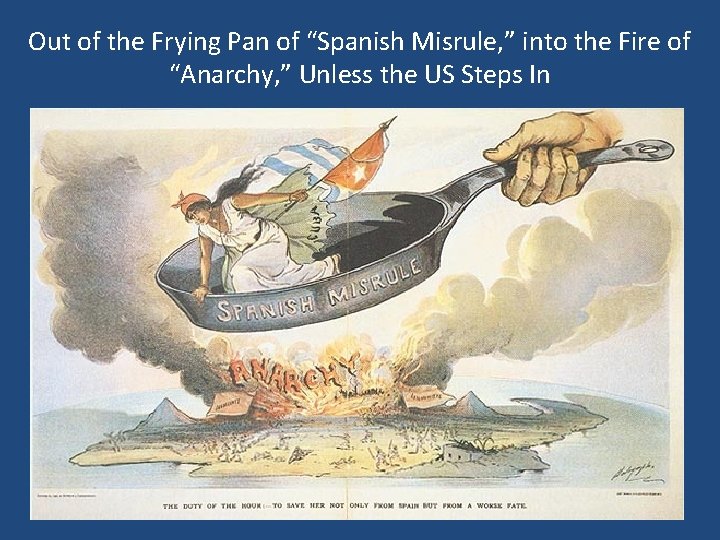
Out of the Frying Pan of “Spanish Misrule, ” into the Fire of “Anarchy, ” Unless the US Steps In
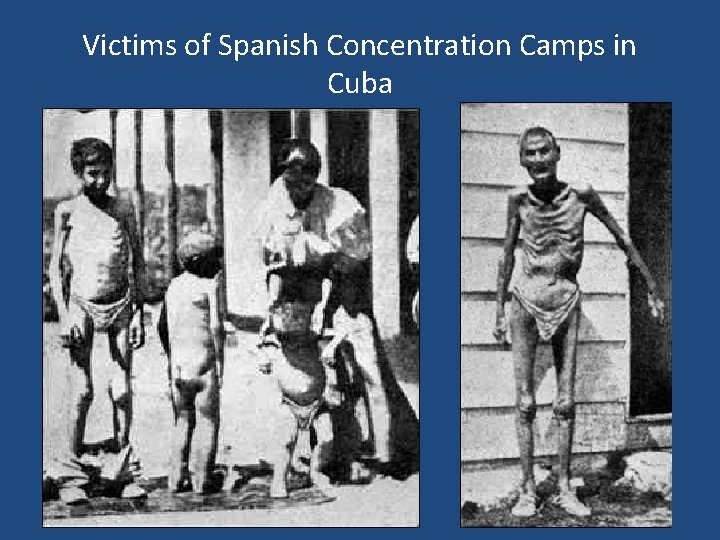
Victims of Spanish Concentration Camps in Cuba
• “yellow journalism” (Hearst and Pulitzer) use Cuban rebellion to sell newspapers with “scoops” • “You furnish the pictures and I’ll furnish the war. ” (Hearst)
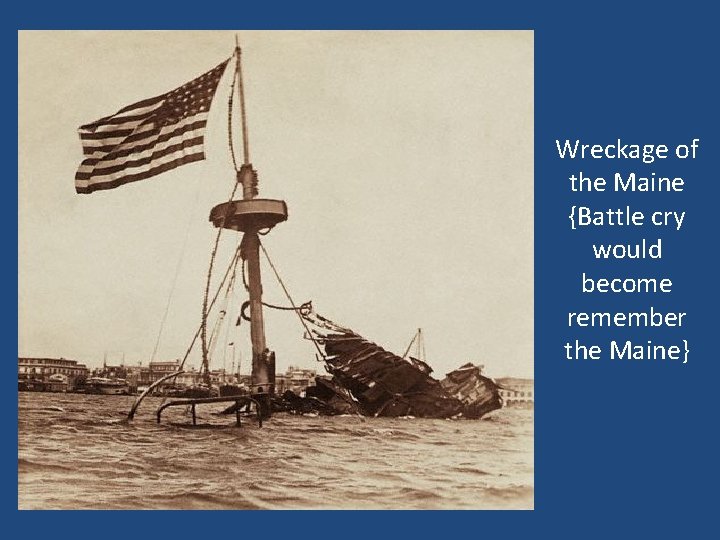
• Maine incident – Early 1898 – USS Maine to Havana to evacuate Americans in case of hostilities – February 15, 1898 – blown up, killing 260 sailors – US public demanded war even though no proof explosion had anything to do with Spain – 1976 Navy investigation finds cause was a spontaneous explosion in a coal bunker near a storage area for gunpowder
Wreckage of the Maine {Battle cry would become remember the Maine}
• February 1898 – asst. secy of the Navy T. R. ordered Commodore Dewey to attack Philippines because of “attack on Maine” – (no declaration of war at that time) – Mc. Kinley backed up Roosevelt’s order after the fact – War declared against Spain in April, 1898 • May 1898 – Dewey attacks at Manila & easily wins naval battle but needs land forces • August – US reinforcements captured Manila, with help of Filipino nationalists who want freedom from Spain
• Mc. Kinley’s dilemma – Mc. Kinley wanted Spain out of Cuba, without war, and might have gotten it eventually but many Americans wanted immediate action and public opinion forces him to act. • April 11, 1898 – Mc. Kinley asks for war – Claimed US would free Cuba from Spain • Teller Amendment – adopted by Congress with declaration of war – US promised to free Cuba so no threat it would become a colony
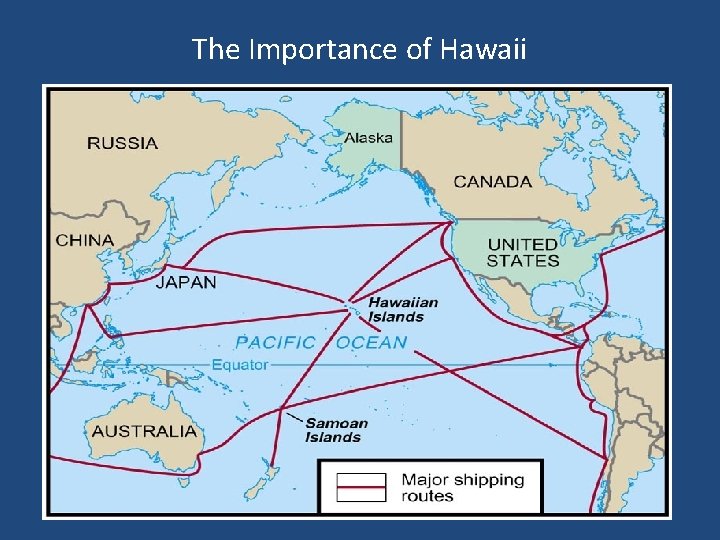
• Dewey’s celebrated victory in Manila leads to July 7, 1898 – resolution annexing Hawaii – US wanted to prevent Japan from taking Hawaii while distracted in Philippines – Hawaii necessary for re-supply and fueling station for US Pacific fleet
The Importance of Hawaii
SPANISH-AMERICAN WAR OVER QUICK • July 1 – Rough Riders (organized by Roosevelt) charged up Kettle Hill, taking heavy casualties • July 3 – naval battle & Spanish navy destroyed by US fleet (old ships can’t compete) – Fall of fleet led to surrender of Santiago • July – August – US also took Puerto Rico from Spain • August 12 – Spain signed cease fire with US • US lost 400+ to battles but 5, 000 to diseases
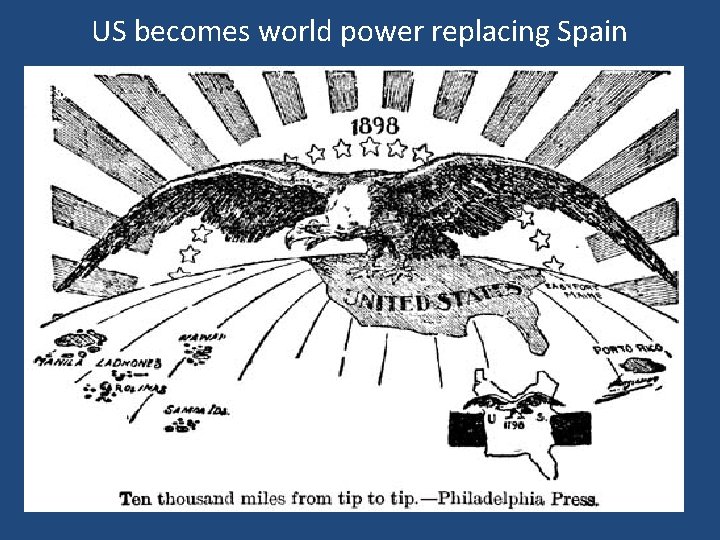
• Late 1898 – negotiations with Spain in Paris (Treaty of Paris) – Cuba freed – US got Guam – Also gets Puerto Rico – Also gets Philippines but problem is what to do with it. If left to themselves anarchy or foreign power might take it. – Mc. Kinley decides to take the islands and give them their freedom later but angers natives who believe they were promised freedom (anger lasts until 1946 independence)
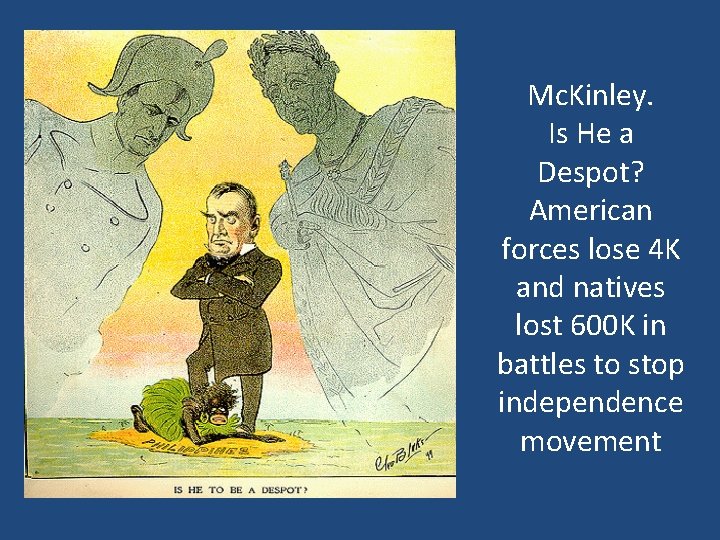
Mc. Kinley. Is He a Despot? American forces lose 4 K and natives lost 600 K in battles to stop independence movement
• Anti-imperialists’ arguments – USA giving up tradition of anti-imperialism – Filipino thirst for freedom – Annexation would violate “consent of the governed” in Declaration of Independence – Despotism outside of US might bring despotism to US – Expensive military adventures overseas – US would become involved in problems in Asia • Imperialists’ arguments – Patriotism and nationalism – US should “civilize” backwards nations – Trade profits will increase with Philippines – “White Man’s Burden” (Rudyard Kipling)
• Puerto Rico’s limbo status – Neither a state nor a territory; not much chance of eventual independence – Foraker Act (1900) – gave Puerto Rico limited popular government – 1917 – Puerto Ricans given citizenship, but not self-rule
• Insular Cases (1901) – Did the Constitution follow the flag? (Did American rights and laws apply with full force in conquered territories (Puerto Rico, Philippines)? – Divided Supreme Court ruled that Constitution was not necessarily in force in conquered territories and thus natives don’t get all the rights that U. S. citizens have.
Cuba • 1902 – US withdraws- honoring Teller Amendment • Before US withdrew, Cuba forced to add Platt Amendment to their Constitution – Cuba can’t make treaties that would compromise their independence without US approval – Can’t take on debt that couldn’t be repaid – US could intervene with troops when it saw fit – US could lease naval stations (Guantanamo) • Platt Amendment provisions ended in 1934, except for Guantanamo Base leasing
US becomes world power replacing Spain
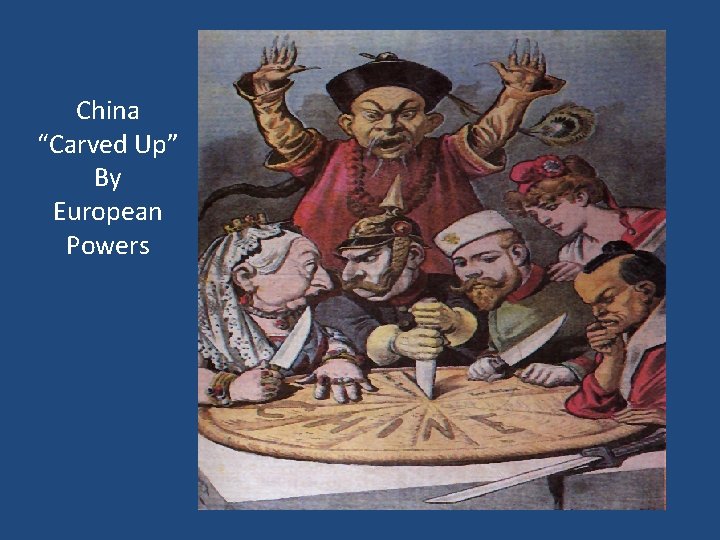
China • 1894 - China defeated by Japan • Europe (especially Russia and Germany) moved in to take advantage of China’s weakened condition (trade agreements and spheres of influence) • US opposed to European intervention in China – Churches wanted access to Chinese converts – Merchants wanted trade with China – US public inflamed
China “Carved Up” By European Powers
• Summer 1899 - Open Door note – Issued by Secretary of State John Hay – Europe must respect Chinese rights and fair competition in their spheres of influence – All great powers except Russia agreed (hesitatingly) to Open Door note • 1900 - the Boxer Rebellion by Chinese nationalists – Call to “kill foreign devils” and 200 foreigners and 1000 s of Chinese Christians killed – Rebels laid siege to Beijing (Peking)
• 1900 - 18, 000 soldiers in multinational force (including US) put down the rebellion – Allies forced China to pay $333 million • 1900 - second Open Door note issued by Hay – Chinese territorial integrity to be upheld – Incorporated in Nine-Power Treaty (1922) – Violated by Japan (when invaded Manchuria in 1930 s)
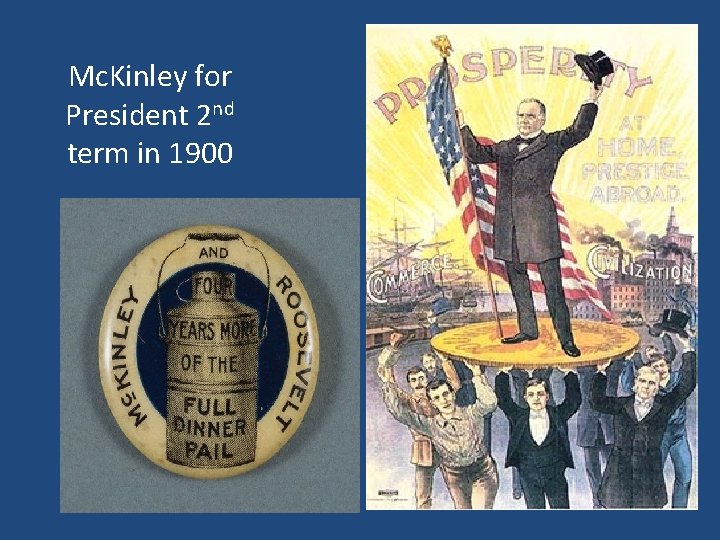
Mc. Kinley for President 2 nd term in 1900
Mc. Kinley vs. Bryan 1900 imperialism against anti-imperialism Dems attack Republican overseas imperialism • Mc. Kinley had enslaved Filipinos • Bryan traveled across US but Mc. Kinley stays on front porch- too dignified to campaign • Election of 1900: Mc. Kinley wins big – People voted for Mc. Kinley because of prosperity and protectionism, not for (or against) imperialism
• September 1901 - Mc. Kinley killed by an anarchist in Buffalo, New York – Roosevelt became youngest president (at age 42) – Born to wealthy family in New York – Was weak and asthmatic as boy, but exercised fiercely to overcome physical weaknesses – Graduated from Harvard & published many books – Worked as ranch owner and cowboy
• Roosevelt as politician – Loved outdoors and meeting people – Attacked weakness (physically and militarily) – Motto was “Speak softly and carry a big stick” – Always wanted to be the center of attention • Roosevelt as president – Little respect for checks and balances of US system – President must lead the nation and other branches
Building the Panama Canal • Need for a canal across isthmus of Panama – Increase strength of the US Navy and help defend recently-acquired territory (Hawaii, Philippines, Puerto Rico) – 1850 - Clayton-Bulwer Treaty between US and Britain • US no exclusive rights to build canal – 1901 - Hay-Pauncefote Treaty between US and Britain • Gave US right to build and fortify canal area
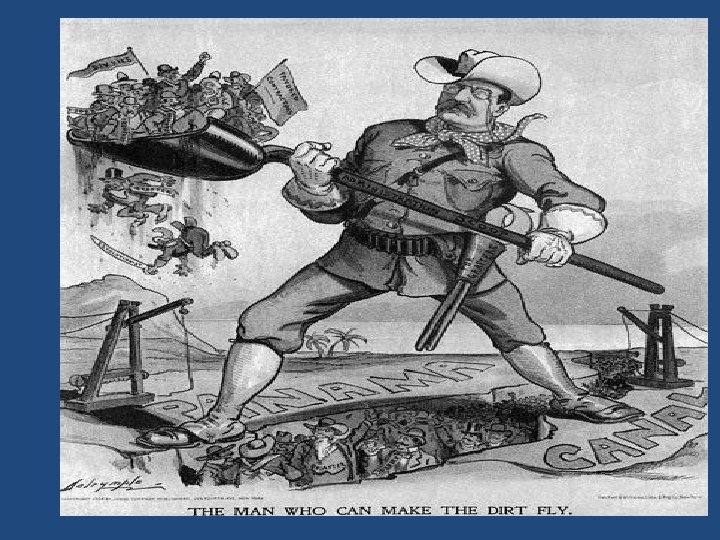
• Issue is where to build the canal? – American experts favored Nicaragua – French had tried before (1880 s) across Panama • French offered to sell equipment to US for $40 million (previously had wanted $109 million) – June 1902 - Congress decided on Panama route (partly to get the French equipment) – Panamanians had history of rebellion & French fear losing $40 million payment from US – November 3, 1903 - Panamanians rebel with French help • US navy ships prevented Columbian troops from crossing isthmus to put down rebellion
• Roosevelt makes Panama a US outpost – Panama recognized by US only 3 days after revolution – 15 days later - Hay-Bunau-Varilla Treaty signed in Washington • US paid $10 million (with annual payment of $250, 000), but US gets 10 mile wide strip of land – US paid French company $40 M. for its equipment
• Building the canal – Began in 1904 & cost $400 M – Many troubles - labor, landslides, diseases – Col. Gorgas used pesticides to eliminate dangerous tropical diseases – Col. Goethals completed canal in 1914
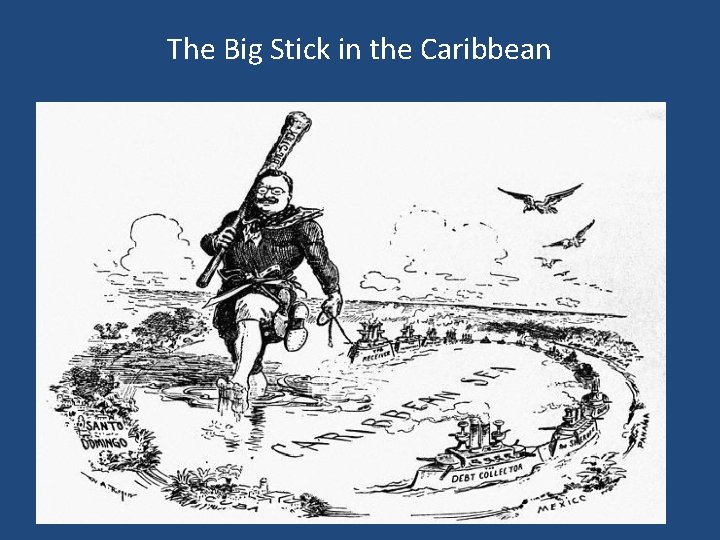
• Debt problems in Latin America – Some countries behind in payments to Europe • Led to attacks by Europeans and their belief they could colonize the nations of S. America – Roosevelt feared Germans or British using debt as excuse to stay in S. A. (violating Monroe Doctrine) • The Roosevelt Corollary – If future problems in Latin America with paying off debts, the US would intervene • US would take over parts of governments and pay off the debts, keeping Europe out – US became “policeman” of Latin America – 1905 USA took over management of tariff collection in Dominican Republic to pay down its debts
The Big Stick in the Caribbean
• 1904 - Russo-Japanese War broke out – Russia wanted access to ports – Japan launched surprise attack on Russian fleet – Japan then beat Russians in series of battles • Important because Europeans did not believe they could be beaten by non-Europeans • Both Sides turn to T. R. to negotiate a truce • 1905 - Roosevelt meets with Russia and Japan at Portsmouth, New Hampshire {Wins Nobel} – Settlement satisfied neither side
• Early 1900 s - new wave of Japanese immigrants came to America – Escape war (with Russia) and high taxes – Californians feared “yellow peril” • 1906 - San Francisco school board ordered segregation of all Asians into special schools – Done to free more space for whites after earthquake and fire Japan insulted and newspapers lead talk of war
• 1907 - the Great White Fleet sent out by Roosevelt – Sent 16 white battleships around the world – Greeted warmly in Japan with thousands of schoolchildren waving US flags • 1908 - Root-Takahira agreement – US and Japan promised to respect each other’s territorial possessions in Pacific and uphold Open Door policy in China