
Chapter 27 The Age of Imperialism Learning Objectives
Chapter 27 The Age of Imperialism Learning Objectives: 1. Define Imperialism 2. Analyze forms and methods of Imperialism 3. Analyze the causes and effects of imperialism 4. Analyze and describe the effects of Berlin Conference on Africa 5. Analyze impact of the Boer War (South African War) 6. Analyze the positive and negative legacy of Imperialism on Africa

27. 1 http: //www. youtube. com/watch? v=t_r. Hr. Gaoh 4 w https: //www. youtube. com/watch? v=u 4 DVNf 3 e. Qhg • Imperialism—seizure of a country or territory by a stronger country – Rule from afar • Factors discouraging Euro Exploration of Africa: – African armies – Rivers (physical geography) – Disease

• • • Causes Economic motives – The I. R. created demand for raw materials and new markets Balance of Power – Euro nations forced to compete for power with their Euro neighbors Nationalism – Belief in Euro superiority – Euro’s viewed empires as a measure of greatness Social Darwinism (Racism): theory advanced by Charles Darwin and used to justify expansion of European “white” dominance. S. D. argues: – Laws of evolution observed in nature, also apply to society. – Fittest or best adapted individuals, or societies prevail. – It is a white man’s burden to enlighten non-European peoples – Euros had the right and duty to spread their progress to the world
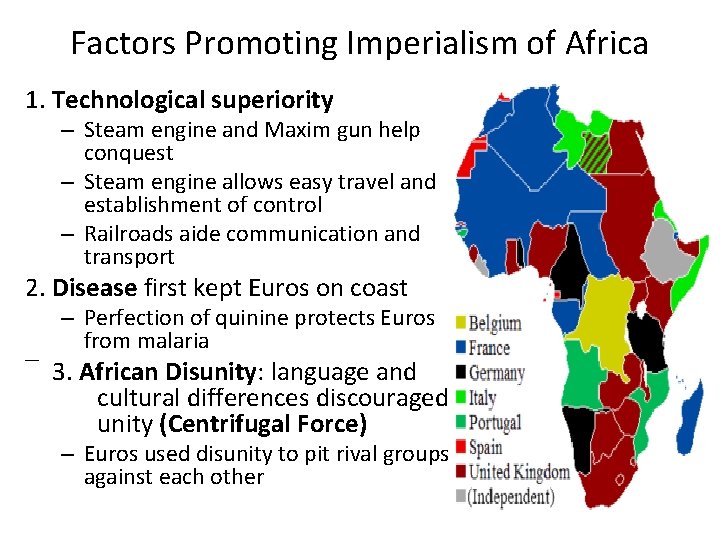
Factors Promoting Imperialism of Africa 1. Technological superiority – Steam engine and Maxim gun help conquest – Steam engine allows easy travel and establishment of control – Railroads aide communication and transport 2. Disease first kept Euros on coast – Perfection of quinine protects Euros from malaria ‾ 3. African Disunity: language and cultural differences discouraged unity (Centrifugal Force) – Euros used disunity to pit rival groups against each other
Background Information Congo – The Brutal History • • • Missionaries, explorers, humanitarians first to reach interior of Africa – David Livingstone (Scottish Missionary) Henry Stanley (American reporter) hired to find Livingstone • Stanley’s exploration interests King Leopold II of Belgium to acquire land in Congo Stanley has local chiefs sign treaties giving Belgium and Leopold control of Congo “Primary” motive to spread Christianity and abolish slavery – Reality: Leopold brutally exploits Africans; millions die Leopold’s actions push Belgian government to take colony – The Belgian Congo Seizure of large part of Africa sparks much of Europe to claim parts of Africa – Britain, Germany, Italy, Portugal, and Spain – http: //www. youtube. com/watch? v=qx 2 Sj 1 fh. Sso&feature=bf_ prev&list=PL 8 BCCE 8 BBE 994 CD 34&lf=results_main
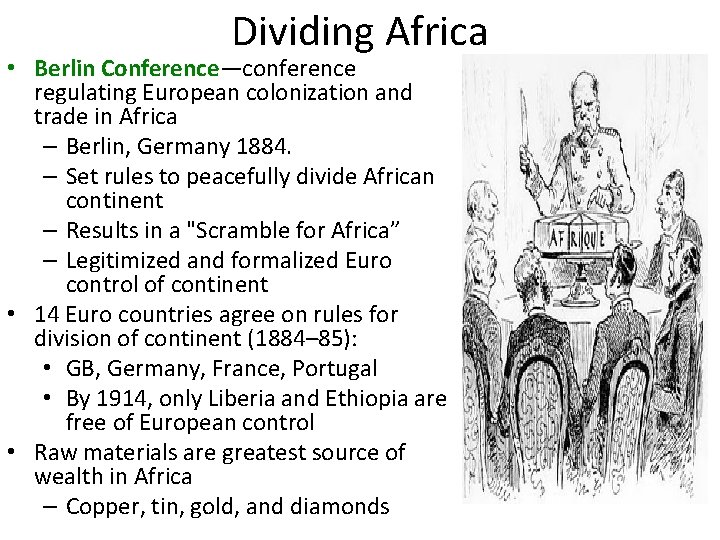
Dividing Africa • Berlin Conference—conference regulating European colonization and trade in Africa – Berlin, Germany 1884. – Set rules to peacefully divide African continent – Results in a "Scramble for Africa” – Legitimized and formalized Euro control of continent • 14 Euro countries agree on rules for division of continent (1884– 85): • GB, Germany, France, Portugal • By 1914, only Liberia and Ethiopia are free of European control • Raw materials are greatest source of wealth in Africa – Copper, tin, gold, and diamonds
Groups Clash over South Africa • South Africa: example of European impact on Africans • S. A. history = clash b/t Africans, Dutch, and British over resources • Shaka—Zulu chief—creates centralized state around 1816 along south east border – Used by British to conquer more land people • British defeat Zulus and gain control of Zulu nation in 1887
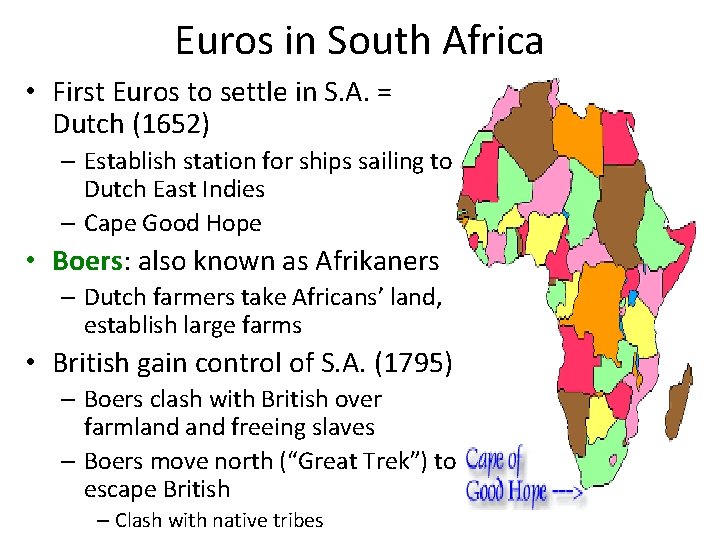
Euros in South Africa • First Euros to settle in S. A. = Dutch (1652) – Establish station for ships sailing to Dutch East Indies – Cape Good Hope • Boers: also known as Afrikaners – Dutch farmers take Africans’ land, establish large farms • British gain control of S. A. (1795) – Boers clash with British over farmland freeing slaves – Boers move north (“Great Trek”) to escape British – Clash with native tribes

Boer War (Dutch vs. British) • Boers discover diamonds and gold • Tension over ownership of land resources result in two wars • Boers win first • British counter attack burning farms and imprisoning women and children – Concentration camps for blacks and whites – British defeat Boers 1902 • Boer republics (states) join into Union of South Africa – Controlled by British • Impact: – Signaled change in the way of life for South Africans (Apartheid) – Euros changed political, economic, and social aspects of African’s lives
- Slides: 9