
Chapter 27 Physical Optics Interference and Diffraction Chapter
- Slides: 36
Chapter 27 Physical Optics: Interference and Diffraction
Chapter 27 • Superposition and Interference • Young’s Two-Slit Experiment • Interference in Reflected Waves • Diffraction • Resolution • Diffraction Gratings
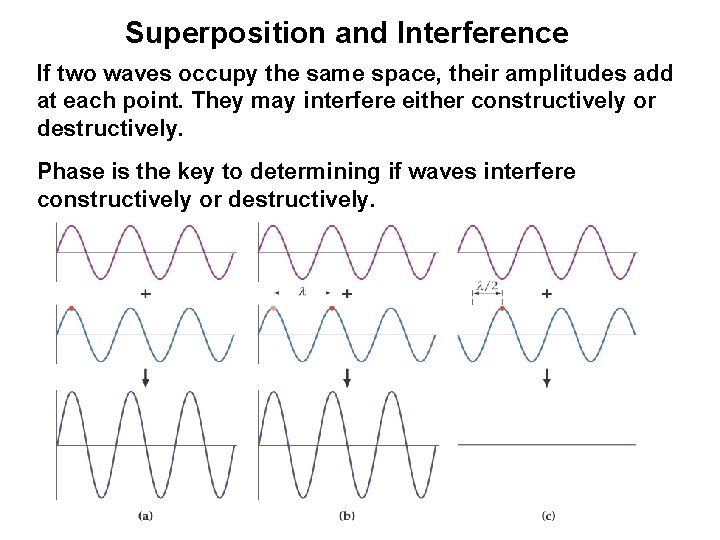
Superposition and Interference If two waves occupy the same space, their amplitudes add at each point. They may interfere either constructively or destructively. Phase is the key to determining if waves interfere constructively or destructively.
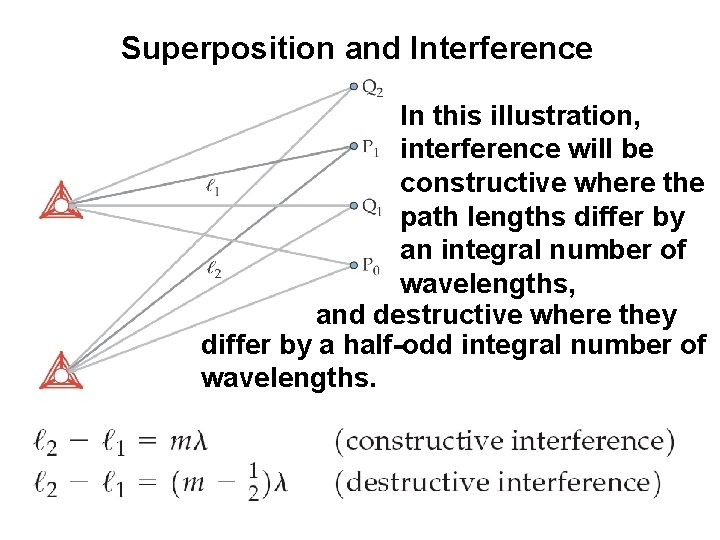
Superposition and Interference In this illustration, interference will be constructive where the path lengths differ by an integral number of wavelengths, and destructive where they differ by a half-odd integral number of wavelengths.
Superposition and Interference With light waves, interference is only noticeable if the light sources are monochromatic (all the light has the same wavelength) and coherent (different sources maintain the same phase relationship over space and time). If this is true, interference will be constructive where the two waves are in phase, and destructive where they are out of phase.
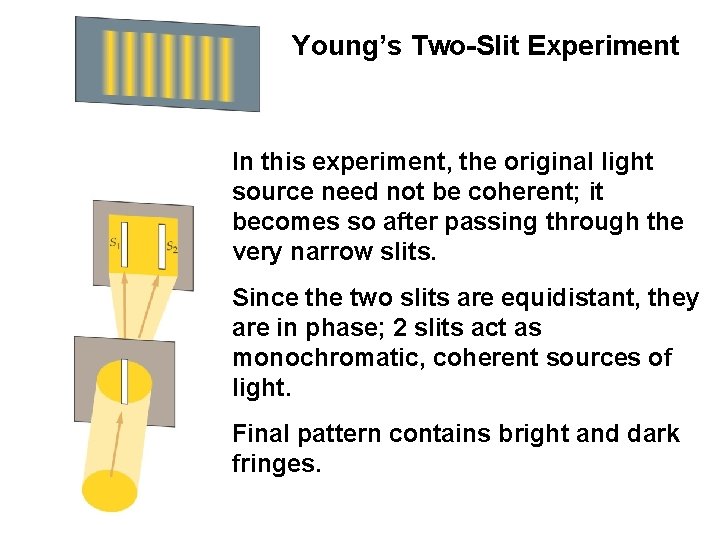
Young’s Two-Slit Experiment In this experiment, the original light source need not be coherent; it becomes so after passing through the very narrow slits. Since the two slits are equidistant, they are in phase; 2 slits act as monochromatic, coherent sources of light. Final pattern contains bright and dark fringes.
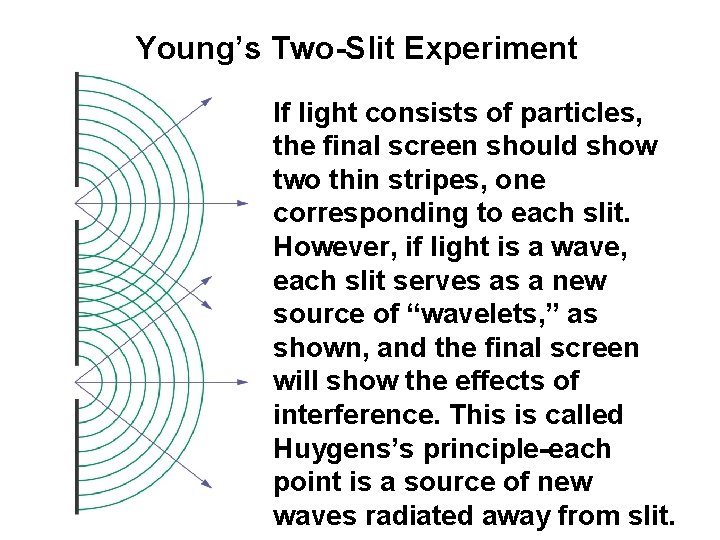
Young’s Two-Slit Experiment If light consists of particles, the final screen should show two thin stripes, one corresponding to each slit. However, if light is a wave, each slit serves as a new source of “wavelets, ” as shown, and the final screen will show the effects of interference. This is called Huygens’s principle-each point is a source of new waves radiated away from slit.
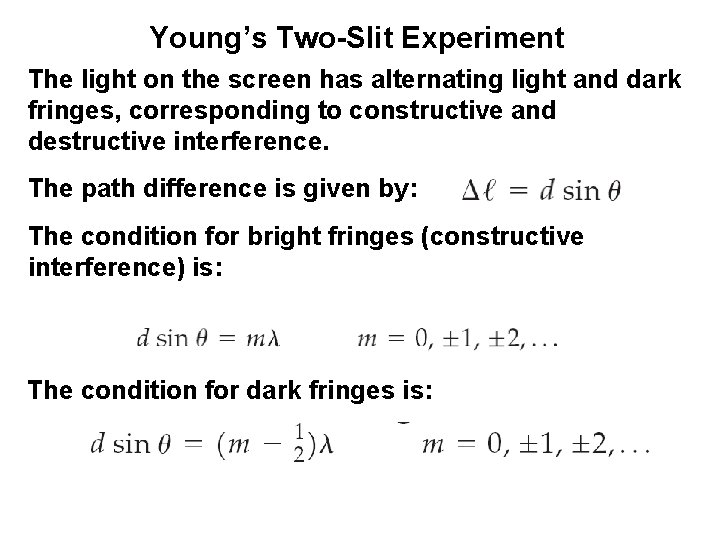
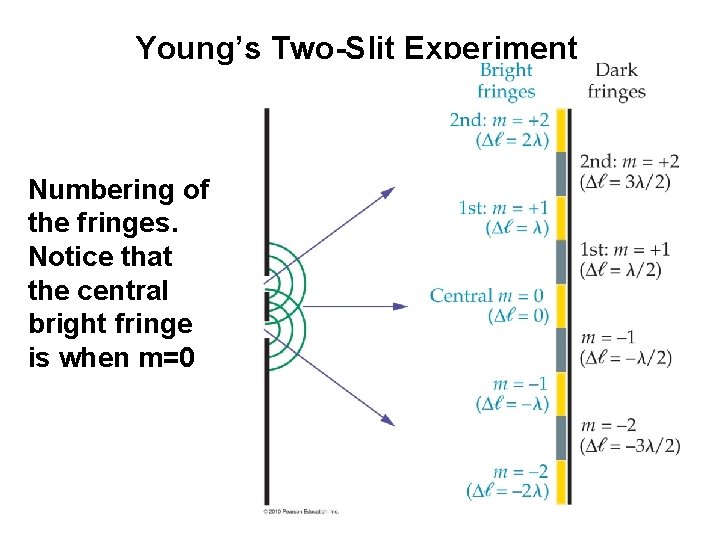
Young’s Two-Slit Experiment The light on the screen has alternating light and dark fringes, corresponding to constructive and destructive interference. The path difference is given by: The condition for bright fringes (constructive interference) is: The condition for dark fringes is:
Young’s Two-Slit Experiment Numbering of the fringes. Notice that the central bright fringe is when m=0
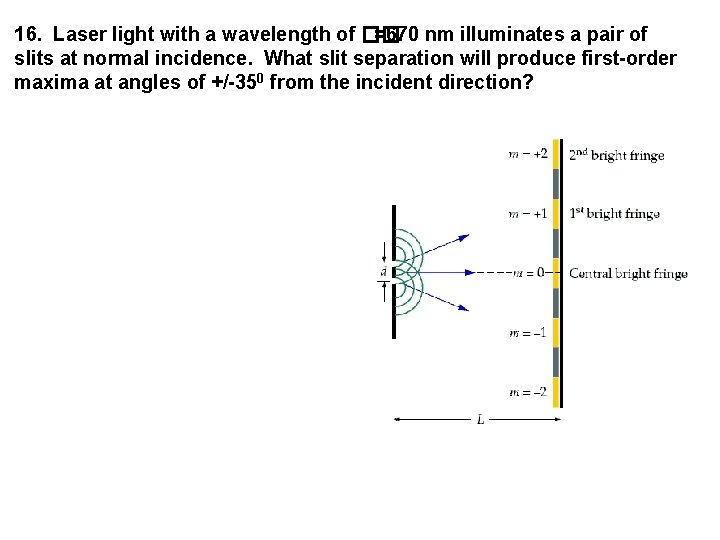
16. Laser light with a wavelength of �� =670 nm illuminates a pair of slits at normal incidence. What slit separation will produce first-order maxima at angles of +/-350 from the incident direction?
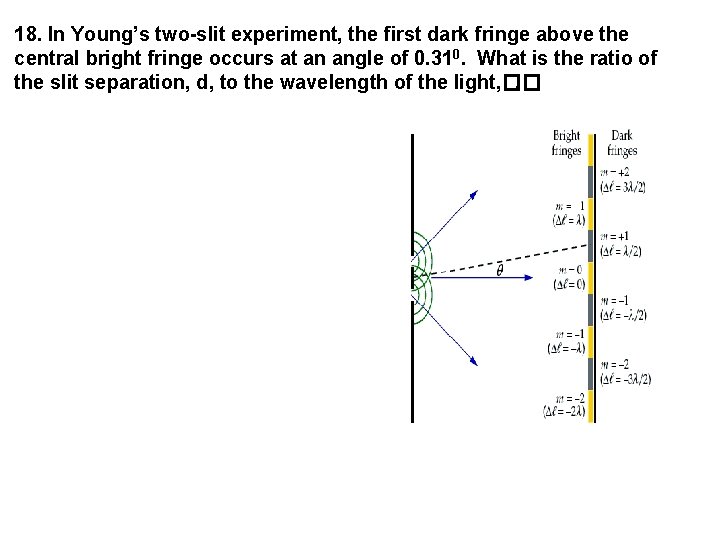
18. In Young’s two-slit experiment, the first dark fringe above the central bright fringe occurs at an angle of 0. 310. What is the ratio of the slit separation, d, to the wavelength of the light, ��.
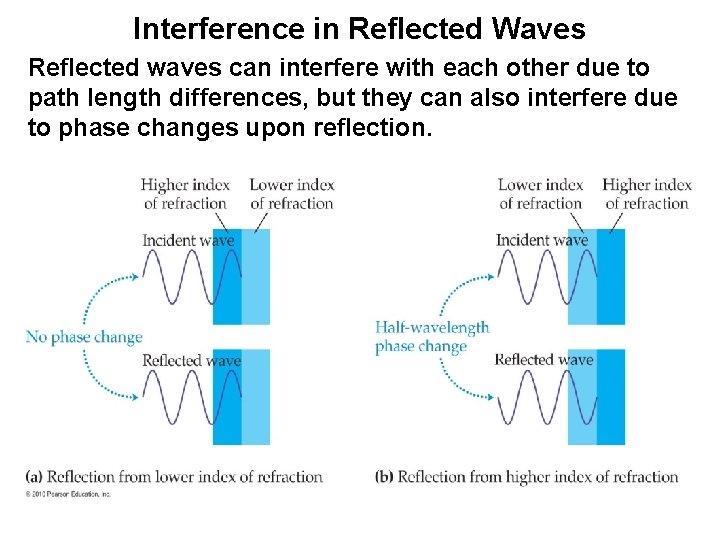
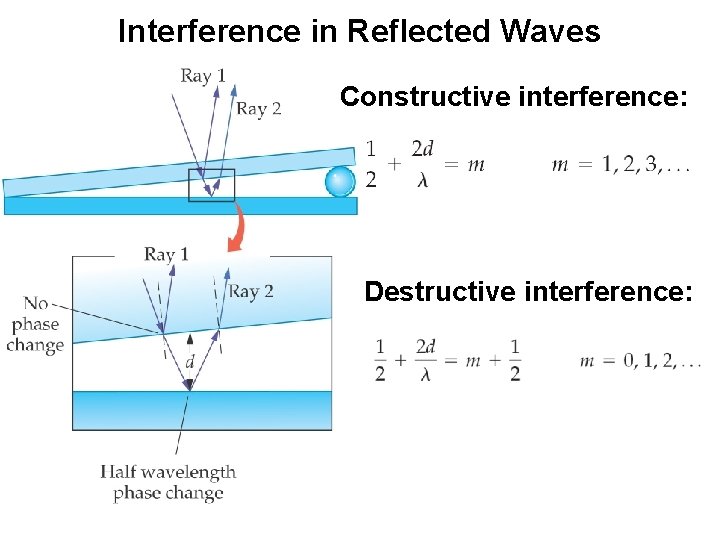
Interference in Reflected Waves Reflected waves can interfere with each other due to path length differences, but they can also interfere due to phase changes upon reflection.
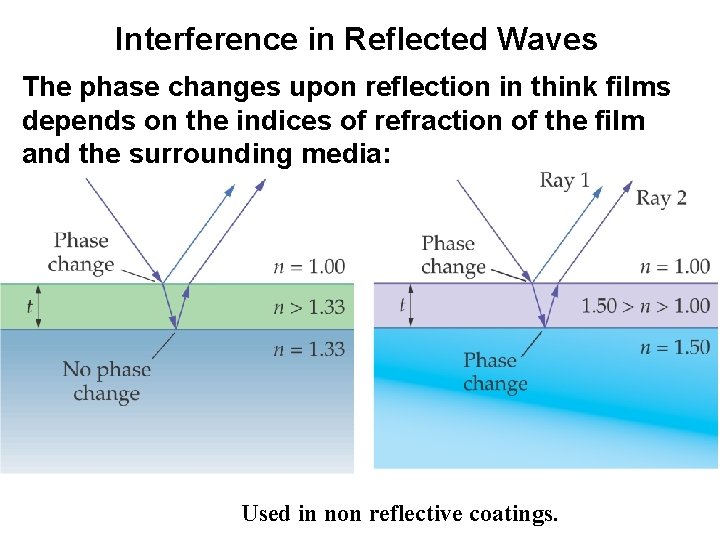
Interference in Reflected Waves There is no phase change when light reflects from a region with a lower index of refraction, interference is constructive. There is a half-wavelength phase change when light reflects from a region with a higher index of refraction, or from a solid surface, interference is destructive. There is also no phase change in the refracted wave.
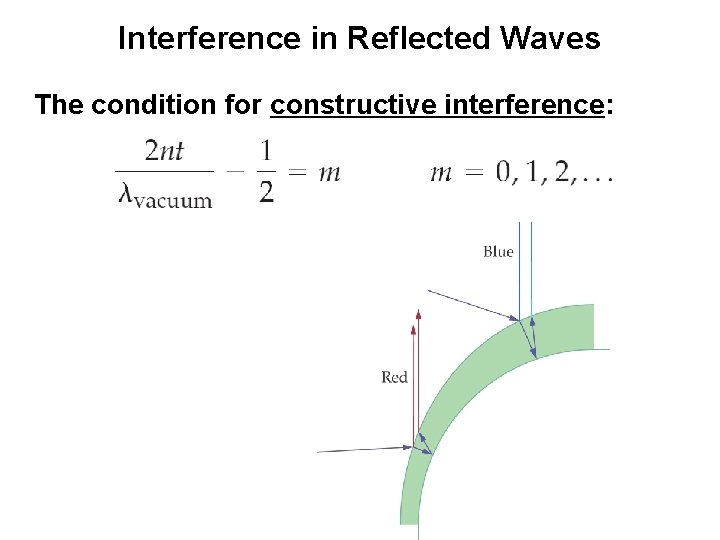
Interference in Reflected Waves Constructive interference: Destructive interference:
Interference in Reflected Waves THIN FILMS Thin films are most common example of interference. Interference occurs when light refracts and reflects from both surfaces of a thin film. This accounts for the colors we see in oil slicks and soap bubbles. Thin films have both path differences and phase changes on reflection; both contribute to constructive and destructive interference.
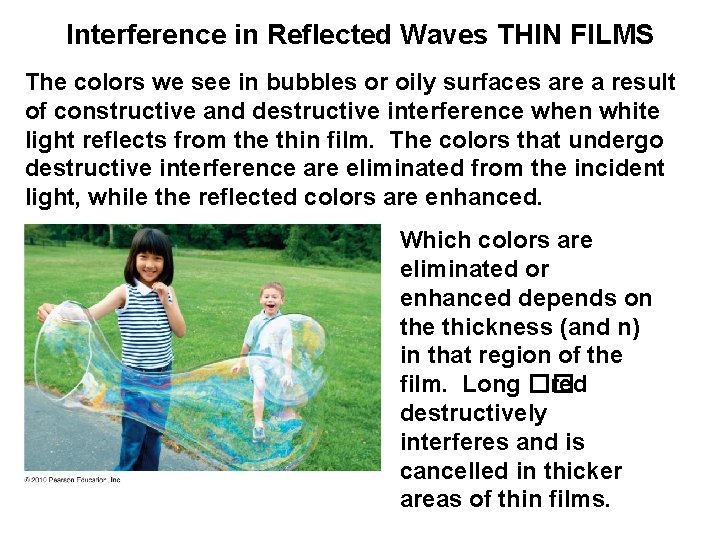
Interference in Reflected Waves THIN FILMS The colors we see in bubbles or oily surfaces are a result of constructive and destructive interference when white light reflects from the thin film. The colors that undergo destructive interference are eliminated from the incident light, while the reflected colors are enhanced. Which colors are eliminated or enhanced depends on the thickness (and n) in that region of the film. Long �� red destructively interferes and is cancelled in thicker areas of thin films.
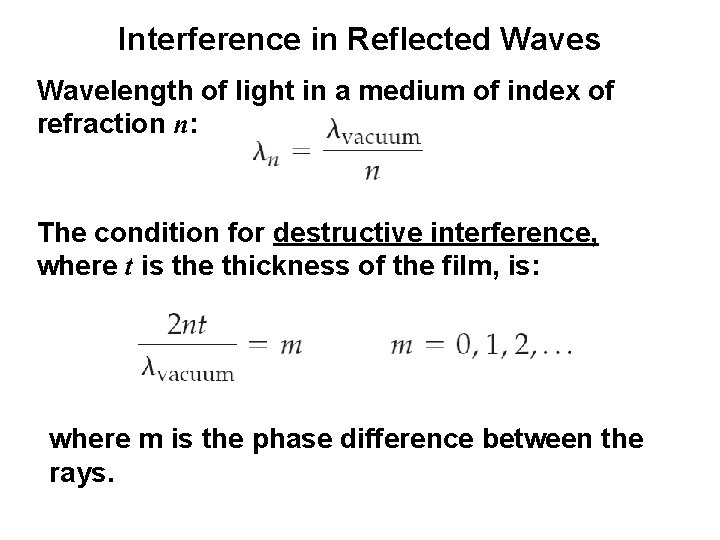
Interference in Reflected Waves Wavelength of light in a medium of index of refraction n: The condition for destructive interference, where t is the thickness of the film, is: where m is the phase difference between the rays.
Interference in Reflected Waves The condition for constructive interference:
Interference in Reflected Waves The phase changes upon reflection in think films depends on the indices of refraction of the film and the surrounding media: Used in non reflective coatings.
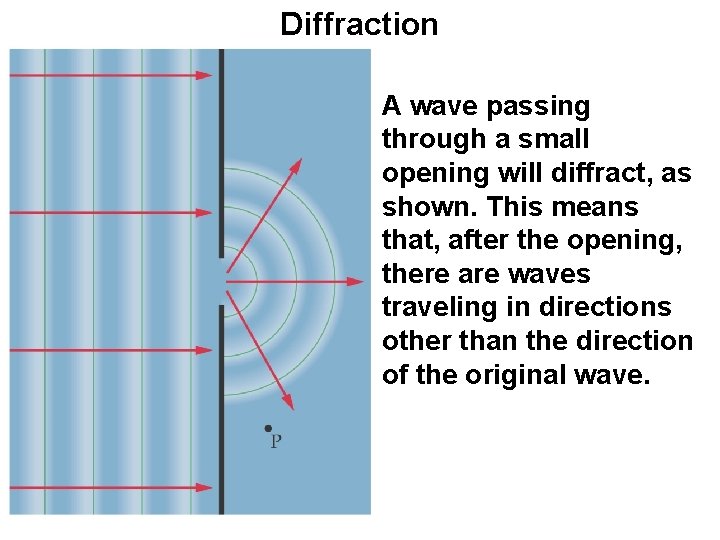
Diffraction A wave passing through a small opening will diffract, as shown. This means that, after the opening, there are waves traveling in directions other than the direction of the original wave.
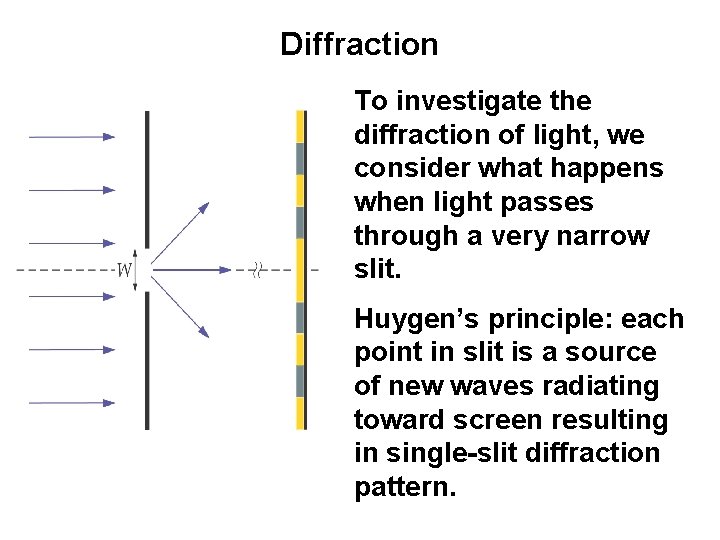
Diffraction To investigate the diffraction of light, we consider what happens when light passes through a very narrow slit. Huygen’s principle: each point in slit is a source of new waves radiating toward screen resulting in single-slit diffraction pattern.
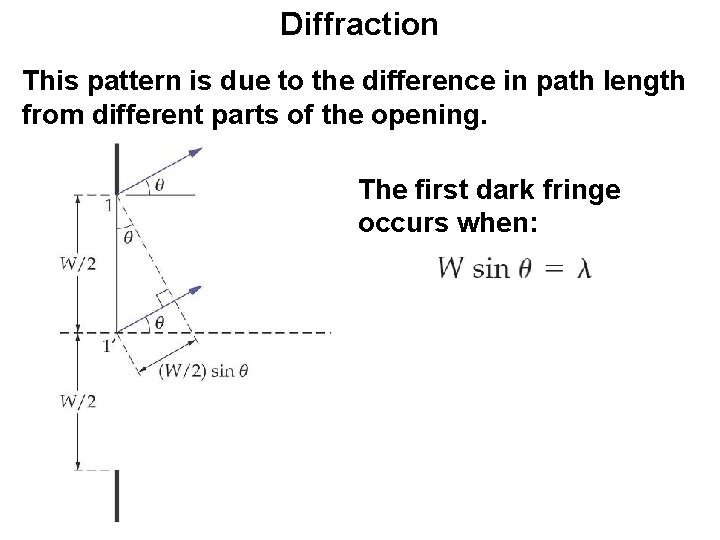
Diffraction This pattern is due to the difference in path length from different parts of the opening. The first dark fringe occurs when:
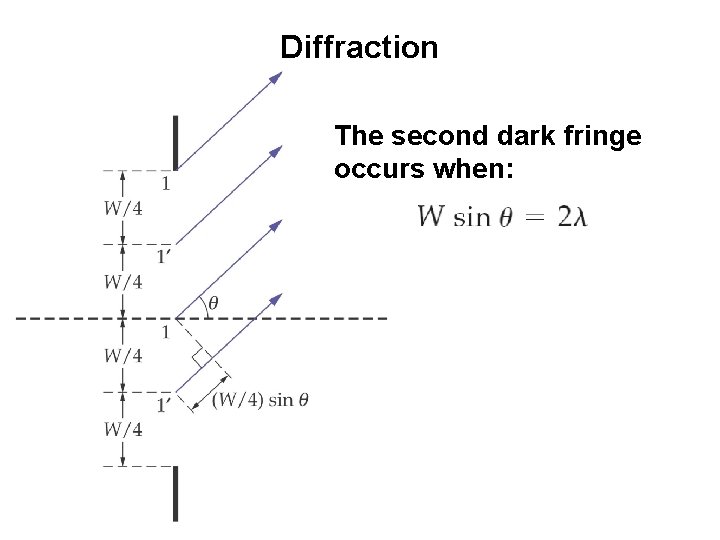
Diffraction The second dark fringe occurs when:
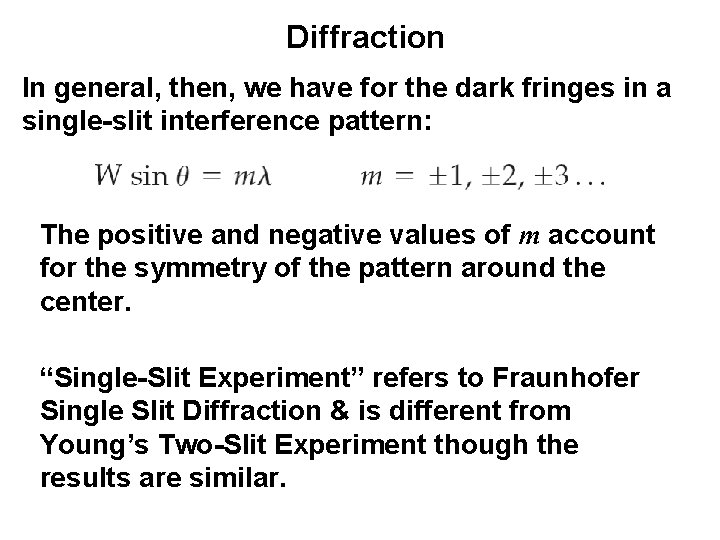
Diffraction In general, then, we have for the dark fringes in a single-slit interference pattern: The positive and negative values of m account for the symmetry of the pattern around the center. “Single-Slit Experiment” refers to Fraunhofer Single Slit Diffraction & is different from Young’s Two-Slit Experiment though the results are similar.
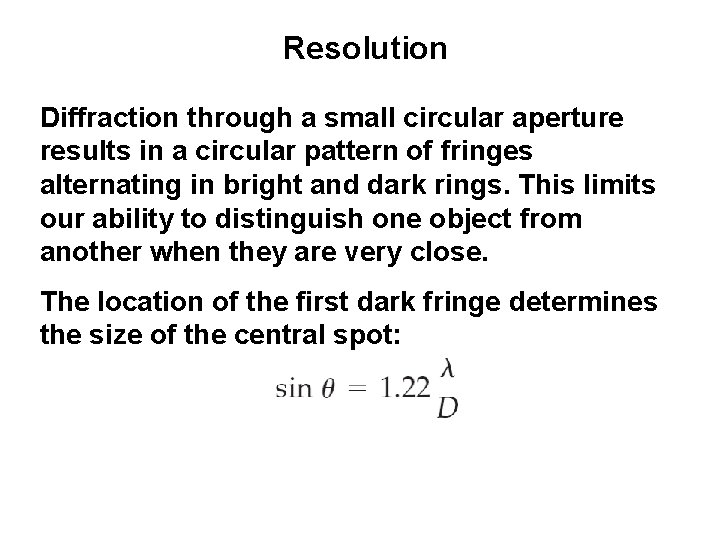
Resolution Diffraction through a small circular aperture results in a circular pattern of fringes alternating in bright and dark rings. This limits our ability to distinguish one object from another when they are very close. The location of the first dark fringe determines the size of the central spot:
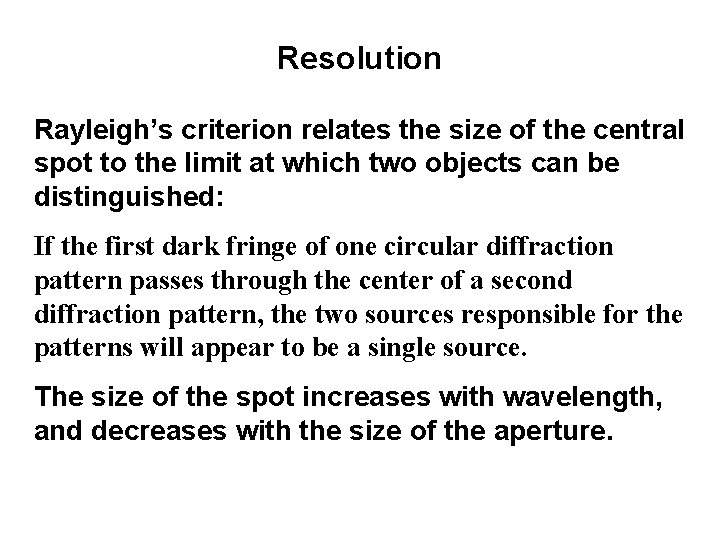
Resolution Rayleigh’s criterion relates the size of the central spot to the limit at which two objects can be distinguished: If the first dark fringe of one circular diffraction pattern passes through the center of a second diffraction pattern, the two sources responsible for the patterns will appear to be a single source. The size of the spot increases with wavelength, and decreases with the size of the aperture.
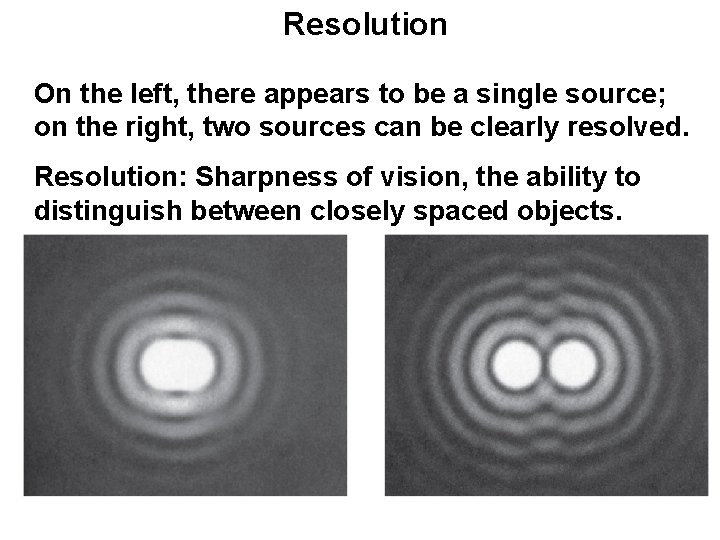
Resolution On the left, there appears to be a single source; on the right, two sources can be clearly resolved. Resolution: Sharpness of vision, the ability to distinguish between closely spaced objects.
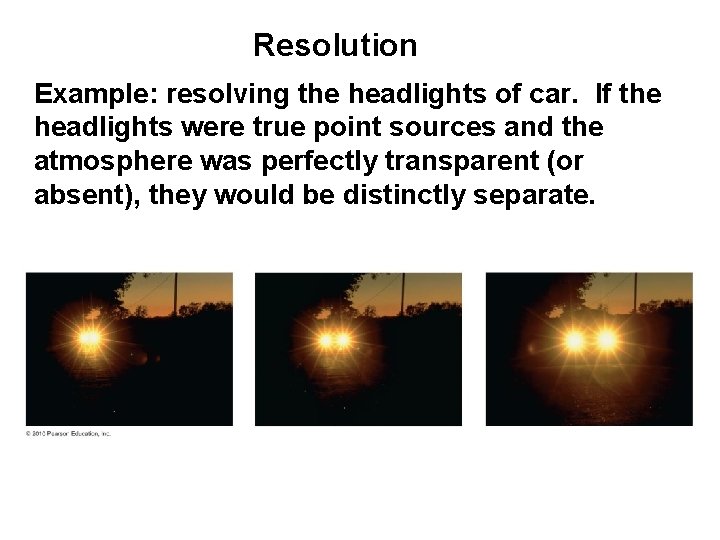
Resolution Example: resolving the headlights of car. If the headlights were true point sources and the atmosphere was perfectly transparent (or absent), they would be distinctly separate.
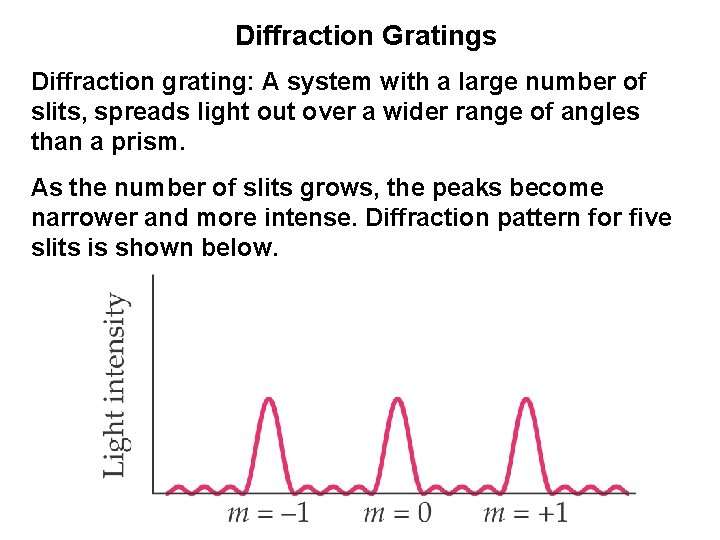
Diffraction Gratings Diffraction grating: A system with a large number of slits, spreads light out over a wider range of angles than a prism. As the number of slits grows, the peaks become narrower and more intense. Diffraction pattern for five slits is shown below.
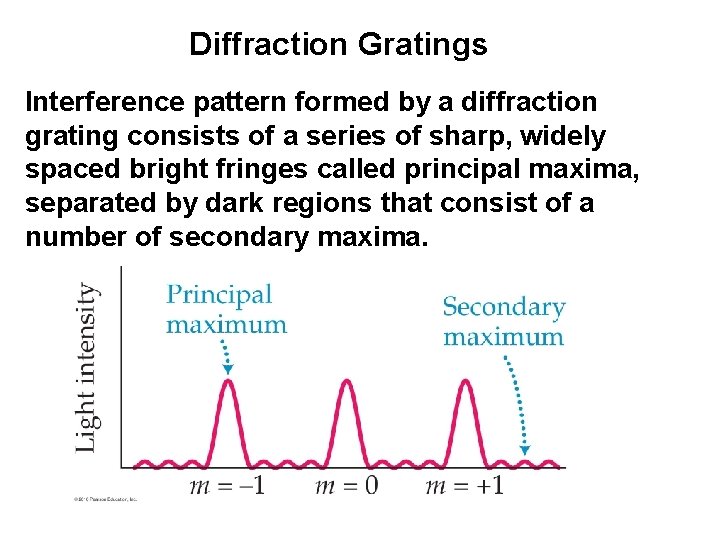
Diffraction Gratings Interference pattern formed by a diffraction grating consists of a series of sharp, widely spaced bright fringes called principal maxima, separated by dark regions that consist of a number of secondary maxima.
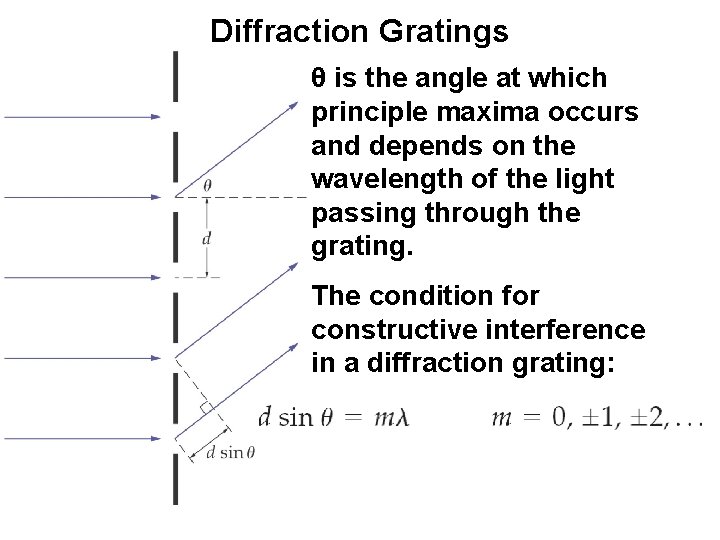
Diffraction Gratings θ is the angle at which principle maxima occurs and depends on the wavelength of the light passing through the grating. The condition for constructive interference in a diffraction grating:
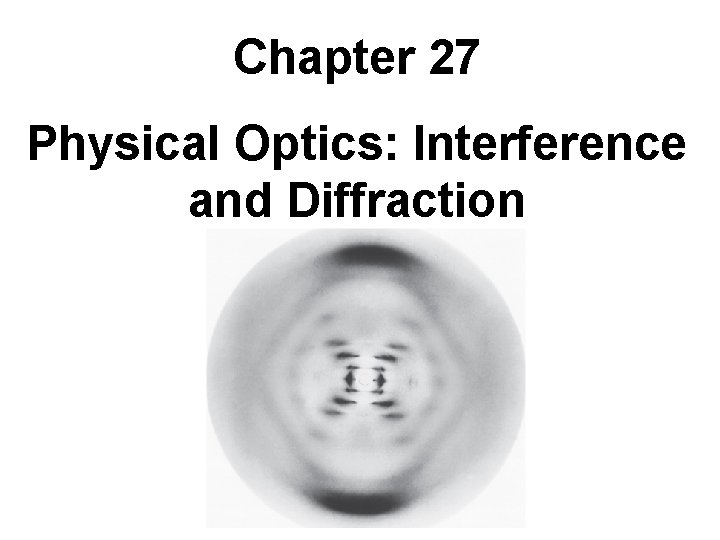
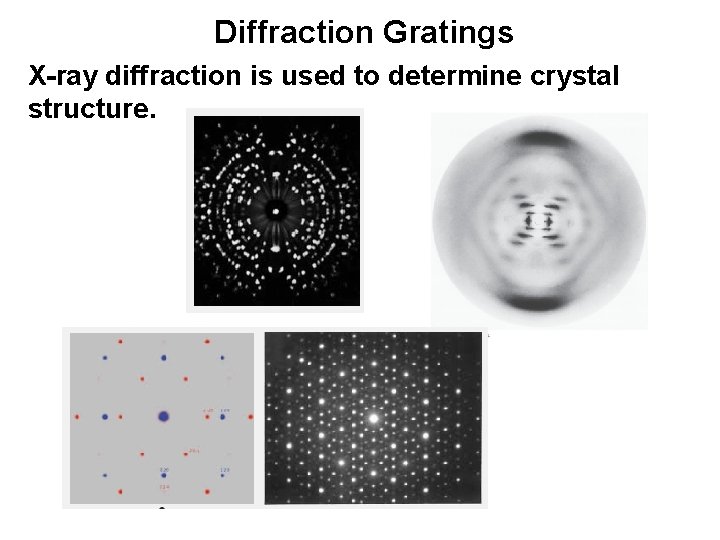
Diffraction Gratings X-ray diffraction is used to determine crystal structure.
Summary of Chapter 27 • When two waves are superposed, the result may be either constructive or destructive interference. • Monochromatic light consists of a single frequency. • Coherent light maintains a constant phase relationship. • Young’s two-slit experiment shows light and dark interference fringes.
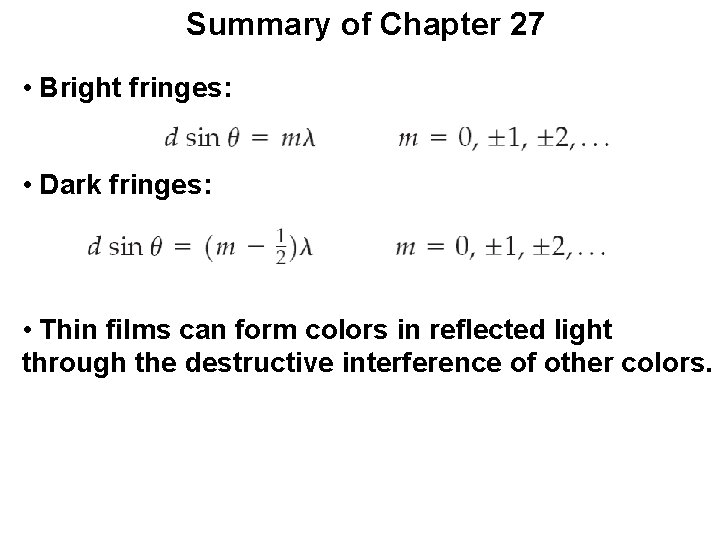
Summary of Chapter 27 • Bright fringes: • Dark fringes: • Thin films can form colors in reflected light through the destructive interference of other colors.
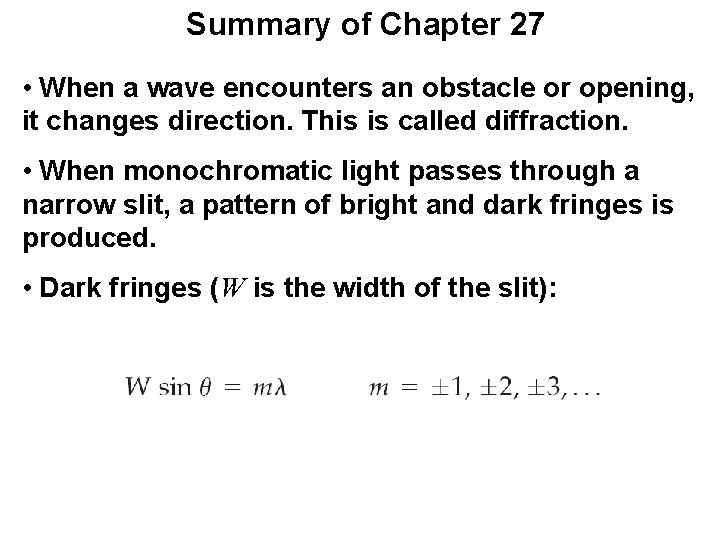
Summary of Chapter 27 • When a wave encounters an obstacle or opening, it changes direction. This is called diffraction. • When monochromatic light passes through a narrow slit, a pattern of bright and dark fringes is produced. • Dark fringes (W is the width of the slit):
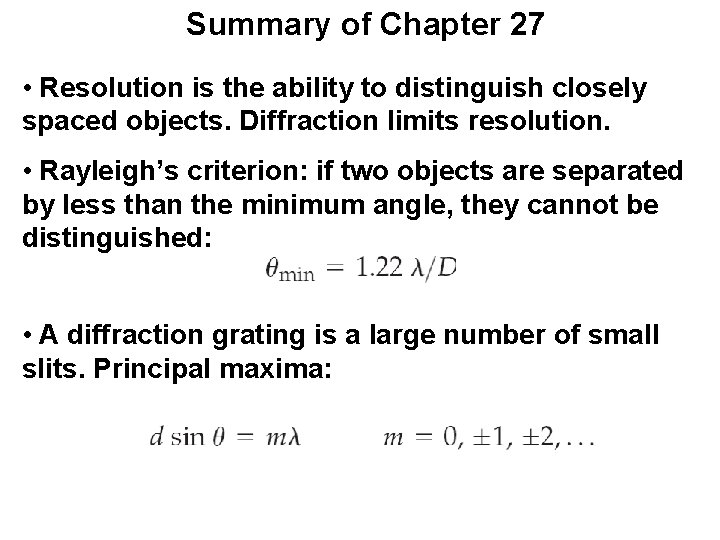
Summary of Chapter 27 • Resolution is the ability to distinguish closely spaced objects. Diffraction limits resolution. • Rayleigh’s criterion: if two objects are separated by less than the minimum angle, they cannot be distinguished: • A diffraction grating is a large number of small slits. Principal maxima: