
Chapter 27 Magnetic Field and Magnetic Forces October
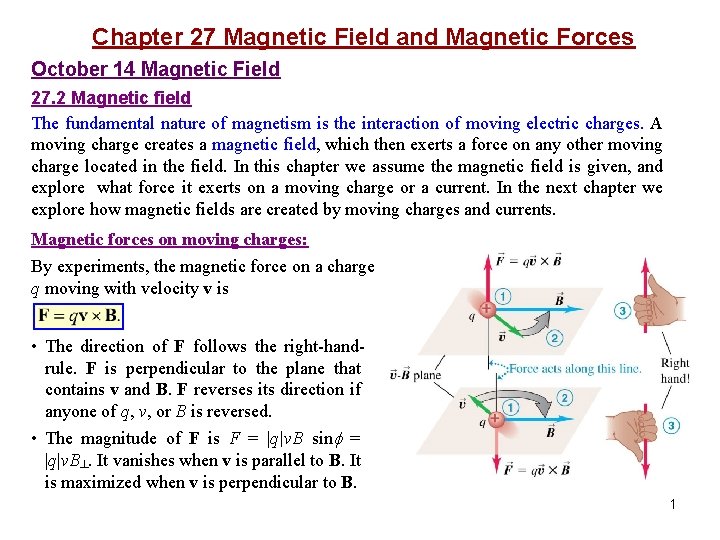
Chapter 27 Magnetic Field and Magnetic Forces October 14 Magnetic Field 27. 2 Magnetic field The fundamental nature of magnetism is the interaction of moving electric charges. A moving charge creates a magnetic field, which then exerts a force on any other moving charge located in the field. In this chapter we assume the magnetic field is given, and explore what force it exerts on a moving charge or a current. In the next chapter we explore how magnetic fields are created by moving charges and currents. Magnetic forces on moving charges: By experiments, the magnetic force on a charge q moving with velocity v is • The direction of F follows the right-handrule. F is perpendicular to the plane that contains v and B. F reverses its direction if anyone of q, v, or B is reversed. • The magnitude of F is F = |q|v. B sinf = |q|v. B┴. It vanishes when v is parallel to B. It is maximized when v is perpendicular to B. 1
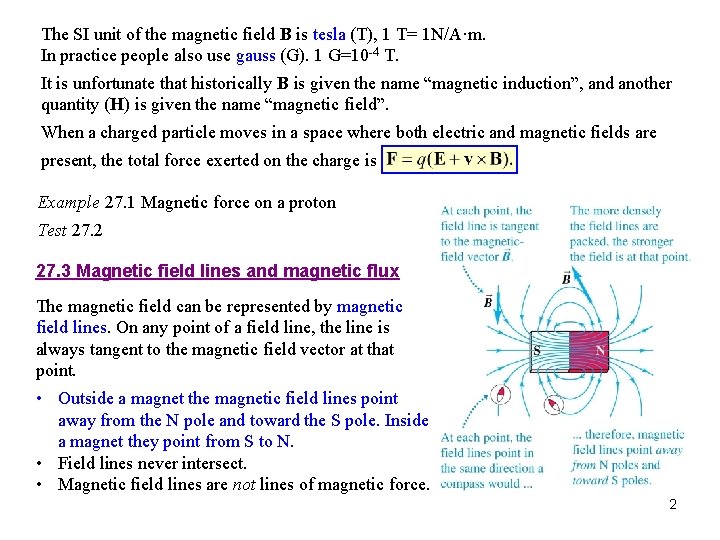
The SI unit of the magnetic field B is tesla (T), 1 T= 1 N/A·m. In practice people also use gauss (G). 1 G=10 -4 T. It is unfortunate that historically B is given the name “magnetic induction”, and another quantity (H) is given the name “magnetic field”. When a charged particle moves in a space where both electric and magnetic fields are present, the total force exerted on the charge is Example 27. 1 Magnetic force on a proton Test 27. 2 27. 3 Magnetic field lines and magnetic flux The magnetic field can be represented by magnetic field lines. On any point of a field line, the line is always tangent to the magnetic field vector at that point. • Outside a magnet the magnetic field lines point away from the N pole and toward the S pole. Inside a magnet they point from S to N. • Field lines never intersect. • Magnetic field lines are not lines of magnetic force. 2
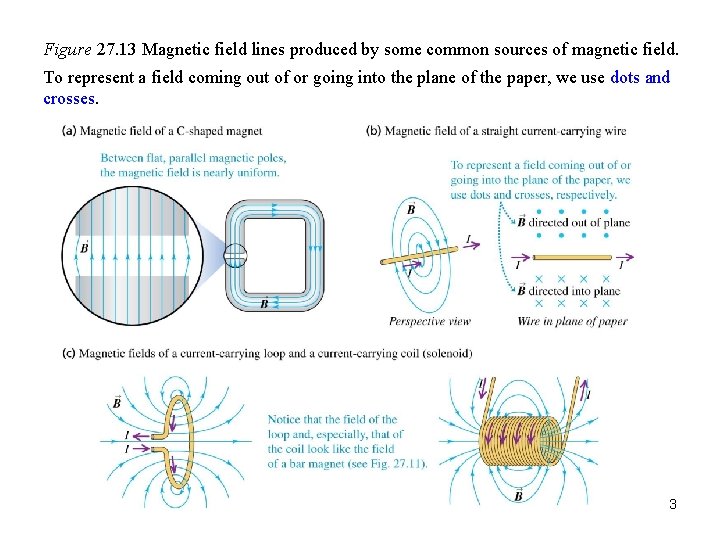
Figure 27. 13 Magnetic field lines produced by some common sources of magnetic field. To represent a field coming out of or going into the plane of the paper, we use dots and crosses. 3
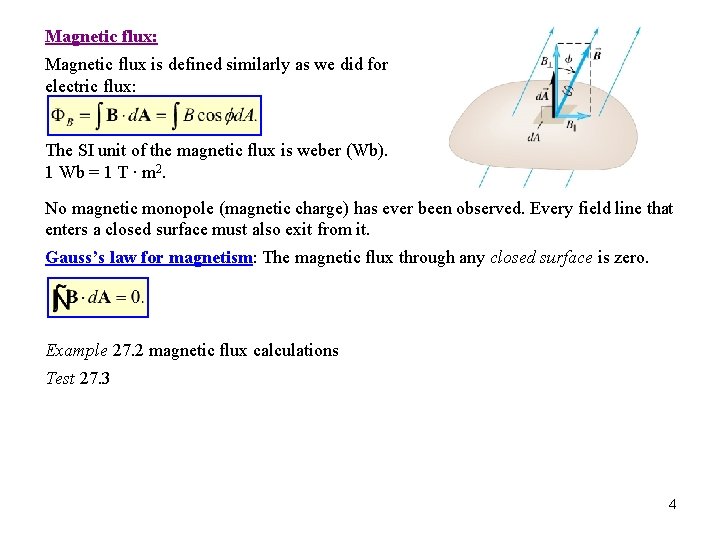
Magnetic flux: Magnetic flux is defined similarly as we did for electric flux: The SI unit of the magnetic flux is weber (Wb). 1 Wb = 1 T ∙ m 2. No magnetic monopole (magnetic charge) has ever been observed. Every field line that enters a closed surface must also exit from it. Gauss’s law for magnetism: The magnetic flux through any closed surface is zero. Example 27. 2 magnetic flux calculations Test 27. 3 4
Read: Ch 27: 1 -3 Homework: Ch 27: 3, 8, 11, 13 Due: October 23 5
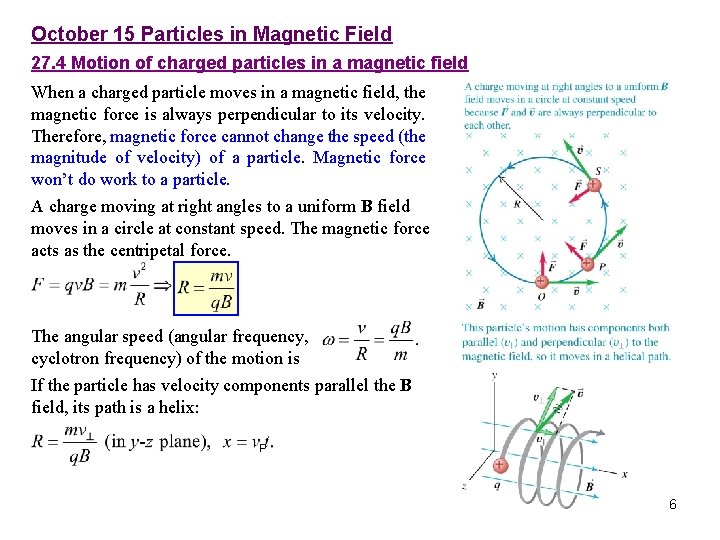
October 15 Particles in Magnetic Field 27. 4 Motion of charged particles in a magnetic field When a charged particle moves in a magnetic field, the magnetic force is always perpendicular to its velocity. Therefore, magnetic force cannot change the speed (the magnitude of velocity) of a particle. Magnetic force won’t do work to a particle. A charge moving at right angles to a uniform B field moves in a circle at constant speed. The magnetic force acts as the centripetal force. The angular speed (angular frequency, cyclotron frequency) of the motion is If the particle has velocity components parallel the B field, its path is a helix: 6
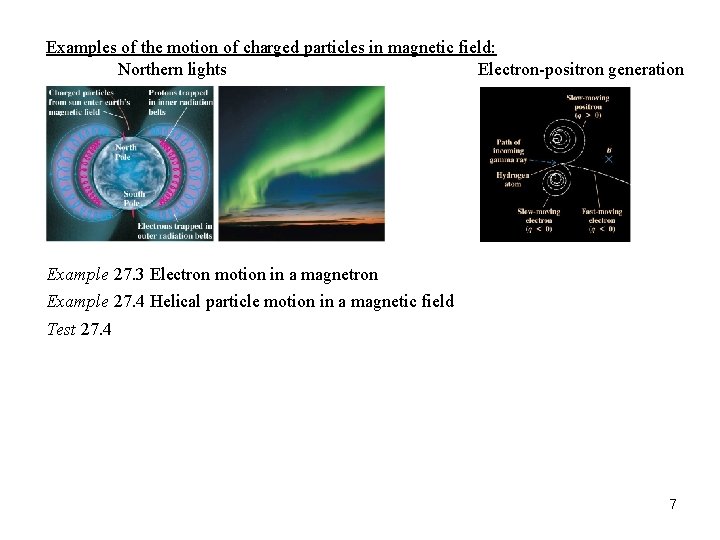
Examples of the motion of charged particles in magnetic field: Northern lights Electron-positron generation Example 27. 3 Electron motion in a magnetron Example 27. 4 Helical particle motion in a magnetic field Test 27. 4 7
Read: Ch 27: 4 Homework: Ch 27: 18, 21, 26 Due: October 23 8
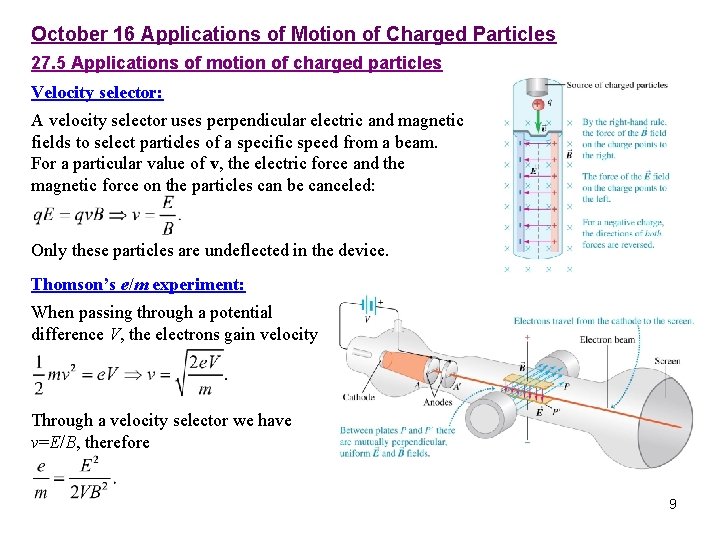
October 16 Applications of Motion of Charged Particles 27. 5 Applications of motion of charged particles Velocity selector: A velocity selector uses perpendicular electric and magnetic fields to select particles of a specific speed from a beam. For a particular value of v, the electric force and the magnetic force on the particles can be canceled: Only these particles are undeflected in the device. Thomson’s e/m experiment: When passing through a potential difference V, the electrons gain velocity Through a velocity selector we have v=E/B, therefore 9
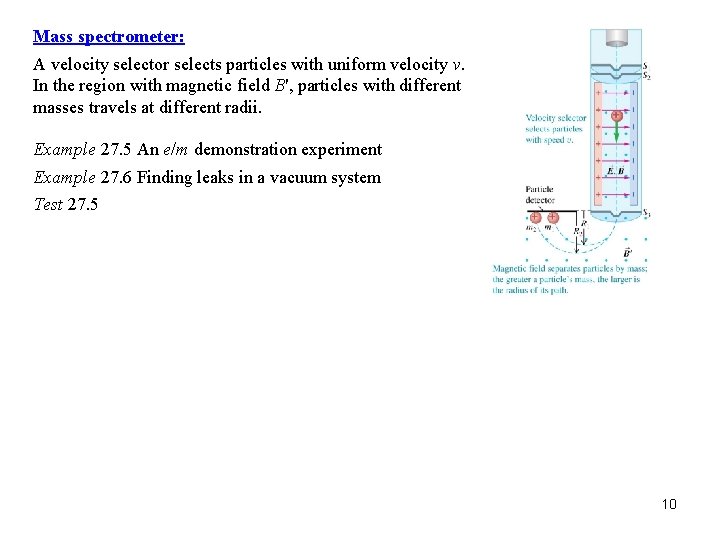
Mass spectrometer: A velocity selector selects particles with uniform velocity v. In the region with magnetic field B', particles with different masses travels at different radii. Example 27. 5 An e/m demonstration experiment Example 27. 6 Finding leaks in a vacuum system Test 27. 5 10
Read: Ch 27: 5 Homework: Ch 27: 28, 29, 31 Due: October 23 11
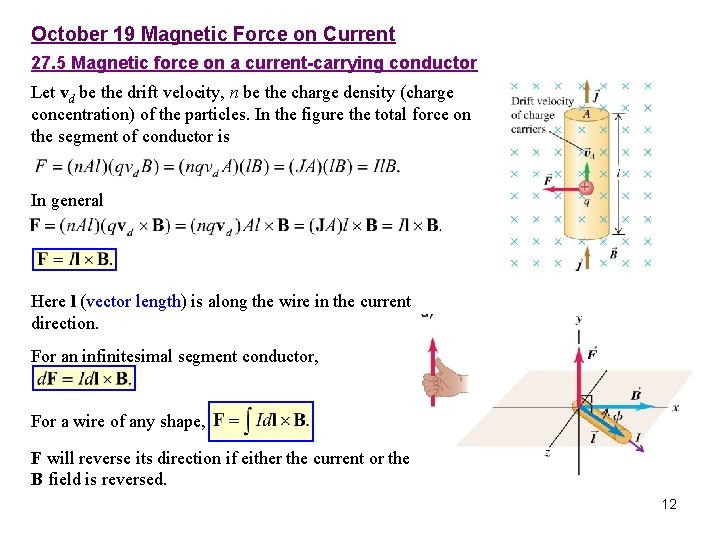
October 19 Magnetic Force on Current 27. 5 Magnetic force on a current-carrying conductor Let vd be the drift velocity, n be the charge density (charge concentration) of the particles. In the figure the total force on the segment of conductor is In general Here l (vector length) is along the wire in the current direction. For an infinitesimal segment conductor, For a wire of any shape, F will reverse its direction if either the current or the B field is reversed. 12
Example 27. 7 Magnetic force on a straight conductor Example 27. 8 Magnetic force on a curved conductor Test 27. 6 13
Read: Ch 27: 6 Homework: Ch 27: 36, 38, 39 Due: October 30 14
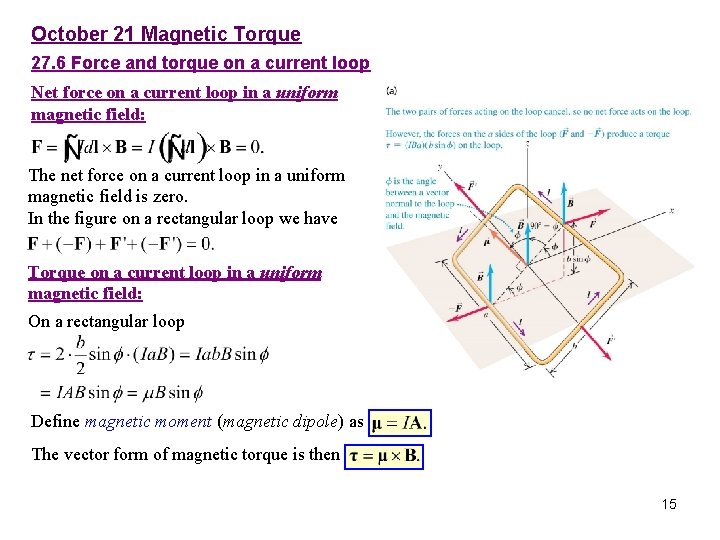
October 21 Magnetic Torque 27. 6 Force and torque on a current loop Net force on a current loop in a uniform magnetic field: The net force on a current loop in a uniform magnetic field is zero. In the figure on a rectangular loop we have Torque on a current loop in a uniform magnetic field: On a rectangular loop Define magnetic moment (magnetic dipole) as The vector form of magnetic torque is then 15
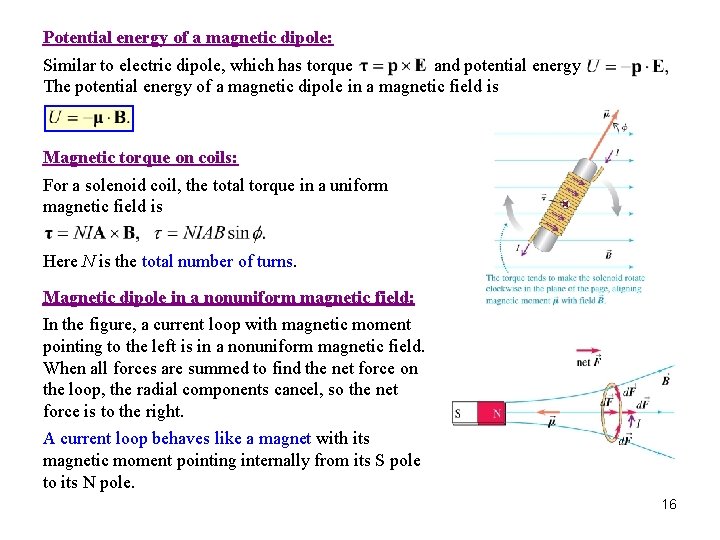
Potential energy of a magnetic dipole: Similar to electric dipole, which has torque and potential energy The potential energy of a magnetic dipole in a magnetic field is Magnetic torque on coils: For a solenoid coil, the total torque in a uniform magnetic field is Here N is the total number of turns. Magnetic dipole in a nonuniform magnetic field: In the figure, a current loop with magnetic moment pointing to the left is in a nonuniform magnetic field. When all forces are summed to find the net force on the loop, the radial components cancel, so the net force is to the right. A current loop behaves like a magnet with its magnetic moment pointing internally from its S pole to its N pole. 16
Example 27. 9 Magnetic torque on a circular coil Confirms that a current loop behaves like a magnet. In a uniform magnetic field it only turns. Example 27. 10 Potential energy for a coil in a magnetic field Test 27. 7 17
Read: Ch 27: 7 -9 Homework: Ch 27: 40, 42, 45 Due: October 30 18
- Slides: 18