
Chapter 27 Energy and Disorder Why Reactions Occur
- Slides: 38
Chapter 27 Energy and Disorder
Why Reactions Occur • • Exothermic Rxns - Take place spontaneously – Go from high energy to low energy • “Downhill” Endothermic Rxns. - Not usually spontaneous – Go from low energy to high energy • “Uphill”
Why Reactions Occur Natural Processes tend to: 1. Go from a state of high energy to a state of lower energy 2. Go from an orderly state to a disorderly state • There are some exceptions to this general rule. •
Why Reactions Occur • • Unless otherwise stated, rxns. will take place @ constant temp. & constant pressure. Isothermal Processes - rxns. taking place @ constant temp. Isobaric Processes - rxns. taking place @ constant press. Themodynamics - studies concerning the flow of energy
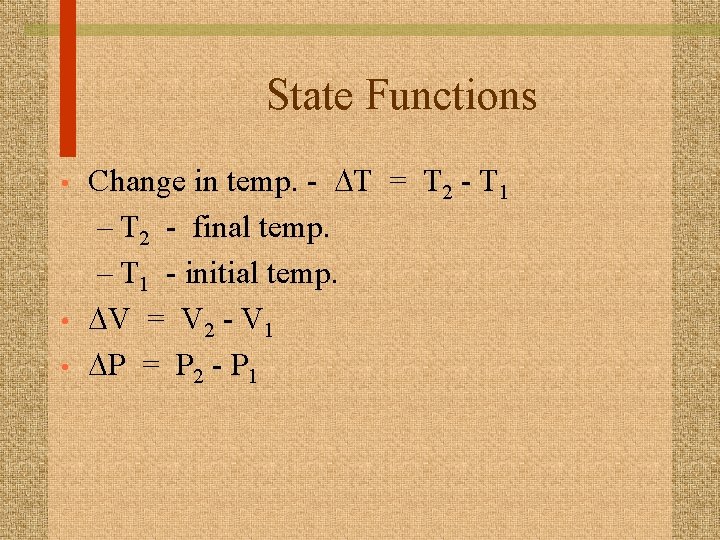
State Functions • • • Change in temp. - DT = T 2 - T 1 – T 2 - final temp. – T 1 - initial temp. DV = V 2 - V 1 DP = P 2 - P 1
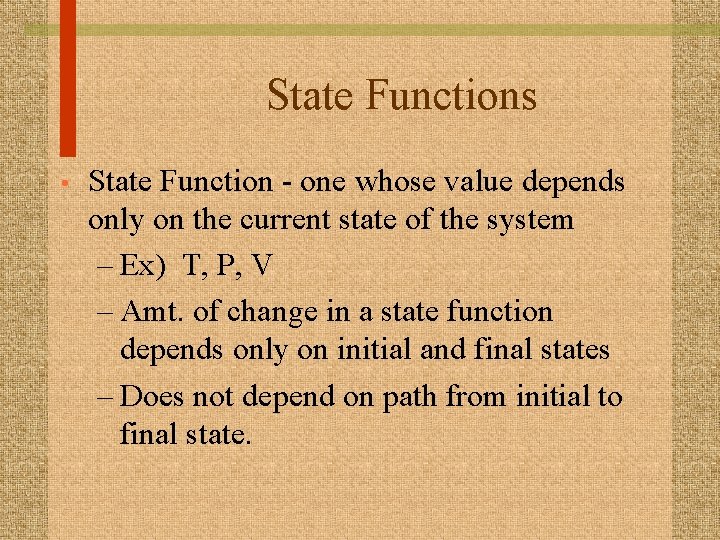
State Functions • State Function - one whose value depends only on the current state of the system – Ex) T, P, V – Amt. of change in a state function depends only on initial and final states – Does not depend on path from initial to final state.
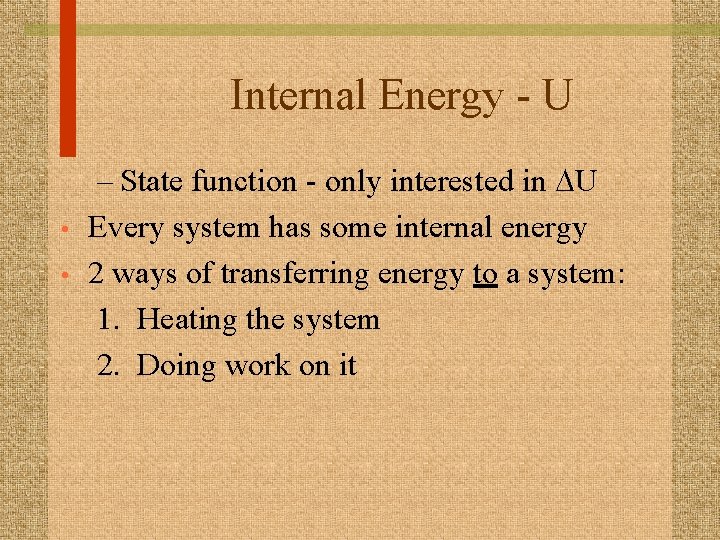
Internal Energy - U • • – State function - only interested in DU Every system has some internal energy 2 ways of transferring energy to a system: 1. Heating the system 2. Doing work on it
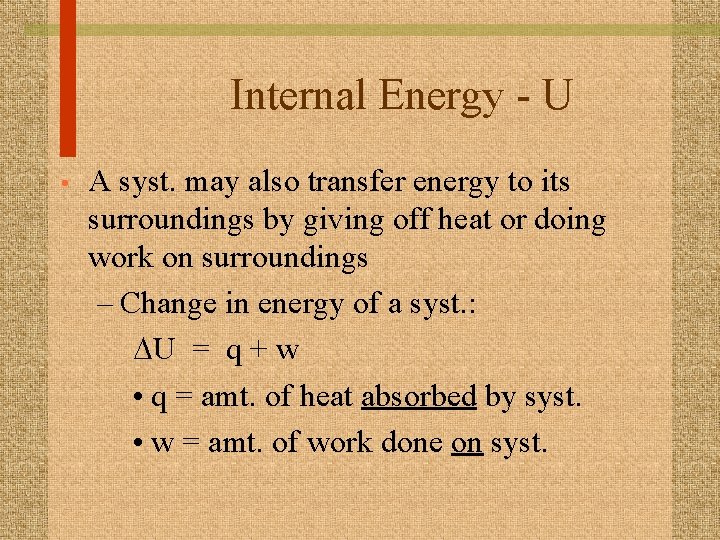
Internal Energy - U • A syst. may also transfer energy to its surroundings by giving off heat or doing work on surroundings – Change in energy of a syst. : DU = q + w • q = amt. of heat absorbed by syst. • w = amt. of work done on syst.
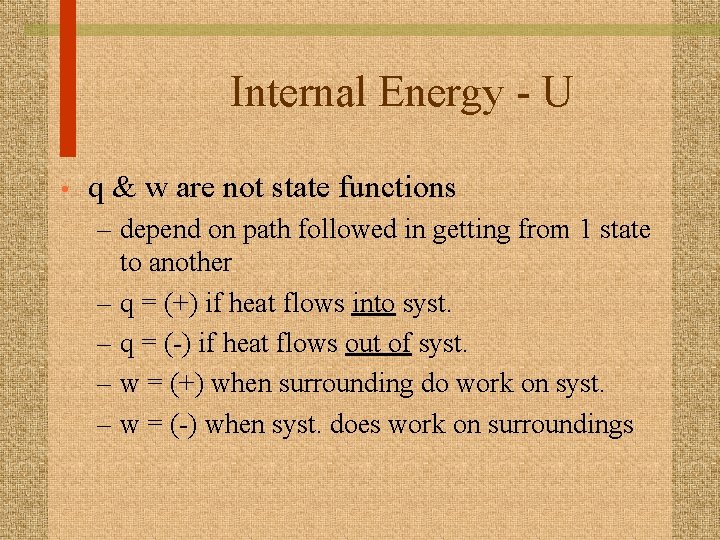
Internal Energy - U • q & w are not state functions – depend on path followed in getting from 1 state to another – q = (+) if heat flows into syst. – q = (-) if heat flows out of syst. – w = (+) when surrounding do work on syst. – w = (-) when syst. does work on surroundings
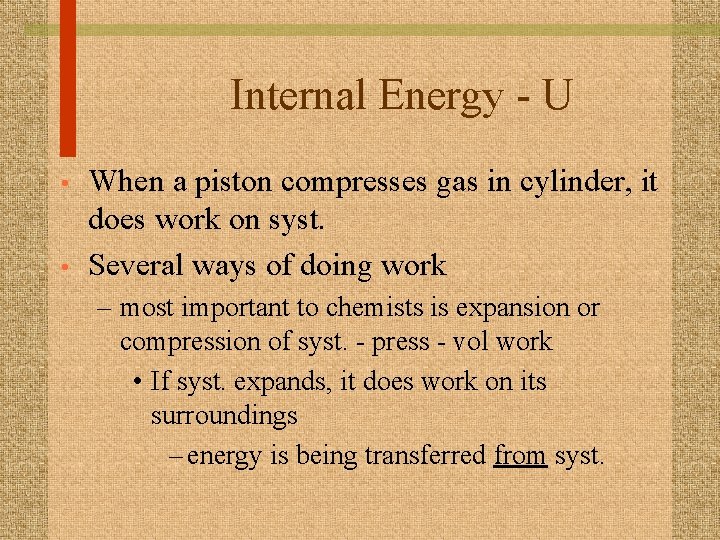
Internal Energy - U • • When a piston compresses gas in cylinder, it does work on syst. Several ways of doing work – most important to chemists is expansion or compression of syst. - press - vol work • If syst. expands, it does work on its surroundings – energy is being transferred from syst.
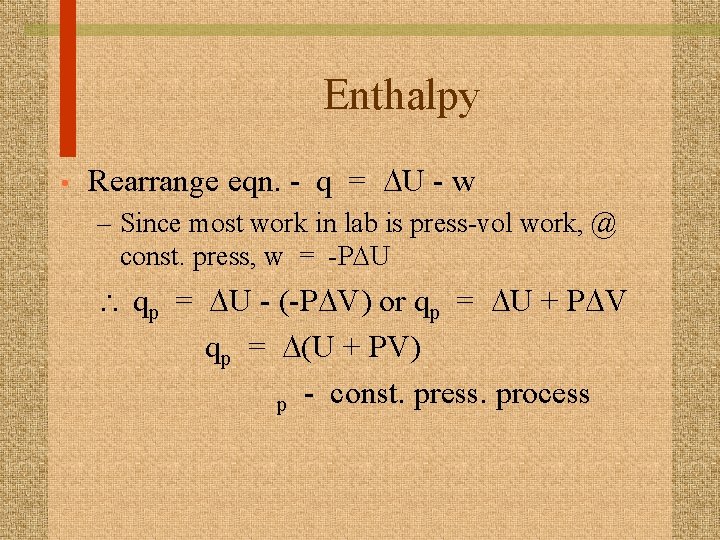
Enthalpy • Rearrange eqn. - q = DU - w – Since most work in lab is press-vol work, @ const. press, w = -PDU qp = DU - (-PDV) or qp = DU + PDV qp = D(U + PV) p - const. press. process
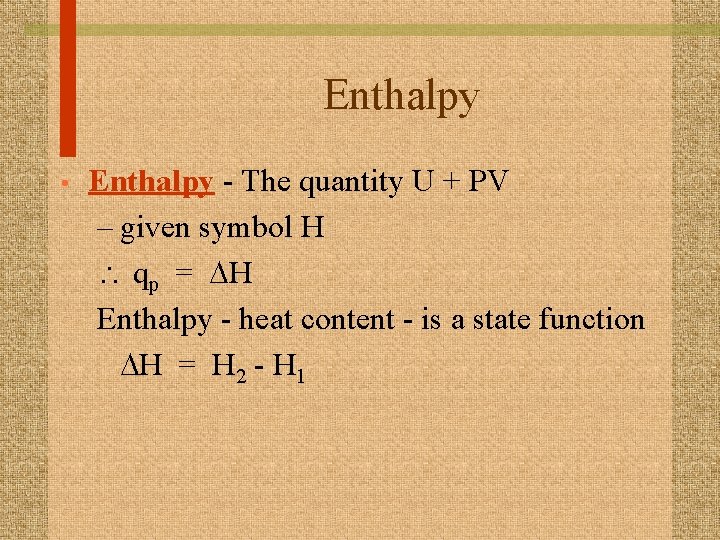
Enthalpy • Enthalpy - The quantity U + PV – given symbol H qp = DH Enthalpy - heat content - is a state function DH = H 2 - H 1
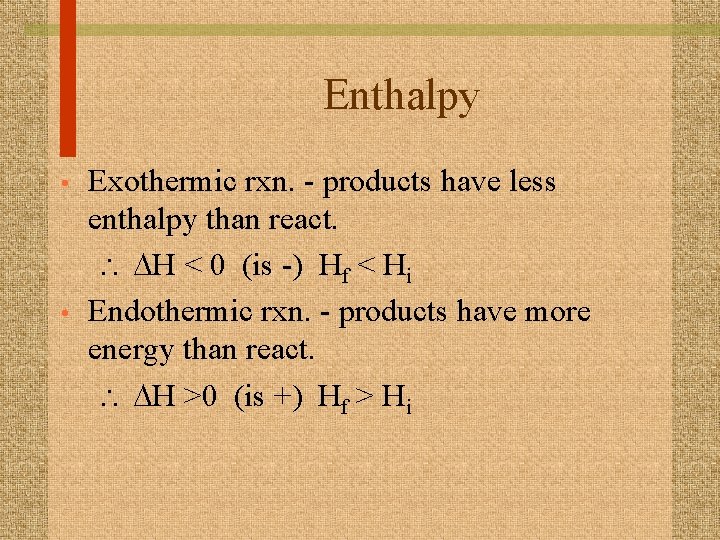
Enthalpy • • Exothermic rxn. - products have less enthalpy than react. DH < 0 (is -) Hf < Hi Endothermic rxn. - products have more energy than react. DH >0 (is +) Hf > Hi
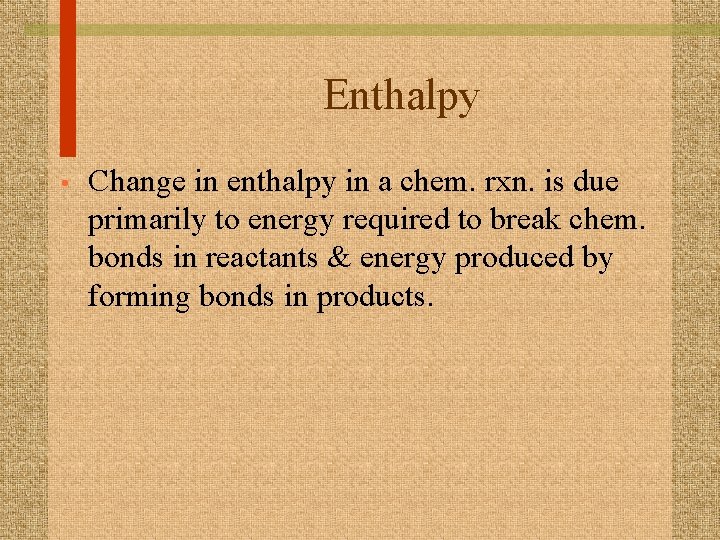
Enthalpy • Change in enthalpy in a chem. rxn. is due primarily to energy required to break chem. bonds in reactants & energy produced by forming bonds in products.
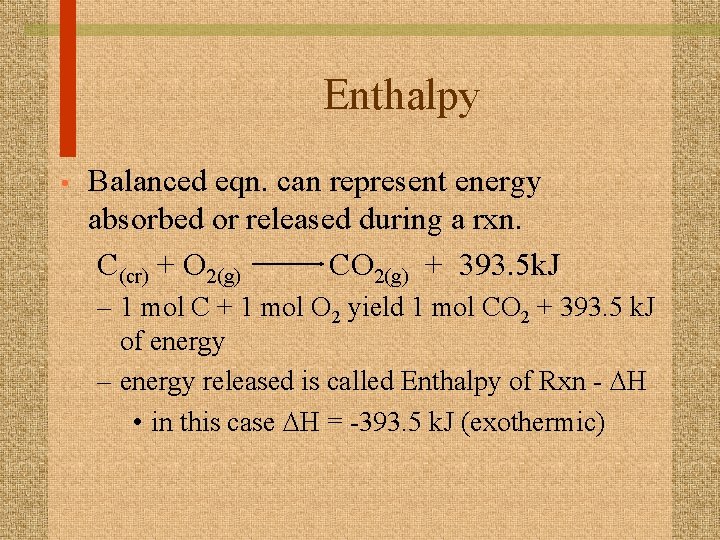
Enthalpy • Balanced eqn. can represent energy absorbed or released during a rxn. C(cr) + O 2(g) CO 2(g) + 393. 5 k. J – 1 mol C + 1 mol O 2 yield 1 mol CO 2 + 393. 5 k. J of energy – energy released is called Enthalpy of Rxn - DH • in this case DH = -393. 5 k. J (exothermic)
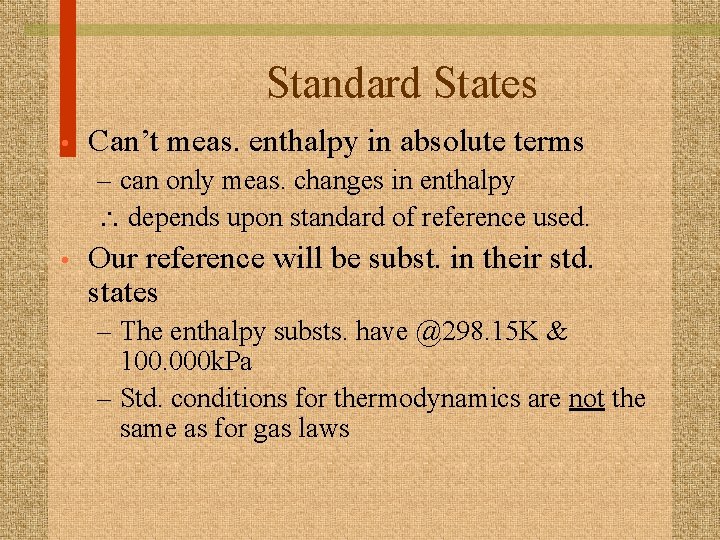
Standard States • Can’t meas. enthalpy in absolute terms – can only meas. changes in enthalpy depends upon standard of reference used. • Our reference will be subst. in their std. states – The enthalpy substs. have @298. 15 K & 100. 000 k. Pa – Std. conditions for thermodynamics are not the same as for gas laws
Standard States • • A change in either temp. or press. can affect enthalpy of a subst. In measuring enthalpy, the enthalpy of free elements are arbitrarily set = to 0
Enthalpy of Formation • The change in enthalpy when 1 mole of a compound is produced from the free elements in their std. states – In: C + O 2 CO 2 + energy – C & O 2 have enthalpies of zero Std. molar enthalpy of form. for CO 2 is -393. 5 k. J/mol (-) - exothermic rxn. DHf is (-) Comps. w/ (+) DHf - endothermic
Enthalpy of Formation • • Comps. w/ large (-) enthalpies of formation are thermodynamically stable Thermodynamic Stability - depends on amt. of energy required to decompose the comp. – 1 mole CO 2 would need 393. 5 k. J to decompose it.
Enthalpy of Formation • Hg(OCN)2 produces 268 k. J when 1 mole decomposes – has (+) enthalpy of formation - explosive – DHfo - enthalpy of formation • o indicates values are at 100. 00 k. Pa & 25 o. C • f - formation
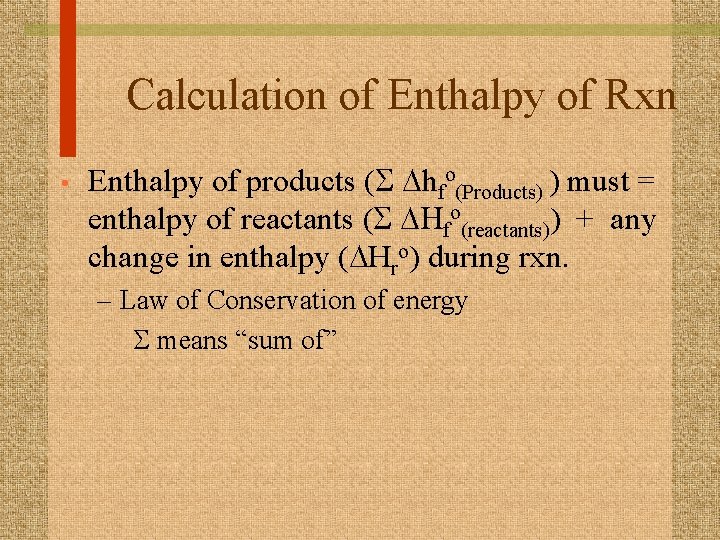
Calculation of Enthalpy of Rxn • Enthalpy of products (S Dhfo(Products) ) must = enthalpy of reactants (S DHfo(reactants)) + any change in enthalpy (DHro) during rxn. – Law of Conservation of energy S means “sum of”
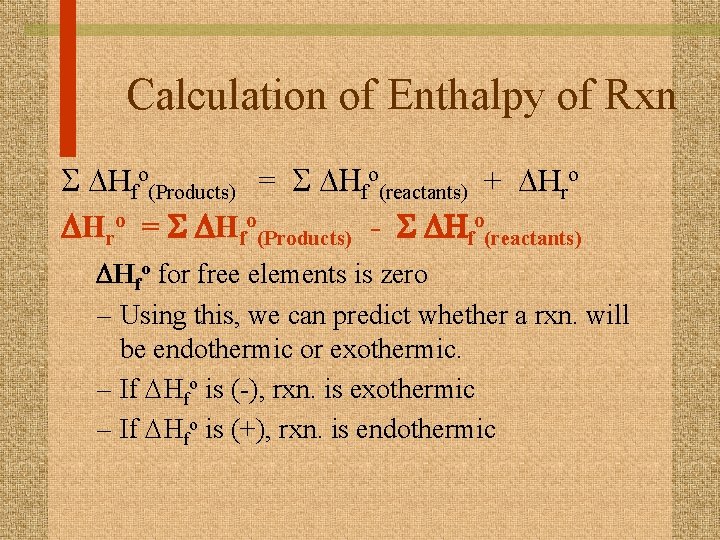
Calculation of Enthalpy of Rxn S DHfo(Products) = S DHfo(reactants) + DHro = S DHfo(Products) - S DHfo(reactants) DHfo for free elements is zero – Using this, we can predict whether a rxn. will be endothermic or exothermic. – If DHfo is (-), rxn. is exothermic – If DHfo is (+), rxn. is endothermic
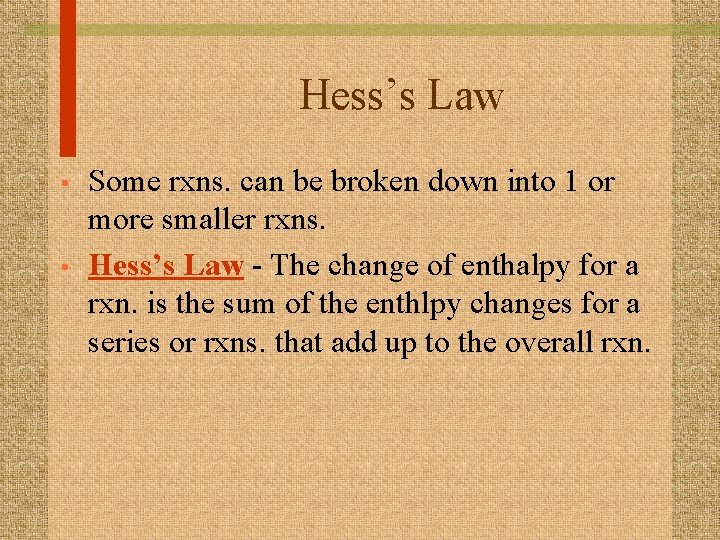
Hess’s Law • • Some rxns. can be broken down into 1 or more smaller rxns. Hess’s Law - The change of enthalpy for a rxn. is the sum of the enthlpy changes for a series or rxns. that add up to the overall rxn.
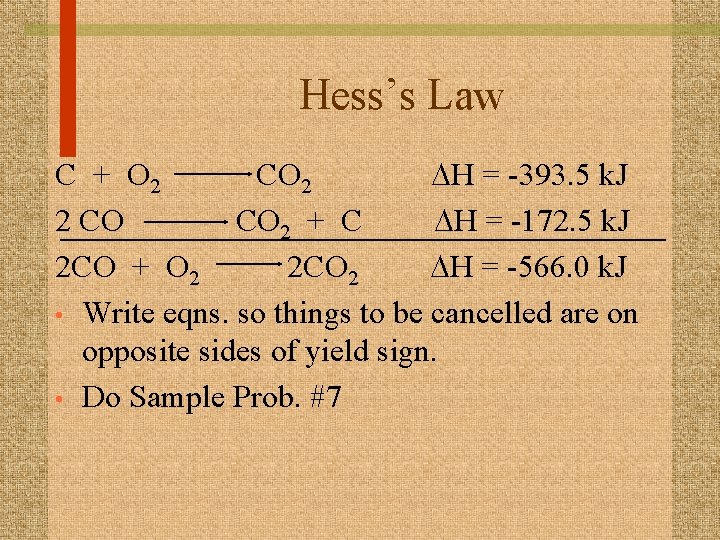
Hess’s Law C + O 2 CO 2 DH = -393. 5 k. J 2 CO CO 2 + C DH = -172. 5 k. J 2 CO + O 2 2 CO 2 DH = -566. 0 k. J • Write eqns. so things to be cancelled are on opposite sides of yield sign. • Do Sample Prob. #7
Entropy • Highly exothermic rxns. go spontaneously – Weak exo. & endothermic rxns. may also be spontaneous • May proceed under strong rxn. conditions – ie. temp. incr.
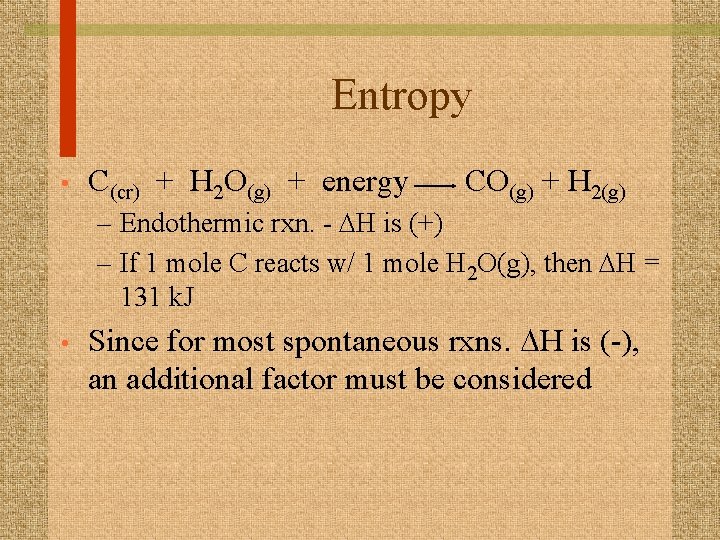
Entropy • C(cr) + H 2 O(g) + energy CO(g) + H 2(g) – Endothermic rxn. - DH is (+) – If 1 mole C reacts w/ 1 mole H 2 O(g), then DH = 131 k. J • Since for most spontaneous rxns. DH is (-), an additional factor must be considered
Entropy • Entropy - degree of disorder - S – Crystalline solids - very orderly arrangement – liquids - somewhat less ordered – gases - no order – high temp. has less order than low temp. • Change in Entropy - DS - state function
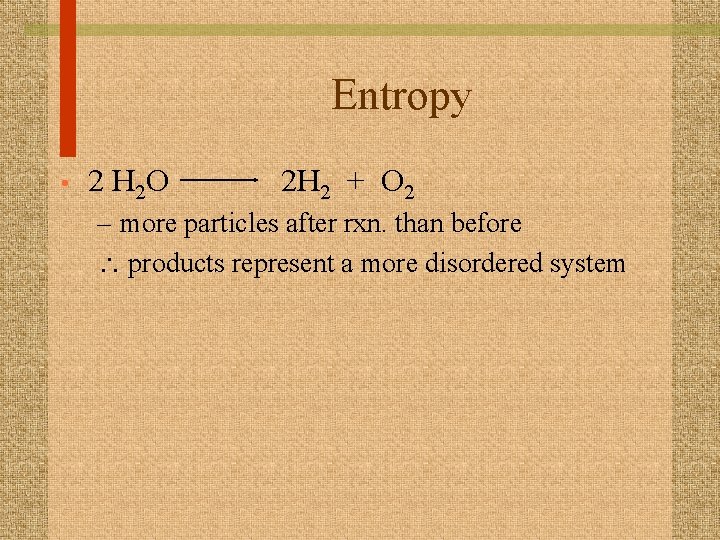
Entropy • 2 H 2 O 2 H 2 + O 2 – more particles after rxn. than before products represent a more disordered system
Entropy • • • Systems in which the molecs. are far apart are more disordered than those w/ particles close together. 2 liquids dissolved in ea. other make a more disordered syst. than 2 separate liquids. When an obj. is heated, molec. motion incr. & entropy is increased.
Entropy • (+) DS means incr. in degree of disorder – syst. becomes less ordered – ex) a solid is converted to liquid or gas – If opposite occurs (liquid or gas solid) DS is (-)
Gibbs Free Energy • • If a rxn. is exothermic, but involves an incr. in order, it may or may not occur. An endothermic rxn. that produces disorder may or may not occur. – In both cases, either the enthalpy chg (-DH) or entropy change (+DS) would make the rxns. spontaneous while the other quantity would prevent the rxns.
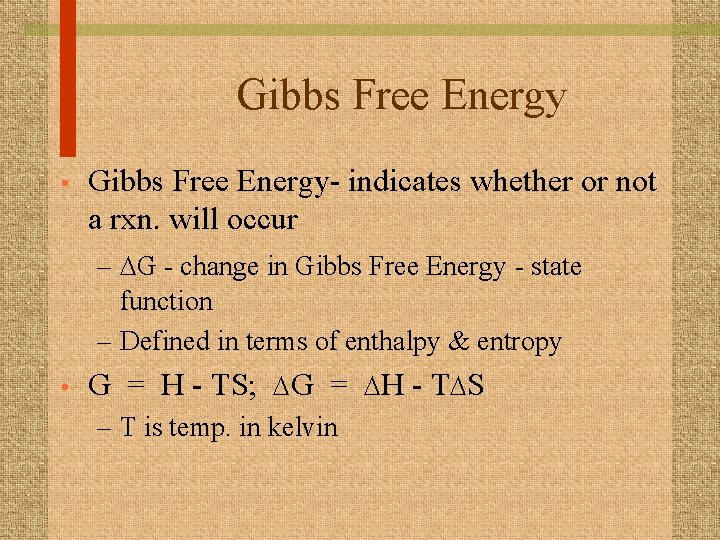
Gibbs Free Energy • Gibbs Free Energy- indicates whether or not a rxn. will occur – DG - change in Gibbs Free Energy - state function – Defined in terms of enthalpy & entropy • G = H - TS; DG = DH - TDS – T is temp. in kelvin
Gibbs Free Energy • • In a spontaneous rxn. , DG is always (-) – Exergonic - spontaneous rxn. DG < 0, (-) – Endergonic - nonspontaneous rxn. DG >0, (+) If a rxn. takes place @ low temp. & has little change in entropy, TDS is negligible DG is mostly a function of DH
Gibbs Free Energy most spontaneous rxns. @ room temp. have a (-) DH – Highly endothermic rxns. occur only if TDS is large. • Either if temp. is high or there’s a large incr. in entropy.
Gibbs Free Energy • If DH & DS have same sign, there’s some temp. @ which DH - TDS will = 0 DG = 0 – This state is thermodynamic def. of a system in equilibrium • @ equilib. , G is @ a minimum for the syst.
Gibbs Free Energy (Summary) • • • If DG is (-), rxn. is spontaneous If DG is (+)m rxn. is not spontaneous If DG = 0, rxn. is @ equilibrium Changes in nature tend toward low energy state (lg (-) DH) and a state of high randomness (lg. (+) DS) All spontaneous rxns. proceed towrd equilib. G - free energy- chemical potential energy is least when syst. is @ equilib.
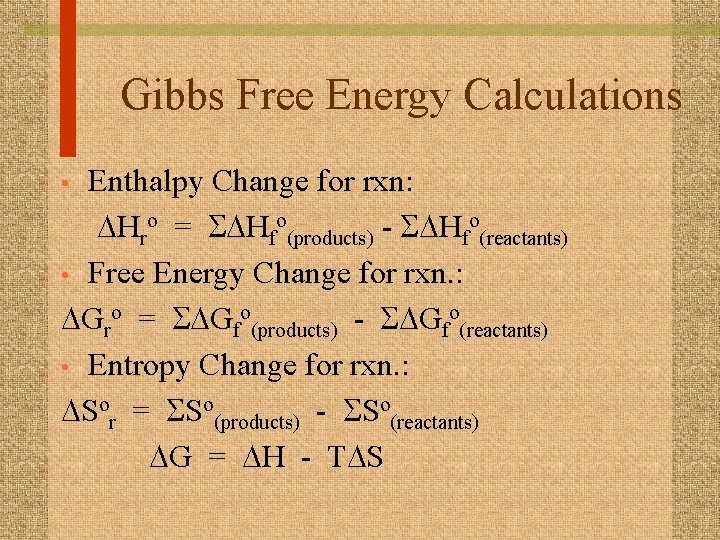
Gibbs Free Energy Calculations Enthalpy Change for rxn: DHro = SDHfo(products) - SDHfo(reactants) • Free Energy Change for rxn. : DGro = SDGfo(products) - SDGfo(reactants) • Entropy Change for rxn. : DSor = SSo(products) - SSo(reactants) DG = DH - TDS •
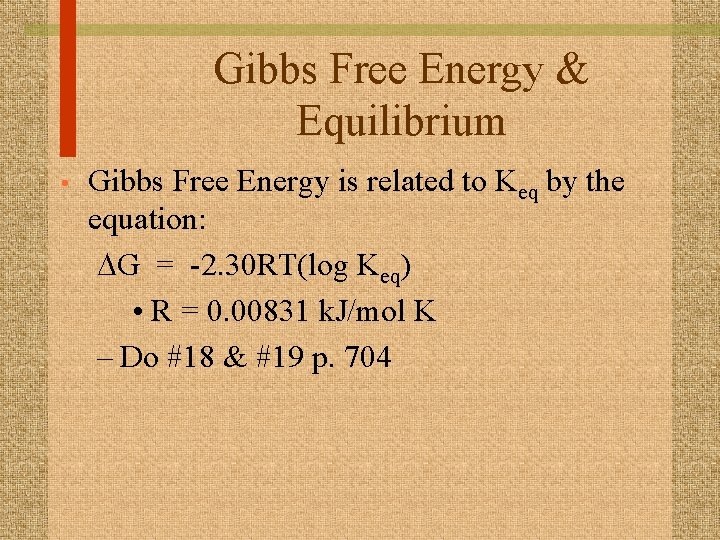
Gibbs Free Energy & Equilibrium • Gibbs Free Energy is related to Keq by the equation: DG = -2. 30 RT(log Keq) • R = 0. 00831 k. J/mol K – Do #18 & #19 p. 704