
Chapter 27 Client Safety 1 Safety in Health
![Risks in Health Care Agencies �Chemical use (Material Safety Data Sheets [MSDSs]) �Medical errors](https://slidetodoc.com/presentation_image_h/002e7eae3f6cd2f83d6a2eab8f602727/image-16.jpg "Risks in Health Care Agencies �Chemical use (Material Safety Data Sheets [MSDSs]) �Medical errors")
- Slides: 34
Chapter 27 Client Safety 1
Safety in Health Care Organizations �Performance improvement �Risk management and safety reports �Current reliable technology �Evidence-based practice �Safe work environment �Adequate staff education Box 27 -1 ▪ http: //www. jointcommission. org/about_us/patient_s afety_fact_sheets. aspx ▪ http: //www. ahrq. gov/qual/
Quality and Safety Education for Nurses (QSEN) �Future nurses need knowledge, skills, and attitudes to promote safety. �KSA: Knowledge, Skills & Attitudes �Continuous improvement is essential. �QSEN minimizes risk of harm to patients and providers by System effectiveness Individual performance http: //www. qsen. org/ksas_prelicensure. php
A Safe Environment �Includes meeting patients’ physical and psychosocial needs �Applies to all places where patients receive care �Includes patients’ and health care providers’ well-being �Reduces risk of injury and transmission of pathogens �Maintains sanitation and reduces pollution
Basic Human Needs Oxygen Temperature �Low concentration �High concentration �Carbon monoxide �Normal �Hyperthermia �Hypothermia Nutrition �Proper storage �Proper refrigeration �Preparation area
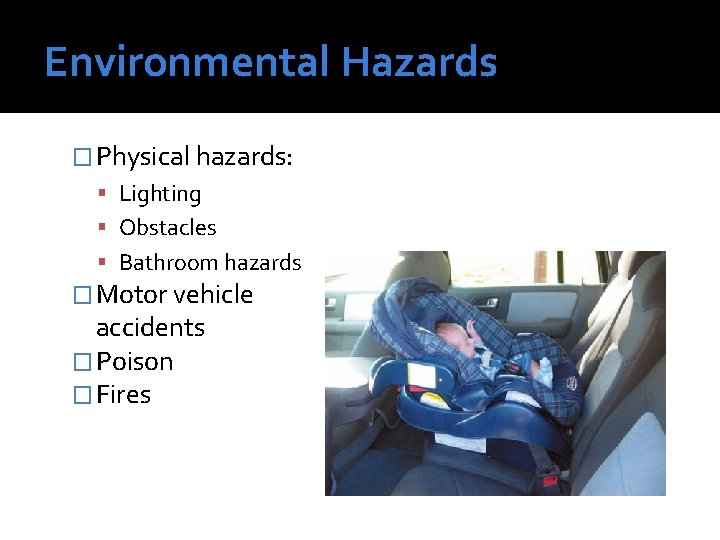
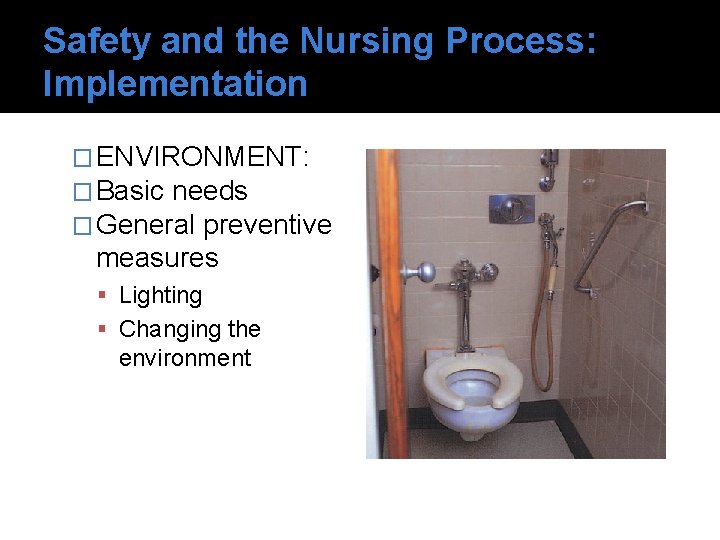
Environmental Hazards � Physical hazards: Lighting Obstacles Bathroom hazards � Motor vehicle accidents � Poison � Fires
Environmental Hazards �Falls �Disasters Natural Man-made Fires Transmission of Pathogens Pollution
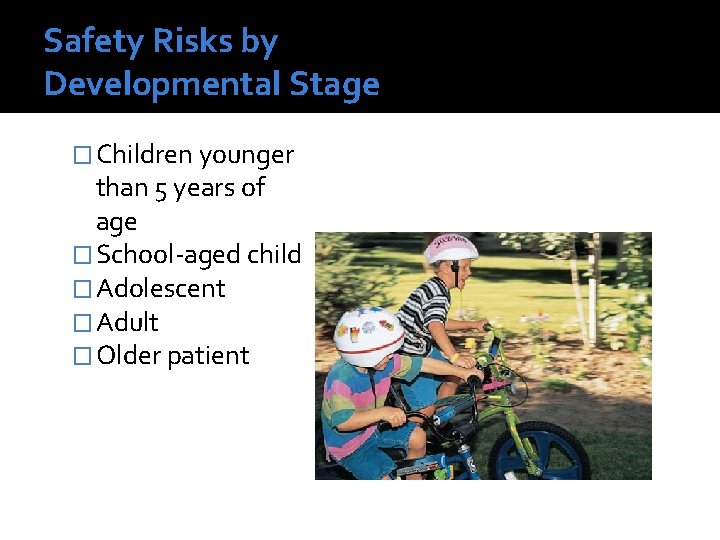
Safety Risks by Developmental Stage � Children younger than 5 years of age � School-aged child � Adolescent � Adult � Older patient
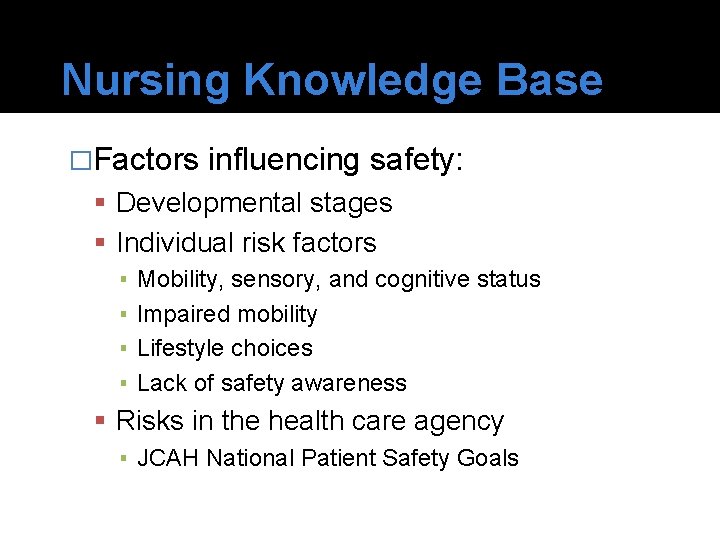
Nursing Knowledge Base �Factors influencing safety: Developmental stages Individual risk factors ▪ Mobility, sensory, and cognitive status ▪ Impaired mobility ▪ Lifestyle choices ▪ Lack of safety awareness Risks in the health care agency ▪ JCAH National Patient Safety Goals
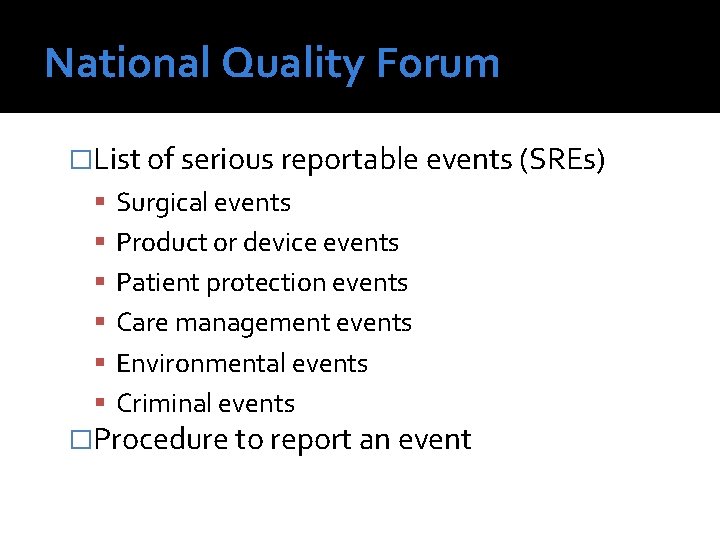
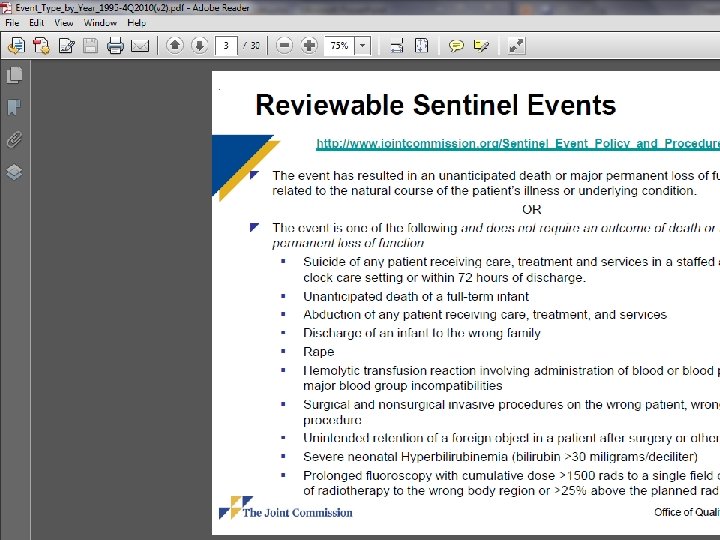
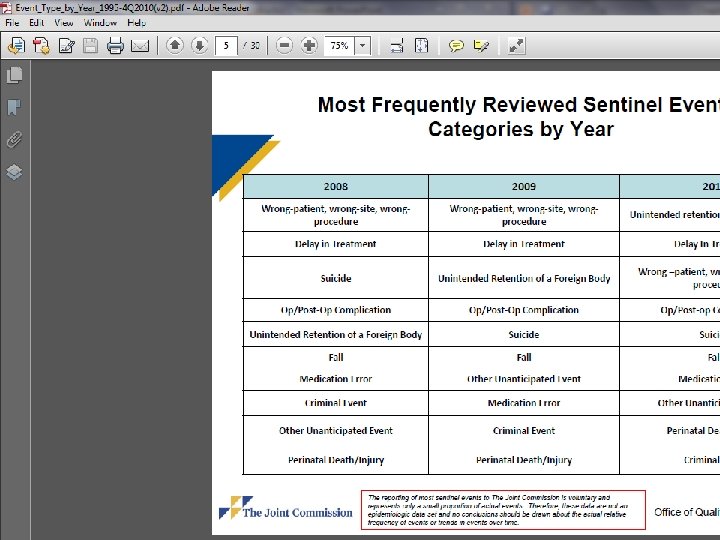
National Quality Forum �List of serious reportable events (SREs) Surgical events Product or device events Patient protection events Care management events Environmental events Criminal events �Procedure to report an event
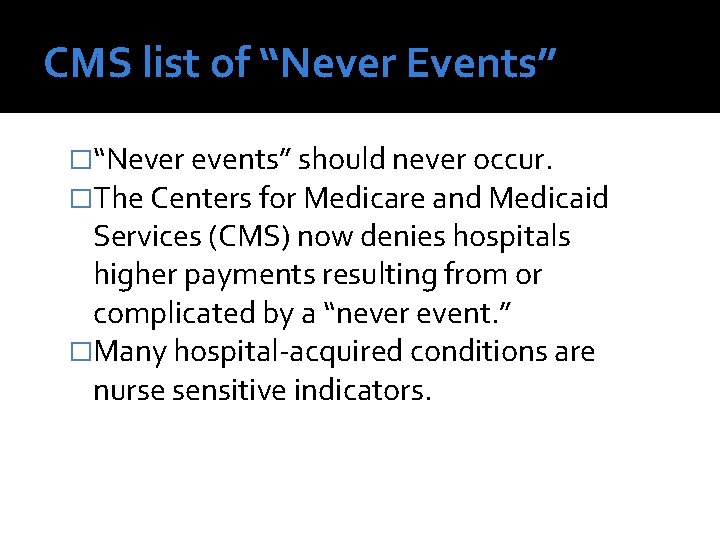
CMS list of “Never Events” �“Never events” should never occur. �The Centers for Medicare and Medicaid Services (CMS) now denies hospitals higher payments resulting from or complicated by a “never event. ” �Many hospital-acquired conditions are nurse sensitive indicators.
12
13
14
15
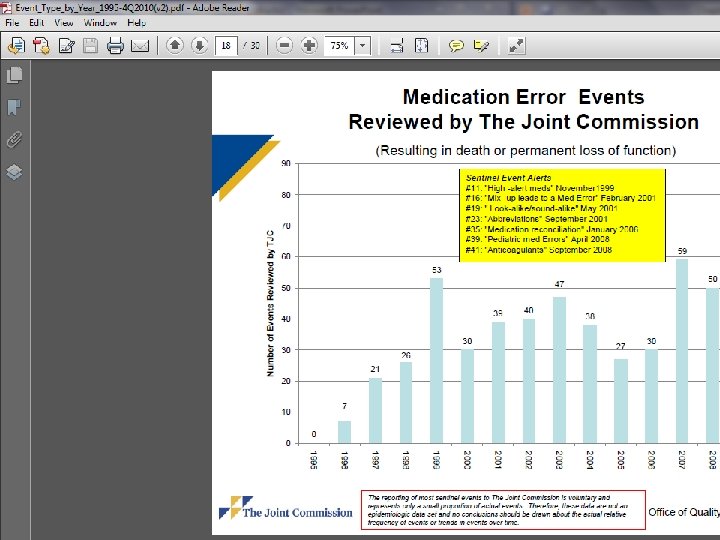
Risks in Health Care Agencies �Chemical use (Material Safety Data Sheets [MSDSs]) �Medical errors Medication errors/Infection/Bed sores Failure to diagnose and treat in time �Falls �Classification accidents: of health care agency Patient-inherent accidents Procedure-related accidents Equipment-related accidents
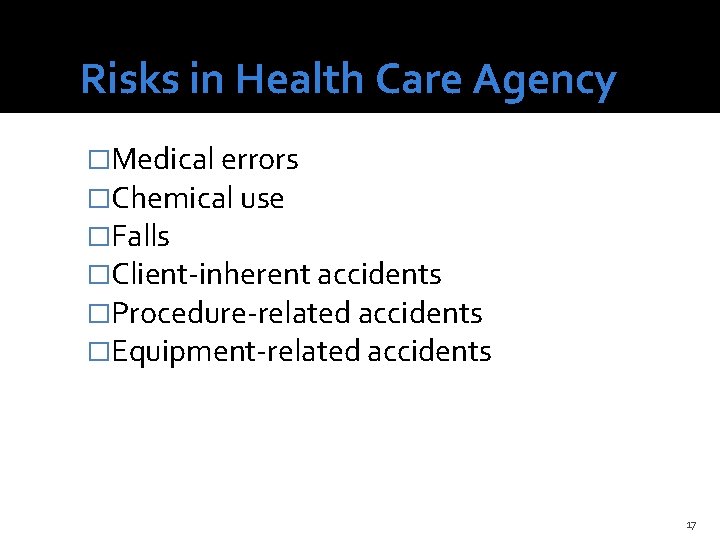
Risks in Health Care Agency �Medical errors �Chemical use �Falls �Client-inherent accidents �Procedure-related accidents �Equipment-related accidents 17
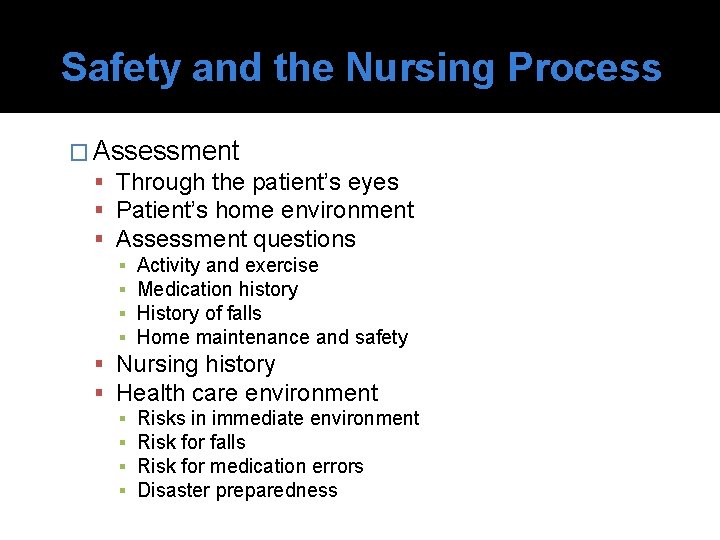
Safety and the Nursing Process � Assessment Through the patient’s eyes Patient’s home environment Assessment questions ▪ ▪ Activity and exercise Medication history History of falls Home maintenance and safety Nursing history Health care environment ▪ ▪ Risks in immediate environment Risk for falls Risk for medication errors Disaster preparedness
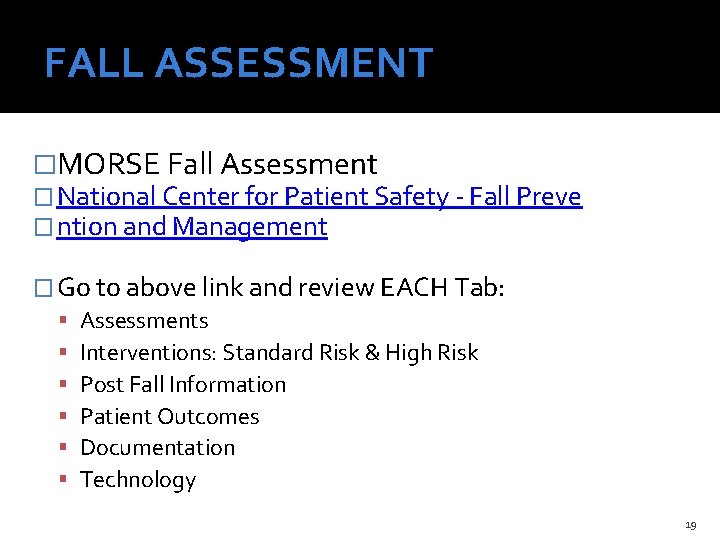
FALL ASSESSMENT �MORSE Fall Assessment � National Center for Patient Safety - Fall Preve � ntion and Management � Go to above link and review EACH Tab: Assessments Interventions: Standard Risk & High Risk Post Fall Information Patient Outcomes Documentation Technology 19
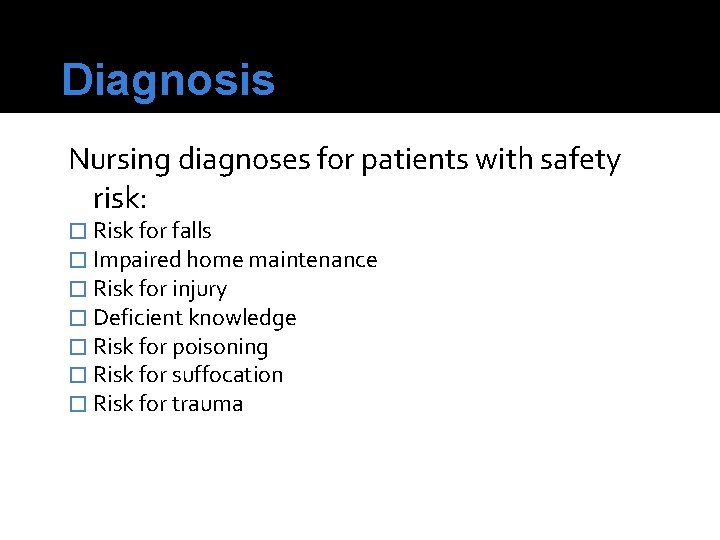
Diagnosis Nursing diagnoses for patients with safety risk: � Risk for falls � Impaired home maintenance � Risk for injury � Deficient knowledge � Risk for poisoning � Risk for suffocation � Risk for trauma
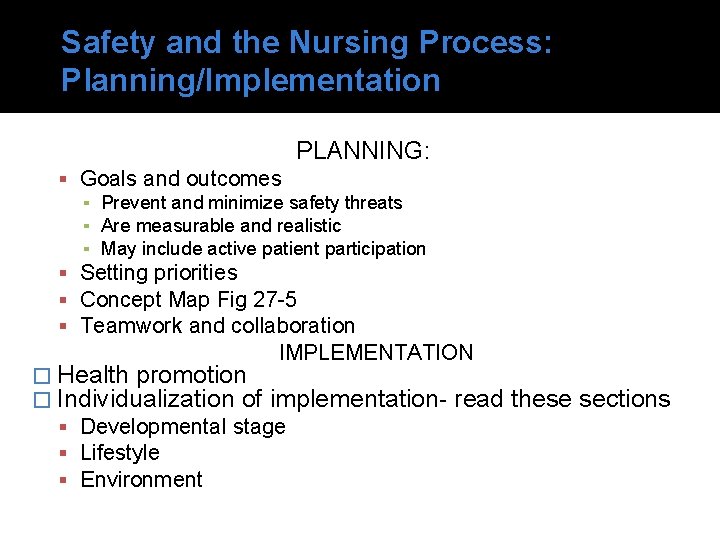
Safety and the Nursing Process: Planning/Implementation PLANNING: Goals and outcomes ▪ Prevent and minimize safety threats ▪ Are measurable and realistic ▪ May include active patient participation Setting priorities Concept Map Fig 27 -5 Teamwork and collaboration IMPLEMENTATION � Health promotion � Individualization of implementation Developmental stage Lifestyle Environment read these sections
Safety and the Nursing Process: Implementation � ENVIRONMENT: � Basic needs � General preventive measures Lighting Changing the environment
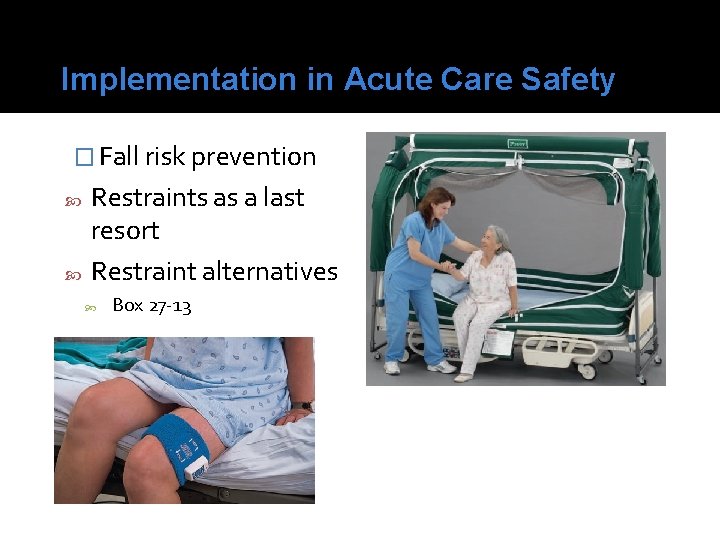
Implementation in Acute Care Safety � Fall risk prevention Restraints as a last resort Restraint alternatives Box 27 -13
Restraints �A physical restraint is a human, mechanical and or physical devise that is used with or without a client’s permission to restrict his or her freedom of movement or normal access to a person’s body and is not a usual part of treatments plans. 24
Alternatives to Restraints �Orient client �Companionship and supervision �Diversionary activities �Relaxation �( table 27 -13) 25
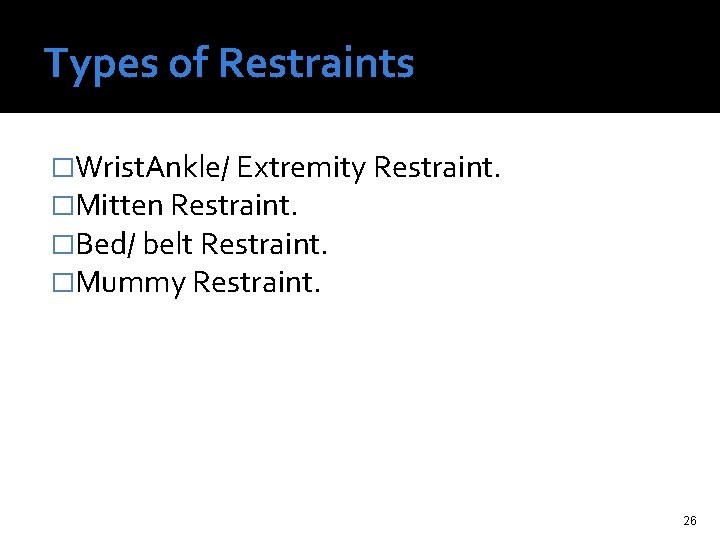
Types of Restraints �Wrist. Ankle/ Extremity Restraint. �Mitten Restraint. �Bed/ belt Restraint. �Mummy Restraint. 26
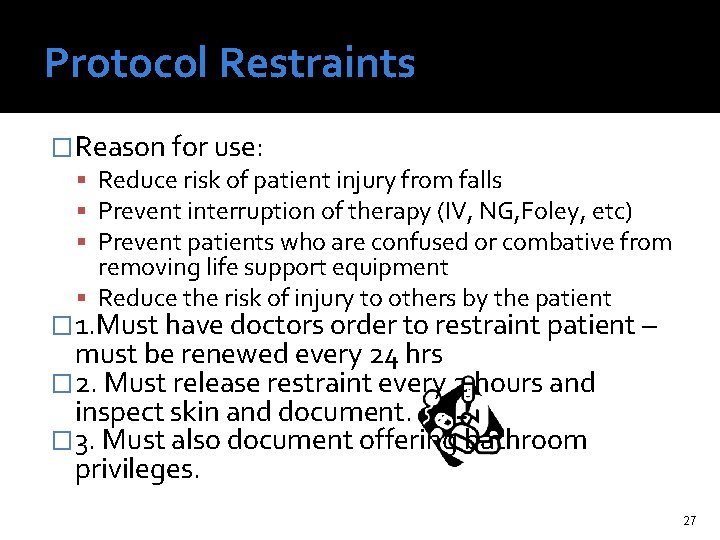
Protocol Restraints �Reason for use: Reduce risk of patient injury from falls Prevent interruption of therapy (IV, NG, Foley, etc) Prevent patients who are confused or combative from removing life support equipment Reduce the risk of injury to others by the patient � 1. Must have doctors order to restraint patient – must be renewed every 24 hrs � 2. Must release restraint every 2 hours and inspect skin and document. � 3. Must also document offering bathroom privileges. 27
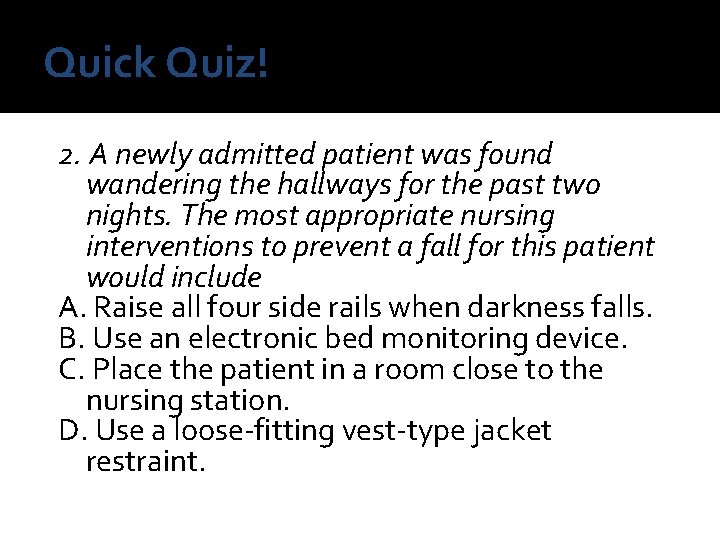
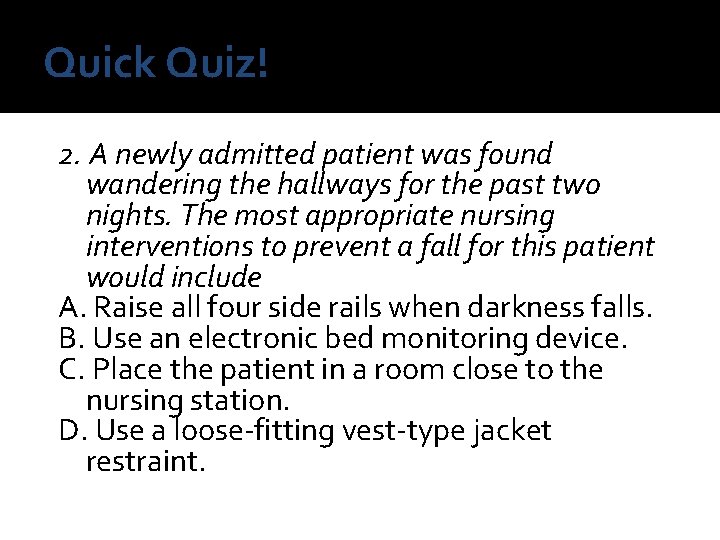
Quick Quiz! 2. A newly admitted patient was found wandering the hallways for the past two nights. The most appropriate nursing interventions to prevent a fall for this patient would include A. Raise all four side rails when darkness falls. B. Use an electronic bed monitoring device. C. Place the patient in a room close to the nursing station. D. Use a loose-fitting vest-type jacket restraint.
Quick Quiz! 2. A newly admitted patient was found wandering the hallways for the past two nights. The most appropriate nursing interventions to prevent a fall for this patient would include A. Raise all four side rails when darkness falls. B. Use an electronic bed monitoring device. C. Place the patient in a room close to the nursing station. D. Use a loose-fitting vest-type jacket restraint.
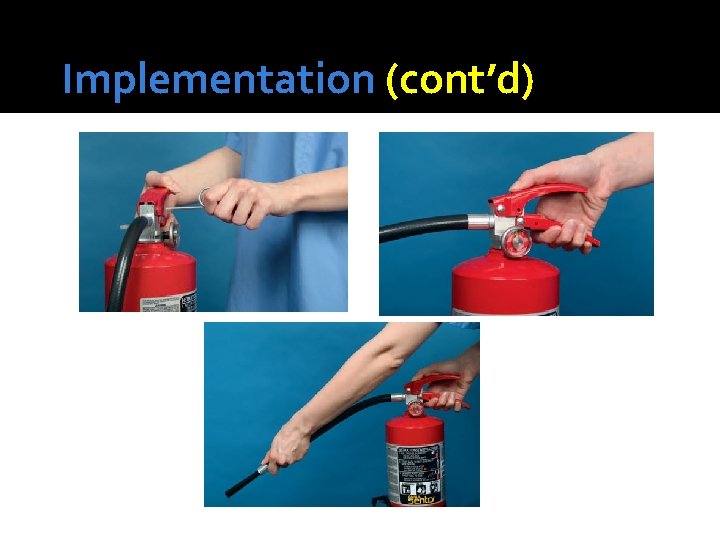
Implementation � Acute care safety Fires: “RACE” and “PASS” ▪ Rescue patients. ▪ Activate alarm. ▪ Confine fire. ▪ Extinguish.
Implementation (cont’d)
Quick Quiz! 2. A newly admitted patient was found wandering the hallways for the past two nights. The most appropriate nursing interventions to prevent a fall for this patient would include A. Raise all four side rails when darkness falls. B. Use an electronic bed monitoring device. C. Place the patient in a room close to the nursing station. D. Use a loose-fitting vest-type jacket restraint.
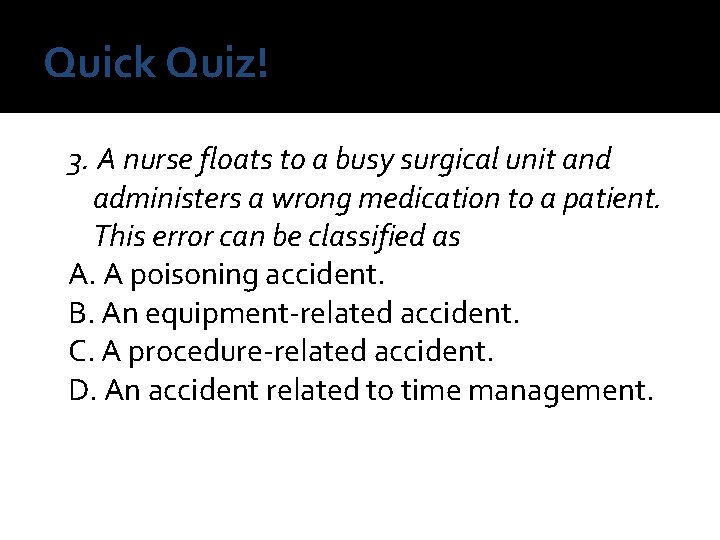
Quick Quiz! 3. A nurse floats to a busy surgical unit and administers a wrong medication to a patient. This error can be classified as A. A poisoning accident. B. An equipment-related accident. C. A procedure-related accident. D. An accident related to time management.
This work is licensed under a Creative Commons Attribution 4. 0 International License. Except where otherwise noted, this content by Southern Regional Technical College is licensed under the Creative Commons Attribution 4. 0 International License. To view a copy of this license, click https: //creativecommons. org/licenses/by/4. 0/ Healthcare Careers Work!(HCW) is sponsored by a $2. 3 million grant from the U. S. Department of Labor, Employment & Training Administration. TAACCCT Grant #TC- 26488 -14 -60 -A-13. Southern Regional Technical College is an equal opportunity employer and will make adaptive equipment available to persons with disabilities upon request. This workforce product was funded by a grant awarded by the U. S. Department of Labor’s Employment and Training Administration. The product was created by the grantee and does not necessarily reflect the official position of the U. S. Department of Labor. The U. S. Department of Labor makes no guarantees, warranties, or assurances of any kind, express or implied, with respect to such information, including any information on linked sites and including, but not limited to, accuracy of the information or its completeness, timeliness, usefulness, adequacy, continued availability, or ownership.