
Chapter 26 The Sun and the Solar System
- Slides: 37
Chapter 26 The Sun and the Solar System
26. 1 The Sun’s Size, Heat, and Structure ¬Explain the structure of the sun and its energy source. ¬Describe the effects of sunspots, solar wind, and magnetic storms on Earth and explain the role of Earth’s magnetic field.
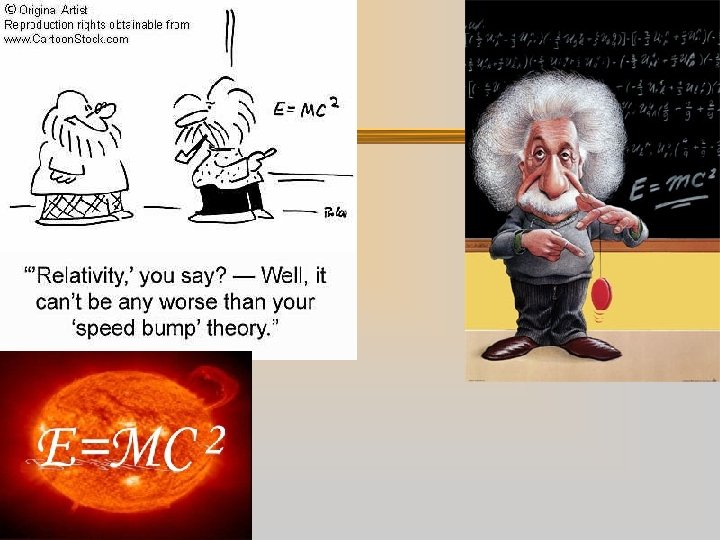
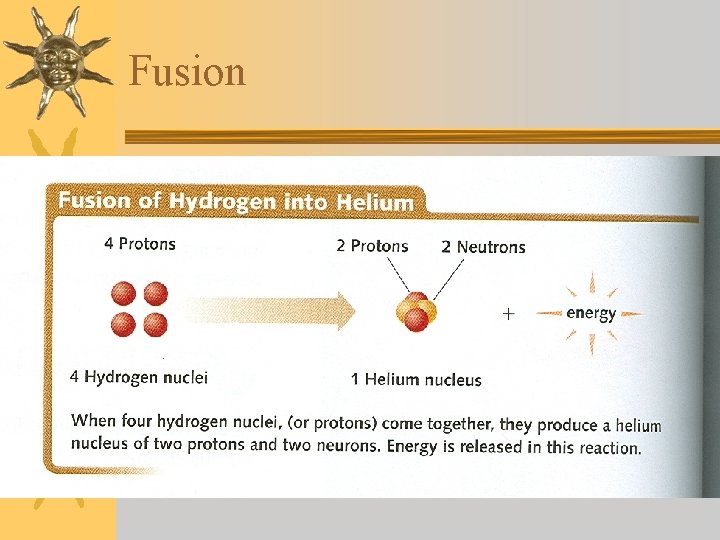
The Sun’s Energy ¬All stars get their energy from fusion. ¬E=mc 2 – Energy is equal to mass times the speed of light – Matter can be converted into energy ¬Mass is greater at the start of fusion—extra mass is converted into energy
Fusion
The Sun’s Energy ¬A star is a place of intense heat and pressure ¬Atoms are torn apart resulting in plasma ¬Plasma is a fourth state of matter consisting of charged particles
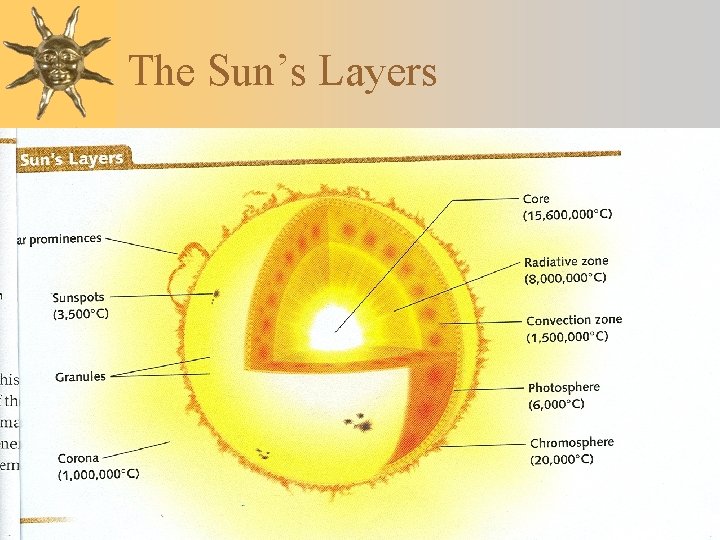
The Sun’s Layers - Core ¬Core – Hydrogen and helium ions in plasma state – 15, 600, 000°C – Very dense – Plasma
The Sun’s Layers - Radiative ¬Radiative Zone – Cooler than core • 8, 000°C – 2, 000°C – Plasma
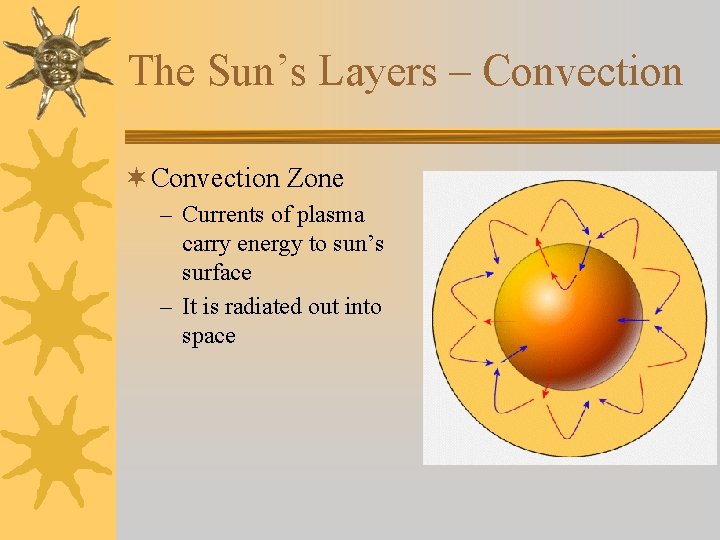
The Sun’s Layers – Convection ¬ Convection Zone – Currents of plasma carry energy to sun’s surface – It is radiated out into space
The Sun’s Layers - Photosphere ¬Photosphere – Visible surface of the sun – ~6, 000°C
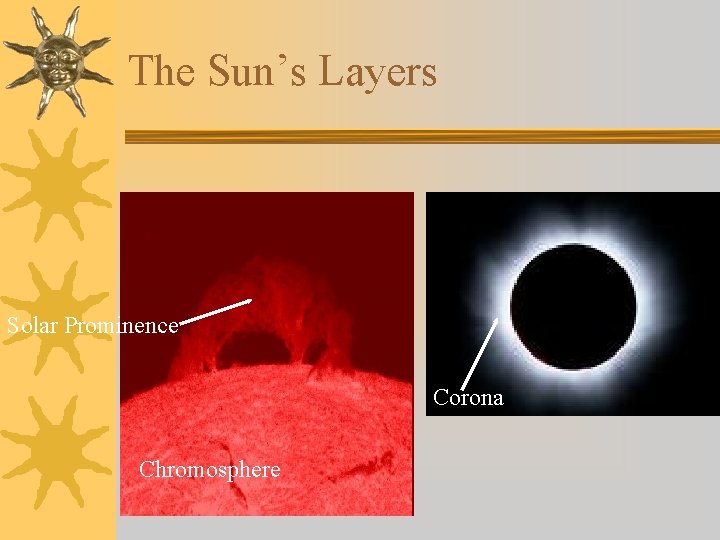
The Sun’s Layers - Atmosphere ¬ Chromosphere – Inner layer of sun’s atmosphere – 20, 000°c – Temperature causes hydrogen to emit distinctive reddish color – Features • Solar prominences ¬ Corona – Thin, outer layer – A million times less bright than photosphere – 1, 000°C to 3, 000°C
The Sun’s Layers Solar Prominence Corona Chromosphere
The Sun’s Layers
Features on the Sun ¬ 150 million km away from Earth – Equal to 1 AU (astronomical unit) ¬Sunspots ¬Solar Wind
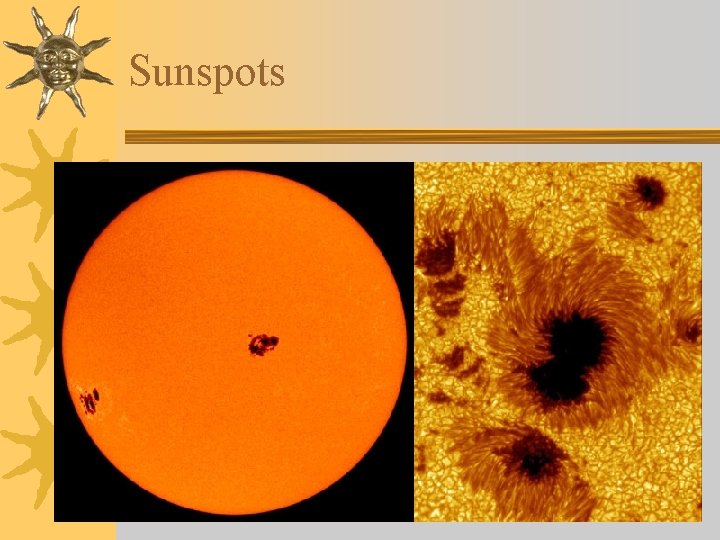
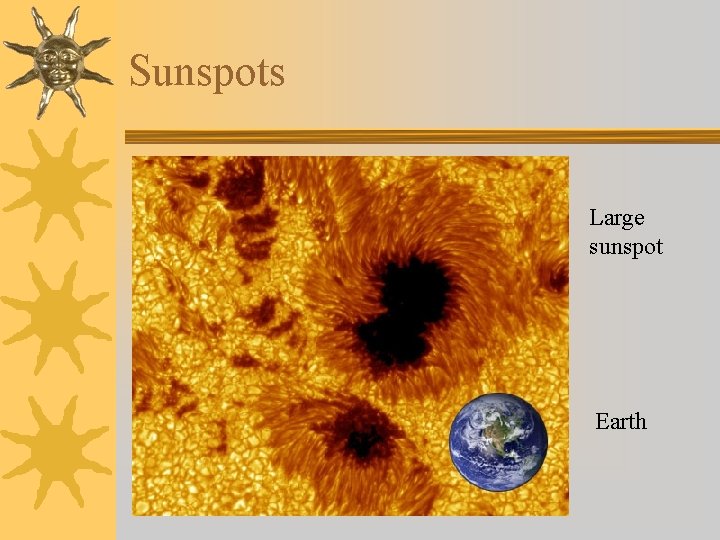
Sunspots ¬Dark spots on photosphere ¬Range in size – Barely visible – Four times larger than Earth’s diameter ¬Last up to a few months ¬Magnetic field associated with sunspots ~1000 stronger than surrounding area
Sunspots
Sunspots ¬Sunspots move from left to right as seen from Earth ¬Sunspots give evidence that the sun rotates on its axis ¬Sun is not solid, so rotation rate differs from place to place – Equator 25 days – Poles 34 days
Sunspots Large sunspot Earth
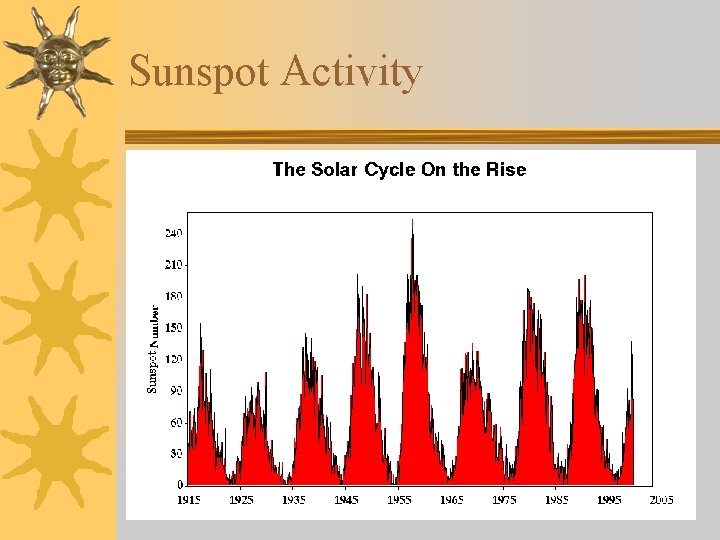
Sunspot Activity ¬Sunspot visibility changes from day to day ¬Sunspot cycle averages ~11 years from one period of peak activity to the next
Sunspot Activity
Solar Wind ¬Solar wind is a constant stream of electrically charged particles from the sun’s corona ¬Solar wind reaches Earth in about 2 days ¬Deflected by Earth’s magnetic field ¬Coronal holes – openings where large amount of solar wind pours out
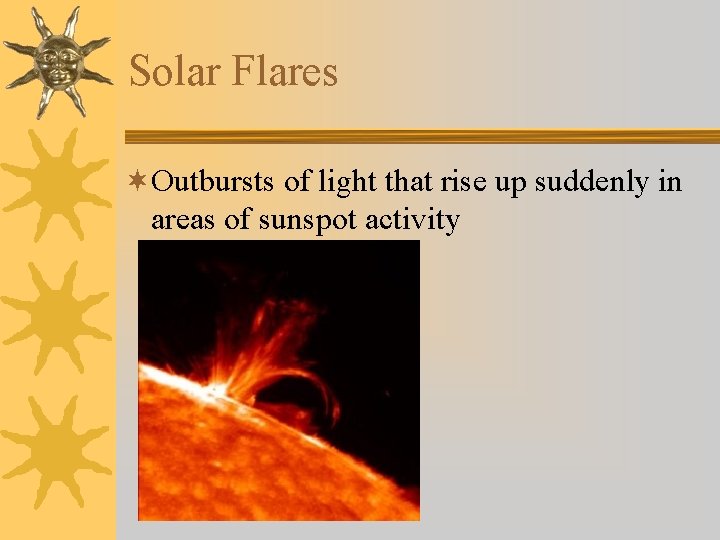
Solar Flares ¬Outbursts of light that rise up suddenly in areas of sunspot activity
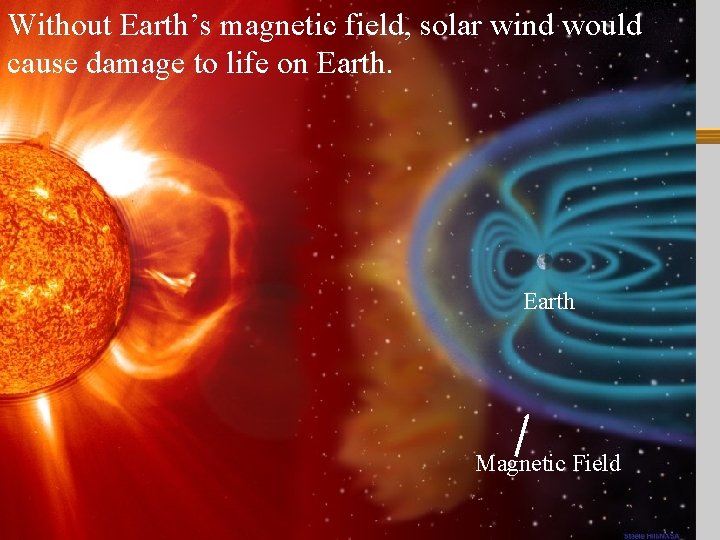
Without Earth’s magnetic field, solar wind would cause damage to life on Earth Magnetic Field
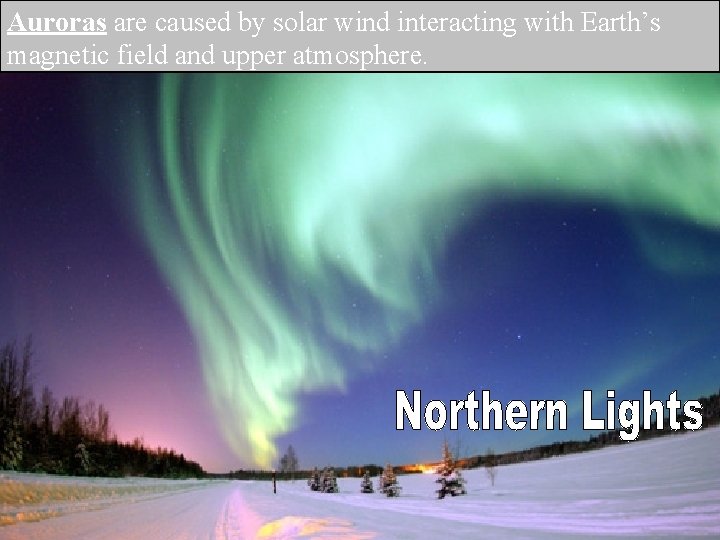
Auroras are caused by solar wind interacting with Earth’s magnetic field and upper atmosphere.
26. 2 Observing the Solar System: A History ¬Describe the early models of the movements of planets and stars. ¬Explain Newton’s Law of Gravitation.
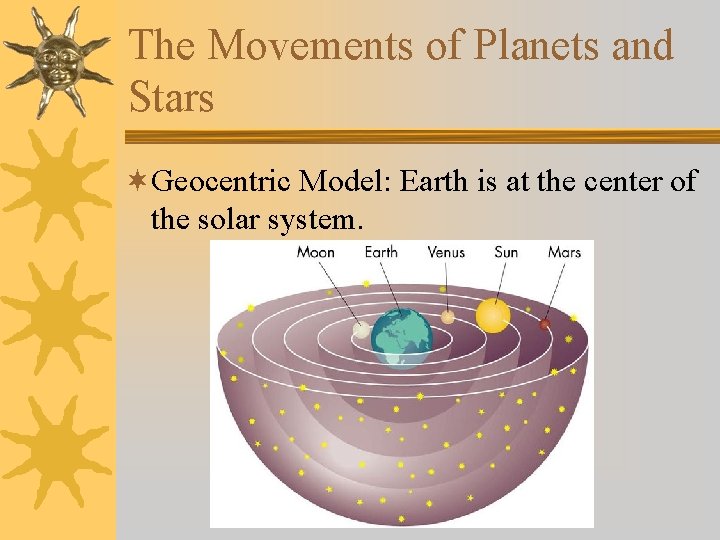
The Movements of Planets and Stars ¬Geocentric Model: Earth is at the center of the solar system.
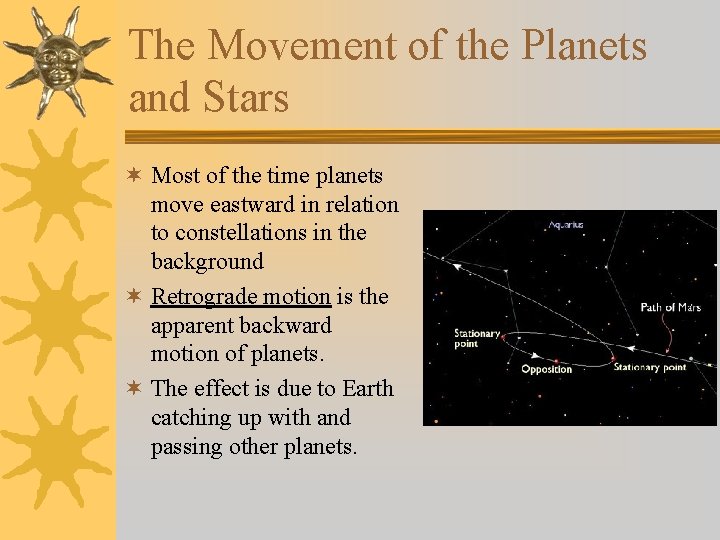
The Movement of the Planets and Stars ¬ Most of the time planets move eastward in relation to constellations in the background ¬ Retrograde motion is the apparent backward motion of planets. ¬ The effect is due to Earth catching up with and passing other planets.
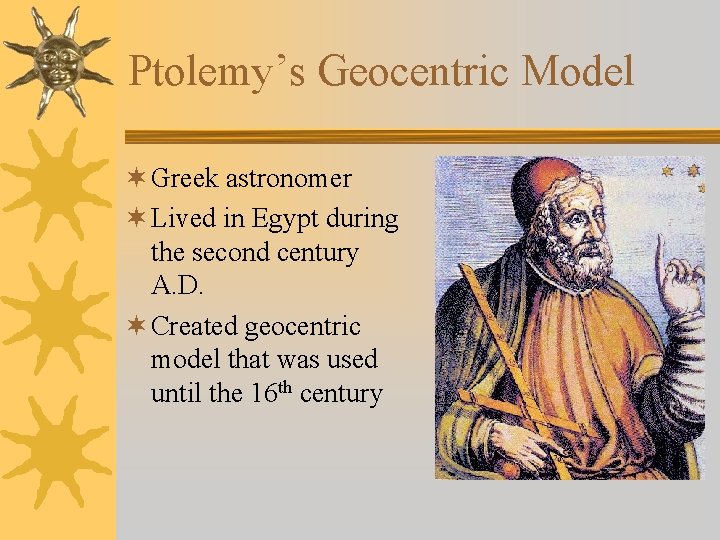
Ptolemy’s Geocentric Model ¬ Greek astronomer ¬ Lived in Egypt during the second century A. D. ¬ Created geocentric model that was used until the 16 th century
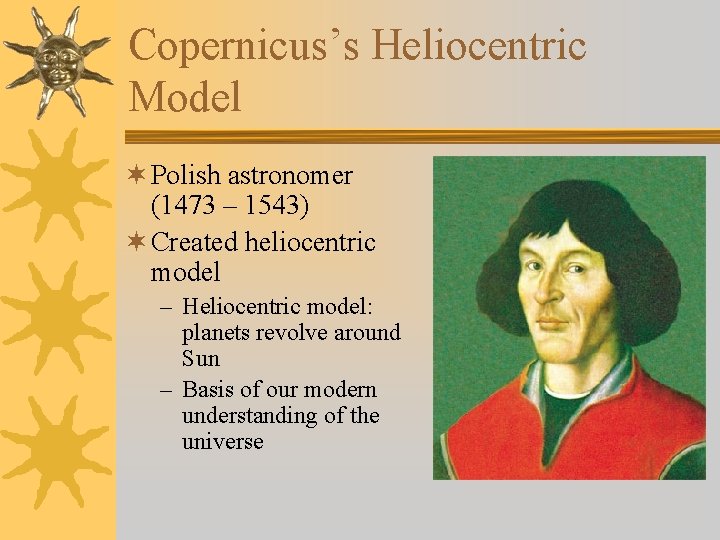
Copernicus’s Heliocentric Model ¬ Polish astronomer (1473 – 1543) ¬ Created heliocentric model – Heliocentric model: planets revolve around Sun – Basis of our modern understanding of the universe
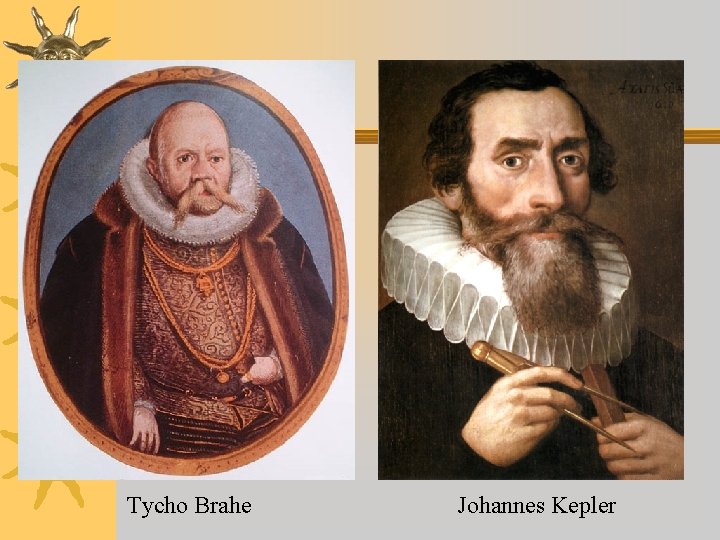
Tycho, Kepler, and Planetary Motion ¬ Tycho Brahe, 16 th century Danish nobleman and astronomer – Most precise records kept without the aid of telescope – Johannes Kepler was his assistant – Tycho died in 1601, before he was able to analyze his data – Kepler built on Tycho’s lifetime of work by discovering that the planet’s paths around the sun were elliptical, not circular
Tycho Brahe Johannes Kepler
Kepler’s 1 st Law of Planetary Motion ¬The planets travel in elliptical orbits with the sun at one focus. – Elliptical orbits with two foci on opposite sides of its center – A planet’s distance from the sun will change throughout its orbit
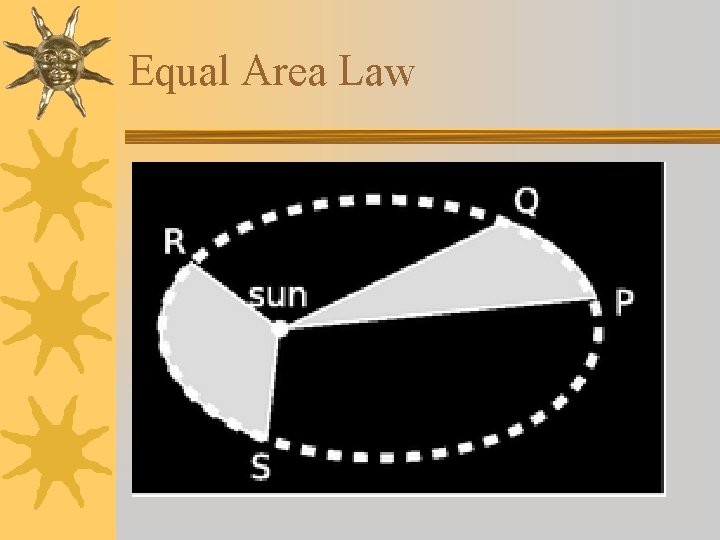
Kepler’s 2 nd Law of Planetary Motion ¬Equal Area Law - Each planet moves around the sun in such a way that an imaginary line joining the planet to the sun sweeps over equal areas of space in equal periods of time. – The speed at which a planet orbits the sun is not constant due to elliptical orbit shape – Planets travel faster when closer to the sun and slower when further from sun
Equal Area Law
Kepler’s 3 rd Law of Planetary Motion ¬Harmonic Law - The period (P) of a planet squared is equal to the cube of its mean distance (D) from the sun, P 2 = D 3. – Period is the time it takes a planet to complete one revolution/orbit around sun – Formula is used to find a planet’s • distance from sun if period is known, or • Period if distance from sun is known
Kepler’s 3 rd Law of Planetary Motion ¬The further a planet is from the sun, the longer its period of revolution. ¬Average orbital speeds – Earth = 30 km/s – Mercury = 49 km/s
Isaac Newton and the Law of Gravitation ¬ Isaac Newton (1642 -1727), English scientist and mathematician ¬ Law of Gravitation – States that every mass exerts a force of attraction on every other mass, and the strength of that force is proportional to each of the masses and inversely proportional to the distance between them – The larger the mass, the stronger the gravitational attraction – The shorter the distance, the stronger the gravitational attraction