
Chapter 26 The Digestive System 24 1 Overview












- Slides: 36
Chapter 26 The Digestive System 24 -1
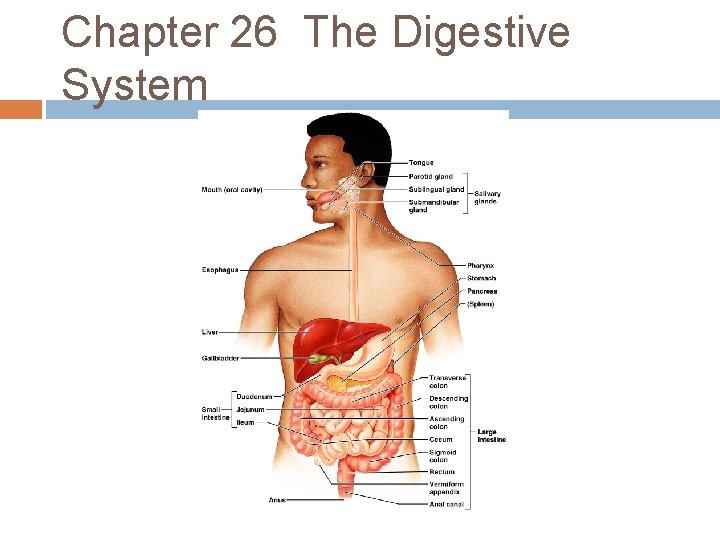
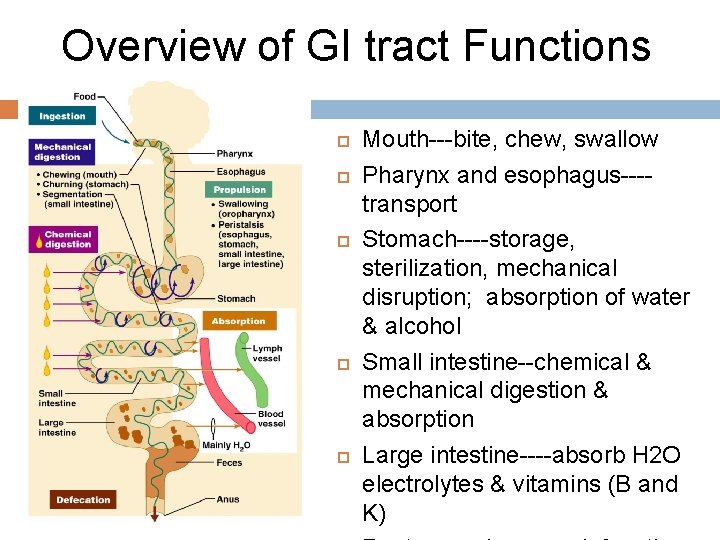
Overview of GI tract Functions Mouth---bite, chew, swallow Pharynx and esophagus---transport Stomach----storage, sterilization, mechanical disruption; absorption of water & alcohol Small intestine--chemical & mechanical digestion & absorption Large intestine----absorb H 2 O electrolytes & vitamins (B and K) 24 -2
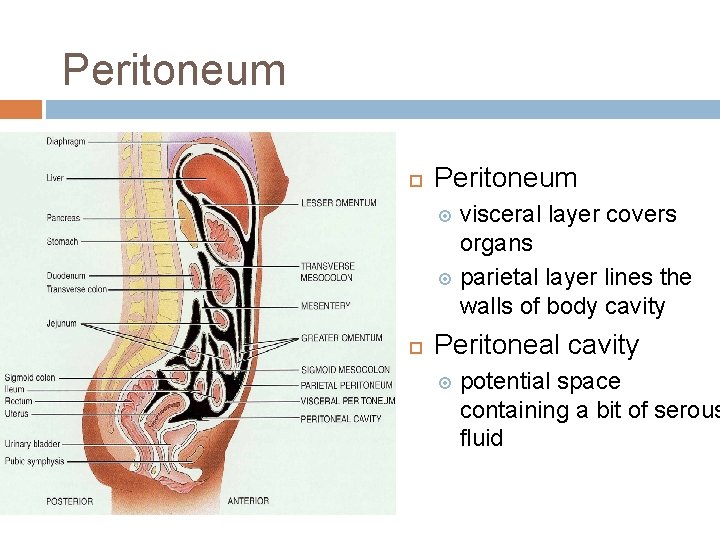
Peritoneum visceral layer covers organs parietal layer lines the walls of body cavity Peritoneal cavity potential space containing a bit of serous fluid 24 -3
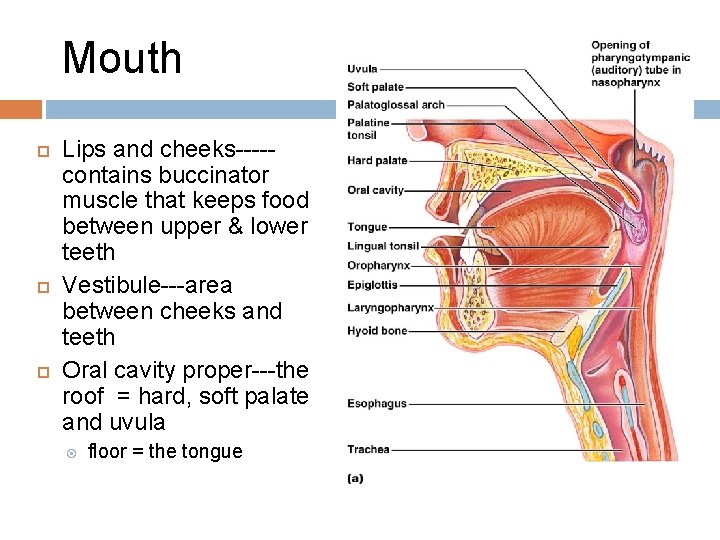
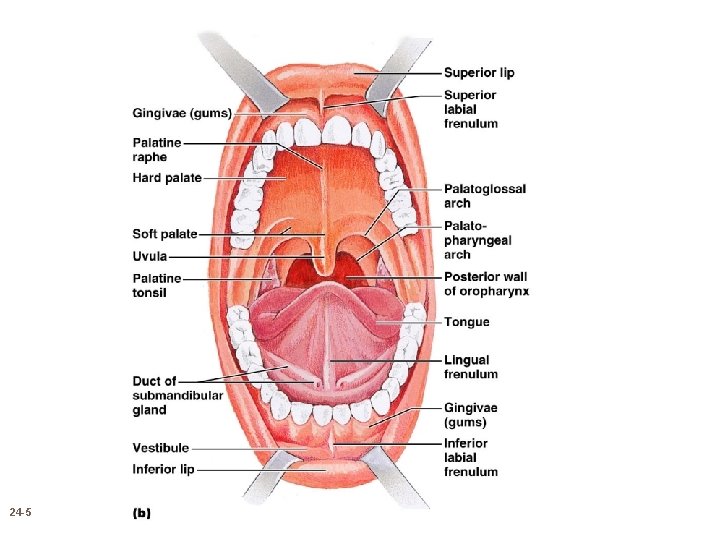
Mouth Lips and cheeks----contains buccinator muscle that keeps food between upper & lower teeth Vestibule---area between cheeks and teeth Oral cavity proper---the roof = hard, soft palate and uvula floor = the tongue 24 -4
24 -5
Salivary Glands Parotid below your ear and over the masseter Produce saliva used to moisten and lubricate food for swallowing All have ducts that empty into the oral cavity 24 -6
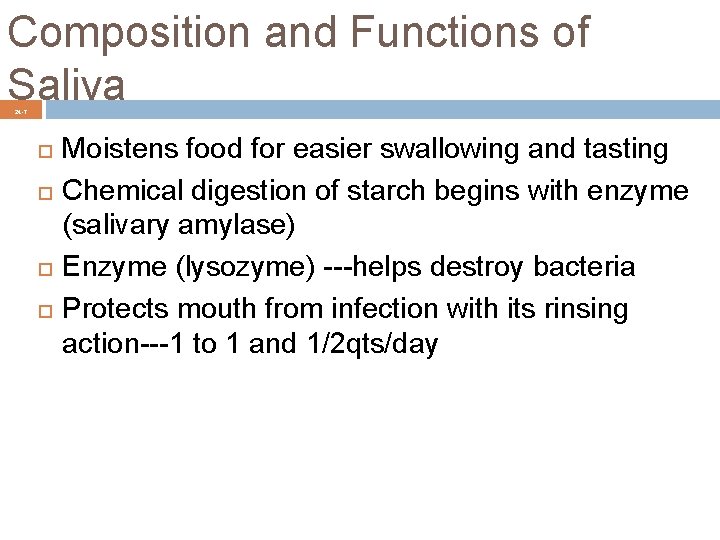
Composition and Functions of Saliva 24 -7 Moistens food for easier swallowing and tasting Chemical digestion of starch begins with enzyme (salivary amylase) Enzyme (lysozyme) ---helps destroy bacteria Protects mouth from infection with its rinsing action---1 to 1 and 1/2 qts/day
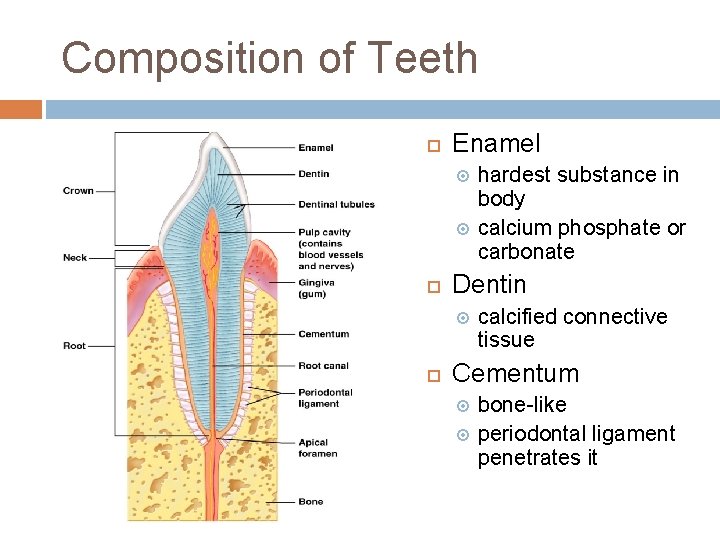
Tooth Structure Crown Neck Roots Pulp cavity 24 -8
Composition of Teeth Enamel Dentin hardest substance in body calcium phosphate or carbonate calcified connective tissue Cementum bone-like periodontal ligament penetrates it 24 -9
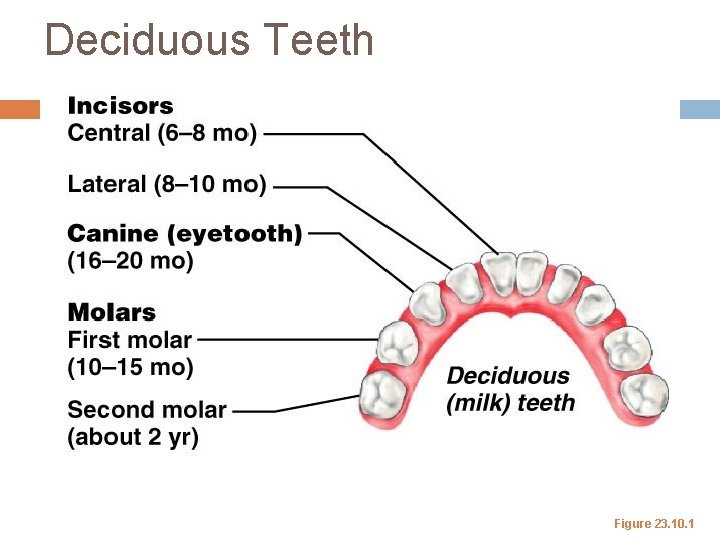
Deciduous Teeth Figure 23. 10. 1
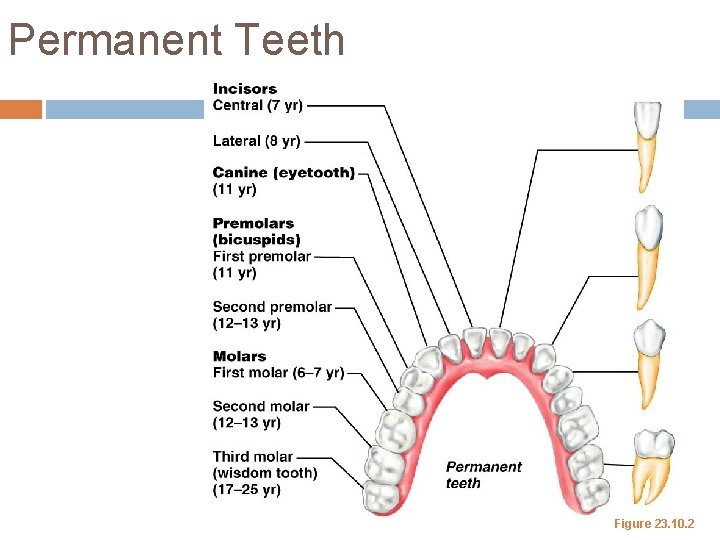
Permanent Teeth Figure 23. 10. 2
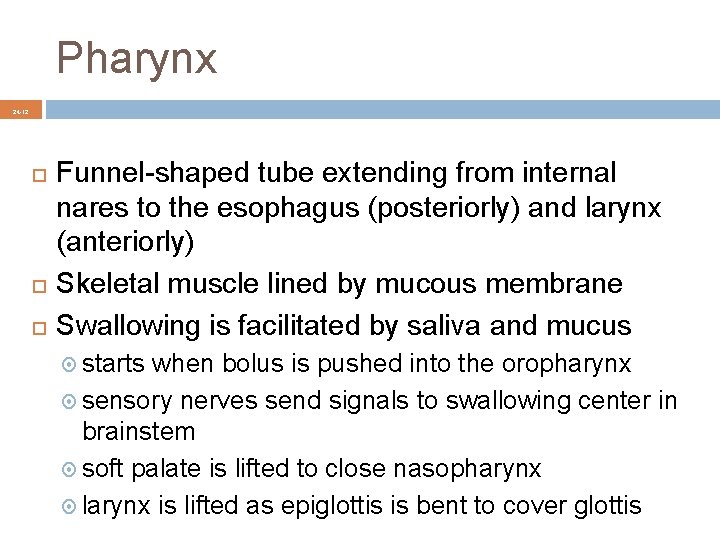
Pharynx 24 -12 Funnel-shaped tube extending from internal nares to the esophagus (posteriorly) and larynx (anteriorly) Skeletal muscle lined by mucous membrane Swallowing is facilitated by saliva and mucus starts when bolus is pushed into the oropharynx sensory nerves send signals to swallowing center in brainstem soft palate is lifted to close nasopharynx larynx is lifted as epiglottis is bent to cover glottis
Esophagus 24 -13 Collapsed muscular tube In front of vertebrae Posterior to trachea Posterior to the heart Pierces the diaphragm at hiatus
Physiology of the Esophagus Swallowing Voluntary phase---tongue pushes food to back of oral cavity Involuntary phase----pharyngeal stage breathing stops & airways are closed soft palate & uvula are lifted to close off nasopharynx vocal cords close epiglottis is bent over airway as larynx is lifted 24 -14
Swallowing 24 -15 Upper sphincter relaxes when larynx is lifted Peristalsis pushes food down Travel time is 4 -8 seconds for solids and 1 sec for liquids Lower sphincter relaxes as food approaches
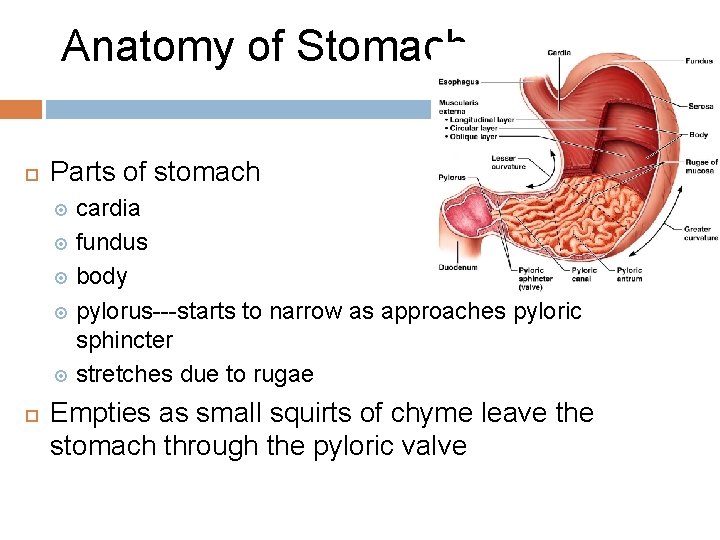
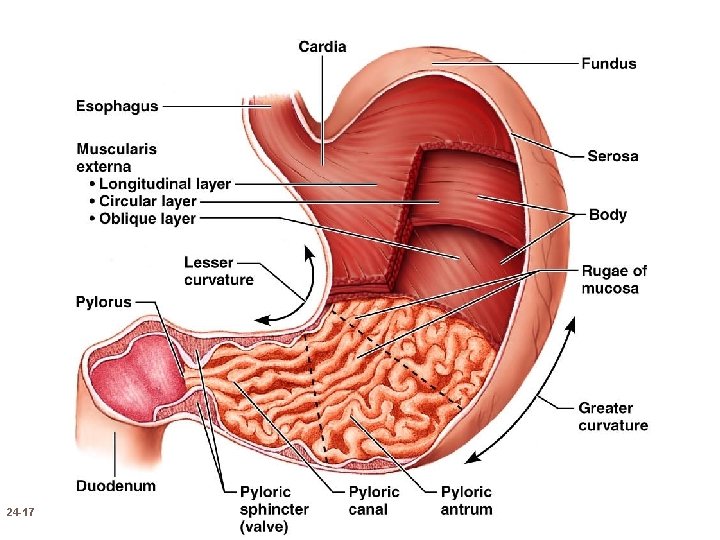
Anatomy of Stomach Parts of stomach cardia fundus body pylorus---starts to narrow as approaches pyloric sphincter stretches due to rugae Empties as small squirts of chyme leave the stomach through the pyloric valve 24 -16
24 -17
Muscular portion of stomach Three layers of smooth muscle-outer longitudinal, circular & inner oblique Permits greater churning & mixing of food with gastric juice 24 -18
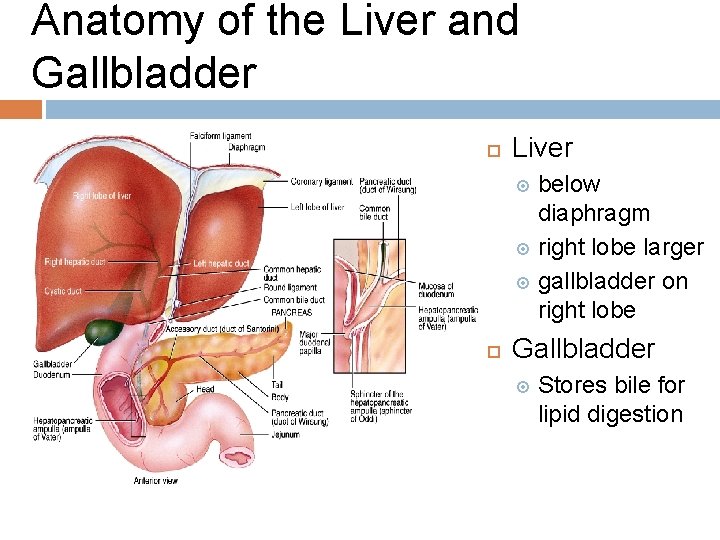
Anatomy of the Pancreas Close to curve in C-shaped duodenum Main duct joins common bile duct from liver Pancreatic duct opens 4" below pyloric sphincter 24 -19
Anatomy of the Liver and Gallbladder Liver below diaphragm right lobe larger gallbladder on right lobe Gallbladder Stores bile for lipid digestion 24 -20
Pathway of Bile Secretion Hepatic ducts connect to form common hepatic duct Cystic duct from gallbladder & common hepatic duct join to form common bile duct Common bile duct & pancreatic duct empty into 24 -21 duodenum
Bile Production 24 -22 Components water & cholesterol bile salts = Na & K salts of bile acids bile pigments (bilirubin) from hemoglobin molecule globin = a reuseable protein heme = broken down into iron and bilirubin
Liver Functions--Carbohydrate Metabolism 24 -23 Turn proteins into glucose Turn triglycerides into glucose Turn excess glucose into glycogen & store in the liver Turn glycogen back into glucose as needed
Liver Functions --Lipid Metabolism 24 -24 Synthesize cholesterol Synthesize lipoproteins----HDL and LDL(used to transport fatty acids in bloodstream) Stores some fat Breaks down some fatty acids
Liver Functions--Protein Metabolism 24 -25 Deamination = removes NH 2 (amine group) from amino acids so can use what is left as energy source Converts resulting toxic ammonia (NH 3) into urea for excretion by the kidney Synthesizes plasma proteins utilized in the clotting mechanism and immune system Convert one amino acid into another
Other Liver Functions 24 -26 Detoxifies the blood by removing or altering drugs & hormones(thyroid & estrogen) Removes the waste product--bilirubin Releases bile salts help digestion by emulsification Stores fat soluble vitamins-----A, B 12, D, E, K Stores iron and copper Phagocytizes worn out blood cells & bacteria Essay: How can you survive without a spleen?
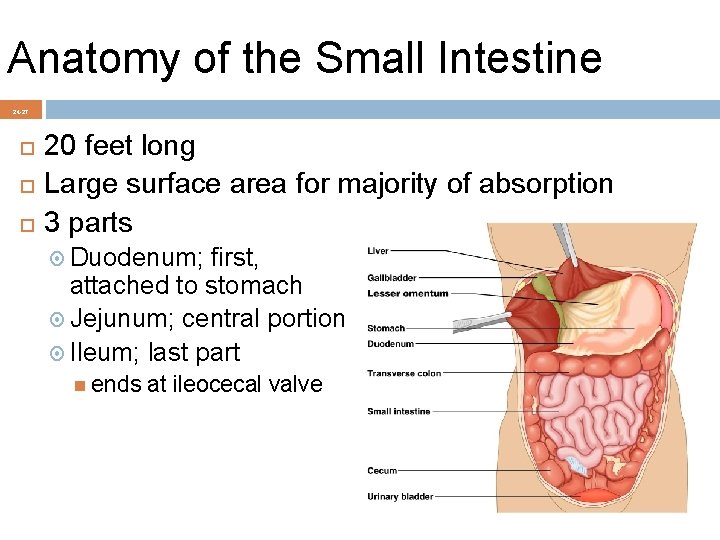
Anatomy of the Small Intestine 24 -27 20 feet long Large surface area for majority of absorption 3 parts Duodenum; first, attached to stomach Jejunum; central portion Ileum; last part ends at ileocecal valve
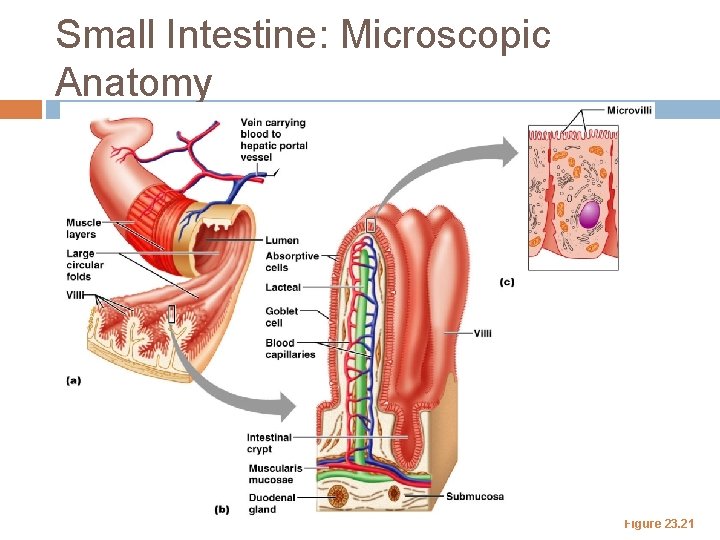
Histology of Small Intestine 24 -28
Functions of Microvilli 24 -29 Absorption and digestion Digestive enzymes found at cell surface on microvilli Digestion occurs at cell surfaces Significant cell division within intestinal glands produces new cells that move up Once out of the way---rupturing and releasing their digestive enzymes & proteins
Small Intestine: Microscopic Anatomy Figure 23. 21
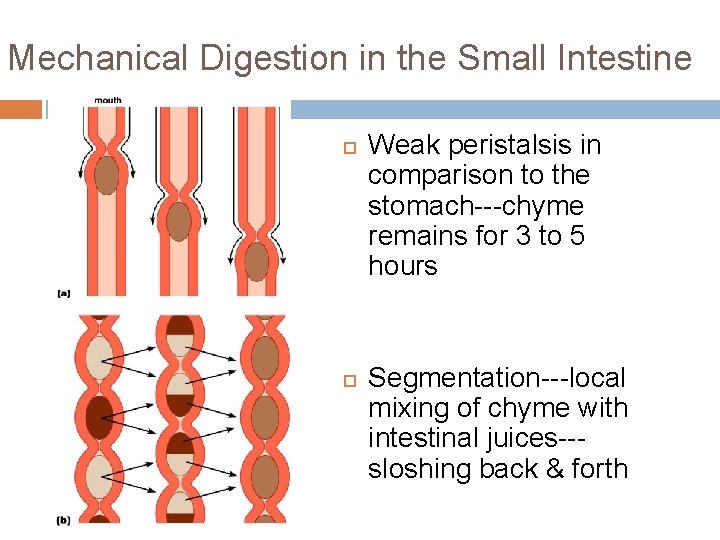
Mechanical Digestion in the Small Intestine Weak peristalsis in comparison to the stomach---chyme remains for 3 to 5 hours Segmentation---local mixing of chyme with intestinal juices--sloshing back & forth 24 -31
Digestion of Carbohydrates 24 -32 Mouth---salivary amylase Esophagus & stomach---nothing happens Duodenum----pancreatic amylase Intestinal enzymes (maltase, sucrase & lactase) act on disaccharides produces monosaccharides--fructose, glucose & galactose intolerance (no enzyme; bacteria ferment sugar)--gas & diarrhea
Digestion of Proteins 24 -33 Stomach HCl denatures or unfolds proteins pepsin turns proteins into peptides Pancreas digestive enzymes---split peptide bonds between different amino acids Intestines enzymes-----aminopeptidase or dipeptidase------split off amino acid at amino end of molecule or split dipeptide
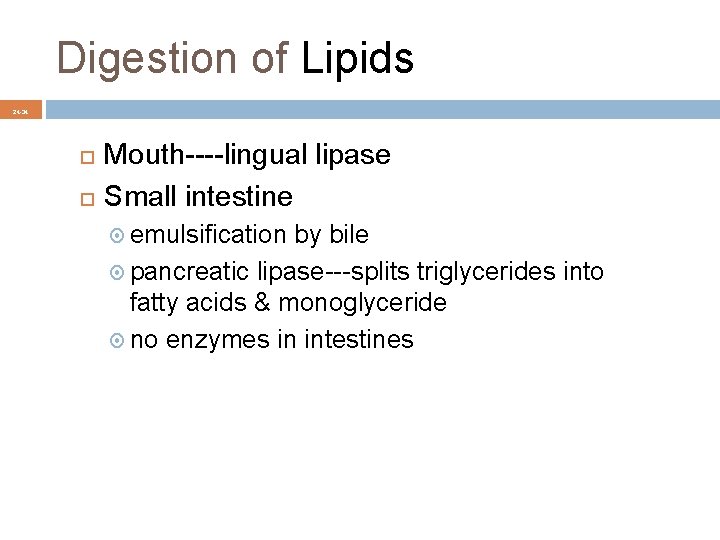
Digestion of Lipids 24 -34 Mouth----lingual lipase Small intestine emulsification by bile pancreatic lipase---splits triglycerides into fatty acids & monoglyceride no enzymes in intestines
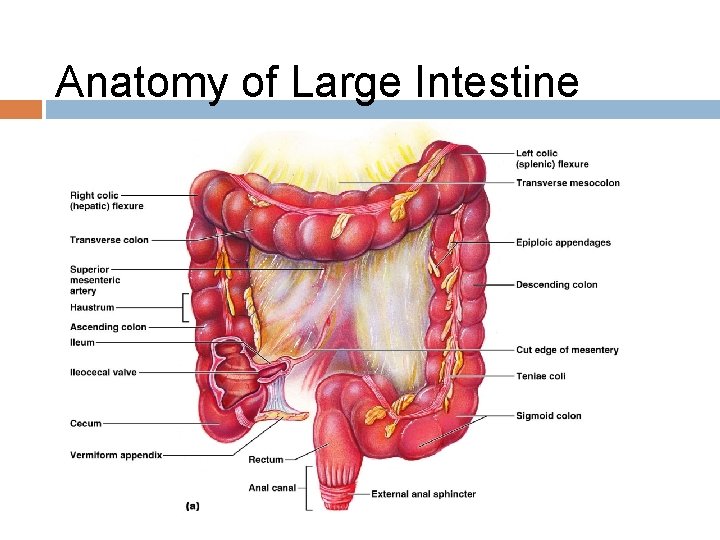
Anatomy of Large Intestine 24 -35
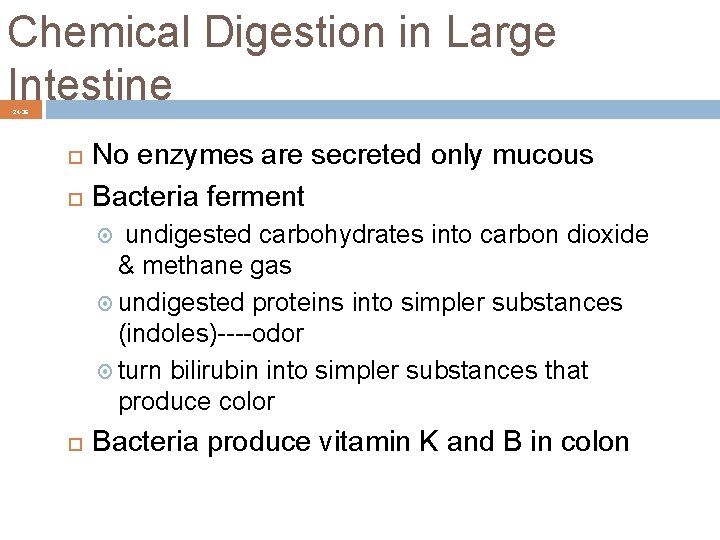
Chemical Digestion in Large Intestine 24 -36 No enzymes are secreted only mucous Bacteria ferment undigested carbohydrates into carbon dioxide & methane gas undigested proteins into simpler substances (indoles)----odor turn bilirubin into simpler substances that produce color Bacteria produce vitamin K and B in colon