
Chapter 26 Phylogeny Systematics AP Biology Copyright 2005
Chapter 26. Phylogeny & Systematics AP Biology Copyright © 2005 Pearson Education, Inc. publishing as Benjamin Cummings
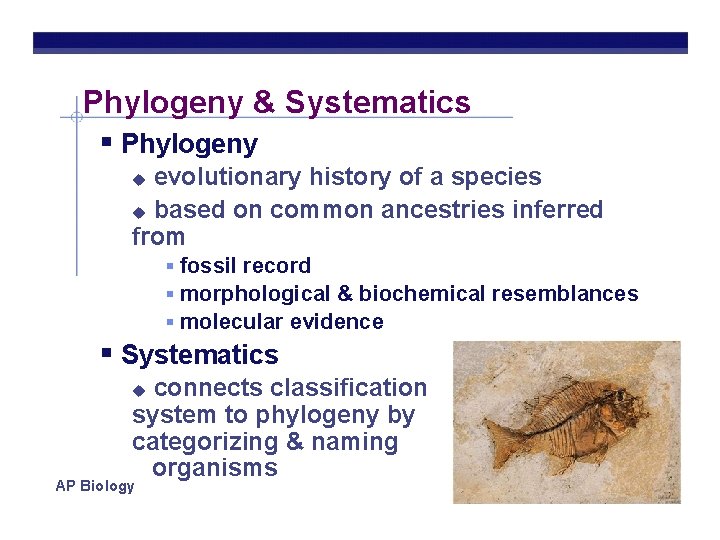
Phylogeny & Systematics Phylogeny evolutionary history of a species based on common ancestries inferred from fossil record morphological & biochemical resemblances molecular evidence Systematics connects classification system to phylogeny by categorizing & naming organisms AP Biology Copyright © 2005 Pearson Education, Inc. publishing as Benjamin Cummings
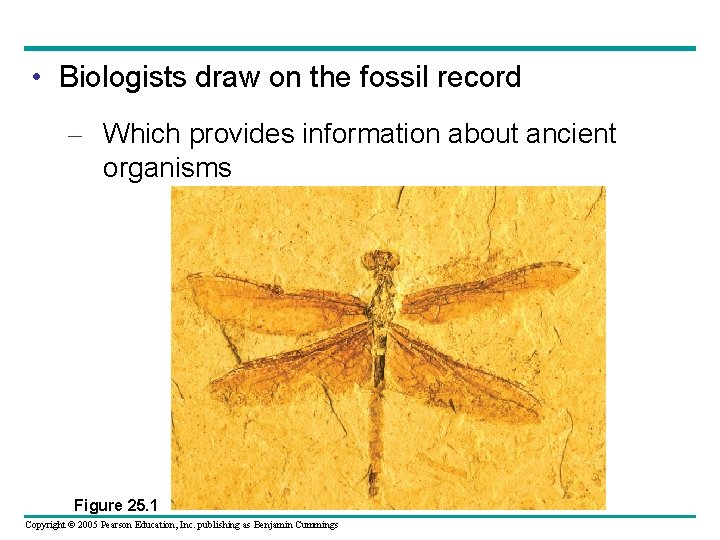
• Biologists draw on the fossil record – Which provides information about ancient organisms Figure 25. 1 Copyright © 2005 Pearson Education, Inc. publishing as Benjamin Cummings

• Currently, systematists use – Morphological, biochemical, and molecular comparisons to infer evolutionary relationships Figure 25. 2 Copyright © 2005 Pearson Education, Inc. publishing as Benjamin Cummings
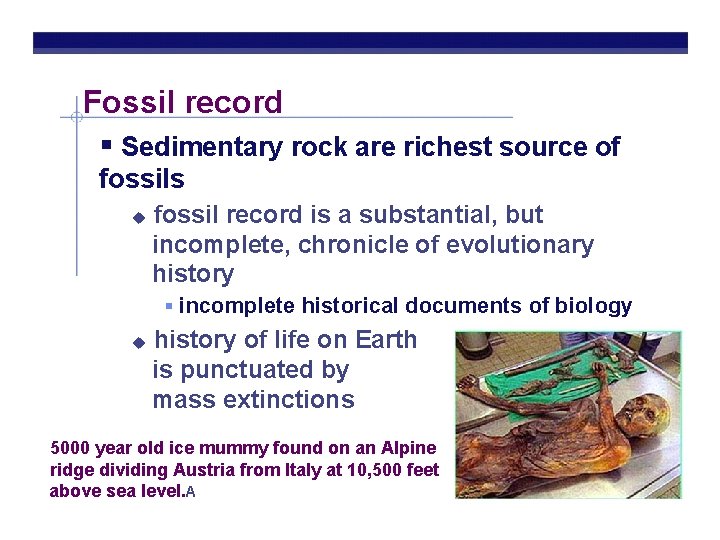
Fossil record Sedimentary rock are richest source of fossils fossil record is a substantial, but incomplete, chronicle of evolutionary history incomplete historical documents of biology history of life on Earth is punctuated by mass extinctions 5000 year old ice mummy found on an Alpine ridge dividing Austria from Italy at 10, 500 feet above sea level. A Copyright © 2005 Pearson Education, Inc. publishing as Benjamin Cummings
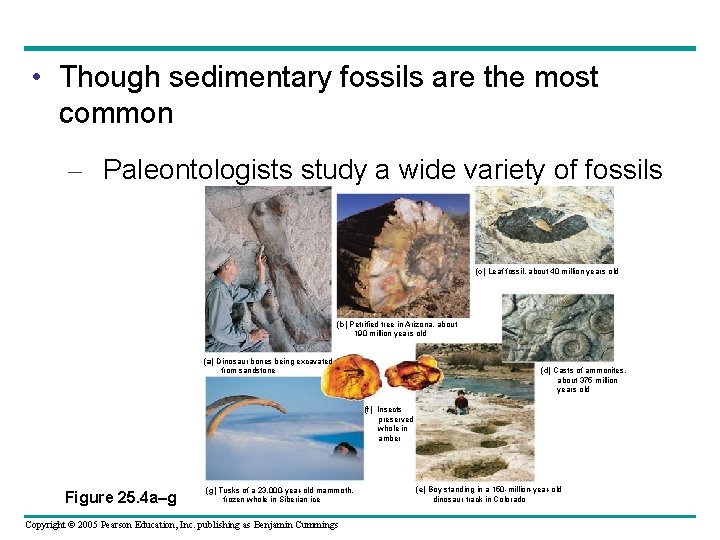
• Though sedimentary fossils are the most common – Paleontologists study a wide variety of fossils (c) Leaf fossil, about 40 million years old (b) Petrified tree in Arizona, about 190 million years old (a) Dinosaur bones being excavated from sandstone (d) Casts of ammonites, about 375 million years old (f) Insects preserved whole in amber Figure 25. 4 a–g (g) Tusks of a 23, 000 -year-old mammoth, frozen whole in Siberian ice Copyright © 2005 Pearson Education, Inc. publishing as Benjamin Cummings (e) Boy standing in a 150 -million-year-old dinosaur track in Colorado
Morphological and Molecular Homologies • In addition to fossil organisms – Phylogenetic history can be inferred from certain morphological and molecular similarities among living organisms • In general, organisms that share very similar morphologies or similar DNA sequences – Are likely to be more closely related than organisms with vastly different structures or sequences Copyright © 2005 Pearson Education, Inc. publishing as Benjamin Cummings
Sorting Homology from Analogy • A potential misconception in constructing a phylogeny – Is similarity due to convergent evolution, called analogy, rather than shared ancestry Copyright © 2005 Pearson Education, Inc. publishing as Benjamin Cummings
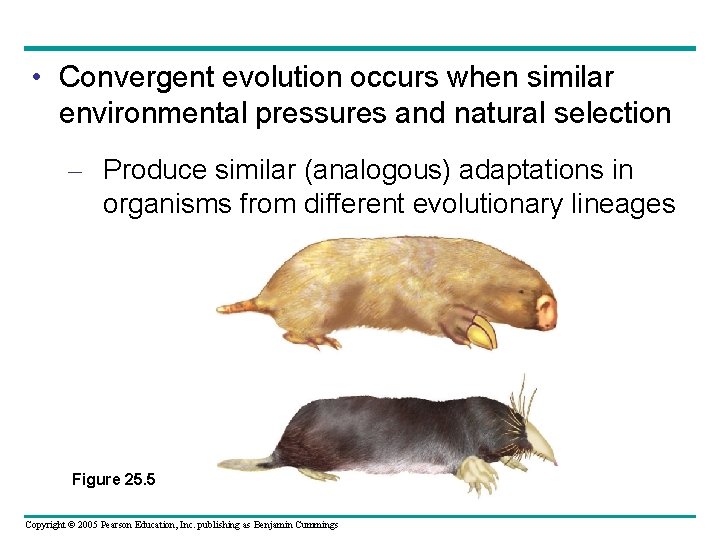
• Convergent evolution occurs when similar environmental pressures and natural selection – Produce similar (analogous) adaptations in organisms from different evolutionary lineages Figure 25. 5 Copyright © 2005 Pearson Education, Inc. publishing as Benjamin Cummings
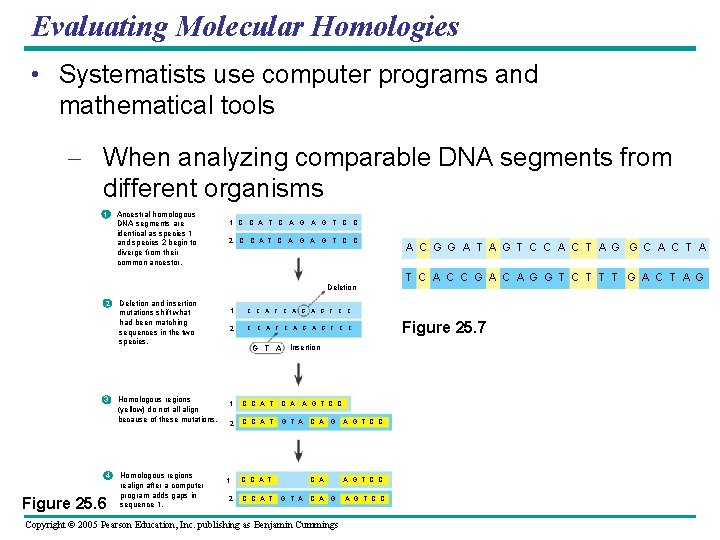
Evaluating Molecular Homologies • Systematists use computer programs and mathematical tools – When analyzing comparable DNA segments from different organisms 1 Ancestral homologous DNA segments are identical as species 1 and species 2 begin to diverge from their common ancestor. 1 C C A T C A G T C C 2 C C A T C A G T C C Deletion 2 3 4 Figure 25. 6 Deletion and insertion mutations shift what had been matching sequences in the two species. Homologous regions (yellow) do not all align because of these mutations. Homologous regions realign after a computer program adds gaps in sequence 1. 1 C C A T C A G T C C 2 C C A T C A G T C C G T A Insertion 1 C C A T C A 2 C C A T G T A 1 2 A G T C C A T G T A C A G T C C C A G T C C Copyright © 2005 Pearson Education, Inc. publishing as Benjamin Cummings A C G G A T A G T C C A C T A G G C A C T A T C A C C G A C A G G T C T T T G A C T A G Figure 25. 7
• Concept 25. 2: Phylogenetic systematics connects classification with evolutionary history • Taxonomy – Is the ordered division of organisms into categories based on a set of characteristics used to assess similarities and differences Copyright © 2005 Pearson Education, Inc. publishing as Benjamin Cummings
Binomial Nomenclature • Binomial nomenclature – Is the two-part format of the scientific name of an organism – Was developed by Carolus Linnaeus Copyright © 2005 Pearson Education, Inc. publishing as Benjamin Cummings
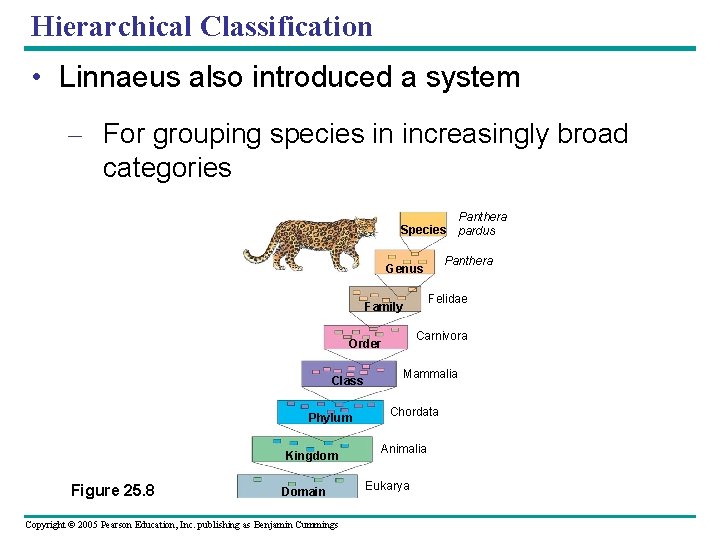
Hierarchical Classification • Linnaeus also introduced a system – For grouping species in increasingly broad categories Panthera Species pardus Panthera Genus Felidae Family Carnivora Order Class Phylum Kingdom Figure 25. 8 Domain Copyright © 2005 Pearson Education, Inc. publishing as Benjamin Cummings Mammalia Chordata Animalia Eukarya
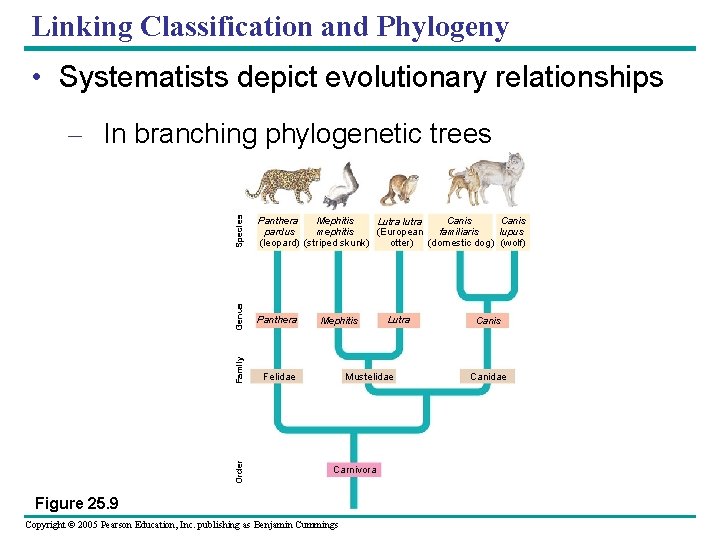
Linking Classification and Phylogeny • Systematists depict evolutionary relationships Species Panthera Order Family Panthera Mephitis Canis Lutra lutra pardus mephitis familiaris lupus (European (leopard) (striped skunk) otter) (domestic dog) (wolf) Genus – In branching phylogenetic trees Mephitis Felidae Lutra Mustelidae Carnivora Figure 25. 9 Copyright © 2005 Pearson Education, Inc. publishing as Benjamin Cummings Canidae
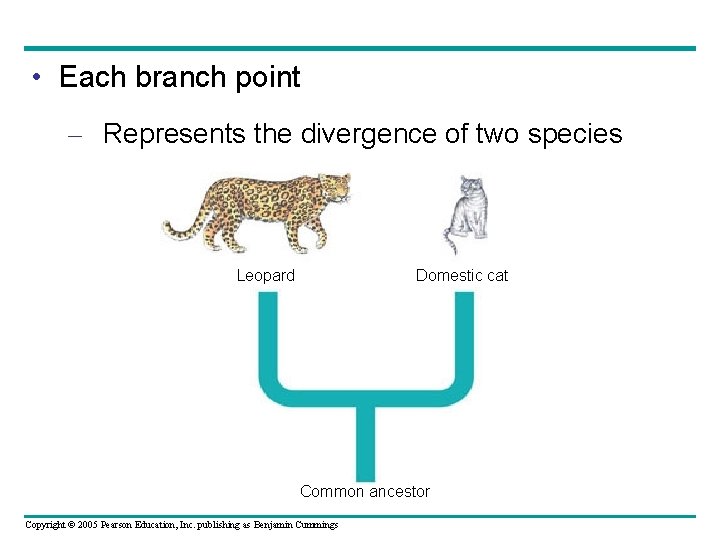
• Each branch point – Represents the divergence of two species Leopard Domestic cat Common ancestor Copyright © 2005 Pearson Education, Inc. publishing as Benjamin Cummings
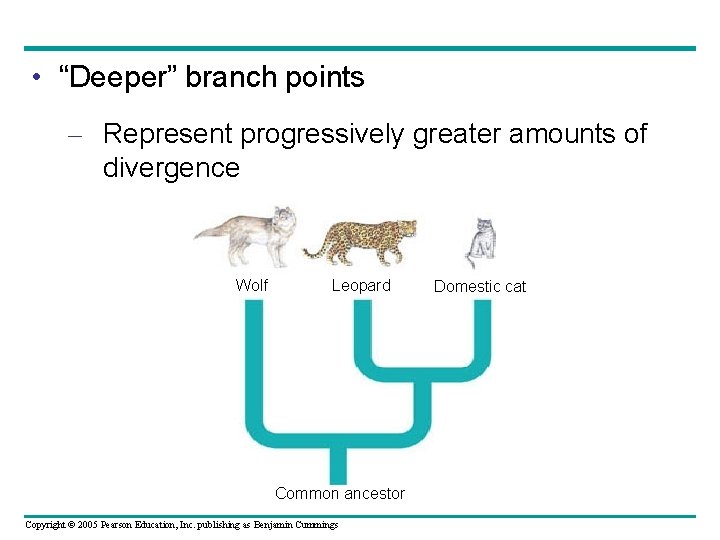
• “Deeper” branch points – Represent progressively greater amounts of divergence Wolf Leopard Common ancestor Copyright © 2005 Pearson Education, Inc. publishing as Benjamin Cummings Domestic cat
• Concept 25. 3: Phylogenetic systematics informs the construction of phylogenetic trees based on shared characteristics • A cladogram – Is a depiction of patterns of shared characteristics among taxa • A clade within a cladogram – Is defined as a group of species that includes an ancestral species and all its descendants • Cladistics – Is the study of resemblances among clades Copyright © 2005 Pearson Education, Inc. publishing as Benjamin Cummings
Cladistics • Clades – Can be nested within larger clades, but not all groupings qualify as clades Copyright © 2005 Pearson Education, Inc. publishing as Benjamin Cummings
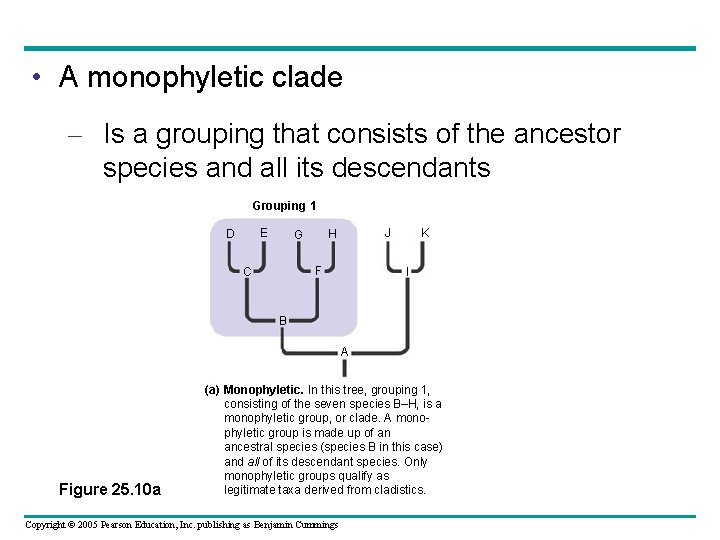
• A monophyletic clade – Is a grouping that consists of the ancestor species and all its descendants Grouping 1 E D J H G F C K I B A Figure 25. 10 a (a) Monophyletic. In this tree, grouping 1, consisting of the seven species B–H, is a monophyletic group, or clade. A monophyletic group is made up of an ancestral species (species B in this case) and all of its descendant species. Only monophyletic groups qualify as legitimate taxa derived from cladistics. Copyright © 2005 Pearson Education, Inc. publishing as Benjamin Cummings
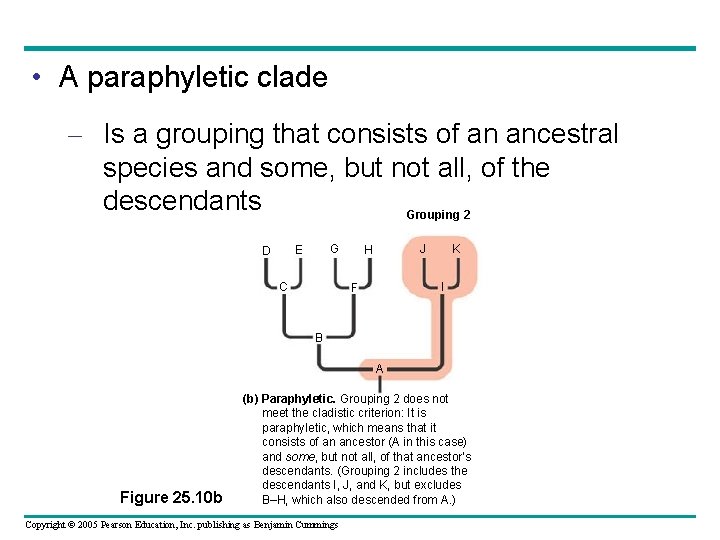
• A paraphyletic clade – Is a grouping that consists of an ancestral species and some, but not all, of the descendants Grouping 2 G E D C J H K I F B A Figure 25. 10 b (b) Paraphyletic. Grouping 2 does not meet the cladistic criterion: It is paraphyletic, which means that it consists of an ancestor (A in this case) and some, but not all, of that ancestor’s descendants. (Grouping 2 includes the descendants I, J, and K, but excludes B–H, which also descended from A. ) Copyright © 2005 Pearson Education, Inc. publishing as Benjamin Cummings
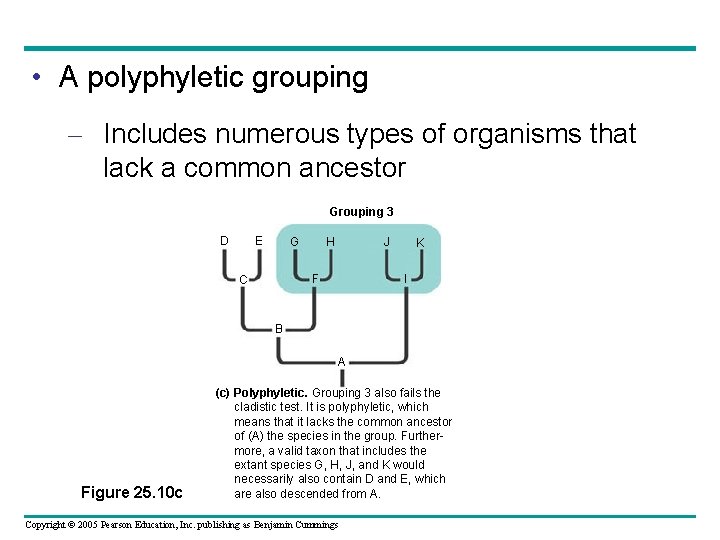
• A polyphyletic grouping – Includes numerous types of organisms that lack a common ancestor Grouping 3 D E G J H I F C K B A Figure 25. 10 c (c) Polyphyletic. Grouping 3 also fails the cladistic test. It is polyphyletic, which means that it lacks the common ancestor of (A) the species in the group. Furthermore, a valid taxon that includes the extant species G, H, J, and K would necessarily also contain D and E, which are also descended from A. Copyright © 2005 Pearson Education, Inc. publishing as Benjamin Cummings
Shared Primitive and Shared Derived Characteristics • In cladistic analysis – Clades are defined by their evolutionary novelties Copyright © 2005 Pearson Education, Inc. publishing as Benjamin Cummings
• A shared primitive character – Is a homologous structure that predates the branching of a particular clade from other members of that clade Copyright © 2005 Pearson Education, Inc. publishing as Benjamin Cummings
• A shared derived character – Is an evolutionary novelty unique to a particular clade Copyright © 2005 Pearson Education, Inc. publishing as Benjamin Cummings
Outgroups • Systematists use a method called outgroup comparison – To differentiate between shared derived and shared primitive characteristics Copyright © 2005 Pearson Education, Inc. publishing as Benjamin Cummings
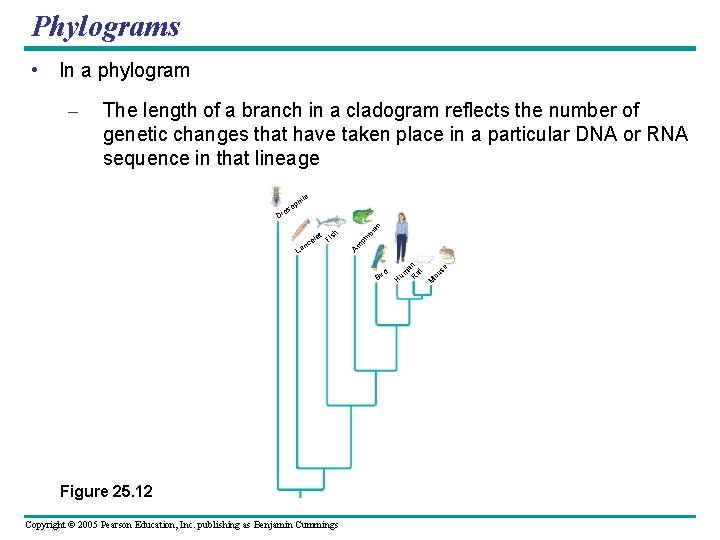
Phylograms • In a phylogram – The length of a branch in a cladogram reflects the number of genetic changes that have taken place in a particular DNA or RNA sequence in that lineage hil op s ro a ib ia n ph Figure 25. 12 Copyright © 2005 Pearson Education, Inc. publishing as Benjamin Cummings se ou M at um R rd H Bi an Am Fi let ce n La sh D
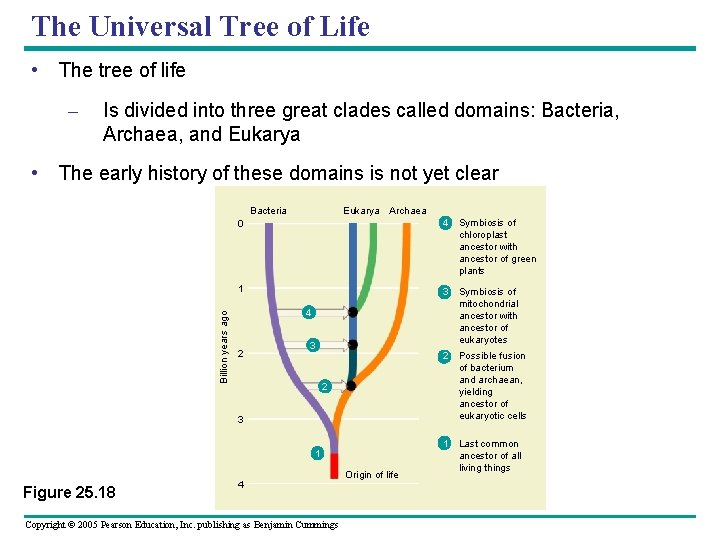
The Universal Tree of Life • The tree of life – Is divided into three great clades called domains: Bacteria, Archaea, and Eukarya • The early history of these domains is not yet clear Billion years ago Bacteria Eukarya Archaea 0 4 Symbiosis of chloroplast ancestor with ancestor of green plants 1 3 Symbiosis of mitochondrial ancestor with ancestor of eukaryotes 2 Possible fusion of bacterium and archaean, yielding ancestor of eukaryotic cells 1 Last common ancestor of all living things 4 2 3 1 Figure 25. 18 4 Copyright © 2005 Pearson Education, Inc. publishing as Benjamin Cummings Origin of life
- Slides: 27