
Chapter 26 Phylogeny And The Tree of Life
- Slides: 9
Chapter 26 Phylogeny And The Tree of Life
I. _____ shows evolutionary relationship. >Phylogenetic _____ depict hypotheses about evolutionary relationships.
• A. _____ is the study of diversity in the context of evolution. – 1. ______ is the naming of organisms. – 2. Each organism is given a ____, or 2 -part name. • Composed of the genus and species name. – 3. The levels of hierarchy in descending order are: domain, kingdom, phylum, class, order, family, genus, and species. (each level is a taxon) – Dumb Kings Play Chess On Fine Green Silk!
• B. _____ evolution occurs when 2 organisms become alike because they have similar environmental challenges. – 1. Results in analogous structures. • wings of a bat/wings of an insect.
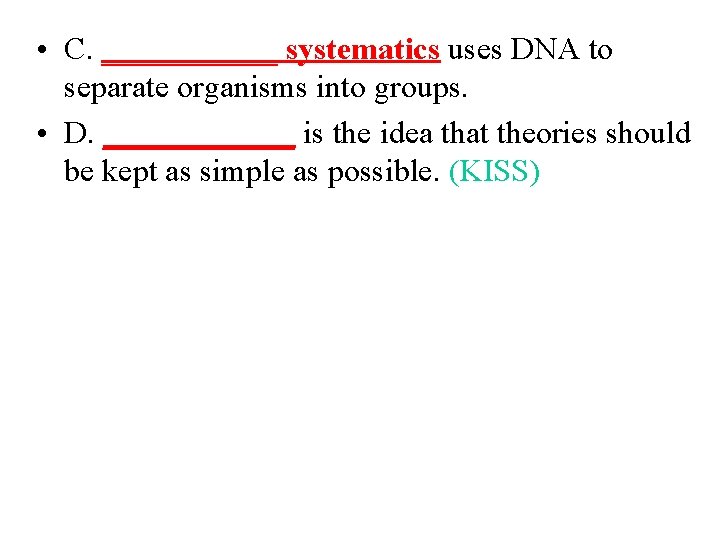
• C. ______ systematics uses DNA to separate organisms into groups. • D. ______ is the idea that theories should be kept as simple as possible. (KISS)
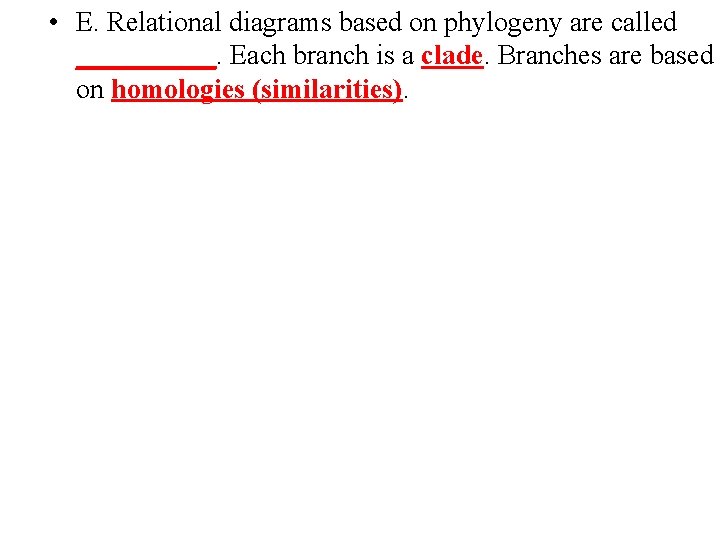
• E. Relational diagrams based on phylogeny are called _____. Each branch is a clade. Branches are based on homologies (similarities).
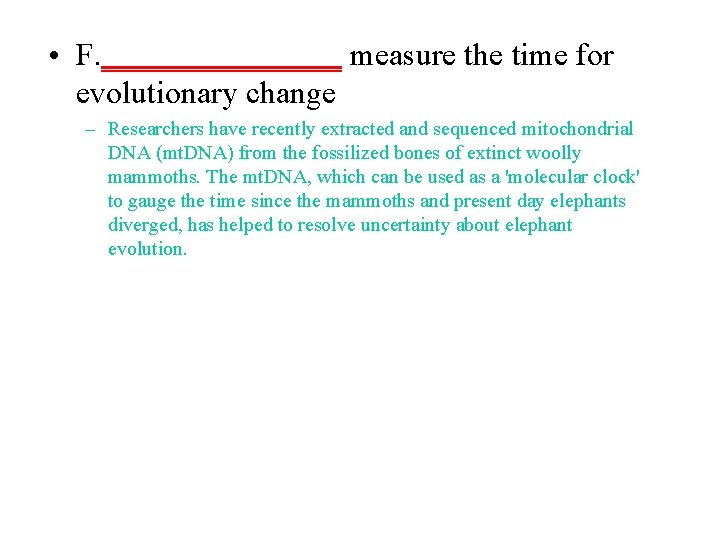
• F. ________ measure the time for evolutionary change – Researchers have recently extracted and sequenced mitochondrial DNA (mt. DNA) from the fossilized bones of extinct woolly mammoths. The mt. DNA, which can be used as a 'molecular clock' to gauge the time since the mammoths and present day elephants diverged, has helped to resolve uncertainty about elephant evolution.
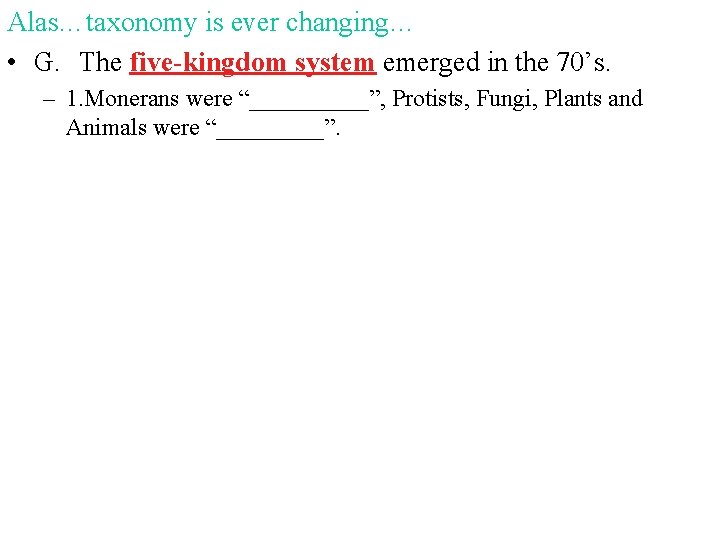
Alas…taxonomy is ever changing… • G. The five-kingdom system emerged in the 70’s. – 1. Monerans were “_____”, Protists, Fungi, Plants and Animals were “_____”.
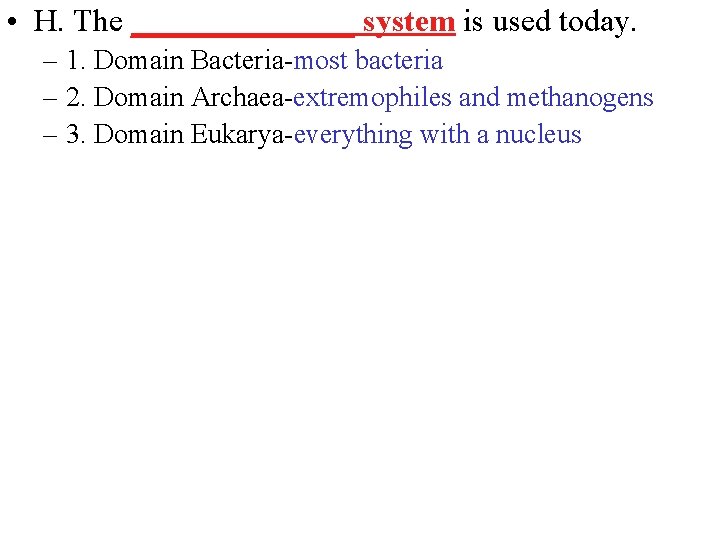
• H. The _______ system is used today. – 1. Domain Bacteria-most bacteria – 2. Domain Archaea-extremophiles and methanogens – 3. Domain Eukarya-everything with a nucleus