
Chapter 26 Performance Skills Implementing Performance Analyses to









- Slides: 29
Chapter 26 Performance Skills: Implementing Performance Analyses to Evaluate the Quality of Occupational Performance Anne G. Fisher, Lou Ann Griswold Copyright © 2019 Wolters Kluwer • All Rights Reserved 1
Learning Objectives After reading this chapter, you will be able to: 1. Describe the difference between (1) performance skills and (2) body functions. 2. Implement an analysis of performance skills (performance analysis) and document a person’s baseline quality of occupational performance. 3. Describe how the results of a performance analysis are used to collaboratively establish client-centered goals. Copyright © 2019 Wolters Kluwer • All Rights Reserved
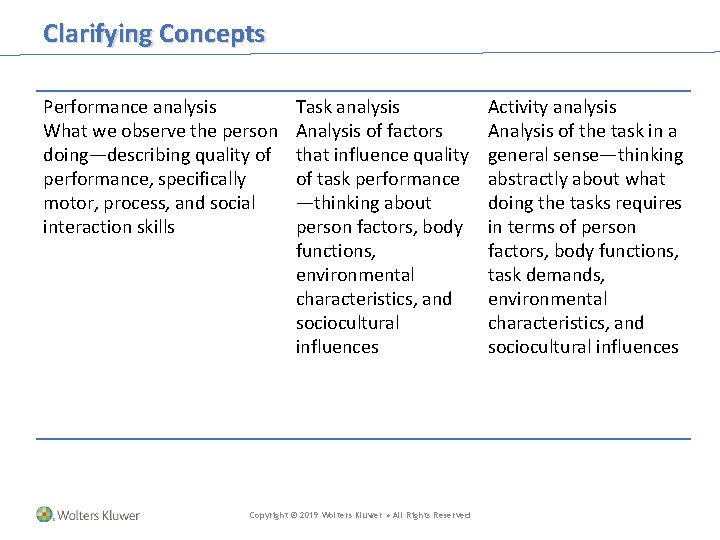
Clarifying Concepts Performance analysis What we observe the person doing—describing quality of performance, specifically motor, process, and social interaction skills Task analysis Analysis of factors that influence quality of task performance —thinking about person factors, body functions, environmental characteristics, and sociocultural influences Copyright © 2019 Wolters Kluwer • All Rights Reserved Activity analysis Analysis of the task in a general sense—thinking abstractly about what doing the tasks requires in terms of person factors, body functions, task demands, environmental characteristics, and sociocultural influences
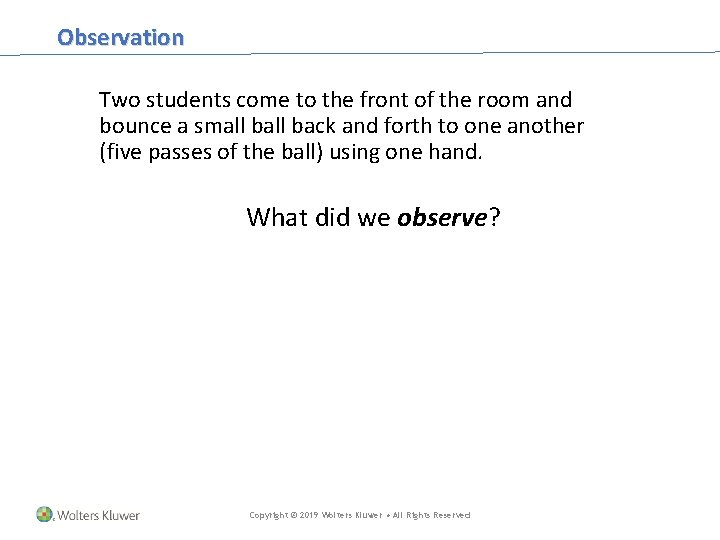
Observation Two students come to the front of the room and bounce a small back and forth to one another (five passes of the ball) using one hand. What did we observe? Copyright © 2019 Wolters Kluwer • All Rights Reserved
Bouncing a Ball Performance analysis: motor skills • Walked to the front of the room without effort • Carried the ball to one side of the room without effort • Bent and reached to catch the ball without stiffness • Turned the ball in hand to bounce it back with dexterity • Used two body parts (two hands or chest) to catch • Used force that was adequate to bounce the ball across the room The statements above reflect analysis of the quality of performance of motor skills. Copyright © 2019 Wolters Kluwer • All Rights Reserved
Bouncing a Ball—(cont. ) Performance analysis: process skills • Searched/located and gathered the ball effectively from instructor • Used the ball as a ball • Handled the ball with care so it did not drop • Initiated bouncing the ball without a delay The statements above reflect analysis of the quality of performance of process skills. Copyright © 2019 Wolters Kluwer • All Rights Reserved
Bouncing a Ball—(cont. ) Performance analysis: social interaction skills • Gestured (e. g. , nodded and pointed) that he or she was ready for the ball • Turned toward and then looked at the other person • Replied to messages with relevant comments related to playing ball • Timed responses such that he or she did not interrupt the social partner The statements above reflect analysis of the quality of performance of social interaction skills. Copyright © 2019 Wolters Kluwer • All Rights Reserved
Performance Analysis Analyzing quality of skills—observable actions The universal performance skills provide a structure to guide analysis. • Motor skills • Process skills • Social interaction skills Copyright © 2019 Wolters Kluwer • All Rights Reserved
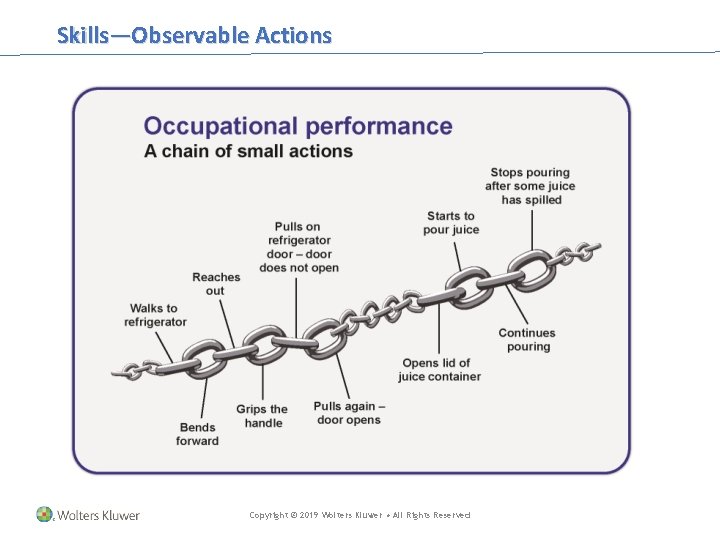
Skills—Observable Actions Copyright © 2019 Wolters Kluwer • All Rights Reserved
Task Analysis Interpreting reasons for any problems in performance: • Person factors and body functions • Task demands • Environmental characteristics • Sociocultural influences Copyright © 2019 Wolters Kluwer • All Rights Reserved
Task Analysis for Bouncing a Ball • Ball was flat or too bouncy. • Ball was too small. • Not a big enough space to play ball • Many people watching • Expectation of good performance in a class Copyright © 2019 Wolters Kluwer • All Rights Reserved
Activity Analysis for Bouncing a Ball Environment • Open space • Another person with whom to bounce ball Task demands • Ball (required object) • Catch and then bounce ball (steps and sequence of steps) Person factors • Internalized routine for playing ball Body functions • • • Shoulder and elbow movements (flexion, extension) Motor planning Vision Visual perception Emotional regulation Copyright © 2019 Wolters Kluwer • All Rights Reserved
Purpose of Each Type of Analysis Performance analysis To describe the quality of a person’s performance during a task Task analysis To consider possible causes of problems in performing a task Activity analysis To analyze requirements of a task Purpose: • To document baseline of occupational performance • To establish goals Purpose: • To consider interventions to address underlying problems Purpose: • To consider the task for possible use in intervention and options for modification of the task Copyright © 2019 Wolters Kluwer • All Rights Reserved
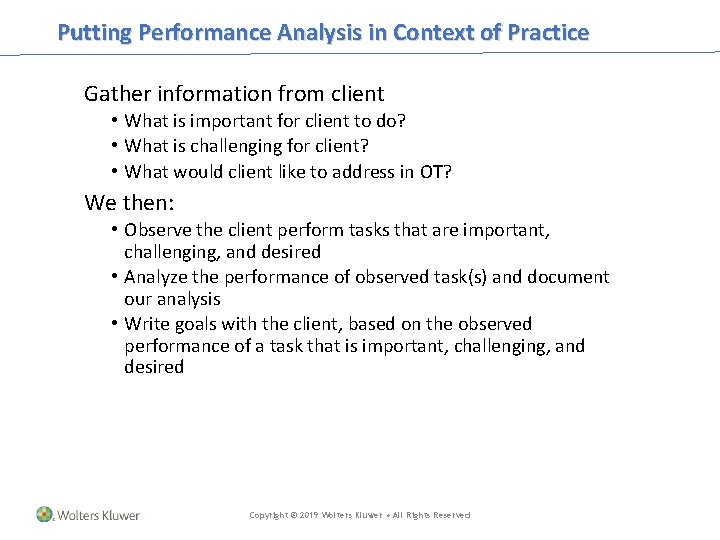
Putting Performance Analysis in Context of Practice Gather information from client • What is important for client to do? • What is challenging for client? • What would client like to address in OT? We then: • Observe the client perform tasks that are important, challenging, and desired • Analyze the performance of observed task(s) and document our analysis • Write goals with the client, based on the observed performance of a task that is important, challenging, and desired Copyright © 2019 Wolters Kluwer • All Rights Reserved
Performance Analysis • Focus on the quality of performance for each observable action (each link in the chain seen earlier) • Motor skills • Process skills • Social interaction skills • Rate the quality of each action using standardized assessment tools or nonstandardized ratings of: • • No problem Mild problem Moderate problem Marked problem Copyright © 2019 Wolters Kluwer • All Rights Reserved
Motor Skills Describe the quality of motor performance. • Physical effort and/or clumsiness As the person: • Moves self and objects in environment during the task • Holds and manipulates task objects There are 16 universal motor skills defined in Table 26 -1. Copyright © 2019 Wolters Kluwer • All Rights Reserved
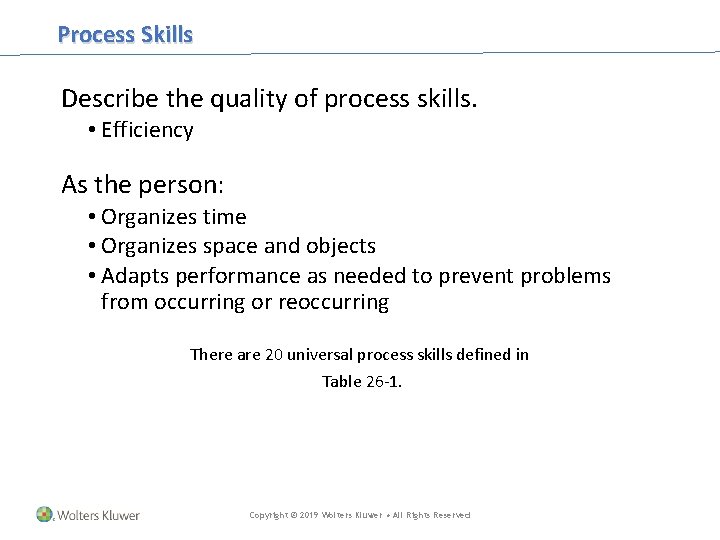
Process Skills Describe the quality of process skills. • Efficiency As the person: • Organizes time • Organizes space and objects • Adapts performance as needed to prevent problems from occurring or reoccurring There are 20 universal process skills defined in Table 26 -1. Copyright © 2019 Wolters Kluwer • All Rights Reserved
Motor and Process Skills Problems in either type of skill can lead to: • Safety concerns • Need for assistance When might this information be useful? Copyright © 2019 Wolters Kluwer • All Rights Reserved
Social Interaction Skills Describe the quality of social interaction skills to: • Share information • Gather information • Problem-solve or make decisions • Collaborate • Acquire goods or services • Converse socially When do people use social interaction skills? Copyright © 2019 Wolters Kluwer • All Rights Reserved
Performance Skill Problems Consider the universal performance skills. Do you ever: • Fumble your pencil or other object? • Have a potato or apple slip from your grip when you are peeling it? • Delay to support and object so that it almost falls? • Pause before starting the next step? • Pause while you are doing an action? • Look away from your task? Of course so, we all do! Good observations will capture these errors. Copyright © 2019 Wolters Kluwer • All Rights Reserved
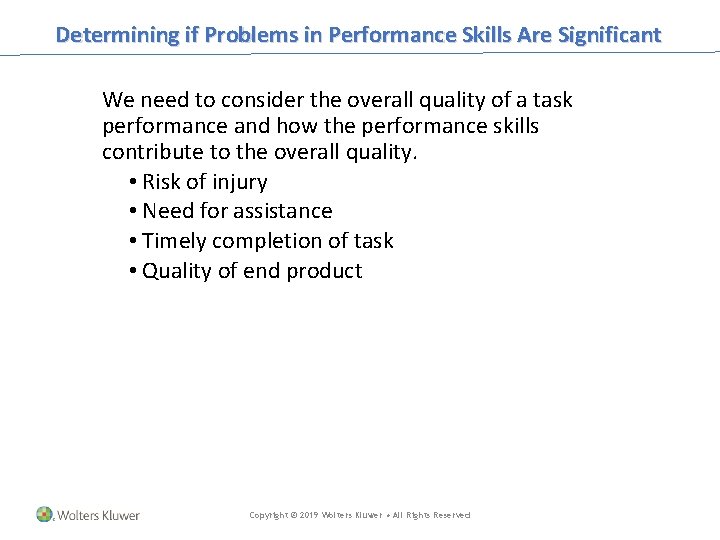
Determining if Problems in Performance Skills Are Significant We need to consider the overall quality of a task performance and how the performance skills contribute to the overall quality. • Risk of injury • Need for assistance • Timely completion of task • Quality of end product Copyright © 2019 Wolters Kluwer • All Rights Reserved
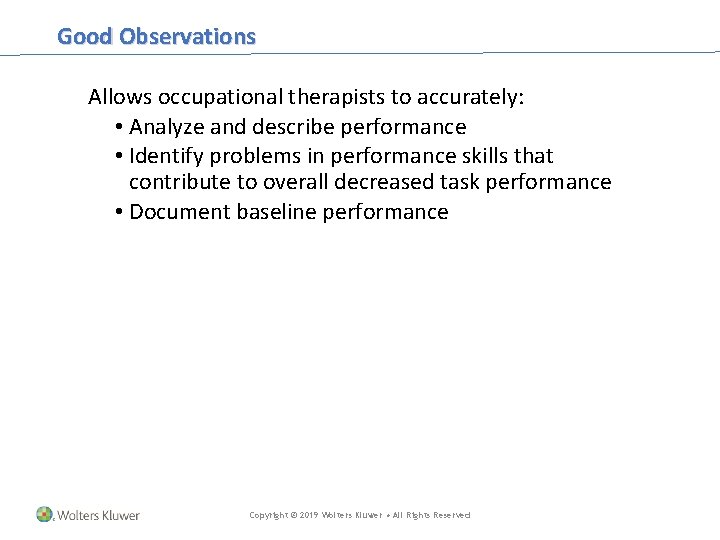
Good Observations Allows occupational therapists to accurately: • Analyze and describe performance • Identify problems in performance skills that contribute to overall decreased task performance • Document baseline performance Copyright © 2019 Wolters Kluwer • All Rights Reserved
Steps of Performance Analysis Step 1. Observe performance. Step 2. Rate performance. Step 3. List effective and ineffective skills. Step 4. Cluster skills and write summary statements. Copyright © 2019 Wolters Kluwer • All Rights Reserved
Implementing a Performance Analysis Step 1. Observe performance. Maurice—preparing a glass of orange juice Re-read the observation description of Maurice pouring a glass of orange juice in the case study presented at the beginning of Chapter 26. Copyright © 2019 Wolters Kluwer • All Rights Reserved
Implementing a Performance Analysis—(cont. ) Step 2. Rate performance. Rate the quality of Maurice’s performance of this task using the universal performance skills in Table 26 -1. The rating of Maurice’s task performance when putting on his socks and shoes, presented in Table 26 -3, will provide a model. Copyright © 2019 Wolters Kluwer • All Rights Reserved
Implementing a Performance Analysis—(cont. ) Maurice’s quality of ADL task performance—preparing a glass of juice ADL motor skills Behavior observed Stabilizes Walks Copyright © 2019 Wolters Kluwer • All Rights Reserved Rating
Implementing a Performance Analysis—(cont. ) Step 3. List effective and ineffective skills. Effective skills Ineffective skills Copyright © 2019 Wolters Kluwer • All Rights Reserved
Implementing a Performance Analysis—(cont. ) Step 4. Cluster skills and write summary statements. Your comments. . . Copyright © 2019 Wolters Kluwer • All Rights Reserved
Benefits of Performance Analysis • Focuses on tasks that client wants to do better • Focuses on analyzing the quality of doing—not underlying body function • Uses language that is clear, objective, and understandable by the client and others • Leads to writing goals that are client-centered and based on occupation • Keeps occupational therapists focused on occupation! Copyright © 2019 Wolters Kluwer • All Rights Reserved