
Chapter 26 Introduction to Semiconductors Semiconductor Basics Atoms
Chapter 26 Introduction to Semiconductors
Semiconductor Basics • Atoms – Protons – Neutrons – Electrons 2
Semiconductor Basics • Electron shells: K, L, M, N, etc. – Conductor • 1 electron in outer shell (valence shell) – Insulator • 8 in valence shell (outer shell full) – Semiconductor • 4 in valence shell 3
Semiconductor Basics • Most common semiconductors – Silicon (Si) – Germanium (Ge) 4
Semiconductor Basics • Valence electrons have greatest energy • Electrons have discrete energy levels that correspond to orbits 5
Semiconductor Basics • Valence electrons have two energy levels – Valence Band • Lower energy level – Conduction Band • Higher energy level 6
Semiconductor Basics • Differences in energy levels provide – Insulators – Semiconductors – Conductors 7
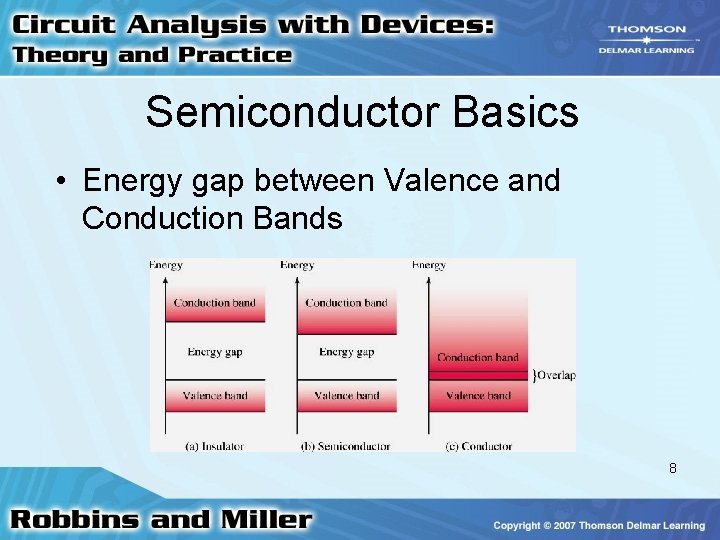
Semiconductor Basics • Energy gap between Valence and Conduction Bands 8
Semiconductor Basics • Conductor has many “free” electrons • These are called “conduction” electrons • Energy Gap is between valence and conduction band 9
Semiconductor Basics • Atomic Physics – Energy expressed in electron volts (e. V) – 1 e. V = 1. 602 10– 19 joules • Energy gap – Small for conductors – Large for insulators 10
Semiconductor Basics • Silicon has 4 electrons in its valence shell • 8 electrons fill the valence shell • Silicon forms a lattice structure and adjacent atoms “share” valence electrons 11
Semiconductor Basics • Electrons are shared so each valence shell is filled (8 electrons) • Valence shells full – No “free” electrons at 0 K 12
Conduction in Semiconductors • At temperatures > °K – Some electrons move into conduction band • Electron-Hole pairs are formed – Hole is vacancy left in lattice by an electron that moves into conduction band – Continuous recombination occurs 13
Conduction in Semiconductors • Electrons available for conduction – Copper ≈ 1023 – Silicon ≈ 1010 – Germanium ≈ 1012 (poor conductor) 14
Conduction in Semiconductors • Hole: absence of an electron in the lattice structure – Electrons move from – to + – Holes (absence of electrons) move from + to – – Recombination • When an electron fills a hole 15

Conduction in Semiconductors 16
Conduction in Semiconductors • As electrons move toward + terminal – Recombine with holes from other electrons – Electron current is mass movement of electrons – Hole current is mass movement of holes created by displaced electrons 17
Conduction in Semiconductors • Effect of temperature – Higher energy to electrons in valence band – Creates more electrons in conduction band – Increases conductivity and reduces resistance – Semiconductors have a negative temperature coefficient (NTC) 18
Doping • Adding impurities to semiconductor – Creates more free electron/hole pairs – Greatly increased conductivity – Known as “doping” 19
Doping • Terminology – Pure semiconductor known as intrinsic – Doped semiconductor known as extrinsic 20
Doping • Creates n-type or p-type semiconductors – Add a few ppm (parts per million) of doping material – n-type • More free electrons than holes – p-type • More holes than free electrons 21
Doping • Creating n-type semiconductors – Add (dope with) atoms with 5 valence electrons – Pentavalent atoms • Phosphorous (P) • Arsenic (As) • Antimony (Sb) – Group V on periodic table 22
Doping • Creating n-type semiconductors – New, donor atoms become part of lattice structure – Extra electron available for conduction 23
Doping • Intrinsic semiconductors – Equal number of holes and electrons – Conduction equally by holes and electrons – Very poor conductors (insulators) 24
Doping • n-type extrinsic semiconductor – Free electrons greatly outnumber free holes – Conduction primarily by electrons – Electrons are the “majority” carriers 25
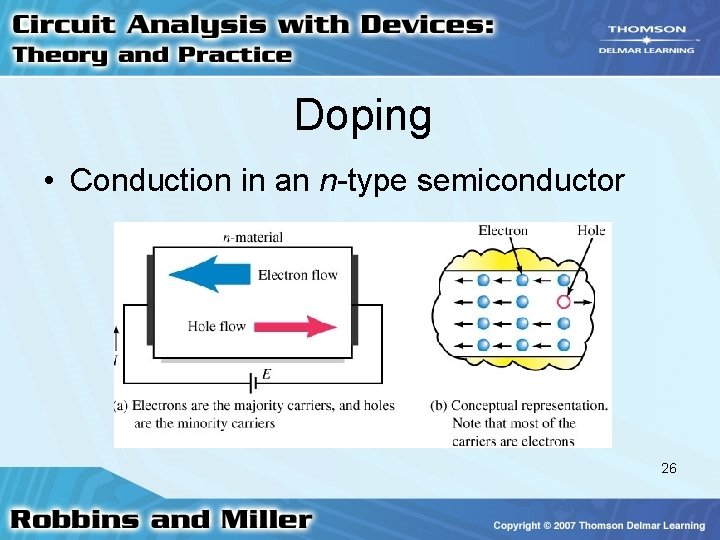
Doping • Conduction in an n-type semiconductor 26
Doping • Creating p-type semiconductors – Add (dope with) atoms with 3 valence electrons – Trivalent atoms • Boron (B) • Aluminum (Al) • Gallium (Ga) – Group III on periodic table 27
Doping • Creating p-type semiconductors – New, acceptor atoms become part of lattice structure – Extra hole available for conduction 28
Doping • p-type extrinsic semiconductor – Free holes greatly outnumber free electrons – Conduction primarily by holes – Holes are the “majority” carriers – Electrons are the “minority” carriers 29
The p-n Junction • Abrupt transition from p-type to n-type material • Creation – Must maintain lattice structure – Use molten or diffusion process 30
The p-n Junction • Example – Heat n-type material to high temperature – Boron gas diffuses into material – Only upper layer becomes p-type – p-n junction created without disturbing lattice structure 31
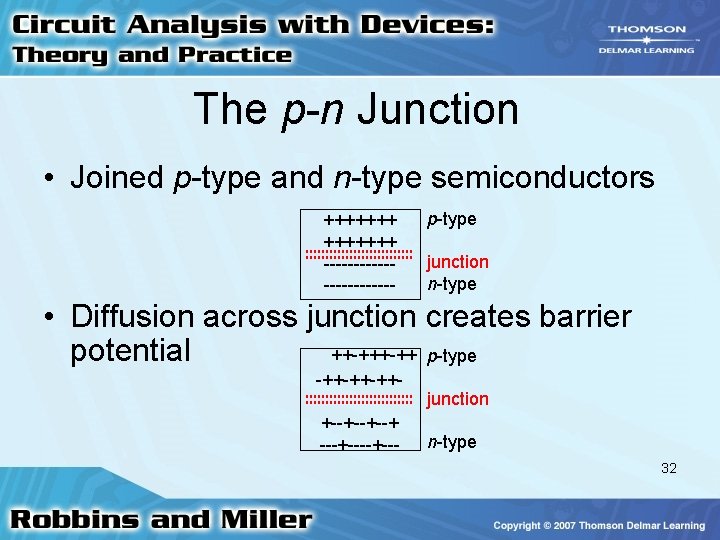
The p-n Junction • Joined p-type and n-type semiconductors +++++++ ------------ p-type junction n-type • Diffusion across junction creates barrier potential ++-++ p-type -++-++-+++--+--+--+ ---+--- junction n-type 32
The p-n Junction • Joined p-type and n-type semiconductors +++++++ ------------ p-type junction n-type • Diffusion across junction creates barrier potential ++-++ p-type -++-++-+++--+--+--+ ---+--- junction n-type 33
The p-n Junction • Depletion region • Barrier voltage, VB • Silicon – VB ≈ 0. 7 volts at 25 C 34
The p-n Junction • Germanium – VB ≈ 0. 3 volts at 25 C • VB must be overcome for conduction • External source must be used 35
The Biased p-n Junction • Basis of semiconductor devices • Diode – Unidirectional current – Forward bias (overcome VB) – conducts easily – Reverse bias – virtually no current – p-type end is anode (A) 36
The Biased p-n Junction • Diode – n-type end is cathode (K) – Anode and cathode are from vacuum tube terminology 37
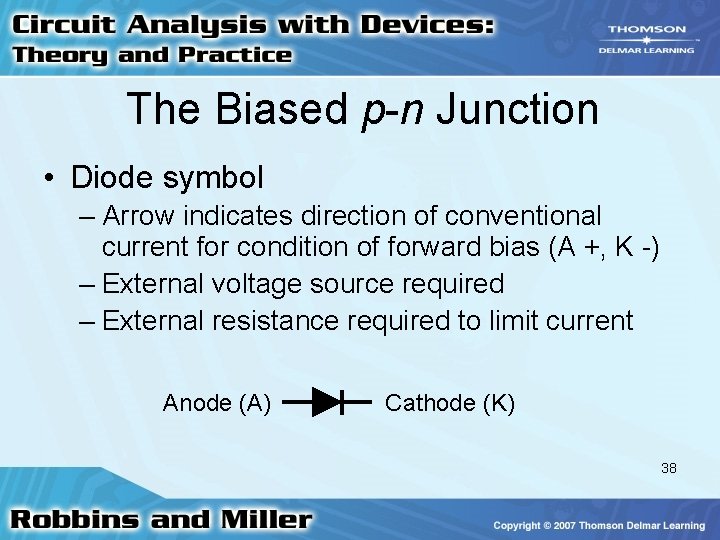
The Biased p-n Junction • Diode symbol – Arrow indicates direction of conventional current for condition of forward bias (A +, K -) – External voltage source required – External resistance required to limit current Anode (A) Cathode (K) 38
The Biased p-n Junction • Holes are majority carriers in p-type • Electrons are majority carriers in n-type 39
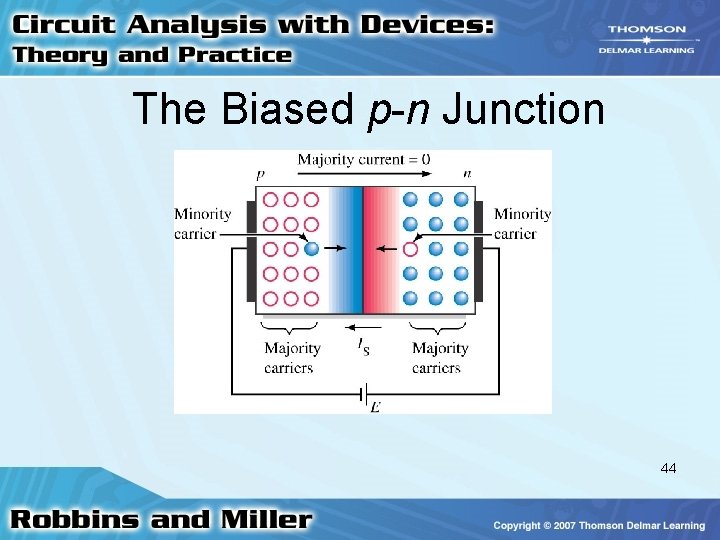
The Biased p-n Junction • Reverse biased junction – Positive (+) terminal draws n-type majority carriers away from junction – Negative (–) terminal draws p-type majority carriers away from junction – No majority carriers attracted toward junction – Depletion region widens 40
The Biased p-n Junction • Electrons are minority carriers in p-type • Holes are minority carriers in n-type • Reverse biased junction – Minority carriers drawn across junction – Very few minority carriers 41
The Biased p-n Junction • Reverse biased current – Saturation current, IS – Nanoamp-to-microamp range for signal diodes 42
The Biased p-n Junction • Reverse biased junction – Positive terminal of source connected to cathode (n-type material) 43
The Biased p-n Junction 44
The Biased p-n Junction • p-type – Holes are majority carriers • n-type – Electrons are majority carriers 45
The Biased p-n Junction • Forward biased junction – + terminal draws n-type majority carriers toward junction – – terminal draws p-type majority carriers toward junction – Minority carriers attracted away from junction – Depletion region narrows 46
The Biased p-n Junction • Forward biased junction – Majority carriers drawn across junction – Current in n-type material is electron current – Current in p-type material is hole current – Current is referred to as Imajority or IF (for forward current) 47
The Biased p-n Junction • Voltage across Forward biased diode ≈ VB – Often referred to as VF (for forward voltage) – VB ≈ 0. 7 for Silicon and 0. 3 for Germanium • Forward biased current – Majority and Minority current – Minority current negligible 48
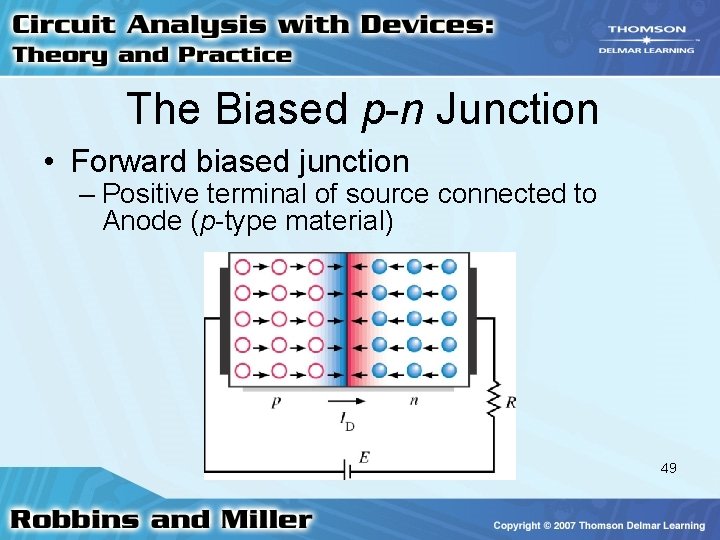
The Biased p-n Junction • Forward biased junction – Positive terminal of source connected to Anode (p-type material) 49
The Biased p-n Junction • Forward biased junction – Conducts when E exceeds VB – For E < VB very little current flows – Total current = majority + minority current – Diode current, IF ≈ majority current – VF ≈ 0. 7 volts for a silicon diode 50
Other Considerations • Junction Breakdown – Caused by large reverse voltage – Result is high reverse current – Possible damage to diode • Two mechanisms – Avalanche Breakdown – Zener Breakdown 51
Other Considerations • Avalanche Breakdown – Minority carriers reach high velocity – Knock electrons free – Create additional electron-hole pairs – Created pairs accelerated • Creates more electrons – “Avalanche” effect can damage diode 52
Other Considerations • Peak Inverse Voltage (PIV) or Peak Reverse Voltage (PRV) rating of diode 53
Other Considerations • Zener Breakdown – Heavily doped n-type and p-type materials in diode – Narrows depletion region – Increases electric field at junction – Electrons torn from orbit – Occurs at the Zener Voltage, VZ 54
Other Considerations • Zener Diodes – Designed to use this effect – An important type of diode 55
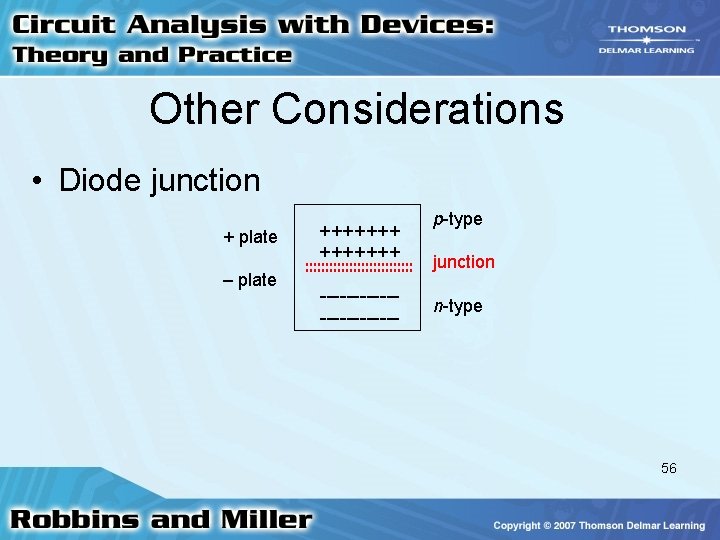
Other Considerations • Diode junction + plate – plate +++++++ ------------ p-type junction n-type 56
Other Considerations • Like a capacitor – Thickness of depletion region changes with applied voltage – Capacitance dependent on distance between plates 57
- Slides: 57