
Chapter 26 Hybrid Drive Technology Objectives After studying
Chapter 26 Hybrid Drive Technology
Objectives After studying this chapter, you will be able to: • Identify the major parts common to hybrid gas/electric or all-electric vehicles. • Compare hybrid design and construction variations. • Explain the operation of a motor-generator, HV battery, and HV power control module. • Correctly answer ASE certification test questions on hybrid drive systems. © Goodheart-Willcox Co. , Inc. Permission granted to reproduce for educational use only.

Hybrid Vehicles • Hybrid electric vehicle (HEV) – Uses two power sources for propulsion – Small gas or diesel engine used with high-voltage battery and motor-generator • To electricians, HV means “high voltage” – All hybrid vehicles operate on high voltage – HV refers to high voltage circuits and components © Goodheart-Willcox Co. , Inc. Permission granted to reproduce for educational use only.
Hybrid Vehicle History • 1898 – Ferdinand Porsche • Small internal combustion engine to spin direct current (dc) electric generator • 1966 – U. S. Congress passed bill recommending developing electric vehicles to reduce air pollution and dependence on foreign oil © Goodheart-Willcox Co. , Inc. Permission granted to reproduce for educational use only.
Hybrid Vehicle History (Cont. ) • 1990 s – Automakers started perfecting hybrid drive systems • Currently – All major automakers build hybrid electric vehicles capable of operating on electricity only • Full electric vehicles practical for short trips or city driving © Goodheart-Willcox Co. , Inc. Permission granted to reproduce for educational use only.
Hybrid Drive Construction • Internal combustion engine (ICE) and electric drive system – Under computer control to propel vehicle and operate accessory systems • Hybrid vehicle comes to a stop – Both internal combustion engine and high-voltage charging system shut off © Goodheart-Willcox Co. , Inc. Permission granted to reproduce for educational use only.
Hybrid Drive Construction (Cont. ) Hybrid electric drive system • Almost silently cranks engine over for starting • Steps-down HV battery dc voltage to 12– 15 volts dc – Power lights, instrumentation, and on-board computer circuits © Goodheart-Willcox Co. , Inc. Permission granted to reproduce for educational use only.
Hybrid Drive Construction (Cont. ) • Shut off internal combustion engine when battery charging is not needed • Hybrid drive regenerative braking system prevents wear of conventional friction brake pads and brake rotors © Goodheart-Willcox Co. , Inc. Permission granted to reproduce for educational use only.
Hybrid Drive Construction (Cont. ) Six major assemblies in hybrid drive system • HV battery • Motor-generator • HV power control module (HV PCM) • Hybrid control module • HV power cables • Internal combustion engine © Goodheart-Willcox Co. , Inc. Permission granted to reproduce for educational use only.
Full Hybrids • Uses motor-generator to initially accelerate and propel vehicle • Internal combustion engine runs only when battery pack discharges, or during heavy acceleration • Full hybrids accelerate normally without consuming fuel or emitting exhaust emissions © Goodheart-Willcox Co. , Inc. Permission granted to reproduce for educational use only.
Mild Hybrids • Mild hybrid or assist hybrid – Propelled by internal combustion engine only • This hybrid shuts down internal combustion engine when vehicle coasts, brakes, or stops • Uses HV starter-alternator to restart engine when brake pedal is released © Goodheart-Willcox Co. , Inc. Permission granted to reproduce for educational use only.
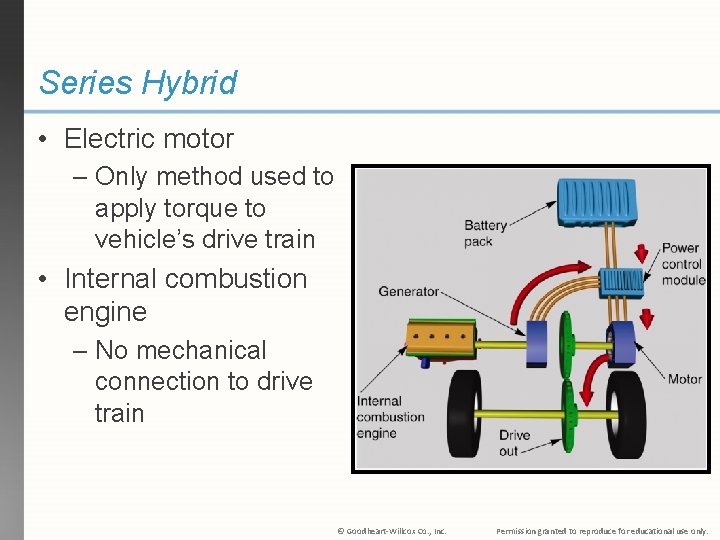
Series Hybrid • Electric motor – Only method used to apply torque to vehicle’s drive train • Internal combustion engine – No mechanical connection to drive train © Goodheart-Willcox Co. , Inc. Permission granted to reproduce for educational use only.
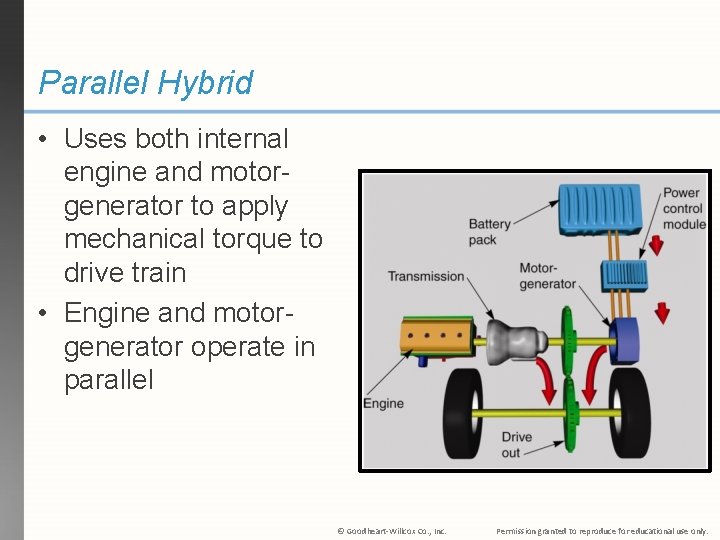
Parallel Hybrid • Uses both internal engine and motorgenerator to apply mechanical torque to drive train • Engine and motorgenerator operate in parallel © Goodheart-Willcox Co. , Inc. Permission granted to reproduce for educational use only.
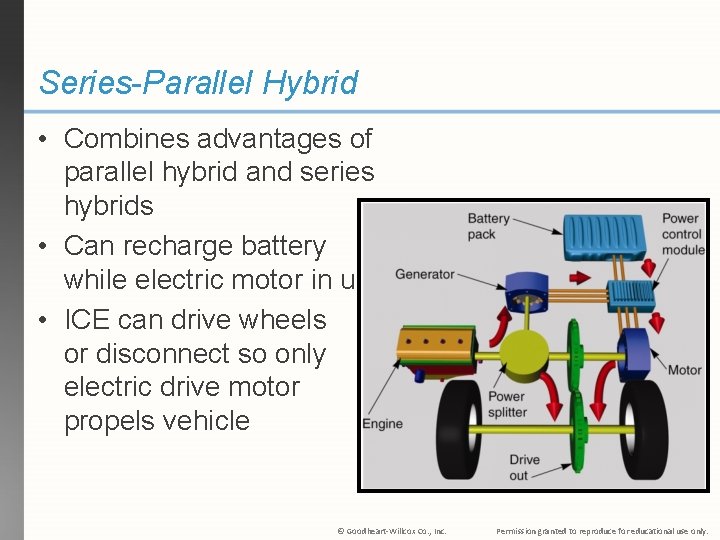
Series-Parallel Hybrid • Combines advantages of parallel hybrid and series hybrids • Can recharge battery while electric motor in use • ICE can drive wheels or disconnect so only electric drive motor propels vehicle © Goodheart-Willcox Co. , Inc. Permission granted to reproduce for educational use only.
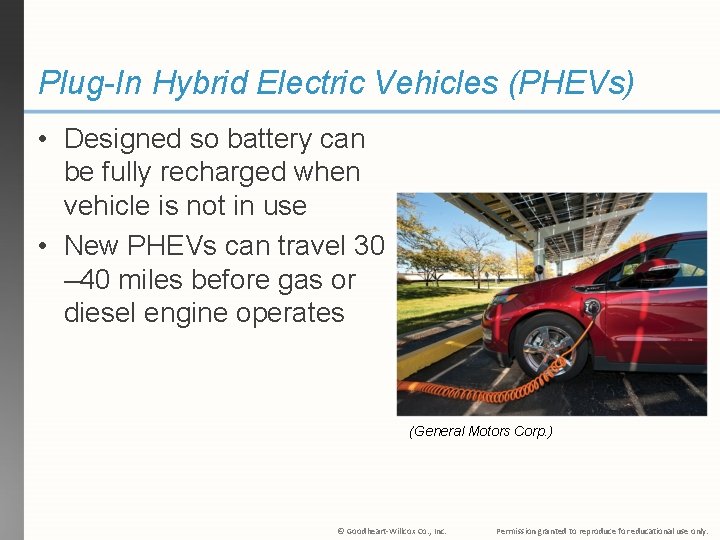
Plug-In Hybrid Electric Vehicles (PHEVs) • Designed so battery can be fully recharged when vehicle is not in use • New PHEVs can travel 30 – 40 miles before gas or diesel engine operates (General Motors Corp. ) © Goodheart-Willcox Co. , Inc. Permission granted to reproduce for educational use only.
Full-Electric Vehicles • Only have electric propulsion system • No method of recharging HV battery when driving • Practical for city driving – Driving range limited to less than 100 miles © Goodheart-Willcox Co. , Inc. Permission granted to reproduce for educational use only.
Flywheel Generator Hybrids • HV flywheel or kinetic energy generator – Uses large, heavy flywheel rotor spinning series of electromagnets to store electrical energy • Equipped in hybrid race cars – Successful on international road race courses – Corner exit boost © Goodheart-Willcox Co. , Inc. Permission granted to reproduce for educational use only.
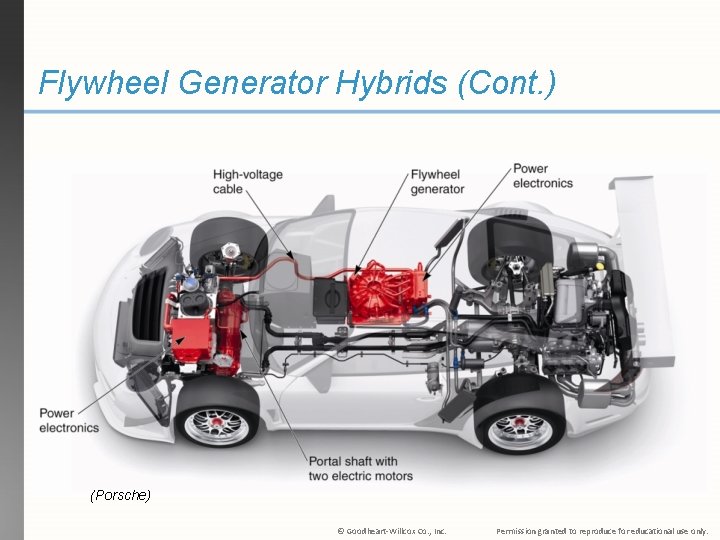
Flywheel Generator Hybrids (Cont. ) (Porsche) © Goodheart-Willcox Co. , Inc. Permission granted to reproduce for educational use only.
Hybrid Vehicle Operation Six basic modes of operation • All-electric drive mode • Motor-assist mode • Idle stop mode • Regenerative braking mode • Engine starting mode • HV battery recharging mode © Goodheart-Willcox Co. , Inc. Permission granted to reproduce for educational use only.
All-Electric Drive Mode • Vehicle operates just like all-electric car • Battery pack provides all energy needed for driving © Goodheart-Willcox Co. , Inc. Permission granted to reproduce for educational use only.
Motor-Assist Mode • Both motor generator and internal combustion engine apply torque to drive train © Goodheart-Willcox Co. , Inc. Permission granted to reproduce for educational use only.
Idle Stop Mode • System automatically shuts off ICE when vehicle stops • Restarts engine when vehicle reaches predetermined speed or HV battery is partially discharged © Goodheart-Willcox Co. , Inc. Permission granted to reproduce for educational use only.
Regenerative Braking Mode • Motor-generator serves as electrical generator – Sends high voltage and current through HV power cables, to HV PCM, and into HV battery © Goodheart-Willcox Co. , Inc. Permission granted to reproduce for educational use only.
Engine Starting Mode • Motor generator spins engine crankshaft to start internal combustion engine • Hybrid ECU energizes transmission solenoids that apply and release clutches – Also signals engine ECU to provide “spark and fuel” to engine © Goodheart-Willcox Co. , Inc. Permission granted to reproduce for educational use only.
Battery Charging Mode • Hybrid control module detects lower voltage – About 70% discharge • Internal combustion engine starts to propel vehicle and recharge HV battery © Goodheart-Willcox Co. , Inc. Permission granted to reproduce for educational use only.
Hybrid Drive Assemblies • HV battery – Sends high-voltage dc into HV PCM through HV power cables • HV PCM – Converts this dc to ac, and usually steps voltage up or down as needed by system circuits • HV battery dc – Converted into three-phase ac to operate motorgenerator © Goodheart-Willcox Co. , Inc. Permission granted to reproduce for educational use only.
HV Battery • HV battery and motor generator easily propel vehicle or start internal combustion engine • Contains several high-efficiency lithium-ion battery modules stacked in sealed enclosure – Wired in series to produce very high-voltage power source © Goodheart-Willcox Co. , Inc. Permission granted to reproduce for educational use only.
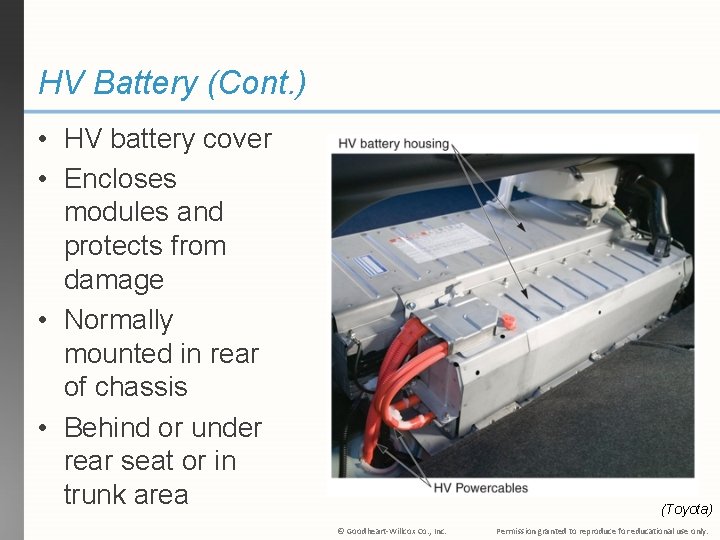
HV Battery (Cont. ) • HV battery cover • Encloses modules and protects from damage • Normally mounted in rear of chassis • Behind or under rear seat or in trunk area (Toyota) © Goodheart-Willcox Co. , Inc. Permission granted to reproduce for educational use only.
Motor-Generator • Functions as traction motor and as alternator in powertrain • Several specific functions – Helps power drive train and propel vehicle – Recharges HV battery – Cranks internal combustion engine – Helps slow and stop vehicle © Goodheart-Willcox Co. , Inc. Permission granted to reproduce for educational use only.
Motor-Generator (Cont. ) Basic parts • Armature – Set of permanent magnets mounted inside segmented steel or carbon fiber disc • Stator – Set of stationary coil windings wrapped around iron cores and arranged around armature • Housing – Holds stator assembly and sometimes armature in place © Goodheart-Willcox Co. , Inc. Permission granted to reproduce for educational use only.
Motor-Generator as an HV Motor • Propel vehicle, three-phase voltage is applied to stator windings by HV PCM • To efficiently control motor-generator, HV PCM can vary ac frequency, voltage, and resulting current – Increase or decrease motor torque and speed © Goodheart-Willcox Co. , Inc. Permission granted to reproduce for educational use only.
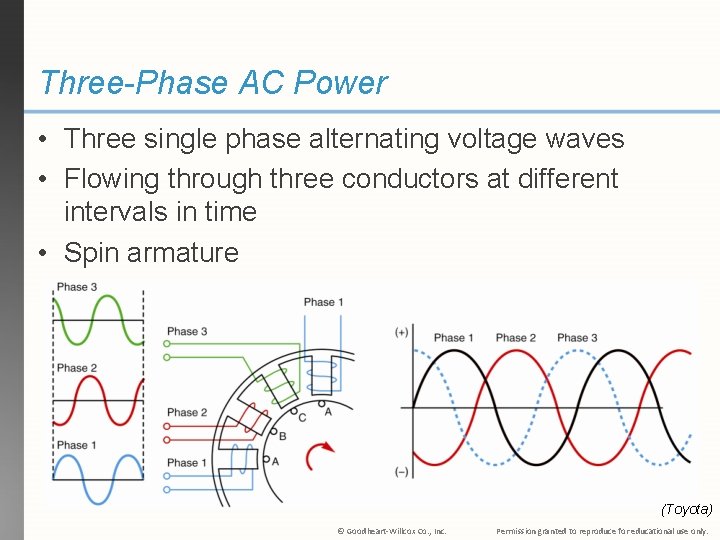
Three-Phase AC Power • Three single phase alternating voltage waves • Flowing through three conductors at different intervals in time • Spin armature (Toyota) © Goodheart-Willcox Co. , Inc. Permission granted to reproduce for educational use only.
Motor-Generator as an HV Generator • Motor-generator acts as ac generator – During regenerative braking – When driven by internal combustion engine or transmission © Goodheart-Willcox Co. , Inc. Permission granted to reproduce for educational use only.
Dual Motor-Generator Hybrids • Two separate motor-generators used to provide assist – Usually located inside transmission or transaxle • During regenerative braking, both act as generators to recharge battery and help drag drive train to a stop • Both motor-generators act as motors to help propel vehicle © Goodheart-Willcox Co. , Inc. Permission granted to reproduce for educational use only.
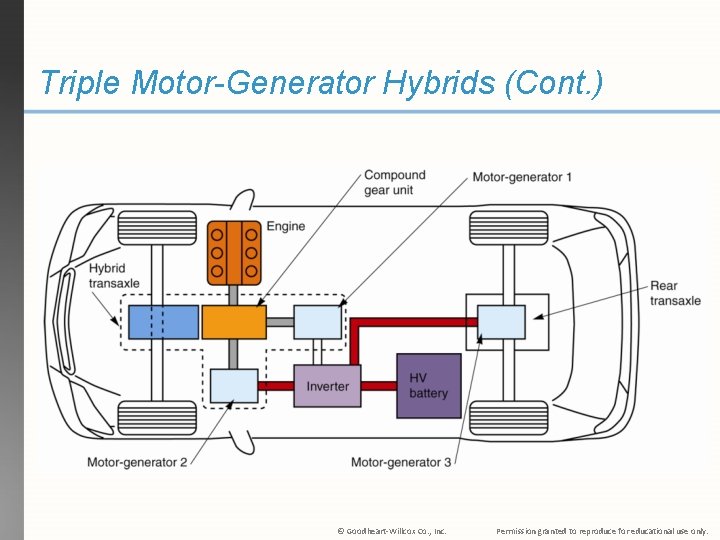
Triple Motor-Generator Hybrids • Two motor-generators located in transmission or transaxle • One motor-generator located in rear drive axle assembly • Triple or quad motor-generator arrangements – Used in large four-wheel drive vehicles to help electrically drive all four wheels © Goodheart-Willcox Co. , Inc. Permission granted to reproduce for educational use only.
Triple Motor-Generator Hybrids (Cont. ) © Goodheart-Willcox Co. , Inc. Permission granted to reproduce for educational use only.
Power Splitter • Hybrid power splitter – Planetary gearset used to control transfer of power through hybrid drive train • With transaxle, under computer control © Goodheart-Willcox Co. , Inc. Permission granted to reproduce for educational use only.
HV Power Control Module • Feeds voltage between HV battery and motorgenerator • Controls amount of ac or dc (0 to 200 amps) flowing through high-voltage power cables • Controls speed and torque of motor-generator by varying ac frequency and ac phase shift © Goodheart-Willcox Co. , Inc. Permission granted to reproduce for educational use only.
HV Power Control Module (Cont. ) • Located next to HV battery, on transaxle, or on top of engine • Contains – Converter circuit • Can step dc voltage up or down – Inverter circuit • Changes dc to ac and ac to dc © Goodheart-Willcox Co. , Inc. Permission granted to reproduce for educational use only.
Hybrid Control Module • Controls inverter and converter circuits to efficiently operate motor-generator(s) • Responds to control signals from other control modules • Controls HV PCM to keep HV battery operating at optimum temperature and state of charge • Increases battery service life and fuel economy © Goodheart-Willcox Co. , Inc. Permission granted to reproduce for educational use only.
Hybrid Rotor Sensor • Measures armature speed and position to control ac phase shift – Controls motor torque and speed © Goodheart-Willcox Co. , Inc. Permission granted to reproduce for educational use only.
HV Power Cables • Transfer extremely high voltage and current levels to components of electric drive system • Heavily insulated to prevent voltages from shorting to ground • Two large HV power cables connect battery pack to HV PCM • Three more large power cables connect HV PCM to motor-generator © Goodheart-Willcox Co. , Inc. Permission granted to reproduce for educational use only.
Hybrid Ground Fault Interrupter • Constantly monitors system for high-voltage leakage into the vehicle’s metal chassis • If high voltage from HV battery or motor-generator is shorting to ground – HV PCM • Illuminates warning light • De-energizes main power relays (contactors) • Disconnects HV battery from its drive circuit © Goodheart-Willcox Co. , Inc. Permission granted to reproduce for educational use only.
Impact Sensors • Impact sensors or inertia switches open during severe impact – Open high-voltage circuits – Disable electric fuel pumps for internal combustion engine – Deploy air bags © Goodheart-Willcox Co. , Inc. Permission granted to reproduce for educational use only.
Hybrid Dash Display • Combination meter – Displays variables pertinent to performance and condition of internal combustion engine and electric drive system • Hybrid drive ready light – Blinks at startup, stays on when electric drive engaged © Goodheart-Willcox Co. , Inc. Permission granted to reproduce for educational use only.
Hybrid Dash Display (Cont. ) • Hybrid master warning light – In combination meter – Warns for problems in any part of drive train • Battery pack warning light – In instrument cluster – Illuminates to signal driver about battery pack problems © Goodheart-Willcox Co. , Inc. Permission granted to reproduce for educational use only.
Hybrid Dash Display (Cont. ) • Malfunction indicator light (MIL) – Turns on when any control module detects vehicle malfunction • Hybrid power display – Informs driver of hybrid drive operating conditions © Goodheart-Willcox Co. , Inc. Permission granted to reproduce for educational use only.
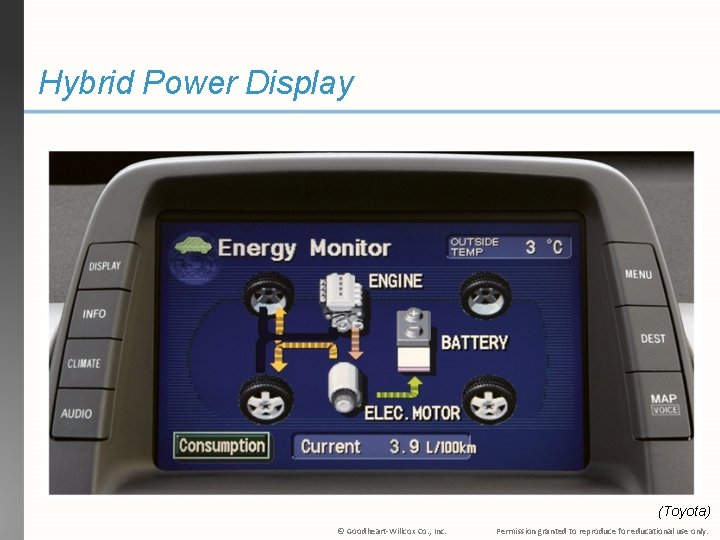
Hybrid Power Display (Toyota) © Goodheart-Willcox Co. , Inc. Permission granted to reproduce for educational use only.
- Slides: 49