
Chapter 25 Worms Mollusks 25 1 FLATWORMS Flatworms





- Slides: 117
Chapter 25 Worms & Mollusks
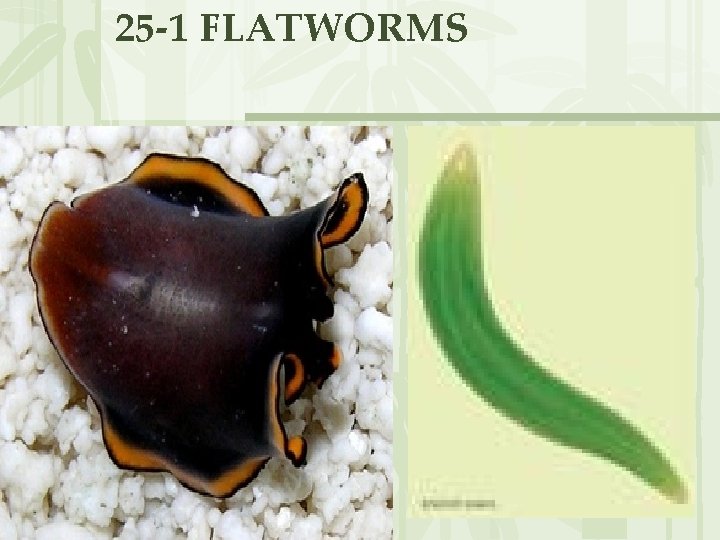
25 -1 FLATWORMS
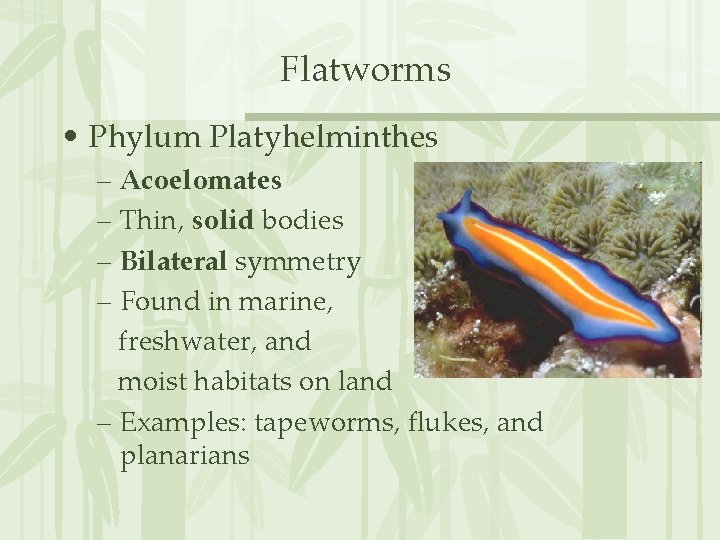
Flatworms • Phylum Platyhelminthes – Acoelomates – Thin, solid bodies – Bilateral symmetry – Found in marine, freshwater, and moist habitats on land – Examples: tapeworms, flukes, and planarians
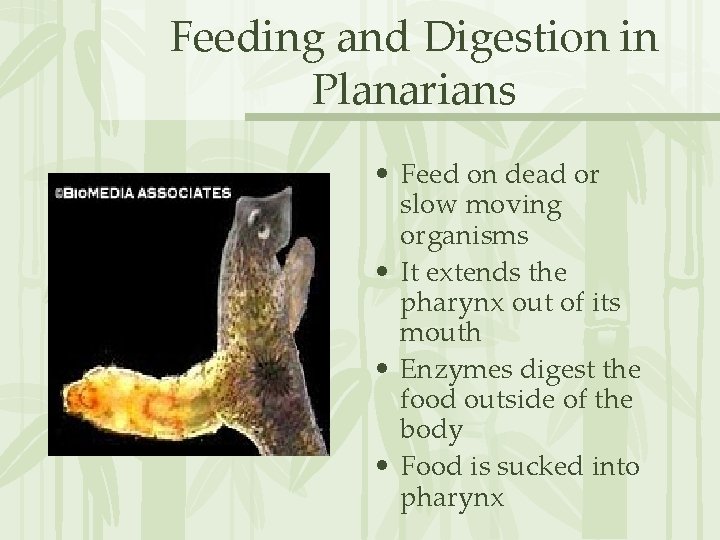
Feeding and Digestion in Planarians • Feed on dead or slow moving organisms • It extends the pharynx out of its mouth • Enzymes digest the food outside of the body • Food is sucked into pharynx
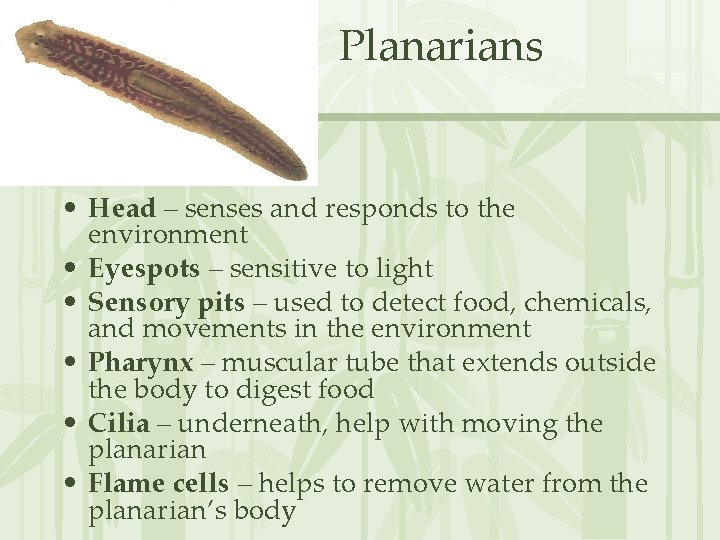
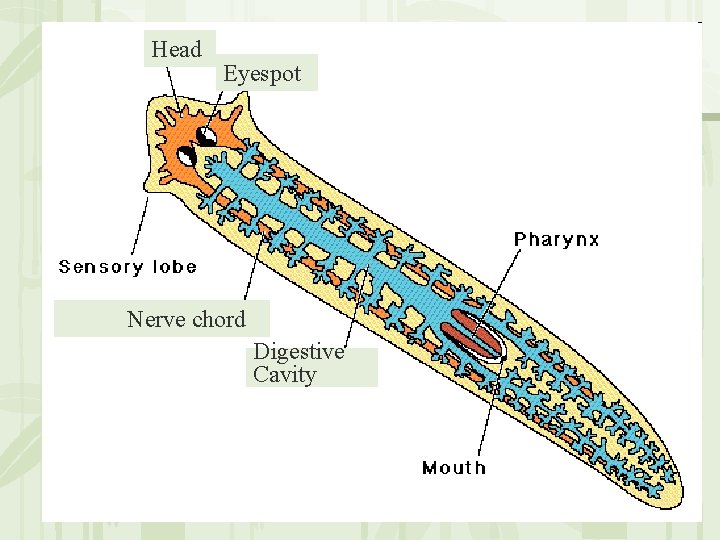
Planarians • Head – senses and responds to the environment • Eyespots – sensitive to light • Sensory pits – used to detect food, chemicals, and movements in the environment • Pharynx – muscular tube that extends outside the body to digest food • Cilia – underneath, help with moving the planarian • Flame cells – helps to remove water from the planarian’s body
Head Eyespot Nerve chord Digestive Cavity
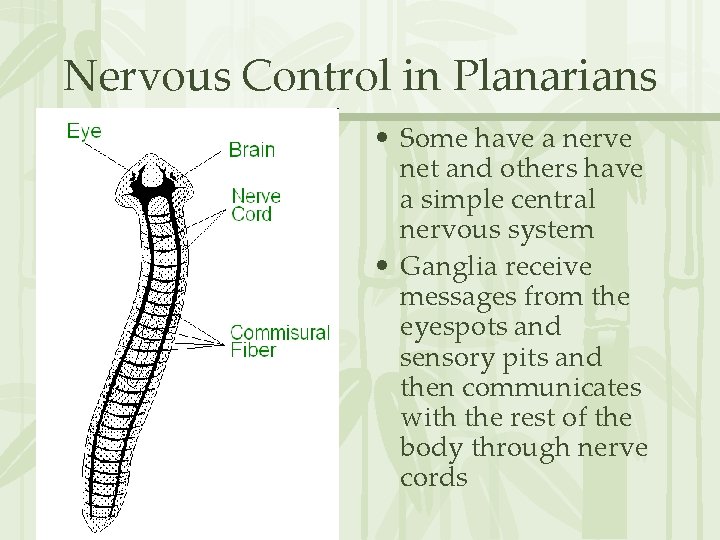
Nervous Control in Planarians • Some have a nerve net and others have a simple central nervous system • Ganglia receive messages from the eyespots and sensory pits and then communicates with the rest of the body through nerve cords
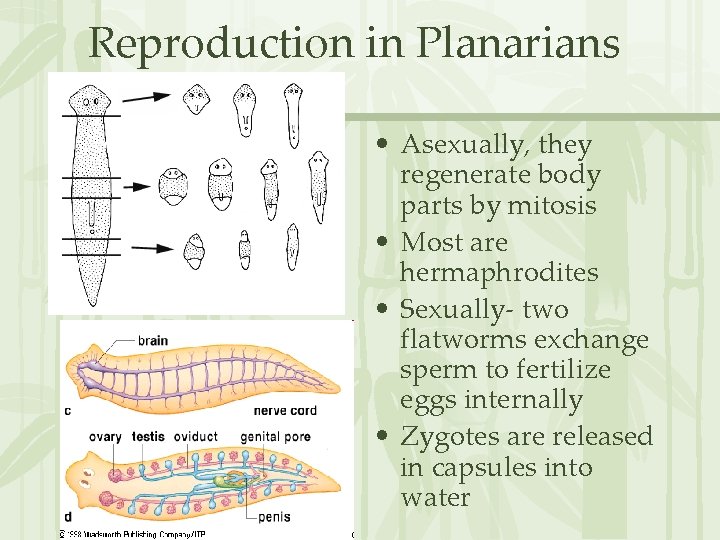
Reproduction in Planarians • Asexually, they regenerate body parts by mitosis • Most are hermaphrodites • Sexually- two flatworms exchange sperm to fertilize eggs internally • Zygotes are released in capsules into water
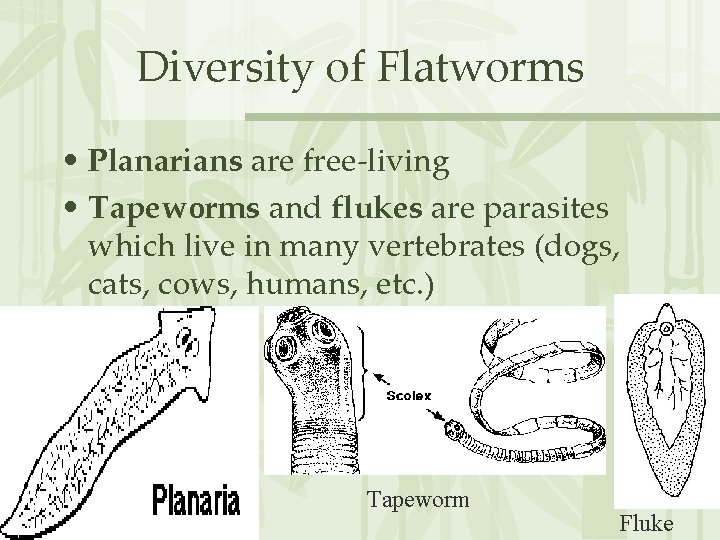
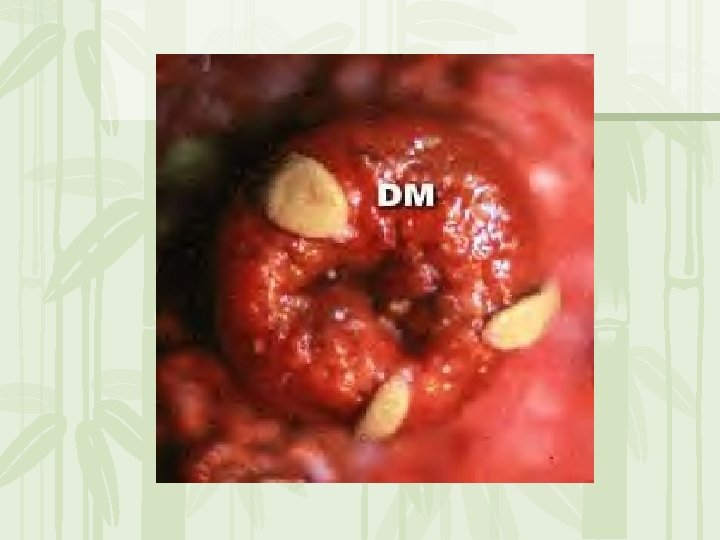
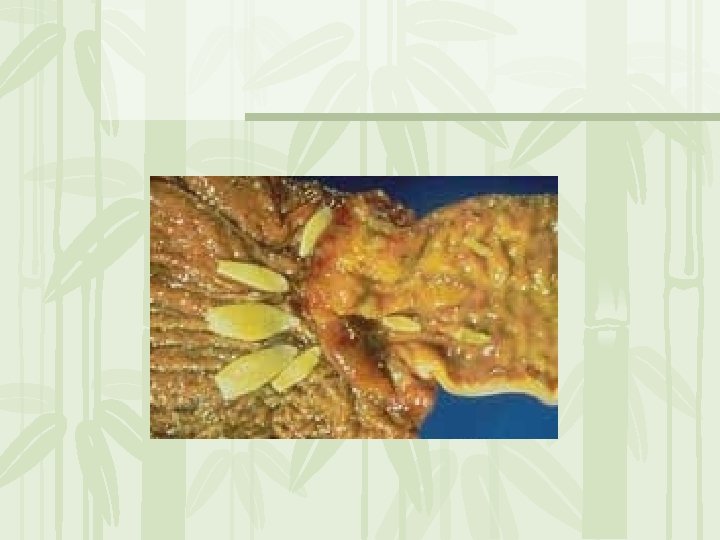
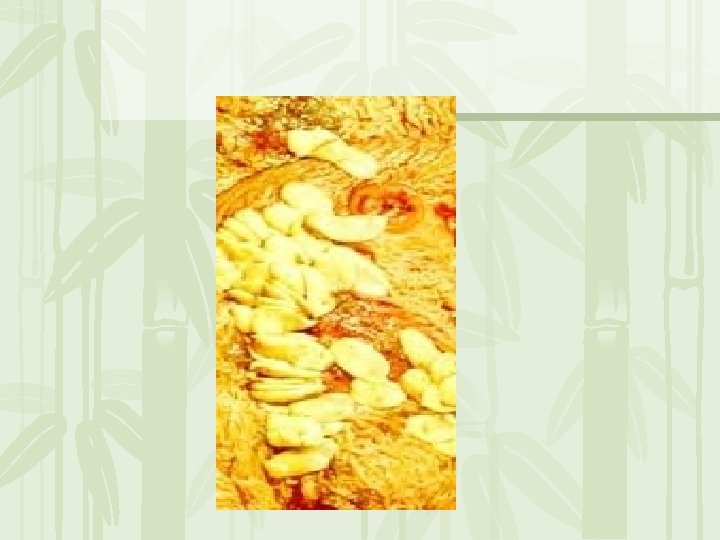
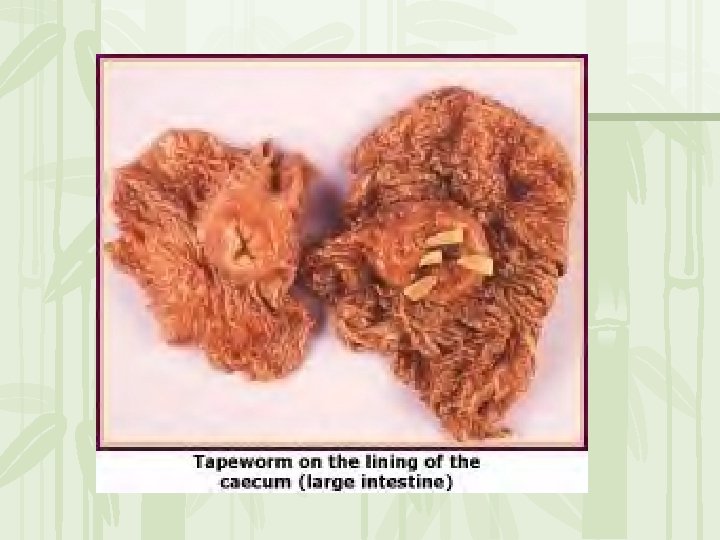
Diversity of Flatworms • Planarians are free-living • Tapeworms and flukes are parasites which live in many vertebrates (dogs, cats, cows, humans, etc. ) Tapeworm Fluke
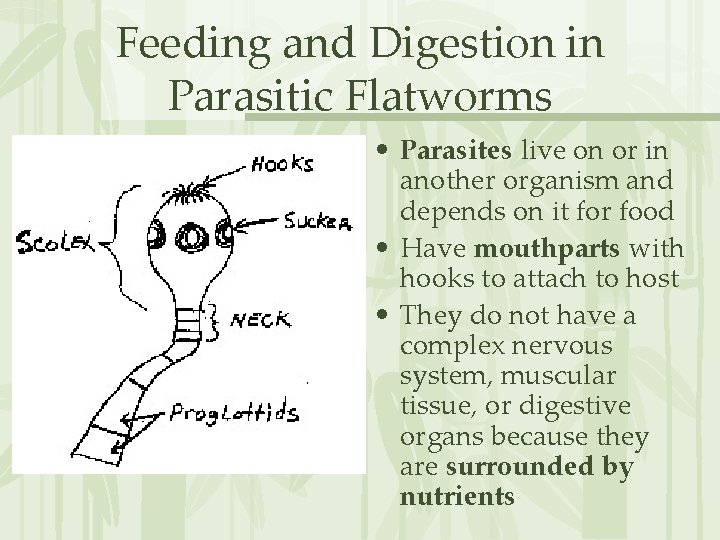
Feeding and Digestion in Parasitic Flatworms • Parasites live on or in another organism and depends on it for food • Have mouthparts with hooks to attach to host • They do not have a complex nervous system, muscular tissue, or digestive organs because they are surrounded by nutrients
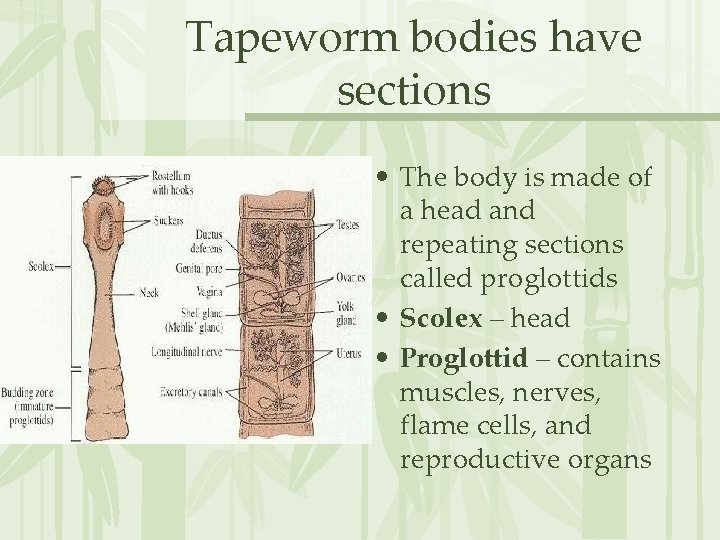
Tapeworm bodies have sections • The body is made of a head and repeating sections called proglottids • Scolex – head • Proglottid – contains muscles, nerves, flame cells, and reproductive organs
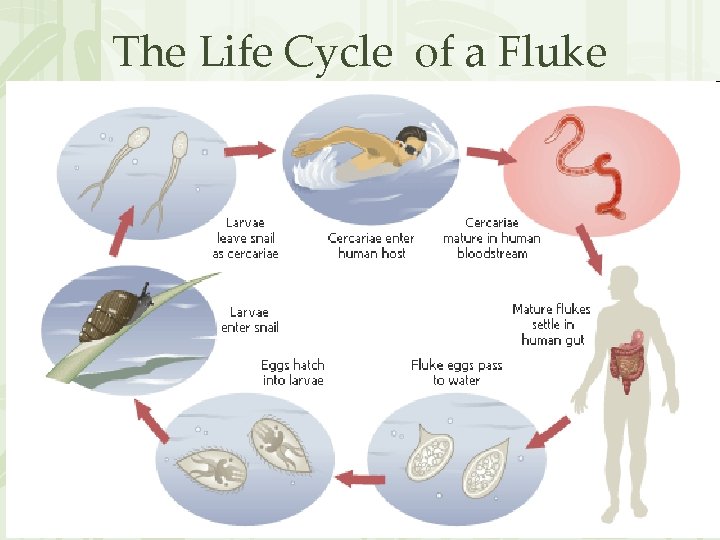
The Life Cycle of a Fluke
The Life Cycle of a Fluke • Adults live in blood vessels • Fluke eggs pass out of body in waste product • Eggs hatch into free-swimming larvae and enter the snail host • Larvae develop and reproduce in the snail and then leave the snail • When humans walk in water, the flukes bore through the skin and enter the bloodstream and into the intestines
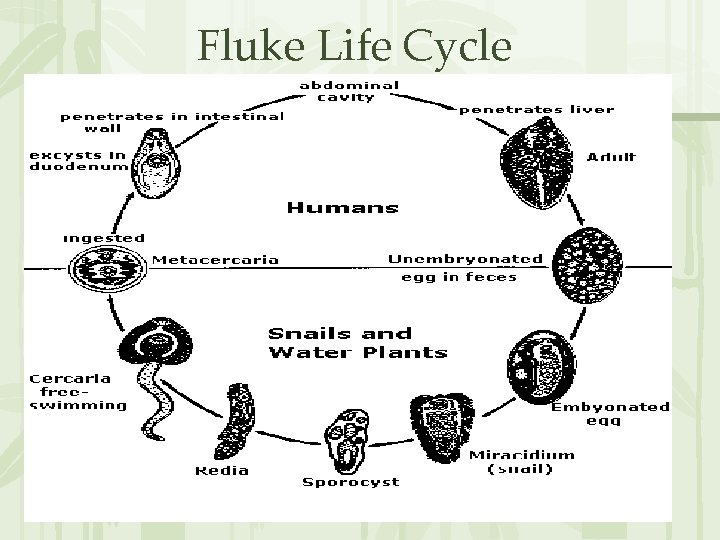
Fluke Life Cycle
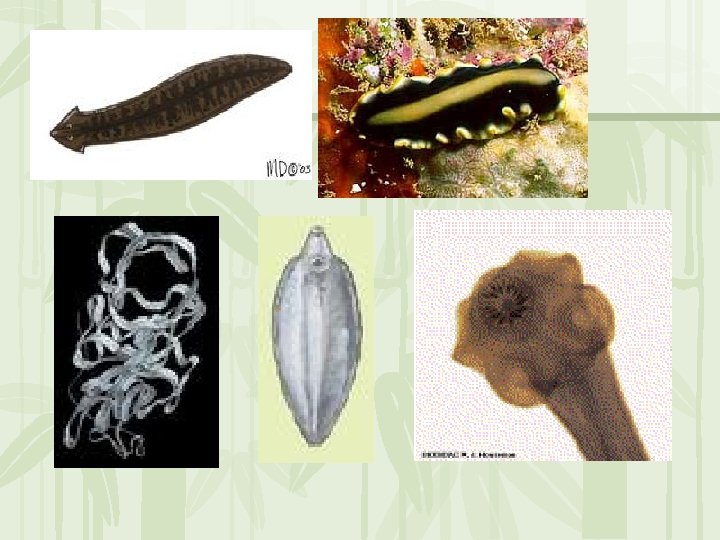
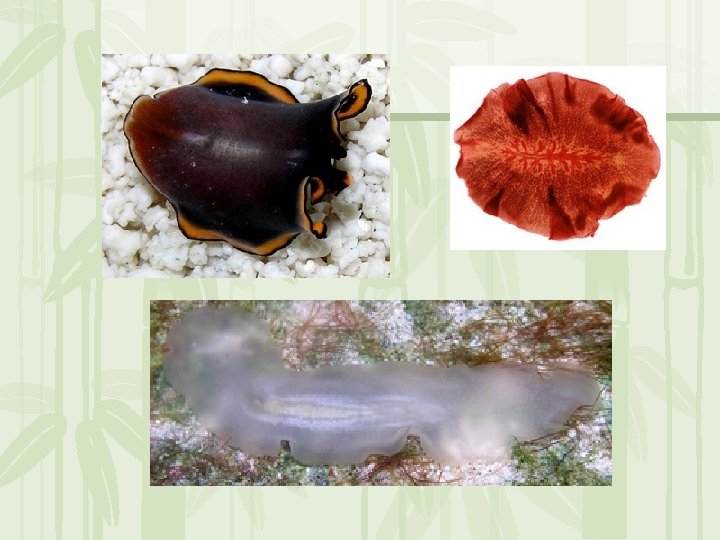
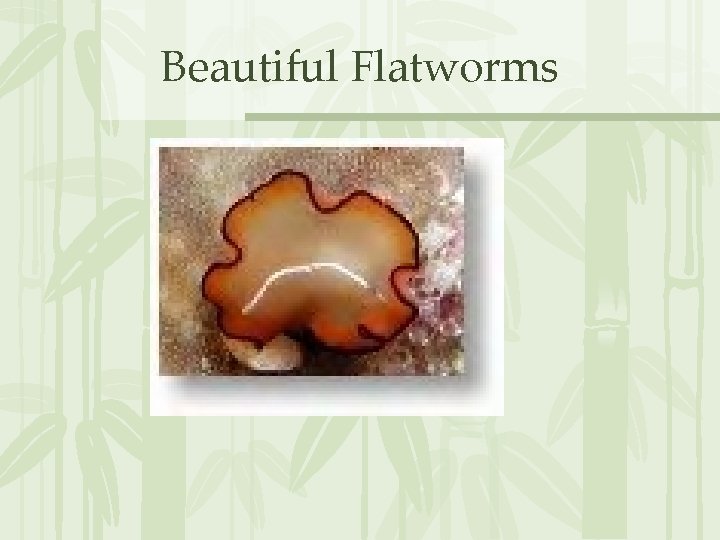
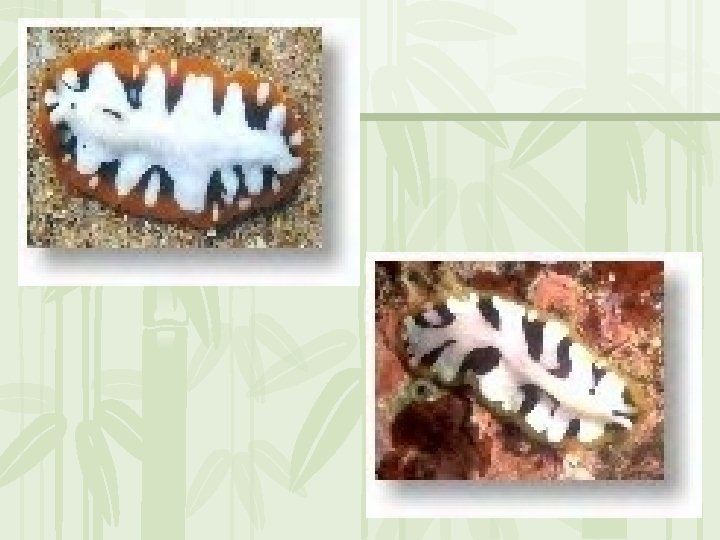
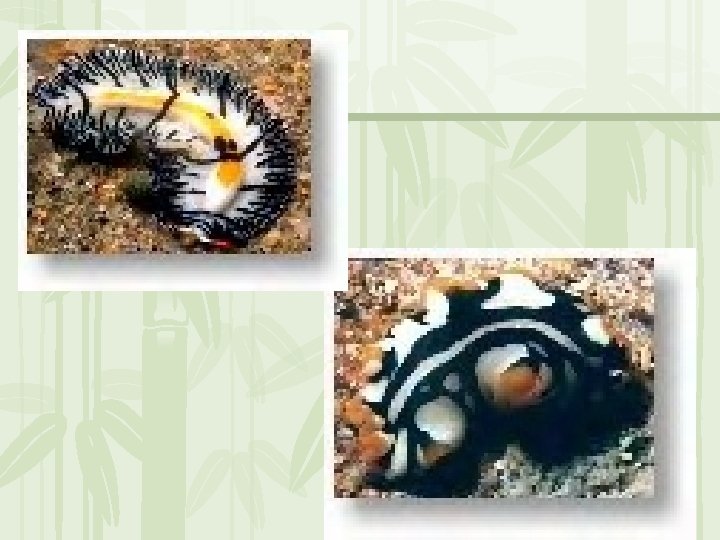
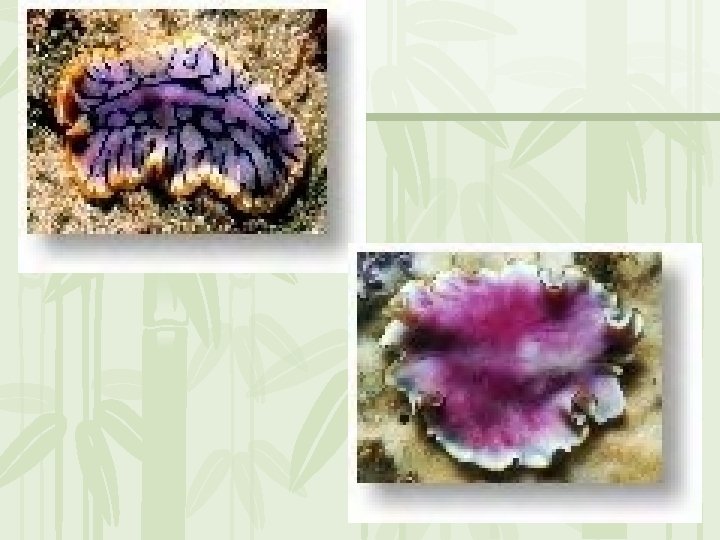
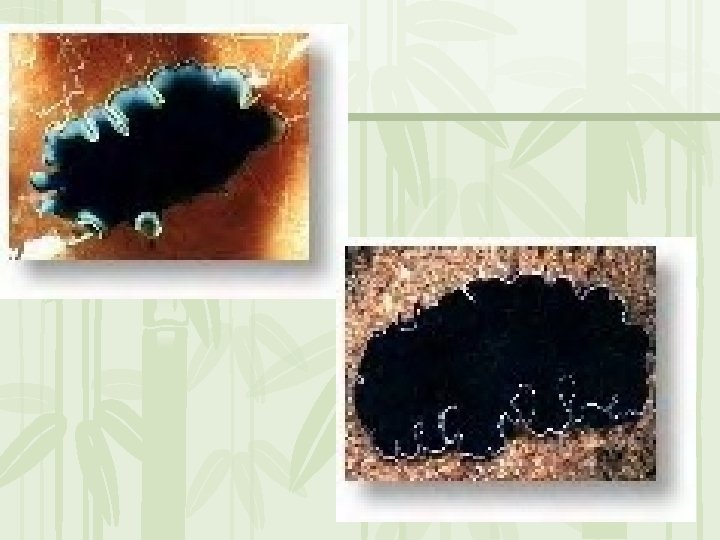
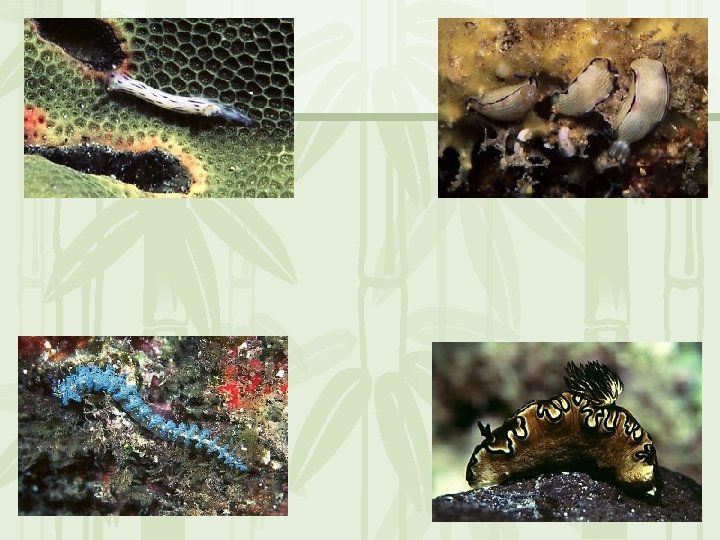
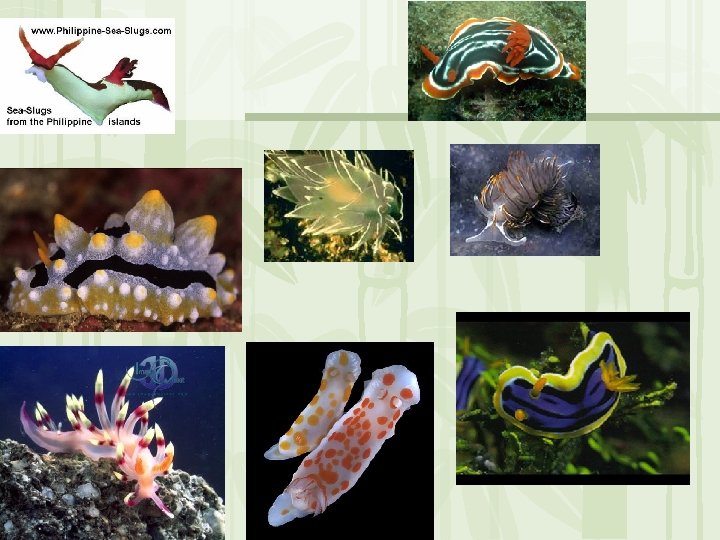
Beautiful Flatworms
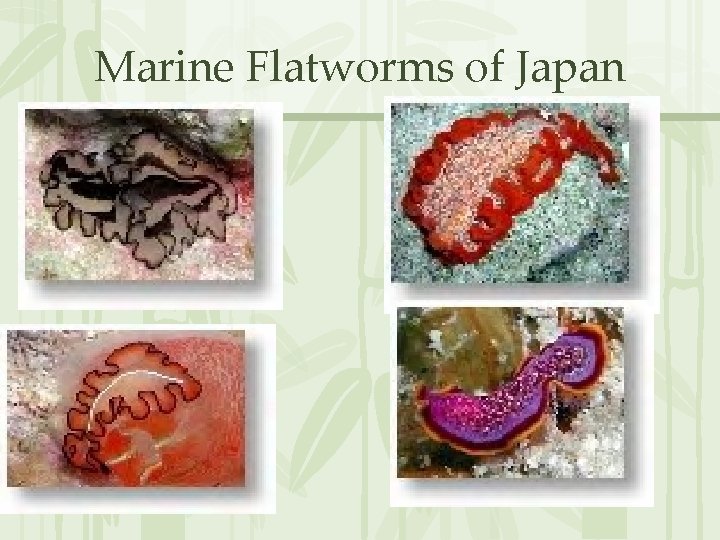
Marine Flatworms of Japan
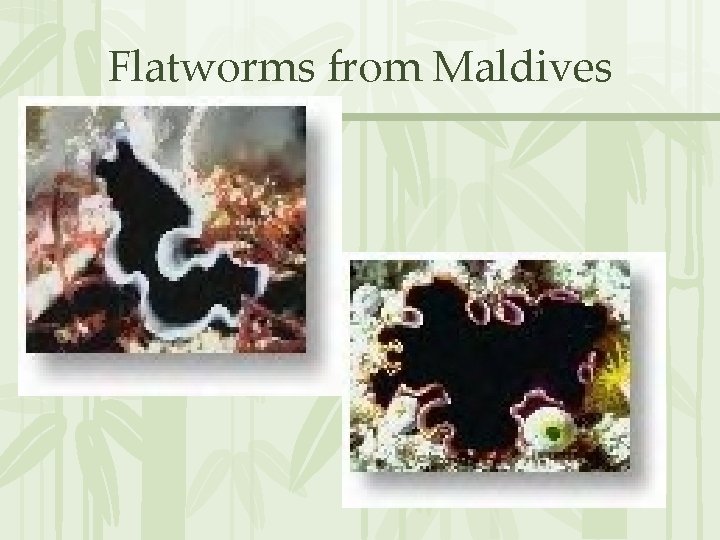
Flatworms from Maldives
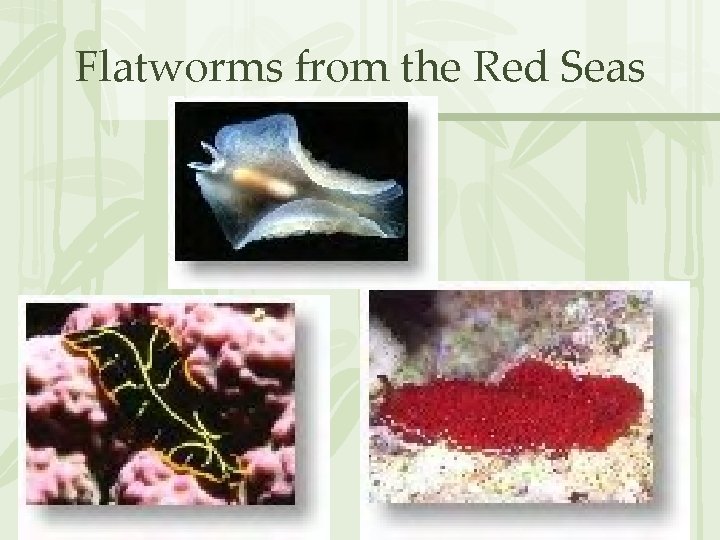
Flatworms from the Red Seas
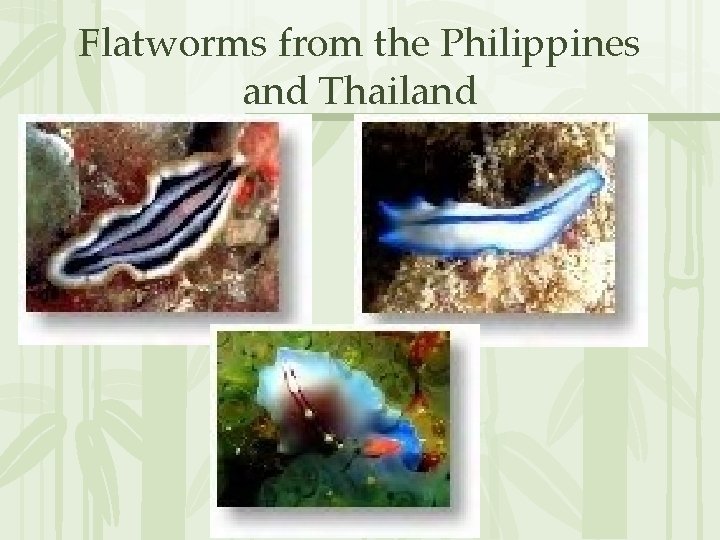
Flatworms from the Philippines and Thailand
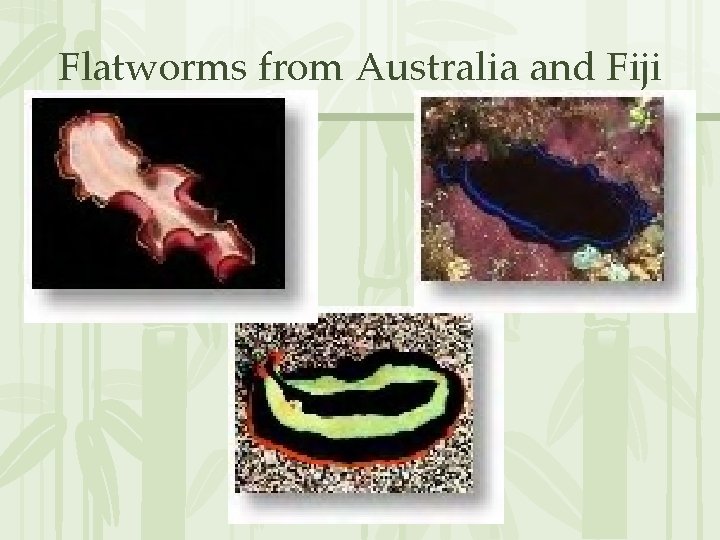
Flatworms from Australia and Fiji
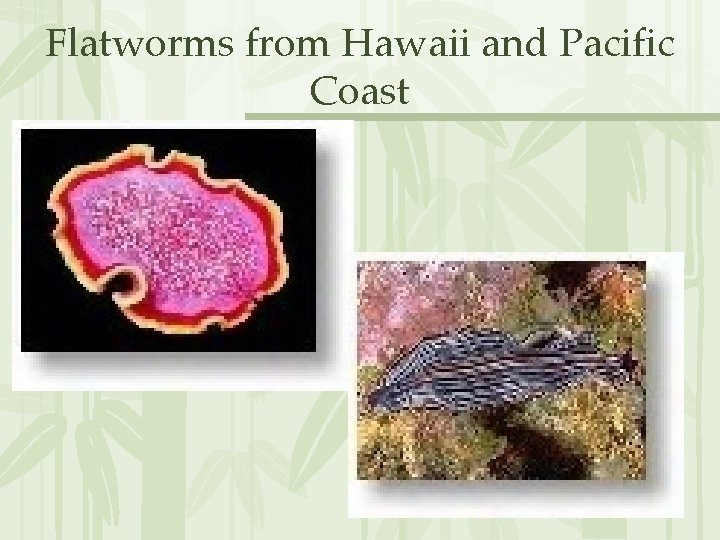
Flatworms from Hawaii and Pacific Coast
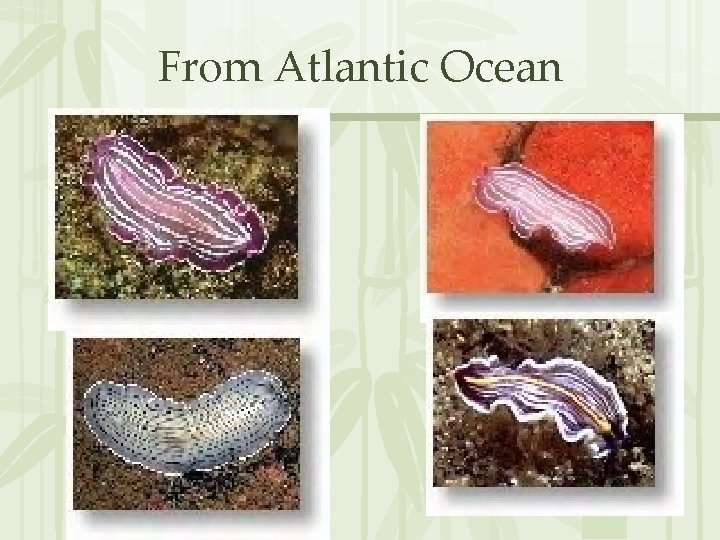
From Atlantic Ocean
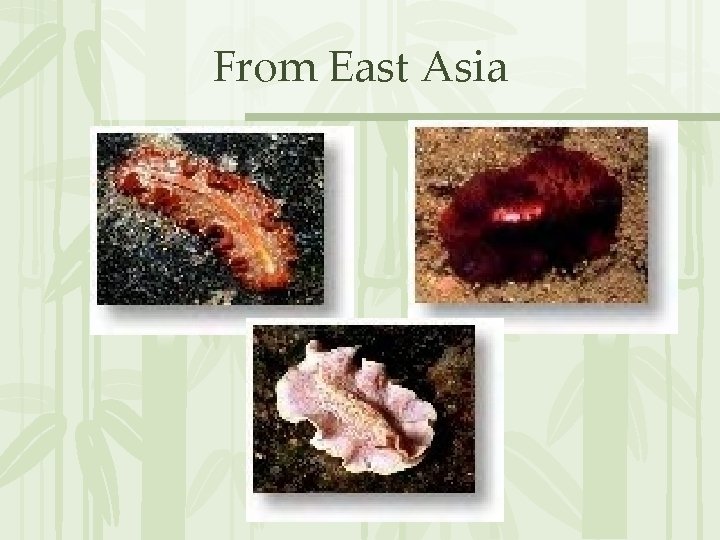
From East Asia
Chapter 25. 2 Roundworms and Rotifers
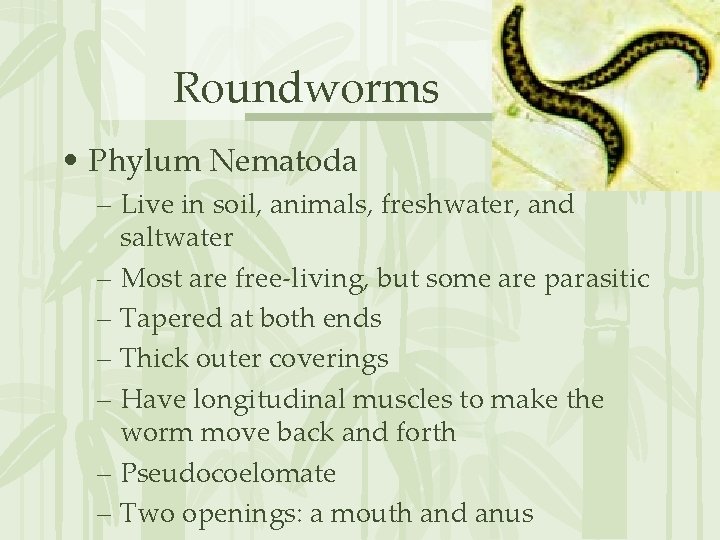
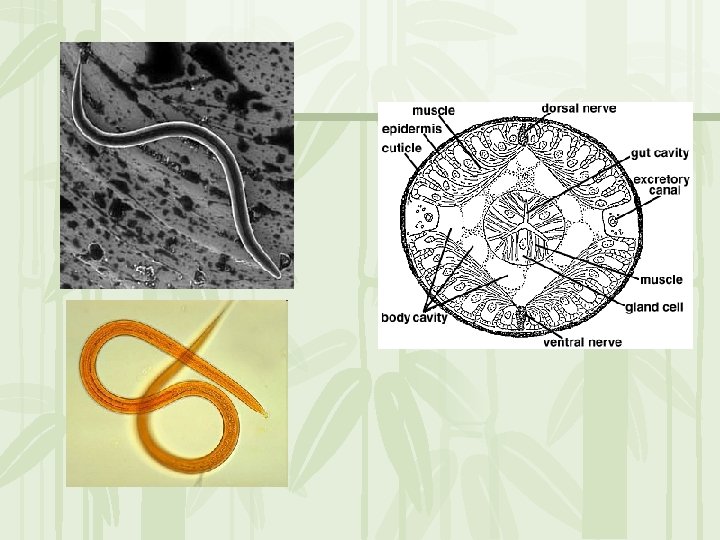
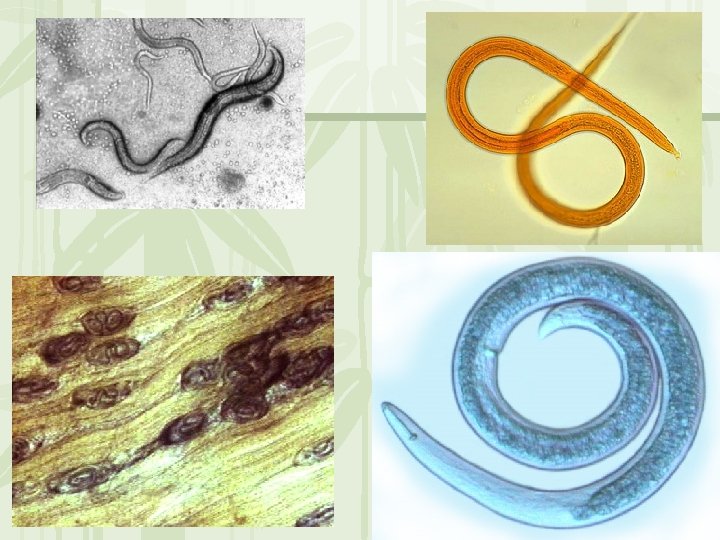
Roundworms • Phylum Nematoda – Live in soil, animals, freshwater, and saltwater – Most are free-living, but some are parasitic – Tapered at both ends – Thick outer coverings – Have longitudinal muscles to make the worm move back and forth – Pseudocoelomate – Two openings: a mouth and anus
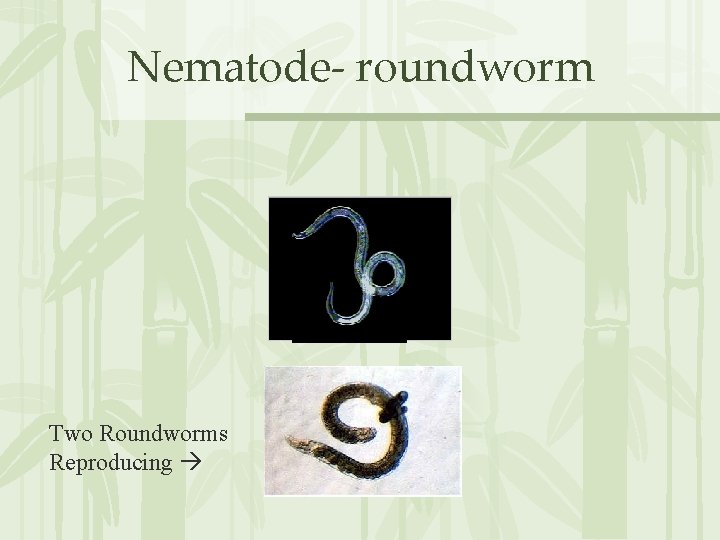
Nematode- roundworm Two Roundworms Reproducing
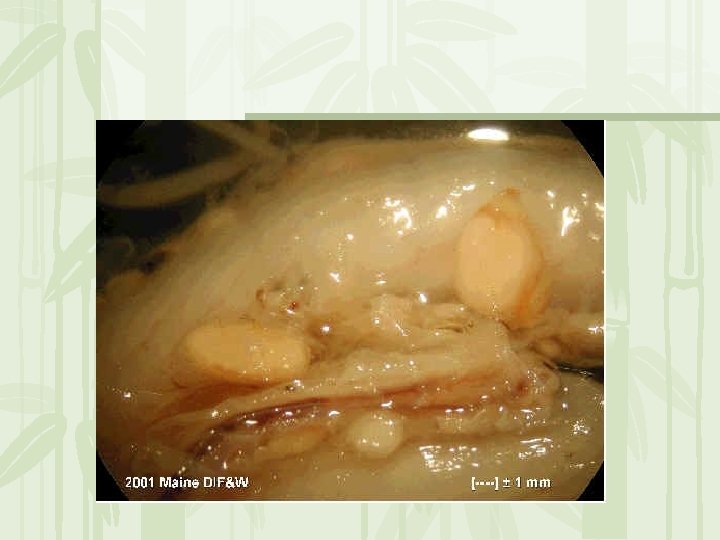
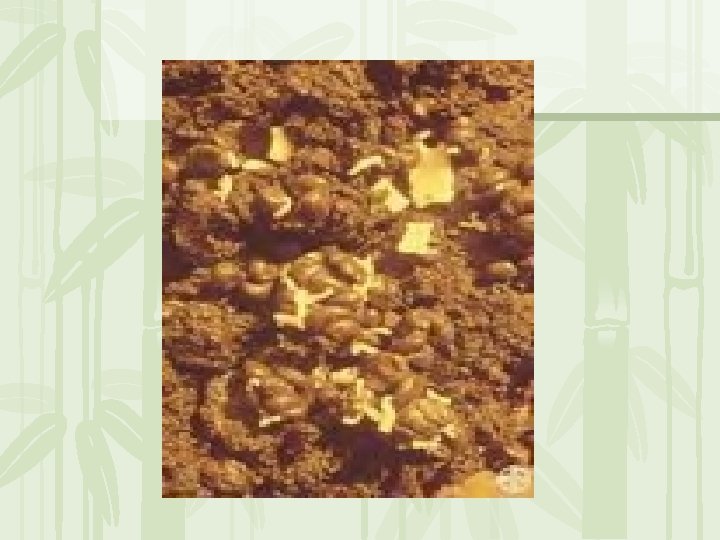
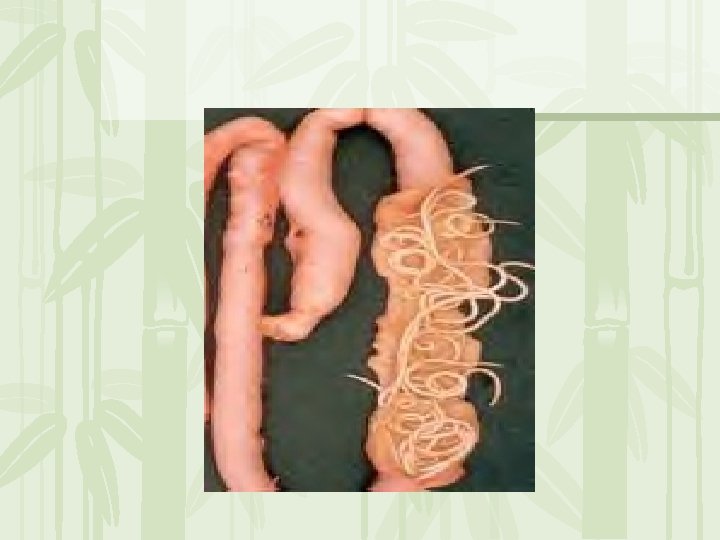
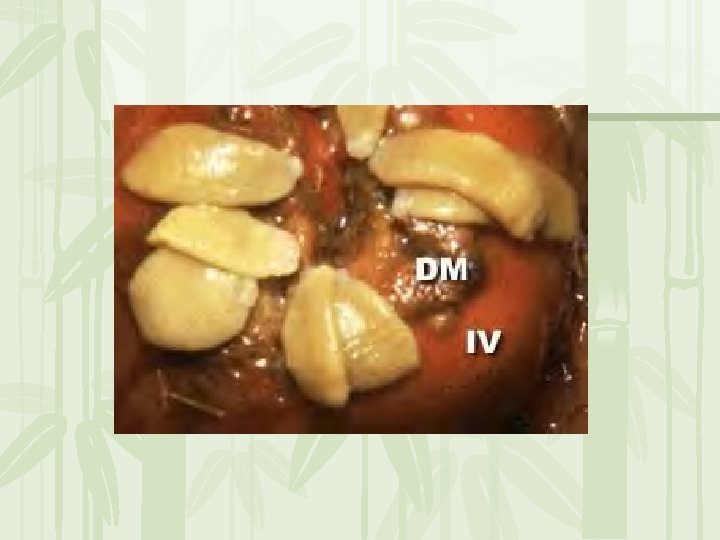
Roundworm Diversity • Ascaris infect mostly children who put soil into their mouths or eat veggies that are not cleaned – Intestines to bloodstream to lungs • Hookworms infect humans walking barefoot in warm climates – Cause weakness due to blood loss
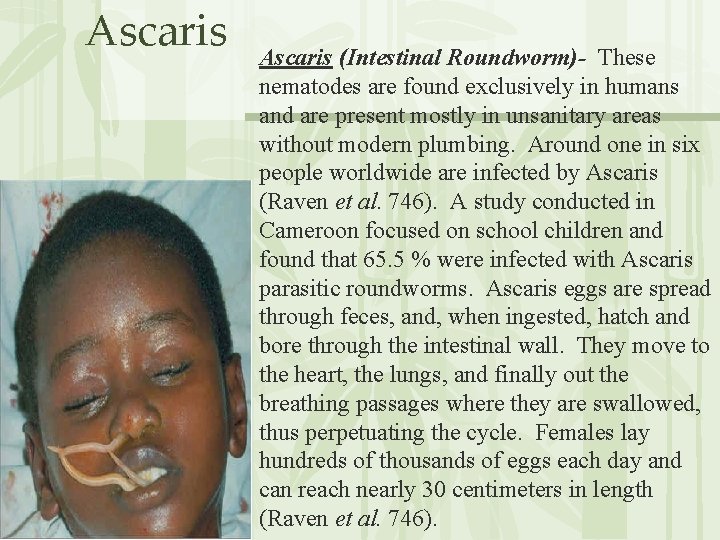
Ascaris (Intestinal Roundworm)- These nematodes are found exclusively in humans and are present mostly in unsanitary areas without modern plumbing. Around one in six people worldwide are infected by Ascaris (Raven et al. 746). A study conducted in Cameroon focused on school children and found that 65. 5 % were infected with Ascaris parasitic roundworms. Ascaris eggs are spread through feces, and, when ingested, hatch and bore through the intestinal wall. They move to the heart, the lungs, and finally out the breathing passages where they are swallowed, thus perpetuating the cycle. Females lay hundreds of thousands of eggs each day and can reach nearly 30 centimeters in length (Raven et al. 746).
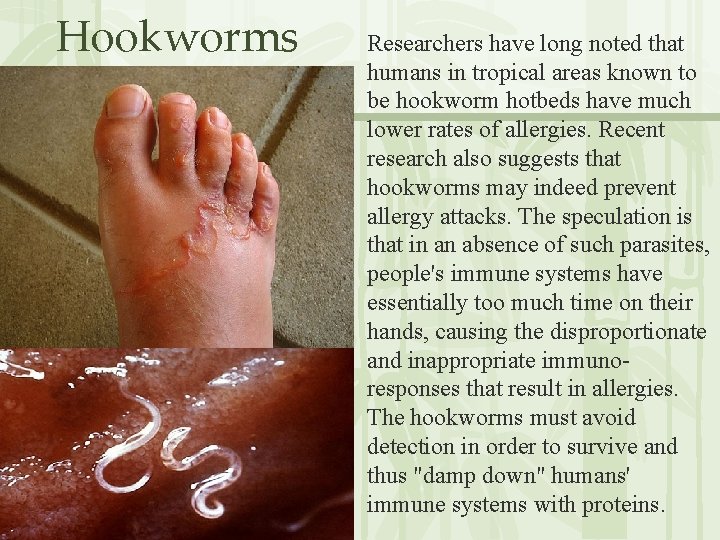
Hookworms Researchers have long noted that humans in tropical areas known to be hookworm hotbeds have much lower rates of allergies. Recent research also suggests that hookworms may indeed prevent allergy attacks. The speculation is that in an absence of such parasites, people's immune systems have essentially too much time on their hands, causing the disproportionate and inappropriate immunoresponses that result in allergies. The hookworms must avoid detection in order to survive and thus "damp down" humans' immune systems with proteins.
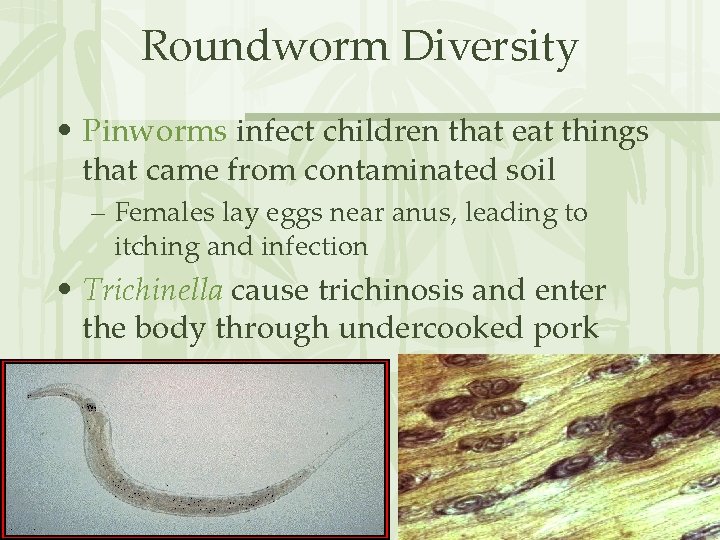
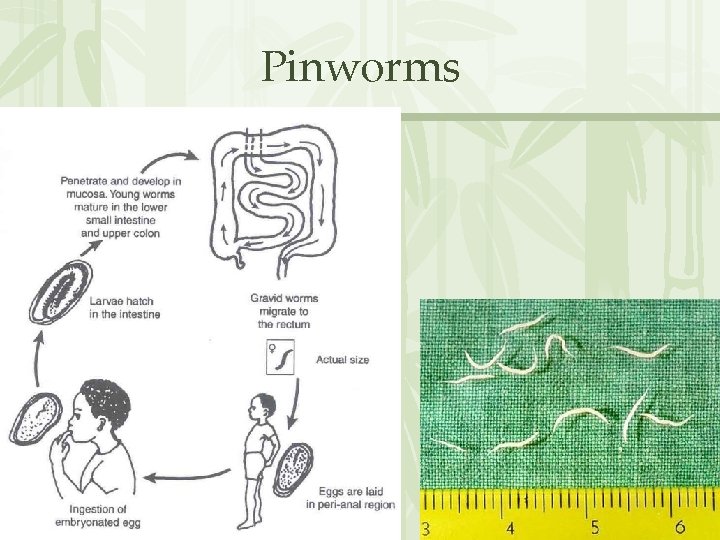
Roundworm Diversity • Pinworms infect children that eat things that came from contaminated soil – Females lay eggs near anus, leading to itching and infection • Trichinella cause trichinosis and enter the body through undercooked pork
Pinworms
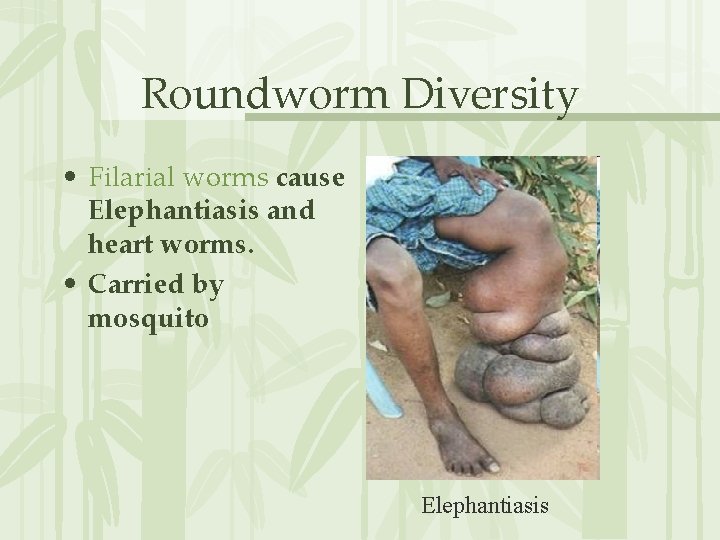
Roundworm Diversity • Filarial worms cause Elephantiasis and heart worms. • Carried by mosquito Elephantiasis
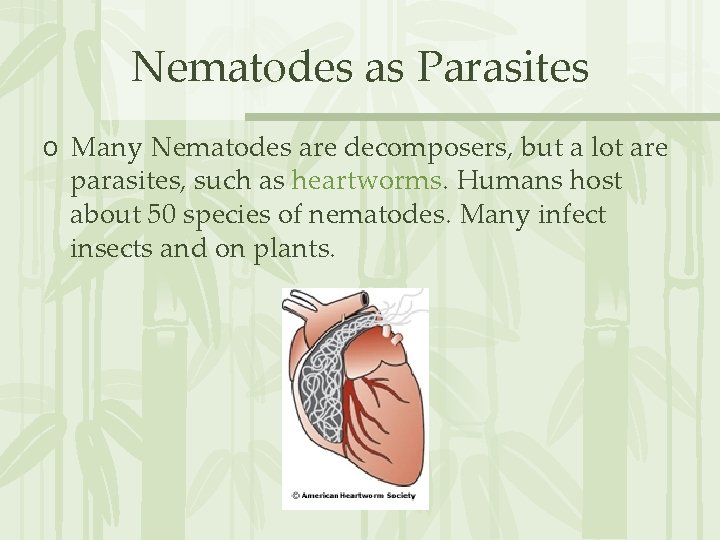
Nematodes as Parasites o Many Nematodes are decomposers, but a lot are parasites, such as heartworms. Humans host about 50 species of nematodes. Many infect insects and on plants.
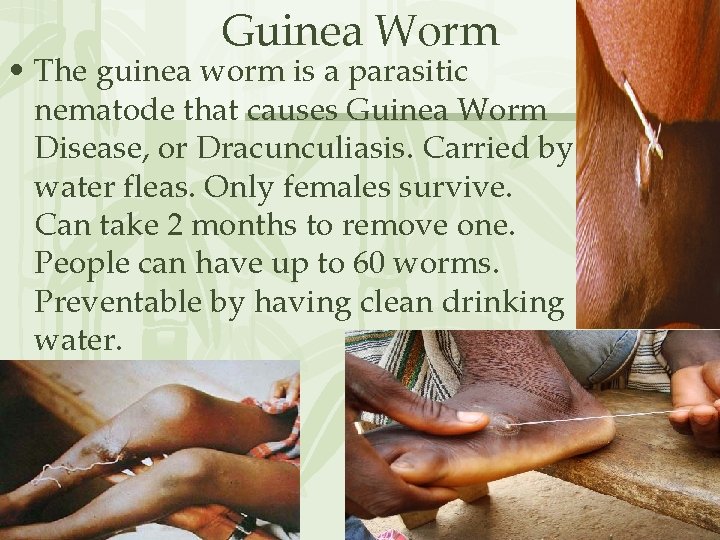
Guinea Worm • The guinea worm is a parasitic nematode that causes Guinea Worm Disease, or Dracunculiasis. Carried by water fleas. Only females survive. Can take 2 months to remove one. People can have up to 60 worms. Preventable by having clean drinking water.
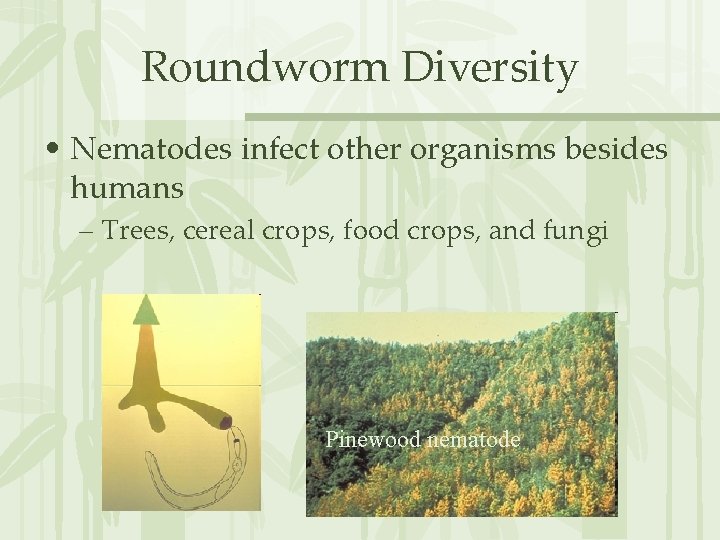
Roundworm Diversity • Nematodes infect other organisms besides humans – Trees, cereal crops, food crops, and fungi Pinewood nematode
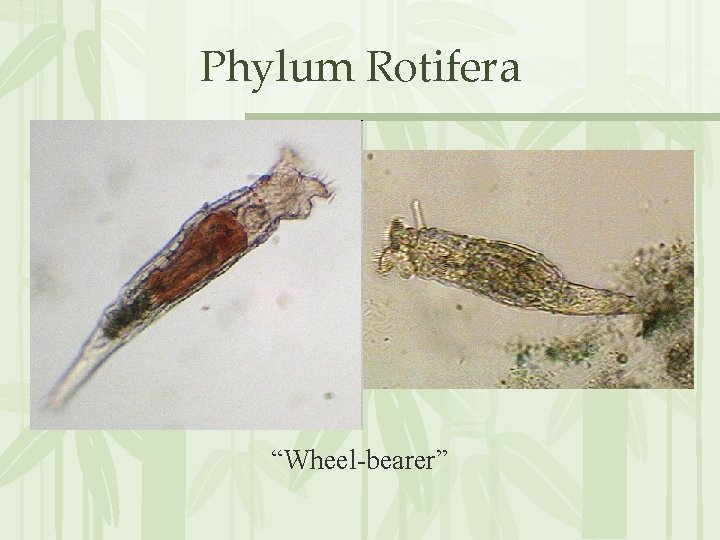
Phylum Rotifera “Wheel-bearer”
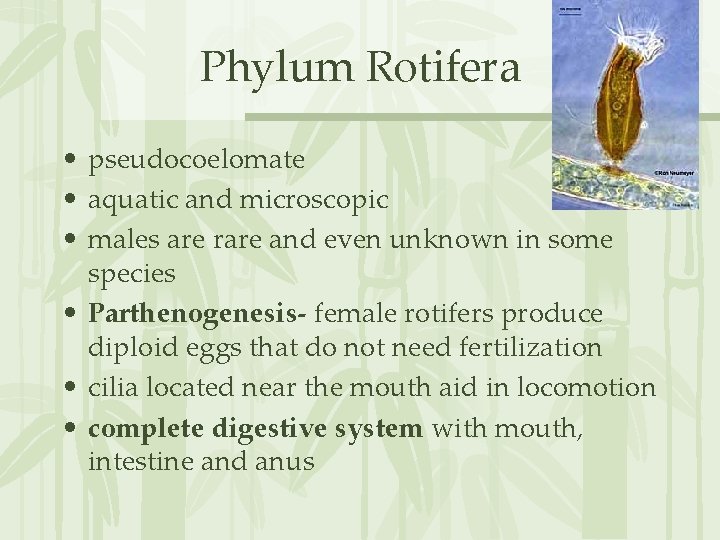
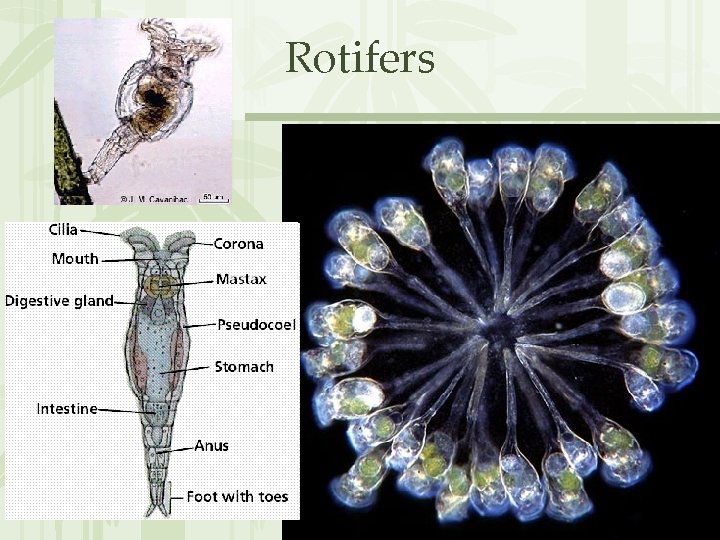
Phylum Rotifera • pseudocoelomate • aquatic and microscopic • males are rare and even unknown in some species • Parthenogenesis- female rotifers produce diploid eggs that do not need fertilization • cilia located near the mouth aid in locomotion • complete digestive system with mouth, intestine and anus
Rotifers
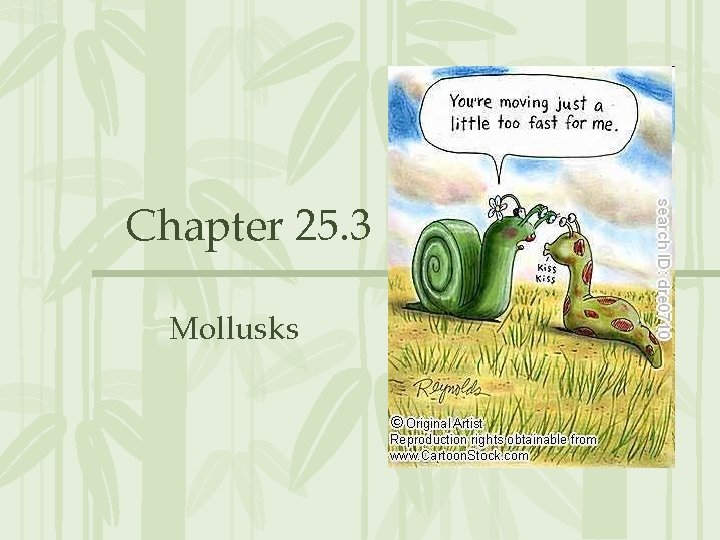
Chapter 25. 3 Mollusks
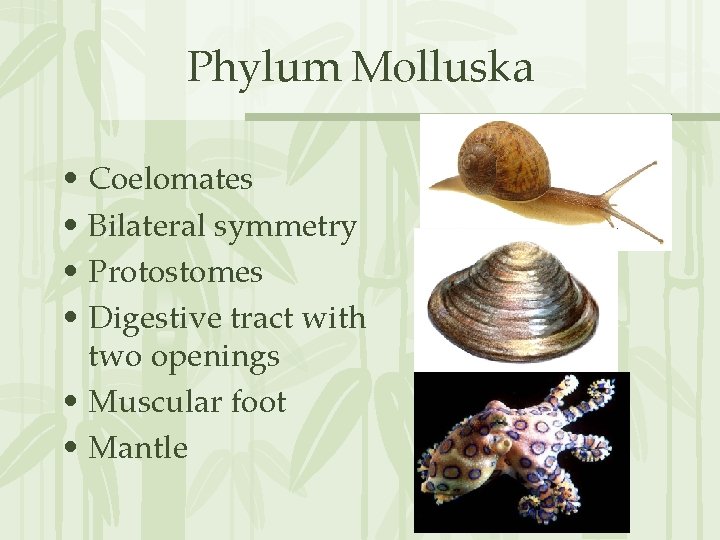
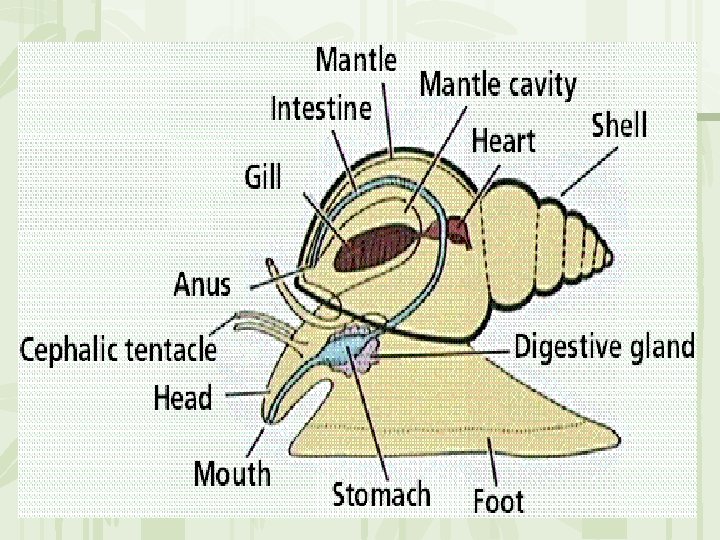
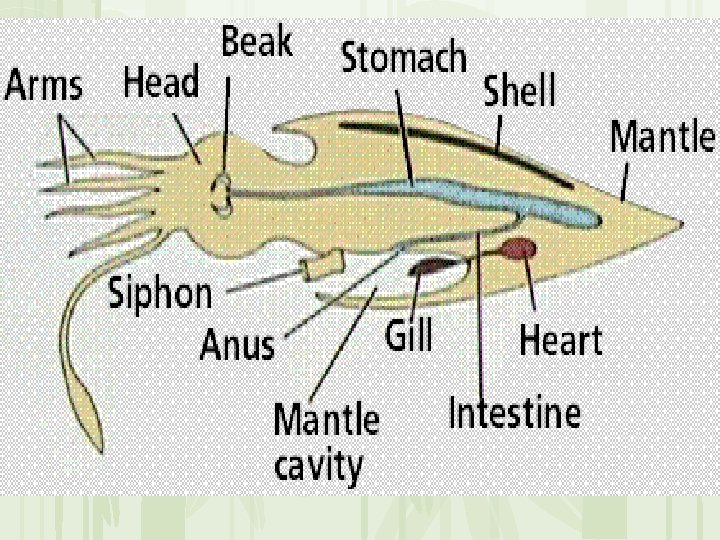
Phylum Molluska • Coelomates • Bilateral symmetry • Protostomes • Digestive tract with two openings • Muscular foot • Mantle
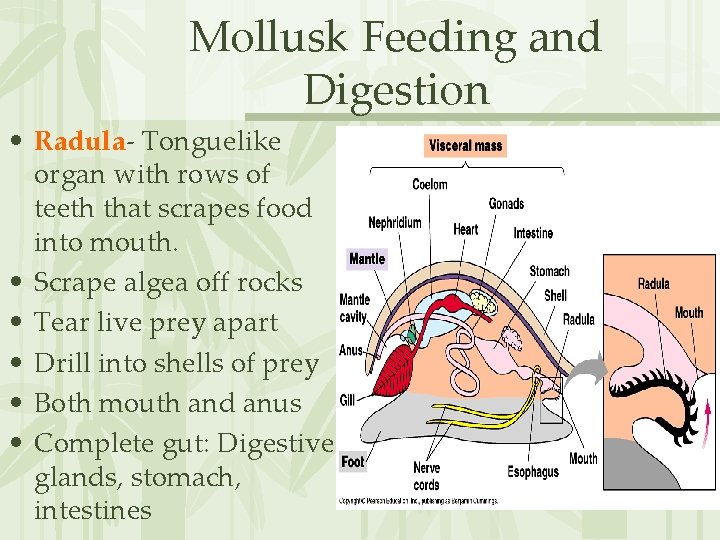
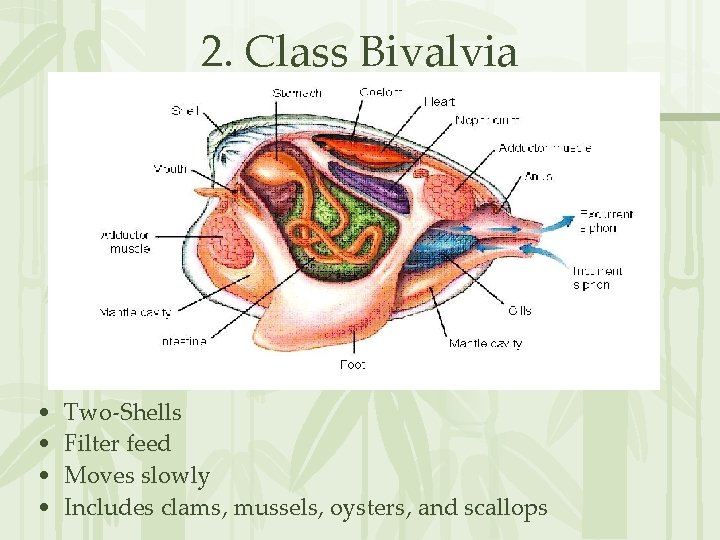
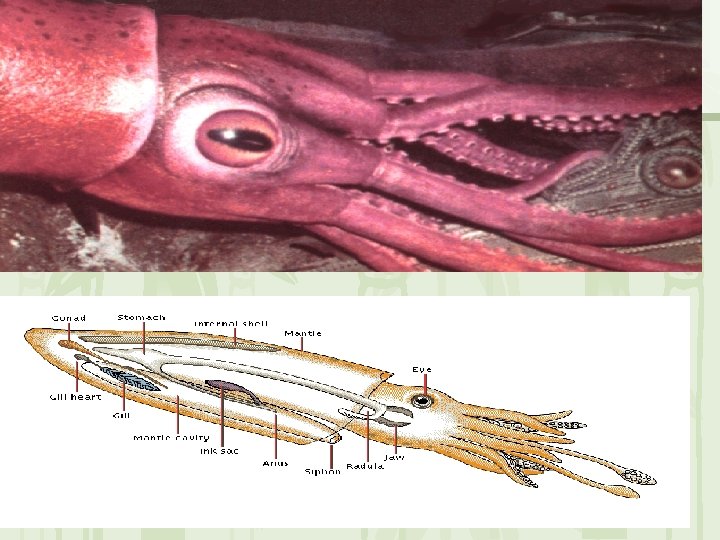
Mollusk Feeding and Digestion • Radula- Tonguelike organ with rows of teeth that scrapes food into mouth. • Scrape algea off rocks • Tear live prey apart • Drill into shells of prey • Both mouth and anus • Complete gut: Digestive glands, stomach, intestines
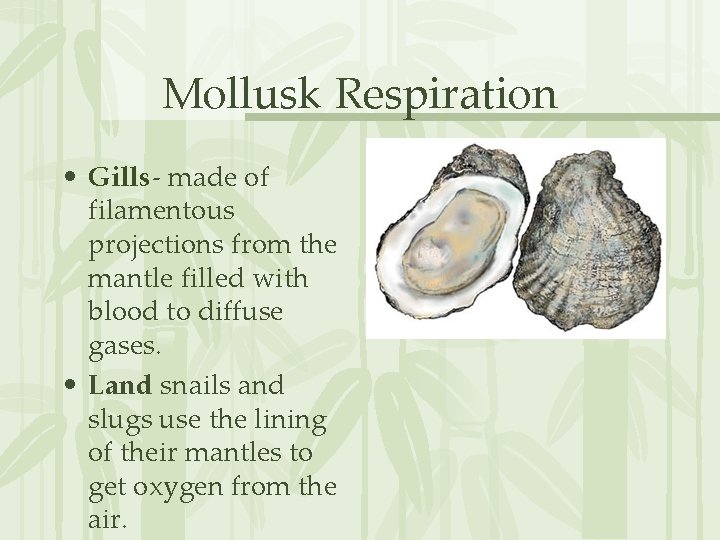
Mollusk Respiration • Gills- made of filamentous projections from the mantle filled with blood to diffuse gases. • Land snails and slugs use the lining of their mantles to get oxygen from the air.
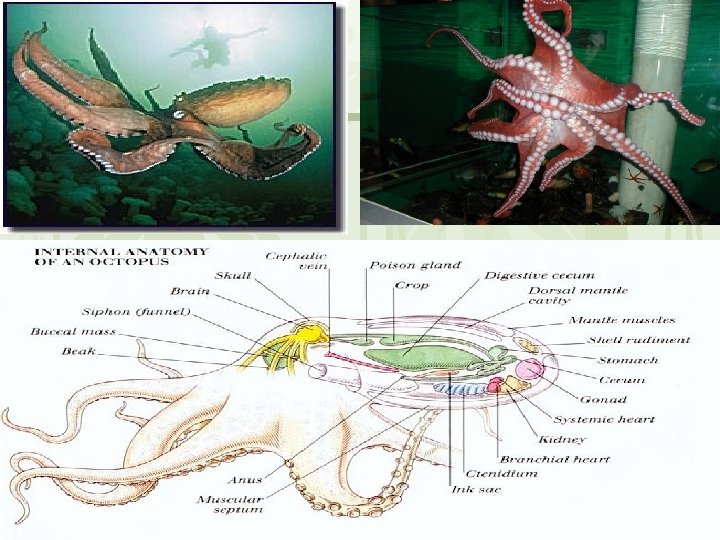
Mollusk Circulation • Open circulatory system - Blood is pumped from vessels to open spaces around organs. Slow moving organisms (snails and clams). • Closed circulatory system - Blood confined to vessels that deliver oxygen where it is needed. Faster moving organisms (squid and octopus)
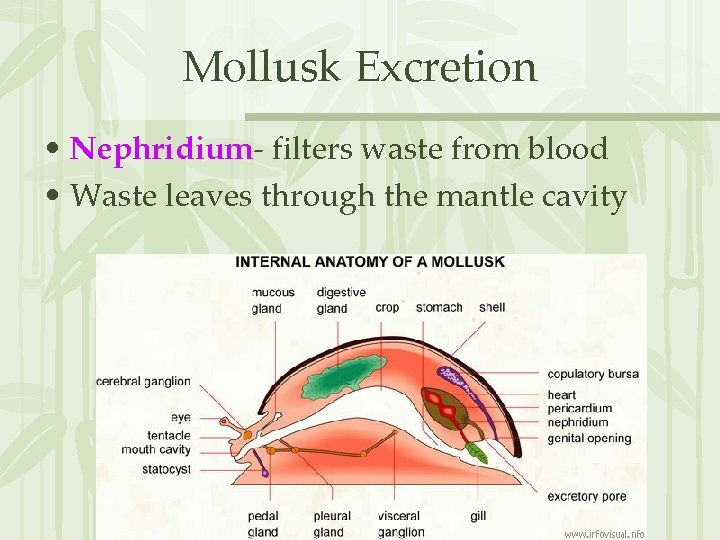
Mollusk Excretion • Nephridium- filters waste from blood • Waste leaves through the mantle cavity
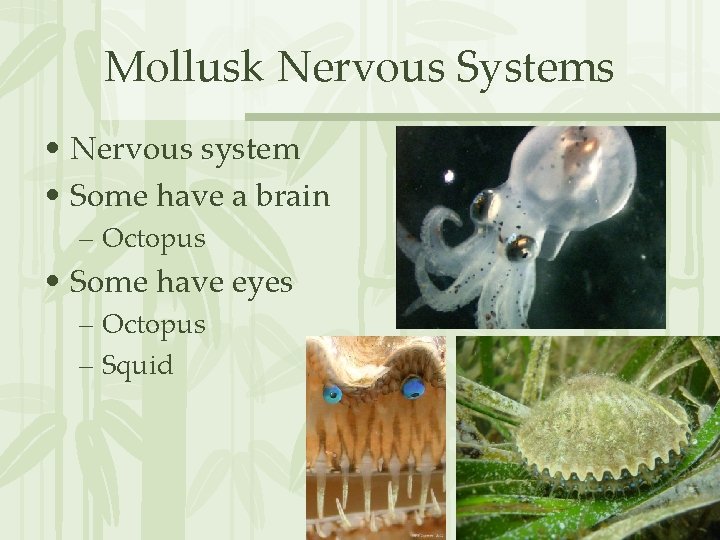
Mollusk Nervous Systems • Nervous system • Some have a brain – Octopus • Some have eyes – Octopus – Squid
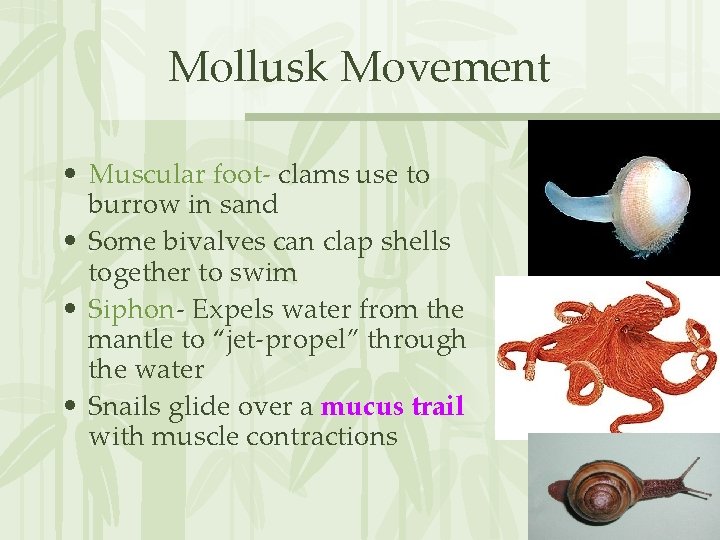
Mollusk Movement • Muscular foot- clams use to burrow in sand • Some bivalves can clap shells together to swim • Siphon- Expels water from the mantle to “jet-propel” through the water • Snails glide over a mucus trail with muscle contractions
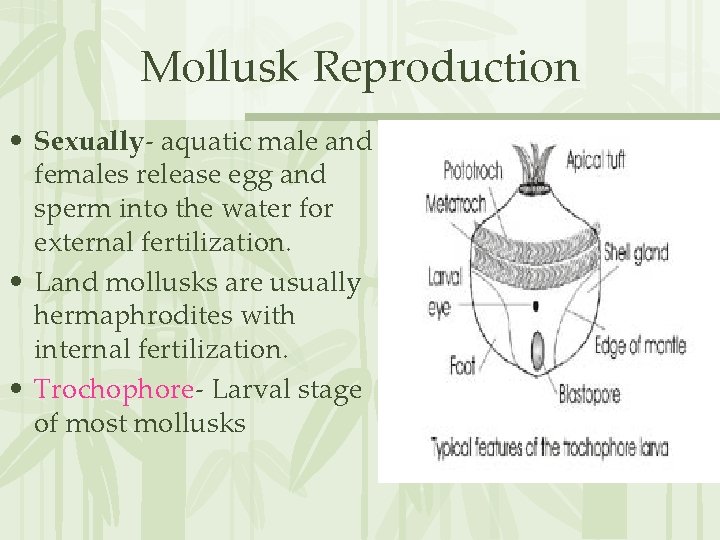
Mollusk Reproduction • Sexually- aquatic male and females release egg and sperm into the water for external fertilization. • Land mollusks are usually hermaphrodites with internal fertilization. • Trochophore- Larval stage of most mollusks
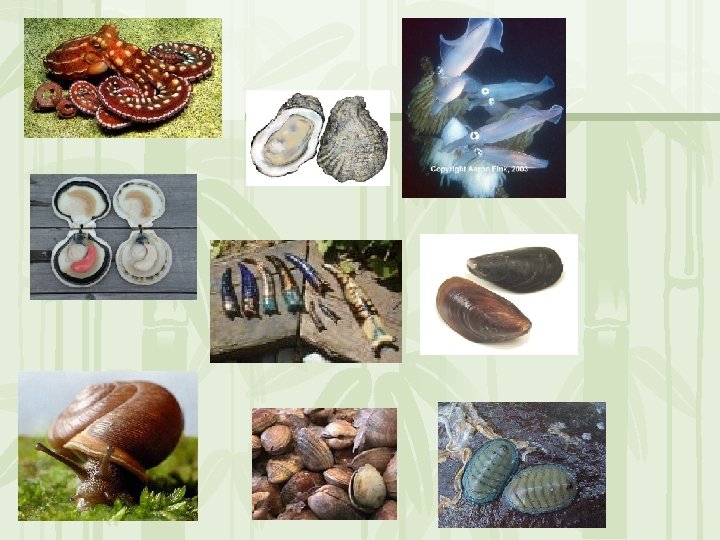
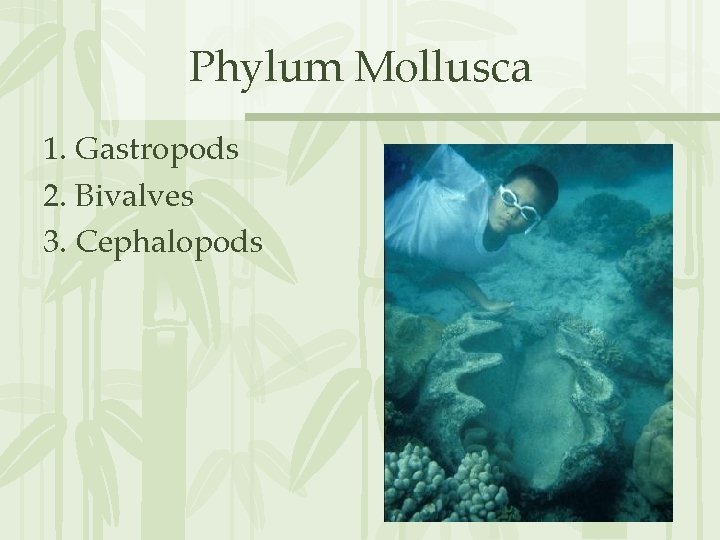
Phylum Mollusca 1. Gastropods 2. Bivalves 3. Cephalopods
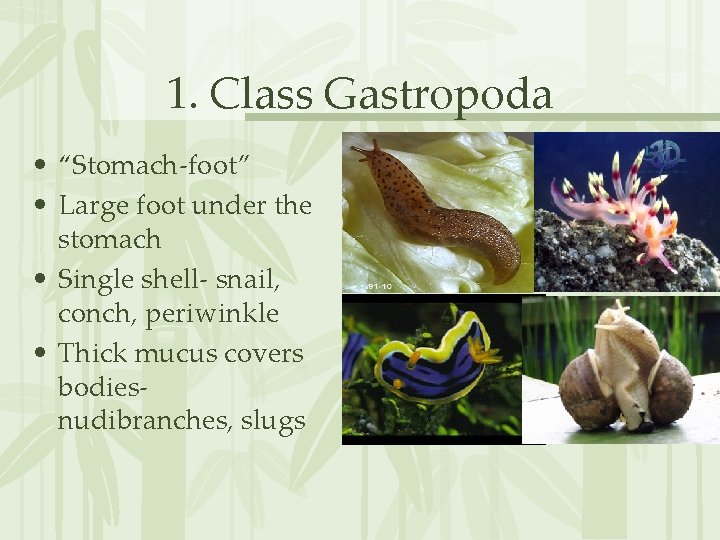
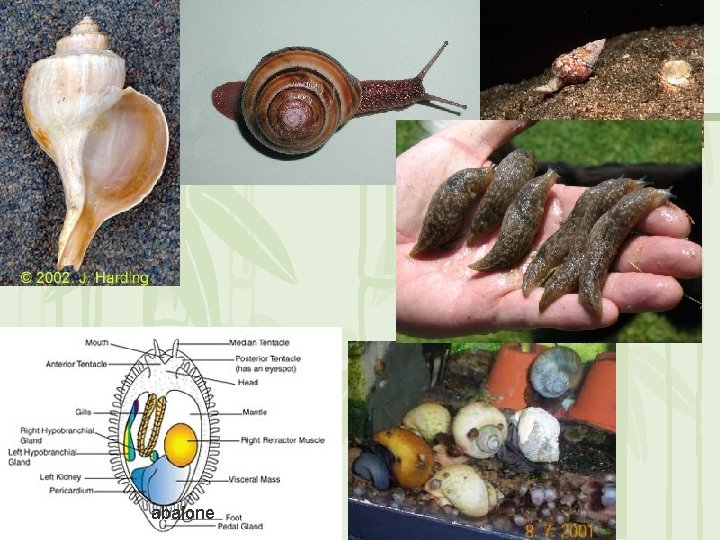
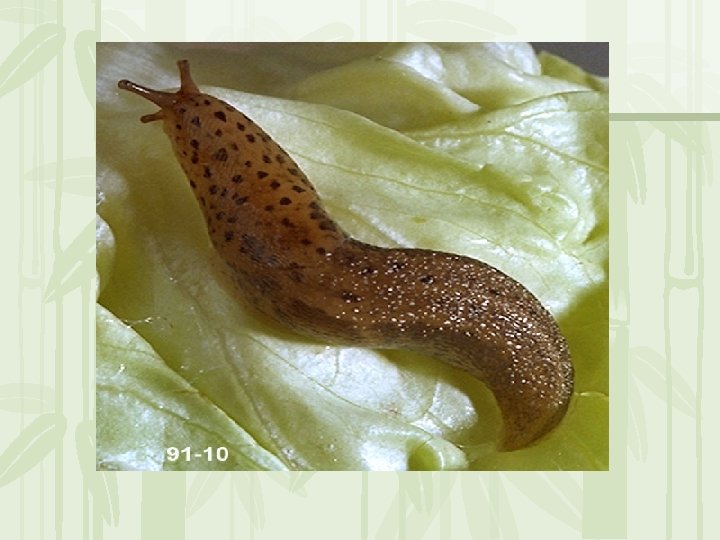
1. Class Gastropoda • “Stomach-foot” • Large foot under the stomach • Single shell- snail, conch, periwinkle • Thick mucus covers bodiesnudibranches, slugs
abalone
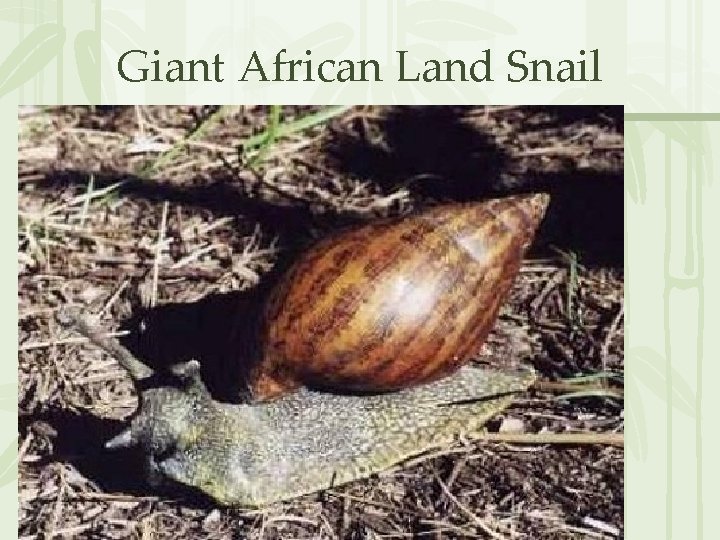
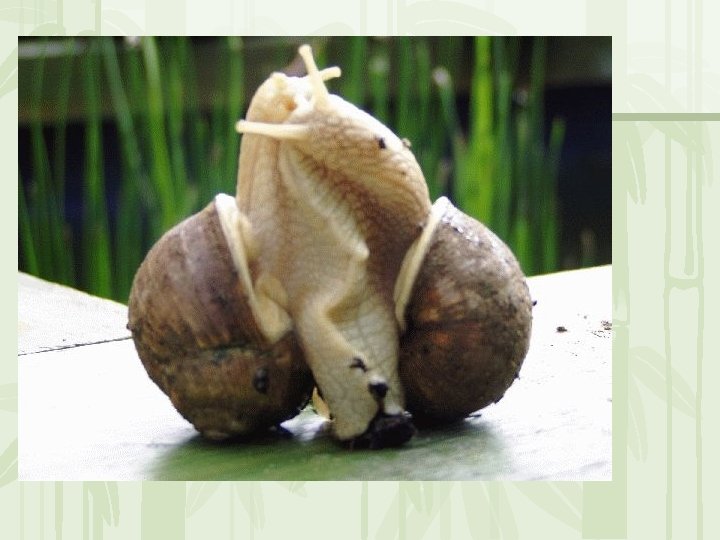
Giant African Land Snail
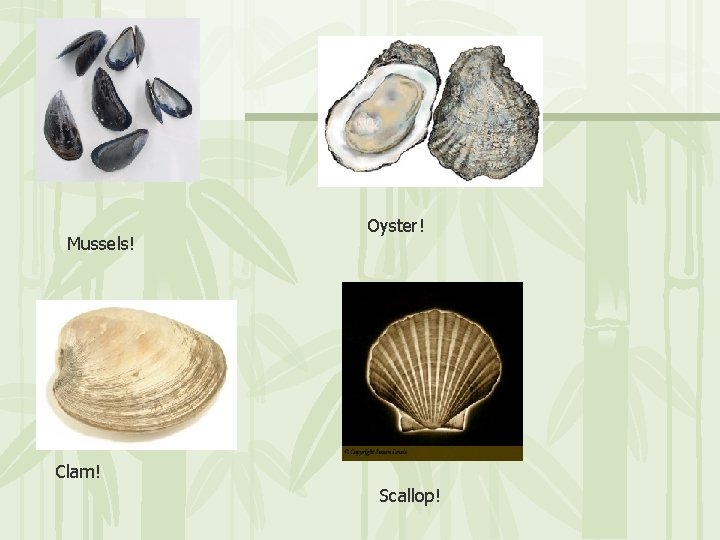
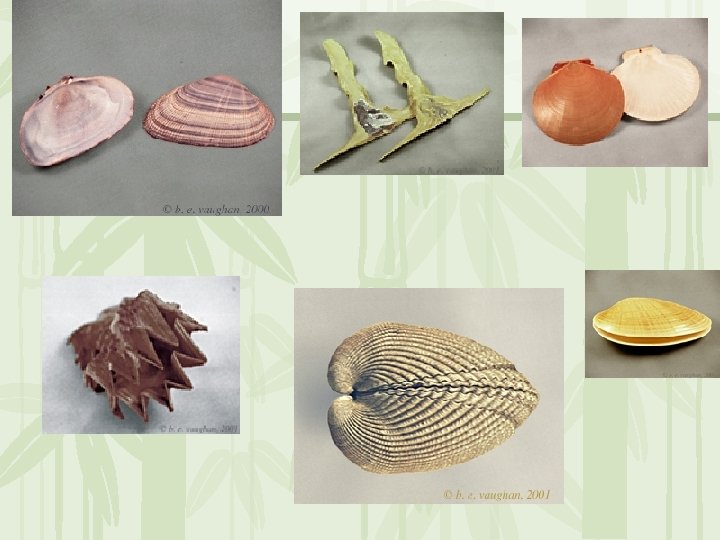
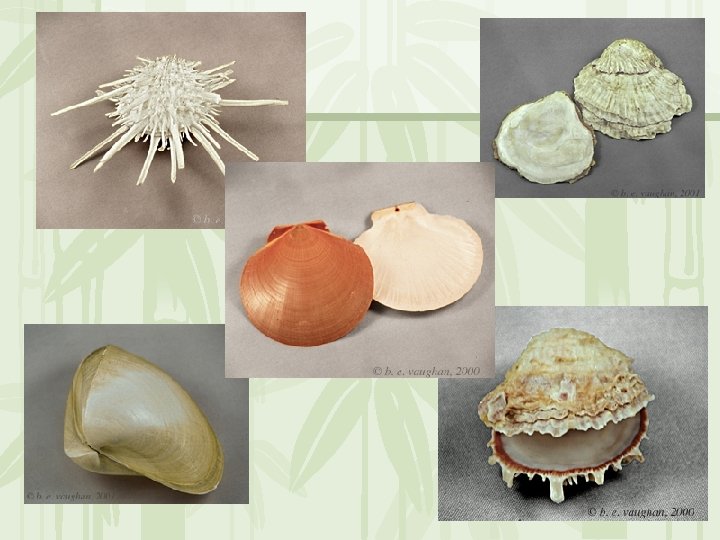
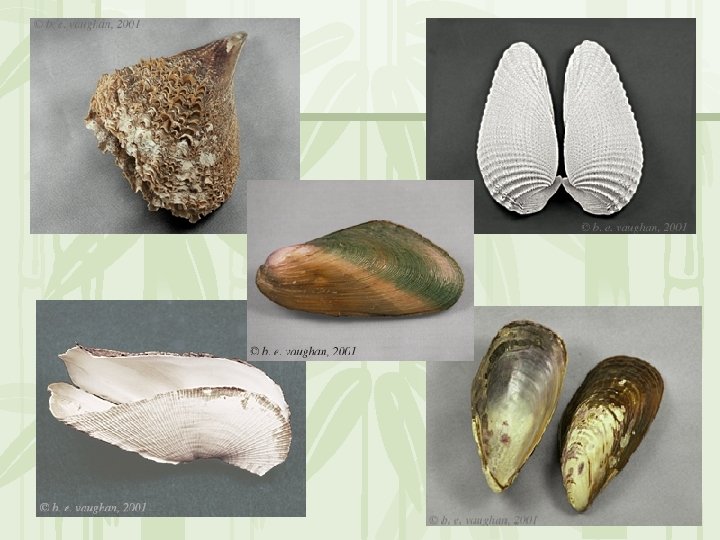
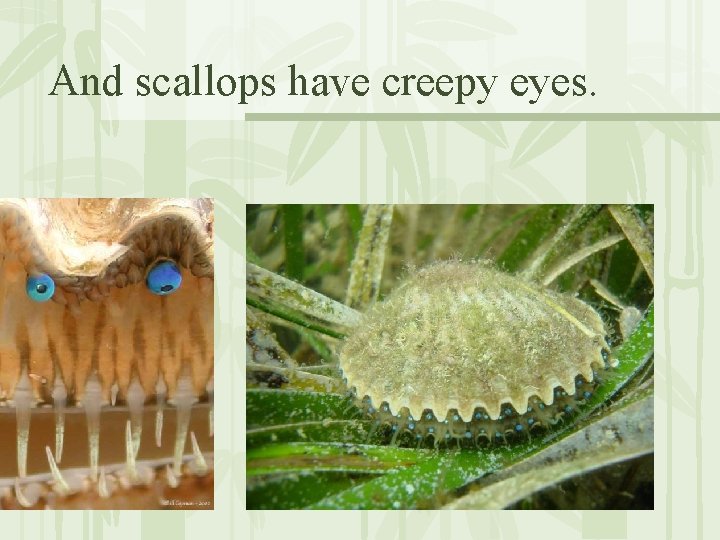
2. Class Bivalvia • • Two-Shells Filter feed Moves slowly Includes clams, mussels, oysters, and scallops
Mussels! Oyster! Clam! Scallop!
And scallops have creepy eyes.
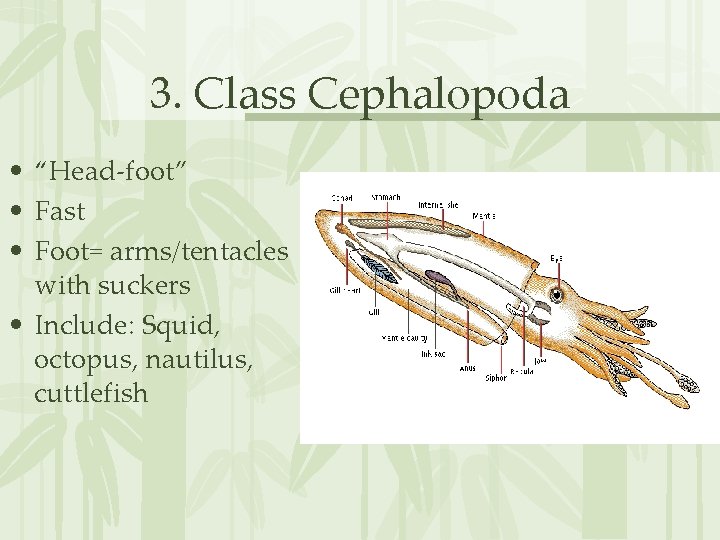
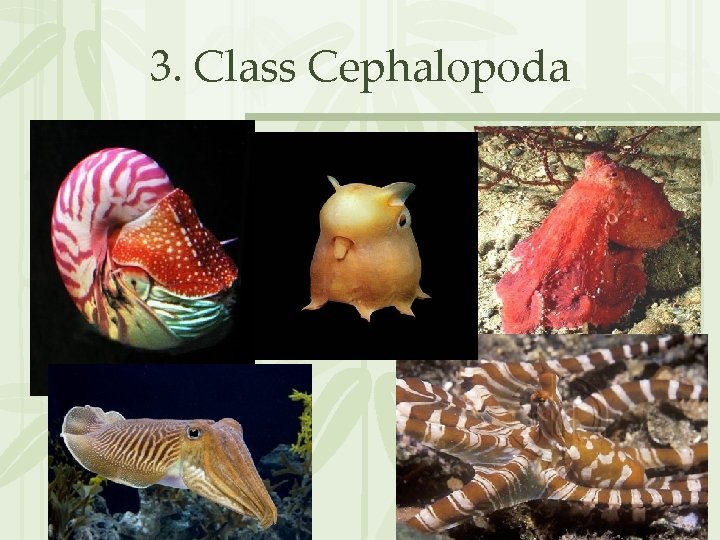
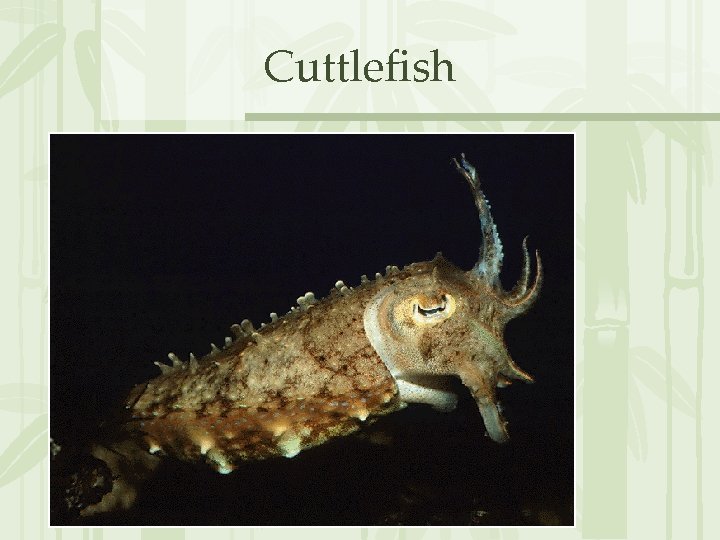
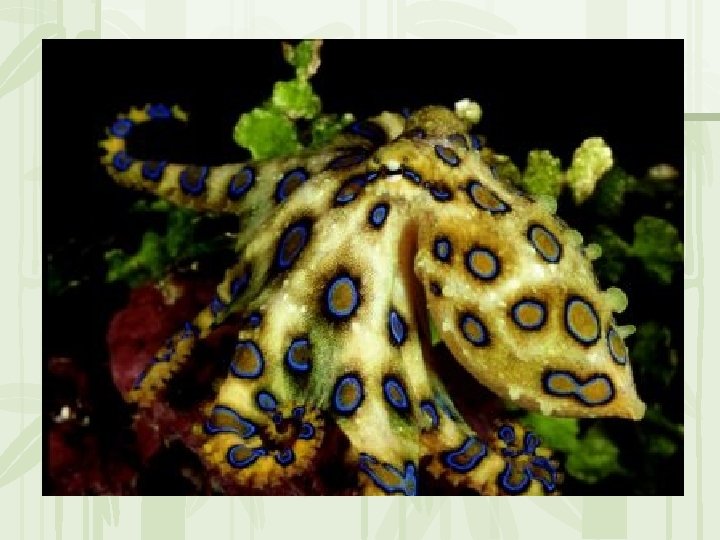
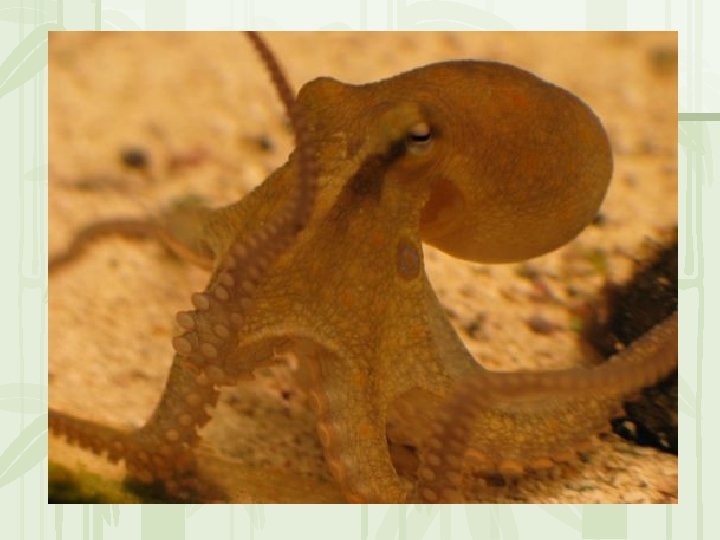
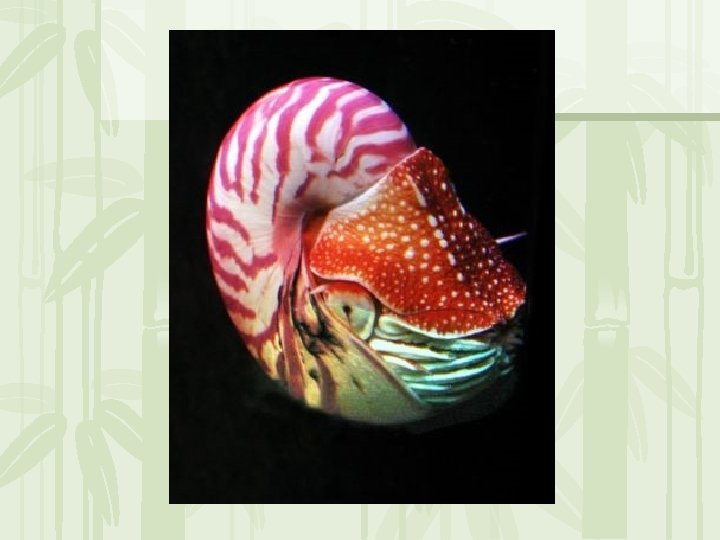
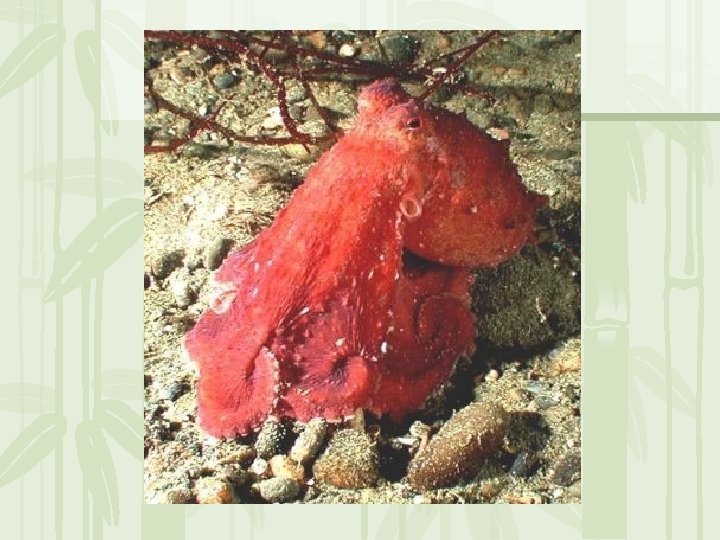
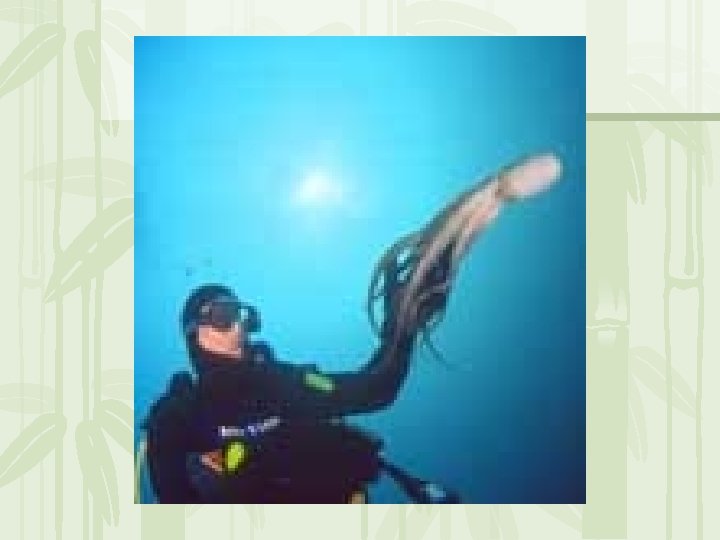
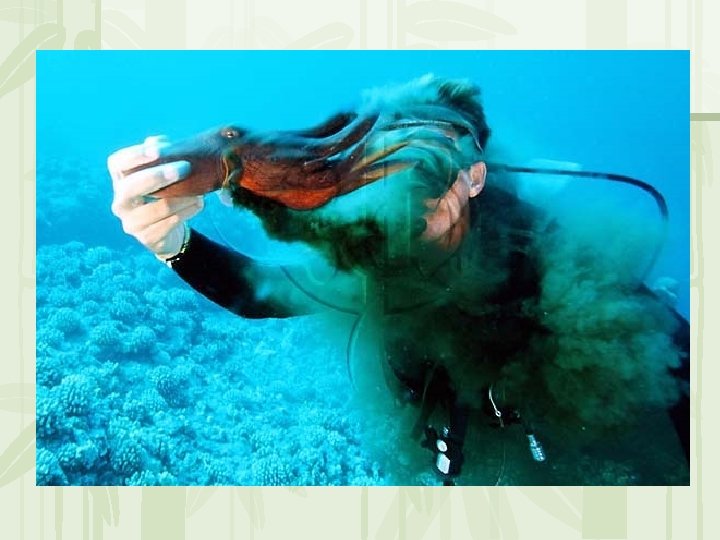
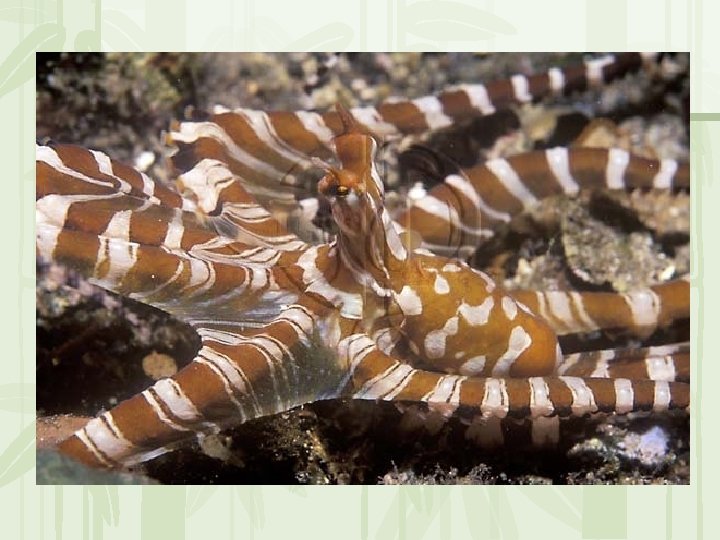
3. Class Cephalopoda • “Head-foot” • Fast • Foot= arms/tentacles with suckers • Include: Squid, octopus, nautilus, cuttlefish
3. Class Cephalopoda
Cuttlefish
Octopus larva
Useful Mollusks Vs. Harmful Mollusks • Filter water to clean ecosystem • Shells collected for their beauty • Pearls from oysters • Snail venom used to treat depression, Alzheimer's, epilepsy, heart disease • Shipworms burrow into boat wood • Slugs eat garden plants
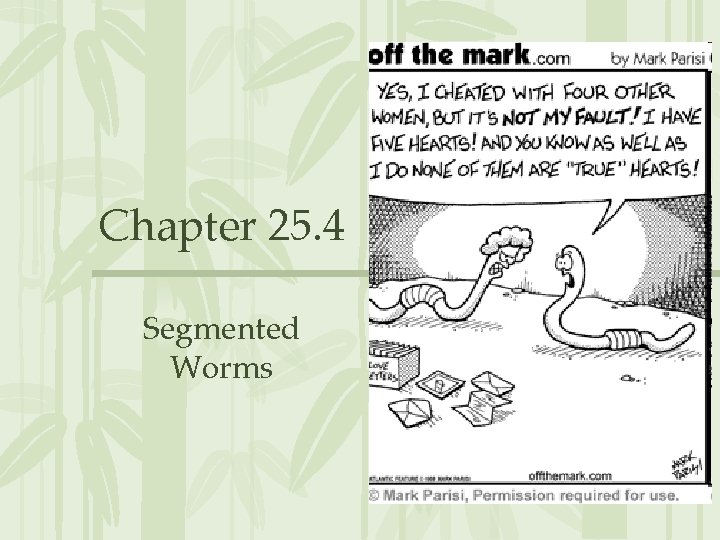
Chapter 25. 4 Segmented Worms
Phylum Annelida • Protostomes • Segmented body divided by walls of tissue • Closed circulatory system • Coelomates • Bilateral symmetry • Two body openings
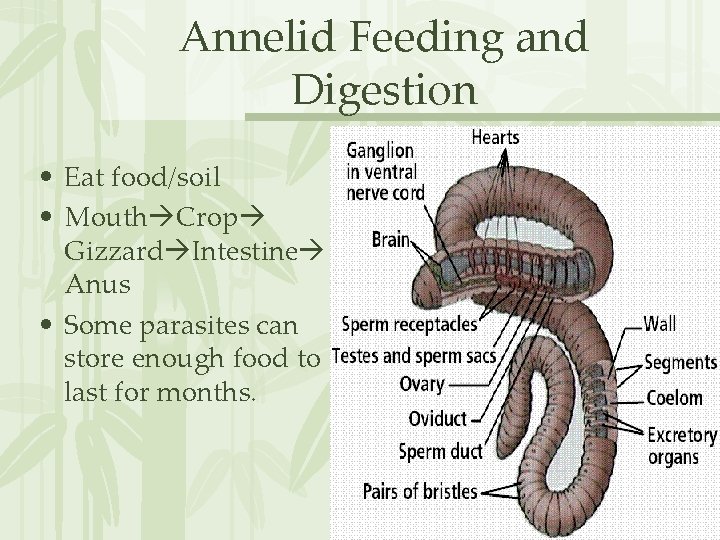
Annelid Feeding and Digestion • Eat food/soil • Mouth Crop Gizzard Intestine Anus • Some parasites can store enough food to last for months.
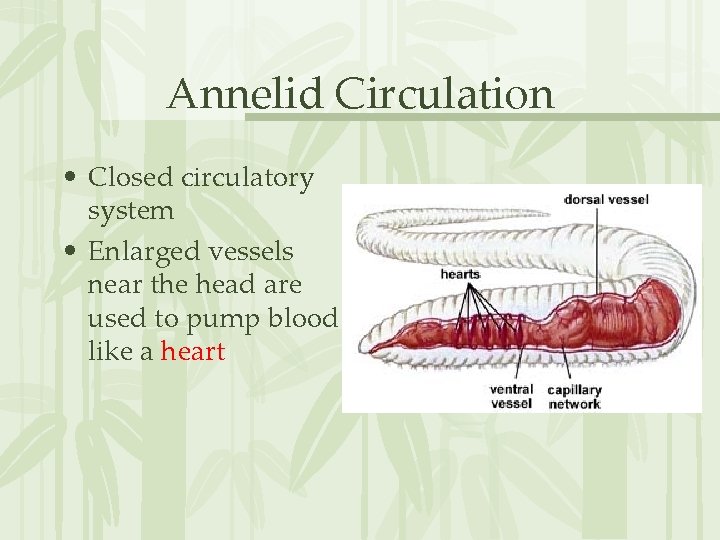
Annelid Circulation • Closed circulatory system • Enlarged vessels near the head are used to pump blood like a heart
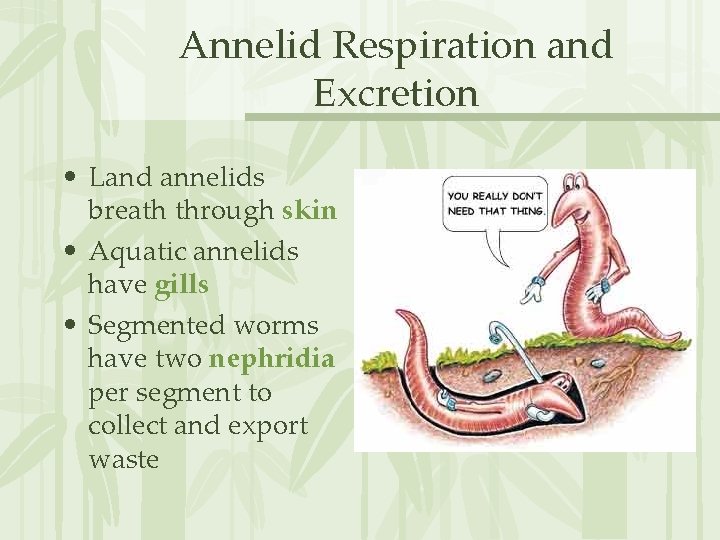
Annelid Respiration and Excretion • Land annelids breath through skin • Aquatic annelids have gills • Segmented worms have two nephridia per segment to collect and export waste
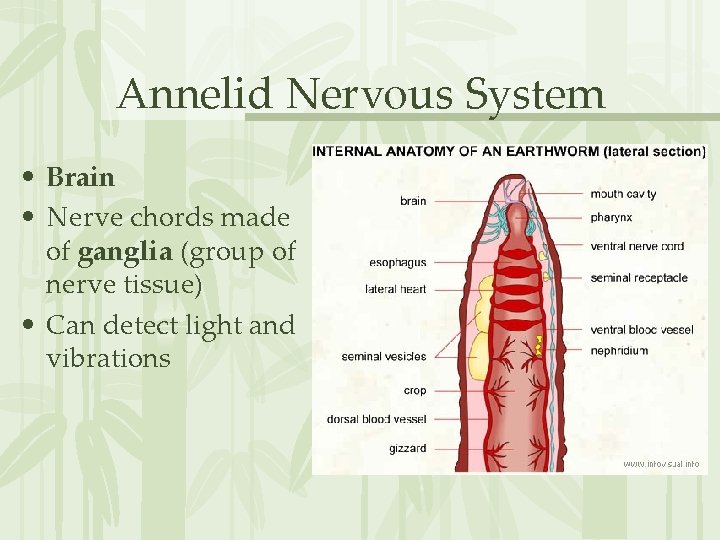
Annelid Nervous System • Brain • Nerve chords made of ganglia (group of nerve tissue) • Can detect light and vibrations
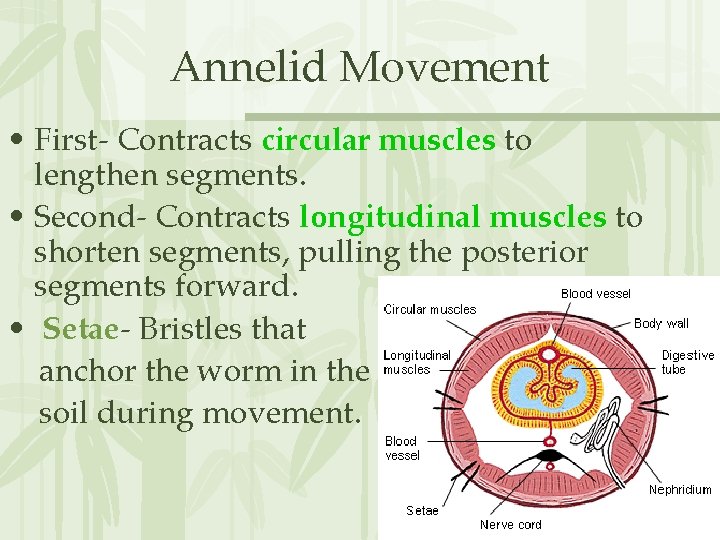
Annelid Movement • First- Contracts circular muscles to lengthen segments. • Second- Contracts longitudinal muscles to shorten segments, pulling the posterior segments forward. • Setae- Bristles that anchor the worm in the soil during movement.
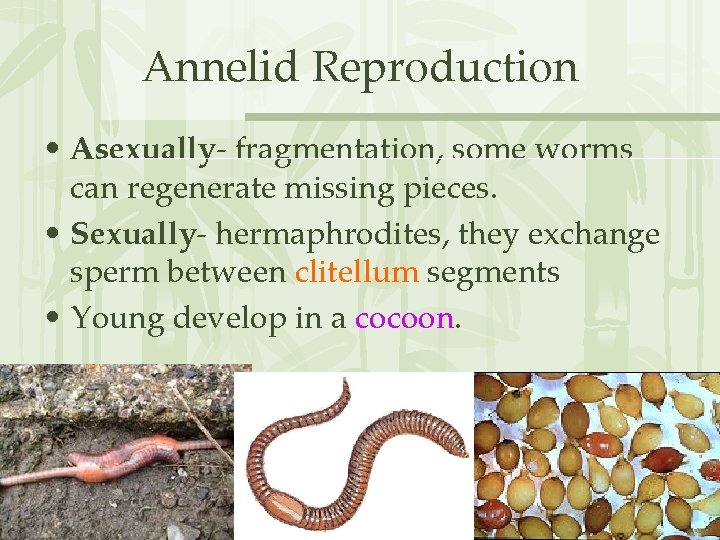
Annelid Reproduction • Asexually- fragmentation, some worms can regenerate missing pieces. • Sexually- hermaphrodites, they exchange sperm between clitellum segments • Young develop in a cocoon.
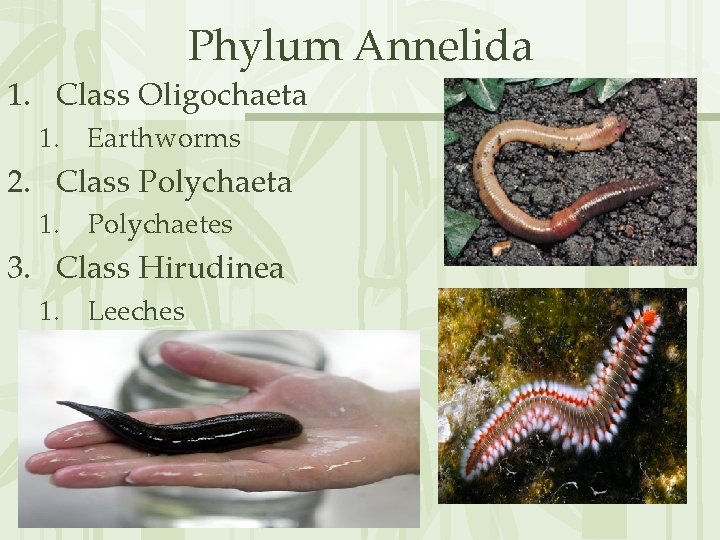
Phylum Annelida 1. Class Oligochaeta 1. Earthworms 2. Class Polychaeta 1. Polychaetes 3. Class Hirudinea 1. Leeches
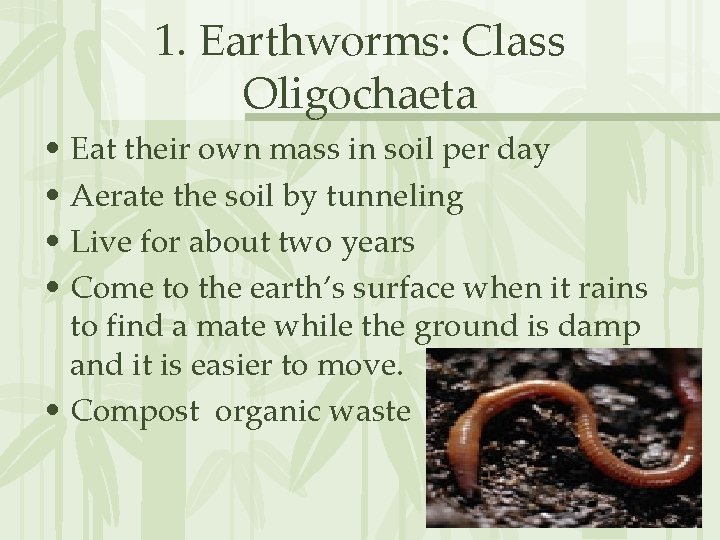
1. Earthworms: Class Oligochaeta • Eat their own mass in soil per day • Aerate the soil by tunneling • Live for about two years • Come to the earth’s surface when it rains to find a mate while the ground is damp and it is easier to move. • Compost organic waste
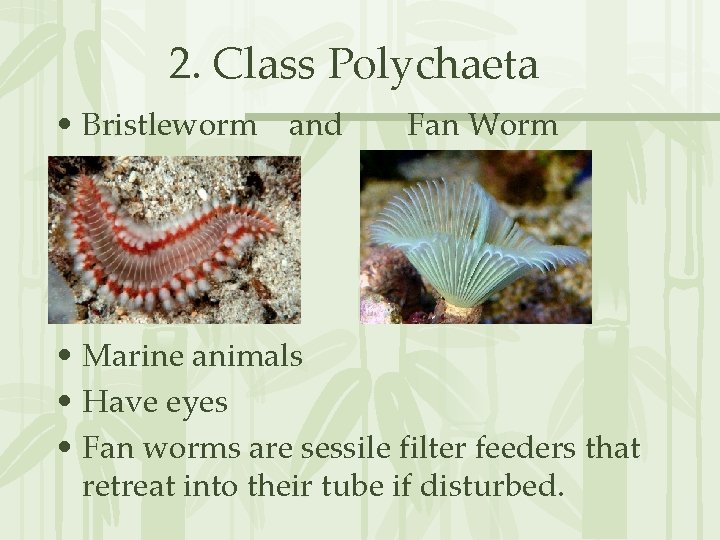
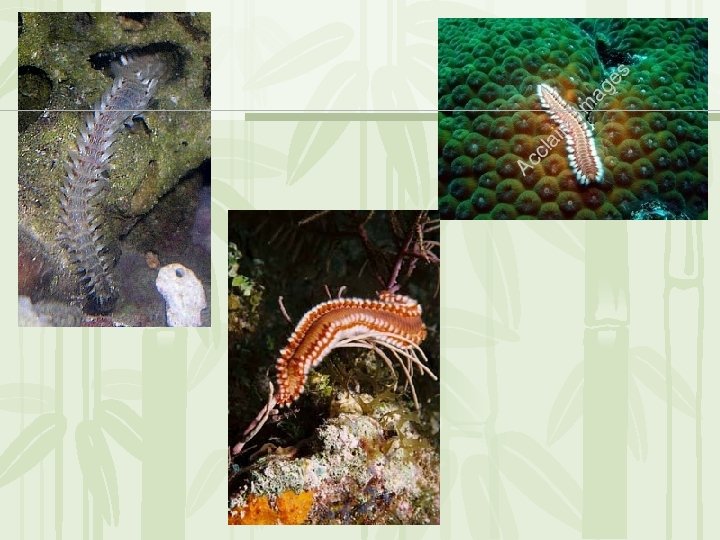
2. Class Polychaeta • Bristleworm and Fan Worm • Marine animals • Have eyes • Fan worms are sessile filter feeders that retreat into their tube if disturbed.
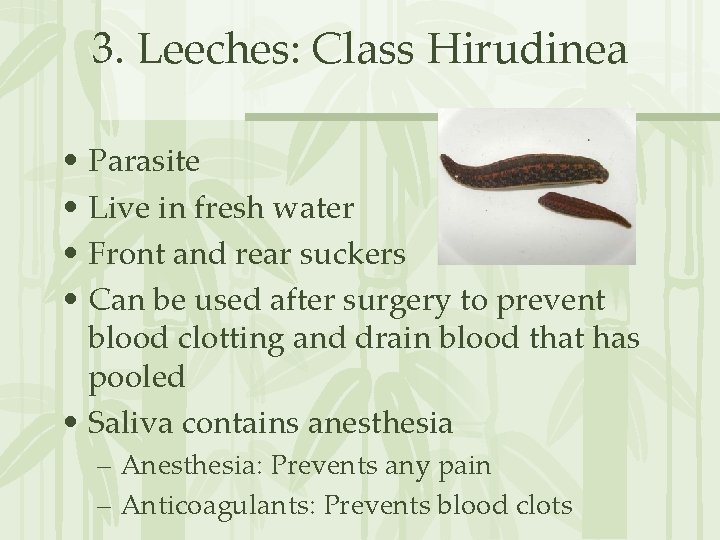
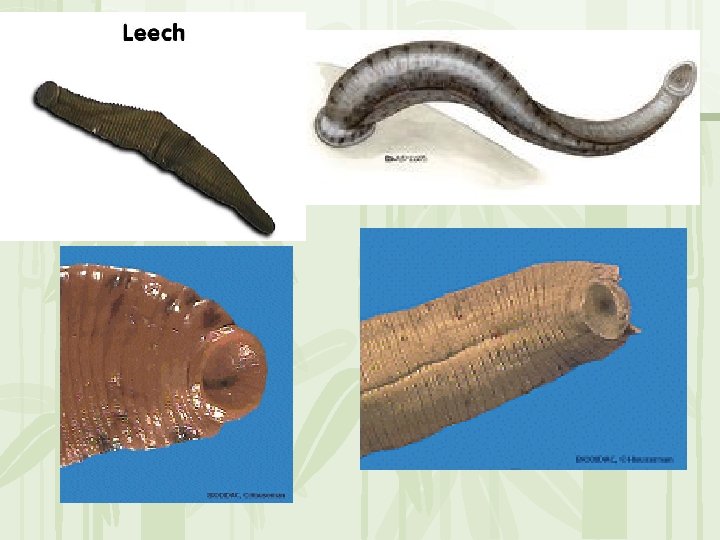
3. Leeches: Class Hirudinea • Parasite • Live in fresh water • Front and rear suckers • Can be used after surgery to prevent blood clotting and drain blood that has pooled • Saliva contains anesthesia – Anesthesia: Prevents any pain – Anticoagulants: Prevents blood clots