
Chapter 25 Metamorphic Facies and Metamorphosed Mafic Rocks

- Slides: 82
Chapter 25. Metamorphic Facies and Metamorphosed Mafic Rocks V. M. Goldschmidt (1911, 1912 a), contact metamorphosed pelitic, calcareous, and psammitic hornfelses in the Oslo region Relatively simple mineral assemblages (< 6 major minerals) in the inner zones of the aureoles around granitoid intrusives Equilibrium mineral assemblage related to Xbulk
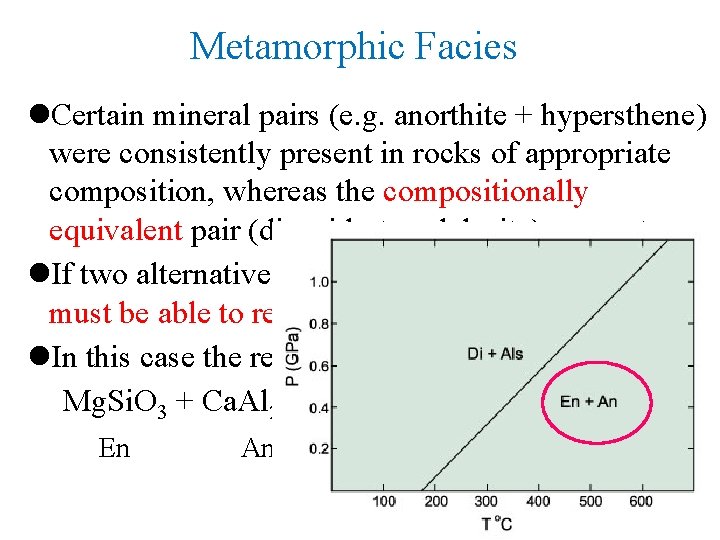
Metamorphic Facies l. Certain mineral pairs (e. g. anorthite + hypersthene) were consistently present in rocks of appropriate composition, whereas the compositionally equivalent pair (diopside + andalusite) was not l. If two alternative assemblages are X-equivalent, we must be able to relate them by a reaction l. In this case the reaction is simple: Mg. Si. O 3 + Ca. Al 2 Si 2 O 8 = Ca. Mg. Si 2 O 6 + Al 2 Si. O 5 En An Di Als
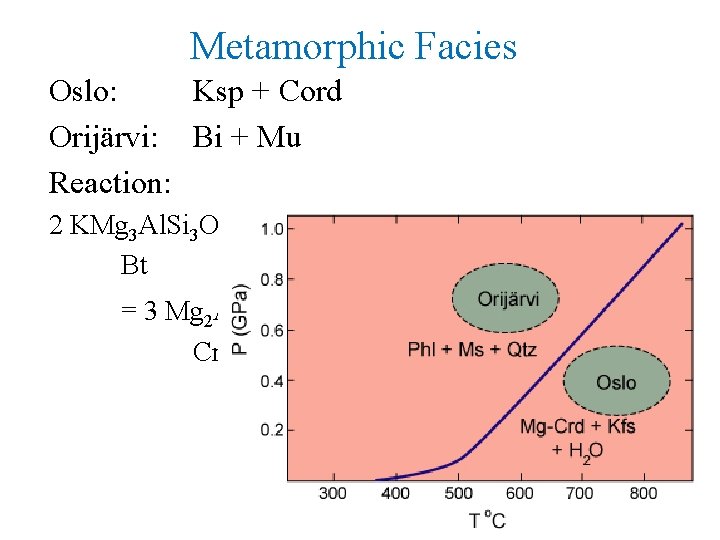
Metamorphic Facies Pentii Eskola (1914, 1915) Orijärvi, S. Finland Rocks with K-feldspar + cordierite at Oslo contained the compositionally equivalent pair biotite + muscovite at Orijärvi Eskola: difference must reflect differing physical conditions Finnish rocks (more hydrous and lower volume assemblage) equilibrated at lower temperatures and higher pressures than the Norwegian ones
Metamorphic Facies Oslo: Ksp + Cord Orijärvi: Bi + Mu Reaction: 2 KMg 3 Al. Si 3 O 10(OH)2 + 6 KAl 2 Al. Si 3 O 10(OH)2 + 15 Si. O 2 Bt Ms Qtz = 3 Mg 2 Al 4 Si 5 O 18 + 8 KAl. Si 3 O 8 + 8 H 2 O Crd Kfs
Metamorphic Facies Eskola (1915) developed the concept of metamorphic facies: “In any rock or metamorphic formation which has arrived at a chemical equilibrium through metamorphism at constant temperature and pressure conditions, the mineral composition is controlled only by the chemical composition. We are led to a general conception which the writer proposes to call metamorphic facies. ”
Metamorphic Facies Dual basis for the facies concept 1. Descriptive: relationship between the Xbulk & mineralogy • A fundamental feature of Eskola’s concept • A metamorphic facies is then a set of repeatedly associated metamorphic mineral assemblages • If we find a specified assemblage (or better yet, a group of compatible assemblages covering a range of compositions) in the field, then a certain facies may be assigned to the area
Metamorphic Facies 2. Interpretive: the range of temperature and pressure conditions represented by each facies • Eskola aware of the P-T implications and correctly deduced the relative temperatures and pressures of facies he proposed • Can now assign relatively accurate temperature and pressure limits to individual facies
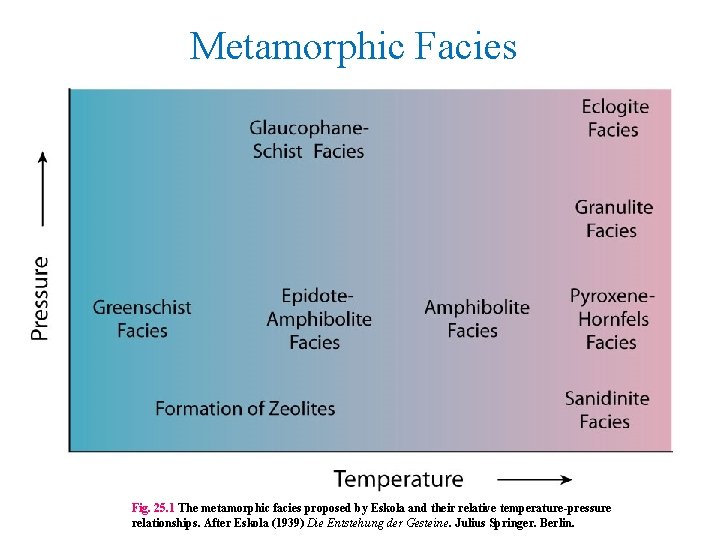
Metamorphic Facies Eskola (1920) proposed 5 original facies: • Greenschist • Amphibolite • Hornfels • Sanidinite • Eclogite Easily defined on the basis of mineral assemblages that develop in mafic rocks
Metamorphic Facies In his final account, Eskola (1939) added: • Granulite • Epidote-amphibolite • Glaucophane-schist (now called Blueschist). . . and changed the name of the hornfels facies to the pyroxene hornfels facies
Metamorphic Facies Fig. 25. 1 The metamorphic facies proposed by Eskola and their relative temperature-pressure relationships. After Eskola (1939) Die Entstehung der Gesteine. Julius Springer. Berlin.
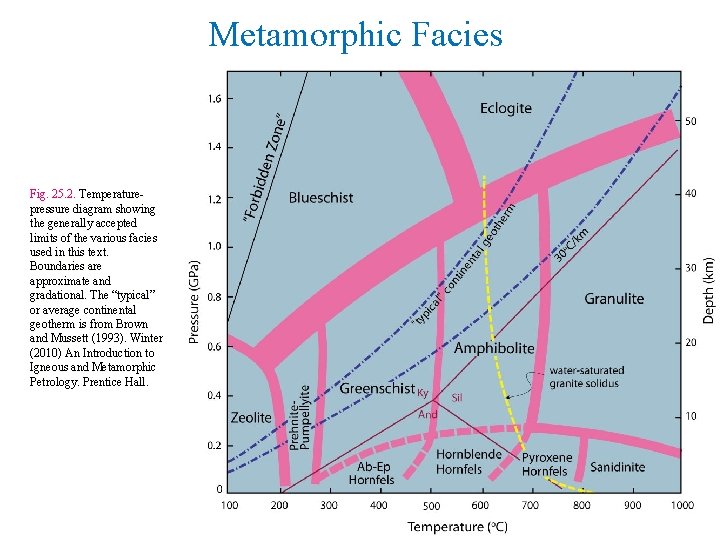
Metamorphic Facies Several additional facies types have been proposed. Most notable are: • Zeolite • Prehnite-pumpellyite. . . from Coombs in the “burial metamorphic” terranes of New Zealand Fyfe et al. (1958) also proposed: • Albite-epidote hornfels • Hornblende hornfels
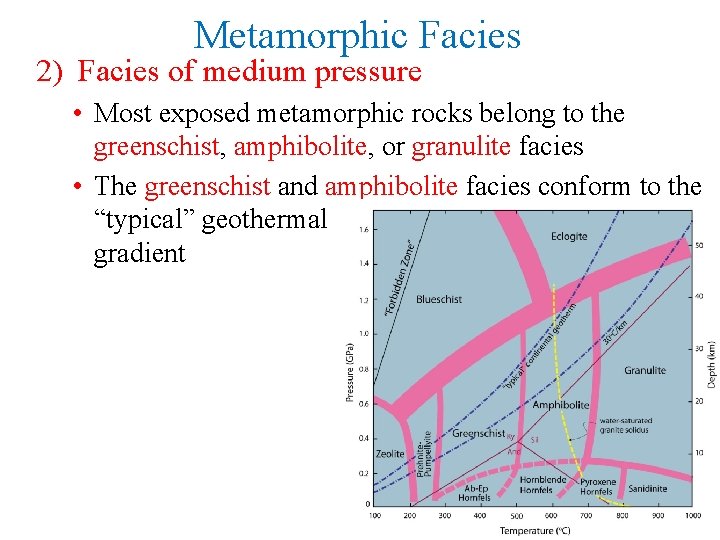
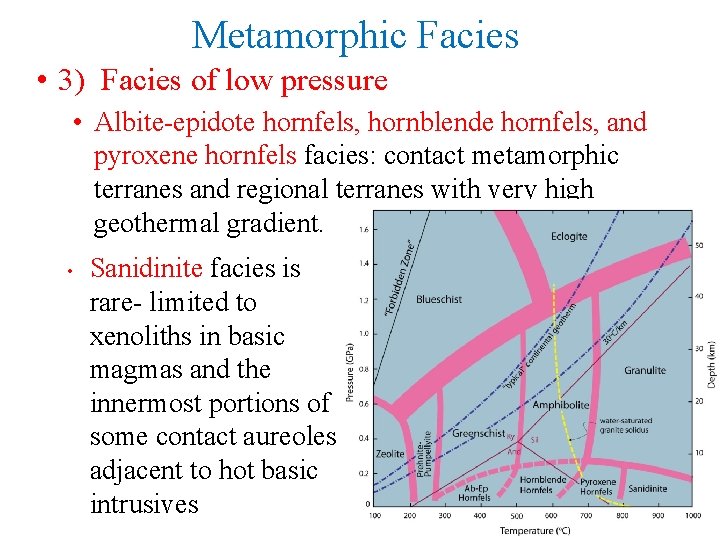
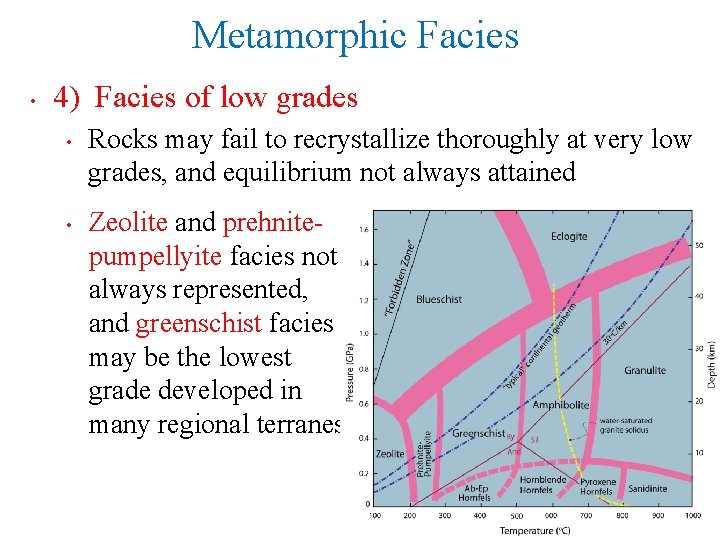
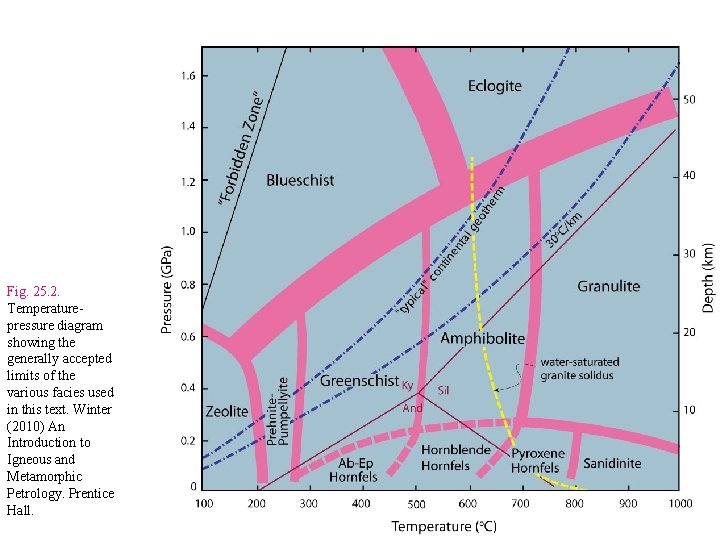
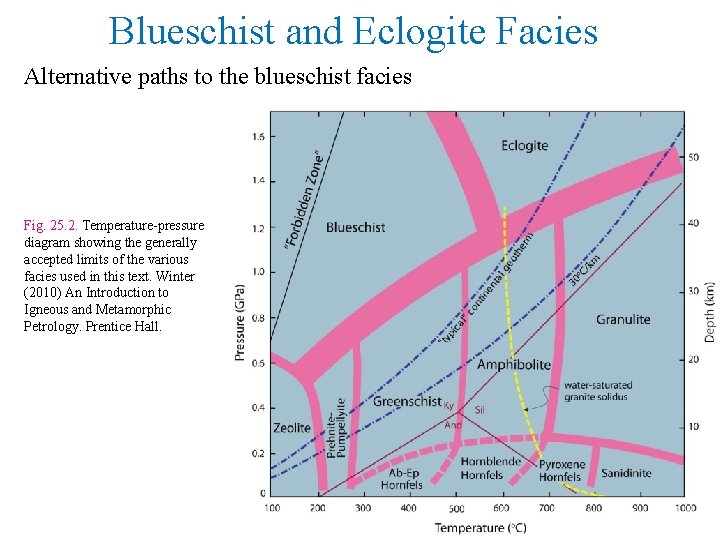
Metamorphic Facies Fig. 25. 2. . Temperaturepressure diagram showing the generally accepted limits of the various facies used in this text. Boundaries are approximate and gradational. The “typical” or average continental geotherm is from Brown and Mussett (1993). Winter (2010) An Introduction to Igneous and Metamorphic Petrology. Prentice Hall.
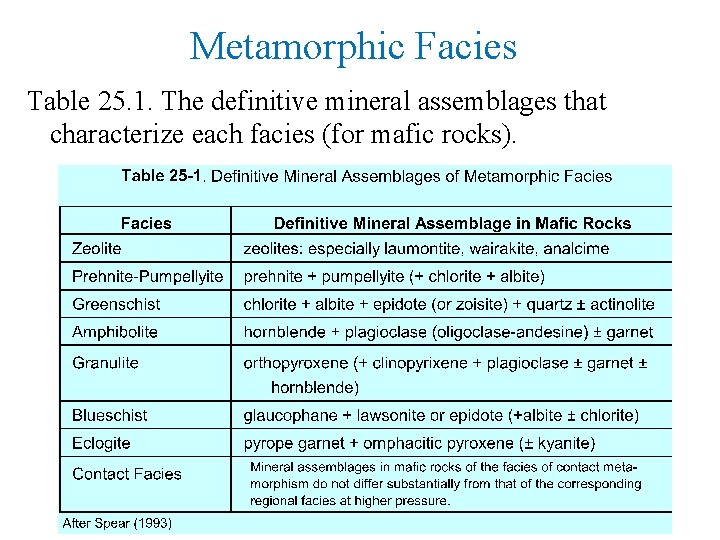
Metamorphic Facies Table 25. 1. The definitive mineral assemblages that characterize each facies (for mafic rocks).
It is convenient to consider metamorphic facies in 4 groups: 1) Facies of high pressure • The blueschist and eclogite facies: low molar volume phases under conditions of high pressure • Blueschist facies- areas of low T/P gradients: subduction zones • Eclogites: stable under normal geothermal conditions Deep crustal chambers or dikes, sub-crustal magmatic underplates, subducted crust that is redistributed into the mantle
Metamorphic Facies 2) Facies of medium pressure • Most exposed metamorphic rocks belong to the greenschist, amphibolite, or granulite facies • The greenschist and amphibolite facies conform to the “typical” geothermal gradient
Metamorphic Facies • 3) Facies of low pressure • Albite-epidote hornfels, hornblende hornfels, and pyroxene hornfels facies: contact metamorphic terranes and regional terranes with very high geothermal gradient. • Sanidinite facies is rare- limited to xenoliths in basic magmas and the innermost portions of some contact aureoles adjacent to hot basic intrusives
Metamorphic Facies • 4) Facies of low grades • • Rocks may fail to recrystallize thoroughly at very low grades, and equilibrium not always attained Zeolite and prehnitepumpellyite facies not always represented, and greenschist facies may be the lowest grade developed in many regional terranes
Metamorphic Facies Combine the concepts of isograds, zones, and facies • Examples: “chlorite zone of the greenschist facies, ” the “staurolite zone of the amphibolite facies, ” or the “cordierite zone of the hornblende hornfels facies, ” etc. • Metamorphic maps typically include isograds that define zones and ones that define facies boundaries • Determining a facies or zone is most reliably done when several rocks of varying composition and mineralogy are available
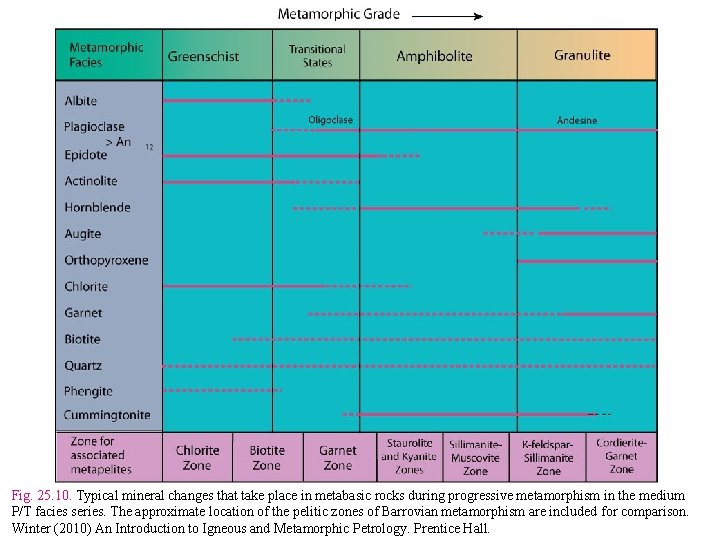
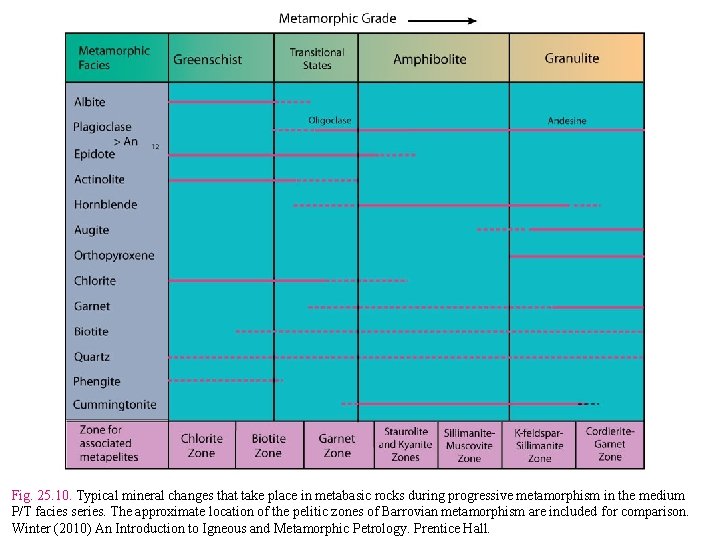
Fig. 25. 10. Typical mineral changes that take place in metabasic rocks during progressive metamorphism in the medium P/T facies series. The approximate location of the pelitic zones of Barrovian metamorphism are included for comparison. Winter (2010) An Introduction to Igneous and Metamorphic Petrology. Prentice Hall.
Facies Series A traverse up grade through a metamorphic terrane should follow one of several possible metamorphic field gradients (Fig. 21. 1), and, if extensive enough, cross through a sequence of facies
Figure 21. 1. Metamorphic field gradients (estimated P-T conditions along surface traverses directly up metamorphic grade) for several metamorphic areas. After Turner (1981). Metamorphic Petrology: Mineralogical, Field, and Tectonic Aspects. Mc. Graw-Hill.
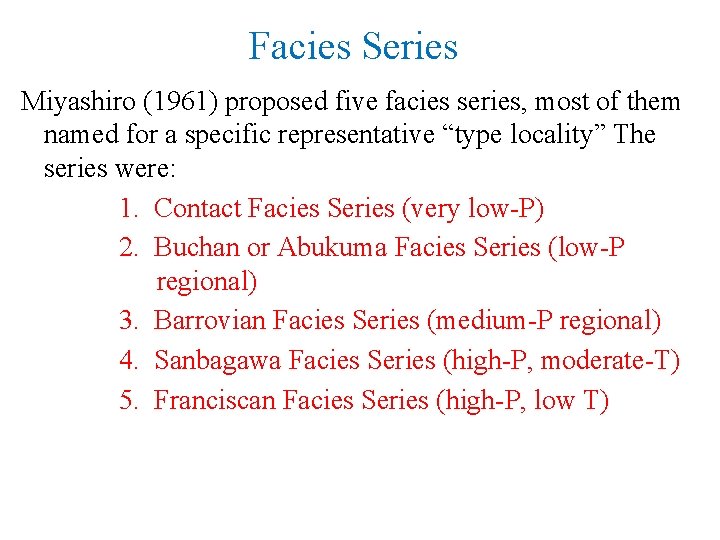
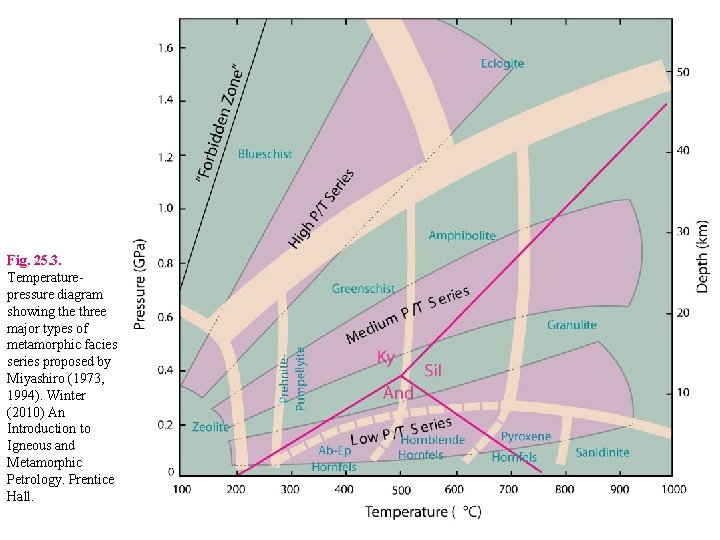
Facies Series Miyashiro (1961) proposed five facies series, most of them named for a specific representative “type locality” The series were: 1. Contact Facies Series (very low-P) 2. Buchan or Abukuma Facies Series (low-P regional) 3. Barrovian Facies Series (medium-P regional) 4. Sanbagawa Facies Series (high-P, moderate-T) 5. Franciscan Facies Series (high-P, low T)
Fig. 25. 3. Temperaturepressure diagram showing the three major types of metamorphic facies series proposed by Miyashiro (1973, 1994). Winter (2010) An Introduction to Igneous and Metamorphic Petrology. Prentice Hall.
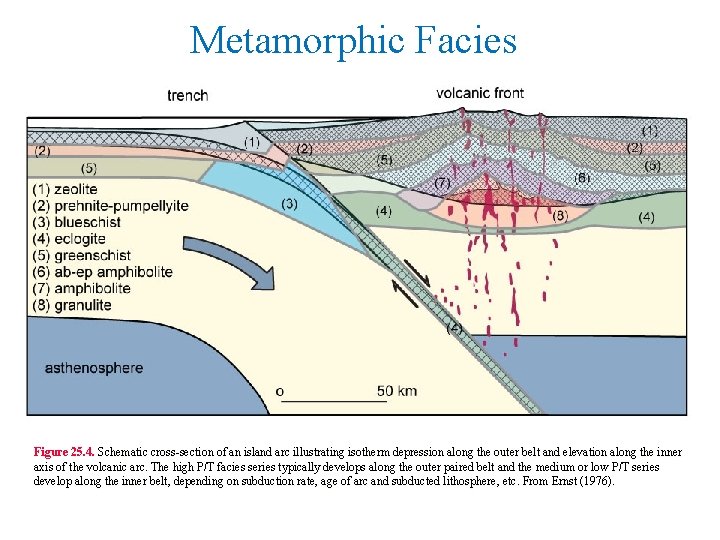
Metamorphic Facies Figure 25. 4. Schematic cross-section of an island arc illustrating isotherm depression along the outer belt and elevation along the inner axis of the volcanic arc. The high P/T facies series typically develops along the outer paired belt and the medium or low P/T series develop along the inner belt, depending on subduction rate, age of arc and subducted lithosphere, etc. From Ernst (1976).
Metamorphism of Mafic Rocks Mineral changes and associations along T-P gradients characteristic of the three facies series • Hydration of original mafic minerals generally required • If water unavailable, mafic igneous rocks will remain largely unaffected, even as associated sediments are completely reequilibrated • Coarse-grained intrusives are the least permeable and likely to resist metamorphic changes • Tuffs and graywackes are the most susceptible
Metamorphism of Mafic Rocks Plagioclase: • Ca-rich plagioclase progressively unstable as T lowered • General correlation between temperature and maximum An -content of stable plagioclase § Low metamorphic grades: albite (An 0 -3) § Upper-greenschist facies oligoclase becomes stable. § An-content jumps from An 1 -7 to An 17 -20 (peristerite solvus) § Andesine and more calcic plagioclase stable in the upper amphibolite and granulite facies • The excess Ca and Al calcite, an epidote mineral, sphene, or amphibole, etc. (depending on P-T-X)
Metamorphism of Mafic Rocks • Clinopyroxene various mafic minerals. • Chlorite, actinolite, hornblende, epidote, a metamorphic pyroxene, etc. • The mafics that form are commonly diagnostic of the grade and facies
Mafic Assemblages at Low Grades • Zeolite and prehnite-pumpellyite facies • Do not always occur - typically require unstable protolith • Boles and Coombs (1975) showed that metamorphism of tuffs in NZ accompanied by substantial chemical changes due to circulating fluids, and that these fluids played an important role in the metamorphic minerals that were stable • The classic area of burial metamorphism thus has a strong component of hydrothermal metamorphism as well
Mafic Assemblages of the Medium P/T Series: Greenschist, Amphibolite, and Granulite Facies • The greenschist, amphibolite and granulite facies constitute the most common facies series of regional metamorphism • The classical Barrovian series of pelitic zones and the lower-pressure Buchan-Abukuma series are variations on this trend
Greenschist, Amphibolite, Granulite Facies • Zeolite and prehnite-pumpellyite facies not present in the Scottish Highlands • Metamorphism of mafic rocks first evident in the greenschist facies, which correlates with the chlorite and biotite zones of associated pelitic rocks § Typical minerals include chlorite, albite, actinolite, epidote, quartz, and possibly calcite, biotite, or stilpnomelane § Chlorite, actinolite, and epidote impart the green color from which the mafic rocks and facies get their name
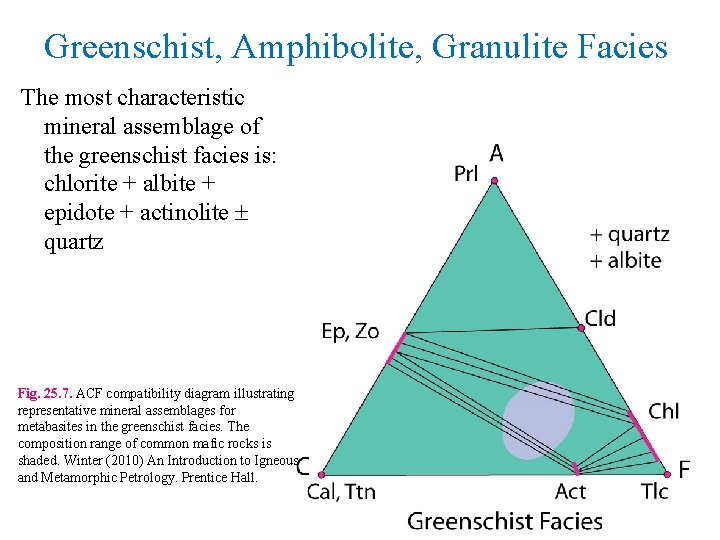
Greenschist, Amphibolite, Granulite Facies The most characteristic mineral assemblage of the greenschist facies is: chlorite + albite + epidote + actinolite quartz Fig. 25. 7. ACF compatibility diagram illustrating representative mineral assemblages for metabasites in the greenschist facies. The composition range of common mafic rocks is shaded. Winter (2010) An Introduction to Igneous and Metamorphic Petrology. Prentice Hall.
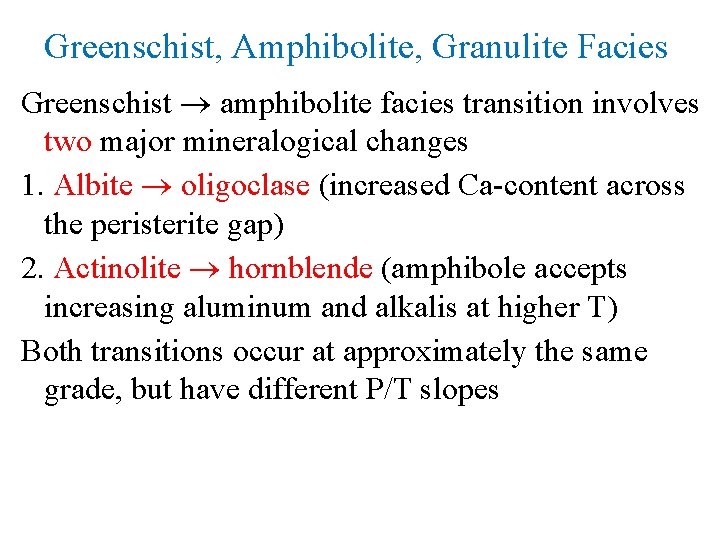
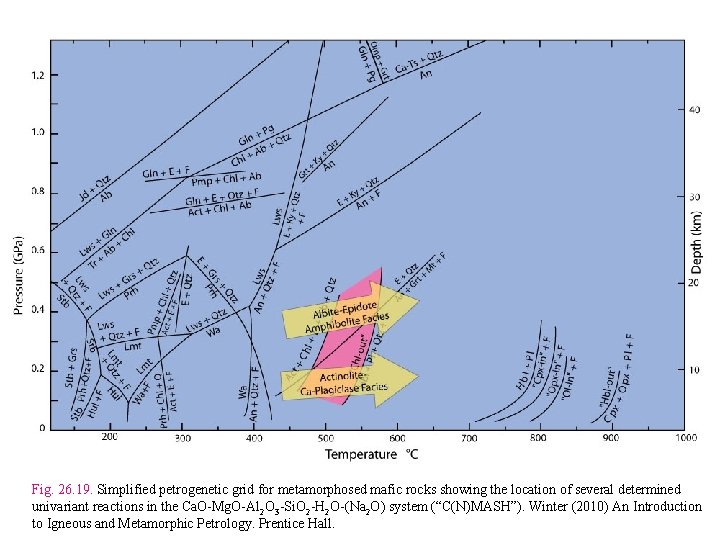
Greenschist, Amphibolite, Granulite Facies Greenschist amphibolite facies transition involves two major mineralogical changes 1. Albite oligoclase (increased Ca-content across the peristerite gap) 2. Actinolite hornblende (amphibole accepts increasing aluminum and alkalis at higher T) Both transitions occur at approximately the same grade, but have different P/T slopes
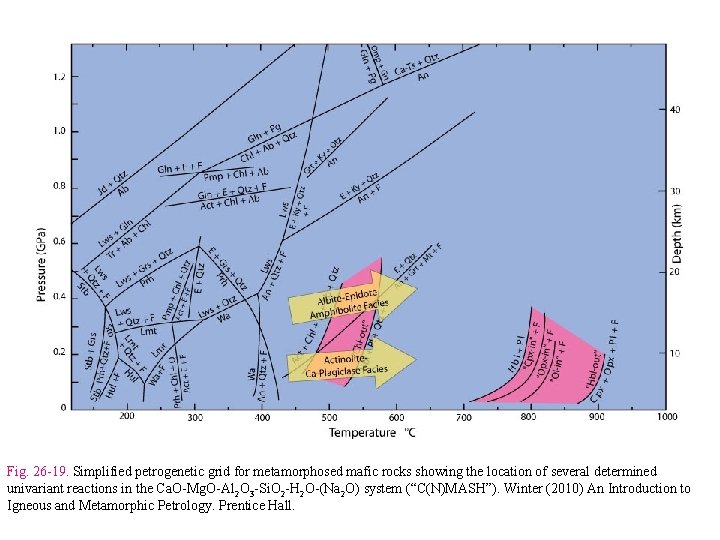
Fig. 26. 19. Simplified petrogenetic grid for metamorphosed mafic rocks showing the location of several determined univariant reactions in the Ca. O-Mg. O-Al 2 O 3 -Si. O 2 -H 2 O-(Na 2 O) system (“C(N)MASH”). Winter (2010) An Introduction to Igneous and Metamorphic Petrology. Prentice Hall.
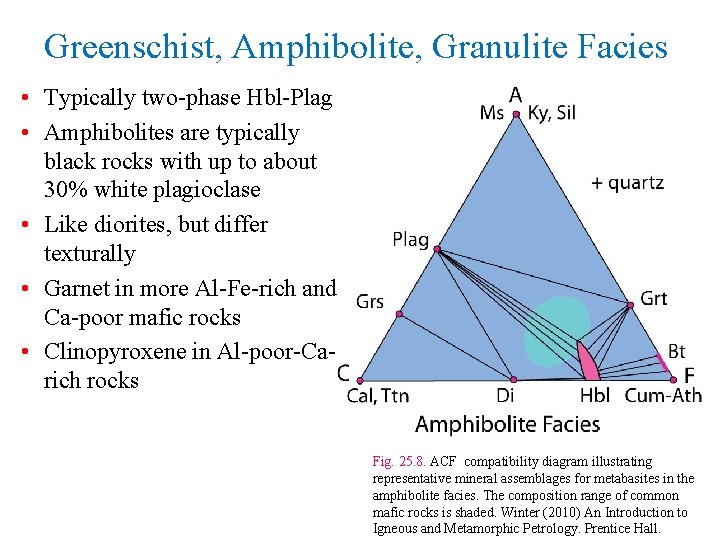
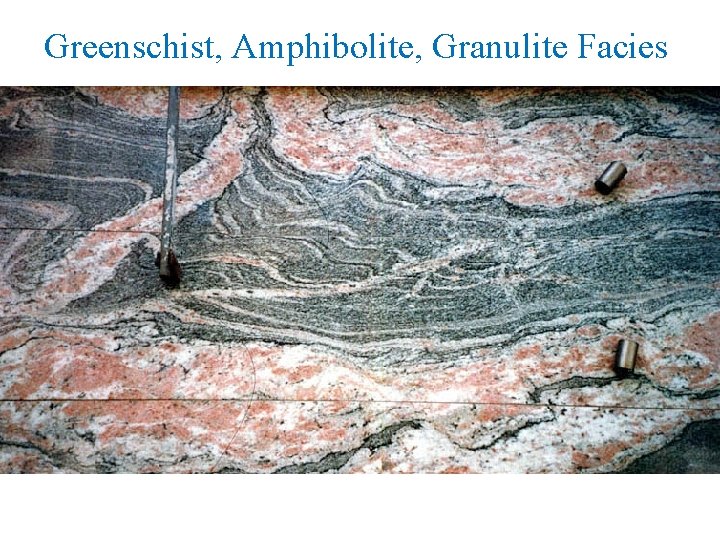
Greenschist, Amphibolite, Granulite Facies • Typically two-phase Hbl-Plag • Amphibolites are typically black rocks with up to about 30% white plagioclase • Like diorites, but differ texturally • Garnet in more Al-Fe-rich and Ca-poor mafic rocks • Clinopyroxene in Al-poor-Carich rocks Fig. 25. 8. ACF compatibility diagram illustrating representative mineral assemblages for metabasites in the amphibolite facies. The composition range of common mafic rocks is shaded. Winter (2010) An Introduction to Igneous and Metamorphic Petrology. Prentice Hall.
Greenschist, Amphibolite, Granulite Facies l. Amphibolite granulite facies ~ 650 -700 o. C l. If aqueous fluid, associated pelitic and quartzofeldspathic rocks (including granitoids) begin to melt in this range at low to medium pressures migmatites and melts may become mobilized l. As a result not all pelites and quartzo-feldspathic rocks reach the granulite facies
Greenschist, Amphibolite, Granulite Facies • Mafic rocks generally melt at higher temperatures • If water is removed by the earlier melts the remaining mafic rocks may become depleted in water • Hornblende decomposes and orthopyroxene + clinopyroxene appear • This reaction occurs over a T interval > 50 o. C
Fig. 26 -19. Simplified petrogenetic grid for metamorphosed mafic rocks showing the location of several determined univariant reactions in the Ca. O-Mg. O-Al 2 O 3 -Si. O 2 -H 2 O-(Na 2 O) system (“C(N)MASH”). Winter (2010) An Introduction to Igneous and Metamorphic Petrology. Prentice Hall.
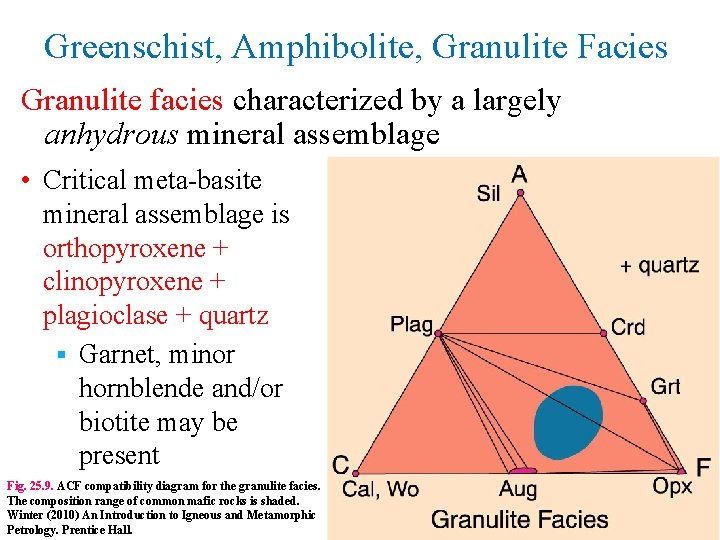
Greenschist, Amphibolite, Granulite Facies Granulite facies characterized by a largely anhydrous mineral assemblage • Critical meta-basite mineral assemblage is orthopyroxene + clinopyroxene + plagioclase + quartz § Garnet, minor hornblende and/or biotite may be present Fig. 25. 9. ACF compatibility diagram for the granulite facies. The composition range of common mafic rocks is shaded. Winter (2010) An Introduction to Igneous and Metamorphic Petrology. Prentice Hall.
Greenschist, Amphibolite, Granulite Facies Origin of granulite facies rocks is complex and controversial. There is general agreement, however, on two points 1) Granulites represent unusually hot conditions • Temperatures > 700 o. C (geothermometry has yielded some very high temperatures, even in excess of 1000 o. C) • Average geotherm temperatures for granulite facies depths should be in the vicinity of 500 o. C, suggesting that granulites are the products of crustal thickening and excess heating
Greenschist, Amphibolite, Granulite Facies 2) Granulites are dry • Rocks don’t melt due to lack of available water • Granulite facies terranes represent deeply buried and dehydrated roots of the continental crust • Fluid inclusions in granulite facies rocks of S. Norway are CO 2 -rich, whereas those in the amphibolite facies rocks are H 2 O-rich
Fig. 25. 10. Typical mineral changes that take place in metabasic rocks during progressive metamorphism in the medium P/T facies series. The approximate location of the pelitic zones of Barrovian metamorphism are included for comparison. Winter (2010) An Introduction to Igneous and Metamorphic Petrology. Prentice Hall.
Mafic Assemblages of the Low P/T Series: Albite. Epidote Hornfels, Hornblende Hornfels, Pyroxene Hornfels, and Sanidinite Facies • Mineralogy of low-pressure metabasites not appreciably different from the med. -P facies series • Albite-epidote hornfels facies correlates with the greenschist facies into which it grades with increasing pressure • Hornblende hornfels facies correlates with the amphibolite facies, and the pyroxene hornfels and sanidinite facies correlate with the granulite facies
Fig. 25. 2. Temperaturepressure diagram showing the generally accepted limits of the various facies used in this text. Winter (2010) An Introduction to Igneous and Metamorphic Petrology. Prentice Hall.
Mafic Assemblages of the Low P/T Series: Albite. Epidote Hornfels, Hornblende Hornfels, Pyroxene Hornfels, and Sanidinite Facies of contact metamorphism are readily distinguished from those of medium-pressure regional metamorphism on the basis of: • Metapelites (e. g. andalusite and cordierite) • Textures and field relationships • Mineral thermobarometry
Mafic Assemblages of the Low P/T Series: Albite. Epidote Hornfels, Hornblende Hornfels, Pyroxene Hornfels, and Sanidinite Facies The innermost zone of most aureoles rarely reaches the pyroxene hornfels facies § If the intrusion is hot and dry enough, a narrow zone develops in which amphiboles break down to orthopyroxene + clinopyroxene + plagioclase + quartz (without garnet), characterizing this facies Sanidinite facies is not evident in basic rocks
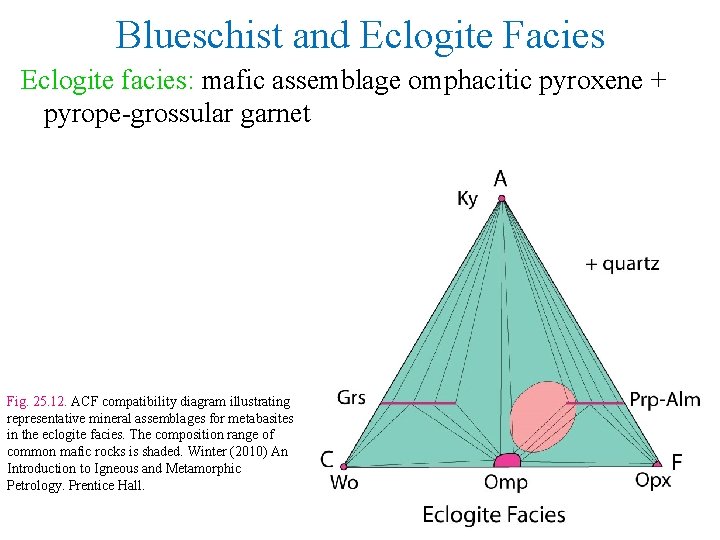
Mafic Assemblages of the High P/T Series: Blueschist and Eclogite Facies l Mafic rocks (not pelites) develop definitive mineral assemblages under high P/T conditions l High P/T geothermal gradients characterize subduction zones l Mafic blueschists are easily recognizable by their color, and are useful indicators of ancient subduction zones l The great density of eclogites: subducted basaltic oceanic crust becomes more dense than the surrounding mantle
Blueschist and Eclogite Facies Alternative paths to the blueschist facies Fig. 25. 2. Temperature-pressure diagram showing the generally accepted limits of the various facies used in this text. Winter (2010) An Introduction to Igneous and Metamorphic Petrology. Prentice Hall.
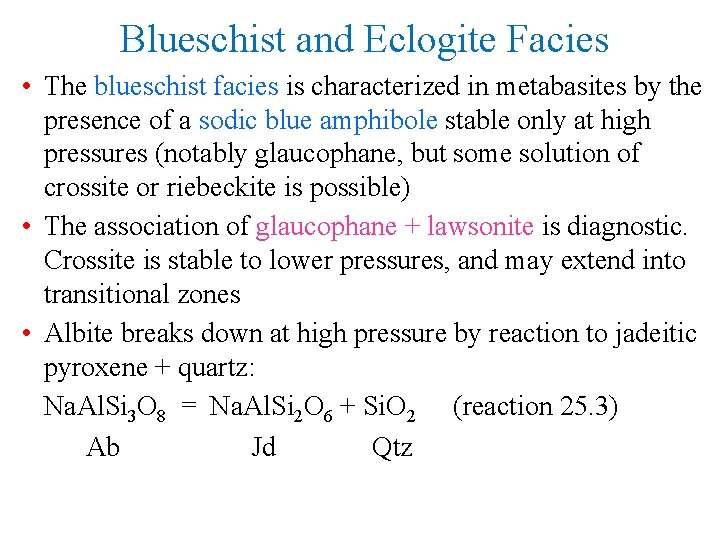
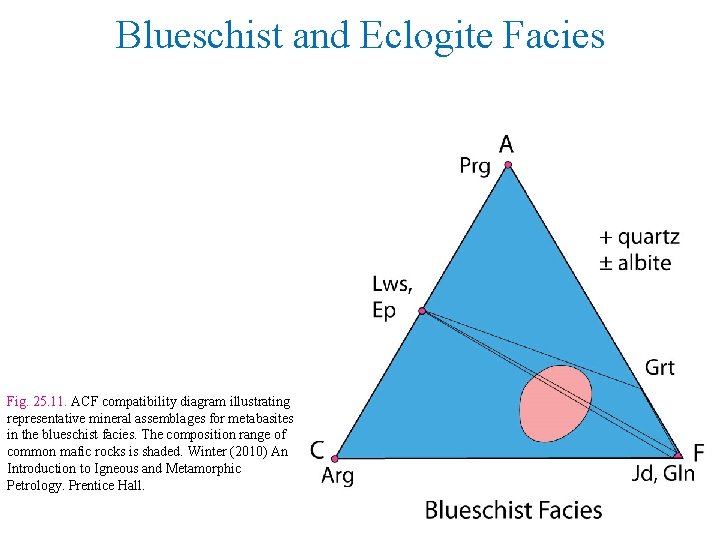
Blueschist and Eclogite Facies • The blueschist facies is characterized in metabasites by the presence of a sodic blue amphibole stable only at high pressures (notably glaucophane, but some solution of crossite or riebeckite is possible) • The association of glaucophane + lawsonite is diagnostic. Crossite is stable to lower pressures, and may extend into transitional zones • Albite breaks down at high pressure by reaction to jadeitic pyroxene + quartz: Na. Al. Si 3 O 8 = Na. Al. Si 2 O 6 + Si. O 2 (reaction 25. 3) Ab Jd Qtz
Blueschist and Eclogite Facies Fig. 25. 11. ACF compatibility diagram illustrating representative mineral assemblages for metabasites in the blueschist facies. The composition range of common mafic rocks is shaded. Winter (2010) An Introduction to Igneous and Metamorphic Petrology. Prentice Hall.
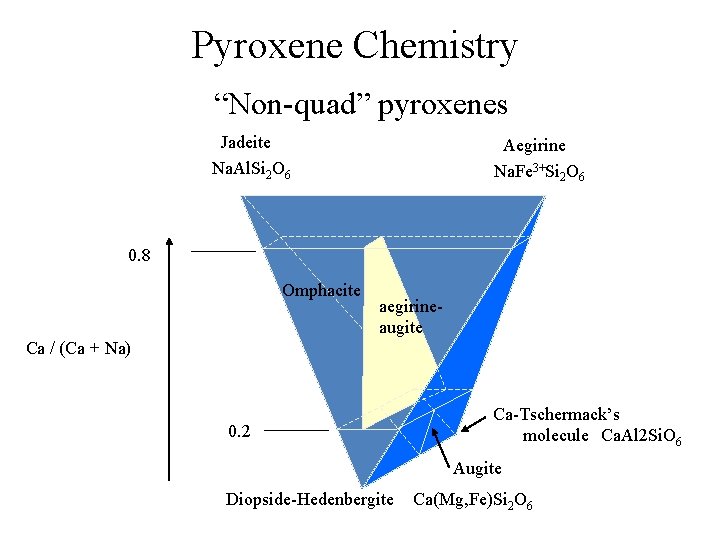
Blueschist and Eclogite Facies Eclogite facies: mafic assemblage omphacitic pyroxene + pyrope-grossular garnet Fig. 25. 12. ACF compatibility diagram illustrating representative mineral assemblages for metabasites in the eclogite facies. The composition range of common mafic rocks is shaded. Winter (2010) An Introduction to Igneous and Metamorphic Petrology. Prentice Hall.
Pyroxene Chemistry “Non-quad” pyroxenes Jadeite Na. Al. Si 2 O 6 Aegirine Na. Fe 3+Si 2 O 6 0. 8 Omphacite aegirine- augite Ca / (Ca + Na) 0. 2 Ca-Tschermack’s molecule Ca. Al 2 Si. O 6 Augite Diopside-Hedenbergite Ca(Mg, Fe)Si 2 O 6
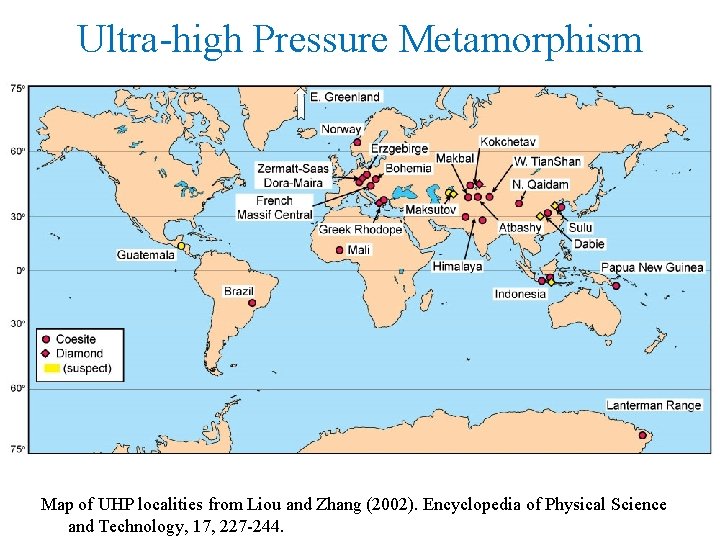
Ultra-high Pressure Metamorphism Map of UHP localities from Liou and Zhang (2002). Encyclopedia of Physical Science and Technology, 17, 227 -244.
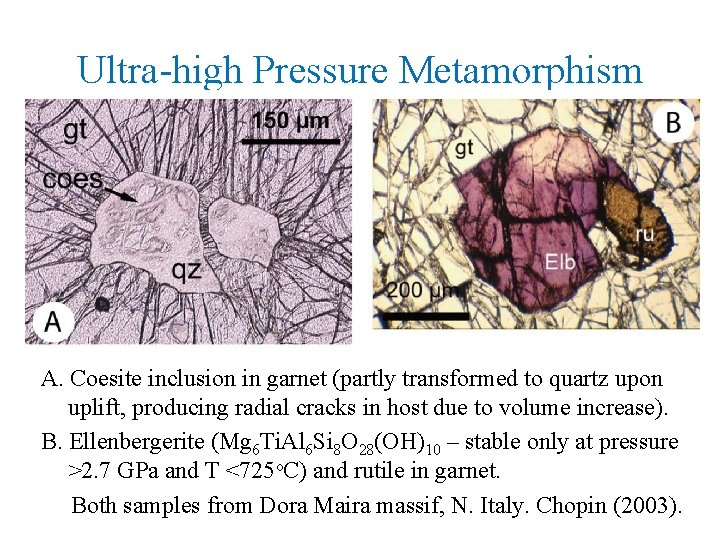
Ultra-high Pressure Metamorphism A. Coesite inclusion in garnet (partly transformed to quartz upon uplift, producing radial cracks in host due to volume increase). B. Ellenbergerite (Mg 6 Ti. Al 6 Si 8 O 28(OH)10 – stable only at pressure >2. 7 GPa and T <725 o. C) and rutile in garnet. Both samples from Dora Maira massif, N. Italy. Chopin (2003).
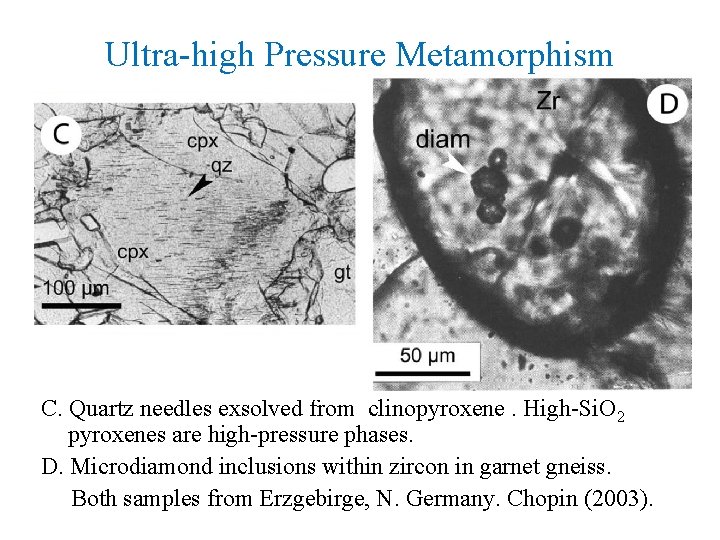
Ultra-high Pressure Metamorphism C. Quartz needles exsolved from clinopyroxene. High-Si. O 2 pyroxenes are high-pressure phases. D. Microdiamond inclusions within zircon in garnet gneiss. Both samples from Erzgebirge, N. Germany. Chopin (2003).
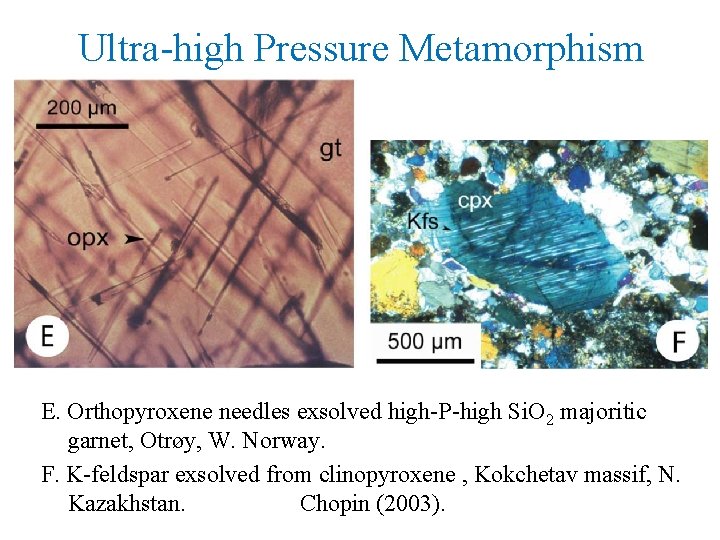
Ultra-high Pressure Metamorphism E. Orthopyroxene needles exsolved high-P-high Si. O 2 majoritic garnet, Otrøy, W. Norway. F. K-feldspar exsolved from clinopyroxene , Kokchetav massif, N. Kazakhstan. Chopin (2003).
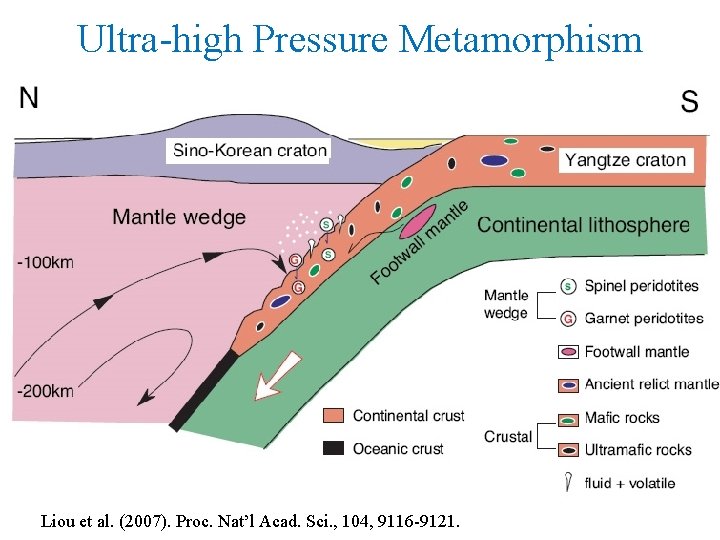
Ultra-high Pressure Metamorphism Liou et al. (2007). Proc. Nat’l Acad. Sci. , 104, 9116 -9121.
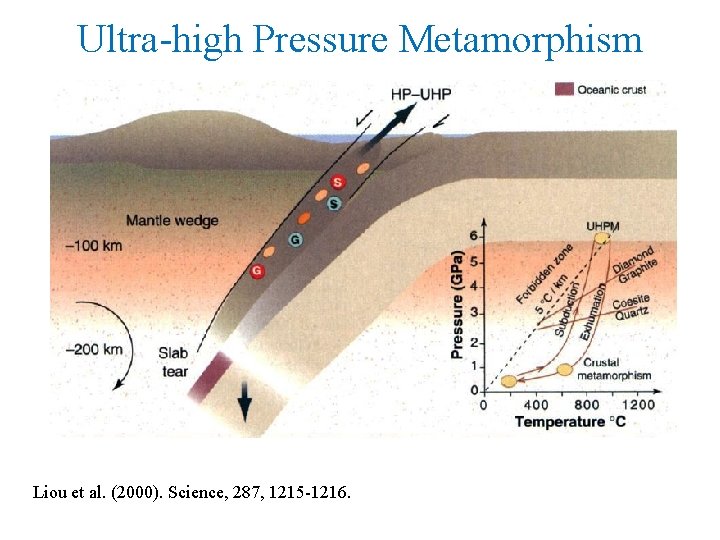
Ultra-high Pressure Metamorphism Liou et al. (2000). Science, 287, 1215 -1216.
Ultra-high Temperature Metamorphism • Defined by Harley (1998, 2004) as a division of mediumpressure granulite facies in which peak temperatures reach 900 -1100 o. C at 0. 7 – 1. 3 GPa. • Over forty known UHT occurrences • Brown (2007 a) attributed most UHT metamorphism to continental back-arc settings where crustal thinning and mantle rise adds significant heat. • Detachment of sub-continental lithospheric mantle may also be responsible for added heat. • UHT metamorphism may have been particularly prevalent in the Precambrian when heat flow was greater, but examples are known throughout Earth history.
Ultra-high Temperature Metamorphism • Geothermobarometry typically fails to record UHT temperatures because Fe/Mg exchange may reset with cooling to 700 -850 o. C. • It is therefore preferable to use mineral parageneses rather than geothermometry. • Indicator mineral assemblages for UHT conditions include – – sapphirine + quartz, orthopyroxene + sillimanite osumilite, wollastonite + scapolite + quartz + grossular in calc-silicates Al 2 O 3 content greater than 8 -2 wt. % in orthopyroxene coexisting with garnet, sillimanite, or sapphirine • UHT terranes cool/decompress along a variety of P-T paths, ranging from isobaric cooling to isothermal decompression.
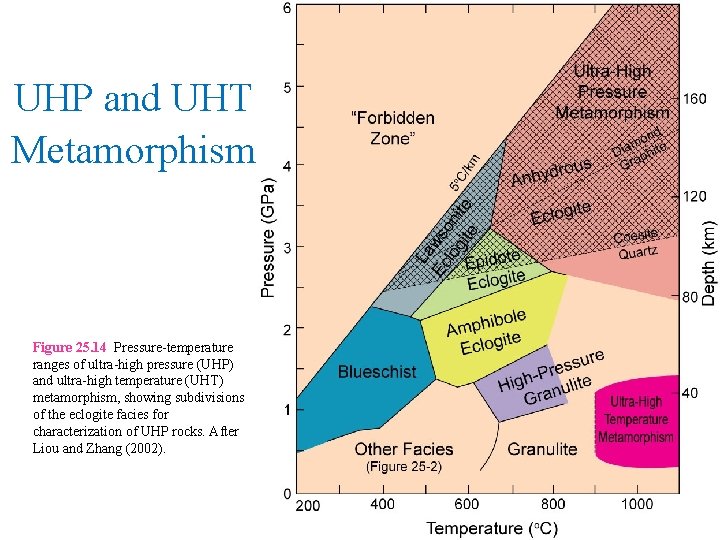
UHP and UHT Metamorphism Figure 25. 14 Pressure-temperature ranges of ultra-high pressure (UHP) and ultra-high temperature (UHT) metamorphism, showing subdivisions of the eclogite facies for characterization of UHP rocks. After Liou and Zhang (2002).
Pressure-Temperature-Time (P-T-t) Paths The facies series concept suggests that a traverse up grade through a metamorphic terrane should follow a metamorphic field gradient, and may cross through a sequence of facies (spatial sequences) Progressive metamorphism: rocks pass through a series of mineral assemblages as they continuously equilibrate to increasing metamorphic grade (temporal sequences) But does a rock in the upper amphibolite facies, for example, pass through the same sequence of mineral assemblages that are encountered via a traverse up grade to that rock through greenschist facies, etc. ?
Pressure-Temperature-Time (P-T-t) Paths The complete set of T-P conditions that a rock may experience during a metamorphic cycle from burial to metamorphism (and orogeny) to uplift and erosion is called a pressure-temperature-time path, or P-T-t path
Pressure-Temperature-Time (P-T-t) Paths Metamorphic P-T-t paths may be addressed by: 1) Observing partial overprints of one mineral assemblage upon another § The relict minerals may indicate a portion of either the prograde or retrograde path (or both) depending upon when they were created
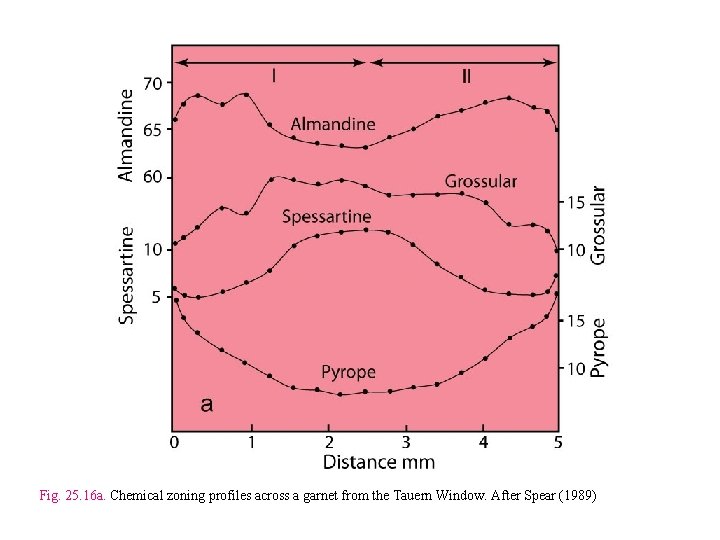
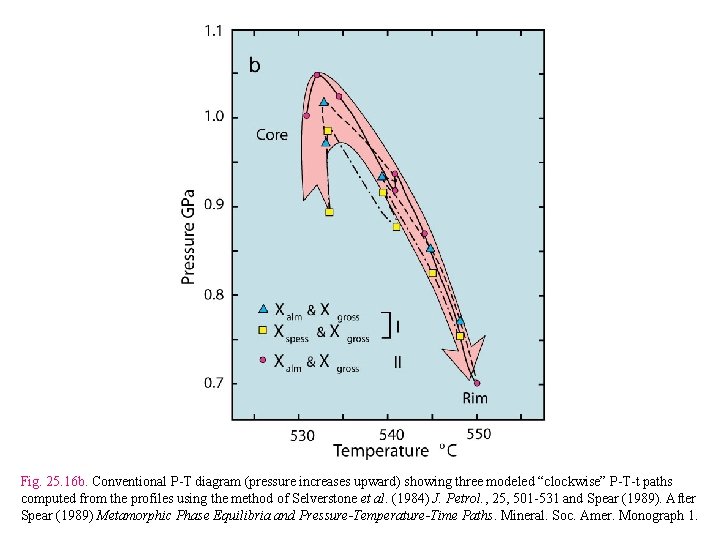
Pressure-Temperature-Time (P-T-t) Paths Metamorphic P-T-t paths may be addressed by: 2) Apply geothermometers and geobarometers to the core vs. rim compositions of chemically zoned minerals to document the changing P-T conditions experienced by a rock during their growth
Fig. 25. 16 a. Chemical zoning profiles across a garnet from the Tauern Window. After Spear (1989)
Fig. 25. 16 b. Conventional P-T diagram (pressure increases upward) showing three modeled “clockwise” P-T-t paths computed from the profiles using the method of Selverstone et al. (1984) J. Petrol. , 25, 501 -531 and Spear (1989). After Spear (1989) Metamorphic Phase Equilibria and Pressure-Temperature-Time Paths. Mineral. Soc. Amer. Monograph 1.
Pressure-Temperature-Time (P-T-t) Paths Even under the best of circumstances (1) overprints and (2) geothermobarometry can usually document only a small portion of the full P-T-t path 3) We thus rely on “forward” heat-flow models for various tectonic regimes to compute more complete P-T-t paths, and evaluate them by comparison with the results of the backward methods
Pressure-Temperature-Time (P-T-t) Paths • Classic view: regional metamorphism is a result of deep burial or intrusion of hot magmas • Plate tectonics: regional metamorphism is a result of crustal thickening and heat input during orogeny at convergent plate boundaries (not simple burial) • Heat-flow models have been developed for various regimes, including burial, progressive thrust stacking, crustal doubling by continental collision, and the effects of crustal anatexis and magma migration § Higher than the normal heat flow is required for typical greenschist-amphibolite medium P/T facies series § Uplift and erosion has a fundamental effect on the geotherm and must be considered in any complete model of metamorphism
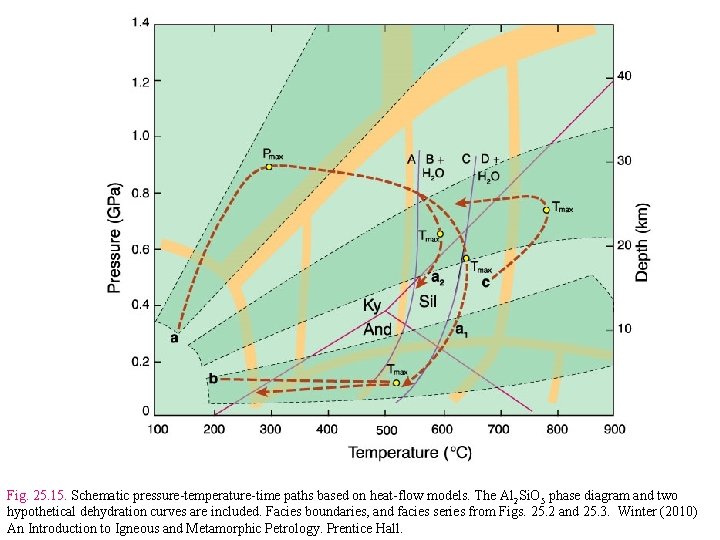
Fig. 25. 15. Schematic pressure-temperature-time paths based on heat-flow models. The Al 2 Si. O 5 phase diagram and two hypothetical dehydration curves are included. Facies boundaries, and facies series from Figs. 25. 2 and 25. 3. Winter (2010) An Introduction to Igneous and Metamorphic Petrology. Prentice Hall.
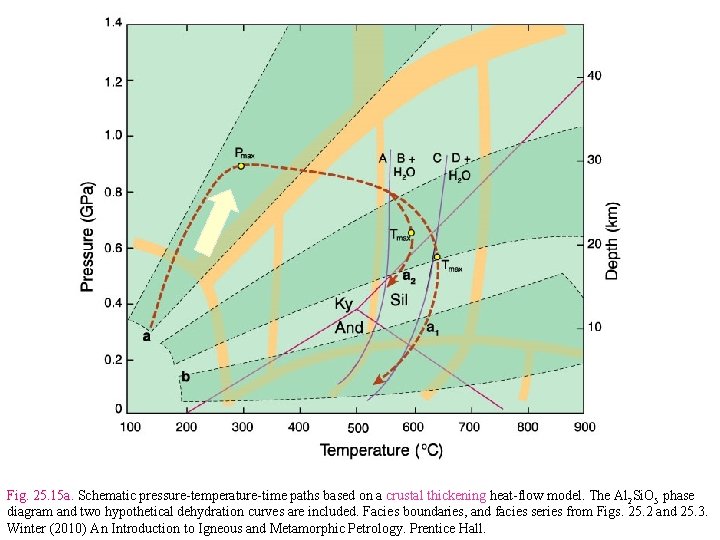
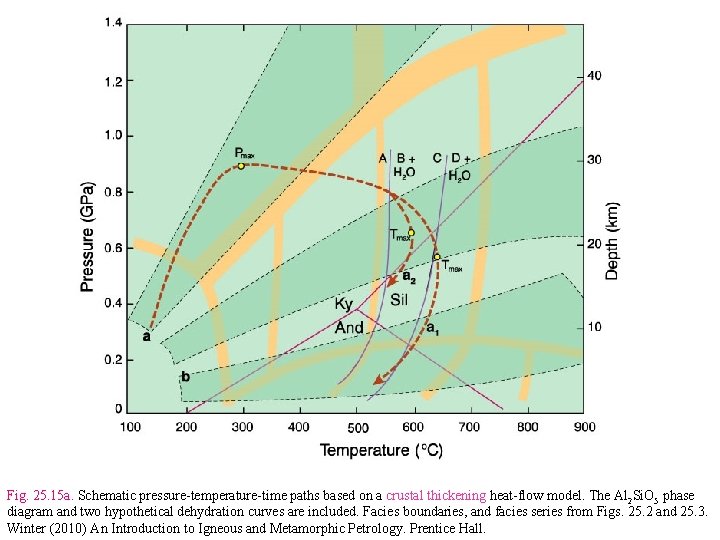
Fig. 25. 15 a. Schematic pressure-temperature-time paths based on a crustal thickening heat-flow model. The Al 2 Si. O 5 phase diagram and two hypothetical dehydration curves are included. Facies boundaries, and facies series from Figs. 25. 2 and 25. 3. Winter (2010) An Introduction to Igneous and Metamorphic Petrology. Prentice Hall.
Pressure-Temperature-Time (P-T-t) Paths • Most examples of crustal thickening have the same general looping shape, whether the model assumes homogeneous thickening or thrusting of large masses, conductive heat transfer or additional magmatic rise • Paths such as (a) are called “clockwise” P-T-t paths in the literature, and are considered to be the norm for regional metamorphism
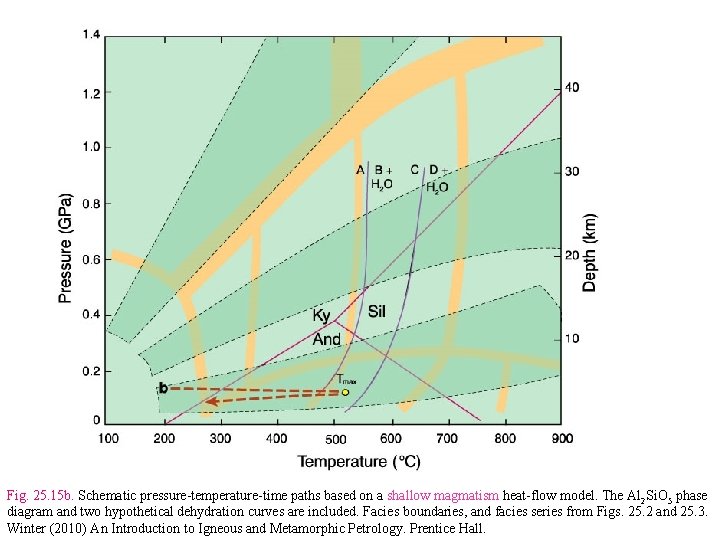
Fig. 25. 15 b. Schematic pressure-temperature-time paths based on a shallow magmatism heat-flow model. The Al 2 Si. O 5 phase diagram and two hypothetical dehydration curves are included. Facies boundaries, and facies series from Figs. 25. 2 and 25. 3. Winter (2010) An Introduction to Igneous and Metamorphic Petrology. Prentice Hall.
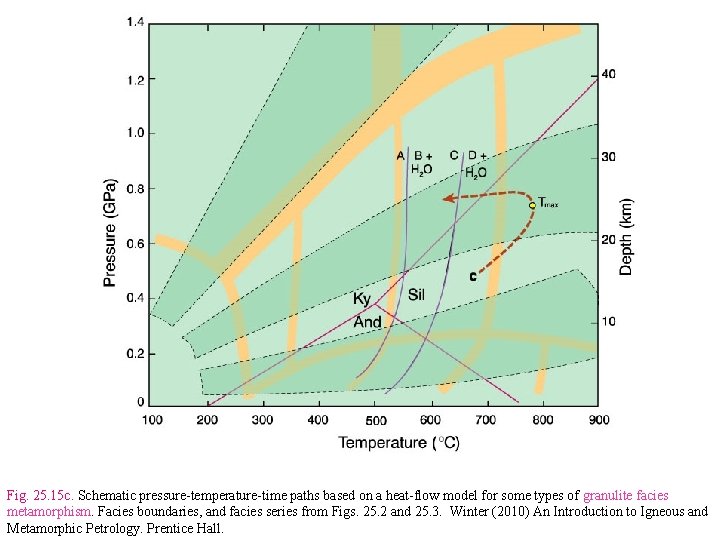
Fig. 25. 15 c. Schematic pressure-temperature-time paths based on a heat-flow model for some types of granulite facies metamorphism. Facies boundaries, and facies series from Figs. 25. 2 and 25. 3. Winter (2010) An Introduction to Igneous and Metamorphic Petrology. Prentice Hall.
Pressure-Temperature-Time (P-T-t) Paths • Broad agreement between the forward (model) and backward (geothermobarometry) techniques regarding P-T -t paths • The general form of a path such as (a) therefore probably represents a typical rock during orogeny and regional metamorphism
Pressure-Temperature-Time (P-T-t) Paths 1. Contrary to the classical treatment of metamorphism, temperature and pressure do not both increase in unison as a single unified “metamorphic grade. ” Their relative magnitudes vary considerably during the process of metamorphism
Pressure-Temperature-Time (P-T-t) Paths 2. Pmax and Tmax do not occur at the same time • In the usual “clockwise” P-T-t paths, Pmax occurs much earlier than Tmax. • Tmax should represent the maximum grade at which chemical equilibrium is “frozen in” and the metamorphic mineral assemblage is developed • This occurs at a pressure well below Pmax, which is uncertain because a mineral geobarometer should record the pressure of Tmax • “Metamorphic grade” should refer to the temperature and pressure at Tmax, because the grade is determined via reference to the equilibrium mineral assemblage
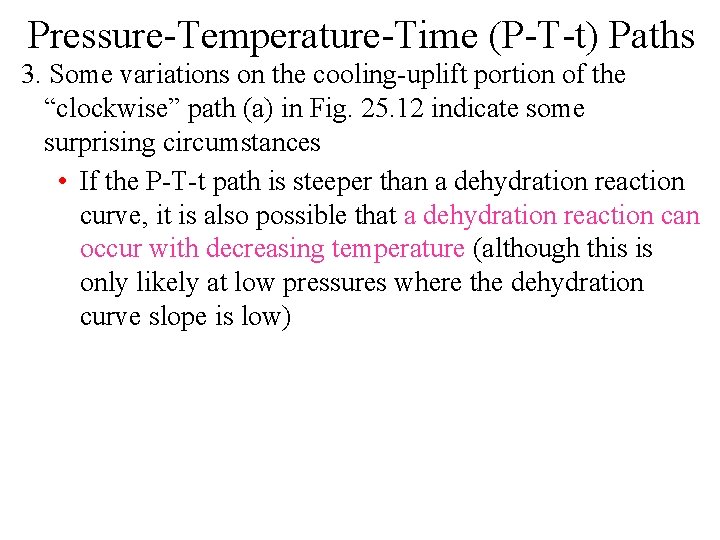
Pressure-Temperature-Time (P-T-t) Paths 3. Some variations on the cooling-uplift portion of the “clockwise” path (a) indicate some surprising circumstances • For example, the kyanite sillimanite transition is generally considered a prograde transition (as in path a 1), but path a 2 crosses the kyanite sillimanite transition as temperature is decreasing. This may result in only minor replacement of kyanite by sillimanite during such a retrograde process
Fig. 25. 15 a. Schematic pressure-temperature-time paths based on a crustal thickening heat-flow model. The Al 2 Si. O 5 phase diagram and two hypothetical dehydration curves are included. Facies boundaries, and facies series from Figs. 25. 2 and 25. 3. Winter (2010) An Introduction to Igneous and Metamorphic Petrology. Prentice Hall.
Pressure-Temperature-Time (P-T-t) Paths 3. Some variations on the cooling-uplift portion of the “clockwise” path (a) in Fig. 25. 12 indicate some surprising circumstances • If the P-T-t path is steeper than a dehydration reaction curve, it is also possible that a dehydration reaction can occur with decreasing temperature (although this is only likely at low pressures where the dehydration curve slope is low)
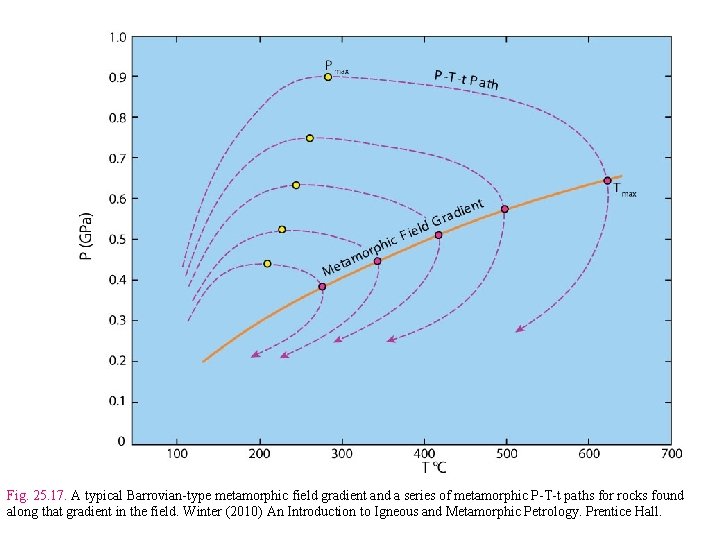
Fig. 25. 17. A typical Barrovian-type metamorphic field gradient and a series of metamorphic P-T-t paths for rocks found along that gradient in the field. Winter (2010) An Introduction to Igneous and Metamorphic Petrology. Prentice Hall.
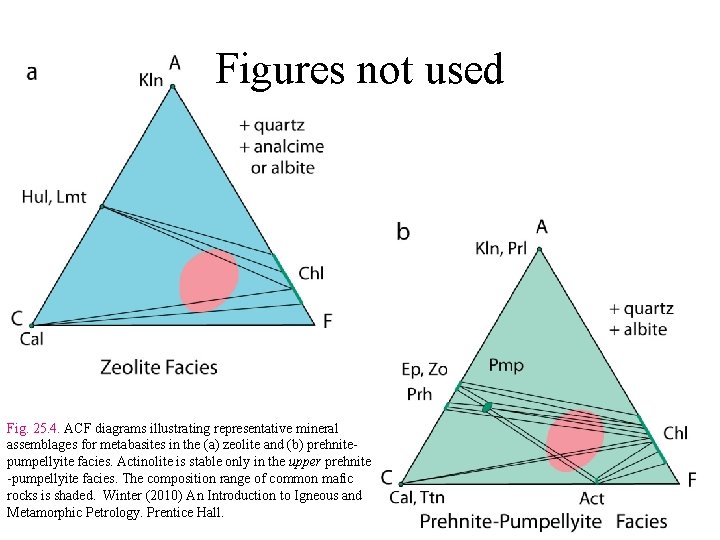
Figures not used Fig. 25. 4. ACF diagrams illustrating representative mineral assemblages for metabasites in the (a) zeolite and (b) prehnitepumpellyite facies. Actinolite is stable only in the upper prehnite -pumpellyite facies. The composition range of common mafic rocks is shaded. Winter (2010) An Introduction to Igneous and Metamorphic Petrology. Prentice Hall.
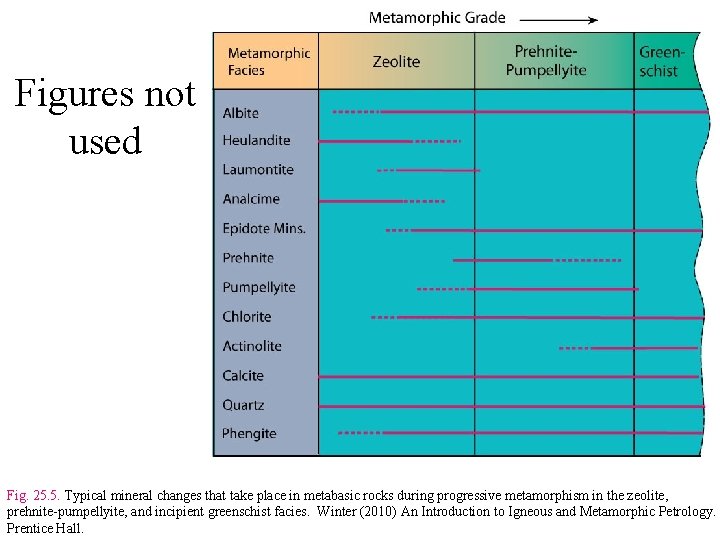
Figures not used Fig. 25. 5. Typical mineral changes that take place in metabasic rocks during progressive metamorphism in the zeolite, prehnite-pumpellyite, and incipient greenschist facies. Winter (2010) An Introduction to Igneous and Metamorphic Petrology. Prentice Hall.